Friday, October 15, 2010

U.S. workers most overworked, productive, yet spit-upon

Americans are not lazy! They are super f-ing productive. And yet we are told all the time to expect less from our work while are expected to put more into it. We have been brainwashed. There is nothing wrong with the U.S. workforce. It is more productive than ever. It is producing scads of engineers and hard-science grads. Yet workers are not reaping the benefits of their productivity; and their jobs are in constant jeopardy.

If somebody from the Democratic or Tea Parties had the GUTS to ask WHY, then maybe we'd be onto something. Otherwise, we can only expect things to get worse for us.

Right now employed Americans are afraid to lose their jobs. To keep their jobs, they are working more hours than ever, and watching their colleagues' positions get replaced by technology and overseas labor. We are told this is inevitable. We are told this is "globalization." We are told there is nothing we can do. And yet other Western countries, like Germany and Finland, somehow manage to do better. Why? How? What do they have, what do they know, that we don't?

It's time we stopped thinking of ourselves as "exceptional" and started comparing ourselves to other developed countries. If the "American Dream" is for real, then it should offer us something better than what they've got. That dream was never meant to be a one-in-a-million lottery ticket; it was a promise to all those who worked hard and played by the rules.


Submitted by G.E. Miller
October 12, 2010 | 20 Something Finance

We, as Americans, work too many hours. If you don't believe so, check out the following data points that compare us to our peers around the world.

American Work-Life Balance
According to the Center for American Progress on the topic of work and family life balance, "in 1960, only 20 percent of mothers worked. Today, 70 percent of American children live in households where all adults are employed." I don't care who stays home and who works in terms of gender (work opportunity equality for all – it's a family choice). Either way, when all adults are working (single or with a partner), that's a huge hit to the American family and free-time in the American household.

[And when conservatives hark back to some mythical golden age of the nuclear family, they must take into account that their fleeting ideal was an historical anomaly both before and after the 1950s-1960s. They want "family values" without any families around to espouse those values. Not gonna happen, folks! - J]
  • The U.S. is the ONLY country in the Americas without a national paid parental leave benefit. The average is over 12 weeks of paid leave anywhere other than Europe and over 20 weeks in Europe.
  • Zero industrialized nations are without a mandatory option for new parents to take parental leave. That is, except for the United States.

American Average Work Hours:
  • At least 134 countries have laws setting the maximum length of the work week; the U.S. does not.
  • In the U.S., 85.8 percent of males and 66.5 percent of females work more than 40 hours per week.
  • According to the ILO, "Americans work 137 more hours per year than Japanese workers, 260 more hours per year than British workers, and 499 more hours per year than French workers."
  • Using data by the U.S. BLS, the average productivity per American worker has increased 400% since 1950. One way to look at that is that it should only take one-quarter the work hours, or 11 hours per week, to afford the same standard of living as a worker in 1950 (or our standard of living should be 4 times higher). Is that the case? Obviously not. Someone is profiting, it's just not the average American worker.

American Paid Vacation Time & Sick Time:
  • There is not a federal law requiring paid sick days in the United States.
  • The U.S. remains the only industrialized country in the world that has no legally mandated annual leave.
  • In every country included except Canada and Japan (and the U.S., which averages 13 days/per year), workers get at least 20 paid vacation days. In France and Finland, they get 30 – an entire month off, paid, every year.
  • Then there's this depressing graph on average paid vacation time in industrialized countries:
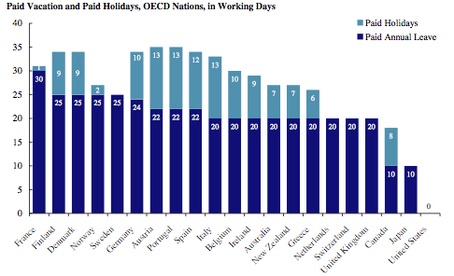
American paid vacations

The Impact of Too Much Work
I'm not telling you to work less hours. If you genuinely love what you do and are doing it for the right reasons, you are more than entitled to spend all of your waking hours plugging away.

But for many of us, more work leads to more stress and a lower quality of life. Without time to unwind, take care of your home, spend time with loved ones, enjoy our hobbies, connect with friends, and generally live a more balance life. Stress is the #1 cause of health problems – mentally and physically. And there are few things that stress us out on a consistent basis like work does, especially when it takes away from all of the other things that life has to offer.

Americans are the Outliers
And if all of this data tells anything, it's that we are the outliers, not the norm. Why are we the outliers?

  • Our companies fairly ruthlessly let people go. We want to keep our jobs and not be a 'low performer' compared to others.
  • The decline of the union has led to less paid time off and other leave benefits.
  • Cultural value of money over everything else. We love money, we want more of it, and we think money can buy happiness. And the more we work, the more we get paid.
  • It's been drilled in our heads that we are lazy compared to emerging market counterpart workers in India, Mexico, China, and other parts of Asia. Who isn't? And what is our mental image of the work environments in those locales? To validate those fears, our jobs are being outsourced to the cheap labor in those countries. In reality, the U.S. is still the world leader in productivity per person.
  • Our legislative branch of the government (on both sides of the aisle) has been bought and as a result has shied away from passing laws that protect workers that every other industrialized nation has passed.
  • We generally don't fight for our working rights. We take what is given to us.
What we All Need to Remember
  • What we all need to remind ourselves is that it doesn't have to be this way.
  • It's OK to ask to move to fewer hours at work.
  • It's OK to take a week-long vacation if we need to.
  • It's OK to ask to work from home.
  • It's OK to take a month of unpaid leave while you raise a child.
  • It's OK… you get the idea.

Don't let life pass you by in the name of fear, circumstance, greed, or misguided hopes. Sometimes you just need to draw a line in the sand and say "enough is enough".

Overworked Discussion:
  • Do you think we work too hard?
  • Do you like the cultural norm around your workplace on working hour expectations?
  • How have you been able to limit unhealthy overworking habits?

Stiglitz: Don't cut taxes or print money -- more stimulus!

My two favorite beared liberal Nobel economists agree we need another, bigger fiscal stimulus. My favorite bearded libertarian iconoclast does not think so.

True, we need to stimulate investment, and not through tax cuts. But I would add a qualifier that many businesses are investing quite a lot lately -- in machines, technology/processes, and outsourcing, which allow them to boost productivity and cut U.S. jobs. This is good for their bottom line but not for U.S. workers. Businesses must be stimulated to hire people. Suspending the payroll tax is one way to do that, and it has bi-partisan support. Another idea is to tax banks' excess reserves. Right now they're sitting on about $1 trillion in cash as they borrow at near-zero percent interest from the Fed. Although corporations have accumulated about $1.8 trillion in cash, small businesseses -- the primary creator of new jobs -- can't get the bank credit necessary for them to start up or grow.


Cutting Taxes Won't Help Recovery: Joseph Stiglitz

By Antonia Oprita
October 13, 2010 | CNBC

The US government should stimulate investment in order to ensure solid and sustainable economic growth, not cut taxes, Nobel Prize-winning economist Joseph Stiglitz told CNBC Wednesday.

Stiglitz, who earlier this month accused the Federal Reserve and the European Central Bank of throwing the world into "chaos" with their money-printing, said the first round of the stimulus did work for the US economy and that without it unemployment would have peaked at 12 percent or even 13 percent.

But the government has underestimated the severity of the downturn and did not design the stimulus as well as it could, he added.

"Before the crisis we were very profligate, we consumed. The question is not spending, but how you spend," Stiglitz said.

"If we spend it on investment… we will grow today and we will grow in the future," he added.

[As Stiglitz has noted elsewhere, when government spends money on infrastructure or clean energy, for example, it is creating an asset as well as a liability, but when government gives tax cuts it creates a liability with no offsetting asset. - J]

If the economy continues to remain weak, the US will be "wasting human capital" because a lot of people will be long-term unemployed, he said.

Investment by the government in the internet "really transformed the economy" and, on average, returns on education, health and infrastructure have been good in the US, according to Stiglitz.

Increasing spending and not cutting taxes is the best way to boost the economy, he said.

"When you have households with an overhang of debt, homeowners owing more on their mortgage than the value of the homes, tax cuts are not going to stimulate the economy," Stiglitz said. "What we need now is to stimulate investment."


Fed, ECB Throwing World Into 'Chaos': Joseph Stiglitz

October 5, 2010 | Reuters

Ultra-loose monetary policies by the U.S. Federal Reserve and the European Central Bank are throwing the world into "chaos" rather than helping the global economic recovery, Nobel Prize-winning economist Joseph Stiglitz said on Tuesday.

A "flood of liquidity" from the Fed and the ECB is bringing instability to foreign-exchange markets, forcing countries such as Japan and Brazil to defend its exporters, Stiglitz told reporters in a conference at Columbia University.

"The irony is that the Fed is creating all this liquidity with the hope that it will revive the American economy," Stiglitz said. "It's doing nothing for the American economy, but it's causing chaos over the rest of the world. It's a very strange policy that they are pursuing."

The U.S. dollar has weakened about 6.5 percent against a basket of major currencies [.DXY 76.485 down -0.16 (-0.21%)] since the beginning of September as prospects for further monetary easing by the Fed have led investors to seek higher returns elsewhere.

That flow of dollars caused currencies to appreciate in many emerging market countries such as Brazil, which offers strong growth prospects. The Japanese yen [JPY=X 81.2 down -0.23 (-0.28%)] has also hit record highs against the dollar on expectation of additional greenback weakness.

Recent actions by those countries to curb the strength of their currency were "necessary," Stiglitz added.

"It's natural in that context for them to say—we can't just let our exchange rates appreciate and destroy our exports," he said.

On Monday, Brazil doubled a tax on foreign investment into local government bonds, while Japan lowered the target for its benchmark interest rate to a range between zero and 0.1 percent.

The Bank of Japan also pledged to buy 5 trillion yen ($60 billion) worth of assets, in a strategy similar to the one adopted by the Fed to pump funds into the economy.

But additional monetary stimulus will "clearly" not solve the problems caused by lack of global aggregate demand, Stiglitz said.

"Lowering the interest rates may help a little bit, but that's much too weak to address the problems facing the United States and Europe," Stiglitz said. "We need fiscal stimulus."

Tuesday, October 12, 2010

Stimulus a band-aid, not a sop, for teachers

This story gives the lie to those who called Obama's stimulus program a giveaway to teachers' unions. Indeed the stimulus did save teachers' jobs -- and firefighters', policemens' and all manner of state employees'.

But teachers are hurting just like all other state employees, since most states are required to run a balanced budget.


States Lay Off 58,000 Teachers In September Despite $26 Billion Aid Package

By Arthur Delaney

October 8, 2010 | Huffington Post

URL: http://huffingtonpost.com/2010/10/08/states-lay-off-58000-teac_n_755965.html

Economist: U.S. should spend like Japan did

"In this type of recession, the amount of money the government has to borrow and spend is exactly equal to the excess saving in the private sector," said Prof. Koo.

That's scary. I'd guess that amount must be in the $ trillions. Just getting another $800 billion stimulus (even with 36 percent of it tax cuts, again!) seems impossible in the current political environment. Economists like Paul Krugman unapologetically call for more and bigger stimulus, and cite estimates that the first stimulus created 2.7 million jobs and added $460 billion to U.S. GDP.

Opposing any stimulus at all is Nassim Taleb, whom I really like, at least for his creativity and direct speech. He tells us we're taken on all kinds of hidden risks and we don't know what could happen with so much debt. Certainly, this frightens me. On the other hand, economists like Koo say they can definitely tell us what we'll lose if we don't do more stimulus, in terms of $ trillions in lost GDP. I tend to find their argument more persuasive, since it's not based on what we can't know, (aka "black swan" event), but rather on experience and economic models. Indeed, there is a lot of unused capacity and idle labor sitting out there, wasting, for no good reason. There is nothing inherently wrong with all these industries which are down across the board -- it's simply a lack of demand preventing a business comeback. That's the catch-22 we're in right now: businesses won't recover enough to hire the unemployed until people (or governments) start buying stuff again; and people won't start buying stuff again until they are employed and feel secure about their economic future.

Even without any government action, the economy will get better. The questions ar how much, and how long will it take? Krugman and others argue that the "new normal" will be higher structural unemployment with still growing inflation. And it's totally unnecessary, they say. All it takes is political will to avoid it.


Economist: U.S. Could Learn From Japan's Fiscal Gap

October 9, 2010 | All Things Considered on NPR

GUY RAZ, host: Almost two decades ago, Japan was hit by two potentially catastrophic events. The first was a crash in real estate values. The financial sector responded by hoarding cash and using it to pay down debts rather than spend it on new investments.

It took Richard Koo and other Japanese economists a few years to figure out that this combination was driving Japan's economy into the ground. And so, they advised the Japanese government to start spending money and ignore growing deficits. And Koo argues that it worked. He wrote a book about it and is now trying to convince economic policymakers in this country that we're in the exact same spot.

Mr. RICHARD KOO (Chief Economist, Nomura Research Institute): This disease is actually the same disease hit Japan 15 years earlier.

RAZ: The same exact disease?

Mr. KOO: Exactly the same disease.

RAZ: It's like nobody knew what it was.

Mr. KOO: Those of us in Japan were flabbergasted. The (unintelligible) raced down to zero, lots of quantitative easing, nothing helped.

RAZ: And you can recognize it instantly here in the U.S. now?

Mr. KOO: Yes, because the key feature of this disease is that people - meaning private sector is still leveraging or paying down debt under zero interest rate condition.

RAZ: Instead of spending money making investments.

Mr. KOO: Exactly.

RAZ: And you didn't know why.

Mr. KOO: Well, the reason actually, when you think about it, is quite simple. Those people bought assets with borrowed money during the bubble days. The asset price collapsed after the bubble, liabilities remain and people suddenly realized that their balance sheet's underwater. What do you do? You used the cash flow to pay down debt.

RAZ: Mm-hmm.

Mr. KOO: And that's the right thing to do for people in that circumstances.

But when everybody does it all at the same time, we enter what we call fallacy of composition in that what is right for the individual taken together is bad for the group.

RAZ: Many economists look to Japan's past two decades as a cautionary tale. But you actually see Japan as a success story, an example for the United States. How so?

Mr. KOO: Those people don't realize what happened to asset values. Commercial real estate in Japan - Tokyo, Osaka...

RAZ: Collapsed.

Mr. KOO: ...all cities - fell 87 percent.

RAZ: Eighty-seven percent, the value of a home in some cities fell 87 percent?

Mr. KOO: Eighty-seven percent. What kind of economy do you think you have left in the United States if Manhattan prices are down 87, Washington down 87, San Francisco down 87?

RAZ: There'd be nothing left.

Mr. KOO: There'd be nothing left. We managed to keep our GDP from falling below the peak of the bubble for the entire 20-year period. Our employment rate never went beyond 5.5 percent because government came in and borrow the money that people were all saving.

RAZ: Japan, at certain times, has (unintelligible) huge budget deficits, has a ballooning national debt, that's not a problem?

Mr. KOO: It's a problem, but it's the best of the possible choices in that government budget deficit increased by something like 460 trillion yen. That means about 92 percent of Japan's GDP.

RAZ: Wow.

Mr. KOO: But what's missing in the debate is that this 460 trillion yen deficit saved the GDP at least 2,000 trillion.

RAZ: Richard Koo, how long could the United States, though, run massive budget deficits?

Mr. KOO: In this type of recession, the amount of money the government has to borrow and spend is exactly equal to the excess saving in the private sector.

RAZ: So when the private sector is saving and not spending, the government has to come in and borrow the equivalent amount and spend it?

Mr. KOO: If you want to keep the GDP from collapsing, yes.

RAZ: That's Richard Koo. He's been an adviser to five Japanese prime ministers. He's the chief economist at the Nomura Research Institute and the author of "The Holy Grail of Macroeconomics: Lessons from Japan's Great Recession."

Friday, October 8, 2010

Bloomberg BW: Business feels unloved by Obama

Obama Wants a Detente with Business

Once the midterm elections are over, the President plans to make up with business

By Julianna Goldman, Hans Nichols, Mark Drajem and Lizzie O'Leary

September 6, 2010 | Bloomberg Businessweek

[...]

Business vs. the Democrats

By many objective measures, most businesses are thriving and should have little to complain about. Corporate profits rose to a record $1.38 trillion in the second quarter, according to the St. Louis Federal Reserve. The Dow Jones industrial average is up more than 38 percent since Obama took office.

So why the criticism? "There is a venerable tradition of business being antagonistic to Democrats, even in instances when the policies are advantageous to them," says Fred I. Greenstein, a professor emeritus at Princeton University and author of books on Presidential leadership. The strain between the Administration and business "was similar for FDR, which was the period of the last great reregulation of the economy," says Bruce Buchanan, a professor of government at the University of Texas at Austin, referring to Franklin D. Roosevelt's New Deal. "And there is an element of hurt feelings to it as well, which surprises me." Despite numerous meals with business leaders, the President seems to approach the relationship in a detached fashion, as if he were checking off a box, say executives who requested anonymity in order to speak freely.

[They want to feel the love! They're like sulky adolescents. What a sentimental bunch! - J]