Showing posts with label PTSD. Show all posts

Sunday, November 10, 2013

Putting vets on a pedestal doesn't help them

On Veteran's Day, let's resolve to help our returning troops do what the WWII generation did after war: get back on with civilian life.  

Applause, "hero worship" and movie theater discounts aren't what they need from us right now. They need education, training and job opportunities. They need patient assistance with reintegrating into society.


By Alex Horton
November 10, 2013 | Atlantic

Sunday, May 26, 2013

Junger: Spend more time listening to vets

This Memorial Day, keep in mind that what our troops did over there, they bring back home with them.  Do we really want to want to share that burden with them?

But the obscenity of war is not diminished when that conflict is righteous or necessary or noble. And when soldiers come home spiritually polluted by the killing that they committed, or even just witnessed, many hope that their country will share the moral responsibility of such a grave event.

Their country doesn’t. Liberals often say that it’s not their problem because they opposed the war. Conservatives tend to call soldiers “heroes” and pat them on the back. Neither response is honest or helpful. Neither addresses the epidemic of post-traumatic stress disorder afflicting our veterans. 

Junger suggests we spend less time showing our admiration of veterans and more time listening to them:

Civilians tend to do things that make them, not the veterans, feel better. Yellow ribbons and parades do little to help with the emotional aftermath of combat. War has been part of human culture for tens of thousands of years, and most tribal societies were engaged in some form of warfare when encountered by Western explorers. It might be productive to study how some societies reintegrated their young fighters after the intimate carnage of Stone Age combat. It is striking, in fact, how rarely combat trauma is mentioned in ethnographic studies of cultures.

Typically, warriors were welcomed home by their entire community and underwent rituals to spiritually cleanse them of the effect of killing. Otherwise, they were considered too polluted to be around women and children. Often there was a celebration in which the fighters described the battle in great, bloody detail. Every man knew he was fighting for his community, and every person in the community knew that their lives depended on these young men. These gatherings must have been enormously cathartic for both the fighters and the people they were defending.

But I wonder if we really want to know what they did and saw over there?  It's easier for us to hang yellow ribbons and give them a pat on the back than to try and comprehend the terrible, gut-wrenching things they did and experienced in our name, at our orders, to defend us.


By Sebastian Junger
May 25, 2013 | Washington Post

Friday, January 4, 2013

M. Moore: We don't 'support our troops'

Well said!  Nothing I could add.


By Michael Moore
January 3, 2013 | MichaelMoore.com

I don't support the troops, America, and neither do you. I am tired of the ruse we are playing on these brave citizens in our armed forces. And guess what -- a lot of these soldiers and sailors and airmen and Marines see right through the bull**** of those words, "I support the troops!," spoken by Americans with such false sincerity -- false because our actions don't match our words. These young men and women sign up to risk their very lives to protect us -- and this is what they get in return:

1. They get sent off to wars that have NOTHING to do with defending America or saving our lives. They are used as pawns so that the military-industrial complex can make billions of dollars and the rich here can expand their empire. By "supporting the troops," that means I'm supposed to shut up, don't ask questions, do nothing to stop the madness, and sit by and watch thousands of them die? Well, I've done an awful lot to try and end this. But the only way you can honestly say you support the troops is to work night and day to get them out of these hell holes they've been sent to. And what have I done this week to bring the troops home? Nothing. So if I say "I support the troops," don't believe me -- I clearly don't support the troops because I've got more important things to do today, like return an iPhone that doesn't work and take my car in for a tune up.

2. While the troops we claim to "support" are serving their country, bankers who say they too "support the troops," foreclose on the actual homes of these soldiers and evict their families while they are overseas! Have I gone and stood in front of the sheriff's deputy as he is throwing a military family out of their home? No. And there's your proof that I don't "support the troops," because if I did, I would organize mass sit-ins to block the doors of these homes. Instead, I'm having Chilean sea bass tonight.

3. How many of you who say you "support the troops" have visited a VA hospital to bring aid and comfort to the sick and wounded? I haven't. How many of you have any clue what it's like to deal with the VA? I don't. Therefore, you would be safe to say that I don't "support the troops," and neither do you.

4. Who amongst you big enthusiastic "supporters of the troops" can tell me the approximate number of service women who have been raped while in the military? Answer: 19,000 (mostly) female troops are raped or sexually assaulted every year by fellow American troops. What have you or I done to bring these criminals to justice? What's that you say -- out of sight, out of mind? These women have suffered, and I've done nothing. So don't ever let me get away with telling you I "support the troops" because, sadly, I don't. And neither do you.

5. Help a homeless vet today? How 'bout yesterday? Last week? Last year? Ever? But I thought you "support the troops!"? The number of homeless veterans is staggering -- on any given night, at least 60,000 veterans are sleeping on the streets of the country that proudly "supports the troops." This is disgraceful and shameful, isn't it? And it exposes all those "troop supporters" who always vote against social programs that would help these veterans. Tonight there are at least 12,700 Iraq/Afghanistan veterans homeless and sleeping on the street. I've never lent a helping hand to one of the many vets I've seen sleeping on the street. I can't bear to look, and I walk past them very quickly. That's called not "supporting the troops," which, I guess, I don't -- and neither do you.

6. And you know, the beautiful thing about all this "support" you and I have been giving the troops -- they feel this love and support so much, a record number of them are killing themselves every single week. In fact, there are now more soldiers killing themselves than soldiers being killed in combat (323 suicides in 2012 through November vs. about 210 combat deaths). Yes, you are more likely to die by your own hand in the United States military than by al Qaeda or the Taliban. And an estimated eighteen veterans kill themselves each day, or one in five of all U.S. suicides -- though no one really knows because we don't bother to keep track. Now, that's what I call support! These troops are really feeling the love, people! Lemme hear you say it again: "I support the troops!" Louder! "I SUPPORT THE TROOPS!!" There, that's better. I'm sure they heard us. Don't forget to fly our flag, wear your flag lapel pin, and never, ever let a service member pass you by without saying, "Thank you for your service!" I'm sure that's all they need to keep from putting a bullet in their heads. Do your best to keep your "support" up for the troops because, God knows, I certainly can't any longer.

I don't "support the troops" or any of those other hollow and hypocritical platitudes uttered by Republicans and frightened Democrats. Here's what I do support: I support them coming home. I support them being treated well. I support peace, and I beg any young person reading this who's thinking of joining the armed forces to please reconsider. Our war department has done little to show you they won't recklessly put your young life in harm's way for a cause that has nothing to do with what you signed up for. They will not help you once they've used you and spit you back into society. If you're a woman, they will not protect you from rapists in their ranks. And because you have a conscience and you know right from wrong, you do not want yourself being used to kill civilians in other countries who never did anything to hurt us. We are currently involved in at least a half-dozen military actions around the world. Don't become the next statistic so that General Electric can post another record profit -- while paying no taxes -- taxes that otherwise would be paying for the artificial leg that they've kept you waiting for months to receive.

I support you, and will try to do more to be there for you. And the best way you can support me -- and the ideals our country says it believes in -- is to get out of the military as soon as you can and never look back.

And please, next time some "supporter of the troops" says to you with that concerned look on their face, "I thank you for your service," you have my permission to punch their lights out (figuratively speaking, of course).

(There is something I've done to support the troops -- other than help lead the effort to stop these senseless wars. At the movie theater I run in Michigan, I became the first person in town to institute an affirmative action plan for hiring returning Iraq/Afghanistan vets. I am working to get more businesses in town to join with me in this effort to find jobs for these returning soldiers. I also let all service members in to the movies for free, everyday.)

Wednesday, October 10, 2012

U.S. military wants to take away troops' guns


There seems to be one set of rules for the U.S. Military that most Americans accept as OK, and another rule for the rest of us, and the rest of the U.S. Government.  For example, the military gives our troops socialized medicine and everybody's OK with that.  

Now the Pentagon, in an attempt to stop a wave of military suicides, is encouraging spouses and family to take troops' personal guns away when they struggle with mental illness.  And the Pentagon is handing out trigger locks.  You know, er, because people kill people, not guns.

Let's wait and see how the NRA and the gun nuts react to this....


By James Dao
October 7, 2012 | New York Times

Monday, January 10, 2011

2010 Ft. Hood suicides set record, out-kill Hasan

So it seems that PTSD has been a much more prolific and enduring killer at Ft. Hood than Maj. Nidal Malik Hasan.

But we can't arrest, try and execute PTSD. It's intangible, depressing and glum. It's an unspeakable wussy downer in a nation that tells us to "get over it."


Despite outreach, self-inflicted deaths hit record

By Gregg Zoroya
January 9, 2010 | USA Today

Monday, August 30, 2010

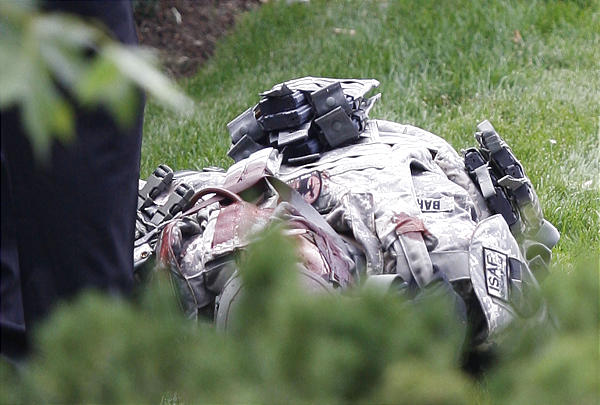
Restore honor to our servicemen, protect 2nd Amendment

I like this story because it has two things that I support most: our troops and our guns. When our troops protect our guns my support is squared.

The late Sgt. Barrett (may he RIP) told witnesses he was "training," which should have been obvious, because whenever Americans dress up in combat fatigues and carry guns, they're practicing to protect guns and freedom. This particular story ended a bit messily, but that, unfortunately, is the price of our freedom, folks. The USA has never been invaded and conquered and people like Sgt. Barrett are the reason why.


You know this is not Iraq or Afghanistan because you would never find a lawn that nice over there.


By Aaron Falk and Abigail Shaha
August 28, 2010 | Deseret News

Friday, November 27, 2009

Tuesday, November 17, 2009

Another year, another record for Army suicides

Oh my, Lib'rul Media, you aint what you used to be. Look at you, ignoring the elephant in the room.

Here CNN writes about record numbers of army suicides and drug abusers, but conveniently fails to mention that they're being deployed to s***holes Afghanistan and Iraq over and over again. CNN doesn't even speculate why so many soldiers are killing themselves. Likewise, the Army is officially baffled. I guess CNN considers it a big, unsolvable mystery, too. Anyway, I bet the solution is more frequent psychiatric testing and counseling. Yeah, that's the ticket.


By Mike Mount
November 18, 2009 | CNN

Suicides among soldiers this year have topped last year's record-breaking numbers, but Army officials maintain a recent trend downward could mean the service is making headway on its programs designed to reduce the problem, Army officials said Tuesday.

Since January, 140 active-duty soldiers have killed themselves while another 71 Army Reserve and National Guard soldiers killed themselves in the same time period, totaling 211 as of Tuesday, Gen. Peter Chiarelli, U.S. Army vice chief of staff, told reporters at a briefing Tuesday.
But he said the monthly numbers are starting to slow down as the year nears its end.

"This is horrible, and I do not want to downplay the significance of these numbers in any way," Chiarelli said.

For all of 2008, the Army said 140 active-duty soldiers killed themselves while 57 Guard and Reserve soldiers committed suicide, totaling 197, according to Army statistics.

The Army is still trying to tackle why soldiers are killing themselves.

[If the Army's cluelessness doesn't undermine your faith in their intelligence, then I don't know what will. But of course they know why. They just can't say it. - J]

"We still haven't found any statistically significant causal linkage that would allow us to effectively predict human behavior. The reality is, there is no simple answer -- each suicide case is as unique as the individuals themselves," Chiarelli said.

He also said there were troubling new statistics showing an increase in suicide rates among young soldiers who have never deployed, another factor puzzling Army researchers.

To add to the Army's problems, Chiarelli said there is a rise in numbers of soldiers abusing prescription drugs and alcohol upon returning from the war zones.

But Chiarelli said the news was not all grim.

"I do believe we are finally beginning to see progress being made," he said referring to a downward trend in suicide numbers in recent months. "The general trend line with the exception of a couple of months has been down."

"We attribute this reduction in the number of suicides to the many actions we have taken since February to inform and educate leaders and soldiers on this important issue," Chiarelli said.
Since March, the Army has implemented numerous programs and policies in an attempt to quickly slow the rate. Programs range from a suicide prevention task force to a day off from official duties to focus on suicide prevention. The service has implemented what it calls a Comprehensive Soldier Fitness Program, giving every soldier a mental assessment twice a year in the same style the Army tests soldiers for fitness.

"It gives the same emphasis to psychological, emotional and mental strength that we have previously given to physical strength," Chiarelli said.

The Army also has tested a program that gave mental-health evaluations to a group soldiers returning from the war zone. Some were treated face-to-face with mental-health providers while others were treated online by providers.

Chiarelli said the initial results were promising, and doctors said they could have great success treating patients online.

The test seems to give the Army some answers on how to treat the variety of soldiers from young to old.

"Younger soldiers prefer the online method of evaluation more than they do the face-to-face, and older soldiers -- some of you might not find this so surprising -- find face-to-face more to their liking," according to the general.

Chiarelli also gave examples of Army bases that seem to have shown improvement in suicide warning signs and prevention this year resulting in decreased number of suicide rates, including Fort Hood in Texas, Fort Bragg in North Carolina and Fort Drum in New York.

Fort Bragg has had six suicides to date, Fort Hood has had two and Fort Hood has had 11, but it is the largest U.S. military base with 60,000 troops.

There are Army posts, however, that were not showing signs of improvement.

"We are very concerned with the increase this year of suicide at Fort Campbell, Fort Stewart and Schofield Barracks," Chiarelli said.

Fort Campbell, in Kentucky, has had 18 suicides so far this year, with 11 of them occurring in the first quarter of 2009. Fort Stewart in Georgia has had 10 deaths, six of them occurring over the first five months of the year. And Schofield Barracks in Hawaii has had seven deaths.

All of the bases Chiarelli mentioned have different populations and deployment levels and reflect different suicide rates and ratios.

Chiarelli stressed his frustration with getting answers to the suicide problem.

"Everywhere I try to cut this and look at it to try to find out what the causal effect is, I get thwarted. And that's why we think that we've got to look in its totality at a whole bunch of different issues, and it's going to take time," he said.

Tuesday, November 10, 2009

U.S. vets' health care massacre

Yeah, we have much more to fear from a "socialist takeover of America" than the actual consequences of our f-ed up health care "system" in the U.S.

Support Our Troops, indeed!


By Alex Seitz-Wald
November 10, 2009 | Think Progress

On the eve of Veterans Day, a team of researchers from Harvard Medical School has released a study finding that an estimated 2,266 veterans under the age of 65 died last year because they did not have health insurance. That "translates to six preventable deaths per day" and more than twice the number killed in Afghanistan since the war began in 2001.

Being uninsured raises a person's odds of dying prematurely by 40 percent. The researchers found that 1.46 million veterans between the ages of 18 and 64 lacked insurance in 2008. While most veterans are eligible to receive excellent care from the Veterans Administration, those who were not injured in combat and whose income is above a certain threshold are often ineligible. Others are assigned low priorities, providing them with less consistent and more expensive access to care:

"Like other uninsured Americans, most uninsured vets are working people – too poor to afford private coverage but not poor enough to qualify for Medicaid or means-tested VA care," said Dr. Steffie Woolhandler, a professor at Harvard Medical School. [...]

Dr. David Himmelstein, the co-author of the analysis and associate professor of medicine at Harvard, commented, "On this Veterans Day we should not only honor the nearly 500 soldiers who have died this year in Iraq and Afghanistan, but also the more than 2,200 veterans who were killed by our broken health insurance system. That's six preventable deaths a day."

Unfortunately, health insurance is just one of many serious problems vets face. Up to one-in-five veterans of the wars in Iraq and Afghanistan suffers from Post Traumatic Stress Disorder, while male vets face suicide rates double the national average. And, as the VA under President Obama recognized, veterans still account for up to a quarter of all homeless.

The fact that even veterans cannot receive adequate health care demonstrates that the current system is broken and in need of dramatic overhaul. A robust public option will guarantee that vets and all working-class Americans will be able to afford quality health insurance. Still, the study's authors warn that the health care legislation "would do virtually nothing for the uninsured until 2013" and would "leave at least 17 million uninsured over the long run when reform kicks in," leaving many veterans without care.

Update Politico reports, "Senate Majority Leader Harry Reid called Sen. Tom Coburn (R-OK) 'illogical' for holding up a veterans care bill Tuesday, criticizing the Oklahoma Republican for supporting war funding while blocking health care funding for veterans.

Sunday, November 8, 2009

PTSD is new US Military norm

I hope we've all moved on from the days when "Support Our Troops" meant "Keep Them in Harm's Way," and "Make Them Develop Mental Illnesse and Lose Their Families Through Extended and Repeated Deployments."

"We know that there is a statistically significant association between having more than one deployment and P.T.S.D.," said Dr. Karen Seal of the Veterans Administration Medical Center in San Francisco.

I hope that now, since Obama is in office, and conservatives don't feel a knee-jerk urge to defend our unnecessary wars in Iraq and Afghanistan simply to show support for their nation's leader, that we can all be more reasonable and rational and agree that our current occupations of two countries are not sustainable, and in fact, are destroying our nation's armed forces. The Right and the Left must come together and put overwhelming pressure on Obama for him to end these disasters and bring our weary troops home to their suffering families.


By Bob Herbert
November 6, 2009 | New York Times