This op-ed is worth re-posting in full.
Never let it be said I'm a partisan hack: I support Borosage's indictment of President Obama's executive overreach in conducting military operations without Congressional approval for war.
More damning to my mind has been President Obama's failure to articulate to the nation (and Congress) a national security-military doctrine/vision (call it what you will) that makes it clear when he thinks the United States should send its troops into battle, and when we shouldn't. Granted, this may be the most difficult job of any POTUS in an ever-changing world, and with inherited conflicts of past presidents.
Is it because Obama and his team doesn't have the strategic capacity to develop such a vision? Is it because Obaama is too arrogant to articulate it for us, we're just supposed to trust him not to do "stupid shit"? Or, most likely, is it because a timid Obama fears that no matter what he says, it will be parsed and pilloried by Republicans -- who also can't agree among themselves on a foreign policy -- looking to score partisan political points?
Borosage is right to point out that the opportunity cost of U.S. military adventures abroad is investment in piss-poor education and crumbling infrastructure at home. Maybe our government can buy guns and butter... but not forever, not at a sustainable cost. This is where the "fiscally responsible" yet "pro-military" Tea Parties and Republicans have fallen on their faces as an opposition, by refusing to specify just what they are willing to give up to achieve their stated top priority of fiscal balance.
By Robert L. Borosage
October 20, 2014 | Reuters

America — proudly dubbed the “indispensable nation” by its national-security managers — is now the entangled nation enmeshed in conflicts across the globe.
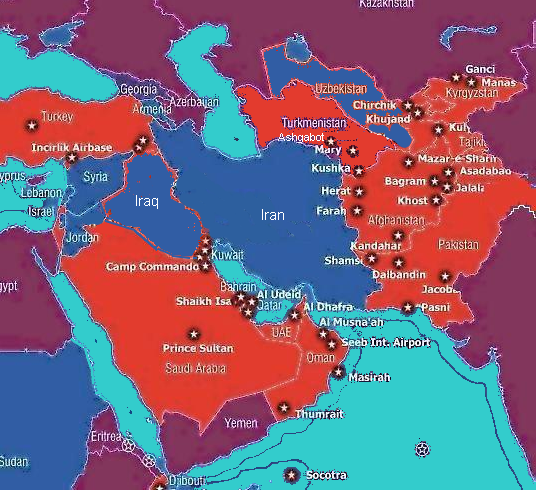
President Barack Obama, scorned by his Republican critics as an “isolationist” who wants to “withdraw from the world,” is waging the longest war in U.S. history in Afghanistan, boasts of toppling the Muammar Gaddafi regime in Libya, launches airstrikes in Iraq and Syria against Islamic State and picks targets for drones to attack in as many as eight countries, while dispatching planes to the Russian border in reaction to its machinations in Ukraine, and a fleet to the South China Sea as the conflict over control of islands and waters escalates between China and its neighbors.
The indispensable nation is permanently engaged across the globe. But endless war undermines the Constitution. Democracy requires openness; war justifies secrecy. Democracy forces attention be paid to the common welfare; war demands attention and resources be spent on distant conflicts. Democracy involves forging coalitions to get action in the Congress; war is waged on executive order. The Constitution restrains the executive in times of peace; constitutional strictures are trampled in times of war.
When the founders wrote the Constitution, they worried about the tendency of kings, or presidents, to make war for personal aggrandizement or national glory. So they gave Congress the power to declare war, intent on “clogging, not facilitating” the rush to war. For the Republic, peace would be the normal state of affairs. War was a disruption — entered into only with prior debate and consideration by Congress, the elected body whose members best reflected the attitudes of their constituents.
The United States, in the words of conservative John Quincy Adams, would provide a shining example of liberty as long as “she goes not abroad in search of monsters to destroy. She is the well-wisher to the freedom and independence of all. She is the champion and vindicator only of her own.”
But now the pursuit of monsters to destroy is unrelenting. Almost inevitably, it seems, the restraints of the Constitution are being trampled. With little debate, U.S. leaders have chosen permanent global intervention even at the cost of undermining the Republic.
For the cost of war can be measured in dollars not spent here at home.
An educated citizenry is the foundation of a robust democracy. Yet from the absence of free, full-day pre-K to affordable colleges to advanced training, the United States is skimping on investment in educating its citizens. A modern infrastructure is also essential to a competitive, high-wage economy. But while Washington spends $3 trillion on Iraq, there hasn’t been a serious discussion about bringing America’s aged infrastructure, including our roads, bridges and airports, up to standard — which would cost about the same.
 |
| A bridge to somewhere... now a bridge to nowhere. |
Instead of this funding, the United States and its North Atlantic Treaty Organization allies spend more on their militaries than the rest of the world combined. Washington maintains more than 1,000 bases, called “military sites,” across the globe, plus 11 aircraft-carrier task forces that are essentially moveable bases. U.S. conventional and nuclear forces are unrivaled — yet Washington plans to spend another trillion dollars over the next 30 years modernizing nuclear weapons that the United States aims never to use. U.S. intelligence and covert forces are permanently engaged, often secretly creating the implicit commitments that will force the next intervention.
It is only America, as the president said in a speech announcing his intention to “degrade and ultimately defeat” Islamic State, which he refers to as ISIL, the Islamic State in Iraq and the Levant, that “has the capacity and the will to mobilize the world against terrorism … against Russian aggression … to contain … Ebola and more.”
This president, more than his predecessors, understands the perils of being the “indispensable nation.” Elected in large part to get the United States out of the seemingly endless wars in the Middle East, he now finds himself forced into another open-ended commitment.
In his speech to the National Defense University in 2013, Obama argued, “We must define the nature and scope of this struggle, or else it will define us, mindful of James Madison’s warning that ‘No nation could preserve its freedom in the midst of continual warfare.’ ” Obama warned specifically about this. “The choice we make about war,” the president said, “can impact — in sometimes unintended ways — the openness and freedom on which our way of life depends.”
Yet even with this awareness, and no reelection race facing him, Obama could not escape the imperatives of America’s role as the indispensable nation. The commitments are too many, the engagement too permanent, the capacity unrivalled — seemingly making all things possible. As a result, this former professor of constitutional law has governed over the greatest assertion of executive authority — claiming the power to make war, to surveil, arrest, detain and even kill Americans without prior judicial review or due process.
 |
| Ike warned us about the growing "military-industrial complex" that sought to feed itself at the federal trough. |
His Justice Department has used espionage laws against reporters and whistleblowers. The secrecy shields massive waste, fraud and abuse, as the military-industrial complex that President Dwight D. Eisenhower warned against consumes the bulk of the national budget, aside from payments on the national debt and the insurance programs of Social Security and Medicare.
When President George W. Bush was about to launch the war in Iraq, millions of Americans – as well as many people around the globe — marched in protest. The large demonstrations against war led the New York Times to dub world public opinion a second superpower. Bush sought authority from Congress and a dramatic congressional debate took place, with strong dissent against the war.

When Obama committed the United States to the fight against Islamic State, he claimed the authority to act without Congress, though adding he would “welcome” congressional support. Yet with the midterm elections then a few months away, both Republicans and Democrats in Congress chose to postpone the debate and the vote.
The bombing began on presidential order. Americans accepted their role as spectators, registering no significant objection to this presidential war-making. The indispensable nation is not only spending lives and resources on endless wars abroad, it is shredding its Constitution at home.
Ironically, America’s democracy is still strong enough to render it less than competent as a global policeman. Our military is the finest in the world, but still finds it hard to win a war. Korea, Vietnam, Afghanistan and Iraq demonstrate that while presidents can commit the nation virtually anywhere, Americans sour on long, costly interventions on the other side of the world.
This leads to strategies like “no boots on the ground” — designed not to rouse public opposition but almost certain to fail. Polls show that Americans have no interest in policing the globe. If the Constitution no longer constrains the president from making war, the public still limits his ability to wage it.