Showing posts with label USSR. Show all posts

Thursday, April 16, 2015

Putin's skewed view of WWII threatens his neighbors and the West

Here's a key point from Lucian Kim's op-ed that most Russians and those who haven't spent time in Eastern Europe do not understand [emphasis mine]:

For most countries that emerged from the Soviet empire 25 years ago, independence from Moscow exposed messy, overlooked histories. The small nations of east central Europe had been pushed and pulled by the Nazi and Communist juggernauts surrounding them. From the Baltics to the Balkans, it was a story of collaboration and betrayal, resistance and subjugation. One and the same army could be viewed as liberator, conqueror and occupier. Loyalties were split, quartered and ground to pieces.

Complexity or inconvenient facts had no place in official Soviet historiography, where the Red Army was celebrated as the undisputed victor in the war against fascism. The 1939 Molotov-Ribbentrop Pact that carved up Poland and ceded the Baltic nations to the Soviet Union was forgotten; the Holocaust downplayed; and the role of the Western Allies diminished. World War Two was remembered as the “Great Patriotic War” and didn’t start until the Nazis’ genocidal invasion of the Soviet Union in 1941. There was no mention that Hitler and Stalin were allies before the attack. The Pacific war was a sideshow that the Soviet Union didn’t enter until Japan’s defeat was imminent.

Kim said it: complexity. There's no place for it in Soviet hagiography, er, historiography. Take Ukraine in WWII, for instance. Today most Russians and many "liberals" in the West decry Ukraine's national freedom fighters in UIA-OUN as "Nazi collaborators." Their history was complex, and messy. UIA fought with Nazis and against them; they fought Soviet occupiers and Polish forces.  But it's important to keep in mind that the Soviet Union had just recently killed over 3 million Ukrainians in 1932-33!  Today's Russians and 20/20-hindsight historians ignore Soviet genocidal mass murder in Ukraine, and instead express indignation that some Ukrainians would ever have chosen to ally themselves with Nazi Germany in the (probably vain) hope of achieving eventual national liberation from Soviet mass-murderers. 

And indeed, Russians conveniently overlook that their WWII hero Josef Stalin was the first to collaborate with Hitler with terrible, tragic results for both Russia and Europe!  

Coldly rationalizing it, we can understand why Stalin sided with Hitler, for much the same reason those subsequent "collaborators" in E. Europe did: to buy time before eventually turning on an "ally"; because his side was relatively weaker; and because both had common enemies. These things happened -- but in the awful context of world war. If we're going to judge these "devil's pacts" post facto, then we should judge them realistically and equanimously.

Unmentioned in Kim's article are the Soviet Cossack paramilitary units -- the true patriotic ones who today wear St. George's ribbons and say that fight Ukrainian "fascists" and "Banderovtsy" -- who went over to the Nazi side by the thousands, including, ironically, in Crimea. They served in the Russian Liberation Army that was directly commanded by German Nazi officers. (To see more, Google translate this article in Russian: http://crime.in.ua/news/20140324/posobniki-nacystov ).  Germany officers never commanded guerrilla fighters in the Ukrainian Insurgent Army. And yet Russians today view Cossack paramilitary units positively and UIA as worse than devils.

Kim also notes, as I and many others have, that today's Russians do not have much to look back at and take pride in. The Allied victory in WWII is one of the few events Russians in the 20th century that they can be proud of:

When Putin came to power in 2000, Russians were still reeling from a decade of nihilism that had followed the collapse of Communism. For a country that was beginning to pick itself up, the “Great Victory” against the Nazis presented itself as the ideal surrogate for a national idea to pull together Russia. Practically every family had suffered in the war, and the whole country knew the iconography from Soviet television and film. Putin couldn’t buy Russia a new identity for all the petrodollars in the world, but he could make Victory Day the de facto national holiday, celebrated with ever more gargantuan military parades.

Finally, I can echo the assertion that most Russians do not understand that there was a real war in the Pacific. To them, the war ended in Berlin when the Soviets seized it. (The Soviets' subsequent rape of Germany is another story....)  Regardless, it's important to Putin and his supporters today that WWII remains a Russian victory to defeat Fascism in Europe. 


By Lucian Kim
April 13, 2015 | Reuters

Thursday, September 18, 2014

Gessen: What comes next 'will be bloodier and more frightening'

Here's the meat of Gessen's essay [emphasis mine]:

This narrative [of essentially blaming the Ukraine crisis on Western-NATO expansion into Russia's traditional sphere of influence] is not without merit. The bombing of Yugoslavia enabled an unprecedented rise in nationalist politics in Russia. And NATO expansion confirmed Russians’ worst suspicions about the West. Ukraine’s attempted move westward last year terrified the Kremlin, as did everything that has happened in that country since the protests began in Kiev last November.

But the sleeping-bear story is missing two essential components: the role of Ukraine and its people, who have been fighting to choose their own destiny – indeed, this story tends to ignore the existence of Ukrainians altogether – and, ironically, the fact that Putin has his own agency.

It is tempting to view Putin as merely the embodiment of Russia’s reaction to the actions of Western powers. It creates the illusion that he can be managed, or contained. If all he wants is a buffer zone between Russia and NATO, then the way to prevent a large European war is to give it to him, whatever the people of Ukraine might want. Let him keep Crimea, make Ukraine grant significant autonomy to its eastern regions and promise not to enter into any military alliances – and the Nobel Peace Prize is on its way.

The only problem is that portraying Putin as an unlikable but, essentially, Western politician – one who formulates his strategic objectives in a way Western analysts can understand – misses the point entirely. Russia’s behavior over the past week of a fragile cease-fire in eastern Ukraine has shown this very clearly. Russia kidnapped an Estonian security officer on Estonian territory – the Russians claim he was arrested on Russian soil while spying – and is holding him in Russia. It has re-opened Soviet-era desertion cases against a large number of Lithuanian men. And Russia has ratcheted up its nuclear saber-rattling.

All this points to the possibility that, rather than the beginning of the end of the conflict, the cease-fire is a stepping stone to the next stage of the crisis. That stage may or may not involve Ukraine, but it will definitely involve the use of force and, as it always happens in warfare, it will be bloodier and even more frightening than what came before.

First, brava to Gessen for an important point about the Maidan Revolution and Russia's ensuing military action in Crimea and eastern Ukraine: many analysts and journalists dismiss the role of Ukrainians altogether, and portray them as helpless pawns of either the West or Russia. What do most Ukrainians want their government to do; and what kind of country do they want to live in? These basic questions often get overlooked, because we've become accustomed to thinking of Ukrainians as pawns in outsiders' game.

Second, contrary to what some have argued, Putin did have a choice whether to invade Crimea and destabilize eastern Ukraine with weapons and fighters. His hand was not forced. This is what Gessen meant by "Putin has his own agency."


Third, kudos to Gessen for acknowledging that Putin "isn't like us" in the West. To many Western leaders' recent astonishment, Putin has no compunction telling one lie today, and a contradictory lie tomorrow. Why? Because he is a former KGB agent and homo soveticus; for him lying is like breathing: second nature. (See Russian writer Mikhail Shishkin's excellent essay on this topic.) 

P.S. -- U.S. conservatives keep crowing that "Romney was right!" and Obama was wrong to criticize him when Romney said in March 2012 that Russia was "without question our number one geopolitical foe."  They have some cause to gloat... although I didn't hear their concern back then, or until March 2014, about Russia's intentions. My only clarification here would be that Russia is not Putin. On the world stage, for all intents and purposes, the two are now one in the same. Yet it is not destiny that the West finds itself opposed to Russia, it is because of Putin

Let's recall that in March 2012, Putin was Prime Minister and Dmitry Medvedev, his protege, was President. Putin had not yet become President again in May 2012, although many feared he would when Russia amended its constitution in 2008 to extend the president's term to six years. Nor had Putin yet cracked down on Russian mediaNGOsopposition political figures and public events. Prior to 2012, there was some hope among liberal Russians that Putin would let a new generation of modern, pragmatic politicians reform Russia. When Putin didn't, there were the most massive and violent street protests that Russia had seen in many years. 

Even former Kremlin insiders say that, since 2012, Putin has become more insular, impulsive and unpredictable. And it wasn't until 2014 that Putin started describing the "Russian World" and Russia's "right to protect" ethnic Russians and Russian speakers wherever they may be; when he started substituting the word russkiy (ethnic Russian) for rossiskiy (regarding matters of Russian state and national interest). 

Essentially, in Russia we are witnessing the frightening metamorphosis of a young, semi-reformist autocrat into a paranoid, bitter old dictator. Indeed, Putin first came to power in 2000. If we count Putin's term as ministerial "gray cardinal" under Medvedev and his likely re-election in 2018 and 2024Putin will have been in power almost as long as Josef Stalin, and outlast at least three U.S. Presidents.


By Masha Gessen
September 15, 2014 | Reuters

M. Shishkin: Thanks to Putin, post-war Europe is now pre-war Europe

I can't think of anything to add this essay by famed Russian writer Mikhail Shishkin except my regret that, in addition to Russians in Russia being zombified and primed to revert amazingly fast to their self-deceiving Soviet ways, so too have many Russian-Americans, including U.S. academics in Russian and post-Soviet studies. 

Emotionally, not intellectually, they have felt the need to take sides, and sadly they have taken the side of the ex-KGB dictator because he's "theirs." 

Moreover, among Russian thinkers and elites there has always been a feeling of chauvinism and superiority vis-a-vis their "little Slav brothers" in Ukraine. I suspect but cannot prove that many Russian "liberals" are jealous of Ukraine's Orange Revolution and Maidan Revolution, and so they seek to discredit both, either as nefarious anti-Russian plots organized and funded by the U.S. (in both cases, they charge) or a neo-Fascist coup by an un-elected "junta," in the latter case.


By Mikhail Shishkin
September 18, 2014 | Guardian

I remember that as a child I read about black holes in a popular science magazine about space and it scared me. The idea of our world being sucked into these breaks in the universe kept bothering me until I realised that it all was so far away that it would not reach us. But then a black hole tore our world very close to us. It started sucking in houses, roads, cars, planes, people and whole countries. Russia and Ukraine have already fallen into this black hole. And it is now sucking in Europe in front of our eyes.

This hole in the universe is the soul of one very lonely ageing man. The black hole is his fear.

TV images of the demise of Saddam Hussein, Hosni Mubarak and Muammar Gaddafi were messages that fate sent him from exotic countries. Protest rallies that gathered hundreds of thousands of people in Moscow ruined his inauguration and signalled approaching danger. The disgraceful flight of Ukraine's Viktor Yanukovych earlier this year set off alarm bells: if Ukrainians could oust their gang, it could serve as an example for the brotherly nation.

The instinct of self-preservation kicked in immediately. The formula for saving any dictatorship is universal: create an enemy, start a war. The state of war is the regime's elixir of life. A nation in patriotic ecstasy becomes one with its "national leader", while any dissenters can be declared "national traitors".

Before our eyes, Russian TV was turned from a tool of entertainment and misinformation into a weapon of mass destruction. Journalists became a special part of the arsenal, maybe the most important one, more important even than missiles. The desired world view formed in the infected minds of a zombified nation: Ukrainian fascists wage a war to annihilate the Russian world on orders from the west.

"There are no Russian soldiers in Crimea," Vladimir Putin claimed to the world with a wry grin in the spring. The west could not understand: how can he tell such blatant lies to his nation's face? But the nation did not take it as lies: we ourselves understand everything, but deceiving the enemy is not a sin, rather a virtue. The fact that "Russian soldiers were indeed in Crimea" was later admitted with such pride!

We are back to the Soviet times of total lies. The government renewed the social contract with the nation under which we had lived for decades: we know that we lie and you lie, and we continue to lie to survive. Generations have grown up under this social contract. These lies cannot even be called a sin: the power of vitality and survival is concentrated in them. The government was afraid of its nation, which is why it lied. The nation participated in the lies, because it was afraid of the government. The lies are a means of survival for a society built on violence and fear.

But just violence and fear cannot explain such an all-encompassing lie.

Why did the father of the Russian paratrooper who lost his legs in Ukraine write on Facebook, "My son is a soldier; he followed orders, which is why, whatever happened to him, he is right and I am proud of him"?

He keeps his mind off the idea that his son went to kill brotherly people and became disabled not defending his motherland from real enemies, but rather because of an insipid colonel's panic-stricken fear of losing his power, because of the ambitions of a clique of thieves swarming around the throne. How can he admit that his country, his motherland is the aggressor and that his son is the fascist? Motherland is always on the side of good. This is why when Putin lies in his nation's face, everyone knows that he is lying, and he knows that everyone knows, but the electorate agrees with his lies.

When Putin tells blatant lies in the face of western politicians, he then watches their reaction with vivid interest and not without pleasure, enjoying their confusion and helplessness. He wants Kiev to return on its knees, like a prodigal son, to the fatherly embrace of the empire. He is sure that Europe will boil with indignation, but eventually calm down, abandoning Ukraine to brotherly rape. He offers the west the chance to join the social contract of lies. All it has to do is say that Putin is a peacekeeper and agree to all the terms of his peacekeeping plan.

The sanctions imposed by western states against Russia represent a timid hope that economic hardship will make Russians resent the regime and nudge them towards active protests. Alas, it is an idle hope. Russians have a proverb: beat your own so the others fear you. It is hard to imagine officials in Berlin or Paris summarily banning food imports. The entire nations would burst in indignation that same day.

In contrast, in Russia such a move boosted the ruler's already sky-high rating. Putin knows the difference between the power he enjoys and the power of European democracies. Democratic governments are liable to their electorate for the people and their future, whereas under a dictatorship, one is only liable to follow orders. Every dictator hopes he is immortal, but since it is impossible, he is ready to drag everyone he despises into the black hole. And he despises everyone – both his own people and everybody else.

Putin knows that the west cannot cross the red line that he himself has long crossed and left behind. The red line is the willingness to go to war. It is hard for a human mind to switch from a postwar to a prewar time. The means of mass informational terror in Russia helped Russians to make the switch. Moreover, Russia is already in a state of war, an undeclared war against the west. Coffins with fallen Russian soldiers have started coming to Russian cities from Ukraine. Europe has fallen behind; it is still enjoying the relaxed prewar peace.

Europeans are not ready for the new reality that has set in. Leave us alone! Return everything to the way it was: jobs, gas, peace! No supplying weapons to Ukraine! One cannot start an armed conflict in the age of nuclear weapons because of some Mariupol! Should the world perish in a catastrophe because Ukraine was to be part of Europe? It is just because the Americans want to cause us to quarrel with Russians! It is all the fault of US imperialists and European bureaucrats! Why do we need sanctions that would hurt us too? The French are ready to take to the streets to protest at the American ruling that forces France to abandon the sale of Mistral warships to Russia. Moscow just protects its interest in Ukraine! And maybe fascists are indeed in power in Kiev? It may have started as a public uprising, but then a Nazi junta took over. Then why should we support them and fight with Russia? Putin offers peace! We want peace!

Putin's calculations are proving correct: it is more likely that citizens of western states, scared by economic woes and the possibility of war, would elect new governments, replacing Putin's enemies with more amenable politicians, than Russians would start to protest because of devastation and rising food prices.

Putin offered Europe his social contract. And with every new person willing to accept it, the black hole will grow and expand.

One needs to realise: postwar Europe is already prewar Europe.

Monday, September 15, 2014

Motyl: Ukraine must build a 'Mannerheim Line' in Donbas against Russia

Here's how Motyl concludes his op-ed about a future partitioned Ukraine:

[T]he Donbas enclave is finished, and, as deindustrialization continues, depopulation will proceed apace. Whoever inherits the mess caused by Putin and his proxies will have a ball and chain on his leg. Fortunately for Ukraine, it doesn’t—and in all likelihood will not anytime soon—control the enclave. Rightly or wrongly, justly or unjustly, legally or illegally, the burden of control, and the burden of governance, will fall on Putin. Bully for him. The day is not far off when the economic disaster that is the Crimea and the Donbas will burden Putin, and he will be hard-pressed to claim that his imperialism has served Russia well.

So, sure, let Kyiv proclaim that it will never ever give up its sovereign territories. But then let Kyiv build The Wall, beef up its defenses, and get down to the business of fixing the country. Kyiv has time on its side. As I’ve frequently suggested, Putin’s fascist regime is doomed. Let it choke on the Donbas and the Crimea. Let it degenerate into an exclusively repressive regime. Let its economy decay thanks to Western sanctions. And let it remain isolated from the rest of the world and Ukraine. And then, when Russians reestablish a democracy, as one day they surely will, The Wall can come down. 

By ceding any of Ukraine's sovereign territory, President Poroshenko will be vulnerable to opportunistic attacks from political rivals who will declare "no retreat" from Donbas and "no surrender" to militarily stronger Russia, even if the Ukrainian army doesn't stand a chance against Putin's mercenaries and armed forces.


By Alexander J. Motyl
September 15, 2014 | World Affairs Journal

Friday, July 25, 2014

Khrushcheva: Remember when USSR shot down S. Korean airliner

I would like to be so optimistic that Putin is digging his own grave with his neo-imperial, 19th century foreign policy against his near neighbors such as Ukraine, Moldova and Georgia.

But my gut tells me he won't quit out of embarrassment at "worldwide condemnation" or even because of crippling sectoral sanctions on Russia's economy. He'll keep going till somebody stops him, by force.

That's certainly what Poland, the Baltics, Romania and others like Kazakhstan are worrying about right now: which one of them is next?


Wednesday, June 11, 2014

Yakov Smirnoff: Putin bringing back bad old Soviet days

No, Yakov Smirnoff is not dead, he's still doing comedy. And thanks to neo-Soviet autocrat Vladimir Putin, Smirnoff is making a comeback:

It's funny but the truth. It is an old, proven formula that dictators use: divide and conquer. It gets rid of all the things that might influence people. Then you're the sole source of information, and that's the key part of the plan. Putin is like a chess player. He understands that there are strategic moves he has to make and certain elements he needs to be able to control to have ultimate power, and the media is one of them. That's how the old Russian regimes -- Lenin, Stalin and all those guys with a unibrow -- were functioning at the time. 

I see the same thing that I grew up with starting to happen again in Russia. 


By Yakov Smirnoff
June 10, 2014 | Huffington Post

Tuesday, March 25, 2014

Peninsula of Nazis: Russian Crimeans who served Hitler

This article is important enough to translate to English in order to put Crimea into its proper historical context vis-a-vis Russia's accusations of "nationalism" and "fascism" in certain regions of Ukraine. You are free to read or Google translate it yourself; the original is here. [Emphasis below mine].


March 24, 2014 | CRIME.in.UA

Recently, thanks to the brilliant follower of Adolf Hitler, Russian President Vladimir Putin, Ukrainian citizens who felt their homeland was Ukraine (not Russia or the Soviet Union) were automatically branded "Banderites" and "neo-Nazis."

For what purpose since the 2000's have our so-called "brothers" stamped all Ukrainian patriots and ordinary Ukrainians to whom is alien the "Russian world" with the stamps "Banderites" (banderovtsy), "Nazi collaborators" and the like?  Why does comrade Putin hate people who fought for the independence of their country against all comers: the Germans, the Red Army and Soviet partisans?  Probably because in the plans of that Nazi there is no place for an independent Ukraine, just as there was not in Hitler's plans.

Today we offer to lift the curtain and shed light on a number of facts that "Putin & Co." does not like to remember, preferring to pretend that it was not in Russia's history of betrayal of millions of Russians during World War II. That it did not exist in the great history of the great Russian millions, as if they just drowned in the endless pages of time.

The Russian media loves to make noise about the "complicity of banderovtsy with fascists," concealing the massive scale of collaboration in Crimea, including Sevastopol, in the period of the German-Romanian occupation. And today, this period of time is still a mystery of mysteries.

But not everything was so simple. If in the western regions of Ukraine, UPA [Ukrainian Resistance Army] protected its people from the Nazi aggressors, in the southeastern regions and in Crimea, it was more difficult -- on the contrary, legions became collaborators to help the invaders oppress native people. Since the middle of the summer of 1942 they went under the same banner under which now walks the Russian community, and wore the same uniform worn by the current Crimean Russian Cossacks.

And, by the way, they all spoke Russian. The absolute majority of Germany's supporters -- Russian Liberation Army (ROA) formations in the territory of Ukraine and Crimea -- were created mostly ​​of Russian-speaking collaborators.

And if Ukrainian battalions "Roland" and "Nachtigall" are a favorite topic of the Russian media, then it is time to tell you about homegrown Crimean Cossacks whose descendants today have lined up in the service of the Moscow as "fighters against fascism," but who in fact are fighting exclusively with the Ukrainian state. Even on the day of celebration of Victory over Nazism on May 9, under the flags of ROA they love to walk the streets of Sevastopol and demonstrate that "in the city of Russian glory" there is no limit to cynicism. The archives and statistics, and documentary research of many Russian writers are packed with dry eloquent facts.

So, Crimea put up "only" 45,000 (!) bayonets in the 11th German Army of Manstein who participated in the storming of Sevastopol.

In the 17th Army of the Wehrmacht were formed nine separate Russian companies.

Crimean "volunteers," unlike the UPA , who defended their land, took part in the siege of Leningrad. Crimean Tatars, by the way, did not take part in the "Wehrmacht," so any theses about "Crimean Tatar traitors" can find no basis in fact here.

Modern Crimean "fighters against fascism" are somehow not in a hurry to to tell Crimeans, how, and with whom, in Simferopol in February 1942 was formed the 5th Simferopol Cossack Squadron, Cossack Cavalry Regiment "Von Yungshultz" and the 1st Andrew Hundred near Simferopol.

In addition, Russian Hitlerites on the peninsula formed four Russian Cossack battalions, which became the basis of the Russian Cossack Security Division "Von Schulenburg." This Division was finally destroyed in battles with UPA in 1944.

In February 1942, in Simferopol, by the headquarters of the 11th Army of the Wehrmacht was formed the 5th Simferopol Rejtarskiy Cossack squadron, on the basis of which was established Cossack Rejtarskiy regiment under the command of Lieutenant-Colonel von Schulze's 1st Panzer Army.  In 1943 the regiment, as one of the best in the fight against the Red Army and the guerrillas, was included in the 1st Cossack Cavalry Division of the Waffen SS, and later expanded and was reorganized into the 15th Waffen SS Cossack Corps.

It should be noted that Hitler included Crimea in the Reikskomisariat "Ukraine". Therefore, it was the 15th SS Cossack Corps, formed in Crimea, not the SS Division "Galicia," that became the first collaborationist unit in Ukraine that was fully included in the Waffen-SS.

Corps-- not division, and still much more. Therefore, Lviv with its Division "Galicia" and two battalions that had not sworn allegiance to the Fuehrer and the Reich mostly went over to UPA, in great contrast to Crimean Cossacks.

In addition to the above facts, inhabitants of Crimea formed three Russian battalions marching in the Wehrmacht, 560th and 994th field battalions of the ROA. Besides the Cossack Corps, first in Sevastopol, and then in Simferopol were well-outfitted headquarters, command and two battalions of the 1st Grenadier Division of the SS "Russia" and initiated the formation of the 2nd Division.

Residents and prisoners of war in Sevastopol formed the 381st Sevastopol Educational Field Division of the Wehrmacht .

Coastal defenses from Sevastopol to Feodosiya in 1942-1944 were provided the team "Kringsmarine Black Sea," in which officers were Germans, and soldiers were Russian, exclusively recruited from the local population and prisoners of war. Although these "kringsmarintsy" at the approach of the Red Army shot their officers and went over to the partisans -- nevertheless, for two years they loyally served the invaders.

Separately, we should mention the Crimean police battalions -- the so-called "Hіwі" ("Volunteer helpers " -- helpers of the Nazis, of course).  In Sevastopol, a battalion was formed of 450 locals that guarded the seaport, and likewise in Crimea "helpers" blockaded Soviet partisans in the mountain forests.

If we compare the number of collaborators pf Crimea and Western Ukraine in their relation to the number of the local population in 1941, we obtain interesting results. In the western regions of Ukraine the number of collaborators that fell in the service of the occupiers (even including the general list of Ukrainian Division "Galicia" and battalions "Roland " and "Nachtigall") was about 2.5% of the total population of the region.  In Crimea -- it was almost 12%.

Today in the Crimea again operate the henchmen of a new Hitler -- from Moscow. Only now they are not fighting against the Soviet power, but against the Ukrainian government. And at the same time against Ukrainian citizens, who do not even really know how to speak Ukrainian .

And so that such "national traitors" would not stay on "native Russian land," Cossacks and FSB agents advise them "delicately" in Russian to leave their home and their Motherland. Because in Russia there is no place for Ukraine. In the twisted imagination of the Moscow Fuhrer there exists only "Little Russia" -- "a petty historical misunderstanding."

Section "Delta" group "IS ." Based primarily on research by Miroslav Mamchak.

Source: Flot2017.

Maps about Ukraine, ethnic Russians

I want to show you two maps.  This first one from 1918 gives the lie to the historical myth that Nikita Khruschev's return of Crimea to Ukraine was some kind of historical anomaly. It clearly shows that Crimea and parts of Belarus and Russia were all part of the free Ukrainian People's Republic before the Bolsheviks conquered it:

Inline image 1


The second map is an infographic from NPR.  It shows you why other Russian satellite states are nervous about Russia's annexation of Crimea on the basis of ethnic kinship:


Inline image 2

The greener the country, the more ethnic Russians live there. As the favored ethnicity in the Soviet Union, Russians were workers, soldiers, managers and party bosses all throughout the Soviet Union.  After the fall of the USSR, many of them or their descendants stayed put.

So the pretext that Putin gave in Crimea could be repeated in, say, NATO member Latvia, to "protect" about half a million ethnic Russians there.  Already, as NPR points out, "since the Crimean crisis broke out, Transnistria's local Parliament has asked Moscow to grant the breakaway region [of Moldova] Russian citizenship and admission to the Russian Federation." And parts of Kazakhstan are more Russian than Kazakh.  

So what is to stop Putin continuing in this way?  So far, only Putin himself.  That is precisely what worries the West and Putin's neighbors alike.

Saturday, March 22, 2014

Comparison of Putin's 2014 speech with Hitler's in 1939

My Russian-speaking friends must watch this! Savik Shuster deserves big kudos for making the obvious, well... obvious. If anybody is a fascist aggressor in the Ukraine-Russia conflict, it's Russia's President Vladimir Putin.

We can compare Putin's words yesterday with Hitler's words in 1939, and the histrionics and trumped up pretexts correspond 1:1.


By Xottabi4009
March 21, 2014 | YouTube

Monday, December 2, 2013

Frum: Fate of Europe at stake in Ukraine

I realize that the most important thing in the world right now to Americans is a government website that doesn't work right, but... David Frum is right: a superpower needs a super attention span, and we must urgently turn our attention now to Ukraine, where the future of Europe and a potentially democratic Russia is being decided.  That's the better part of the world.


Maidan Nezalezhnosti in Kyiv, Ukraine: pro-EU protests.

By David Frum
December 2, 2013 | CNN

A superpower needs a super attention span. Unfortunately, Americans seem to take little interest in the troubles of the world around them, even when those troubles threaten soon to vex Americans themselves.

Americans fought two world wars -- and faced nuclear annihilation in a protracted Cold War -- to defend the freedom of Europe. In the thrilling days of 1989-91, four generations of American sacrifice were magnificently vindicated. The communist regimes of central Europe collapsed. The Soviet Union itself broke apart into smaller and less threatening pieces.

For four centuries, the rulers of Russia had sought security for themselves by dominating first their own people, then their neighbors, then their neighbors' neighbors, then their neighbors' neighbors' neighbors ... until their power extended from Berlin to the Pacific Ocean.

Then, abruptly, that imperial project broke apart. Subject nations regained their freedom. The Russians themselves gained a new opportunity -- perhaps the first in their national existence -- to choose a government that served its people.

The former rulers, unfortunately, had other ideas. Democracy did not take root in Russia after 1991. How and why it failed is a long story, with many villains, but let's cut to the end result: A former top officer of the KGB maneuvered his way into the Russian presidency in 1999-2000. Vladimir Putin restored to power the old secret police apparatus.

Since then, Putin and his coterie have attempted to reconstitute as much of the old Soviet Union as they could, while plundering Russia's wealth for themselves.

One step to that reconstitution of the Soviet Union was absolutely indispensable: Reasserting Moscow's power over Ukraine.

No nation suffered more from Soviet communism than the Ukrainians. Ukrainian farmers lost their lands and homes to Soviet collectivization in the 1920s; millions died in the man-made famine that followed in the 1930s. Their language and culture were stunted under Moscow rule; their intellectuals and writers were suppressed, banished, murdered, and defamed. In 1991, Ukrainians seized their chance to build a country of their own.

Ukrainian independence liberated not only the Ukrainian people, but all Europe. Russia without the nearly 46 million people and vast natural resources of the Ukraine is a large and powerful country, but it is no superpower.

Since Putin's entry into power, Russia minus Ukraine has sought to influence and corrupt the democracies of Europe. A Russia that reintegrated Ukraine would possess the power -- like the Soviet Union of old -- to intimidate and bully democratic Europe. Russia minus Ukraine can aspire to become a normal nation state, a democracy, even a liberal democracy. A Russia that holds Ukraine by force must forever be a militarized authoritarian regime, a menace to its own people as much as to the rest of the European continent and the democratic world.

Upholding Ukrainian independence is thus a deep concern, not only to the Ukrainians, but to all the free countries of Europe -- and thus to the United States, free-Europe's security and trading partner.

Vladimir Putin understands all this too, and he doesn't like any of it. Since he came to power, he's worked to undermine and subvert Ukrainian independence. He has been successful. Ukraine imports its oil and natural gas from Russia, and Putin has used energy dependency to sway Ukrainian politics and bribe Ukraine's dauntingly corrupt leaders.

But every once in a while, Putin goes too far. He went too far in 2004, collaborating with Ukrainian former communists to rig a presidential election. Blatant fraud inspired Ukraine's famous "Orange Revolution" -- and a temporary swing in Ukraine's political orientation to the West.

Now Putin is trying again -- and again he is meeting massive resistance in the Ukrainian streets. Over the past years, the European Union negotiated a trade pact with Ukraine. The pact would enrich ordinary Ukrainians, today the third poorest people in Europe, after the Kosovars and Moldovans. The pact would lessen Ukraine's economic dependence on Russia -- and prepare the way for Ukraine's own eventual membership in the EU.

Under extreme Russian pressure, the Ukrainian president -- the very same man whose election fraud triggered the Orange Revolution nine years ago -- has repudiated his own treaty, and his country's best hopes.

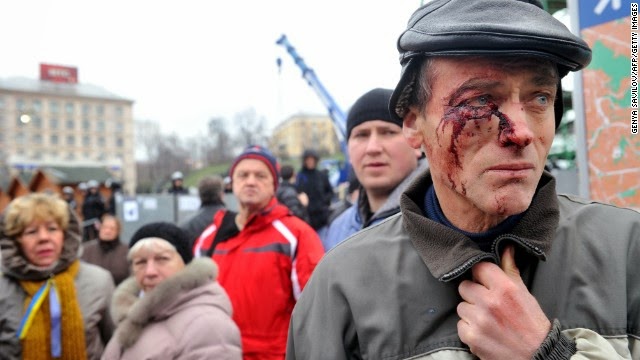
Tens of thousands of protesters have filled the streets and squares of the capital, Kiev, two weekends in a row. Police have suppressed the protests brutally, injuring many people. The regime's controlled courts have banned any further public demonstrations until January.

German Chancellor Angela Merkel expressed disappointment in muted tones after a November 28 summit with the Ukrainian leadership: "Unfortunately not all expectations have been fulfilled. We will make very clear here that the EU is ready to accept Ukraine as an associate member, to sign the association treaty. Then we will see. We have no hope that it will happen this time, but the door is open."

Don't be fooled by the muted words, however. What's at stake in the streets of Kiev is the future of the European continent -- and American prosperity and security. An inward-looking America is averting its attention from its own most important interests and highest ideals.

Saturday, April 20, 2013

Re-post: What makes - and un-makes - young jihadists?

I want to re-post this article from 2009 about what made -- and un-made -- young British jihadists: "What Makes a Young Person Embrace Death and Murder? Former Jihadists Speak Out."

Here's what I had to say then:

It's not really that complicated. If white Western societies can successfully integrate Muslims, they will not feel alienated and look for a radical identity. (I cannot fail to mention that, for whatever reason, I haven't yet figured it out, the USA is light years ahead of Britain in this regard.) And if white Christians would be, well, more Christian, and embrace Muslims with love and acceptance, there would be many fewer terrorist recruits. That is not to say, "It's all our fault," but we do have a role to play, and a responsibility to build tolerant, loving societies -- as saccharine and heretically un-military as that solution may sound in today's post-9/11 world, where violence is always the answer.

From what we know so far about the alleged Boston bombers, they seemed to have been isolated loners who never felt like a part of U.S. society. The older brother said he had never made an American friend; he didn't understand Americans.

It's telling that they didn't have their parents or strong family ties in the U.S. either that could have offered psychological support.

It seems that they sought out a radical Islamist ideology that was ready and waiting for them on the Internet, to fill the void inside themselves, and perhaps to re-make themselves in a heroic image to compensate for their personal failures.

Many people will accuse me of trying to justify the alleged killers with these simple observations. People will accuse me of arguing that Islamist ideology played no role.  I'm not.  Explaining is not the same as justifying. It may make political hay and provocative punditry to paint all U.S. Muslims with the broad brush of "terrorist," but it's a dead-end conclusion. It's not operational. We must be smarter... and more human.

UPDATE (04.21.2013): OK, now a more detailed picture of the younger brother, Dzhokar Tsarnaev, is emerging. Apparently he "partied" in his dorm after the Boston marathon bombings. Maybe he wasn't such a loner after all. 

On the other hand, I know how loosely Americans use the word "friend," and how lonely U.S. life can be even while surrounded by smiling "friends," especially for non-natives.  In the U.S., a "friend" is anybody who says, "hey" to you on the street, shares a table with you in the cafeteria, or once had a drink with you. The American understanding of "friend" really confuses and ultimately disappoints many emigres to America, who after a time tend to seek out other foreigners, especially from their respective home countries, who share a similar understanding of friendship. So how many real friends did Dzhokar have, if any?.... Didn't he confide in a single friend besides his brother? 

Moreover, I think it's telling that Dzhokar Tsarnaev maintained an account on VKontakte, the Russian equivalent of Facebook. The stories I've seen didn't mention his having a Facebook account. Isn't that a bit weird? I don't know a single American teen or 20-something without a Facebook account. This kid emigrated to the U.S. when he was 9 or 10, and yet apparently he felt more connected to people in the former USSR. 

He did have a Twitter feed though, apparently. Here's one of those tweets: "Jahar @J_tsar: a decade in america already, i want out.

UPDATE (05.02.2013): So it looks like Dzhokar Tsarnaev partly confided in three of his buddies, two of them from the ex-Soviet Republic of Kazakhstan, that he knew how to make a bomb; and asked them to take whatever they wanted from his dorm room after his photo appeared as a suspect.

Friday, February 8, 2013

Only an elite can secure the gains of revolution

I'm not a fan of Anne Applebaum but she makes a good point here, one that I have already mentioned:

As the Arab Spring nations mark their second anniversaries, it’s worth keeping this [post-Soviet] precedent in mind. True, there were dissenters of many kinds in pre-revolutionary Egypt, as one expert told Foreign Policy this week. But “they were largely suppressed, except for the mosque and the soccer pitch. With these two institutions, the numbers were too big and the emotions they evoked were too strong.” The result: The Muslim Brotherhood was the only political “party” with any organizational capacity after 2011. And Egyptian soccer clubs are the only organizations that can reliably be counted on to create major protests, as they have recently. Another alternative elite was not available.

The upshot is that positive change in the Mideast and North Africa is going to take many years, because the erstwhile regimes there brutally suppressed the formation of any kind of local elite, and a civil society in which they could exchange ideas and cooperate:

After all, the time to help create an alternative [in Arab Spring countries] was three, five or, better yet, 10 years ago. But even then, an authentic alternative elite couldn’t have been wholly created on the outside, by exiles or by foreigners: If opposition leaders aren’t the product of an indigenous impulse to create alternative institutions — political parties, charities, newspapers, human rights organizations — then they won’t have the political clout to push through radical reforms when they get the chance. Yet in many Arab states, the opportunity to start doing so arrived only in 2011, and the alternative elite is forming only now.

We Americans especially like to believe the myth that revolutions are mass endeavors. The truth is that our American Revolution, the Bolshevik Revolution and others were carried out by a minority of the population led by a tiny, well-educated, well-connected elite. The People always need leaders -- especially people trying to move on after bad leaders.


By Anne Applebaum
February 7, 2013 | Washington Post

Monday, October 1, 2012

Forgotten history: Twice the U.S. rescued Russia

This one's worth posting in full.  [HT: Sasha.]  I've had several Russians tell me I don't know history, especially World War II history, (true enough), but I never once heard any of them mention these two examples.  It's understandable why their Soviet schools never told them.  Of course most Americans know nothing about it either.  So all y'all git yerselfs edumacated!


By James Brooke
September 25, 2012 | VOA Blogs

As American officials struggle to meet an Oct. 1 deadline for closing the 20-year-old USAID office in Moscow, it is worth looking at America’s other great 20th century aid program to Russians.

In a corner of Public School 1262 in Moscow, there is a one-room, privately run museum, the Museum of the Allies and Lend-Lease. It celebrates a crucial act of American generosity largely unknown to Russians.

Under the bland title of the Lend-Lease Act, American taxpayers sent to the Soviet people, from 1941 to 1945, $11.3 billion worth of war supplies. That is $146 billion in contemporary dollars.

This steel river of jeeps, trucks and bombers was neither a loan nor a lease. Franklin Roosevelt chose that title in the hopes of deluding American isolationists who opposed what they saw (correctly) as an outright gift to Moscow.

What did this money buy for the USSR? 3,770 bombers, 11,594 fighter planes, 5,980 anti-aircraft guns, 2,000 railroad locomotives, 51,000 jeeps, 361,000 trucks, 56,445 field telephones, 600,000 kilometers of telephone wire, 22 million artillery shells, almost one billion rifle cartridges, and 15 million pairs of army boots.

Shipped through the North Atlantic, driven up through Persia, or flown in from Alaska, this ready-made war material also freed up 600,000 Soviet factory workers to directly fight the Nazi invaders.

What was the impact of this generosity?

Joseph Stalin, during the Tehran Conference in 1943, said publicly of the American Lend-Lease program: “Without American production the United Nations could never have won the war.”  After the war, the aid became a taboo topic. 

Without it, Adolf Hitler might have enjoyed his planned victory banquet at the Hotel Astoria in St. Petersburg. Then, he might have proceeded with his plan to raze Moscow and turn Russia’s capital into a lake. As a rump Soviet government retreated to the Urals, Hitler might have pursued his grand plan to reduce “excess” Slav populations and convert the Black Soil belt into agricultural plantations devoted to feeding the Third Reich. (Note to Russian neo-Nazis: Sorry to break the news, but the real Nazis wanted your grandfathers dead).

Russian cynics will say the United States needed the Soviet Union to bolster the American war effort.

Au contraire.

Even after Dec. 7, 1941, one current of thought in the United States said, in effect: trade Britain for the Bolsheviks. In other words: Adolf, lay off London. Focus your energies on Moscow. An Anglo-American alliance could learn to live with a Nazi dominated Europe. Our fight is with the Japanese, who attacked Hawaii, and were killing and interning Americans in the Philippines and the Marianas.

Instead, a more generous and liberal American worldview prevailed: free the world from fascism.

It was toward this goal, that my mother worked at a factory building bomb sites outside of New York City, and my father drove a military ambulance in the North African campaign against the Nazis. They were just two of the millions of Americans who volunteered — were not drafted — in the war effort.

Today, American Lend-Lease aid is largely ignored in Russian history books.

It did not fit with Stalin’s self-aggrandizing victory narrative.

After the fall of communism, the Lend-Lease never recovered its place in Russian history books.

There was an earlier precedent.

American aid accounted for the bulk of aid that fed 10 million Russians at the height of the 1921-22 famine. The aid was coordinated by Fridtof Nansen, the Norwegian explorer, who was High Commissioner of the International Committee for Russian Relief. This photo, of two boys in fatal stages of hunger, was taken by Nansen in early 1922 and used in pamphlets to win donations in Europe and the United States for food aid to Russia.


American aid accounted for the bulk of aid that fed 10 million Russians at the height of the 1921-22 famine. The aid was coordinated by Fridtof Nansen, the Norwegian explorer, who was High Commissioner of the International Committee for Russian Relief. This photo, of two boys in fatal stages of hunger, was taken by Nansen in early 1922 and used in pamphlets to win donations in Europe and the United States for food aid to Russia.

In 1921-22, the United States Congress-funded American Relief Administration helped feed about 10 million starving Russians. Initially, Lenin had refused Western aid. But as the death toll mounted, he relented. American food aid continued through 1923. But American popular support dwindled when it became clear that the Soviet government was exporting its own grain to earn foreign currency, and then asking foreigners to feed Russian peasants.

Soviet textbooks ignored the American aid and glossed over the famine. Largely manmade, this hunger killed about five million people – 10 times higher than any late Czarist era famine.

I bring this up because a similar Kremlin official revisionism is now underway about American taxpayers’ third great aid project to Russia in the last century: the USAID project.

Over the last 20 years, the United States has given $2.7 billion in aid to post-communist Russia. Initially, the aid was designed to stave off severe food shortages. But the bulk was to ease Russia’s transition from a closed society and economy to an open one.

Much of the money went to such building block projects as drawing up a land code, a tax code, promoting small business and judicial reforms.

Over the last two decades, I have known many AID workers in Russia. They came in all shapes and sizes, but seemed to be motivated by a common goal: to see Russia progress from a state-controlled economy and society to an open one.

The program had American support. Year after year, it was approved by the U.S. Congress. Congress answers to the 138 million Americans who pay income tax. If aid to Russia was unpopular, it would have been thrown out years ago.

As Russia’s economy stabilized and grew, the aid shrank. This year, it is $49 million – less than 20 percent of the mid-1990s peak. It increasingly went into health issues – fighting tuberculosis, AIDS prevention, and reducing the abandonment of children.

On one level, the Putin Administration feels Russia has outgrown foreign aid. But, just as Russia seeks foreign investment in factories, foreign aid in health care brings in new techniques and experience. There is no point in reinventing the wheel in either sector. Should Russia throw out foreign car companies and go back to making its own world-beating cars?

On another level, Vladimir Putin feels that Washington is interfering in Russian politics by granting a total of $29 million this year to such civil society groups as Golos, a clean elections group, Memorial, a human rights group, and Transparency International, a corruption fighting group.

Hmm, what does that say about the Kremlin’s attitudes toward clean elections, human rights, and corruption fighting?

The USAID Russia civil society promotion budget is barely 1 percent of USAID’s total $23.8 billion budget this year.

And what does it say, when the Kremlin elephant stands on a stool, and cries ‘eek, eek’ at the sight of a $29 million American mouse?

Today, Russia’s finance minister, Andrei Belousov, announced that Russia’s net capital outflow for the first eight months of 2012 was $52 billion. At that rate, it took three hours to clock $29 million out the door. Presumably, private Russian donors can be found to pick up the slack. Of course that assumes that the Kremlin will allow non-governmental groups to take non-governmental donations.

Kremlin apologists try to persuade the public that Western money is the reason for the protest movement in Russia. But, in a recent Pew Global Attitudes survey, 58 percent of Russians believe the opposition protests were home-grown. Only 25 percent believe that foreign powers are behind the protests.

All the same, 20 years of USAID assistance to Russia is being sacrificed on the current altar of anti-Americanism.

In a sign of the times, an American, Marc Schneider, was chosen earlier this month to play the role of Napoleon in the Sept. 2 reenactment of the Battle of Borodino. This 1812 epic confrontation pitted the French dictator’s Grande Armee against the forces of Czar Alexander I.

So while, President Putin and former French President Valery Giscard d’Estaing met at the battlefield and talked to reporters about the eternal friendship between France and Russia, a pint-sized American Napoleon swaggered up and down the French lines, urging his troops to kill Russians.

An American Napoleon.

Now, THAT fits the Kremlin’s historical narrative.

Tuesday, February 14, 2012

Why does America lock so many people up?


This is really a must-read article, a real revelation for those on the "left" and "right" sides of the crime & prison debate. But it's long so I'll quote excerpts. Let's start with the shocking, shameful stats:

"More than half of all black men without a high-school diploma go to prison at some time in their lives. Mass incarceration on a scale almost unexampled in human history is a fundamental fact of our country today—perhaps the fundamental fact, as slavery was the fundamental fact of 1850. In truth, there are more black men in the grip of the criminal-justice system—in prison, on probation, or on parole—than were in slavery then. Over all, there are now more people under 'correctional supervision' in America—more than six million—than were in the Gulag Archipelago under Stalin at its height. That city of the confined and the controlled, Lockuptown, is now the second largest in the United States.

"The accelerating rate of incarceration over the past few decades is just as startling as the number of people jailed: in 1980, there were about two hundred and twenty people incarcerated for every hundred thousand Americans; by 2010, the number had more than tripled, to seven hundred and thirty-one. No other country even approaches that. In the past two decades, the money that states spend on prisons has risen at six times the rate of spending on higher education."

Think about that. I regard the Soviet Union with horror; it was a giant murder mill and prisoner factory spanning a dozen time zones. And yet, according to Gopnik, today's America is in an important way even worse. How is that possible in the country that defeated Communism? How have we let ourselves get so bad?


And then there is prison rape. We all know about it. We joke about it, or fear it, or try to ignore it, or sometimes say (cruelly) that it is just punishment. Here's what Gopnik has to say:

"Prison rape is so endemic—more than seventy thousand prisoners are raped each year—that it is routinely held out as a threat, part of the punishment to be expected. The subject is standard fodder for comedy, and an uncoöperative suspect being threatened with rape in prison is now represented, every night on television, as an ordinary and rather lovable bit of policing. The normalization of prison rape—like eighteenth-century japery about watching men struggle as they die on the gallows—will surely strike our descendants as chillingly sadistic, incomprehensible on the part of people who thought themselves civilized."

There are two theories for how the modern U.S. prison system came into being (and let's remember it's a fairly new institution, compared to what we had before): a result of Northern efficiency and procedural justice without room for judges to make commonsense, common law rulings; or a continuation of the Southern slave plantation by other means. Regarding that latter theory, writes Gopnik:

"'American prisons trace their lineage not only back to Pennsylvania penitentiaries but to Texas slave plantations.' White supremacy is the real principle, this thesis holds, and racial domination the real end. In response to the apparent triumphs of the sixties, mass imprisonment became a way of reimposing Jim Crow. Blacks are now incarcerated seven times as often as whites. 'The system of mass incarceration works to trap African Americans in a virtual (and literal) cage,' the legal scholar Michelle Alexander writes. Young black men pass quickly from a period of police harassment into a period of 'formal control' (i.e., actual imprisonment) and then are doomed for life to a system of 'invisible control.' Prevented from voting, legally discriminated against for the rest of their lives, most will cycle back through the prison system. The system, in this view, is not really broken; it is doing what it was designed to do. Alexander's grim conclusion: 'If mass incarceration is considered as a system of social control—specifically, racial control—then the system is a fantastic success.'"

And then there is the more recent phenomenon of for-profit U.S. prisons, run as corporations, whose only source of growth, perversely, is more and more inmates:

"It's hard to imagine any greater disconnect between public good and private profit: the interest of private prisons lies not in the obvious social good of having the minimum necessary number of inmates but in having as many as possible, housed as cheaply as possible. No more chilling document exists in recent American life than the 2005 annual report of the biggest of these firms, the Corrections Corporation of America. Here the company (which spends millions lobbying legislators) is obliged to caution its investors about the risk that somehow, somewhere, someone might turn off the spigot of convicted men:

"'Our growth is generally dependent upon our ability to obtain new contracts to develop and manage new correctional and detention facilities. . . . The demand for our facilities and services could be adversely affected by the relaxation of enforcement efforts, leniency in conviction and sentencing practices or through the decriminalization of certain activities that are currently proscribed by our criminal laws. For instance, any changes with respect to drugs and controlled substances or illegal immigration could affect the number of persons arrested, convicted, and sentenced, thereby potentially reducing demand for correctional facilities to house them.'"


Gopnik goes on to describe how falling crime rates -- about a 40 percent decline in crime throughout the Western world in the 1990s -- cannot be explained by increased incarceration; the numbers so far defy easy explanation. But New York City is a different story: its crime rate decreased 80 percent. Why? Not for the reasons often cited. New York is not richer or whiter than it was, in fact, it is twice as black and Hispanic today compared to 1961. Nor did "broken-window" policing do it:

"In the nineties, the N.Y.P.D. began to control crime not by fighting minor crimes in safe places but by putting lots of cops in places where lots of crimes happened— 'hot-spot policing.' The cops also began an aggressive, controversial program of 'stop and frisk'— 'designed to catch the sharks, not the dolphins,' as Jack Maple, one of its originators, described it—that involved what's called pejoratively 'profiling.' This was not so much racial, since in any given neighborhood all the suspects were likely to be of the same race or color, as social, involving the thousand small clues that policemen recognized already. Minority communities, [researcher Franklin E.] Zimring emphasizes, paid a disproportionate price in kids stopped and frisked, and detained, but they also earned a disproportionate gain in crime reduced. 'The poor pay more and get more' is Zimring's way of putting it."

"Zimring said, in a recent interview, 'Remember, nobody ever made a living mugging. There's no minimum wage in violent crime.' In a sense, he argues, it's recreational, part of a life style: 'Crime is a routine behavior; it's a thing people do when they get used to doing it.' And therein lies its essential fragility. Crime ends as a result of 'cyclical forces operating on situational and contingent things rather than from finding deeply motivated essential linkages.' Conservatives don't like this view because it shows that being tough doesn't help; liberals don't like it because apparently being nice doesn't help, either. Curbing crime does not depend on reversing social pathologies or alleviating social grievances; it depends on erecting small, annoying barriers to entry."

And what about NYC's rate of incarceration?

"'New York City, in the midst of a dramatic reduction in crime, is locking up a much smaller number of people, and particularly of young people, than it was at the height of the crime wave,' Zimring observes. Whatever happened to make street crime fall, it had nothing to do with putting more men in prison."

And these facts lead Gopnik to the inevitable but "radical" conclusion that:

"...since prison plays at best a small role in stopping even violent crime, very few people, rich or poor, should be in prison for a nonviolent crime. Neither the streets nor the society is made safer by having marijuana users or peddlers locked up, let alone with the horrific sentences now dispensed so easily. For that matter, no social good is served by having the embezzler or the Ponzi schemer locked in a cage for the rest of his life, rather than having him bankrupt and doing community service in the South Bronx for the next decade or two."

Gopnik admits this goes against our current "common sense" and even a lot of "liberal" studies on crime prevention:

"To read the literature on crime before it dropped is to see the same kind of dystopian despair we find in the new literature of punishment: we'd have to end poverty, or eradicate the ghettos, or declare war on the broken family, or the like, in order to end the crime wave. The truth is, a series of small actions and events ended up eliminating a problem that seemed to hang over everything. There was no miracle cure, just the intercession of a thousand smaller sanities. Ending sentencing for drug misdemeanors, decriminalizing marijuana, leaving judges free to use common sense (and, where possible, getting judges who are judges rather than politicians)—many small acts are possible that will help end the epidemic of imprisonment as they helped end the plague of crime."

This should give us all hope. And it should serve as an example that systemic change does not necessarily result from "changing the whole system," but rather from small, high-leverage interventions which turn self-reinforcing vicious cycles backwards, turning them into virtuous ones.


Why do we lock up so many people?
By Adam Gopnik
January 30, 2012 | New Yorker