Showing posts with label Medicare. Show all posts

Tuesday, November 11, 2014

On Jonathan Gruber's comments 'bashing' Obamacare


which have talk radio, Fox and Republicans publicly all aflutter. So check this out:


"Healthy people pay, sick people get money," is the way all health insurance works, I'm afraid. It's the way insurance works, period: "Unsunken ships pay; sunken ships get money;" "Undamaged homes pay; damaged homes get money;" "Safe drivers pay; unsafe drivers get money," and so on.

Nevertheless the insurance companies through rescission have tried, illegally, to mitigate the economics of health insurance, retroactively; but PHSA, HIPPA and Obamacare have restricted that underhanded business practice.

No, Obamacare isn't "something for nothing." It's not "free healthcare." More people have to pay in by buying private insurance, or having their employer pay part of their insurance cost, but the economics are sound, there is no other way. The other side of the ledger, (which any accountant should acknowledge), is that having more people insured will lower health spending overall. That's what the CBO has said consistently. 

In the U.S. we're spending nearly 20 percent of GDP on health care, and that's not sustainable. It's also not competitive. Check this out from the World Bank,health expenditure, total (% of GDP):

Australia -- 9.1 percent
Canada -- 10.9 percent
France -- 11.1 percent
Germany -- 11.3 percent
Great Britain -- 9.4 percent
Japan -- 10.1 percent
... and so on.

Next, take a deep breath and check this out: "Revisions to CBO's Projections of Federal Health Care Spending" from July 2014. Upshot: The U.S. economy, at least the federal government'share of it, is projected to spend less  on health care in the long term, which is exactly what we liberal-progressives wanted, to bend the cost curve:

CBO now projects that, if current laws remained generally unchanged, net federal spending for the government’s major health care programs in 2039 would equal 8.0 percent of gross domestic product (GDP)—1.6 percentage points, or about 15 percent, less than the 9.6 percent the agency projected in 2010 (see the figure below). That revision stems in large part from the observed slowdown in health care spending in recent years, but it also includes the effects of other factors; some of those factors reduced projected spending, and others increased it.

The programs included in the calculations are Medicare, Medicaid, the Children’s Health Insurance Program, and subsidies for insurance purchased through exchanges. 

But how can that be, my conservative interlocutor will ask? How can the government be spending more on [Obamacare] subsidies yet projected to spend less, overall?  

The answer, (not to get too wonky), if you read between the lines of the CBO's revised estimate, is that growth in healthcare spending, including on Medicare, has been slowing down faster than anybody projected. 

Indeed, noted conservative Forbes, "The current numbers represent the slowest rate of growth since the government began tracking the data in 1960."

And why is that? Apparently nobody knows yet. But for four years running, the rate of spending on health care in America has slowed... just coincidentally under President Obama, under an Obamacare regime. 

Harvard economist David Cutler argued in the Washington Post a few days ago that, in fact, we do indeed have Obamacare to thank for it.

Probably it's still premature to say for sure, but the signs are good. Yet one more reason not to "repeal and replace" Obamacare when it's doing what it was designed to do -- covering about 7 million more Americans in its first full year; and lowering -- or at least not increasing -- healthcare costs for four years running.


UPDATE (11.15.2014): Here's kind of a fair and balanced analysis of what Jonathan Gruber said (on multiple occasions, unfortunately), from none other than CNN: "Obamacare: Voters, are you stupid?"

Sunday, August 17, 2014

Study: Healthcare prices 'irrational'

Here's yet more evidence to prove what I've been saying all along: healthcare does not, and cannot, operate like a business.  "The charging system and payment system are irrational," i.e. not based on any known criteria, concluded a recent study:

One California hospital charged $10 for a blood cholesterol test, while another hospital that ran the same test charged $10,169 — over 1,000 times more.

For another common blood test called a basic metabolic panel, the average hospital charge was $371, but prices ranged from a low of $35 to a high of $7,303, more than 200 times more.

[...] Earlier studies by [Dr. Renee] Hsia [the study's leading author] identified variations in listed charges for labor and deliveries and for appendectomies in California, with labor and delivery charges varying eight to 11-fold between hospitals, and charges for a routine appendectomy ranging from $1,500 to $182,955.

So what does the healthcare industry have to say for itself?

Officials with the California Hospital Association dismissed the report as irrelevant, saying that the vast majority of patients pay discounted rates that have been negotiated by their insurance plans.

"Charges are meaningless data — virtually no one pays charges," said Jan Emerson-Shea, the association's vice president for external affairs.

That's right, my free market-loving, Tea Partying friends: prices are meaningless.  That's the way it was before Obamacare, and that's the way it is now.

But if the hospitals aren't the problem, then private health insurance must be. What's the answer? Make private health insurance unnecessary, (or an added luxury for those who want it), by introducing a single-payer insurance system, aka "Medicare for everybody."  

Medicare already negotiates the best prices on health care and prescription drugs, better prices than you or I can get, or our insurance providers. That's why this year the Obama Administration was the first ever to publicize the prices that Medicare pays for all kinds of health services, in the vain, (let's say misguided) hope that it would spur health "consumers" to ask tough questions of their providers and insurers and *shop around.

(*Just to illustrate the absurdity of "shopping" for healthcare, let's take the above-mentioned example of an appendectomy that could cost anywhere from $1,500 to $183,000. Nobody in the world researches prices on an appendectomy when they are healthy and able to choose where they get medical care; it is almost always an emergency procedure performed amid searing abdominal pain and the life-threatening risk of organ rupture. Anyway, the local EMT decides what hospital to go to, not the patient!)  


By Roni Caryn Rabin 
August 15, 2014 | NPR

Tuesday, November 19, 2013

How KY, CT and WA got Obamacare to work

How'd they get Obamacare to work in the states Connecticut, Kentucky and Washington?  Step 1: Giving a damn.  Step 2: Less bitching at Washington and more working at home.

Republican state politicians, take note!


By Jay Inslee, Steve Beshear and Dannel P. Malloy
November 18, 2013 | Washington Post

In our states — Washington, Kentucky and Connecticut — the Affordable Care Act, or “Obamacare,” is working. Tens of thousands of our residents have enrolled in affordable health-care coverage. Many of them could not get insurance before the law was enacted.

People keep asking us why our states have been successful. Here’s a hint: It’s not about our Web sites.

Sure, having functioning Web sites for our health-care exchanges makes the job of meeting the enormous demand for affordable coverage much easier, but each of our state Web sites has had its share of technical glitches. As we have demonstrated on a near-daily basis, Web sites can continually be improved to meet consumers’ needs.

The Affordable Care Act has been successful in our states because our political and community leaders grasped the importance of expanding health-care coverage and have avoided the temptation to use health-care reform as a political football.

In Washington, the legislature authorized Medicaid expansion with overwhelmingly bipartisan votes in the House and Senate this summer because legislators understood that it could help create more than 10,000 jobs, save more than $300 million for the state in the first 18 months, and, most important, provide several hundred thousand uninsured Washingtonians with health coverage.

In Kentucky, two independent studies showed that the Bluegrass State couldn’t afford not to expand Medicaid. Expansion offered huge savings in the state budget and is expected to create 17,000 jobs.

In Connecticut, more than 50 percent of enrollment in the state exchange, Access Health CT, is for private health insurance. The Connecticut exchange has a customer satisfaction level of 96.5 percent, according to a survey of users in October, with more than 82 percent of enrollees either “extremely likely” or “very likely” to recommend the exchange to a colleague or friend.

In our states, elected leaders have decided to put people, not politics, first.

President Obama announced an administrative change last week that would allow insurance companies to continue offering existing plans to those who want to keep them. It is up to state insurance commissioners to determine how and whether this option works for their states, and individual states will come to different conclusions.

What we all agree with completely, though, is the president’s insistence that our country cannot go back to the dark days before health-care reform, when people were regularly dropped from coverage, and those with “bare bones” plans ended up in medical bankruptcy when serious illness struck, many times because their insurance didn’t cover much of anything.

Thanks to health-care reform and the robust exchanges in our states, people are getting better coverage at a better price.

One such person is Brad Camp, a small-business owner in Kingston, Wash., who received a cancellation notice in September from his insurance carrier. He went to the state exchange, the Washington Healthplanfinder, and for close to the same premium his family was paying before got upfront coverage for doctor’s office visits and prescription drug , vision and dental coverage. His family was able to keep the same insurance carrier and doctors and qualified for tax credits to help cover the cost.

Since Howard Stovall opened his sign and graphics business in Lexington, Ky., in 1998, he has paid half the cost of health insurance for his eight employees. With the help of Stovall’s longtime insurance agent and Kentucky’s health exchange,Kynect, Stovall’s employees are saving 5 percent to 40 percent each on new health insurance plans with better benefits. Stovall can afford to provide additional employee benefits, including full disability coverage and part of the cost of vision and dental plans, while still saving the business 50 percent compared with the old plans.

In Connecticut, Anne Masterson was able to reduce her monthly premiums from $965 to $313 for similar coverage, including a $145 tax credit. Masterson is able to use her annual premium savings of $8,000 to pay bills or save for retirement.

These sorts of stories could be happening in every state if politicians would quit rooting for failure and directly undermining implementation of the Affordable Care Act — and, instead, put their constituents first.  Health reform is working for the people of Washington, Kentucky and Connecticut because elected leaders on both sides of the aisle came together to do what is right for their residents.

We urge Congress to get out of the way and to support efforts to make health-care reform work for everyone. We urge our fellow governors, most especially those in states that refused to expand Medicaid, to make health-care reform work for their people too.

Sunday, November 17, 2013

Geezers not to blame for high medical costs

"Stop blaming us!"

Good news, old folks! Now you can feel less guilty about being a burden on society. (You were feeling guilty, right?) Don your reading glasses and check this out:

[A] new study published Tuesday in the Journal of the American Medical Association strongly undercuts the assertion that an aging population is primarily to blame for soaring health care costs. Instead, the study concludes, the overwhelming share of increased health expenditures can be traced to the higher prices that hospitals, medical professionals and drug companies charge to treat a wide swath of illnesses, from cancer to depression.

[...]  All told, costs incurred from treating patients who suffer from chronic illnesses account for 84 percent of all health expenditures in the U.S.

"The attention given to rising Medicare costs is warranted, but chronic disease at all ages, not just those over 65, account for the lion's share of higher costs," said Hamilton Moses, a physician and management consultant who co-authored the report, in an interview.

Despite those high costs, we still have the finest health care system in the world, with the best delivery, right? It's because of all our innovative drugs and newfangled medical technology that let us live longer, right?  Wrong and wrong again:

Since 1980, costs have tripled, in real terms. Yet price increases have not translated into better care, the study found. By the starkest possible measure of health care success -- mortality rate -- the U.S. is slipping behind its peer countries.

Americans in almost every corner of the country die earlier, on average, than residents of other developed countries, with the difference most pronounced in the South, the study found.

And, very importantly, we must note that, "The U.S. also has relatively few doctors, at least as compared to other wealthy nations, ranking 19th out of 25 peer countries in terms of primary care physicians as a percentage of the population."

According to the OECD, in 2011, "the United States had 2.5 practising physicians per 1000 population, below the OECD average of 3.2."

We can thank the AMA, the authors of the abovementioned study, for that. As many have noted, it acts like a cartel to limit the number of medical schools (thus making fewer doctors) and hospitals, thereby keeping medical schools and hospitals more expensive and physicians' salaries higher. In 1962, uber-conservative economist Milton Friedman called the AMA “the strongest trade union in the United States." Also, the AMA's "RUC" committee strongly influences the prices for Medicare. 


By Ben Hallman
November 12, 2013 | Huffington Post

GOP's alternative: Un-Affordable Care Act?

I hesitate to post this because of the author's conclusion: give single-payer (aka "Medicare for all") a second look.

Don't get me wrong, I prefer single-payer. But as I said recently, many Obamacare critics illogically believe the conspiracy theory that Obama has intended all along for the Affordable Care Act to fail, ushering in "socialized medicine" to save the day.    

Even single-payer is not socialized medicine; it's socialized payment for medicine. There are plenty of private doctors and hospitals today that make a fine living off Medicare patients, and nobody accuses them of communist sympathies.


By Caroline Poplin
November 14, 2013 | McClatchy-Tribune News Service

Republicans can hardly believe their good luck. The Obama administration has once again snatched defeat from the jaws of victory. After successfully holding off Republican efforts to destroy Obamacare by shutting down the government and threatening default, the administration badly bungled the rollout of the crown jewel of health reform: the insurance exchanges. (No surprise to those of us who wrestle with computers daily.) Somehow administration leaders also failed to anticipate the predictable response of insurance companies to a perfect opportunity to raise premiums wholesale, while blaming someone else.

Nevertheless, we need to keep in mind that even as they gleefully tear into the ACA, Republicans have not offered an alternative.

On reflection, however, this is no surprise. Republicans don't see a problem with health care in America. Insurers can sell what they chose to whom they chose; people can select policies they like and can afford, or save their money for other things. This is how markets work. The only change Republicans would make is deregulation, so insurers and good prospects can find one another more easily across state lines.

As Ronald Reagan said: "Government is not the solution to the problem, government (in this case, the ACA) is the problem."

For conservatives, health insurance and health care are ordinary commodities to be traded in the marketplace, just like automobile insurance and automobiles.

But health care is not just another item in the shopping cart. As the African-American spiritual observed, "If living were something that money could buy, the rich would live and the poor would die."

And that is where we are in the 21st century. Health care is a matter of life and death. Our medicine is highly effective. Today, we can cure, or treat, diseases that were once fatal - heart attacks, many cancers, even HIV. That is, if you have the money. Today rich Americans live, on average, five years longer than poor citizens.

Nor is health insurance an ordinary insurance product.

Illness today is not evenly distributed across the population. Some 10 percent of people are responsible for 60 percent of health-care costs in the United States. Because most illness continues for many years after diagnosis, these people are easy to identify: patients with multiple sclerosis, congestive heart failure, lymphoma.

No one wants to pay for the sick people - not the insurance companies (particularly if they cannot recover their costs by charging the sick higher premiums), and not healthy customers. We hear this now, as single men and older people complain that to comply with the ACA, they have to pay for maternity benefits that they will never use.

A free market with lots of choices among multiple insurers, risk pools, policies with all sorts of benefits and price structures, allows insurers and healthy individuals to avoid the sick. The less affluent healthy can gamble on inexpensive policies with spotty coverage (useless to the chronically ill): since most people are healthy most of the time, few of them will ever need to test their insurance. (Or they can join large groups of other healthy people working for large employers who provide insurance.) Insurers can charge sick people thousands of dollars a month to cover the cost of their claims, and then some.

The result? The people who need health care the most have the most difficulty getting insurance that covers it. Doesn't this defeat the whole purpose of the exercise?

That, however, is the Republican alternative to the ACA. And remember, even before the ACA, things were not stable, but deteriorating: as health costs rose, premiums, co-pays and deductibles were going up, employers were cutting back. Without the ACA, those trends will continue.

The ACA was an effort to preserve a private health insurance market, using regulation to achieve a better result. As we see, this is very complicated.

There is a third option. If everyone is in the same, large, pool, everything medically necessary is covered, insurers are paid merely to process claims, and premiums are scaled to income, there is enough money to cover everyone at reasonable cost without elaborate, expensive, error-prone computer programs and geniuses to run them. People will be able to choose their doctors and hospitals. (And the rich can always buy more if they want.)

A crazy, wild-eyed socialist nightmare? No, this is Medicare, a familiar, popular, competently-run public insurance system that everyone's parents or grandparents rely on. Person-for-person, disease-for-disease, Medicare is the cheapest, most efficient health insurance program in the country. (There is virtue in simplicity.) Medicare already controls health care costs better than private insurers, and with a few tweaks, could do much more, forcing prices down to the level citizens of every other advanced democracy pay, with no sacrifice in quality.

Given the alternatives, maybe Medicare-for-all deserves a second look.

Thursday, October 17, 2013

Bernie Sanders tells it like it is on GOP shutdown

Zakaria: Beware the dark side of conservatism

Zakaria may tend to lift material from other journalists, but even so, he's lifting the right stuff. This one gets posted in full!  I mean, this is simply epic. Check it out [emphasis mine]:

But compared with almost any period in U.S. history, we live in bourgeois times, in a culture that values family, religion, work and, above all, business. Young people today aspire to become Mark Zuckerberg. They quote the aphorisms of Warren Buffett and read the Twitter feed of Bill Gates. Even after the worst recession since the Great Depression, there are no obvious radicals, anarchists, Black Panthers or other revolutionary movements — save the tea party.

And here's the upshot of his smackdown:

The era of crises could end, but only when this group of conservatives makes its peace with today’s America. They are misty-eyed in their devotion to a distant republic of myth and memory yet passionate in their dislike of the messy, multiracial, quasi-capitalist democracy that has been around for half a century — a fifth of our country’s history. At some point, will they come to recognize that you cannot love America in theory and hate it in fact?

Ouch!  And so... as my Tea Party friends dust themselves off and wipe the figurative blood from their noses, here's a stylistic note for my journo colleagues: it really is incorrect and misleading to refer to the "tea party" in the singular. They should always be referred to in the plural. They have no overarching organization, leadership, common platform, or even history of playing nicely with each other. They run the gamut from billionaire-funded astro-turf operations like Americans For Prosperity to local coffee klatches in Flyoverville, MO.  

This is why blithering, bilious idiots like Sarah Palin, Jim DeMint or Ted Cruz can rightly claim to speak for the Tea Parties: they have just as valid a claim to leadership of this brainless millipede of an "organization" as anybody does. To be totally honest, Glenn Beck and Rush Limbaugh have the most legitimate claim. They speak directly to the Tea Parties everyday, and humor their every paranoid anti-government fantasy.  


By Fareed Zakaria
October 17, 2013 | Washington Post

The crisis has been resolved, but this respite is temporary. We are bound to have more standoffs and brinkmanship in the months and years ahead. To understand why, you must recognize that, for the tea party, the stakes could not be higher. The movement is animated and energized by a fear that soon America will be beyond rescue.

Sen. Ted Cruz (R-Tex.) put it plainly at the recent Values Voter Summit in Washington: “We’re nearing the edge of a cliff, and our window to turn things around, my friends, I don’t think it is long. I don’t think it is 10 years. We have a couple of years to turn the country around or we go off the cliff to oblivion.”

Cruz dominated the summit’s straw poll, taking 42 percent of the vote, more than three times his nearest rival. His fundraising committees reported this week that they took in $1.19 million in the third quarter, double the total in the preceding quarter. Cruz’s national approval rating may be an abysmal 14 percent, but to the base of the Republican Party he is an idol.

The current fear derives from Obamacare, but that is only the most recent cause for alarm. Modern American conservatism was founded on a diet of despair. In 1955, William F. Buckley Jr. began the movement with a famous first editorial in National Review declaring that the magazine “stands athwart history, yelling Stop.” John Boehner tries to tie into this tradition of opposition when he says in exasperation, “The federal government has spent more than what it has brought in in 55 of the last 60 years!”

But what has been the result over these past 60 years? The United States has grown mightily, destroyed the Soviet Union, spread capitalism across the globe and lifted its citizens to astonishingly high standards of living and income. Over the past 60 years, America has built highways and universities, funded science and space research, and — along the way — ushered in the rise of the most productive and powerful private sector the world has ever known.

At the end of the 1961 speech that launched his political career, Ronald Reagan said, “If I don’t do it, one of these days you and I are going to spend our sunset years telling our children and our children’s children what it once was like in America when men were free.” But the menace Reagan warned about — Medicare — was enacted. It has provided security to the elderly. There have been problems regarding cost, but that’s hardly the same as killing freedom.

For most Americans, even most conservatives, yesterday’s deepest causes are often quietly forgotten. Consider that by Reagan’s definition, all other industrial democracies are tyrannies. Yet every year, the right-wing Heritage Foundation ranks several of these countries — such as Switzerland — as “more free” than the United States, despite the fact that they have universal health care.

For many conservatives, the “rot” to be excoriated is not about economics and health care but about culture. A persistent theme of conservative intellectuals and commentators — in print and on Fox News — is the cultural decay of the country. But compared with almost any period in U.S. history, we live in bourgeois times, in a culture that values family, religion, work and, above all, business. Young people today aspire to become Mark Zuckerberg. They quote the aphorisms of Warren Buffett and read the Twitter feed of Bill Gates. Even after the worst recession since the Great Depression, there are no obvious radicals, anarchists, Black Panthers or other revolutionary movements — save the tea party.

For some tacticians and consultants, extreme rhetoric is just a way to keep the troops fired up. But rhetoric gives meaning and shape to a political movement. Over the past six decades, conservatism’s language of decay, despair and decline have created a powerful group of Americans who believe fervently in this dark narrative and are determined to stop the country from plunging into imminent oblivion. They aren’t going to give up just yet.

The era of crises could end, but only when this group of conservatives makes its peace with today’s America. They are misty-eyed in their devotion to a distant republic of myth and memory yet passionate in their dislike of the messy, multiracial, quasi-capitalist democracy that has been around for half a century — a fifth of our country’s history. At some point, will they come to recognize that you cannot love America in theory and hate it in fact?

Wednesday, August 21, 2013

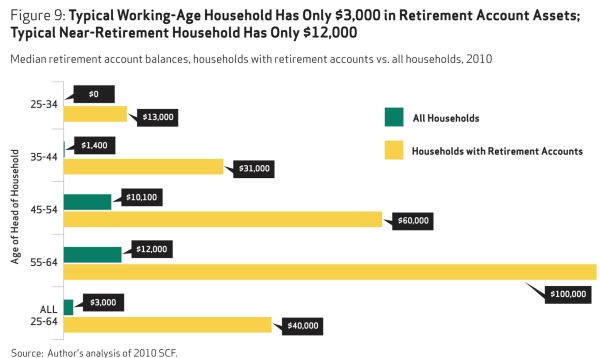
MB360: Americans unprepared for retirement

MB360 brings us some shocking figures on U.S. retirement savings:


retirementcrisisJ


What we find in the above chart is that most Americans are flat broke when it comes to saving for retirement.  You might say that those 25 to 34 years of age have simply avoided dealing with the future.  However, this is the most indebted young cohort of Americans we have ever seen largely due to student debt.  Yet look at the other age brackets.  The median amount saved for those 35 to 44 is $1,400 (one month of rent and food in many parts of the country).  Those 45 to 54 do a little bit better coming in at $10,100.  Those 55 to 64?  About $12,000.

In total, the median saved for retirement by all US households is $3,000.

Even those with retirement accounts (obviously a small figure) have a median amount saved of $40,000.  The $3,000 figure should shock people into realizing that programs like Social Security are going to become the default “retirement plan” for millions.


But should we really be surprised?  How many U.S. generations have experienced what is now considered a real, comfortable retirement, where savings combined with Social Security and Medicare allowed them to live out the last 20 or so years of life in comfort and security?  One generation?  The Baby Boomers are entering retirement now.  Let's see how well they do.  But it doesn't look good for them, not good at all. 

We need to re-think classical retirement, which is not classical at all, just an ideal that one or two generations of Americans managed to enjoy, and which now, thanks to demographics and cuts to Social Security, the Great Recession, fewer pensions and rising health costs, will soon cease to exist entirely.  


Posted by MB360
August 21, 2013

Friday, May 10, 2013

Obama reveals hospitals' real prices. Now what??

There goes that socialist Obama Administration again!:

The database released on Wednesday by the federal Centers for Medicare and Medicaid Services lays out for the first time and in voluminous detail how much the vast majority of American hospitals charge for the 100 most common inpatient procedures billed to Medicare. The database -- which covers claims filed within fiscal year 2011 -- spans 163,065 individual charges recorded at 3,337 hospitals located in 306 metropolitan areas.

This time Obama had the gall to publicly release information about the real prices that hospitals and doctors charge for medical procedures.  So that people, can, like, you know, compare prices and stuff.

If that sounds like something out the free market, you're right. But that doesn't matter, because it was OBAMA who publicized the information!  He always has a diabolical ulterior motive!  We just don't know what it is yet....

Seriously though, I know from personal experience that the prices hospitals charge are totally wacko. Recently my young child spent five days in the hospital while our registration for new health insurance, retroactive to Jan. 1, was still in process.  She's perfectly fine now, thank Allah, but we subsequently received a hospital bill for $31,000.  Bill collectors immediately started to call the house several times a day, every day, and all we could tell them was the same thing the insurance company told us: the paperwork is still in process; later the hospital could re-submit the claim.  

After our health insurance finally kicked in and the claim was processed, the hospital told us over the phone that our share would be about $3,000, but a few months have passed and still no bill for $3,000.  Meanwhile the hospital's billing office asked us to submit an application for a discount, which we did.  I suspect that $3,000 remaining charge will simply disappear, but if not.... Thankfully, I can afford to pay it, but for most poor families an unexpected medical emergency like that would ruin them.  

Indeed, medical bills are the #1 cause of personal bankruptcy in the U.S.

This case illustrates why health care can never be a free market.  First, the patient has no clue what he needs to buy.  If you're in critical condition and the doctor says, "We're going to stick this tube down your throat," you're not going to second-guess him... and meanwhile bargain or threaten to "take your business elsewhere."  No, you just do whatever he says, immediately. (This is assuming you're conscious at the time; otherwise the doctor just does it.)  

As a medical "consumer," you rarely have an actual choice.  Without information/knowledge, prices and choice there cannot be a competitive free market.  

The most that such information provided by Obama can do is help a patient after the fact who asks his provider, "Why did you charge me so much, when Hospital X down the road charges one-tenth as much for the same thing?"  But a patient is in a pretty weak bargaining position ex post facto.

This case also illustrates why everybody needs to be insured.  You cannot plan for the unplanned that costs who-knows-how-much.  And you're in no condition to bargain when you're critically ill.  That's why people buy insurance.  But for any kind of insurance scheme to work, the insurance pool has to be large enough to spread out risk and expense over many customers/insured.

Usually it's the 49 million poorer Americans who have no health insurance. The sick irony is that those people who are least able to pay are the ones asked to pay the full, "real" price of medical treatment.  Of course they often cannot pay.  So the hospital's actual cost for that treatment, whatever it really is, gets passed onto those who can pay, i.e. to health insurance companies.  It's a terribly messed-up "system."

Again, let me remind you that Obamacare opts to work primarily through this existing labyrinth of private health insurance.  This is the same system that Republicans think is not broken so we don't need to fix it.  Obamacare's most unpopular aspect -- the individual mandate -- requires people to participate in this "free-market" system.  It sets up new healthcare exchanges where people can buy private health insurance.  This is all as the Heritage Foundation, Newt Gingrich and Mitt Romney said it should be, before Obama took their suggestion and they decided they hated it.  

Whereas many liberals like myself want us to have a single-payer system, aka Medicare for all, to keep down costs and ensure universal coverage. But our compromiser-in-chief didn't opt for that route, he never even tried.  


By Jeffrey Young and Chris Kirkham
May 8, 2013 | Huffington Post

Friday, April 19, 2013

Rosenberg: Obama wanted to cut safety net all along

Rosenberg "uncovers" an Obama "conspiracy" that Tea Partyers and liberals alike don't want to acknowledge: he's been plotting to cut Social Security and Medicare without raising taxes to Clinton-era levels since BEFORE he was inaugurated, before the Tea Parties even existed.

Then, when Obama proposed cutting Medicare, exactly as Republicans proposed, they attacked him for it. He doesn't understand he's playing a losing game.

Or maybe he doesn't care?:

But, of course, Obama is not going to be running again. He will be collecting speaker's fees from the donor class. And they like what he is doing just fine. Obama's real base, it turns out, is exactly the same as George W Bush's: the have and have-mores. This budget is for them and them alone. To think otherwise is to continue living in denial.

Read it and weep, everyone.


By Paul Rosenberg
April 18, 2013 | Aljazeera

Friday, March 15, 2013

Ryan's budget either dumb or disingenuous

BOO-ya! Miller can't miss with this shot at the demographically challenged Congressional GOP:

Did I mention that Ronald Reagan ran the federal government at 22 percent of GDP when the country’s population was much younger, and health care consumed about 11 percent of GDP?

Now Paul Ryan says we can run the federal government at 19 percent of GDP as the massive baby-boom generation retires and when health costs (largely for seniors) have already soared to 18 percent of GDP.

Sorry, but Ryan is either deeply confused or doing his best to snooker us.

Miller puts in other words, same upshot:

In 1989, when President Reagan left office, there were 34 million people on Medicare and 39 million on Social Security. In 2025, according to these programs’ trustees, there will be 73 million on Medicare and 78 million on Social Security.

This is not happening because we’re stringing up the “hammock of dependency” that Ryan often invokes. It’s happening because our famously big postwar birth cohort is getting older.

Ryan obviously knows these facts. This means he’s disingenuously trying to use the aging of America to force a severe cutback in the non-elderly, non-defense portion of government, which is already headed toward historic lows as a share of GDP.

And here's what would happen if Ryan got his way:

At 19 percent, Ryan’s vision is an America with 50 million uninsured ... forever. Of infrastructure and R&D investment that trails other advanced nations ... in perpetuity. Of a nation that assigns its least effective teachers to poor children . . . permanently. (Amazingly, Senate Democrats have fallen prey to Ryan’s gravitational pull, with the budget they put out Wednesday coming in at 21.7 percent of GDP in the years ahead, a tad below Reagan-era spending.)

Ryan thinks we’re too dumb to see what he’s up to.

Well I'm not that dumb. Are you? 


By Matt Miller
March 14, 2013 | Washington Post

Thursday, March 7, 2013

Myerson: Re-secure U.S. retirement

You tell me what's wrong with this scenario:
  • "Greedy old people" are poorer than they were 30 years ago;
  • Old people are working longer than they did 30 years ago;
  • Fewer retirees receive a defined-benefit pension than 30 years ago;
  • Retirees rely more on Social Security than ever to avoid poverty;
  • Medical and drugs costs for seniors continue to climb, making Medicare more necessary than ever. 
         Meanwhile, 
  • U.S. corporate profitability and productivity are at all-time highs;
  • "Fix the Debt" CEOs, the American Chamber of Commerce and other "pro-business" groups keep telling us we need to cut Social Security, Medicare and Medicaid... or else.

Here's how Harold Myerson sums it up:

Just as U.S. businesses have been able to raise the share of corporate profits to a half-century high by reducing the share of their workers’ wages to a half-century low, so, too, their ability to reduce pension payments has contributed not just to their profits but also to the $1.7 trillion in cash on which they are currently sitting.

Myerson, Paul Krugman, Rep. Alan Grayson, et al are right: this entitlement- and debt-cutting fetish in the aftershocks of the Great Recession is total bullshit.  It's a scam. It is complete opportunism by corporate big-wigs and bankers who see a way to cut their costs and attract more SS money into financial markets for them to gamble with, while they enjoy both real and implicit subsidies and government guarantees in case they f**k up (again). 

Let's face it, our national 401-k  experiment has been a disaster for this generation of retirees and near-retirees.  This is not to mention the young and middle aged: "Today, more than half of U.S. workers have no workplace retirement plan" at all, according to Myerson. And yet Republicans want to cut younger workers' future SS and Medicare benefits "so that Social Security and Medicare will be there for them when they retire"?!  

Sorry for my potty mouth, folks, but that's called "getting f***ed at both ends," there's just no other way to describe it.

UPDATE (03.16.2013): I usually don't loop back like this, but I can't get this one phrase written by Lynn Stuart Parramore out of my head, it was such an eye-opener for me, and it totally relates to this antedated article: "There was no imagined past where people saved up for their old age."  What we are going through, we are the first people in the history of the earth to go through, not to mention the history of the United States. We need to cut ourselves a little slack here.

This is so, so important for Americans to remember when they're feeling financially stressed out and inadequate in the face of global financial markets and contradictory investment advice, not to mention getting lectured at by rich businessmen and their pocket politicians about how underpaid, overworked Americans need to save more and depend on government less.


By Harold Myerson
March 7, 2013 | Washington Post

Saturday, February 16, 2013

Deficits are not a problem; actuaries are not oracles

Worrying about U.S. federal deficits in this down economy is like worrying about what your lawn will look like in 20 years when you're house is on fire right now.


By Derek Thompson
February 15, 2013 | The Atlantic

The showdown between Joe Scarborough and Paul Krugman over our debt is interesting and important, not merely as a media skirmish, but also as a keyhole into the way deficit "hawks" and deficit "doves" misunderstand and talk past each other. A great deal of the animosity and confusion between both sides of the debate would be improved with an honest assessment today's economy and tomorrow's debt. 

Basically, this is a discussion about (a) what we know about the economy and (b) what we think we know about the economy.

WHAT WE KNOW

Here are six things we know about the economy. [1] We know that unemployment is still high. [2] We know that inflation is low. [3] We know that 4 million people have been out of work, and looking, for more than a year. [4] We know that GDP growth has been fine for normal times, but awfully weak for a recovery following a steep recession. [5] We know that cutting government spending takes money out of an economy. [6] We know that government spending cuts in the last few years have coincided with hundreds of thousands of lost government jobs, which has kept our unemployment rate from falling further.

And here are four things we know about our debt. [1] We know that government borrowing rates are low. [2] We know that global appetite for our debt is high. [3] We know we borrow in our own currency, and not, like Europe, in a common currency that we don't control. [4] And we know that makes us less vulnerable (but not invincible) from a debt crisis.

Out of these ten things we know, how many of them suggest that we should cut our deficits today? Basically, zero. And that's Paul Krugman's point. Everything we know about the economy today provides a clear argument for elevated deficits.

WHAT WE DON'T KNOW

Joe Scarborough understands this. He says he wants higher deficits and a game-plan for cutting our long-term debt (which is the accumulation of our deficits). But he doesn't fully understand -- or properly communicate -- how the argument for long-term debt reduction rests on assumptions about the future that are exquisitely sensitive to change. The precise dimensions of our 2020 debt are calculated from a matrix of variables (e.g. immigration, productivity growth, hospital construction growth, MRI inflation rates) whose very nature is to fluctuate, sometimes dramatically, on a quarterly or annual basis.

Here are four things we think we know about our future debt -- which is almost entirely a health care spending problem. [1] We think we know that the cost of caring for Americans will continue to grow faster than the economy. [2] We think we know that demand for this increasingly expensive care will grow along with our aging boomer population. [3] We think we know that tax revenue will grow about in line with the economy. [4] Thus, we think we know what the gap between future taxes and future spending will be, and how much we have to start saving today to cover it.

It's possible that the deficit hawks have it 100 percent right. But it would also take a rather astonishing clairvoyance for anybody to foresee the next ten years with even slightly useful clarity. Scarborough and Mika Brzezinski often talk about "math" when they talk about debt ...

... and our debt projections look like math, what with all of those numbers. But math is a law. Actuarial projections are not. They are smart guesswork facilitated by multiplying current trends over many years. There's an important difference.

For example, what if health care inflation slows down?

Actually, that's not a "what-if." Two weeks ago, CBO revealed that health care spending has "grown much more slowly than historical rates would have predicted." It cut estimates of federal spending on Medicaid and Medicare in 2020 by "about $200 billion." That's a lot of money. It is much more than Washington would save by raising the Medicare eligibility age from 65 to 67. If you thought raising the retirement age was enough to calm the market's appetite for debt reduction, then guess what? We just got 2X those savings by doing nothing.

It's generally considered goofy for somebody to pretend he can see the next 75 years in robotics, or software, or bio-sciences.  But somehow it's not goofy for Joe Scarborough, Steven Rattner and other serious, well-intentioned media people point out that we have $60+ trillion in "unfunded liabilities" to Social Security, Medicare, and federal pensions in the next seven decades. That statistic isn't wrong. It's just kinda ... goofy. Medicare actuaries are legally obligated to predict the future of their program past 2070.But the press [and the public! - J] is not legally obligated to pretend that our actuaries are oracles.

Paul Krugman isn't an oracle either. He's just a very smart economist with an astonishingly good track record. And even he isn't saying that debts don't matter. In fact, he's saying almost exactly what Alan Blinder -- an economist Scarborough cites approvingly -- wrote in The Atlantic: Don't worry too much about deficits now, and put aside some worry about the future total cost of health care.

Deficit reduction is sometimes framed as stimulus. It's not. It's insurance -- insurance against the possibility that the market will turn against U.S. debt and drive up interest rates and badly hurt the country. Insurance isn't bad. But it's expensive. And money taken out of the economy too soon could prolong an unemployment crisis that is creating structural deficiencies in our atrophying workforce. Deficit doves should concede that there is a risk to doing nothing for too long. But deficit hawks must concede that there is also a risk to taking out that insurance policy too soon -- or distracting attention from everything we know about the economy.
_______________________

Please don't say that our debt is exactly like global warming. It is true that both global warming and debt are arguably subtle and gathering forces whose impact on the world could surprise us somewhere down the line. But unlike our 2020 debt, global warming isn't just an actuarial projection. It's a scientific finding about the world right now. And whereas even deficit hawks allow that there is good debt (right now) and bad debt (in ten years), there is no analogous argument I'm aware of that says global warming is great for the world today -- or that we actually we need more of it! -- but bad for the world tomorrow.