Thursday, October 17, 2013


Sunday, September 15, 2013
MB360: Looming U.S. retirement disaster

Wednesday, August 21, 2013
MB360: Americans unprepared for retirement
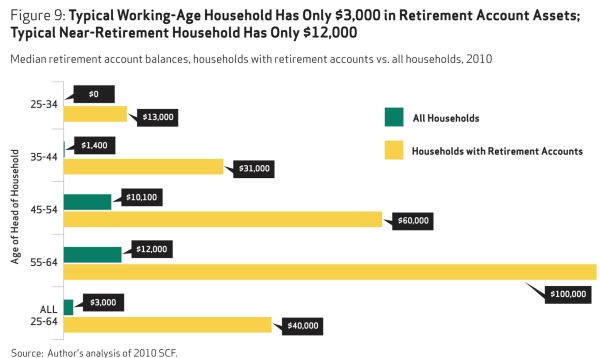
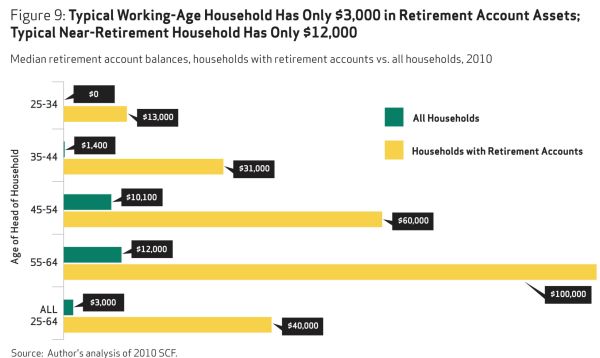
What we find in the above chart is that most Americans are flat broke when it comes to saving for retirement. You might say that those 25 to 34 years of age have simply avoided dealing with the future. However, this is the most indebted young cohort of Americans we have ever seen largely due to student debt. Yet look at the other age brackets. The median amount saved for those 35 to 44 is $1,400 (one month of rent and food in many parts of the country). Those 45 to 54 do a little bit better coming in at $10,100. Those 55 to 64? About $12,000.In total, the median saved for retirement by all US households is $3,000.Even those with retirement accounts (obviously a small figure) have a median amount saved of $40,000. The $3,000 figure should shock people into realizing that programs like Social Security are going to become the default “retirement plan” for millions.
Friday, April 19, 2013
Rosenberg: Obama wanted to cut safety net all along
But, of course, Obama is not going to be running again. He will be collecting speaker's fees from the donor class. And they like what he is doing just fine. Obama's real base, it turns out, is exactly the same as George W Bush's: the have and have-mores. This budget is for them and them alone. To think otherwise is to continue living in denial.
Tuesday, March 26, 2013
14 million Americans collect disability
As far as the federal government is concerned, you're disabled if you have a medical condition that makes it impossible to work. In practice, it's a judgment call made in doctors' offices and courtrooms around the country. The health problems where there is most latitude for judgment -- back pain, mental illness -- are among the fastest growing causes of disability.
But going on disability means you will not work, you will not get a raise, you will not get whatever meaning people get from work. Going on disability means, assuming you rely only on those disability payments, you will be poor for the rest of your life. That's the deal. And it's a deal 14 million Americans have signed up for.
Friday, March 15, 2013
Ryan's budget either dumb or disingenuous
Did I mention that Ronald Reagan ran the federal government at 22 percent of GDP when the country’s population was much younger, and health care consumed about 11 percent of GDP?Now Paul Ryan says we can run the federal government at 19 percent of GDP as the massive baby-boom generation retires and when health costs (largely for seniors) have already soared to 18 percent of GDP.Sorry, but Ryan is either deeply confused or doing his best to snooker us.
In 1989, when President Reagan left office, there were 34 million people on Medicare and 39 million on Social Security. In 2025, according to these programs’ trustees, there will be 73 million on Medicare and 78 million on Social Security.This is not happening because we’re stringing up the “hammock of dependency” that Ryan often invokes. It’s happening because our famously big postwar birth cohort is getting older.Ryan obviously knows these facts. This means he’s disingenuously trying to use the aging of America to force a severe cutback in the non-elderly, non-defense portion of government, which is already headed toward historic lows as a share of GDP.
At 19 percent, Ryan’s vision is an America with 50 million uninsured ... forever. Of infrastructure and R&D investment that trails other advanced nations ... in perpetuity. Of a nation that assigns its least effective teachers to poor children . . . permanently. (Amazingly, Senate Democrats have fallen prey to Ryan’s gravitational pull, with the budget they put out Wednesday coming in at 21.7 percent of GDP in the years ahead, a tad below Reagan-era spending.)Ryan thinks we’re too dumb to see what he’s up to.
Thursday, March 7, 2013
Myerson: Re-secure U.S. retirement
- "Greedy old people" are poorer than they were 30 years ago;
- Old people are working longer than they did 30 years ago;
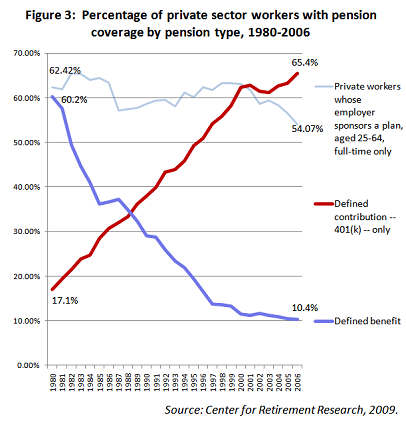
- Fewer retirees receive a defined-benefit pension than 30 years ago;
- Retirees rely more on Social Security than ever to avoid poverty;
- Medical and drugs costs for seniors continue to climb, making Medicare more necessary than ever.
- U.S. corporate profitability and productivity are at all-time highs;
- "Fix the Debt" CEOs, the American Chamber of Commerce and other "pro-business" groups keep telling us we need to cut Social Security, Medicare and Medicaid... or else.
Just as U.S. businesses have been able to raise the share of corporate profits to a half-century high by reducing the share of their workers’ wages to a half-century low, so, too, their ability to reduce pension payments has contributed not just to their profits but also to the $1.7 trillion in cash on which they are currently sitting.
UPDATE (03.16.2013): I usually don't loop back like this, but I can't get this one phrase written by Lynn Stuart Parramore out of my head, it was such an eye-opener for me, and it totally relates to this antedated article: "There was no imagined past where people saved up for their old age." What we are going through, we are the first people in the history of the earth to go through, not to mention the history of the United States. We need to cut ourselves a little slack here.
This is so, so important for Americans to remember when they're feeling financially stressed out and inadequate in the face of global financial markets and contradictory investment advice, not to mention getting lectured at by rich businessmen and their pocket politicians about how underpaid, overworked Americans need to save more and depend on government less.
Saturday, February 16, 2013
Deficits are not a problem; actuaries are not oracles
Thursday, December 6, 2012
Simpson debases himself before kids for his CEO paymasters
Thursday, November 29, 2012
Reagan on Social Security and the deficit
"Social Security has nothing to do with balancing a budget or erasing or lowering the deficit."
Wednesday, October 31, 2012
Baker: Why isn't Social Security an election issue?
Sunday, October 14, 2012
Median, middle and 'moochers'
- 2011 Census data says the the median U.S. household income is $50,500; that means half of U.S. households make more, and half less than $50,500.
- 2010 Social Security data says the median worker's income is $26,000.
- An individual making more than $250,000 is in the top one percent of all earners in the U.S.
- A household making more than $250,000 per year is in the top two percent of all U.S. households.
- A household making more than $100,000 is in the top 20 percent of all U.S. households.
- Food stamps, unemployment insurance, welfare: $210 billion
- Medicaid and CHIP grants to states: $265 billion
- Medicare: $550 billion (2011)
- Social Security: $778 billion
TOTAL: $1.8 trillion
Monday, August 13, 2012
Cutting 'welfare' won't fix the deficit
Between 2001 and 2011, the tax cuts delivered by George W. Bush and continued under Obama have cost roughly $2.8 trillion. That is about 17 times the roughly $165 billion that has been spent on the primary federal grant that funds welfare.
Wednesday, August 1, 2012
Those poor, greedy Boomers
Wednesday, June 20, 2012
The coming crisis of elderly poverty
Saturday, May 5, 2012
Wednesday, April 25, 2012
Social Security ain't bankrupt
I also note that [my students] are being asked to support cuts now to their future benefits on the basis of the argument that if those are not cut now, they might have to be cut in the future. When that is posed to them, they also rather shake their heads in disbelief about how seriously this whole thing has been misrepresented to them.
I would only add that the glut of Baby Boomers moving through the SS and Medicare/Medicaid system, like a golf ball through a garden hose, is a problem we have seen coming a long way off, at least since the 1980s. It's like one of those cheesy scenes in every action film where the hero shouts "Nooooooooooooooo!...", only slowed down to about 40 years. Enough. Even if all the Baby Boomers live to be 90, they'll all be dead by 2055. We just have to let the system gets back to demographic balance, and not dismantle and/or privatize one of the most successful anti-poverty programs ever designed out of fear of a hypothetical. And it is certainly not the fault of the young that Social Security is the main source of income for most present retirees, aka those "affluent" and "responsible" ones who preach to us about the need to live within our means.Most critical is, as skepto is suggesting, to completely end the facade of framing SS as a defined benefits program (it is not, you can read this in your annual statement), and simply re-frame it as old age and disability insurance, with some base levels and trickling off for the wealthy (a SS Buffet rule). That was the original intent, only modified to bring in the Republicans in the 30s, while ignoring demographics. Then the funding can be done optimally, rather than fraudulently confounding the benefits with the payroll deductions.
Friday, February 3, 2012
MB360: Boomers have no savings, live on SS

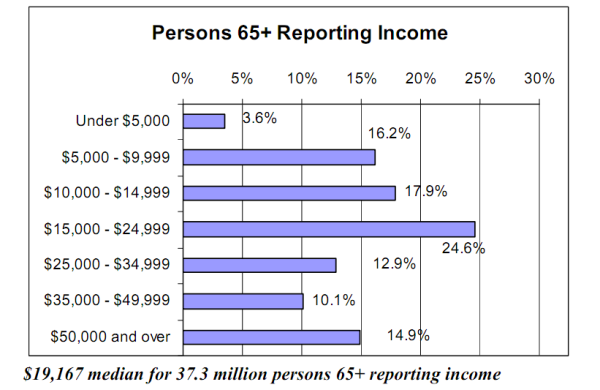
What happens when a society that prides itself on a middle class and self-sufficiency suddenly starts losing both? For over a decade the middle class in the US has been shrinking. This isn't some speculation but is reflected in the stagnant household income data. You also have a giant demographic train in that many baby boomers are now retiring in mass. Over 10,000 baby boomers enter into retirement each day and many have an inadequate amount of savings (if any) to get them through the leaner years. Couple this with a less affluent younger generation and you have a recipe for financial and social turmoil. Many of these younger Americans, many saddled with large student debt, are moving back home with parents that have seen their entire home equity evaporate. Do you think these are happy households especially when the median income of those 65+ is $19,167?
Median income of the old
There seems to be this misconception that older Americans are simply well off. The data shows us otherwise:
Source: US Dept. of Health
What is troubling about the above data is that during some of the most affluent decades in US history, most Americans have very little income in older age. In fact, most rely on Social Security as their primary source of income:
"Social Security constituted 90% or more of the income received by 34% of beneficiaries (21% of married couples and 43% of non-married beneficiaries)."
How is this even possible? Keep in mind the average Social Security payout is roughly $1,000 per month and this is fixed. Since the government has juiced the CPI data most of these fixed income Americans are seeing their energy and healthcare costs soar all the while they are told inflation is virtually non-existent. Try arguing that after going to the grocery store.
There is also this sense that since many older Americans own their home, they are somehow immune to the housing bubble. That is not true:
"In 2009, 48% of older householders spent more than one-fourth of their income on housing costs – 42% for owners"
Many older Americans still spend a lot of money on housing even if they are owners. Much of this comes from property taxes and costs associated with owning a home. Since many older Americans do own their home this housing bubble crash has harmed their largest asset.
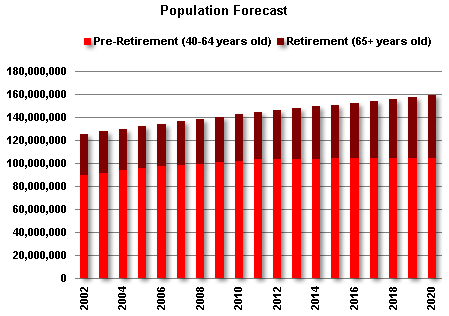
As time presses on more and more of our population is going into retirement. Lower birth rates and more Americans making it into older age conjure up memories of Japan:
Source: Baby boomer stats
-There are approximately 77.6 million baby boomers in the U.S.
-The baby boom phenomenon is responsible for over half of all consumer spending in the United States
-80% of all leisure travel is taken by boomers.
-Every 8.5 seconds a baby boomer in the U.S. turns 50 years old.
-The baby boom generation is the largest generation in American history.
-On January 1st, 2011 the very first Baby Boomers turned 65
Baby boomers tended to also be big spenders (at least they were during the debt bubbles). But what now? The strongest spending group is losing a large part of their wealth with the housing crash and many are exiting their peak earning stages. From the Social Security data, we realize many did not save in what was likely the most affluent times for America. With many younger Americans carrying major debt loads and finding items like pensions disappearing, how will they prepare for retirement? What access to savings do they have? Homes are still expensive for many younger Americans and that is why millions have moved back home:
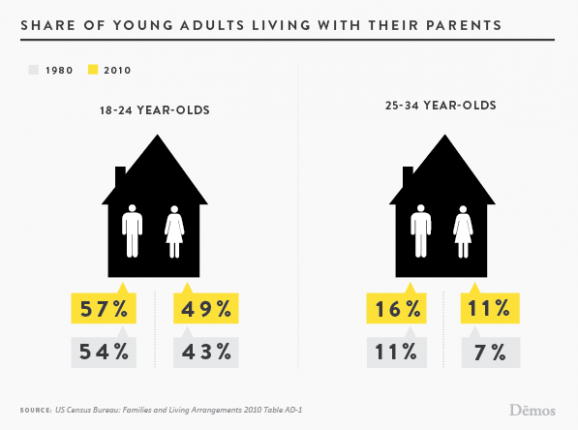
A society that has preaches independence and pushes out young at 18 will have a hard time dealing with boomerang kids coming back home. Many younger Americans will feel the strain as well especially if they "did the right thing" and went to college but now find a tough employment market and being back home. This demographic train has left the station and nothing will slow it down.