Showing posts with label college tuition. Show all posts

Sunday, January 5, 2014

Big Lib Idea of the Day: Free public higher education

About $40 billion. That's how much it would cost per year to pay for all students' education at public universities.  

This will never happen, sadly, because of the Tea Party mentality that is present in many Democrats' minds, too, that for some reason we have to approach every policy problem with a complicated cocktail of tax credits, loans, exceptions, opt-outs and incentives instead of government simply paying for it, at a lower cost, with less anxiety and uncertainty for qualifying students and their parents.

Meanwhile, our conservative brethren don't make a peep or give a second thought about the $1.5 trillion cost so far (or at least $4 trillion in the long-term) for Dubya's unnecessary wars in Afghanistan and Iraq.  $4 trillion is enough to pay for college for everybody for about 100 years, and somehow we found that money.  

Priorities, folks.  Priorities!  Jobs, health, education, housing.  (These all happen to be winning issues for Democrats, but hey, that's just incidental.)


By Jordan Weissmann
January 3, 2014 | The Atlantic

A mere $62.6 billion dollars!

According to new Department of Education data, that's how much tuition public colleges collected from undergraduates in 2012 across the entire United States. And I'm not being facetious with the word mere, either. The New America Foundation says that the federal government spent a whole $69 billion in 2013 on its hodgepodge of financial aid programs, such as Pell Grants for low-income students, tax breaks, work study funding. And that doesn't even include loans. 


If we were we scrapping our current system and starting from scratch, Washington could make public college tuition free with the money it sets aside its scattershot attempts to make college affordable today.

Of course, we're not going to start from scratch (and I'm not even sure we should want to make state schools totally free). But I like to make this point every so often because I think it underscores what a confused mess higher education finance is in this country. On the whole, Americans seem to want affordable colleges that are accessible to all. But rather than simply using our resources to maintain a cheap public system (and remember, public schools educate 75 percent of undergrads), we spill them into a fairly wasteful and expensive private sector. At one point, a Senate investigation found that the for-profit sector alone was chowing down on 25 percent of all federal aid dollars. 

If that story sounds awfully similar the problems the U.S. faces with healthcare costs, well, that's because it is similar. Americans have an allergy to straightforward policy solutions involving the public sector. And for that, we pay a price.

Update—Friday Jan. 3, 3:45 PM: Just to clarify, because some readers have asked, making tuition free in 2012 would have required $62.6 billion on top of what state and local governments already spend subsidizing public colleges, as well as some of the federal spending that doesn't go towards financial aid. Again, you can find a detailed breakdown of how our colleges are funded in the Department of Education's data. 

For anybody interested in reading more about the idea of making public college tuition free, and the vast array of economic considerations that would entail, here's a lengthy piece I wrote last year.

Update—Friday Jan. 3, 4:31 PM: One more update to answer another good question I've received. Technically, you could say the additional cost of making college tuition free would be even cheaper than $62.6 billion. How come? Because most Pell Grant money is already spent at public colleges. In 2011 - 2012, state school students received $21.8 billion in grants. So, if you subtract that from the total needed to completely eliminate tuition, it the sum would be closer to $40 billion. (Apologies for not teasing that point out earlier. I'd noted it in a previous article and didn't think to repeat it.)

Tuesday, September 3, 2013

Why U.S. college tuition is so high

Interesting analysis by Dylan Matthews over at Wonkblog of why U.S. higher education is so expensive.  (Spoiler: It ain't tenured left-wing professors or the education lobby).  Basically, it's a messed up market.  Higher education is a market for what economists call an "experience good" whose ultimate quality is unknown for a long time even after a student begins to consume it; and there are too many customers involved in one transaction; and there's something called Bowen's Law at work:

The main signal that you can use is price, and in particular sticker price. The theory is schools that cost more will deliver a better education. That means schools have a real incentive to push up tuition for its own sake. And if the Bowen theorem is right, once tuition goes up, so too does spending, making it harder for the effect to be undone.

“It sets in motion some really bad incentives,” [Robert] Martin [of Centre College] says. “The first is that consumers tend to take their cue on quality from how much each institution spends. Even more damaging is that any institution that tries to compete on the basis of cost, consumers are going to construe that to mean they’re cutting quality. So you don’t have cost competition, and you thus don’t have a competitive pressure to reduce cost.”

Matthews offers evidence that administrative "gilding" is the real cause [emphasis mine]:

At public and private research universities, “institutional support” costs grew more than instruction costs from 2000 to 2010. Indeed, instruction costs accounted for only about 28 percent of cost increases (in those areas where they occurred) for public research universities from 2000 to 2010. It sure looks like administration, rather than instruction, is what’s driving this.

Meanwhile, as Matt Taibbi recently described in Rolling Stone, we have the federal government financing this zany college spending spree while loading up America's youth with onerous debt.


By Dylan Matthews
September 2, 2013 | Washington Post

Tuesday, August 27, 2013

Taibbi: College loan system scam

Better late than never, I'm posting this exposé by Taibbi about the exorbitant cost of U.S. higher education.

Today's graduates leave college with have an average of $27,000 in student loan debt.


As Taibbi reveals, 

... the dirty secret of American higher education is that student-loan interest rates are almost irrelevant. It's not the cost of the loan that's the problem, it's the principal – the appallingly high tuition costs that have been soaring at two to three times the rate of inflation, an irrational upward trajectory eerily reminiscent of skyrocketing housing prices in the years before 2008.

Another dirty little secret is that the federal government, by its own estimates, stands to make $185 billion in profit on student loans over the next 10 years. Boosting the government's profits, borrowers cannot discharge their student loan debt through personal bankruptcy. The Department of Education can even garner federal disability checks!

So why is college so expensive in America?  The knee-jerk conservative response is: tenured ivory tower professors; and money for Democrats from the education lobby.

The former is untrue and the latter is only partly true.  But conservatives should note that the federal student loan system does cause a kind of market distortion, the so-called "Bennet hypothesis," named after conservative William Bennett: with any accredited college eligible to receive students with federal financial aid, there is really no incentive for colleges to cut costs, compete, or focus on degrees that give students a decent Return on Investment (ROI).  

"A degree in bullshit" does the job for both colleges and the government lender when the collection rate on student loans can exceed 100 percent.

And as we all know, the newer for-profit colleges have been gaming the student loan system -- as well as the education allowances given to members of the U.S. Military -- for several years now, even as students at for-profit colleges have a loan default rate as high as 40 percent.

Another reason colleges are so expensive is what Taibbi calls "gilding": the expensive administration buildings, sports stadiums and celebrity professors. These used to be paid for by nervous, eager parents... until they ran out of money. Now the federal government subsidizes colleges. So why shouldn't colleges go on a spending spree?


By Matt Taibbi
August 15, 2013 | Rolling Stone

Saturday, May 18, 2013

MB360: US student debt grew 284% from 2004-13

The facts behind the mountain of student debt: 13 percent of students owe more than $50,000 and nearly 4 percent owe more than $100,000. Student debt grew by 284 percent from 2004 to 2013.
Posted by mybudget360 
May 18, 2013

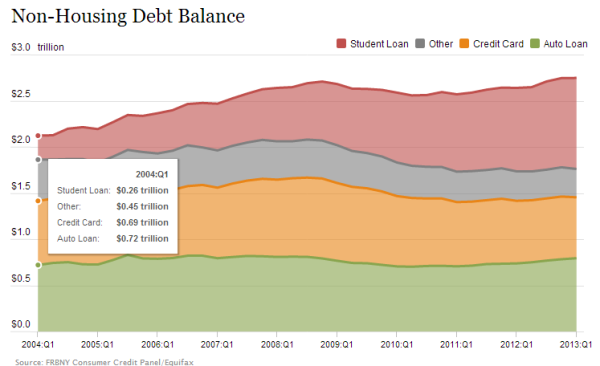
Many Americans view a college education as a way to build a better life.  College is seen as an avenue for better prosperity and the ability to pull yourself up beyond your current circumstances.  In fact, after World War II programs like the G.I. Bill allowed many Americans the opportunity to pursue a college degree.  In many cases, the United States at this time developed the largest middle class the world had come to know.  This is still the case today but the economic trends show a shrinking middle class that is largely having a tough time competing in this quickly globalizing economy.  One fact that stands out is that back in 2004, student debt was the smallest portion of all non-housing related debt in the US.  Only a short nine years later, student debt is the largest portion of debt in non-housing related debt.  What happened in this short period of time and what information can we pull from the mountains of student debt information?

Student debt and the decade of massive growth

One could argue that every segment of the economy experienced a growth in debt over the last decade.  That is not true.  Let us examine non-housing related debt carefully:

non-housing debt and student debt

Source:  Federal Reserve, Equifax

This is an interesting chart.  What we find is that Auto debt was the largest debt segment in 2004.  This was followed up by credit card debt and then other debt.  Student loan debt at this time was $260 billion.  In total, student debt made up 12 percent of all non-housing related debt back in 2004.

Fast forward to where we stand today:

non-housing debt and student debt 2

Source:  Federal Reserve, Equifax

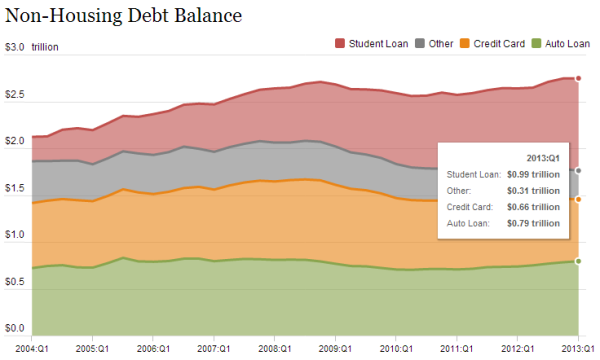
Student debt is now by far the largest portion of non-housing related debt in our economy.  Student debt is now well above $1 trillion.  The growth of student debt in this short window was 284 percent.  Student debt now makes up a stunning 36 percent of all non-housing related debt.  What is interesting then is when we compare this to the growth of the other segments of non-housing related debt:

Growth between 2004 and 2013
Non-housing related debt
Auto loans:       9%
Other:              -31%
Credit Card:     4.5%
Student Debt:  284%

In essence, nearly all the growth in non-housing related debt over this time has come from student debt growth.  This makes the following data more troubling regarding the amounts of student debt by tiers but also the rising number of delinquencies:

“(NY Times)  According to the Federal Reserve Bank of New York, almost 13 percent of student-loan borrowers of all ages owe more than $50,000, and nearly 4 percent owe more than $100,000. These debts are beyond students’ ability to repay, (especially in our nearly jobless recovery); this is demonstrated by the fact that delinquency and default rates are soaring. Some 17 percent of student-loan borrowers were 90 days or more behind in payments at the end of 2012. When only those in repayment were counted — in other words, not including borrowers who were in loan deferment or forbearance — more than 30 percent were 90 days or more behind. For federal loans taken out in the 2009 fiscal year, three-year default rates exceeded 13 percent.

America is distinctive among advanced industrialized countries in the burden it places on students and their parents for financing higher education. America is also exceptional among comparable countries for the high cost of a college degree, including at public universities. Average tuition, and room and board, at four-year colleges is just short of $22,000 a year, up from under $9,000 (adjusted for inflation) in 1980-81.”

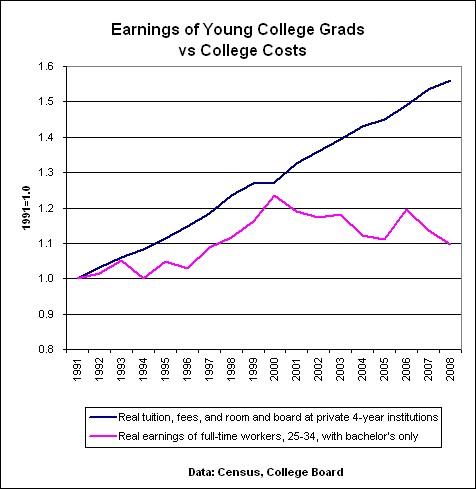
Averages do hide a lot of the facts but what we can deduct is that the 13 percent that owe more than $50,000 and the 4 percent that owe more than $100,000 have largely come in the recent decade.  While the cost of tuition has soared in this short period of time a large part of it has not corresponded to actual earnings:

college grads and earnings

What is interesting about the above chart is that real tuition is up (with new data) by close to 70 percent while real earnings are roughly the same as they were back in 1991.  So over a 20 year period college costs have soared but the return doesn’t seem to justify the rise.  We also have the proliferation of non-profit schools that target lower income Americans and provide them a questionable level of education.  Yet this is only one small part of the larger issue.  The addiction to debt.  We have discussed how this recession has hit young Americans incredibly hard.  In the current marketplace it has become hyper-competitive and expensive while starting salaries have fallen behind when it comes to inflation.  The rising number of delinquencies also shows that many students are simply unable to pay their debts.

If student debt were to grow at the current rate, we would be at $3.84 trillion in student by 2023.  Do you think that is sustainable?  If not, something has to give.

Monday, April 9, 2012

Report: Real causes of U.S. college tuition hikes

For all those who believe that an abundance of overpaid, tenured professors is to blame for skyrocketing U.S. college tuition costs, check it out:

In the past decade at public two-year colleges ... published tuition and fees, excluding scholarship aid and adjusted for inflation, have increased by 44.8 percent.  Faculty salaries, meanwhile, have decreased by 2.5 percent, according to the [American Association of University Professors] report.
Over the past decade at public four-year colleges and universities, tuition and fees have increased by 72 percent, the association said.

The cost of higher education continues to soar, rising 8.3 percent at four-year public colleges in the fall, the College Board reported.

So what is the real cause of college tuition hikes?

Tuition prices have been rising, in part, because state funding is providing a smaller proportion of revenues, and institutions have shifted more of the burden to students and their families, Curtis said.  At the same time, financial aid awards have not kept pace, and have been converted primarily into loans rather than grants, thereby increasing the student debt burden.


By Susanna Kim
April 9, 2012 | ABC News