Showing posts with label middle class. Show all posts

Sunday, June 8, 2014

Half the U.S. makes under $27 K, and other signs the middle class is dying

Submitted by Tyler Durden
June 5, 2014 | Zero Hedge

Submitted by Michael Snyder of The Economic Collapse blog,

If you make more than $27,520 a year at your job, you are doing better than half the country is.  But you don't have to take my word for it, you can check out the latest wage statistics from the Social Security administration right here.  But of course $27,520 a year will not allow you to live "the American Dream" in this day and age. After taxes, that breaks down to a good bit less than $2,000 a month.  You can't realistically pay a mortgage, make a car payment, afford health insurance and provide food, clothing and everything else your family needs for that much money.  That is one of the reasons why both parents are working in most families today.  In fact, sometimes both parents are working multiple jobs in a desperate attempt to make ends meet.  Over the years, the cost of living has risen steadily but our paychecks have not.  This has resulted in a steady erosion of the middle class.  Once upon a time, most American families could afford a nice home, a couple of cars and a nice vacation every year.  When I was growing up, it seemed like almost everyone was middle class.  But now "the American Dream" is out of reach for more Americans than ever, and the middle class is dying right in front of our eyes.

One of the things that was great about America in the post-World War II era was that we developed a large, thriving middle class.  Until recent times, it always seemed like there were plenty of good jobs for people that were willing to be responsible and work hard.  That was one of the big reasons why people wanted to come here from all over the world.  They wanted to have a chance to live "the American Dream" too.

But now the American Dream is becoming a mirage for most people.  No matter how hard they try, they just can't seem to achieve it.

And here are some hard numbers to back that assertion up.  The following are 15 more signs that the middle class is dying...

#1 According to a brand new CNN poll, 59 percent of Americans believe that it has become impossible for most people to achieve the American Dream...

The American Dream is impossible to achieve in this country.
 
So say nearly 6 in 10 people who responded to CNNMoney's American Dream Poll, conducted by ORC International. They feel the dream -- however they define it -- is out of reach.
 
Young adults, age 18 to 34, are most likely to feel the dream is unattainable, with 63% saying it's impossible. This age group has suffered in the wake of the Great Recession, finding it hard to get good jobs.

#2 More Americans than ever believe that homeownership is not a key to long-term wealth and prosperity...

The great American Dream is dying. Even though many Americans still desire to own a home, they are losing faith in homeownership as a key to prosperity.
 
Nearly two-thirds of Americans, or 64%, believe they are less likely to build wealth by buying a home today than they were 20 or 30 years ago, according to a survey sponsored by non-profit MacArthur Foundation. And nearly 43% said buying a home is no longer a good long-term investment.

#3 Overall, the rate of homeownership in the United States has fallen for eight years in a row, and it has now dropped to the lowest level in 19 years.

#4 52 percent of Americans cannot even afford the house that they are living in right now...

"Over half of Americans (52%) have had to make at least one major sacrifice in order to cover their rent or mortgage over the last three years, according to the “How Housing Matters Survey,” which was commissioned by the nonprofit John D. and Catherine T. MacArthur Foundation and carried out by Hart Research Associates. These sacrifices include getting a second job, deferring saving for retirement, cutting back on health care, running up credit card debt, or even moving to a less safe neighborhood or one with worse schools."

#5 According to the U.S. Census Bureau, only 36 percent of Americans under the age of 35 own a home.  That is the lowest level that has ever been measured.

#6 Right now, approximately one out of every six men in the United States that are in their prime working years (25 to 54) do not have a job.

#7 The labor force participation rate for Americans from the age of 25 to the age of 29 has fallen to an all-time record low.

#8 The number of working age Americans that are not employed has increased by 27 million since the year 2000.

#9 According to the government's own numbers, about 20 percent of the families in the entire country do not have a single member that is employed at this point.

#10 This may sound crazy, but 25 percent of all American adults do not even have a single penny saved up for retirement.

#11 As I noted in one recent article, total consumer credit in the United States has increased by 22 percent over the past three years, and 56 percent of all Americans have "subprime credit" at this point.

#12 Major retailers are shutting down stores at the fastest pace that we have seen since the collapse of Lehman Brothers.

#13 It is hard to believe, but more than one out of every five children in the United States is living in poverty in 2014.

#14 According to one recent report, there are 49 million Americans that are dealing with food insecurity right now.

#15 Overall, the U.S. poverty rate is up more than 30 percent since 1966.  It looks like LBJ's war on poverty didn't work out too well after all.

Sadly, it does not appear that there is much hope on the horizon for the middle class.  More good jobs are being shipped out of the country and are being lost to technology every single day, and our politicians seem convinced that "business as usual" is the right course of action for our nation.

Unless something dramatic happens, it is going to become increasingly difficult to eke out a middle class existence as a "worker bee" in American society.  The truth is that most big companies these days do not have any loyalty to their workers and really do not care what ends up happening to them.

To thrive in this kind of environment, new and different thinking is required.  The paradigm of "go to college, get a job, stay loyal and retire after 30 years" has been shattered.  The business world is more unstable now than it has been during any point in the post-World War II era, and we are all going to have to adjust.

Our McJobs economy...and the GOP plan to make it worse

My dear conservative friends will blame the shrinking middle class and more McJobs on Obama, naturally. 

But to see they're wrong you only have to look at their policy "fixes": no minimum wage; no guaranteed health insurance for workers; no right to unionize; and privatizing Medicare.  Oh, and cutting unemployment benefits to motivate more people to compete for low-wage jobs, thereby driving wages down even further. The most radical Tea Partiers even say we should abolish the Department of Education, when U.S. public schools are most people's shot at a better life.  

None of these ideas makes any economic sense.  (It makes a heckuva lot of sense from a class warfare perspective, however.)  And in the case of conservatives' debt fetish, they confuse economic cause and effect: debt causes recessions, not the other way around.

So they can't diagnose the problem, nor can they prescribe any cures.

But wait, they have more great ideas. Cutting "job-killing regulations" and income taxes on the rich should stimulate growth, then all the unemployed could get jobs in the new businesses that Republicans say their hands-off policies would create.  Yet we tried that before and saw how it worked out.  

Conservative talk radio says we can all move to Texas or North Dakota and find high-paying jobs in the shale gas boom, but that's hardly practical. Most people can't just pick up and move their entire lives, like Okies of the Depression era, to where the jobs are.  Doesn't matter. Republicans want to open up even more public lands for oil & gas drilling, even though that oil is sold by multinational corporations on the world market; it's not "ours."

Or as I like to sum it up, the GOP thinks we can cut and burn our way to a better economic future.  


David Nather over at Politico put it thusly in his article, "And the GOP economic plan is...?":


It’s the sixth year of Barack Obama’s presidency, the job market is still sluggish, most Americans say they’re unhappy with the economy, and Obama’s approval ratings are down. So what’s the Republican plan to turn it around?

The answer is, they don’t all think they need one and those who do can’t agree on a unified view.

This is why it's so ominous that Republicans, thanks to gerrymandering and stronger off-election turnout, could take over Congress in November.  I'm not saying they're solely responsible for the Great Recession, (although Phil Gramm could certainly make a case), but they certainly haven't learned any economic lessons from it, and that's scary. This is a party that's pissed off yet feels zero responsibility for its policies -- it's a veritable chimpanzee with a hand grenade.... And they have as many good ideas as a chimp how to grow the middle class and get Americans back to work.


Posted by mybudget360 | June 8, 2014

The US is slowly becoming a McJob nation. While the press jumps up and down that the US is now finally at a breakeven point from the jobs lost since the recession started in 2007, they fail to mention that those not in the labor force is up by nearly 13 million. Even looking into the recent employment report, we continue to find a heavy trend of hiring in low wage employment sectors. For example, 32,000 jobs were added in “leisure and hospitality” bringing the annual total of jobs added to 311,000. Another 21,000 jobs were added in social assistance which pay very little but will grow as demand for health support grows by an aging population. The system at least in the eyes of Wall Street and the government is working perfectly fine. We have a plentiful supply of low wage labor while laws and bailout mechanisms are in place for the financially and politically connected. The middle class continues to fall off the bandwagon one by one and enters a labor force of permanent low wage labor with very little prospect of a decent retirement. In fact, most will be working until all the wheels come flying off. We also find that 1 out of 4 Americans are working in jobs that pay $10 or less per hour. How about trying to earn the Americans Dream on that McJob salary?

Breaking even and seeing the non-labor force surge

It has taken us 7 slow and painful years simply to recover the jobs we had back in 2007. With the latest jobs number, we finally are back to where we were in 2007. Of course, the population has increased and many of these new jobs come with horrible benefits, lower wages, and very little security. Is it any wonder why home buying in the country continues to be so anemic?

Low wages are also creating an entire nation that is unprepared for retirement. For example, 1 out of 3 Americans has zero dollars in their savings account. Half the country is one paycheck away from a financial avalanche. During the last 7 years, we have added close to 13 million Americans to the “not in the labor force” category:

record jobs in context
Source:  BLS, ZH

A part of this growth is an older population but a large part of it isn’t. We have many digging into college degrees with massive debt to avoid the current economic situation. Others have simply given up looking for work. The low wage recovery has been extremely painful for many Americans and wealth growth has not occurred for 90 percent of the country. These are simply the facts. This is what we find in every piece of data we look at.

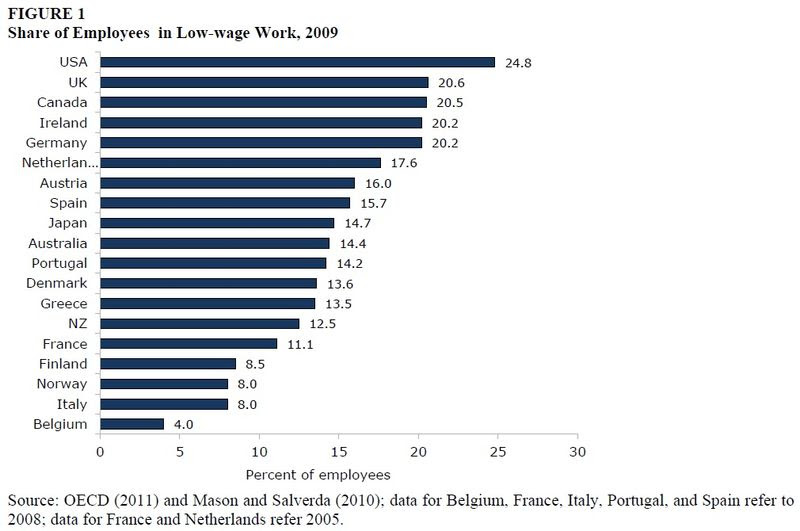
Economist Tim Taylor presented a chart highlighting that the US has a very high portion of its population working in low wage jobs. This is contrary to the image that the US is a land with middle class jobs for many:

low-wage-2
low-wage-2

Low wage work as defined in the data set above is employment that pays less than $10 per hour. Imagine trying to support a family on this. 2,000 hours of work would yield $20,000 which is below the poverty line for a family of three. And then we wonder how we have roughly 47 million Americans on food stamps.

The reason we continue to see this kind of recovery is that all policy made during the collapse was dictated by those in the banking industry that led up to this collapse in the first place. Even former Treasury Secretary Tim Geithner mentioned that if we didn’t do the bailouts exactly as we did (i.e., keep big payouts to banking execs, money for corrupt workers, etc) then the economy would have imploded. Well the economy did implode for most workers and a recovery never happened. Maybe for his closely knit group of people things are looking great:

growth-in-income-inequality

But for the rest of country people are running the Red Queen’s Race by working harder and harder simply to stay in the same place. A McJob recovery is not something to be proud about especially when the middle class in the US continues to dwindle.

Wednesday, April 30, 2014

American Dream is a myth for aspiring middle class

RIP, American Dream [emphasis mine]:

[A]s a sobering New York Times  article last week made clear, America could have a lot to learn by looking to Europe. According to the New York Times, the American middle class – the linchpin of the country's phenomenal postwar economic growth – can no longer call itself the richest in the world. "While the wealthiest Americans are outpacing many of their global peers," says the NYT, "across the lower- and middle-income tiers, citizens of other advanced countries have received considerably larger raises over the last three decades." America's poorest citizens lag behind their European counterparts; 35 years ago, the opposite was true.

Here's how Cohen sums it up:

In the immortal words of Ralph Waldo Emerson, "conservatism makes no poetry, breathes no prayer, has no invention". Its success comes in standing in the path of reform and saying no. With the Republican party currently in charge of the House of Representatives (and unlikely to lose that control in this autumn's mid-term election) there is little reason, unfortunately, to believe that the nearly four-decade decline in the financial standing of the American people will right itself soon. In short, the "choice" that America made to pursue the path of decline will be with us for some time to come.

Kind of makes looking to Europe seem like not such a bad idea.


By Michael Cohen
April 26, 2014 | Guardian

Wednesday, February 5, 2014

More evidence the middle class is gone

Sedulous readers (all three of you) will remember how back in 2011 I remarked on Citbank's "consumer hourglass theory": companies should either sell high-end products or bottom basement. Because the middle-class consumer is gone.

Well, it took the New York Times only three years to catch on.

Check this out: "[A]bout 90 percent of the overall increase in inflation-adjusted consumption between 2009 and 2012 was generated by the top 20 percent of households in terms of income." 

Bye-bye, American Dream!


By Nelson D. Schwartzfeb
February 2, 2014 | New York Times

Thursday, January 2, 2014

Is Red Lobster an economic bellwether?


As you may recall, I'm a fan of Dead Lobster, (no snickering!), even though I've criticized Darden Restaurants (Red Lobster's owner) for trying in 2012 to cut back on employee hours to avoid giving them health insurance. Facing a 37 percent drop in revenue, Darden was apparently trying to scapegoat Obamacare for its restaurants' poor performance.

LZ Granderson sees ominous portents in Darden's plan announced late 2013 to spin off its 700 Red Lobster restaurants because they are losing money. He says this reflects poor and middle class families' shrinking wages and buying power. Especially black and Latino families.

My latest visit to Red Lobster was a bust: it was so busy that the wait time was one hour and 40 minutes. So my local Lobster seems to be doing OK.

At any rate, Granderson rightly laments the U.S. working class's 30-year fall from prosperity:

From November 2012 to November 2013, weekly earnings rose 1.1% while the consumer price index increased 1.2%, according to the Bureau of Labor Statistics. That small uptick may not seem like much until you factor in three years ago, wages increased 1.8%, and the CPI was up 3.5%. And that may not seem like much until you realize that almost every year since 1983, a series of small ticks like those two examples has been widening the gap between between what we earn and what we can buy.

Consider the poverty threshold.

For a family of four in 1983 it was $10,178. Adjusted for inflation, that should be $23,817.03 today. However, the actual 2013 poverty threshold is $23,492, a difference of $325.03.

When you're living check to check, that's a lot of money.

Indeed, a family of four can have a very nice meal at the Lobster for about 70-80 bucks. So $325 is about four trips to Red Lobster a year, now out of the picture. Or maybe it's money spent on something else, it doesn't really matter in macroeconomic terms. Multiply that $325 times 9.5 million poor households, and we're talking $3 billion in consumer demand sucked out of the U.S. economy. 

This is where the minimum wage, SNAP and unemployment benefits matter, because we have an economy built to serve the working poor and disappearing middle class, and if those people don't have income then businesses that cater to them will die, taking more jobs and income with them, in a vicious cycle. 

It's much easier to destroy than to create; and what's destroyed doesn't come back.

UPDATE (04.01.2014): Furthermore, Harvard economist Lawrence Katz recently estimated that the U.S. economy is losing $400 million to $1 billion every week  thanks to Republicans' decision to end long-term unemployment benefits for about 1.3 million Americans.


By LZ Granderson
January 1, 2014 | CNN

Tuesday, December 31, 2013

MB360: U.S. income divide is a yawning chasm

Here MB360 reminds us how the U.S. middle class has disappeared in our new Gilded Age of wealth inequality, where the top 10 Percent own 75 percent of all wealth [emphasis mine]:

Since the 1950s the trend has only moved in one direction.  People often talk about top tax brackets and how high income taxes are but if you look at the above chart, the average tax rate for those in the top 1 percent is 23.5 percent.  How is that when the top tax bracket is 39.6 percent?  First, many people have better methods of tax avoidance: IRAs, 401ks, dividend income, real estate deductions, etc.  Since the bulk of wealth is in the hands of the top 10 percent, this group is already lowering their tax burden via these deductions and beneficial tax structures.  Since the typical American is living paycheck to paycheck with little saved for retirement these tax reducers don’t really help.  Besides, their income tax burden share is minimal.  However, their other tax burdens are large as a proportion to their income.  This is usually ignored when people talk about how little the working class pay in this country as they try to scapegoat the disappearing middle class.

More to the point, the middle class by definition should be well, the middle.  In this case, being middle class is a household making $35,000 or more.  We often hear about $250,000 being middle class by the media but by the IRS tax data, this is closer to being in the top 2 percent of AGI.  Not exactly middle class when 98 percent are below you.  Even if we look at the bottom 75 percent, the cutoff here is $70,492; certainly a far away cry from $250,000.  Or even the top 5 percent starting point of $167,728.

Remember the 2012 presidential campaign when Romney said, amazingly, that the middle class was any household making "$200,000 to $250,000 and less"?  And less, indeed. The media didn't put his absurd comment in context, although the IRS income data was right there for them to see -- probably because the Obama campaign's definition of middle class was basically the same. 

Folks, U.S. economic inequality is still the elephant in the room; it was the most under-reported story of 2013.

Happy New Year!  Let's hope it's a more equitable one.


Posted by mybudget360 | December 31, 2013

Tuesday, November 26, 2013

Baker: Technology didn't kill middle class jobs, public policy did

Baker doesn't mention other advanced countries like Germany that did not lose their middle class and manufacturing jobs, even though they are subject to the same global, technological forces that ostensibly destroyed U.S. wages and jobs. Why? Because their politicians protected their unions and domestic manufacturers, among other things.


By Dean Baker
November 25, 2013 | Guardian

Wednesday, October 30, 2013

Heritage's Mike Lee: What's next for conservatives?

You know me, I'm all about equal time and the Fairness Doctrine, so I'm linking here in full a speech on October 29 by former Senator Mike Lee, the director of the Heritage Foundation.

Very quickly, Lee has taken Heritage from a right-wing think tank to an activist wing of the Tea Party; and many on the Right call Lee the leader of the Tea Party movement.  He very much positions himself as outside the "Republican establishment," whatever that is. 

(Everybody except John Boehner and Mitch McConnell? I guess "outside the establishment" is what you call yourself instead of "outside the Beltway" when you're actually located inside the Beltway, like Heritage is.)

Just a few interesting lines I'd like to point out that sound OK on the surface, until you get to the ideas part. Such as:

It’s hard to believe, but by the time we reach November 2016, we will be about as far – chronologically speaking – from Reagan’s election as Reagan’s election was from D-Day! Yet as the decades pass and a new generation of Americans faces a new generation of problems, the party establishment clings to its 1970s agenda like a security blanket.

The result is that to many Americans today, especially to the underprivileged and middle class, or those who have come of age or immigrated since Reagan left office the Republican Party may not seem to have much of a relevant reform message at all.

This is the reason the G.O.P. can seem so out of touch. And it is also the reason we find ourselves in such internal disarray.

And here's Lee's guidepost:

Where do we begin? A generation ago, conservatives forged an agenda to meet the great challenges facing Americans in the late 1970s: inflation, poor growth, Soviet aggression,along with a dispiriting pessimism about the future of the nation and their own families.

I submit that the great challenge of our generation is America’s growing crisis of stagnation and sclerosis – a crisis that comes down to a shortage of opportunities.

This opportunity crisis presents itself in three principal ways: immobility among the poor, trapped in poverty; insecurity in the middle class, where families just can’t seem to get ahead; and cronyist privilege at the top, where political and economic elites unfairly profit at everyone else’s expense.

OK, so far, so good. Sounds like good 'ole liberal rhetoric, I'm liking it.

Lee goes on to talk about breaking up corrupt cronyism of business and government elites, of backing the "little guy" again, and helping the middle class with one of its biggest expenses: health care.  (Lee supports "a comprehensive health reform plan proposed by Representatives Steve Scalise and Phil Roe" that I'm sure you all heard about when it was rolled out in September...?) 

Lee says there are, "[F]our leading challenges facing middle-class families today: the cost of raising children; the difficulties of work-life balance; the time Americans lose away from work and home, stuck in traffic; and the rising costs of and restricted access to quality higher education."  

OK, maybe those aren't America's top four problems, but they're definitely up there, so I'm liking the rhetoric.

He says the Republicans have proposed legislation to address these four challenges.  Now we get into the problems....

To address the cost of raising children -- about $300,000 per child, cites Lee -- he proposes (yep, you guessed it), a tax cut for the middle class.  Yet more right-wing social engineering through the tax system.  I'm against trying to do policy through the tax code.  That's what our tax code is so darn complicated.  Moreover, what's to say the right won't turn around and call these same middle-class families "moochers" and part of the "47 percent" that doesn't pay net income tax?  

Anyhow, Mike Lee says the middle class should keep more of its own money, "not give parents more of other people's money."  That's just dandy, but the median U.S. income is $25,000. Double that and a two-income family with two children would owe only about $500 in income tax anyway.  So what good would a $5,000 tax cut do them?

Mike Lee has the answer: a $2,500 per-child tax credit that can offset income and payroll taxes.  Now he's talking about taking the 47 percent of moochers and exempting them from the only taxes they do pay, Social Security and Medicare.  What about our yawning deficits? What about, "You should pay taxes if you want to participate in our democracy"? No answer. It's just more conservative voodoo economics: cut everybody's taxes, then cry about deficits. And then call the middle-class beneficiaries of this tax system a bunch of moochers.

Next, Lee proposes old-school liberal policies: mandatory flex-time for working parents; and more investment in infrastructure and mass transit, so that people don't spend so much time in traffic.  Fine!  Great!  Welcome to the Democratic Party.  

But there's always a "but."  Mike Lee proposes to to build new highways and mass transit... but by cutting taxes (you knew that had to be part of it!) and shifting responsibility for infrastructure projects to the states.  That's not a solution; that's passing the buck. That's magical thinking.

Finally, Lee proposes opening up the accreditation system for higher education and vocational training. This is a pretty complicated subject and I won't go into it now, except to say that accreditation for alternative forms of education like apprenticeships and e-learning matters because only accredited institutions are eligible to participate in federal student loan programs. In other words, Lee wants to allow more educational-training providers to benefit from federally subsidized student loans. This could be good or bad -- bad if it ends up as a federal subsidy for businesses to provide training to their employees, which would not really be the intention.

Lee concludes in very un-Tea Party-like fashion [emphasis mine]:

Especially in the wake of recent controversies, many conservatives are more frustrated with the establishment than ever before. And we have every reason to be. But however  justified, frustration is not a platform. Anger is not an agenda. And outrage, as a habit, is not even conservative. Outrage, resentment, and intolerance are gargoyles of the Left. For us, optimism is not just a message – it’s a principle. American conservatism, at its core, is about gratitude, and cooperation, and trust, and above all hope. It is also about inclusion. [Ha! -- That made me LOL. -- J]  Successful political movements are about identifying converts, not heretics.

But anger sure can pack a town hall meeting!  A message of exclusion -- of welfare-mooching minorities, gate-crashing illegals, and culture-subverting gays and intellectuals -- sure turns 'em out at the polls!  Indeed, Lee's message here is not hopeful -- it's hypocritical and delusional. Anger and fear are the real drivers of today's Republican Party, not optimism.

Interestingly, in a recent highly quoted interview about politics, English comedian Russell Brand quoted the same phrase: that the Left's problem is that it is always looking for heretics -- those who are not pure enough -- while the Right is looking for allies. That may be true of Britain, but the opposite is true in the U.S. right now. The Tea Party is on a perpetual RINO hunt; whereas Democrats are too embarrassed to even call themselves "liberal" anymore; they're grateful to let any politician put a [D] behind his name, even he's a Republican by 1991 standards.

Sunday, September 22, 2013

U.S. middle class & unions fall together

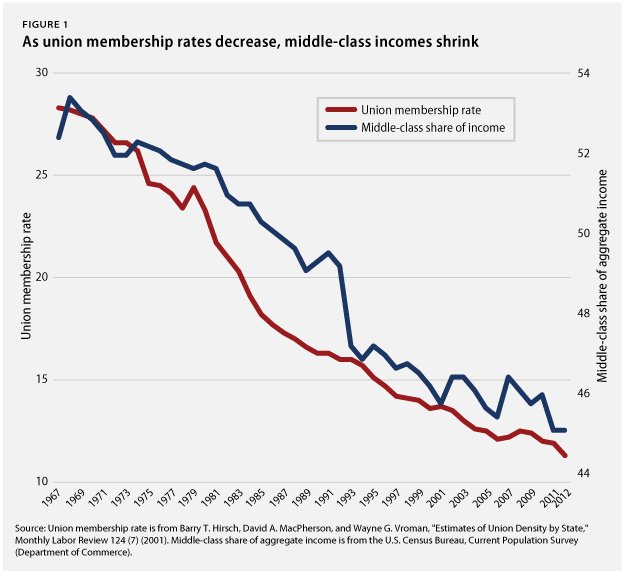
Correlation ain't necessarily causation, but... check out below how those red and blue lines have fallen in sync!

Big Business and Republican politicians who have taken swings at unions as "lazy" and "corrupt" and cut private union membership have in fact kneecapped America's middle class.  

With the exception of France, with its socialist welfare system and already strong labor laws, there is not a developed Western country with a lower rate of unionization than the U.S. at 11.3 percent.  The OECD average is 17 percent.

Meanwhile, Red State conservatives, many of them America's economic losers, swallow the GOP-talk radio explanation for falling U.S. incomes: Obamacare (yet to be enacted) and food stamps.  

Among the 254 counties where food stamp recipients doubled between 2007 and 2011, Republican Mitt Romney won 213 of them in last year’s presidential election, according to U.S. Department of Agriculture data compiled by Bloomberg.

These poor suckers don't know what's best for themselves or others.  There cannot be a strong U.S. middle class without unions.  End of story. 


By Caroline Fairchild
September 18, 2013 | Huffington Post  

This week the Census Bureau reported the latest depressing decline in middle-class incomes during the so-called economic recovery. But it may have missed an important factor in this story.

A report on Wednesday from the left-leaning think tank Center For American Progress notes that as middle-class incomes have steadily fallen, so have union membership rates. The middle 60 percent of households earned 53.2 percent of national income in 1968. That number has fallen to just 45.7 percent. During that same period, nationwide union membership fell from 28.3 percent to a record-low 11.3 percent of all workers.

Put these two economic trends together, and a striking image appears: 

unions middle income

Indeed, declining labor-union participation is not the only factor killing middle-class income growth. But increased union participation would likely mean more income for the middle class, the left-leaning think tank Economic Policy Institute argued in a 2009 report. Unions typically increase the wages of their workers while also raising pay for nonunion workers in industries with a strong union presence.

Higher union participation rates might also reduce income inequality. The U.S. has the worst income inequality of any county in the developed world, and the nation's top earners continue to see their pay rise as median incomes fall. Union participation could counteract this trend, according to the EPI.

So why is union participation declining so rapidly? Private sector union membership reached a peak of about 35 percent of the labor force in the 1950s, The New York Times reports. Since then, labor unions have steadily become smaller as many states have rolled out new laws limiting union power.

Young millennials' disenchantment with organized labor may also be an important contributor to its decline. From 2002 to 2012, union members ages 16 to 24 fell by 26 percent. That's double the decline in union membership for all workers, according to Quartz.

That said, younger generations may have a good reason to be less than eager to join a union. Studies have discovered that during the economic recovery, non-union workers fared considerably better than union workers in fields like manufacturing and private construction. Also, during the 1982 and 1991 recessions, states with fewer union members were found to recover more quickly than states with a strong union presence.

Sunday, September 15, 2013

MB360: Looming U.S. retirement disaster

In this context, cutting Social Security makes even less sense.  Just like with health insurance, the private sector has foisted this responsibility onto its employees, and the federal government.  


Posted by mybudget360 | September 15, 2013

Americans are on the verge of a retirement disaster.  As pension plans slowly go extinct Americans are not saving enough for retirement.  The figures point to a looming pension and retirement disaster.  Retirement for most Americans is largely a mirage.  As organizations switched from pensions to 401ks it was expected that most Americans would save money. This trend started in 1980 and over 30 years have now passed.  We now have enough data to see if this transition has been beneficial to most Americans.  Unfortunately the answer highlights an American population that has not saved enough for retirement.  Most Americans will make Social Security their default retirement plan.  Pension issues also loom as many state governments contend with deep underfunding for retirement benefits.  In the end, there is a disaster looming.

The disappearing pension

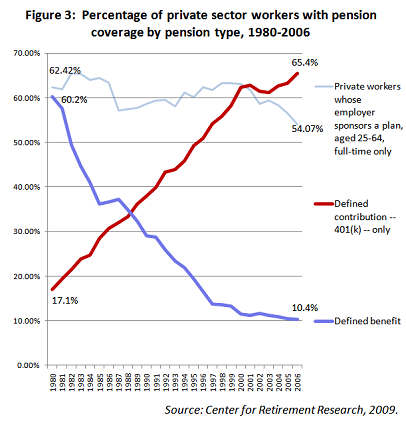
Very few Americans now have access to a pension.  This wasn’t always the case:

pensions
Today, less than 10 percent of Americans have access to a pension.  Most however have access to 401k plans and other retirement options.  Unfortunately as the middle class shrinks more Americans are finding it more difficult to save any money.

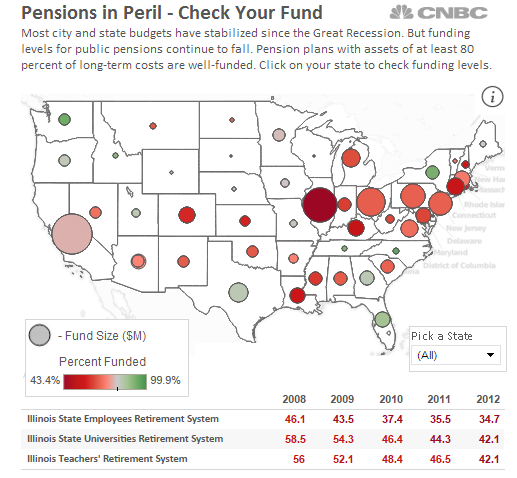
Social Security unfortunately is going to become the default retirement plan for many.  Many current pension plans are setup with unrealistic returns.  Many states are underfunded in spite of the dramatic returns in the stock market:

underfunded

Keep in mind there is simply no way the stock market can continue producing returns as it has. It is simply impossible and already ratios are getting inflated showing a slight exuberance.  As the chart above highlights, many state pensions are underfunded and if the market even has a slight correction, this will exacerbate the problem.

Beyond the above data that only impacts a small number of Americans, most simply do not have enough (or anything) saved for retirement.

The lack of savings in retirement accounts

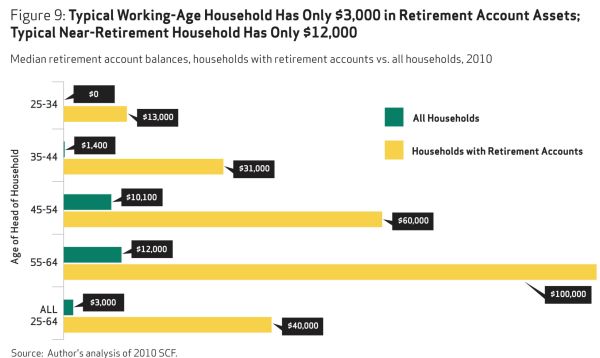
Without pensions many Americans are left to fend for themselves via retirement accounts.  How has this worked out?

retirementcrisisJ

These are disturbing figures.  The median amount saved by all Americans is $3,000 for retirement!  Even those nearing retirement in the 55 to 64 age group have roughly $12,000 to get by in their later years.  In other words, many are going to be working deep into old age.

A lot of this can be attributed to the lack of income being made by most Americans.  As we have seen income inequality is at record levels, even higher than it was prior to the Great Depression.  It is simply hard to get by when the per capita wage is $26,000 and the cost of living continues to increase without any wage increases.  Getting by is priority number one, not a far off retirement.

Retirement dreams pushed out

As you would imagine the retirement age is being pushed out:

at what age did you retire

It is becoming tougher for Americans to retire and there is less of a safety net.  Since the retirement amount saved is so low, many are going to depend on Social Security as their main income stream in their later years.  Much of this money is going to be paid by a younger and less affluent generation.  You can already see this disaster lining up.  As young people struggle, how will they feel when they see pensions going out while they struggle to find work?  If you think you have heard the last of this think again.

Friday, August 30, 2013

'McJobs' lead to middle class?!


Never say I don't give equal time. To wit, here's the chairman of the National Restaurant Association Phil Hickey carrying water (er, super-size soda?) for America's "McJobs" creators:

The truth is that both part-time and full-time positions make the restaurant industry a versatile career option for a variety of workers. From underemployed or hard-to-employ workers to college graduates, the industry provides a pathway to the middle class and often beyond.

Efforts to devalue the industry and mandate changes, like raising the minimum wage, hurt workers by preventing businesses of all sizes from creating more jobs.

Hickey argues that the $7.25 federal minimum wage doesn't need to be raised because... hardly anybody earns minimum wage:

According to the Bureau of Labor Statistics, 71% of minimum-wage employees in the restaurant industry are under the age of 25; 47% are teenagers.  

So why is Hickey wrong?  First, Hickey is actually admitting that 53 percent of fast-food workers earning minimum wage are adults.  He is also admitting, indirectly, that the current minimum wage sucks and people don't deserve it.

In fact, according to USA Today, the average non-management fast-food employee currently earns $9.09 per hour or $18,886 per year. Though that is still below the 2013 federal poverty threshold of $19,530 for a family of three.

Moreover, "Eighty-eight percent of workers in jobs paying less than $10 an hour are older than 20, and a third are older than 40, according to the Economic Policy Institute."  

Granted, two adults working full-time in fast food could make for a (barely) middle-class household... but don't forget that most fast food joints don't offer their employees health insurance or other benefits. BTW, who's taking care of their kid(s)? And if a family is paying its health costs out of pocket without insurance then God help them, because one medical emergency could bankrupt them. As indeed will happen to 2 million Americans this year. 

And if a family of three elects to buy health insurance on their own, either HSA or HDHP, then chances are their annual deductible + monthly costs will be $10,000 and up, or about 1/3 of that fast-food family's gross income.  

Next fact: in the U.S., workers' wages make up 25 to 35 percent of the cost of fast food, according to experts. Meanwhile, the norm in Europe where the minimum wage is higher is about 45 percent; and yet somehow, McDonald's manages to operate more than 7,400 restaurants in Europe. This indicates there is room for higher U.S. wages.  Still, the cost of fast food would probably go up, since restaurant owners, whose average profit margins hover around 4 percent, would pass on all or most of a wage increase to customers. 

"That's terrible, higher prices must be avoided at all costs!" my conservative interlocutor will object. To them inflation is the biggest bogeyman next to taxes. But you know what? I'm cool with it.  Poorer people would do well to eat less fast food anyway, and prepare their own meals; and wealthier people could afford to pay a little more. 

It reminds me how "Papa" John Schnatter warned in dire terms that Papa John's restaurants would have to raise their prices 14 cents per pizza to give their employees health insurance to comply with Obamacare. But what's 14 cents to a customer who can afford to buy a pizza instead of groceries? Plus it's customary to tip the deliver guy at least a couple bucks.

(BTW, President Obama's proposal in February to raise the minimum wage to $9 and tie it to the cost of living was projected to raise the price of fast food 3 percent. With a $9 minimum wage, the average cost of a McDonald's Extra Value Meal would then increase from $4.45 to $4.58.  Hardly noticeable.  Doing a little algebra -- although I have no idea if this is economically sound -- at the same ratio, a $15 minimum wage would increase the cost of fast food by 13.3 percent, for a Value Meal price of $5.03.  Heck, let's suppose a $15 wage would raise the price 40 percent: the Value Meal would still cost only $6.23.  Not exactly hyperinflation.)

According to economic theory, there is a big benefit to higher wages: lower employee turnover. Lower turnover leads to higher productivity (output per employee per hour). U.S. workers, incidentally, are already the most productive in the world, although you wouldn't guess it, considering real U.S. incomes have been stagnant since the 1970s; and the median male is especially worse off today, earning as much in real dollars as a man in 1964!

Next problem with Hickey's apologia: McDonald's, Walmart and most other retailers employ few full-time workers anyway; workers are not permitted to work full time.  So we're really talking about workers below the U.S. poverty line unless they work two part-time jobs.  That is, assuming they can get those part-time jobs: there are still 3 applicants for every job opening.

To protest this sad state of affairs, yesterday fast-food workers in about 60 U.S. cities carried out a one-day strike for a minimum hourly wage of $15.  

Theirs is the next great struggle for organized labor and fair compensation.  But it's not their struggle alone.  Even the middle and upper classes stand to lose -- or gain -- along with the lowest-paid Americans.  

"There is a spillover effect from raising the minimum wage, and those who are currently earning [just] above it will also benefit, as many employers will raise their wages too," said Lawrence Mishel of the Economic Policy Institute.

Furthermore, as entrepreneur Nick Hanauer explained in his Bloomberg op-ed, "The Capitalist’s Case for a $15 Minimum Wage": 

Raising the minimum wage to $15 an hour* would inject about $450 billion into the economy each year. That would give more purchasing power to millions of poor and lower-middle-class Americans, and would stimulate buying, production and hiring.

Studies by the Economic Policy Institute show that a $15 minimum wage would directly affect 51 million workers and indirectly benefit an additional 30 million. That’s 81 million people, or about 64 percent of the workforce, and their families who would be more able to buy cars, clothing and food from our nation’s businesses.

... [C]ontrary to conventional economic orthodoxy, increases in the minimum wage increase employment. In 60 percent of the states that raised the minimum wage during periods of high unemployment, job growth was faster than the national average.

Some business people oppose an increase in the minimum wage as needless government interference in the workings of the market. In fact, a big increase would substantially reduce government intervention and dependency on public assistance programs.

(*Here's yet more equal time for crusty conservatives, a very long argument why "A $15 minimum wage is a terrible idea" by Dylan Matthews over at WaPo's Wonkblog.)

Regardless of whether the new minimum wage should be $9 or a few bucks more, $7.25 'MCJobs' just aren't cutting it for our economy.  And 'McJobs' are certainly not "a pathway to the middle class and often beyond" -- not unless something changes.  

Eric Liu, a former speechwriter for Bill Clinton, summed it up best in his TIME piece, "McDonald’s and the Fate of the Middle Class":

Too many American think that the plight of the low-wage worker has nothing to do with them. In fact it is both a preview and a parable. The fate of the middle class rests, in part, on whether more Americans learn to see the fate of fry cooks as their own.

We must all rise or fall together!