Showing posts with label food. Show all posts

Monday, August 8, 2011

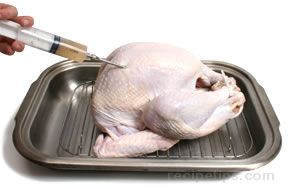
29 million lbs. of antibiotics pumped into livestock


Isn't it disgusting that we can't feed ourselves without doing this? Well, I guess we could, it would just cost more, maybe a few cents a pound.


By Allison Aubrey
August 5, 2011 | NPR

[...]

So how did this happen? Farmers who raise food-producing animals use about 29 million pounds of antibiotics each year, according to the Food and Drug Administration. That's about four times as much as doctors prescribe to people.

"Animals are given antibiotics for a number of reasons — including to get them to grow faster," explains Gail Hansen, a veterinarian who works for the Pew Campaign on Human Health and Industrial Farming. "[Antibiotics] are given to perfectly healthy animals to convert their food more efficiently so they can get to market faster."

And she says this practice of routinely adding low doses of medicines to animal feed is creating bacteria resistant to antibiotics.

Salmonella Heidelberg — the strain that has made [at least 78] people sick and led to the recall of ground turkey meat — is resistant to three different antibiotics: ampicillin, streptomycin and tetracycline.

[...]

"We really believe that the responsible use of antibiotics to provide safe, nutritious, affordable foods is the appropriate way to go," said Sherrie Rosenblatt, vice president of the National Turkey Federation.

Wednesday, July 27, 2011

Friday, July 22, 2011

Most sales at Family Dollar, 99-cent stores for food

Dumpster diving will be the next step down for middle-class Americans. Maybe behind the Dollar Store. They can charge a fee for it.


Posted by mybudget360 | July 20, 2011

URL: http://www.mybudget360.com/rise-of-dollar-stores-family-dollar-99-cents-store-only-grow-faster-than-population-growth-reflect-lower-incomes/?utm_source=feedburner&utm_medium=email&utm_campaign=Feed%3A+mybudget360%2FQePx+%28My+Budget+360%29

Thursday, June 9, 2011

Food is not a commodity

Sure, some food is traded as a commodity, but the food we eat is not a commodity. We don't go to the supermarket to buy big boxes labelled "FOOD" for the cheapest price we can possibly find. But when it comes to school lunches, we're not far from it.

The food we put in children's bodies is not a commodity.

Just like Jesus threw the money changers out of the temple, the government needs to throw these junk food marketers out of our schools.


By Peter Overby
June 8, 2011 | NPR


Sunday, January 9, 2011

Fitness clubs went from a fad to a con

I bet this op-ed will make a lot of people, especially Americans, angry. But there's a lot of truthful reminders in here, as many of us make our New Year's health resolutions. Just like we Americans and Britons do not understand what food to put in our bodies anymore, (best advice: eat all the stuff your grandmother did), we also don't understand what kind of physical activity our bodies need. Driving to the gym every day to exercise for an hour only to spend the rest of the day inert and eating a lot of junk food is not productive. Indeed, that 1 hour at the gym may stimulate an unhealthy appetite.

Our bodies evolved to walk, stand, and crouch for most of the day; when we sit or recline for longer than an hour, our ancient metabolism declines to nearly nothing -- because our ancestors had to work for every calorie, and then conserve each calorie as long as possible. So I'd bet that doing no exercise but having a standing work station would be more healthy -- and burn more calories -- than going to the gym for an hour every day only to spend the other 23 hours sitting or lying down.


By Zoe Williams
January 5, 2010 | Guardian

It's January and everybody's on a diet, except that diets are undignified and nobody will admit to them, so instead they're going to the gym. It's an unimpeachable activity, sound from every angle. It is entirely logical: calories out exceed calories in (it's so simple, fatty. Can't you even count?) It is socially beneficial: think how much you save the NHS, with that cocktail of sweat, determination and foresight. It's not vanity, it's self-improvement. It's not a hobby, it's a moral act.

Except that all this is a total swindle. The gym is so much greater a capitalist con than the casino, and yet so much more acceptable, so legitimate. How do they get away with it?

Outdoor pursuits, from ladies jumping in Hampstead pond to adolescents running off their primal urges – anything that could be filed under "fresh air" – have always had exponents. But the bizarre fascinations of the gym – the airless, repetitive flexing and relaxing, the determined pointlessness, the feverish generation of sweat – none of this was even conceived of until the 60s. It was a fad. By the 80s, sensible people played racquet sports, and the only people who wore Lycra and star-jumped at random were fast-living young women who wanted to be Jane Fonda. Bill Clinton's treadmill habit was weird in 1992; now, imagine how weird it would be if Barack Obama didn't go to the gym.

It has taken fewer than 20 years for aerobic (or, if you prefer to sound less girly, cardio) exercise to go from an urban fad to the very core of medical orthodoxy. Fruit, vegetables, gym: these are now the musketeers of good health. The fitness market was worth £682m in 1996, £1.6bn in 2001 and is now stable at £2.5bn (these are Mintel figures). In the UK, 5.2 million adults have membership of a private gym. That market penetration is phenomenal. I don't want to labour the point about how this correlates with obesity, because some people – myself, for instance – have membership and don't use it. But put it this way: whether we're using the gym or not, as a cohort, it's not making us any thinner.

One of the reasons for this is that vigorous exercise stimulates your appetite. So a 20-minute run might use up 200 calories, but your hunger won't necessarily – indeed, almost certainly won't – restrain itself to that amount of extra food. Well then, use willpower to overcome the appetite. That might work, except that willpower is like a muscle (or, as Oliver Burkeman described it, "a unitary, depletable resource"). You've already used your day's determination going to the gym in the first place: your ability to resist the temptations of your appetite is already diminished, even before that appetite has increased. Some doctors happily bandy about the importance of rigorous exercise, but experts on the obesity "epidemic" have been questioning this advice for ages, and rarely recommend anything more demanding than walking and cycling.

This vexed area yields my favourite anti-capitalist conspiracy from a mainstream source. Steven Gortmaker, who heads the Harvard Prevention Research Centre on nutrition and physical activity, said this about playgrounds at fast-food restaurants: "Why would they build those? … if a kid plays five minutes and burns 50 calories, he might then go inside and consume 500 calories."

Studies come out all the time showing that exercise doesn't make you thin. But gyms have become so central to our idea of what it means to take responsibility for oneself that sensible people write this evidence off as crank stuff emanating from academic troublemakers. In fact, sensible people should never even see the word "gym" without mentally ending the sentence "stimulates appetite". They are a good answer for elite athletes with specific muscular needs. Everybody else should just go for a walk, or – if that too seems pointless – take a walk to a particular destination.

In one way, it doesn't matter. It is possible to be fit but fat, and exercise improves health – it's good for your heart, it has a prophylactic effect against a number of cancers. And yet the raison d'ĂȘtre of the private health club is the body beautiful. These places would have got nowhere had they flogged themselves as a long-term preventative measure against future heart attack. They had to appeal to vanity: the genius of gym culture was to dress up personal vanity in the sackcloth of good health, and thereby overcome all the natural, decent reservations we would have had about blowing 94 quid a month on a beauty regime that didn't even work.

We should really be ashamed. There is no more obvious profligacy than spending money to pump out energy on treadmills, just to force us to consume more energy, none of which has any result that couldn't be replicated by taking a turn around the block. Never mind the Earth's resources, we should have more respect for our own resources. We ought to see the waste of our toil in the same terms as wasting food. As we set off for the gym, we should be able to hear the echo of our mums shouting: "There are children in Africa who have to jog five miles up an incline every day!"

I hope they don't revoke my membership for saying this. I still like the sauna.

Sunday, November 29, 2009

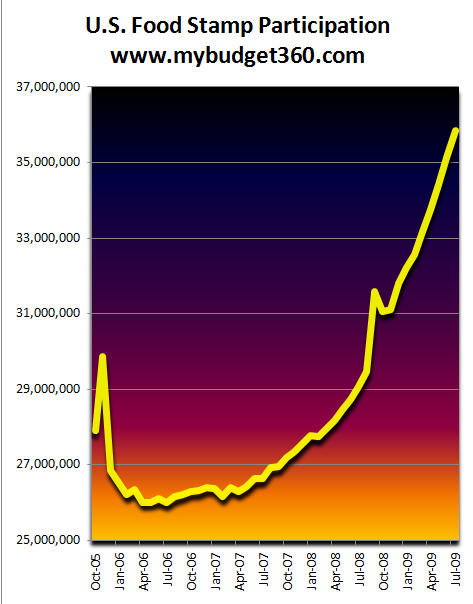
Thanks, Obama: 12% of Americans on food stamps

Look what BHO has reduced us to: 1 out of 8 Americans is a helpless welfare junkie dependent on gov't cheese.

Meanwhile, the states, like drug dealers, are pushing food stamps on more and more erstwhile honest, hard-working, self-sufficient Americans, because unlike cash welfare payments, food stamps are 100% federally funded.

Even conservative and once proud Warren County, Ohio, which turned down federal stimulus funds on principle, has lately doubled its dependence on food stamps. Said proud, principled, Warren County Commissioner Dave Young [R]: "As soon as people figure out they can vote representatives in to give them benefits, that's the end of democracy. More and more people will be taking, and fewer will be producing." You tell 'em, Dave! ... I mean, wait! Don't tell them! You just helped the people figure it out! Nooooooo!.....

Seriously though, the following excerpt so neatly encapsulates everything that's wrong with white, middle-class, conservative Americans, who are getting beaten over the head by economic forces they can't control and yet oppose any programs or reforms designed to help them or their compatriots:

While Mr. Dawson, the electrician, has kept his job, the drive to distant work sites has doubled his gas bill, food prices rose sharply last year and his health insurance premiums have soared. His monthly expenses have risen by about $400, and the elimination of overtime has cost him $200 a month. Food stamps help fill the gap.

Like many new beneficiaries here, Mr. Dawson argues that people often abuse the program and is quick to say he is different. While some people "choose not to get married, just so they can apply for benefits," he is a married, churchgoing man who works and owns his home. While "some people put piles of steaks in their carts," he will not use the government's money for luxuries like coffee or soda. "To me, that's just morally wrong," he said.

He has noticed crowds of midnight shoppers once a month when benefits get renewed. While policy analysts, spotting similar crowds nationwide, have called them a sign of increased hunger, he sees idleness. "Generally, if you're up at that hour and not working, what are you into?" he said.

Note how even as he receives welfare, he can't overcome his hardwired angry-white-guy programming to criticize other people on welfare. Classic.


Sunday, June 14, 2009

U.S. farms weaken our antibiotics


I just finished reading the best-selling book The Omnivore's Dilemma, which describes in detail the use of antibiotics in industrial farms. I'm almost to the point where I don't believe any meat produced large-scale in the U.S. is healthy to eat, or good for the public health, or even cheaper for the people, when all the hidden health and environmental costs are factored in.

This study by Johns Hopkins only supports my apprehension about industrial meat.

I am not a vegetarian though, nor do I plan to be one. But we can buy locally and eat seasonally, like our grandparents did. (Don't confuse this with buying "organic," which doesn't mean much.) This directory of local farmers who raise grass-fed animals is a useful tool to eat healthy and enjoy meat the way it's supposed to be. If you live in a city, you can look for so-called metropolitan buying clubs (aka farm subscription clubs) in your area, a type of community-supported agriculture, which pool orders from city residents, making it economically worthwhile for small farmers to deliver their products. Even when you eat out, you can ask the server if any menu items feature locally sourced foods.

Today we spend less on food, relatively, than our parents & grandparents did. Food didn't used to be a commodity, where beef was beef, eggs were eggs, and price was all that mattered. Americans used to know and care where their food came from, and often who grew and/or processed it.


By Dale Keiger
June 2009 | Johns Hopkins Magazine

Johns Hopkins researchers are investigating a troubling potential source of resistant pathogens: the American farm

Wednesday, May 20, 2009

Re: Cow farts & energy costs


Yep, cap-and-trade of cow farts is next on Obama's agenda.

Seriously though, eating less meat is very good for the environment. The meat supply chain takes a lot more grain to feed, and fuel and energy to process livestock than it does to bring vegetables and grains to market. Livestock also require lots of inputs: it takes 5 kilos of grain to produce 1 kilo of meat. Raising livestock and processing meat also generates a lot of waste -- including direct runoff into our water supply. This is not to mention all of the (sometimes illegal) steroids and antibiotics they feed livestock nowadays, which go into us.

Check out this extremely interesting analysis from the NYT, which compared meat to oil:

"... if Americans were to reduce meat consumption by just 20 percent it would be as if we all switched from a standard sedan — a Camry, say — to the ultra-efficient Prius. Similarly, a study last year by the National Institute of Livestock and Grassland Science in Japan estimated that 2.2 pounds of beef is responsible for the equivalent amount of carbon dioxide emitted by the average European car every 155 miles, and burns enough energy to light a 100-watt bulb for nearly 20 days."

And, as usual, the poorer countries suffer the most because of our high consumption:

"Though some 800 million people on the planet now suffer from hunger or malnutrition, the majority of corn and soy grown in the world feeds cattle, pigs and chickens. This despite the inherent inefficiencies: about two to five times more grain is required to produce the same amount of calories through livestock as through direct grain consumption, according to Rosamond Naylor, an associate professor of economics at Stanford University. It is as much as 10 times more in the case of grain-fed beef in the United States."

It's also healthier and cheaper to eat less meat: there is a growing "meatless Monday" movement. Americans eat about 8 oz. of meat a day, twice the global average. If China starts eating beef like we do, the world will be in trouble.

Saturday, February 16, 2008

Hungry to know what to eat

Cute, but spot on. It is ironic that we "orthorexic" Americans are the most concerned with detailed nutritional labeling and all the latest food research, and yet we are the flabbiest, most diabetic, hypertensive and infarcted people in the developed world. Forget the health jargon; bring back the "Great-Granny Diet!"


I'm hungry for some certainty
By Ellen Goodman
February 15, 2008 | Washington Post 

I am sitting at the breakfast table taking my medicine. This drug is a cup of coffee formerly identified by its native and urban origins: Sumatra and Peet's. But now it has been declared good for what might eventually ail me, if what might ail me is Parkinson's disease or colon cancer. Coffee has also been praised as a prevention for diabetes in Minnesota and cursed as a risk for diabetics in North Carolina, but I am in Massachusetts.

On my place mat is a bowl of antioxidants formerly known as blueberries. These round little health capsules have been scientifically evaluated as a barrier against mental decline and cancer. Alas, they come from Chile, which is not good for my carbon footprint.

I am pondering an egg, which was once considered a suicidal act, death by cholesterol. Now it is praised for its carotenoids - lutein and zeaxanthin - essential for healthy eyes.

These healthy eyes are needed to read the newspaper stories in front of me full of the latest food health bulletins. The first dateline is New York, which has joined the crowd in banning those evil trans fats that were once our salvation against those devilish animal fats. Now the city has also decided that calories of every dish should be posted in chain restaurants.

The second dateline is Seattle, which has one-upped the East Coast. Its new law will not only list the calories but the carbohydrates, fats, and sodium lurking in the beurre blanc, crĂšme fraĂźche, and Big Mac.

How did it come to this? How did eating become a science rather than an art? How did food become conflated with medicine? We now have shelves full of boxes with bragging rights promising better eating through chemistry. Meanwhile, our uncertainty is growing as quickly as our waistlines.

Imagine what our ancestors would have made of a book titled "In Defense of Food." They would never have believed that food needed a defense lawyer. But one of the leading indicators of the fix we are in is how quickly Michael Pollan's manifesto vaulted to the top of the best-seller list. There it sits, proof of the transformation of the land of plenty into the land of plenty of anxieties.

Pollan's previous book raised "The Omnivore's Dilemma" - what to eat. He masticated the meaning of four meals for people, the earth, and the agricultural industry. He single-handedly made "locavore" the word of the year for the New Oxford American Dictionary. Think global, eat local.

Now he solves the omnivore's dilemma with seven little words wrapped around a head of lettuce on the new book cover: "Eat Food. Not Too Much. Mostly Plants." (Not including the philodendron.) And the word that he's launching this year is "orthorexia," an unhealthy fixation with healthy eating.

"What other animal needs professional help in deciding what it should eat?" he asks, recognizing the absurdity of the need for his own advice. Two different forces got us here. The first is "nutritionism," the idea fostered by science that food is nothing more than the sum of its nutrients. The second and more pernicious force is the $36 billion food-marketing industry that turns food into "food-like substances."

Remember the French paradox: wine, cheese, and low weight? Well, the American paradox, Pollan writes, is "a notably unhealthy population preoccupied with nutrition and diet and the idea of eating healthily."

His tips for the land of the overweight orthorexics are rather charmingly simple. Among them:

> Avoid products made with ingredients you can't read or pronounce.
> Avoid products making health claims on the package.
> Yes, eat plants. (But not the sansevieria.)
> But the best of them is: don't eat anything your great-grandmother wouldn't recognize as food.

Frankly, I'm pretty sure my great-grandmother never saw an avocado. But I am all for moving from what conservatives grudgingly call the nanny state to the great-granny state.

Even as we speak, someone working to combine the eating disorder with the great American paradox must be writing the next best-seller: The Great-Granny Diet. [Molasses! Lots and lots of molasses! And butter. And lard. And cream. And bacon. Yum! – J] You read it hear first. Meanwhile, the moguls of the agricultural-industrial complex will work up a great-granny product line. And we will soon see great-granny stickers on all the beleaguered fruit and vegetables that line the market walls.

In the meantime, I plan to begin eating at least one plant that my great-granny knew so well: the good old Theobroma cacao. Rich in flavanols, not to mention polyphenols, this is a known treatment for fatigue, coughs and anxieties - and maybe even orthorexia. What was it my great-granny called this plant? Oh yeah, chocolate.