If you can't see this charts then follow the headline link becaue they're worth studying. If the Tea Parties would mobilize against this kind of thing then they might be relevant and useful.
Posted by mybudget360
January 6, 2010
The US banking system is largely a system based on consumer confidence. You would require the confidence of Zeus if you had $13.3 trillion in assets backed by an FDIC Deposit Insurance Fund (DIF) that is practically insolvent. Even as the stock market solidly recovers to the green the state of the average American's financial health is in jeopardy. 1 out of 3 Americans has zero in retirement savings so the hope is that somehow Social Security will be around or maybe there is no longer term strategy since they are merely struggling with daily financial existence. There seems to be this premature joy about the preliminary jobs report but much of this was based on low wage temporary retail hiring for the holidays. Not much a surprise there and did they not get the memo that 14 million Americans are still unemployed? However the banking industry is still in serious problems. Over 11 percent of all US banks are considered "troubled financial institutions" based on the optimistic FDIC quarterly report. The numbers are of course a lot worse but thanks to the suspension of mark to market banks can pretend empty shopping malls in the barren desert or flailing condos are somehow valuable assets. The FDIC just like much of the big banking industry players is performing a dance of economic delusion.
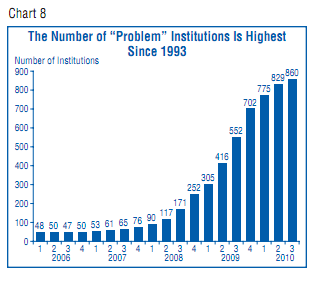
First, take a look at the number of problem institutions:
Source: FDIC
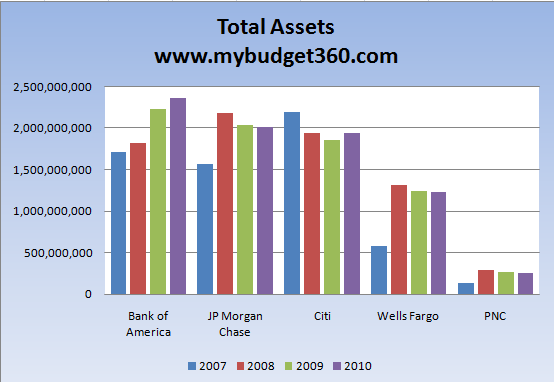
The US currently has 7,760 active banks. So that would put nominally 11 percent of all banks as troubled institutions. This is on par with the number of Americans in the foreclosure process (though there is no correlation but no one is saying that things are healthy when 11 percent of all American mortgages are in some state of foreclosure or have stopped making payments). What is even more disturbing is much of the $13 trillion in "assets" is still in the hands of the too big to fail with a disproportionate of assets in real estate:
Notice how the big five banks actually increased their assets over a time when the financial worth of average Americans has declined? The big banks really do not serve the retail customer anymore which is odd since it is the retail taxpayer that bailed these banks out. Each one of the above banks received financial assistance in some shape or form.
All of this comes when banks are announcing record profits and consumer bankruptcies are up to record highs posing a stark dichotomy.
Bankruptcies would be even higher but for the 2005 bankruptcy legislation that has made it much harder to file. Even with a tighter collar on the finances of Americans bankruptcies are soaring because there is only so much you can squeeze from a shrinking middle class turnip.
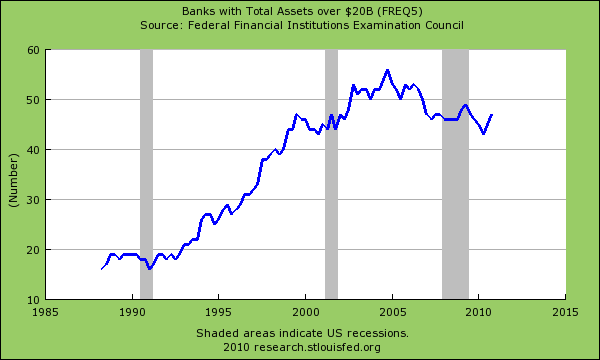
The era of the mega bank is still alive and well:
Over 45 US banks have $20 billion or more in assets. And keep in mind what banks consider as assets. For a bank a toxic multi-million dollar loan on a failed strip mall with potholes the size of large dogs in the parking lot is an asset:
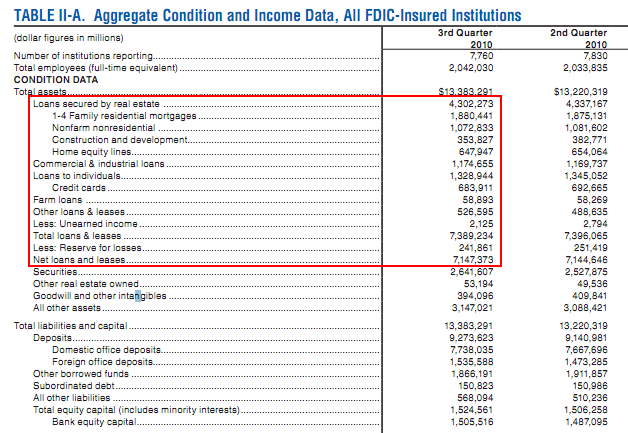
Of the $13 trillion in assets $4.3 trillion is in real estate. Now would it then not be logical to assume with such a horrible real estate market that there would be a major impact here in terms of valuation? Of course it would but suspending prudent accounting practices is the necessary spice to keep this charade up. Banks continue to value real estate at optimistic levels to continue a pretend game that they are solvent while draining taxpayer dollars. The Federal Reserve continues to offer quantitative easing because the economy is solid? Of course not, they are trying to reflate the balance sheet of banks through the slow wealth transfer from the middle class to the top 1 percent.
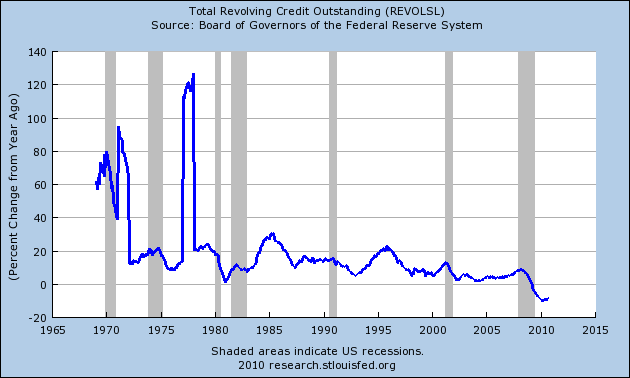
If you want to see how generous FDIC insured banks are to average Americans just look at the amount of credit being extended:
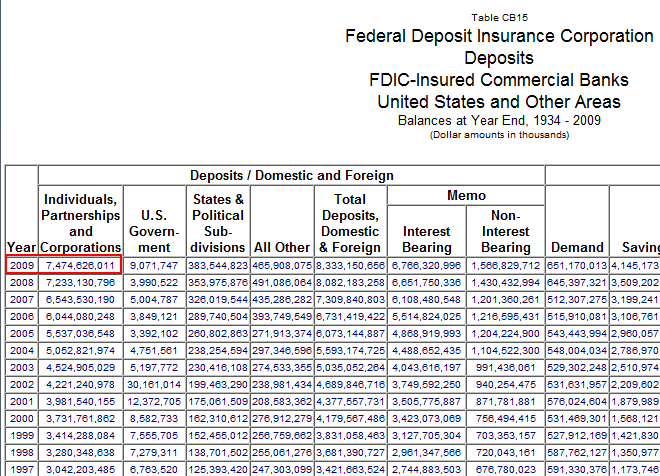
Yet the Federal Reserve is extending unprecedented credit to the banks. There are two financial worlds in the US and many are starting to wake up as to which one they are living in. Americans still have a lot of hard earned money in banks:
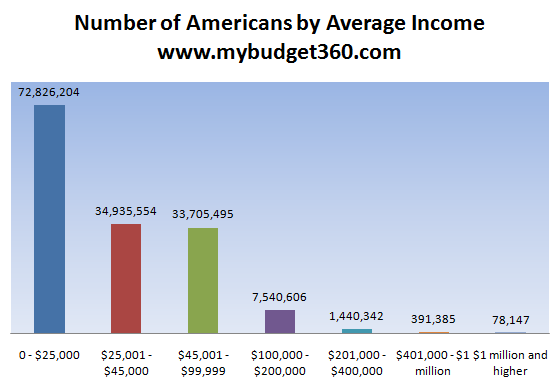
Over $7.4 trillion in deposits are on the banking balance sheets. Keep in mind these are liabilities to banks, not assets. Yet the FDIC with an insolvent fund is backing these up. Banks are also offering close to zero percent in interest rates on savings accounts so this idle money is being slowly devoured by inflation which is a hidden tax by the Federal Reserve. Notice how gas is up over $3 a gallon? Notice how grocery food isn't getting cheaper? How about college costs? Healthcare? Housing has gotten cheaper but it is still too expensive given the amount of money Americans have with 100 million Americans making $39,999 or less a year:
Source: Social Security
Even more disturbing is the fact that 72 million Americans make $25,000 or less a year. If you want to know what your global business leaders are thinking after the generous bailouts here is a recent comment at a CEO roundtable:
"(MotherJones) His point was that if the transformation of the world economy lifts four people in China and India out of poverty and into the middle class, and meanwhile means one American drops out of the middle class, that's not such a bad trade," the CEO recalled."
This coming from leaders who were in industries that were saved by American taxpayers. Those retail sales that many are clamoring about came because of a middle class in the US. Yet to these companies the only thing that matters is customers even if it means they have to leverage the American middle class and destroy the wealth of Americans in order to gain more customers around the globe. Politicians never brought this up during the election cycle but they continue to protect these industries because politicians are merely another line item for many of these companies.