Monday, October 31, 2011

Born to be a birther, or, Birther till I die!

This third-string squad of colorful right-wing nutjobs and cranks, including serial racial profiler Sheriff Joe Arpaio and serial Supreme Court rejectee Orly Taitz, are teasing us that they're about to go "Geraldo" with a really big revelation about Obama's citizenship that will blow the lid off this whole thing.

I don't even know why I'm dignifying this nonsense with a re-post, but... something about this quixotic quest of theirs has passed from unbelievable to infuriating to laughable to passe and now to... a study in human beings' perseverance to regard a lie as the truth, no matter what.  And there's something strangely poignant in their complete disregard for how stupid they look to others in doing so.  They don't care.  They're just going to keep at this thing until... like in the real "Cold Case" show, some bit of evidence turns up 30 years later, like Obama's real Kenyan passport, or his straight-A childhood report card from his radical Muslim madrasah, and they'll be able to yank Obama out of his old folks' home and deport him to Sweden to join Roman Maronie.  


By Luke Johnson 
October 28, 2011 | Huffington Post

Friday, October 28, 2011

TARP wasn't 'paid back,' not by a long shot

So it turns out that TARP loans weren't "paid back," we should be owed about $300 billion in risk premiums for the year 2009 alone, and this is not to mention the $16 trillion in Fed bailouts for the international TBTF banks. TARP was absolutely free money.

TARP wasn't really even a loan, it was a gift, it was a sick joke on U.S. taxpayers, because the bailed-out banks can pay off their TARP loans with even more government loans at zero-percent interest. (Remember how the GOP went ballistic when GM tried a similar trick to pay off some of its TARP loan?) The bailed-out banks have in turn used this borrowed money to fund their trades, which only have to earn more than 0.0% return to net them a profit. In fact, it gets worse, because often the banks have turned around and used those borrowed funds to... buy risk-free U.S. treasuries, which means they loaned their government loan money back to the government at a guaranteed higher rate of interest. But it's even worse still: the banks have been leveraging their trades, "borrowing at least $10 for every $1 of equity capital they have, to increase the size of their bets."

Stealing isn't enough vice for these sleazebags -- they have to gamble, too!

Any small-time crook of average intelligence could be explained this scam in a matter of an hour and then become a successful present-day Wall Street CEO. I mean, how could you not make stacks of cash with a scam as perfectly foolproof as this?

(Well, nearly foolproof. There is one remote pitfall: If the banks' unlimited ATM machine, the U.S. Government, is severely downgraded and defaults on its debt. Then the banks would be pretty screwed... which is why they've been giving U.S. politicians and the unwashed electorate sanctimonious lectures about the need to get our fiscal house in order, i.e. gut Social Security, Medicare, Medicaid, unemployment insurance, and government-sponsored health care, so that their scam can continue indefinitely.)

"We've got to re-think the relationship between taxpayers and financial institutions," said Prof. Ed Kane of Boston College, "Taxpayers are essentially implicit stockholders. And they're in for the worst part of the ride." The downside, that is. While the banks get all the upside -- all the profit. This is moral hazard, big time. Not to mention colossally unjust corporate socialism on a scale never before seen on Earth.

This is further evidence that the Occupy protests, despite their shortcomings like the occasional errant turd, have chosen absolutely the correct target, while erstwhile bailout opponents in the Tea Parties have, sadly, taken their eyes off the ball. The TPs now blame the attempted cure (fiscal stimulus) for the illness caused by the financial crisis and aggravated by the bank bailouts which continue to distort the real economy while denying desperately needed credit to firms and households.


Uploaded by INETeconomics
August 23, 2011 | YouTube

Thursday, October 27, 2011

'We are the 1 percent': 147 firms own 40% of global wealth

Gee, I'm relieved to hear that 1 percent of transnational corporations (TNCs) control the world not thanks to a global conspiracy, but thanks to nature.

And it's comforting to hear that the top 25 TNCs includes many global financial institutions, such as Barclays, Bank of America, Credit Suisse, Deutsche Bank, JPMorgan Chase, Meryll Lynch, Morgan Stanley, UBS, Societe Generale, and Goldman Sachs, which are all officially Too Big Too Fail -- and all recipients of the $16 trillion Fed bailout (see page 131).

Run wild and free, TNCs, like you were born to do! OWS, stop opposing nature!

Seriously though, the problem here is not necessarily industry concentration, but rather interconnectedness that, in a case like the 2007-08 financial crisis, could lead to a systemic collapse. As Nassim Taleb notes, nature loves "robustness," meaning, through evolution, biological systems favor backups & redundancies which don't necessarily lend themselves to optimal efficiency, but are quite effective at preventing system failure.

In our new global economy the establishment of transnational anti-monopoly rules is a timely idea, but we must figure out how to implement them in practice.


By Andy Coghlan and Debora MacKenzie
October 24, 2011 | New Scientist

AS PROTESTS against financial power sweep the world this week, science may have confirmed the protesters' worst fears. An analysis of the relationships between 43,000 transnational corporations has identified a relatively small group of companies, mainly banks, with disproportionate power over the global economy.

The study's assumptions have attracted some criticism, but complex systems analysts contacted by New Scientist say it is a unique effort to untangle control in the global economy. Pushing the analysis further, they say, could help to identify ways of making global capitalism more stable.

The idea that a few bankers control a large chunk of the global economy might not seem like news to New York's Occupy Wall Street movement and protesters elsewhere (see photo). But the study, by a trio of complex systems theorists at the Swiss Federal Institute of Technology in Zurich, is the first to go beyond ideology to empirically identify such a network of power. It combines the mathematics long used to model natural systems with comprehensive corporate data to map ownership among the world's transnational corporations (TNCs).

"Reality is so complex, we must move away from dogma, whether it's conspiracy theories or free-market," says James Glattfelder. "Our analysis is reality-based."

Previous studies have found that a few TNCs own large chunks of the world's economy, but they included only a limited number of companies and omitted indirect ownerships, so could not say how this affected the global economy - whether it made it more or less stable, for instance.

The Zurich team can. From Orbis 2007, a database listing 37 million companies and investors worldwide, they pulled out all 43,060 TNCs and the share ownerships linking them. Then they constructed a model of which companies controlled others through shareholding networks, coupled with each company's operating revenues, to map the structure of economic power.

The work, to be published in PLoS One, revealed a core of 1318 companies with interlocking ownerships (see image). Each of the 1318 had ties to two or more other companies, and on average they were connected to 20. What's more, although they represented 20 per cent of global operating revenues, the 1318 appeared to collectively own through their shares the majority of the world's large blue chip and manufacturing firms - the "real" economy - representing a further 60 per cent of global revenues.

When the team further untangled the web of ownership, it found much of it tracked back to a "super-entity" of 147 even more tightly knit companies - all of their ownership was held by other members of the super-entity - that controlled 40 per cent of the total wealth in the network. "In effect, less than 1 per cent of the companies were able to control 40 per cent of the entire network," says Glattfelder. Most were financial institutions. The top 20 included Barclays Bank, JPMorgan Chase & Co, and The Goldman Sachs Group.

John Driffill of the University of London, a macroeconomics expert, says the value of the analysis is not just to see if a small number of people controls the global economy, but rather its insights into economic stability.

Concentration of power is not good or bad in itself, says the Zurich team, but the core's tight interconnections could be. As the world learned in 2008, such networks are unstable. "If one [company] suffers distress," says Glattfelder, "this propagates."

"It's disconcerting to see how connected things really are," agrees George Sugihara of the Scripps Institution of Oceanography in La Jolla, California, a complex systems expert who has advised Deutsche Bank.

Yaneer Bar-Yam, head of the New England Complex Systems Institute (NECSI), warns that the analysis assumes ownership equates to control, which is not always true. Most company shares are held by fund managers who may or may not control what the companies they part-own actually do. The impact of this on the system's behaviour, he says, requires more analysis.

Crucially, by identifying the architecture of global economic power, the analysis could help make it more stable. By finding the vulnerable aspects of the system, economists can suggest measures to prevent future collapses spreading through the entire economy. Glattfelder says we may need global anti-trust rules, which now exist only at national level, to limit over-connection among TNCs. Sugihara says the analysis suggests one possible solution: firms should be taxed for excess interconnectivity to discourage this risk.

One thing won't chime with some of the protesters' claims: the super-entity is unlikely to be the intentional result of a conspiracy to rule the world. "Such structures are common in nature," says Sugihara.

Newcomers to any network connect preferentially to highly connected members. TNCs buy shares in each other for business reasons, not for world domination. If connectedness clusters, so does wealth, says Dan Braha of NECSI: in similar models, money flows towards the most highly connected members. The Zurich study, says Sugihara, "is strong evidence that simple rules governing TNCs give rise spontaneously to highly connected groups". Or as Braha puts it: "The Occupy Wall Street claim that 1 per cent of people have most of the wealth reflects a logical phase of the self-organising economy."

So, the super-entity may not result from conspiracy. The real question, says the Zurich team, is whether it can exert concerted political power. Driffill feels 147 is too many to sustain collusion. Braha suspects they will compete in the market but act together on common interests. Resisting changes to the network structure may be one such common interest.

Wednesday, October 26, 2011

MB360: Here is the One Percent

The top One Percent of Americans are those who earn $1 million or more in gross adjusted income per year.

Meanwhile the median annual income per American worker is $26,250.

And 75 percent of total income tax is being paid by households earning $500,000 or less per year.

These stats put things in perspective, don't they? Looks like OWS is right on the mark.


Posted by mybudget360 | October 26, 2011

This weekend I spent time digging through IRS and Social Security data to get a better perspective on working and middle class Americans. I find it amazing that in a consumer driven economy, meaning we live to spend in some respect that the media never even bothers to focus on household incomes. Even on self branded "business" programs with fancy watermarks which tout their major expertise on knowing about Americans they fail to do any analysis on income. Need we even point out their missing of the biggest economic recession in our recent history? This silence as you know is purposeful. The media is largely beholden to advertisers and it might be perceived as a downer to tell the public how far back they have gone in the last decade on the income treadmill. It is understandable although not acceptable that large television outlets do not discuss wages and income but what about the respectable press? Where is there voice? Either way, as we dig into the data it is understandable why so few even bother to cover this unsavory topic.

Tax return data by income levels

First, let us gather a glimpse of actual household tax filing information:

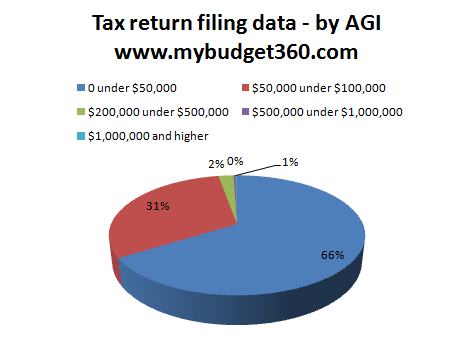
tax return breakdown by income levels

Source: IRS

With all the discussion about the 99 percent I think you have many people that are largely off on what they assume is the one percent. The media is largely to blame and I have even seen business outlets interview people that claim to make $100,000 and are afraid of being taxed because they are in the one percent. Uh, not exactly.
Let us examine the data:

66 percent of tax returns show an adjusted gross income of $50,000 or less
31 percent of tax returns show an adjusted gross income between $50,000 and $100,000

So with these two groups, you are covering 97 percent of all households. Now keep in mind we are looking at adjusted gross income so actual wages will be higher, but not by much.

"So what does it take to be in the top one percent? You will need an adjusted gross income of $1,000,000 or more."

Even folks with an AGI between $200,000 and $500,000 don't fall in this category. Of course Wall Street investment bankers want to make people believe that even with a $100,000 household income that somehow if investment banks were regulated that they will lose their entire life savings (this is actually already happening with housing and the casino known as Wall Street).

Let us dig deeper into the tax data.

Tax returns broken down further

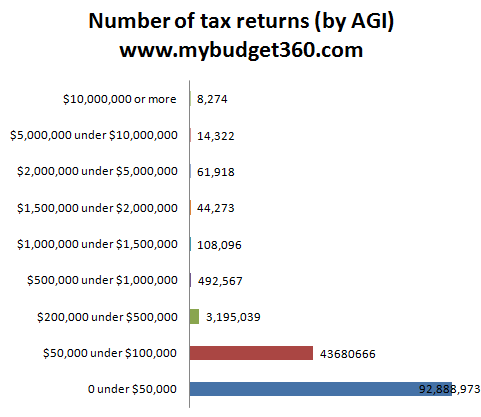
tax returns by adjusted gross income

Out of roughly 140 million tax returns in the latest data, 92 million had AGI of less than $50,000. Couple this with Social Security data which is based on raw W2 income and we find that the typical American worker is pulling in $26,000 a year. Is this giving you a better perspective of wages in the United States?

It isn't the case that those at the very top are increasing in number in a sizeable level, it is that the few at the top are getting wealthier and wealthier because of a:

-1. System favoring lobbying even if it is negative for the overall economy (which it is)
-2. A system where Wall Street speculators pay less on their taxes than regular households
-3. A government for the banks and run by the banks
-4. A financial system focused on short term profits instead of long term sustainability
-5. A system that bails out the wealthy and forces the losses on the public

This is unfortunately the way the system is tilted at the moment. You have high frequency trading that is all about making a quick buck on mini trends. What about charging a surcharge on every transaction? Let the hedge funds go wild but they will need to pay for it. The poor buy and hold investor stands no chances against these Wall Street gamblers.

The burden of student loan debt

Hopefully this gives you a better perspective on the tax side of the equation. Contrary to how some big business shows portray the working class, 75 percent of total income tax is being paid by households making $500,000 or less. Of course the perception is that millionaire households are carrying the largest burden here which is not true.

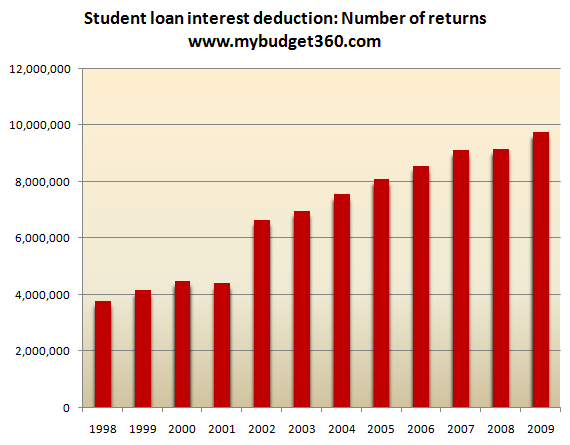
It is hard to get data on how many people are carrying student loan debt. I think I may have accidentally stumbled on a great measure for this. Since you can deduct student loan interest why not see how many people are claiming this on their tax returns?

tax returns with student loan deduction

Source: IRS

Now the above may understate the number of students in debt because it looks like one tax return may have two people claiming the deduction but only showing up as one (for one tax return). This is stunning data. In 2000 roughly 4,000,000 were claiming the student loan deduction. By 2009 this number was nearly 10,000,000! I'm sure once we get IRS data for 2010 we will see this figure surpass 10,000,000. This just highlights the fact that with rising education costs and declining household incomes, more and more Americans are simply financing their education. Why else would those claiming the student loan deduction surge nearly 150 percent in a decade?

The disappearing middle class

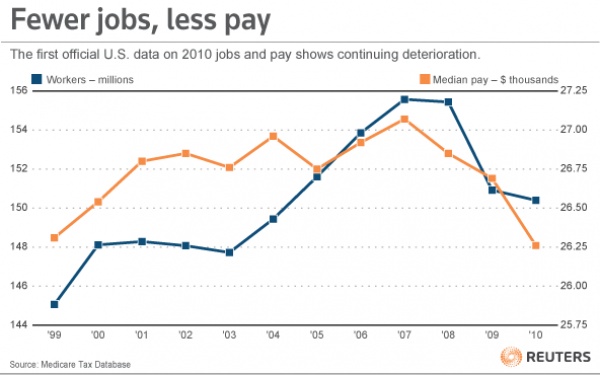
Another troubling data point was found in the Social Security data showing an entire decade of wiped out wage growth:

median pay and wages

Source: Social Security, Reuters

Since the recession hit in 2007 actual pay has been decimated. The median per worker wage for Americans fell from roughly $27,000 in 2007 to $26,250 in 2010. This is in nominal terms so inflation is eating away even more and more at the middle class as the Federal Reserve continues to bail out the banking sector.

It is rather clear why the press doesn't want to cover this. They want to keep people spending and believing in the financial system even though it is completely rigged. Why bring this up? Yet as we reach peak debt situations around the world we have tough decisions to make.

57% of Ohioans favor repealing GOP's anti-labor law

It's not long now till the Nov. 8 referendum when Ohioans will have the chance to strike this law down. No republic stuff this time, just direct democracy!


October 25, 2011 | Quinnipiac University