Showing posts with label inequality. Show all posts

Saturday, November 29, 2014

The Economist: 110 individuals control 35% of Russia’s wealth

[HT: OP]  In Russia, forget about the One Percent!  

Instead focus on the 0.0000008 percent. They control 35 percent of Russia's wealth, according to the new book Putin’s Kleptocracy: Who Owns Russia? by Karen Dawisha.

We can hold our noses up and feel superior to Russia, but in fact, in the U.S. the top 0.1 percent owns 20 percent of all national wealth. And things are getting worse by the year.

We in the West must come to a renewed appreciation of not just democracy, with its formalities of elections and voting, but more importantly pluralism, because real pluralism is the built-in antidote to oligarchy and the national insurance policy against any form of tyranny, exploitation or extremism. 


November 22, 2014 | The Economist 

Saturday, October 25, 2014

More college grads won't fix income inequality


And anyway, we shouldn't have so many kids thinking their best bet is an expensive college degree, and with it onerous debt at the outset of their lives -- that prevents or delays marriage and household formation, the backbone of the middle class.

Yes, we do need to make college less expensive, not just offer more federal loans and grants. In fact, I say public universities should be FREE for students who qualify, as many European countries do.

More importantly, we need to develop (almost from scratch, sadly), a concurrent educational tracking system for the provision of technical-vocational training, paired with apprenticeships at real companies, as Germany does.  

Indeed, we don't need manufacturing workers or even necessarily engineers with 4-year degrees. Or if a kid wants to write software code for the next great app, he doesn't necessarily need a 4-year degree. These are artificial hurdles to entering today's workforce. But there is nothing in their place; so employers demand a degree because they don't know how else to find and filter candidates.

Meanwhile (and I can attest to this personally), in today's "parachute-in-and-start-running" hiring environment, employers are increasingly looking at certifications that attest to a candidate's concrete work skills, not necessarily their broad-based knowledge or ability to learn quickly as attested by a bachelors degree. That's sad, but it is what it is and I don't see it changing anytime soon. It's an employers' labor market now, and it will continue to be so for the foreseeable future....

And then there are all sorts of in-demand jobs that can't find enough workers, such as nurses, home healthcare workers, medical office administrators, billing specialists and cost accountants that don't necessarily call for 4-year degrees. We end up over-educating future workers to fill these jobs who end up training on-the-job anyway to gain experience. 

As Pierson and Riley allude to, teachers may be the big exception to where federal action is warranted. We can't let the employment "market" determine where our best teachers go. We need the best teachers where they are needed most. To do that, we must compensate them accordingly. This requires concerted federal and state action. We can't just hope or leave this to chance anymore. Indeed:

Under the current system, teachers have more school choice than students do. Rather than sending the most qualified and experienced teachers to educate the kids who need them the most, we do the reverse.

That's a recipe for continued failure.  

But to end on a high note, I refer to the writings of education reform over-blogger (that's the only way I describe her verbal fecundity) Diane Ravitch, who points out that our K-12 system is not necessarily broken, it's just forced to deal with huge economic disparities that it is not equipped to remedy. Indeed, educational superstar countries like Finland took their best notes from U.S. public schools back in the day. So we DO know a thing or two about teaching our kids, we just need to do them without the politics and funding shortfalls.


By James Piereson and Naomi Schaefer Riley
October 23, 2014 | Washington Post

Saturday, October 11, 2014

News digest / Catching up on news (10.11.2014)

I've been busy lately for personal reasons, but also my laptop was out of commission for a week thanks to my 2-year-old (see photo), so below are some stories that deserved more attention than I was able to give them. If you've read these then you know (some of) what I do. Enjoy!

It took her about 2 minutes to do that. God love her, the little s--t.

"Scott Walker lost his fight for voter ID. He's still everything that's wrong with the GOP," By Arvina Martin, October 10, 2014, Guardian. URL: http://gu.com/p/42a3m  ANOTHER MAD TEA PARTY EXPERIMENT BLOWING UP IN THEIR FACES... CONTAINED AT THE STATE LEVEL, THANKFULLY.


"Bill de Blasio: From Education to Poverty, Leadership by Example," By Richard (RJ) Eskow, October 9, 2014, Huffington Post. URL: http://huff.to/1vR5knB


"Time for a Guaranteed Income?" By Veronique de Rugy, March 2014 issue, Reason. URL: http://reason.com/archives/2014/02/19/time-for-a-guaranteed-income  WATCH OUT, THE LIBERTARIANS ARE TALKING SOCIALIST REDISTRIBUTION!


"Some Americans Boosted Charitable Giving In Recession; The Rich Did Not," By Bill Chappell, October 6, 2014, NPR. URL: http://n.pr/1CPvxHk  CHARITY WORKS THE LEAST WHEN IT'S NEEDED MOST -- TIME TO STOP RELYING ON IT, IT'S JUST A FEEL-GOOD OUTLET FOR THE FORTUNATE.

"Why would anyone want to talk on the phone ever again?" By Jess Zimmerman, October 6, 2014, Guardian. URL:http://gu.com/p/426qh  AGREED: PHONES ARE ANNOYING AND INTRUSIVE.

"Firestone Did What Governments Have Not: Stopped Ebola In Its Tracks," By Jason Beaubien, October 6, 2014., NPR. URL: http://n.pr/1COVoPL  UMM... NOT SURE WHAT TO THINK ABOUT THIS ONE. KUDOS TO THE COMPANY FOR WANTING ITS WORKERS NOT TO DIE?  WELL OK THEN.

"How the Russian Orthodox Church answers Putin's prayers in Ukraine," By Gabriela Baczynska and Tom Heneghan, October 6, 2014, Reuters. URL: http://www.reuters.com/article/idUSKCN0HV0MH20141006   KBG AND NOW FSB COLLABORATORS.

"Voodoo Economics, the Next Generation," By Paul Krugman, October 5, 2014, New York Times. URL: http://huff.to/1s49pG2  DYNAMICALLY SCORE THIS!

"Oceans Getting Hotter Than Anybody Realized," By John Upton, October 5, 2014, Climate Central. URL:http://www.climatecentral.org/oceans


"Even if we defeat the Islamic State, we’ll still lose the bigger war," By Andrew J. Bacevich, October 3, 2014, Washington Post. URL: 
http://wapo.st/1vlnuxk    NOBODY GETS THIS.  IT'S LIKE TALKING TO A BRICK WALL.

"Regarding political differences, just blame biology," By Cynthia M. Allen, October 3, 2014, McClatchy DC. URL:http://www.mcclatchydc.com/2014/10/03/242055/cynthia-m-allen-regarding-political.html   KIND OF DEPRESSING, ACTUALLY. WHY DO I BOTHER?


"China’s explanation for the Hong Kong protests? Blame America," By Anne Applebaum, October 3, 2014, Washington Post. URL: http://wapo.st/1py9Y5S   JUST LIKE PUTIN DOES, BLAME AMERICA.  GEE, WHO KNEW WE WERE SO POWERFUL?? (YET WE CAN'T TAKE OUT A BUNCH OF YAHOOS IN THE DESERT??...)


"Big Food more effective than Big Government in tackling obesity," By Richard Williams, October 3, 2014, McClatchy-Tribune. URL: http://www.mcclatchydc.com/2014/10/03/242079/big-food-more-effective-than-big.html   I'LL RAISE MY DIET COKE AND OLESTRA CHIPS TO THAT!


"Russia ends US student exchange in part over 'friendly relations' of gay men," By Alec Luhn, October 2, 2014, Guardian. URL: http://gu.com/p/42568  WELL IF YOU DON'T WANT YOUR KIDS TO BE GAY THEN DON'T SEND THEM TO THE U.S. OBVIOUSLY. JEEZ.

"Europe, facing common jihadi threat, has no common security policy," By Matthew Schofield, October 2, 2014, McClatchy DC. URL: http://www.mcclatchydc.com/2014/10/02/241856/europe-facing-common-jihadi-threat.html   EUROPE IS INFURIATING IN ITS SLOWNESS AND DIVISION IN THE MIDST OF SO-CALLED UNITY.

"Your baby looks like your ex? This research is scarier than Alien," By Daisy Buchanan, October 2, 2014, Guardian. URL:http://gu.com/p/424kt    YES INDEED, DAISY, YOUR BABY WITH TOM LOOKS JUST LIKE GATSBY!


"Putin Supports Project to ‘Secure' Russia Internet," By Andrew E. Kramer, October 2, 2014. New York Times. URL:http://huff.to/1rPXsUi


"The White House Could Be Made A Fortress, But Should It Be?" By Ron Elving, October 1, 2014, NPR. URL:http://n.pr/1oAUG01   THE U.S. PRESIDENTIAL INAUGURATION USED TO BE AN OPEN HOUSE PARTY... WHO COULD IMAGINE IT NOWADAYS?!

"The 9 Biggest Myths About ISIS Debunked," By Andrew Hart, October 1, 2014, Huffington Post. URL: http://huff.to/YH0xKH

"Putin’s view of power was formed watching East Germany collapse," By Mary Elise Sarotte, October 1, 2014, Guardian. URL: 
http://gu.com/p/4249a   DAS IST KAPUT!

"Is The New AP U.S. History Really Anti-American?" By Emmanuel Felton, October 1, 2014, Huffington Post. URL:http://huff.to/1rM7XrO  CRITICAL THINKING IS INHERENTLY ANTI-AMERICAN, DUH.

"Obamacare's First Year: How'd It Go?" By John Ydstie, October 1, 2014, NPR. URL: http://n.pr/1ozUXR2   IT WENT PRETTY F-ING WELL: I GOT HEALTH INSURANCE AND SO DID MY REPUBLICAN UNCLE T.  'NUF SAID.

"Is America on the ISIS Hit List?," By Graham Allison, September 30, 2014, The National Interest. URL:http://nationalinterest.org/feature/america-the-isis-hit-list-11372   I'LL SAY IT AGAIN: THERE'S NO BETTER LOCATION TO STAGE A TERRORIST INVASION OF AMERICA THAN THE SYRIAN DESERT, NO SIR.

"Federalization as a ’Terrorist’ Act," By Halya Coynash, September 30, 2014, Human Rights in Ukraine. URL:http://khpg.org/index.php?id=1411869882   WHAT'S GOOD FOR THE GOOSE WILL GET THE GOOSE COOKED, OR SOMETHING LIKE THAT....


"Earth lost 50% of its wildlife in the past 40 years, says WWF," By Damian Carrington, September 29, 2014, Guardian. URL:http://gu.com/p/42vvx  SCARY. SCARY.  DID I SAY SCARY?


"Neoliberalism has brought out the worst in us," By Paul Verhaeghe, September 29, 2014, Guardian. URL:http://gu.com/p/42v9g


"Europe’s Austerity Zombies," By Joseph E. Stiglitz, September 26, 2014, Project Syndicate. URL: http://www.project-syndicate.org/commentary/joseph-e--stiglitz-wonders-why-eu-leaders-are-nursing-a-dead-theory   EUROPE IS WEIRD.

"The Economic Case for Paternity Leave," By Gwynn Guilford, September 24, 2014, The Atlantic. URL:http://www.theatlantic.com/business/archive/2014/09/the-economic-case-for-paternity-leave/380716/   THE WORLD MUST BE PEOPLED! 

Sunday, August 24, 2014

News digest / Catching up on news (08.24.2014)

Here's a news roundup from the past few weeks. Sorry I haven't had time to re-post these with the thoughtful and incisive commentary that you've come to expect from me:

"How Isis came to be," By Ali Khadery, August 22, 2014, Guardian. URL: http://gu.com/p/4xx9z  -- FASCINATING, ESP. CONSIDERING THE U.S. HAS ARMED ISIS TWICE ALREADY

"Obama's legacy could be a revitalized NATO," By Anne Applebaum, August 22, 2014, Washington Post. URL:http://wapo.st/1p27Z8v -- A SCARIER RUSSIA DEMANDS A STRONGER NATO

"New Study Debunks Big Corporations' Tax Inversion Arguments," By Ben Hallman, August 19, 2014, Huffington Post. URL:http://huff.to/1vdX4Ow  -- THE FACTS DON'T SUPPORT INVERSION

"Left out in the cold by the ice bucket fad," By Michael Hiltzik, August 21, 2014, Los Angeles Times. URL:http://www.mcclatchydc.com/2014/08/21/237217/michael-hiltzik-left-out-in-the.html --  DONATE MONEY; CONSERVE WATER

"US still has time to stake out a position of strength in Ukraine," By John Bolton, August 21, 2014, Los Angeles Times. URL:  http://www.mcclatchydc.com/2014/08/21/237223/us-still-has-time-to-stake-out.html#storylink=cpy -- USUALLY I DISAGREE WITH 'YOSEMITE SAM' BOLTON, BUT HE'S BASICALLY CORRECT

"Shoddy US roads, bridges take a toll on the economy," By Don Lee, August 17, 2014, Los Angeles Times. URL:http://www.mcclatchydc.com/2014/08/17/236762/shoddy-us-roads-bridges-take-a.html  -- WHY LIBERALS AND DEMOCRATS CAN'T RUN AND WIN ON THIS SIMPLE FACT IS BEYOND MY UNDERSTANDING

"Among world leaders, the trend for acting like Vladimir Putin is catching on," By Adam Taylor, August 14, 2014, Washington Post. URL: http://wapo.st/1mKGRLp  -- JUST TAKE YOUR SHIRT OFF IF YOU WANT TO BE LIKE PUTIN!

"The GOP’s war on voters continues in Virginia," By Editorial Board, August 14, 2014, Washington Post. URL:http://wapo.st/1sHGEjf -- PESKY VOTERS! WISH THEY'D JUST STAY AT HOME!

"The case for free tampons," By Jessica Valenti, August 14, 2014, Guardian. URL: http://gu.com/p/4vjeg -- IT GENERATED A LOT OF BUZZ ON THE INTERNETS


"Economic inequality, not just wages at the bottom, needs to be addressed," By Harold Meyerson, August 13, 2014, Washington Post. URL: http://wapo.st/1kCqWmT  -- AMEN BROTHER

"WATCH this to understand the level of Russia’s sickness," August 9, 2014, YouTube. URL: http://youtu.be/EwwBFJkwZ_Q --EVER WONDERED WHAT FASCIST STATE THEATER LOOKS LIKE?  HERE YOU GO

"Teenagers in US prisons: it's time for the savagery and neglect to finally end," By Sadhbh Walshe, August 7, 2014, Guardian. URL: http://gu.com/p/4vh3h -- OUR COLLECTIVE SHAME

Friday, August 8, 2014

News digest / Catching up on news (08.08.2014)

Lately I can't keep up with my re-posting duties. Quickly, here are several stories you might have missed:


Federal Judge Rules Some College Players Are Entitled To Payment:  http://n.pr/V95KJ7 -- SOME JUSTICE!

How Big Is a $16 Billion Bank Fraud Settlement, Really?:  http://huff.to/1A036VM  -- NOT VERY.

FEAR: 11 TOP BANKS STILL TOO BIG TO FAIL:  http://huff.to/1zS8ZnU  -- TBTF HERE TO STAY, BY DESIGN.

Nine myths about the social safety net, annotated:  http://wapo.st/1pF1Cvr  -- OLD PEOPLE ARE THE BIGGEST WELFARE QUEENS?

Unwealthy in America: New study finds that Top 1 percent hold 37 percent of nation’s wealth. A quarter of US families feel they are under economic stress caused by the Great Recession:  http://www.mybudget360.com/unwealthy-in-america-wealth-in-united-states/?utm_source=feedburner&utm_medium=email&utm_campaign=Feed%3A+mybudget360%2FQePx+%28My+Budget+360%29  

The Conflict In Gaza Explained In One Map:  http://huff.to/1ASuhTK  -- UNLESS IT'S A MAP DERIVED FROM THE OLD TESTAMENT, I'M NOT INTERESTED.

Your chicken is about to get more full of feces:  http://gu.com/p/4v9ex  -- YUM!

Tuesday, July 22, 2014

Yale prof.: How privileged kids can 'avoid becoming out-of-touch, entitled little shits'

You might have seen that movie Admission with Tina Fey. I watched it on a plane, quaffing a lot of red wine with my tiny meal, so parts of it really got to me.... Anyhow, if the admissions process at Ivy schools is anything like in that movie... it's no wonder today's well-groomed leaders are out-of-touch, elitist, uncreative, self-absorbed a-holes.

Here's how Deresiewicz sums it up:

Our system of elite education manufactures young people who are smart and talented and driven, yes, but also anxious, timid, and lost, with little intellectual curiosity and a stunted sense of purpose: trapped in a bubble of privilege, heading meekly in the same direction, great at what they’re doing but with no idea why they’re doing it.

Sedulous readers might recall how back in 2007 I re-posted an Atlantic article by conservative pundit David Brooks with similar sentiments, "The Organization Kid." Unlike Deresiewicz, Brooks also worried that kids today are too coddled (safe) and pleasantly addled with mollifying prescription pharmaceuticals:

All your life you have been pleasing your elders, performing and enjoying the hundreds of enrichment tasks that dominated your early years. You are a mentor magnet. You spent your formative years excelling in school, sports, and extracurricular activities. And you have been rewarded with a place at a wonderful university filled with smart, successful, and cheerful people like yourself. [...] The world they live in seems fundamentally just. If you work hard, behave pleasantly, explore your interests, volunteer your time, obey the codes of political correctness, and take the right pills to balance your brain chemistry, you will be rewarded with a wonderful ascent in the social hierarchy. 

Of course, Brooks said the problem is that we've taken the moral backbone out of elite education, that "when it comes to character and virtue, the most mysterious area of all, suddenly the laissez-faire ethic rules: You're on your own, Jack and Jill; go figure out what is true and just for yourselves." In other words, elite education is OK, as long as it inculcates a touch of roughhousing rebel sensibility and dash of Christian noblesse oblige in future leaders.

Brooks and  Deresiewicz agree that these coddled kids are less likely to be brave and original than their parents or grandparents, because, as Deresiewicz describes it:

Look beneath the façade of seamless well-adjustment, and what you often find are toxic levels of fear, anxiety, and depression, of emptiness and aimlessness and isolation. A large-scale survey of college freshmen recently found that self-reports of emotional well-being have fallen to their lowest level in the study’s 25-year history.

So extreme are the admission standards now that kids who manage to get into elite colleges have, by definition, never experienced anything but success. The prospect of not  being successful terrifies them, disorients them. The cost of falling short, even temporarily, becomes not merely practical, but existential. The result is a violent aversion to risk. You have no margin for error, so you avoid the possibility that you will ever make an error. 

Personally, I find Deresiewicz's thesis, minus Brooks' moral backbone stuff, more convincing. Smart kids from privileged families learn a lot, they're polite, kind and well-intentioned, but they're so busy with studying, extracurriculars and having "essay-ready summers" that they don't experience real life the way most other kids do. For example, if they work it's because they WANT to, because it looks good on a college application, not because the HAVE to.  

I'm not saying all high schoolers should work. No, at least not during the school year. Studying is their job, forget sports and extracurriculars. At the same time, public university should be free for those with good grades, like it is in Europe. That should be the new social contract: study hard, free college. It's also the smartest investment we could make in our workforce. (And those who aren't cut out for college should be tracked into quality trade and technical schools.) 

The way things are now, we have kids who work to help pay the family's bills and save up for college, then work during college, and then probably never finish college. (The NY Times recently showed just how dependent U.S. college graduation rates are on their parents' income.) Privileged children will never understand that world; they're carried up and away from it blithely and forever on their parents' shoulders. 

That's a failed system of education for top and bottom. For those who never make it to college or don't finish, the failure is obvious. For those who "succeed" their failure is less obvious, since they will have mastered at an Ivy "climbing the greasy pole of whatever hierarchy [they] decide to attach [themselves] to;" however, leadership for them has no higher meaning, or any meaning at all, it just means being on top: the One Percent.

Or as Deresiewicz  writes: "This system is exacerbating inequality, retarding social mobility, perpetuating privilege, and creating an elite that is isolated from the society that it’s supposed to lead."

UPDATE (08.17.2014):  Here's a pretty critical review by Carlos Lozada of Deresiewicz's Excellent Sheep in the Washington Post: "A mind is a terrible thing to waste at Yale." I think most of Lozada's criticisms miss the mark and are full of snark.

UPDATE (08.23.2014): And here's a pretty sympathetic interview with Deresiewicz in Slate: "My Most Offended Readers Are Ivy-Bound 18-Year-Olds."


By William Deresiewicz
July 21, 2014 | New Republic

Monday, July 14, 2014

Reich: How to save capitalism from itself

I'm stitching several of Robert Reich's remarks together here:

In the United States, the progressive movement in the early 20th century pursued a very similar agenda: They sought a progressive income tax, limits to campaign spending, break-ups of corporate monopolies, food safety and health regulations, labor rights, etcetera. Those changes occurred not because of a cataclysm but because political reformers had enough influence to push extremely important reforms. I am looking to those historical periods for inspiration about the future. They give me hope.

[...] In the United States, we can already see the beginning of a populist and progressive reaction to the concentration of economic wealth. I disagree with the goals of the Tea Party, but it’s important to remember that the movement began as opposition to the bail-outs of Wall Street and rejected the establishment of the Republican Party. On the Left, you had the short-lived Occupy movement. But we can see the rebirth of progressivism in the election of people like Bill de Blasio or Elizabeth Warren. They were elected on explicitly progressive platforms. And if we are to believe surveys, the U.S. public is increasingly weary of concentrated economic power. The Supreme Court decisions on campaign finance are widely greeted with dismay and anger.

[...] I have nothing but admiration for Thomas Piketty’s book, but I think that it shows a lack of political sophistication if you believe that only crises can generate waves of political reform. I believe – and I think that history bears me out – that democratic capitalism has something like a balance wheel: The public becomes deeply offended by great concentrations of economic and political power. That offense quickly moves to outrage, and that can have serious political consequences. 


Interview with Martin Eiermann
June 17, 2014 | The European

Friday, June 27, 2014

Eric Liu: Coates is right, we need a study on reparations

Hear, hear!  For those who didn't bother to read Ta-Nehisi Coates' provocative, thought-provoking essay on reparations in The Atlantic,  Eric Liu underscores Coates' main point [emphasis mine]:

Coates is not quite making a case for reparations. He's making a case for a discussion of reparations. He doesn't pretend to spell out all the operational policy choices that would have to be made to put reparations into effect. The closest he comes to a legislative recommendation is to tout a perennially neglected bill that Rep. John Conyers, D-Michigan, introduces every session of Congress, which calls simply for a public study of the possibility of reparations.

This isn't a shortcoming of Coates' argument; it is its purpose. What we need to do is to study the issue in earnest. To have a hearing, in the deepest sense. To listen to the difference between Americanness and whiteness, and to notice the manifold ways that whiteness was (and is) an identity fabricated from the myth of blackness.

To be sure, every ethnic group that's not called white has experienced suffering in American life. But the experience of African-Americans is exceptional in its systematic, multigenerational, reverberating effects.  And it's exceptional in its centrality to the founding and building of our nation.  No experience reveals more than the African-American experience both the hypocrisy and the possibility of our national creed.

I characterized the way most critics have jumped on Coates' essay a case of "leaping from justice to practicalities," as in, some would like to anticipate and dismiss the possible terms of a settlement on reparations, and so doing, dismiss the case for reparations itself.  

Recently on The Colbert Report, Ta-Nehisi Coates half-jokingly told Colbert he would forget about reparations for slavery if the U.S. would seriously study and consider a reckoning for Jim Crow and everything that happened after, including FHA "redlining policies," etc.  Indeed, it's a further injustice to African-Americans to say that the injustices stopped with the emancipation of black slaves. That was just the beginning of a long journey for black equality that continues to this day.


UPDATE:  My conservative friends and family just couldn't let it go, they immediately asked me, "Well, how much would you be willing to pay?"  That was my Uncle T.  So here's what I wrote him:
Oh, please. You want me to name a dollar figure, as if that's the key issue here? OK, fine.  Seventy-two percent of Americans are of European ancestry, let's say 30% of them are adults, that's more than 68 million white adults.  If each of them was asked to give $200, that would be a fund of almost $14 billion.  Put partially in trust, and partially into targeted scholarships, housing loans, job training programs, etc., that money could do a hell of a lot of good.  And that's just me throwing out a dollar figure, since that seems to matter to you more than anything.
Believe it or not, (you'll choose not to), there are very rich families and companies still living well on the money made from slavery. No less than Bloomberg said it, if you recall: 
http://what-is-is.blogspot.com/2012/01/bloomberg-us-economy-powered-by-slavery.html
So I for one would be in favor of companies that made money off slavery that still exist today paying more than I would as an individual.  
I'm aware that a fund of about $14 billion would break down to a bit over $350 for every African-American alive today. That "small" sum is not an argument against reparations, to my mind; rather -- and this is just my opinion -- I think that money would be better spent pooled and targeted to specific programs over which blacks would have significant or total say-so in how it was spent.

And my Republican buddy Rusty asked me, "Do you agree that the only people who should be required to pay them are the descendants of slave owners?"  

To which I replied: "No, I think we all should pay it, everybody except blacks, but that's just my opinion. You're still jumping from the verdict (=reparations are morally warranted) to the settlement terms (= $$??), and then using that hypothetical settlement to determine the justice of of the verdict, which is not the way American justice should or does work in any kind of class-action suit."

To which I should have added that many Northerners and non-slave owners benefited from slavery, including the Lehman Bros. and JP Morgans, et al, of the financial community, as described by Bloomberg. And to a great extent slaves and Jim Crow-era blacks built this country, and so all citizens of the U.S owe them a debt of gratitude.

Rusty thought the idea of asking Mexicans and Asian-Americans to pay reparations was "truly insulting," but I don't necessarily agree, since all Americans today benefit from the country that slaves and Jim-Crow era second-class citizens built for us.  


By Eric Liu
June 27, 2014 | CNN

Tuesday, June 10, 2014

Stiglitz: Tax fairness can eliminate U.S. debt and grow the economy

My main bearded liberal Nobel economist Joe Stiglitz gives a clear and hopeful message: we can fix our tax system, fix the debt and grow our country all at the same time.

This is a message the MSM will not tell you; they say we can only, and must, cut Social Security, Medicare and welfare programs for the poorest Americans in order to cut the national debt.

It's a corporate media lie!  There is another way.


May 30, 2014 | Moyers & Company

A new report by Nobel Prize-winning economist Joseph E. Stiglitz for the Roosevelt Institute suggests that paying our fair share of taxes and cracking down on corporate tax dodgers could be a cure for inequality and a faltering economy.

This week on Moyers & Company, Stiglitz tells Bill that Apple, Google, GE and a host of other Fortune 500 companies are creating what amounts to “an unlimited IRA for corporations.” The result? Vast amounts of lost revenue for our treasury and the exporting of much-needed jobs to other countries.

“I think we can use our tax system to create a better society, to be an expression of our true values.” Stiglitz says. “But if people don’t think that their tax system is fair, they’re not going to want to contribute. It’s going to be difficult to get them to pay. And, unfortunately, right now, our tax system is neither fair nor efficient.”


Saturday, June 7, 2014

HBR blogs: Western malaise spawns extremist parties

Mr. Haque at Harvard Business Review offers us as good a summary as any of the Western economic malaise [emphasis mine]:

While the super-rich are vastly disproportionately enjoying the fruits of global prosperity, too many are being left behind. What is common in societies with extremists on the rise? The poor and the middle feel cheated — because they are. In the sterile parlance of economics, their wages aren’t comparable to their productivity — but more deeply, their lives are literally not valued in this system. And so they turn, in anger and frustration and resignation, to those who promise them more.

In all these societies, social contracts prize growth over real human development. Economies “grow”; but the benefits of growth are enjoyed vastly disproportionately by a small coterie of people — usually those politically connected; at the very top of a socially constrained pecking order; a caste society. We are told this is capitalism; in fact, it’s a perversion of free markets I call “growthism.”

Indeed, we were never meant to worship at the altar of GDP, the DOW or Nasdaq as real indicators of people's well-being.  

And as I've remarked before, U.S. workers are the most productive in the world; meanwhile, U.S. labor practices are among the most efficient (meaning, hands-off) -- 4th in the 2013-14 WEF rankings -- in the globalized economy. So why do U.S. workers feel so insecure and put-upon?  

As before, John Maynard Keynes foresaw this and pointed the way [emphasis mine]:

Yet, today, the situation Keynes foresaw is repeating itself — only more subtly. The problem today isn’t a small number of creditor nations, to whom the vast benefits of global wealth are flowing. It is a small number of super rich individuals: oligarchs, monopolists, scions. In a sense, the same problem, of vast, unjust imbalances, has reemerged; this time beyond national boundaries. Today, the super-rich and their empires span multiple nation-states; whisked from home to home and country to country by private transport, they use different infrastructure (who cares if roads and airports are crumbling when you’ve got a helipad?), play by different rules (do tax laws really matter if your assets are all offshore?), and even different methods of wielding political influence (why knock on doors when you can fund your own super-PAC?).

Here's how Haque sums it up:

The paradox of prosperity is this. It is at times of little that we must plant the seeds of plenty; not fight another for handfuls of dust. And it is at times of plenty when we must harvest our fields; and give generously to all those who enjoy the singular privilege of the miracle we call life.

(Nope, extremists; that’s not communism — not government redistribution of dust. It is, as Keynes foresaw, just common sense).

Once again I tip my hat to Keynes, a giant among men.


By Umair Haque
June 5, 2014 | HBR Blog Network

Saturday, May 17, 2014

Summers: Piketty is right about the past, but the future is ours

I'm tired so I'm not going to analyze now in depth Larry Summers' analysis of Piketty's seminal, once-in-a-generation economic treatise, I'm just gonna say what Summers says Piketty's data should lead us to believe [emphasis mine]:

Perhaps the best way of thinking about Piketty’s wealth tax is less as a serious proposal than as a device for pointing up two truths. First, success in combating inequality will require addressing the myriad devices that enable those with great wealth to avoid paying income and estate taxes. It is sobering to contemplate that in the United States, annual estate and gift tax revenues come to less than 1 percent of the wealth of just the 400 wealthiest Americans. With respect to taxation, as so much else in life, the real scandal is not the illegal things people do—it is the things that are legal. And second, such efforts are likely to require international cooperation if they are to be effective in a world where capital is ever more mobile. The G-20 nations working through the OECD have begun to address these issues, but there is much more that can be done. Whatever one’s views on capital mobility generally, there should be a consensus on much more vigorous cooperative efforts to go after its dark side—tax havens, bank secrecy, money laundering, and regulatory arbitrage.

Beyond taxation, however, there is, one would hope, more than Piketty acknowledges that can be done to make it easier to raise middle-class incomes and to make it more difficult to accumulate great fortunes without requiring great social contributions in return. Examples include more vigorous enforcement of antimonopoly laws, reductions in excessive protection for intellectual property in cases where incentive effects are small and monopoly rents are high, greater encouragement of profit-sharing schemes that benefit workers and give them a stake in wealth accumulation, increased investment of government pension resources in riskier high-return assets, strengthening of collective bargaining arrangements, and improvements in corporate governance. Probably the two most important steps that public policy can take with respect to wealth inequality are the strengthening of financial regulation to more fully eliminate implicit and explicit subsidies to financial activity, and an easing of land-use restrictions that cause the real estate of the rich in major metropolitan areas to keep rising in value.

I'm no fan of Summers, yet his last two prescriptions are, I daresay, things you will never hear discussed in depth on Fox, MSNBC, CNBC, CNN or elsewhere. Wherefore the lib'rul media, indeed!

The only thing I will criticize now, is Summers' argument that "productivity" and "entrepreneurship" explain the outsized gains of U.S. managers. A look at average CEO pay among U.S. corporations and others gives the lie to this argument.  Nobody is arguing that U.S. CEOs are that much better, yet they earn orders of magnitude more than their workers.

As wonkish and un-sexy as it may be, I've talked about this before and will continue to talk about the OECD's effort to fight BEPS (tax base erosion and profit shifting) among global corporations. This is indeed a global problem, not just a U.S. problem, and the U.S. cannot hope to solve it in isolation, but must nevertheless play a leading role in ending this global "race to the bottom."


Thursday, May 1, 2014

2 Americas when it comes to health care

So, once again we see Southern conservatives love to be poor and sick, and continually vote against their own best interests. Boy, talk radio and FOX have sure done a number on them!....

What's really a shame are the poor blacks "imprisoned" in these mostly Southern states, who can't get decent health care like their fellow Americans in other parts of the country, because of white conservative voters in the majority.


By Jillian Berman
April 30, 2014 | Huffington Post

When it comes to the quality of health care, there are two Americas.

In one America, infant mortality, avoidable deaths, health-care costs and other measures are far worse than in the other America, according to a new study by the Commonwealth Fund, a health policy research firm. And thanks to Republican lawmakers and the Supreme Court, the gulf between them may only get wider.

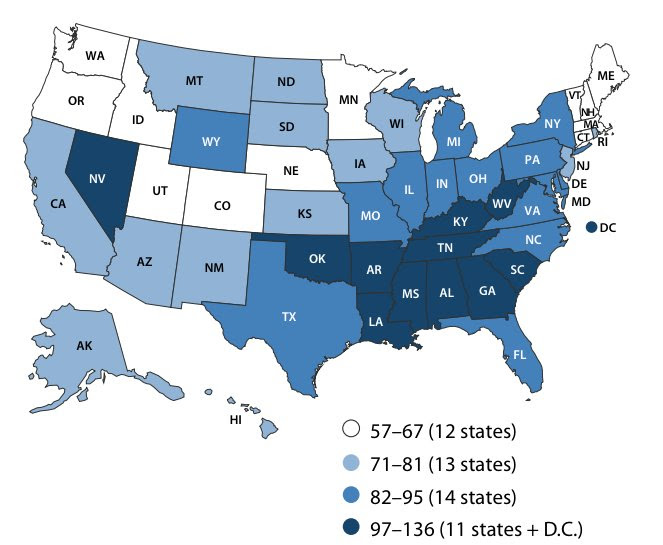
The map below from the Commonwealth Fund shows the stark divide. States with the worst overall health care systems -- as measured by factors like the number of insured adults and children, avoidable emergency room visits and access to affordable care -- are dark blue. States with better health-care systems are white.

map 1

When it comes to things like health care access, quality and cost, certain states can be as much as eight times better than others, the report found.

“We continue to see this very wide geographic spread,” said Commonwealth Fund senior vice president Cathy Schoen, a coauthor of the report. Millions of lives could be saved if the low-performing states could close just half the gap with the top states, Schoen said. "We really need to stay focused on aiming higher.”

Many of the lower-performing states have higher rates of early deaths that could have been prevented by access to quality health care. The Commonwealth map below shows the number of avoidable deaths per 100,000 in each state.

map 2

Many of the worst states for health care have several things in common. They’re mostly in the South and are more likely to be among the poorest in the nation. Many of them have long had unusually tight standards for applicants to qualify for Medicaid, said Schoen, and many have been slow to expand children’s health insurance.

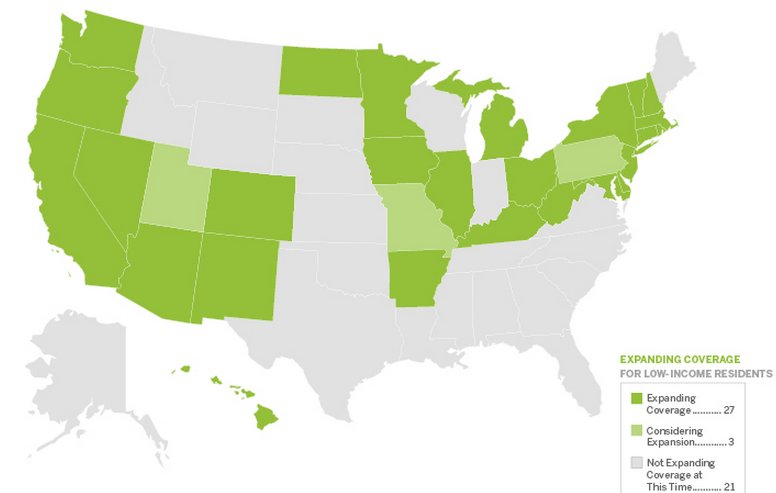
What's more, 16 of the 26 states at the bottom of the Commonwealth Fund’s scorecard aren’t expanding Medicaid under the Affordable Care Act, also known as Obamacare.

map

The states in grey aren't expanding Medicaid. Many of these are also states in which overall health systems are worse.

One of Obamacare’s major tools for giving the poor better access to health care is expanding Medicaid to those making 133 percent of the federal poverty limit -- about $15,521 for a single person -- or less.

But the Supreme Court ruled in 2012 that states could opt out of joining the Medicaid expansion and the extra federal money that came with it. Many states with Republican governors or majority Republican legislators have done just that, leaving millions of their residents out of the national effort to cover the uninsured.

Increasing access to Medicaid isn't a cure-all for low-performing states, and improving health care outcomes overall will require more than just expanding Medicaid. But it could help, Schoen said. For one, it will extend health coverage to more people, making it less likely that poor patients will head to the emergency room for things other than emergencies. And if more low-income residents can pay for health care, more doctors might be convinced to move to poor or rural areas.

"The states that stay out could fail to improve, or fail to improve as fast as other states that choose to participate,” Schoen said. “In some of these states, staying where you are is not very good performance.”

Black Americans are likely to suffer disproportionately from these policies. More than two-thirds of poor, uninsured blacks live in states not expanding Medicaid, according to a December 2013 New York Times report. Already, the rate of avoidable early deaths among blacks is twice as high as among whites in many states, Commonwealth found. That gap is even wider in states with higher early death rates overall.

chart 3

The difference in avoidable death rates in white and black populations in different states.

Still, there is some hope: Kentucky, Arkansas and Nevada, which all rank in the bottom quarter of the Commonwealth Fund's scorecard, are expanding Medicaid. That could help them catch up.

"You could see a few states start to improve quickly," Schoen said.