Showing posts with label public employees. Show all posts

Sunday, December 22, 2013

America's 'age of unprecedented austerity'

You won't hear this from the mainstream media!

The greatest trick austerians ever pulled was convincing people that it was stimulus that had failed.

And the greatest trick the Koch brothers ever pulled was convincing Tea Party Republicans that deficits are a cause, not an effect.


By Matthew O'Brien
December 20, 2013 | The Atlantic

We're living in an age of unprecedented austerity.

Now, that sounds impossible to conservatives who know, just know, that government has exploded under Obama's socialist watch. And that we have trillion dollar deficits—dun, dun, dun—as far as the eye can see. But I have some good news for them (though not the economy). They're wrong. Government employment has actually fallen under Obama, and the deficit is falling fast too. 

As Ben Bernanke put it, "people don't appreciate how tight fiscal policy has been." And how much that's knee-capped the economy. Take jobs. Bernanke points out that total public sector employment—local, state, and federal—has fallen by over 600,000 during the recovery alone. As point of comparison, it rose by 400,000 during the previous one.

But even this million person job swing doesn't tell us how historic austerity has been this time. You have to look at the chart below to see that. It shows government job growth during every recovery on record, going back to 1945. This is the least there's ever been.


How is it possible that government added more jobs after World War II demobilization than now? Or after the 1980 recession, which was followed by another recession a year later? Well, it's what Paul Krugman calls the 50 Herbert Hoovers effect. See, state governments are required to (mostly) run balanced budgets, even during a recession. That's usually not too much of a problem as long as the slump is quick or shallow.

But the Great Recession was neither. The crisis hit and tax revenue disappeared—and didn't come back. Now, the federal government did use the stimulus to fill some of these state budget holes, which is why public sector employment didn't fall much in the first year of the recovery. But then the stimulus money ran out—really, it did—and states were left on their own. Like Hoover in the 1930s, they tried to balance their books amidst a depressed economy. And like Hoover in the 1930s, it didn't work out too well. They went on a cops-and-teachers firing spree the likes of which we've never seen before. And one that was the difference between unemployment being 6 instead of 7 percent today.

The greatest trick austerians ever pulled was convincing people that it was stimulus that had failed.

Tuesday, December 10, 2013

Big Government? Try smallest in half a century

I missed this story back in October but it's still relevant. For all you Big Gubument hatas out there, just FYI: U.S. federal employment is at a 47-year low. (Gee, I wonder why the Tea Parties haven't noticed? Maybe it's because all they care about is cutting their own income taxes and welfare for "moochers" and not about fiscal responsibility?)

I'll say it again, President Obama is a terrible failure as a closet socialist. For that, the GOTP should rejoice. But something makes me think they won't....


By Floyd Norris
October 22, 2013 | New York Times

It was the summer of 1966. Lyndon Johnson was in the White House and the Great Society was roaring. In August, the federal government had 2,721,000 employees.

Now it is the fall of 2013. There are complaints from Washington about a bloated federal government. Another Democrat, Barack Obama, is president.

In September, before the government shutdown, the government had 2,723,000 employees, according to the latest job report, on a seasonally adjusted basis. That is the lowest figure since 1966. Until now, the lowest figure for the current century had been 2,724,000 federal employees in October 2004, when George W. Bush was seeking a second term in the White House.

Now, the federal government employs exactly 2 percent of the people with jobs in this country. In 1966, the figure was more than twice that, 4.3 percent.

All these figures, by the way, are for civilian jobs. Members of the armed forces are not counted. If they were included, the contrast would be even sharper. In 1966 the Vietnam War was going on, and around 2.6 million people were on active duty. This year the figure is around 1.4 million.

While the federal government continues to shrink — the September figure is down 3.1 percent from a year ago — state and local government jobs have begun to grow again, albeit slowly.

September is, of course, a month when teachers are back on the job, and it is useful to look at the unadjusted numbers each year to see how school employment is growing, or not. Over the past 12 months, the number of people working in state and local government education jobs rose 0.6 percent. The prior year, through September 2012, the figure was up 0.3 percent. That came after three consecutive years of declines.

Other state and local jobs are up 0.02 percent — 2,000 jobs — over the past 12 months. That is not much, but if revisions do not change it, a string of four consecutive annual declines will have been erased.

The following chart shows the percent changes in government jobs, from September to September, since 2007. The federal government figures exclude temporary jobs hired for the 2010 census.

Source: Bureau of Labor Statistics

Sunday, October 6, 2013

Pentagon is largest U.S. employer

Yes, the federal government is too big, and this proves it: the Pentagon has 400,000 civilian employees! 


This is not counting the 700,000 or so civilian contractors who also work for the Defense Department.

Nor does it count, of course, our 1.4 million active-duty members of the armed services, and 850,000 reservists and National Guard troops.

So altogether, about one percent of the U.S. population works for the Pentagon.

That may not sound like a lot, but that makes it America's largest employer with about 3.3 million. By comparison, America's largest private employer Walmart has only 1.3 million workers.

Furthermore, the Pentagon's annual "income" from taxpayers dwarfs Walmart's in the U.S. by 25 times: $682 billion vs. $27 billion!  (2012 figures).

So why aren't my fellow Americans in the Tea Parties complaining and agitating to shrink America's bloated defense budget?  

P.S. -- To head off some predictable retorts, first check out this fact sheet from the Center for International Policy, "Myths vs. Realities of Pentagon Spending."

Friday, August 16, 2013

No accident U.S. is most unequal

I'll continue to hammer away at America's growing wealth inequality that is here by design, not by accident. What do I mean? 

One the one hand, we have government policies that help out the rich: the tax code (that gives U.S. corporations an effective tax rate lower than any official rate among G-20 countries, encourages overseas outsourcing and offshoring of income, favors capital gains and executive stock options over wages, protects 401-k and IRAs for rich people who save anyway, and has dramatically lowered inheritance tax over the past 30 years); deregulation of banking combined with the $30 trillion TBTF bank bailouts; deregulation of health, safety and environmental codes; fraudulent H1B visas that displace U.S. workers to cut corporate costs; and allowing more money -- and more independent money -- into our elections.  

One the other hand, we have government policies that hurt workers and the poor: a regressive tax system that targets workers; Social Security cuts; laws against unions; public transportation fee hikes and service cuts; public employment cuts; public education cuts; falling real minimum wage; and exploding student debt that is immune from personal bankruptcy.

Some anti-worker policies are well-intended. For example, cities often seek to outbid each other with ever-growing subsidies and tax breaks to attract large retailers that promise job creation... with the unintended effect of ruining local mom-and-pop businesses that used to offer better wages and benefits -- wages and benefits that never come back -- and degrading their local tax base.  

We Democrats and liberals can't ignore inequality or its root causes and hope they go away, or fear accusations of "class warfare" for our speaking out. Class warfare is already being waged against the poor and working class, whether we admit it or not.


By Mark Gongloff
August 15, 2013 | Huffington Post

Hey, who says America is in decline? The U.S. is still more awesome than the rest of the world at making at least one thing. And that thing is income inequality.

A new paper by economists Facundo Alvaredo, Anthony B. Atkinson, Thomas Piketty, and Emmanuel Saez lays out just how much better at making inequality the U.S. is than everybody else and tries to explain how it got that way.

Since the 1970s, the top 1 percent of earners in the U.S. has roughly doubled its share of the total American income pie to nearly 20 percent from about 10 percent, according to the paper. This gain is easily the biggest among other developed countries, the researchers note. You can see this in the chart below, taken from the paper, which maps the income gains of the top 1 percent in several countries against the massive tax breaks most of them have gotten in the past several decades. (Story continues after chart.)


The higher the dot, the more income inequality has grown in that country. See the red dot waaaay up in the left-hand corner, far away from everybody else? That is the United States, where the top earners have made more while getting their taxes slashed by over 40 percent.

This echoes an OECD study from earlier this year that found the U.S. had the highest income inequality in the developed world. It followed only Chile, Mexico and Turkey among all nations.

So how did America get so darn great at ratcheting open the chasm between the haves and have-nots? Thank the dynamic duo of Wall Street and Washington, which have been working so well together for the past few decades to make laws that favor banks. Turns out this Axis Of Making It Rain has also been making laws that favor the exorbitantly wealthy. Win-win. Unless you are poor, in which case: Sorry, be born to richer parentsnext time, maybe?

One thing you'll notice in this chart is that, typically, the bigger the tax cuts given to the 1 percent (the horizontal scale on the chart), the bigger the income inequality. This is consistent with other studies that have shown the tax code has a big effect on income distribution. That's one way Washington has boosted inequality: By slashing taxes on the rich, for freedom and growth and trickling down on the poor. Unfortunately, the paper points out, contrary to what you will hear from conservatives, lower tax rates on the wealthy offer no obvious benefits to growth, or to the poor.

One other thing you'll notice from the chart is that the United Kingdom has slashed taxes on the top 1 percent almost as aggressively the U.S. has, and yet the share of income going to the top 1 percent is not nearly as big. So there's something else going on here besides just tax breaks.

That something is Wall Street, more or less, as Matthew O'Brien of The Atlantic points out. The same politicians that have busily been slashing taxes on the wealthy have also been loosening fetters on banking, allowing the financial sector to swell to bloated size and mop up ever-more income while contributing ever-less back to the economy. Again, this is consistent with other studies that have attributed much of the rise in in inequality to the pay being sucked up by bankers and overpaid CEOs.

At the same time, U.S. lawmakers have also made it easier and more tax-friendly for the wealthy to pile up more capital gains on their investments. As O'Brien puts it, "The top 1 percent leveraged itself to the market, and haven't looked back."

One nifty benefit to having nine metric craptons of money is that you can use it to buy politicians to help you craft the laws you like, particularly those that will help you end up with 10 metric craptons of money. The poor and middle class, meanwhile, just get ever more discouraged about the political system and stop bothering to fight it, increasingly turning the whole process over to the wealthy and the politicians they own, according to arecent paper by Frederick Solt at Southern Illinois University. Sound familiar?

Monday, August 12, 2013

Kuttner: It's not just Detroit

We bailed out the auto industry in 2008 and it was a roaring success, saving at least 1 million jobs.  We bailed out New York City in 1975 and it was well worth it. We shouldn't let Detroit go under either.

BTW, while Michigan Governor Rick Snyder is ready to let Detroit go down the tubes and cancel its pension commitments, he can somehow find at least $285 million to buy the Detroit Red Wings a new arena.  Snyder calls it a "catalyst project," and "something that is important to all of us."  As if paying city workers and rebuilding crumbling city infrastructure is not important to all Detroiters?  

This is the economic Bizarro world that conservative politicians live in, where sports socialism and bank payoffs are just dandy, yet they can't find the money to pay (already reduced) pensions as prescribed in the state's constitution.   


By Robert Kuttner
August 11, 2013 | Huffington Post

Do you think the damage from the pending bankruptcy of the city of Detroit will be limited to Detroit? Think again.

Detroit is partly the victim of economic trends far beyond its control, the downsizing and outsourcing of the auto industry and the collapse of the sub-prime bubble, to name just two. And yes, the city has suffered from corrupt and inept local government. But leaving Detroit to a bankruptcy process that favors investment bankers over local pensioners will neither provide a fair outcome nor contain the damage.

In the past two weeks, other Michigan cities and counties, including Saginaw and Battle Creek, have had to postpone bond issues, as the damage from the Detroit bankruptcy spills over. Michigan Governor Rick Snyder, who hoped to whack both public employees and the heavily Democratic city of Detroit by promoting bankruptcy, could end up shooting himself and his state in the foot.

Those who hope to use the pain of cities to undermine public employee pensions are playing with fire. One of the striking government failures of the era since the collapse of 2008 is that the federal government has done so little to help municipalities whose revenues were doubly hit by the subprime collapse and the recession itself. In the absence of aid, we can expect a prolonged era of dwindling services and scapegoated public workers and retirees.

It is a travesty that the federal government and the Michigan state government are not sending Detroit a lifeline. Other cities and states stand to lose both public services and pension benefits as this trend spreads. Chicago, which just suffered three levels of bond-downgrading, looks to be next.

Some background: In 1975, New York City very nearly went bankrupt. It faced a financial crisis and was unable to roll over maturing bonds. When Mayor Abe Beame appealed to Washington for help, President Ford initially refused, prompting the famous headline in the New York Daily News, "Ford to City: Drop Dead."

But that was a different era and in the end, Ford did approve $2.3 billion in federal loans. The New York State government, through a hastily legislated Municipal Assistance Corporation, agreed to refinance the city's debt, subjecting it to a rigorous supervision process. The Big Apple avoided bankruptcy, its economy recovered -- and New York is now home to the wildly profitable financial industry that is destroying Detroit in order to protect bankers.

In contrast to President Ford and New York's then Democratic governor Hugh Carey, Michigan's Republican governor Rick Snyder was happy to collude with Wall Street by embracing a bankruptcy proceeding rigged in favor of investment banks. And President Obama, who successfully sponsored a recapitalizing of the auto industry, is staying far away from Detroit this time.

These policies are short-sighted as well as cruel. If you think about it, many of Detroit's citizens are getting screwed both as debtors and as creditors. With the city having lost tax revenues in the housing collapse and property values at rock bottom, most homeowners with mortgages -- debtors -- can't qualify for refinancing. But many of the same people are also creditors, the city owes them pensions.

In principle, a bankruptcy proceeding is a system for fairly allocating claims when a debtor can't service all of its debts. The Michigan state constitution guarantees that Detroit pensioners will be paid what they are owed. Even Michigan's Republican attorney general, Bill Schuette,agrees that the constitutional protection is binding.

But the most recent changes (2005) in the federal bankruptcy law, lobbied for by Wall Street, put bankers in line ahead of pensioners. As attorney, author and debt expert Ellen Brown explains, this special-interest provision gives credit default swaps held by banks priority over other forms of debt. So banks that speculated in Detroit's debt stand to get paid ahead of ordinary bondholders and pensioners.

As Brown writes:

Derivative claims are considered "secured" because the players must post collateral to play. They get not just priority but "super-priority" in bankruptcy, meaning they go first before all others, a deal pushed through by Wall Street in the Bankruptcy Reform Act of 2005. Meanwhile, the municipal workers, whose pensions are theoretically protected under the Michigan Constitution, are classified as "unsecured" claimants who will get the scraps after the secured creditors put in their claims. The banking casino, it seems, trumps even the state constitution. The banks win and the workers lose once again.

The average pension owed to Detroit municipal workers, incidentally, is just $1,900 a month, and only 4 percent of Detroit's general revenues go to pensions. According to AFSCME President Lee Saunders, Detroit's non-uniformed public workers have already had pensions cut by 40 percent.

As we saw in the Wisconsin assault on collective bargaining for public employees and most recently in the San Francisco area BART strike, all public workers are losing public sympathy because wages, pension and health benefits have declined even faster in the private sector, leaving regular people to conclude that government employees have it too good. In fact, a study by pension expert Alicia Munnell finds that average state and local employee pensions are well below level needed to maintain living standards in retirement. Wall Street must be chortling, as ordinary workers blame civil servants rather than bankers.

But the assault on public workers and pensioners will continue to spread until citizens generally start appreciating that the culprit is not "over paid" public employees but a banker-dominated system that undermines decent living standards for public and private workers alike.

Tuesday, August 7, 2012

Rush: 'Private aerospace' put rover on Mars... and Obama backs him up?!

It's one thing for Rush Limbaugh to lie about Big Gubument, that's what he gets paid for.  But when our liberal-socialist POTUS backs him up?!  That's just wrong and bizarre.  Obama credited American "technology" and "ingenuity," not government employees at NASA, for building the Curiosity and landing it on Mars.  

Obama has been so utterly whipped into obedience by the right-wing media, he is so thoroughly afraid of his own liberal shadow, that he can't even give Big Government a high-five when it genuinely deserves one.  Pathetic!


By James Hepburn
August 6, 2012 | Daily Kos

Monday, August 6, 2012

GOP reneges on spending cuts, says gov't creates private-sector jobs

Newsflash: Congressional Republicans say deficit spending is good and creates private-sector jobs!... As long as it's for defense-related industries.

Yo, where the Tea Parties at when we need them?  


By Dave Helling
August 6, 2012 | Kansas City Star

Monday, July 16, 2012

Big Gov't creates private-sector jobs all the time

Two huge take-aways here:

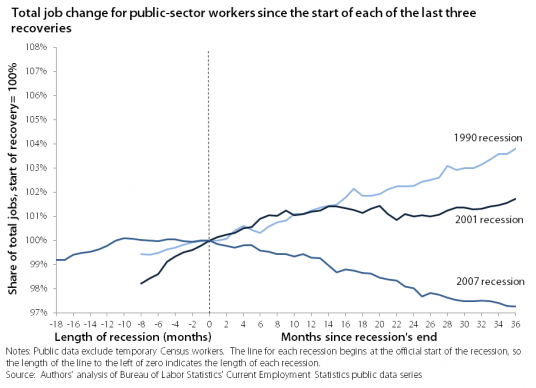
1) Compared to previous recessions, the real difference in the recovery from Dubya's Great Recession is not the comeback of private-sector jobs -- those are about on pace.  No, it's the huge cuts in public-sector jobs.  

2012-07-13-epi_public1.png
Source: EPI

2) The economic "multiplier" of state and local spending is around 1.24.  And roughly 0.67 private sector jobs are lost for every public sector job cut.

So when people like Rush Limbaugh parrot the line that "government never created a job," that's just hogwash, because that's real money moving through the economy that ALWAYS ends up in the hands of the private sector eventually, with the same economic effect as any other kind of private spending or investment.


By Jared Bernstein
July 13, 2012 | Huffington Post

Monday, June 18, 2012

Dems, Repubs talk past each other on economy

This is what Obama was supposed to fix in three-odd years in the White House: a loss of 39 percent of Americans' net wealth during the Great Recession, according to the Fed.

In particular, the median value of Americans' stake in their homes fell 42 percent between 2007 and 2010.  That's particularly awful because: 1) most Americans' wealth is in their homes; and 2) construction, the hardest hit sector in this crisis, is usually the sector that brings us out of recession.  

Underwater houses and oversupply of housing are still the biggest obstacles to increased spending (demand) and investment, including in construction, hence hampering our economic recovery. Moreover, of the 8 million jobs lost during Dubya's recession, 2 million were in construction.

Obama should have done so much more, particularly by pushing mortgage modifications with principal reduction.  But instead he concentrated on giving $29 trillion to the Too Big To Fail banks.

But since Republicans don't believe in helping Main Street, they don't criticize Obama for that failure of leadership.  Instead, they argue what's held the economy back are Obama's "job-killing regulations," and not enough drilling, fracking and mining.  It's like they're living in a different country!  Our bipartisan dialog over the past two years has gone something like this:

Democrats:  Americans lost 39 percent of their net wealth during Dubya's Great Recession, mainly from the burst housing bubble.  Nevertheless, Americans are well on their way to reducing their private debts; and the U.S. is the only major Western economy to have decreased its ratio of total debt to GDP since the crisis.

Republicans:  The problem is the national debt!  Slash it now, even if it causes a depression! People who are unemployed and suffering now need to suffer even more so that their (unborn) grandchildren don't have to!

Democrats:  Let's not repeat the mistakes of EU countries that adopted strict austerity measures hoping to appease global bond markets and keep their interest rates low, only to cause zero-negative economic growth that scared away global bond markets and increased their interest rates and national debts.  

Republicans:  Adopt austerity measures now or we'll end up like those socialists in Europe!

Democrats:  636,000 state and local employees (firefighters, policemen, teachers, et al) have lost their jobs since the Great Recession.

Republicans:  States need more flexibility to fire their fireman, policemen and teachers!

Democrats:  China is investing $1.5 trillion in government subsidies for solar PV innovation over the next five years, even though they already control 50 percent of the world's solar market --  a market that has grown more than 5 times since 2007, with long-term growth prospects of 20-30 percent per year -- and export 90 percent.  Meanwhile, Solyndra has been the only U.S. government energy loan guarantee that has soured, 1.3 percent of America's relatively tiny $38 billion portfolio over the past 6 years.

Republicans:  Drill, baby, drill!  

So, as you can see, Republicans claim that they have all the answers, while it is evident that they don't understand the questions.

Monday, April 9, 2012

Public-sector employment has shrunk under Obama

For those of you who think Obama has inflated the public sector during his presidency, here's the truth:

Since February 2010, the nation's private employers have added more than 3.9 million jobs, or roughly 164,000 per month.  Over the same period, however, some 485,000 government jobs were lost.

But Obama is still throwing bones to the teachers' unions, right?  Wrong:  "The per-capita employment rate in public education, by far the largest sector of government hiring, is at the lowest level since 1999."  In fact: 

... the recession caused 41 states to raise state-college tuition and lay off university staff; 30 cut funding for local school districts; 25 cut funding for seniors and people with disabilities; and 30 states cut the availability of health care services.  Teachers have been one of the hardest-hit professions in the public sector.  Seventy-one percent of school districts reported cuts in state and local funding from last year's budget, 68 percent eliminated positions this year, and 65 percent expect to do so again next year, according to a new survey by the American Association of School Administrators.

And in California, in particular, poorer and majority-minority schools are losing teachers 30 and 60 percent faster than richer and majority-white schools, respectively.  As usual, in hard times it's the poor and minorities who suffer more.


By Tony Pugh
April 4, 2012 | McClatchy Newspapers

Saturday, March 31, 2012

Free markets work: Privatize firefighting!

Thanks to the recession and local budget shortfalls, libertarians' dream of citizens paying for all city services on a per-usage basis is coming true.

In this case, the cost of putting out fires will be borne by insurance companies and passed onto policy holders....  The next step is privatizing the fire department.  The next step is having all fire departments purchased by insurance companies, who will put out fires only if you are a policy-holder... or agree to sign on the dotted line for a policy while your house/car/office is on fire.

That's the free market in action, baby!  No free lunch!


How Does $1,000 For House Fires And $600 For Car Fires Grab You?
March 30, 2012 | CBS 2 New York


Monday, February 14, 2011

Ohio class warfare case study has national implications

FOXNews opinionater turned Ohio Governor John Kasich and his GOP henchmen want to fire Ohio state employees and cut the salaries and benefits of those who remain. Taking Rahm Emanuel's advice never to let a good crisis go to waste, Kasich is using Ohio's projected $8 billion budget deficit as a pretext to fire teachers and cripple unions. Among the provisos which he supports are an end to collective bargaining and binding arbitration for public-sector employees, automatic 1-year continuation of outgoing contracts in the case of a dispute, and making it illegal for them to strike. This despite that fact that strikes in Ohio are extremely rare, and since 2008 binding arbitration has resolved fewer than 2 percent of public labor disputes.

Indeed, an irrefutable study on Ohio's labor force by Rutgers University professor Jeffrey H. Keefe shows that public-service workers are actually underpaid 3.3 percent compared to private-sector workers of similar education and hours worked.

Moreover, according to the 35,000-member Ohio Civil Service Employees Association, state workers have taken five pay cuts in the last nine years and saved Ohio $250 million in its current contract alone.

On February 9 at the first reading of SB5, more than 1,000 firefighters, police, corrections officers and other public workers stormed Ohio's Statehouse in opposition. Why so upset? Because the bill, proposed by GOP State Senator Shannon Jones – which Gov. Kasich said "of course" he supports – would eliminate: (1) collective bargaining for all state workers, including those at universities; (2) binding arbitration for local police officers and firefighters, who also could not strike; (3) health insurance as part of labor negotiations, and require government workers to pay at least 20 percent of the cost; and (4) automatic pay increases and mandatory sick days for teachers from state law.

The Ohio Tea Parties and the rest of the GOP state apparatus naturally support the bill, as they believe that all union members, especially public union members, are lazy and overpaid compared to lean, mean private-sector, non-union workers. And of course state employees and union members tend to vote Democrat precisely because they know Republicans have it in for them -- which makes the GOP hate them even more. Ohio's Tea Partiers are counter-mobilizing as this goes to post.

Yes, state workers' compensation makes up about 1/3 of most states' operating budgets, but in fact recent state budget shortfalls are due to the Great Recession with resulting lower tax receipts and higher demand for state services like Medicaid and unemployment benefits -- not any sudden increas in spending on state salaries. And the more ominous problem of unfunded state retirement benefits -- which Newt Gingrich and other Republicans lately argue calls for national legislation to allow states to declare bankruptcy and erase their liabilities to state workers, bond markets be damned -- has been building up for years. The Wall Street crash just made it worse. State workers are not actuaries, accountants, or elected legislators charged with a fiduciary duty to prudently set aside and invest these funds. Therefore, it is completely unfair to attribute the states' fiscal irresponsibility to everyday state workers. (Source: http://www.nationalaffairs.com/publications/detail/the-states-in-crisis)

Republicans will cut public-sector jobs and wages and cripple public unions in the bad times in the name of balanced budgets -- but does anybody seriously think they're going to undo all that when the economy recovers? No, these "emergency" measures will be permanent. Conservative idealogues smell blood and they're going in for the kill. They are patient but ruthless hunters; now is their time to pounce.

This death struggle is being waged in other budget-strapped states, which show a similar picture as described above.

Ohioans, Americans, don't let them win!