Showing posts with label pensions. Show all posts

Saturday, September 28, 2013

Sirota calls b.s. on public pension 'crisis'

Sirota argues that states' public pension shortfalls are a manufactured crisis by conservatives and big business, caused by years of states' chronic under-funding of pension funds while giving tax breaks and subsidies to business:

Public pensions face a 30-year shortfall of $1.38 trillion, or $46 billion on an annual basis. This is dwarfed by the $80 billion a year states and cities spend on corporate subsidies.

As usual, conservatives' go-to "solution" for a "crisis" is more cuts.

Sirota cites one state example that I've mentioned already:

Perhaps the most famous illustration of the pervasiveness of this deceptive argument comes from Detroit, Michigan. When the city recently declared bankruptcy, much of the media and political narrative around the fiasco simply assumed that public pension liabilities are the problem. Few noted that both Detroit and the state of Michigan have for years been spending hundreds of millions of dollars on wasteful corporate subsidies.13 Worse, the very same political leaders pleading poverty to demand cuts to municipal pensions were simultaneously promising to spend more than a quarter billion taxpayer dollars on a professional hockey arena.

And now conservative idealogues in the states are treating everywhere like Detroit:

But as outrageous as the blame-the-pensioners mythology from Detroit is, it is the same misleading mythology that is now driving public policy in states across America. In Rhode Island, the state government slashed guaranteed pension benefits while handing $75 million to a retired professional baseball player for his failed video game scheme. In Kentucky, the state government slashed pension benefits while continuing to spend $1.4 billion on tax expenditures. In Kansas, the state government slashed guaranteed pension benefits despite being lambasted by a watchdog group for its penchant for spending huge money on corporate welfare “megadeals.” 

Sirota reveals a devilish bait-and-switch is at work here:

The goals of the plot against pensions are both straightforward and deceptive. On the surface, the primary objective is to convert traditional defined-benefit pension funds that guarantee retirement income into riskier, costlier schemes that reduce benefits and income guarantees, and subject taxpayers and millions of workers’ retirement funds to Enron’s casino-style economics. At the same time, waging a high-profile fight for such an objective also simultaneously helps achieve the conservative movement’s larger goal of protecting profligate corporate subsidies. 

The bait-and-switch at work is simple: The plot forwards the illusion that state budget problems are driven by pension benefits rather than by the far more expensive and wasteful corporate subsidies that states have been doling out for years. That ends up 1) focusing state budget debates on benefit-slashing proposals and therefore 2) downplaying proposals that would raise revenue to shore up existing retirement systems. The result is that the Pew-Arnold initiative at once helps the right’s ideological crusade against traditional pensions and helps billionaires and the business lobby preserve corporations’ huge state tax subsidies. 

Kentucky offers a good example of the real problem, what this bait-and-switch is meant to protect by means of distraction:

... Kentucky’s $760 million annual pension shortfall is far less than the $1.4 billion a year Kentucky spends so-called “incentive programs” – much of them classic corporate welfare. These programs have included subsidies of $300 million to Ford Motor Company, $205 million to Weyerhauser and $110 million to United Parcel Service. They also include a $560 million subsidy to the mining industry. Meanwhile, thanks to Kentucky’s loophole-riddled tax code, profitable Kentucky-based Fortune 500 companies like Yum Brands and Ashland Inc. have during one of the last few years paid no state income tax whatsoever.

Thanks to corporate lobbying, Kentucky converted its defined-benefit public pension system into a cash balance hybrid system, while keeping corporate welfare.  

Privatizing Social Security is their next aim, trust me!  


By David Sirota
Institute for America's Future

Sunday, September 15, 2013

MB360: Looming U.S. retirement disaster

In this context, cutting Social Security makes even less sense.  Just like with health insurance, the private sector has foisted this responsibility onto its employees, and the federal government.  


Posted by mybudget360 | September 15, 2013

Americans are on the verge of a retirement disaster.  As pension plans slowly go extinct Americans are not saving enough for retirement.  The figures point to a looming pension and retirement disaster.  Retirement for most Americans is largely a mirage.  As organizations switched from pensions to 401ks it was expected that most Americans would save money. This trend started in 1980 and over 30 years have now passed.  We now have enough data to see if this transition has been beneficial to most Americans.  Unfortunately the answer highlights an American population that has not saved enough for retirement.  Most Americans will make Social Security their default retirement plan.  Pension issues also loom as many state governments contend with deep underfunding for retirement benefits.  In the end, there is a disaster looming.

The disappearing pension

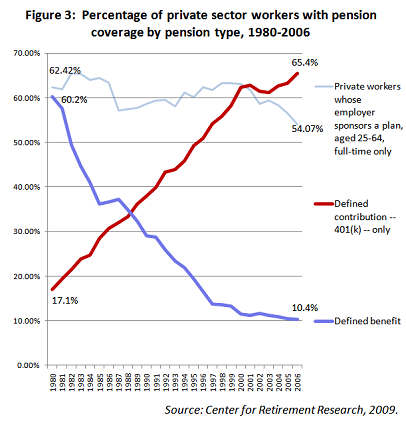
Very few Americans now have access to a pension.  This wasn’t always the case:

pensions
Today, less than 10 percent of Americans have access to a pension.  Most however have access to 401k plans and other retirement options.  Unfortunately as the middle class shrinks more Americans are finding it more difficult to save any money.

Social Security unfortunately is going to become the default retirement plan for many.  Many current pension plans are setup with unrealistic returns.  Many states are underfunded in spite of the dramatic returns in the stock market:

underfunded

Keep in mind there is simply no way the stock market can continue producing returns as it has. It is simply impossible and already ratios are getting inflated showing a slight exuberance.  As the chart above highlights, many state pensions are underfunded and if the market even has a slight correction, this will exacerbate the problem.

Beyond the above data that only impacts a small number of Americans, most simply do not have enough (or anything) saved for retirement.

The lack of savings in retirement accounts

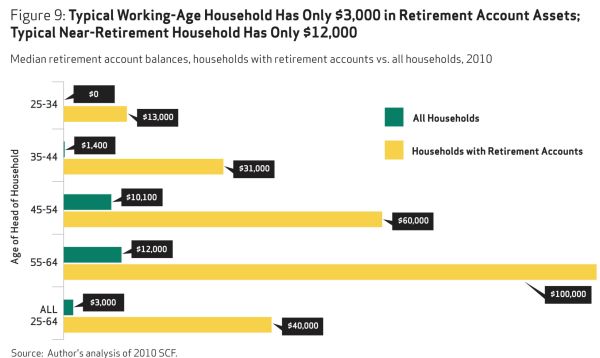
Without pensions many Americans are left to fend for themselves via retirement accounts.  How has this worked out?

retirementcrisisJ

These are disturbing figures.  The median amount saved by all Americans is $3,000 for retirement!  Even those nearing retirement in the 55 to 64 age group have roughly $12,000 to get by in their later years.  In other words, many are going to be working deep into old age.

A lot of this can be attributed to the lack of income being made by most Americans.  As we have seen income inequality is at record levels, even higher than it was prior to the Great Depression.  It is simply hard to get by when the per capita wage is $26,000 and the cost of living continues to increase without any wage increases.  Getting by is priority number one, not a far off retirement.

Retirement dreams pushed out

As you would imagine the retirement age is being pushed out:

at what age did you retire

It is becoming tougher for Americans to retire and there is less of a safety net.  Since the retirement amount saved is so low, many are going to depend on Social Security as their main income stream in their later years.  Much of this money is going to be paid by a younger and less affluent generation.  You can already see this disaster lining up.  As young people struggle, how will they feel when they see pensions going out while they struggle to find work?  If you think you have heard the last of this think again.

Monday, August 12, 2013

Kuttner: It's not just Detroit

We bailed out the auto industry in 2008 and it was a roaring success, saving at least 1 million jobs.  We bailed out New York City in 1975 and it was well worth it. We shouldn't let Detroit go under either.

BTW, while Michigan Governor Rick Snyder is ready to let Detroit go down the tubes and cancel its pension commitments, he can somehow find at least $285 million to buy the Detroit Red Wings a new arena.  Snyder calls it a "catalyst project," and "something that is important to all of us."  As if paying city workers and rebuilding crumbling city infrastructure is not important to all Detroiters?  

This is the economic Bizarro world that conservative politicians live in, where sports socialism and bank payoffs are just dandy, yet they can't find the money to pay (already reduced) pensions as prescribed in the state's constitution.   


By Robert Kuttner
August 11, 2013 | Huffington Post

Do you think the damage from the pending bankruptcy of the city of Detroit will be limited to Detroit? Think again.

Detroit is partly the victim of economic trends far beyond its control, the downsizing and outsourcing of the auto industry and the collapse of the sub-prime bubble, to name just two. And yes, the city has suffered from corrupt and inept local government. But leaving Detroit to a bankruptcy process that favors investment bankers over local pensioners will neither provide a fair outcome nor contain the damage.

In the past two weeks, other Michigan cities and counties, including Saginaw and Battle Creek, have had to postpone bond issues, as the damage from the Detroit bankruptcy spills over. Michigan Governor Rick Snyder, who hoped to whack both public employees and the heavily Democratic city of Detroit by promoting bankruptcy, could end up shooting himself and his state in the foot.

Those who hope to use the pain of cities to undermine public employee pensions are playing with fire. One of the striking government failures of the era since the collapse of 2008 is that the federal government has done so little to help municipalities whose revenues were doubly hit by the subprime collapse and the recession itself. In the absence of aid, we can expect a prolonged era of dwindling services and scapegoated public workers and retirees.

It is a travesty that the federal government and the Michigan state government are not sending Detroit a lifeline. Other cities and states stand to lose both public services and pension benefits as this trend spreads. Chicago, which just suffered three levels of bond-downgrading, looks to be next.

Some background: In 1975, New York City very nearly went bankrupt. It faced a financial crisis and was unable to roll over maturing bonds. When Mayor Abe Beame appealed to Washington for help, President Ford initially refused, prompting the famous headline in the New York Daily News, "Ford to City: Drop Dead."

But that was a different era and in the end, Ford did approve $2.3 billion in federal loans. The New York State government, through a hastily legislated Municipal Assistance Corporation, agreed to refinance the city's debt, subjecting it to a rigorous supervision process. The Big Apple avoided bankruptcy, its economy recovered -- and New York is now home to the wildly profitable financial industry that is destroying Detroit in order to protect bankers.

In contrast to President Ford and New York's then Democratic governor Hugh Carey, Michigan's Republican governor Rick Snyder was happy to collude with Wall Street by embracing a bankruptcy proceeding rigged in favor of investment banks. And President Obama, who successfully sponsored a recapitalizing of the auto industry, is staying far away from Detroit this time.

These policies are short-sighted as well as cruel. If you think about it, many of Detroit's citizens are getting screwed both as debtors and as creditors. With the city having lost tax revenues in the housing collapse and property values at rock bottom, most homeowners with mortgages -- debtors -- can't qualify for refinancing. But many of the same people are also creditors, the city owes them pensions.

In principle, a bankruptcy proceeding is a system for fairly allocating claims when a debtor can't service all of its debts. The Michigan state constitution guarantees that Detroit pensioners will be paid what they are owed. Even Michigan's Republican attorney general, Bill Schuette,agrees that the constitutional protection is binding.

But the most recent changes (2005) in the federal bankruptcy law, lobbied for by Wall Street, put bankers in line ahead of pensioners. As attorney, author and debt expert Ellen Brown explains, this special-interest provision gives credit default swaps held by banks priority over other forms of debt. So banks that speculated in Detroit's debt stand to get paid ahead of ordinary bondholders and pensioners.

As Brown writes:

Derivative claims are considered "secured" because the players must post collateral to play. They get not just priority but "super-priority" in bankruptcy, meaning they go first before all others, a deal pushed through by Wall Street in the Bankruptcy Reform Act of 2005. Meanwhile, the municipal workers, whose pensions are theoretically protected under the Michigan Constitution, are classified as "unsecured" claimants who will get the scraps after the secured creditors put in their claims. The banking casino, it seems, trumps even the state constitution. The banks win and the workers lose once again.

The average pension owed to Detroit municipal workers, incidentally, is just $1,900 a month, and only 4 percent of Detroit's general revenues go to pensions. According to AFSCME President Lee Saunders, Detroit's non-uniformed public workers have already had pensions cut by 40 percent.

As we saw in the Wisconsin assault on collective bargaining for public employees and most recently in the San Francisco area BART strike, all public workers are losing public sympathy because wages, pension and health benefits have declined even faster in the private sector, leaving regular people to conclude that government employees have it too good. In fact, a study by pension expert Alicia Munnell finds that average state and local employee pensions are well below level needed to maintain living standards in retirement. Wall Street must be chortling, as ordinary workers blame civil servants rather than bankers.

But the assault on public workers and pensioners will continue to spread until citizens generally start appreciating that the culprit is not "over paid" public employees but a banker-dominated system that undermines decent living standards for public and private workers alike.

Friday, May 10, 2013

Nader: Preserve the Post Office!

I've said most of this before, about how the Postal Services's real problem is Congressional meddling, but Ralph Nader says it very well.  Here's one argument for the USPS that I was not aware of:

But there is much value in maintaining this historic institution. For example, UPS and FedEx do not have an emergency preparatory response in place in case of a major disaster or crisis. The Postal Service does -- it bears the responsibility of a full federal agency. In the event of an emergency, the USPS is ready to deliver critical medicine and supplies to every residence in its enormous database of addresses. This response was put to the test and proved to be invaluable after Hurricane Katrina in 2005.

The Post Office is one of my pet issues, because if anti-government Republicans can manage to tear down an agency mentioned in the U.S. Constitution and built by Benjamin Franklin, then they can destroy anything.


By Ralph Nader
May 3, 2013 | Huffington Post

The United States Postal Service is in a freefall due to poor management, a starkly shortsighted, paralyzed Congressional leadership, and the steady march of right wing ideologues. Corporate competitors who advance corporatization have severely eroded the historic institution created by Benjamin Franklin; one that currently delivers over 150 billion pieces of mail a year and walks and drives all neighborhoods.

According to Postmaster General Patrick Donohoe, who spoke at the National Press Club in Washington D.C. two weeks ago, a massive, billion dollar bailout might be in the Postal Service's future, unless drastic measures are taken. In his words: "Congress faces a simple choice: It can decide to start appropriating a lot of money to prop up a broken Postal Service or it can give the organization the flexibility to operate more effectively."

Many practical, ignored reforms are necessary for our nation's troubled postal system, but what is the "flexibility of operation" that Mr. Donohoe is referring to?

Notably, absent from his speech was the fact that the USPS has not taken any taxpayer money since 1971, or that the USPS is the only major corporation that is a net creditor of the United States government (the others receive varieties of corporate welfare.) According to USPS's own Inspector General, the USPS has overpaid as much as $80 billion dollars to the Civil Service Retirement System (CSRS), which the federal government owes the USPS and refuses to return. Why didn't Donohoe mention that in his speech?

Further, under his misguided leadership, the USPS has moved to raise rates and cut service -- almost assuredly a poor turnaround plan to anyone with any sense. Any rational postal customer might ask, why should I pay more for less?

Mr. Donohoe put forth this strategy at the same time he oversaw over 100,000 postal job cuts, proposed closing thousands of post offices and the reduction of office hours, slowed delivery standards, and closed mail processing centers. Corporate competitors FedEx and UPS often provide express delivery with fewer glitches than then post office -- in part because of the way the USPS has been undermined by its own management to actually subsidize FedEx and UPS. Senator Claire McCaskill makes this latter point frequently.

Of most concern is the Postmaster General's downplaying of Congress' decision to require an unparalleled prefunding of retiree health benefits.The USPS has been forced to pay out $103.7 billion by 2016 to cover future health benefits of postal retirees for the next 75 years. No other government or private corporation -- not one -- is required to undertake such an unreasonable, draining financial burden. It is the primary reason the Postal Service is in a financial hole.

The Postmaster General's turnaround plan is reliant on scaling back, and not actively seeking out new sources of revenue. Many opportunities of new revenue exist for the Postal Service. One idea is the return of the Postal Savings System. From 1911 until 1967, the Postal Savings System offered simple savings accounts to anyone who preferred an alternative to a private bank. There are currently millions of lower income Americans who do not use a bank, and millions more who have to resort to exorbitant payday lenders and check cashing services, who could benefit immensely from a Postal Savings System. The USPS has more than enough retail locations to make such an endeavor very convenient to these consumers. (Princeton professor Sheldon Garon makes the case for such a system in this article and in his book Beyond Our Means: Why America Spends While the World Saves [Princeton University Press, 2011]).

In addition, the USPS could explore ways to provide email and internet services to its customers, giving an affordable alternative to the telecom monopolies and cable companies that dominate the country's broadband markets. After all, isn't it the Post Office's mission to provide Americans the ability to communicate with each other anywhere, all at an affordable, common rate? Other easy revenue generating ideas have been proposed by members of Congress and Ruth Goldway, Chair of the United States Postal Regulatory Commission: a notary service, selling fishing and hunting licenses, and ending restrictions on shipping wine and beer.

Another solution that would go a long way is the development of an independent, nonprofit Post Office Consumer Action Group (POCAG). The purpose of the POCAG would be to allow postal consumers to organize and use their unified voice to push for consumer-friendly postal policies. All it would take is a simple law directing the USPS to send mailers several times a year to its patrons and offer them the opportunity to join. Congressman Dennis Kucinich introduced such a law just last year (H.R. 6648). A public voice is vital to help protect one of America's greatest public institutions. (Read our Preserving the People's Post Office by Christopher Shaw for more on this.

Congress shares much of the blame for the USPS's plight, as its members take campaign contributions from USPS's competitors. The USPS was once the symbol of reliability, punctuality and efficiency. Its defining mission is "to bind the nation together." Much of that reputation has been damaged by the threat or actual rural post office closings, cuts in service (including the on-again off-again threat of ending Saturday delivery), and diminishing revenue due to the recession, an uneven playing field with UPS and FedEx, and the expansion of the digital age.

But there is much value in maintaining this historic institution. For example, UPS and FedEx do not have an emergency preparatory response in place in case of a major disaster or crisis. The Postal Service does -- it bears the responsibility of a full federal agency. In the event of an emergency, the USPS is ready to deliver critical medicine and supplies to every residence in its enormous database of addresses. This response was put to the test and proved to be invaluable after Hurricane Katrina in 2005.

For over two centuries, Post Office buildings have been the gathering places in small towns and rural areas all across the United States. These are important intangibles. With some creative leadership and the support of Congress, there is no reason why the United States Postal Service cannot thrive for centuries more. Call the Congressional switchboard and let your Members of Congress know the value of preserving the post office -- (202) 224-3121.

Monday, March 11, 2013

Personal finance gurus are dead wrong

Thank goodness somebody is stating the obvious, as if people today are just so much dumber and profligate with their money, when in fact we're the first ones to deal with retirement and very old age all on our own!:

[O]nce upon a time, a majority of us at least had the possibility of receiving a pension when we retired. That’s no longer the case. We’re now expected to do this on our own. And, frankly, most of us aren’t capable of this task, and we have 30 years of evidence – that is, the lifespan of the 401(k) – to prove this fact. We do everything wrong we possibly can. We are unable to save enough money and we don’t invest it well. At the same time, we lack the crucial ability to see the future. We don’t really know when we will retire and why that will occur. We don’t know if our investments will pan out. We don’t know how the greater economic environment will either play out or interact with our lives.

I was reporting on this stuff 15 years ago and I can tell you just about no one said anything like “oh, by the way, you’ll need more than $200,000 just for medical expenses in retirement.” It’s just unfair to expect people – who are not financial experts – to be able to pull this off. The fact is Social Security and other such schemes were created for a reason. There was no imagined past where people saved up for their old age.

Here's another sacred cow slaughtered:

Financial literacy classes sure sound good. But students who take the classes don’t seem to retain much of the knowledge. And, when you think about it for a moment, that makes sense. The idea that taking a class on how finance works at the age of 17 can save someone from a predatory 100-page small-print mortgage when they are 40 is just preposterous. 

[...] Wouldn’t it just be a heck of a lot easier to not offer certain products, or design them in such a way so that they are easily comprehended, than to take on the seemingly hopeless task of teaching a consumer what a structured product is? Of course. So why isn’t this happening?  Well, a cynic might say that’s because financial literacy works quite well at what it was really designed to do and that’s head off legislative protection of consumers.

And here's the simple truth that the Suze Ormans of the world will never utter:

Our best hope for our personal finances is to realize we aren’t in this alone. There is a powerful culture of shame around money in this country, and it is so powerful it actually seems to prevent us from stepping forward, saying things aren’t working out for us financially, and asking not for charity, but for substantive legislation designed to help us all.


By Lynn Stuart Parramore 
March 5, 2013 | AlterNet

Sunday, December 4, 2011

Will GOP make hard cuts to troops' pay & benefits?

I wonder if those same folks on the right who want to gut "bloated" union-employee benefits want to employ the same dull scalpel to the Pentagon's pension & benefits budget?

Consider this: the average enlisted soldier retires at 43; the average officer at 47 -- and then they collect pension & health benefits for the rest of their lives, regardless of income or ability to work. That is a "Cadillac" benefits plan if I've ever heard of one.


December 4, 2011 | All Things Considered on NPR

Bean counters at the Pentagon are working long hours to figure out how to cut close to a trillion dollars from the Department of Defense budget over the next 10 years.

Those were the Pentagon's marching orders after the congressional supercommittee failed to come up with a plan to slash the country's deficit. Pentagon officials are looking at cutting weapons programs, troop levels and possibly even some base closures.

Part of the defense budget usually protected from budget cuts is personnel costs: mainly health care and retirement benefits. While Defense Secretary Leon Panetta has said everything's on the table, cutting benefits for troops is not an easy sell.

Bryan McGrath served in the U.S. Navy for 21 years, part of that time commanding the USS Bulkeley, a naval destroyer. Like many officers, he had enlisted in ROTC in college and figured he'd serve four years, get school paid for and be done.

"The problem was within those first four years, I came to absolutely love what I was doing," McGrath tells weekends on All Things Considered guest host Rachel Martin. "There was no reason to leave."

The Cost Of Benefits

It's easy to listen to someone like McGrath and think the military should be doing everything possible to recruit people like him, and then take care of them after they retire. But McGrath is the first to tell you that his military benefits — his $3,000 pension, and his health care — are costing his country too much money.

"My health care costs me the equivalent of approximately one triple latte a week, about $20 a month," he says. "My view — and this is my view only – is that my 21 years of service [is] rolled up into a great big love of country, and I think my country is in trouble."

Military retiree benefits cost the Pentagon $50 billion a year. That's more than next year's entire budget for the Department of Homeland Security. There are 1.9 million military retirees drawing pay and benefits, compared to 1.5 million in the active duty force. In 2010, then-Defense Secretary Robert Gates said those costs are "eating the Defense Department alive."

(To be clear, veterans are those who have served in the military; they receive benefits from the Department of Veterans Affairs. Military retirees are those who serve 20 years or more — it is their benefits that are often seen as unsustainable.)

"Military retirees who are working age ... for a family plan you pay $460 a year, [and] that covers you and all of your dependents," says Todd Harrison, a senior fellow at the Center for Strategic and Budgetary Assessments in Washington, D.C. "And if you're single, it's $230 a year."

When military retirees reach age 65 and are eligible to go on Medicare, they gets something called TRICARE, a Medicare supplemental insurance plan, Harrison says. It covers everything Medicare doesn't cover. The cost: It's free. In addition to that, retirees also receive pensions. Depending on the rank of the retiree, the pension can be a couple thousand dollars a month or more.

To understand why these benefits are so expensive, you have to think about when military retirees start collecting them. Unlike private sector employees, who don't receive entitlements like Social Security and Medicare until they are 65 years old, military retirees generally begin collecting benefits in their 40s. The average age of officers when they retire is 47, Harrison says. The average age of enlisted soldiers when they retire is 43.

"They're paying retirement benefits to people who are 90 [or] even 100 years old right now, who served a couple of generations ago," he says.

A Sensitive Issue

The cost of military retiree benefits, and the possibility of cutting them, is something no one in Washington wants to talk much about. Arnold Punaro is an exception.

Punaro served as a major general in the Marine Corps and is part of an agency that advises the Pentagon on budget issues. He says the line he often uses to talk about the issue is that, "General Motors didn't start out as a health care company that occasionally builds an automobile."

"We can't let these trends continue so that the [Department of Defense] turns into a benefits company that occasionally kills a terrorist," Punaro tells NPR's Martin.

People at the Pentagon know that the issue is a huge problem, Punaro says, but the problem is finding someone willing to take up the fight. Though he is eligible for military health benefits, Punaro says he chooses not to use a system he criticizes and currently pays "a small fortune" for his health care. What concerns Punaro is that the cost of retiree benefits weakening the current and future military.

"I am very concerned that as current trends continue, this country will not have the strong military it needs 20 years from now, because all of the money is going to go to pay people that are no longer serving," he says.

Punaro says it's not a new problem.

Harrison of the CSBA says military benefits have been growing, unchecked, since the end of the draft in 1973. At the time, there was a sense troops needed to be compensated better, Harrison says. The problem is the way it was done.

"They didn't try to understand how they could get the best value for every dollar of compensation they added," he says. "They basically just spread the benefits all across the board."

Harrison's fear in the current budget environment is that the opposite will occur and that cuts will be made haphazardly.

"If you're smart about it, you can mitigate, even in some cases completely eliminate, any adverse effects on your force in terms of recruiting and retention," he says.

Potential Changes

The Obama administration has suggested retirees pay about $200 a year more for their health care, which the administration says could save $6.7 billion.

Some also suggest that, instead of a pension plan, soldiers should pay into a retirement plan, like a 401(k). But Panetta recently told a group of U.S. service members that he wouldn't support a change like that.

"You're asked to put your lives on the line. You're asked to go into battle. You're asked to be able to fight for America. You're asked to deploy time and time again. Nobody ought to compare what the military is doing to the civilian sector," Panetta said.

Retired Navy Cmdr. Bryan McGrath says that's true, but protecting military benefits shouldn't undercut the military's ability to do what it was created to do: fight and win wars.

"I would submit that support for the troops starts with the notion that our position of world leadership costs something," McGrath says. "Right now, personnel costs [and] personnel entitlements — including those that come to me — are impacting our ability to put the best force on the field and I think that's something that we as a nation need to think very deeply about as we go forward."

Wednesday, September 7, 2011

Post Office gets a raw deal

I've written before about how the U.S. Postal Service, which is mentioned in the U.S. Constitution, gets a raw deal from Congress. Meanwhile, many Americans castigate it as a model of "government" inefficiency.

First, let's recall that the USPS gets no money from the federal gov't. Zero.

Second, let's recall that Congress has obligated the Postal Service to fully fund in the present its future pension obligations, something no other gov't agency or private corporation is required to do, not even Social Security! (Indeed, most private firms with pensions have simply abandoned them.) So, the Postal Service's impending "bankruptcy" is a direct result of its inability to fully cover an obligatory pension fund payment this year of $5.5 billion (!).

Third, Congress continues to mandate both Saturday delivery and "universal delivery" to every podunk address with a mailbox -- and each delivery has to cost the same, since Congress decides the price of stamps, not the Postal Service, which is not allowed to react to the "free market."

Finally, Congress forbids the USPS from introducing innovative revenue-generating measures such as selling additional items and services, like banking (in Japan the Post Office is the country's largest deposit bank). By the way, the NYT article misses the major reason why USPS is low on revenue. It's not just because of the Internet and UPS/FedEx/DHL, but also because the recession and lower economic activity in the country has drastically lowered year-on-year postal volume.

So don't you dare listen to those who say the Postal Service is a sick dog and an example of how government never works. It's run as a business which must cover all its own costs, unfortunately, in fulfilling its mandate, it is micro-managed and hamstrung by Congress.


By Steven Greenhouse
September 4, 2011 | New York Times

Saturday, June 4, 2011

European pension innovation

FYI, since 2010, Finland has been using a "life expectancy coefficient" to calculate the amount of old-age pensions. The coefficient started out at 1. If the average life expectancy increases, then the coefficient decreases. The coefficient is multiplied by what would be the normal pension payment.

In addition, "The life expectancy coefficient offers the insured a chance to choose whether to preserve the size of their present pension by staying longer in the labour market, or whether to accept a somewhat smaller pension at the current retirement age."

Leave it to euro-socialists to find a cost-effective solution to Baby Boomers' ever-increasing longevity!


Friday, February 25, 2011

Johnston: Walker's lying about 'contributions' and the media's parroting it

It is a lie when Gov. Walker says that Wisconsin public workers should "contribute more" to their pensions and health insurance.

They already contribute 100% of the costs. If you don't immediately understand that that's true, then read Johnston's very patient explanation.


By David Cay Johnston
February 24, 2011 | Tax.com

Monday, February 14, 2011

Ohio class warfare case study has national implications

FOXNews opinionater turned Ohio Governor John Kasich and his GOP henchmen want to fire Ohio state employees and cut the salaries and benefits of those who remain. Taking Rahm Emanuel's advice never to let a good crisis go to waste, Kasich is using Ohio's projected $8 billion budget deficit as a pretext to fire teachers and cripple unions. Among the provisos which he supports are an end to collective bargaining and binding arbitration for public-sector employees, automatic 1-year continuation of outgoing contracts in the case of a dispute, and making it illegal for them to strike. This despite that fact that strikes in Ohio are extremely rare, and since 2008 binding arbitration has resolved fewer than 2 percent of public labor disputes.

Indeed, an irrefutable study on Ohio's labor force by Rutgers University professor Jeffrey H. Keefe shows that public-service workers are actually underpaid 3.3 percent compared to private-sector workers of similar education and hours worked.

Moreover, according to the 35,000-member Ohio Civil Service Employees Association, state workers have taken five pay cuts in the last nine years and saved Ohio $250 million in its current contract alone.

On February 9 at the first reading of SB5, more than 1,000 firefighters, police, corrections officers and other public workers stormed Ohio's Statehouse in opposition. Why so upset? Because the bill, proposed by GOP State Senator Shannon Jones – which Gov. Kasich said "of course" he supports – would eliminate: (1) collective bargaining for all state workers, including those at universities; (2) binding arbitration for local police officers and firefighters, who also could not strike; (3) health insurance as part of labor negotiations, and require government workers to pay at least 20 percent of the cost; and (4) automatic pay increases and mandatory sick days for teachers from state law.

The Ohio Tea Parties and the rest of the GOP state apparatus naturally support the bill, as they believe that all union members, especially public union members, are lazy and overpaid compared to lean, mean private-sector, non-union workers. And of course state employees and union members tend to vote Democrat precisely because they know Republicans have it in for them -- which makes the GOP hate them even more. Ohio's Tea Partiers are counter-mobilizing as this goes to post.

Yes, state workers' compensation makes up about 1/3 of most states' operating budgets, but in fact recent state budget shortfalls are due to the Great Recession with resulting lower tax receipts and higher demand for state services like Medicaid and unemployment benefits -- not any sudden increas in spending on state salaries. And the more ominous problem of unfunded state retirement benefits -- which Newt Gingrich and other Republicans lately argue calls for national legislation to allow states to declare bankruptcy and erase their liabilities to state workers, bond markets be damned -- has been building up for years. The Wall Street crash just made it worse. State workers are not actuaries, accountants, or elected legislators charged with a fiduciary duty to prudently set aside and invest these funds. Therefore, it is completely unfair to attribute the states' fiscal irresponsibility to everyday state workers. (Source: http://www.nationalaffairs.com/publications/detail/the-states-in-crisis)

Republicans will cut public-sector jobs and wages and cripple public unions in the bad times in the name of balanced budgets -- but does anybody seriously think they're going to undo all that when the economy recovers? No, these "emergency" measures will be permanent. Conservative idealogues smell blood and they're going in for the kill. They are patient but ruthless hunters; now is their time to pounce.

This death struggle is being waged in other budget-strapped states, which show a similar picture as described above.

Ohioans, Americans, don't let them win!

Wednesday, February 9, 2011

'Older generations have eaten younger ones'

"In many countries the young are being crushed by a gerontocracy of older workers who appear determined to cling to the better jobs as long as possible and then, when they do retire, demand impossibly rich private and public pensions that the younger generation will be forced to shoulder."

"The older generations have eaten the future of the younger ones," former Italian Prime Minister Giuliano Amato said.

You Boomers who are in good health and making good money want to keep working until you're 80, and then collect every dime you're entitled to under Social Security.
Whereas we in Gens X and Y will have to work till we're 80 (or dead) just to survive.

But here's a solution, which I have long advocated, as opposed to the false solutions of more same-old technical schools or even more STEM (science, technology, engineering, and math) graduates in the U.S.: apprenticeships, which by definition match skills training to the needs of markets:

"These days there's a newfound appreciation for an ancient work arrangement, the apprenticeship, because it greases the transition from learning to doing. Germany and Austria experienced milder youth unemployment in the global downturn partly because of blue-collar apprenticeship programs."

If you Boomers would teach some youngins what you know, you could do the country some good, instead of hoarding all the jobs while demanding Social Security and Medicare payouts!


The Youth Unemployment Bomb
From Cairo to London to Brooklyn, too many young people are jobless and disaffected. Inside the global effort to put the next generation to work
By Peter Coy
February 2, 2011 Bloomberg Businessweek

URL: http://www.businessweek.com/print/magazine/content/07_52/b4064058743638.htm

Sunday, February 6, 2011

NYC-union 'snowjob' hoax a salvo in conservative class war

On Friday I heard a Wall Street guy from NYC cite the now debunked union-"silent strike" story as fact for all us non-New Yorkers in the room.

Man, lying really works well!

As Alterman points out, if enough Americans believe that public employees are all lazy, cheating slobs, then it won't be hard for conservative politicians to cut their wages, and do things like allow states to declare bankruptcy in order to cancel their pension obligations to public employees.


Wednesday, January 19, 2011

State pension deficits to blame on Wall St.?

Here is how an international pensions expert responded to the blog post referenced below:

"This is partly true, although all can't be blamed on Wall Street.

"State schemes, although not the US Federal Public Service Thrift Plan, are defined benefit schemes which basically guarantee you a percentage of your final salary near retirement for every year you have contributed. This is paid till you die and often a reduced amount is also paid to your spouse till she dies. And all the time the amount is increased either by increases in inflation or wages.

"To fund this the pension fund takes advice as to what contribution rate is needed to be paid to meet the cost. There are a number of key variables but the most important one is the assumed investment return. And whilst Wall Street may do its bit in either meeting or failing to meet the assumptions, it will be interesting in the future, given the willingness of US residents to sue for everything, to see if somebody sues the trustee of the pension fund or the fund's actuary. The main reason for the debt is that assumptions used in most of these scheme have been totally unrealistic. Many States have has assumed rates of return, for every year, of around 7 or 8% above inflation. In the UK or Australia the most optimistic actuary would be saying no more than 4%, many would argue for 3 or less. The result of such high assumed returns is that the Actuary tells the employer that how much he needs to put into the scheme is much lower. And that is where the problem mainly lies. The true funding rate for many of these schemes should be nearly 30% of wages but of course they don't want to pay that much with the consequence that there is a huge deficit and that deficit is then made worse when Wall Street goes south.

"But it seems a very good source of information. Thanks for sending it to me."


January 17, 2011 | Pension Pulse