Saturday, September 28, 2013

Sirota calls b.s. on public pension 'crisis'

Sirota argues that states' public pension shortfalls are a manufactured crisis by conservatives and big business, caused by years of states' chronic under-funding of pension funds while giving tax breaks and subsidies to business:

Public pensions face a 30-year shortfall of $1.38 trillion, or $46 billion on an annual basis. This is dwarfed by the $80 billion a year states and cities spend on corporate subsidies.

As usual, conservatives' go-to "solution" for a "crisis" is more cuts.

Sirota cites one state example that I've mentioned already:

Perhaps the most famous illustration of the pervasiveness of this deceptive argument comes from Detroit, Michigan. When the city recently declared bankruptcy, much of the media and political narrative around the fiasco simply assumed that public pension liabilities are the problem. Few noted that both Detroit and the state of Michigan have for years been spending hundreds of millions of dollars on wasteful corporate subsidies.13 Worse, the very same political leaders pleading poverty to demand cuts to municipal pensions were simultaneously promising to spend more than a quarter billion taxpayer dollars on a professional hockey arena.

And now conservative idealogues in the states are treating everywhere like Detroit:

But as outrageous as the blame-the-pensioners mythology from Detroit is, it is the same misleading mythology that is now driving public policy in states across America. In Rhode Island, the state government slashed guaranteed pension benefits while handing $75 million to a retired professional baseball player for his failed video game scheme. In Kentucky, the state government slashed pension benefits while continuing to spend $1.4 billion on tax expenditures. In Kansas, the state government slashed guaranteed pension benefits despite being lambasted by a watchdog group for its penchant for spending huge money on corporate welfare “megadeals.” 

Sirota reveals a devilish bait-and-switch is at work here:

The goals of the plot against pensions are both straightforward and deceptive. On the surface, the primary objective is to convert traditional defined-benefit pension funds that guarantee retirement income into riskier, costlier schemes that reduce benefits and income guarantees, and subject taxpayers and millions of workers’ retirement funds to Enron’s casino-style economics. At the same time, waging a high-profile fight for such an objective also simultaneously helps achieve the conservative movement’s larger goal of protecting profligate corporate subsidies. 

The bait-and-switch at work is simple: The plot forwards the illusion that state budget problems are driven by pension benefits rather than by the far more expensive and wasteful corporate subsidies that states have been doling out for years. That ends up 1) focusing state budget debates on benefit-slashing proposals and therefore 2) downplaying proposals that would raise revenue to shore up existing retirement systems. The result is that the Pew-Arnold initiative at once helps the right’s ideological crusade against traditional pensions and helps billionaires and the business lobby preserve corporations’ huge state tax subsidies. 

Kentucky offers a good example of the real problem, what this bait-and-switch is meant to protect by means of distraction:

... Kentucky’s $760 million annual pension shortfall is far less than the $1.4 billion a year Kentucky spends so-called “incentive programs” – much of them classic corporate welfare. These programs have included subsidies of $300 million to Ford Motor Company, $205 million to Weyerhauser and $110 million to United Parcel Service. They also include a $560 million subsidy to the mining industry. Meanwhile, thanks to Kentucky’s loophole-riddled tax code, profitable Kentucky-based Fortune 500 companies like Yum Brands and Ashland Inc. have during one of the last few years paid no state income tax whatsoever.

Thanks to corporate lobbying, Kentucky converted its defined-benefit public pension system into a cash balance hybrid system, while keeping corporate welfare.  

Privatizing Social Security is their next aim, trust me!  


By David Sirota
Institute for America's Future

Thursday, September 26, 2013

Russia and American exceptionalism

American exceptionalism in foreign policy is valid only if we believe that U.S. leaders, regardless of party or ideology, always act out of the best interests of the world.

If you're a Republican: do you think President Obama (or Clinton, or Carter) meets that criterion?

If you're a Democrat: do you think Dubya, Bush, Sr., or Reagan met that criterion?  

No, of course not. This alone should give the lie to the myth of American exceptionalism. The bulk of the evidence shows that the U.S. does what's best for itself, according to the judgment of current partisan administrations.

Now here's an interesting historical tidbit that I didn't know, courtesy of Tom Engelhardt.  Did you know? [emphasis mine]:

I’m talking about actual property rights to “American exceptionalism.”  It’s a phrase often credited to a friendly nineteenth century foreigner, the French traveler Alexis de Tocqueville.  As it happens, however, the man who seems to have first used the full phrase was Russian dictator Joseph Stalin.  In 1929, when the U.S. was showing few signs of a proletarian uprising or fulfilling Karl Marx’s predictions and American Communists were claiming that the country had unique characteristics that left it unready for revolution, Stalin began denouncing “the heresy of American exceptionalism.”  Outside the U.S. Communist Party, the phrase only gained popular traction here in the Reagan years.  Now, it has become as American as sea salt potato chips.  If, for instance, the phrase had never before been used in a presidential debate, in 2012 the candidates couldn’t stop wielding it.

Engelhardt spends some time talking about Putin and Russia.  I know a little about both.  We're oddly connected, America and Russia, although we may not realize or acknowledge it.


I mean, if there are two countries on Earth with delusions of exceptionalism, they are the U.S. and Russia. That's the irony of Putin's recent denial of American exceptionalism.  I have confirmed this in many conversations with Russians. They are always curiously eager to convince me of Russia's enduring greatness, its parity with America, what their country means to the world, and so on.  Nobody I've ever met from any other country suggests much less seeks out a conversation like this. A few times Britons, wistful for empire, have told me, "It's your problem now, you deal with it."  As if that's what we've volunteered for! 

The U.S. perspective is a bit different. Since 1992, we have taken our hyper-power status for granted. We basically stopped paying attention to Russia 20 years ago. So what I usually tell Russians, both to enlighten and provoke them, is that the average American doesn't think about Russia at all.  Many ignorant Americans still think the USSR exists; and yet Russians don't figure in our worldview anymore.  (For the mere fact of 8,500 nuclear weapons still in Russia's arsenal, Americans are quite mistaken in their disregard).

What most Americans don't realize is that Russians, like Americans, take inordinate pride from their country's foreign policy, and perceived military prowess. Just as in America, where rednecks who can hardly spell their own names feel an out-sized sense of personal pride for being the citizen of a country that can bomb, drone or nuke anybody on Earth, so do Russians -- who are mostly poor, without basic liberties and cut off from the outside world -- augment their self-esteem with pride in being citizens of a nuclear-armed super power that can bully its near neighbors with impunity and occasionally stand up to the U.S. in the UN Security Council.

So my rhetorical question is: are Americans just Russians with a different political economy? Or are we indeed different?  Is America exceptionally exceptional?  And if so, in what ways? Taking pride in our civilian-controlled (read: political) military can't be the reason why.

UPDATE (30.09.2013): FYI, here's a report on a recent Gallup poll of Americans' attitude toward Russia, "Poll: Half Of Americans See Russia As 'Unfriendly' Or Worse".  Looks like Putin is successfully lowering Russia's rating in the U.S.


By Tom Engelhardt
September 26, 2013 | Tom Dispatch

Sunday, September 22, 2013

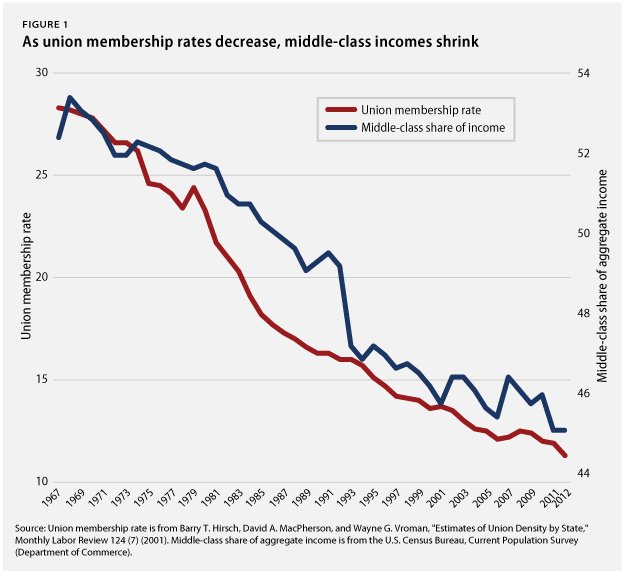
U.S. middle class & unions fall together

Correlation ain't necessarily causation, but... check out below how those red and blue lines have fallen in sync!

Big Business and Republican politicians who have taken swings at unions as "lazy" and "corrupt" and cut private union membership have in fact kneecapped America's middle class.  

With the exception of France, with its socialist welfare system and already strong labor laws, there is not a developed Western country with a lower rate of unionization than the U.S. at 11.3 percent.  The OECD average is 17 percent.

Meanwhile, Red State conservatives, many of them America's economic losers, swallow the GOP-talk radio explanation for falling U.S. incomes: Obamacare (yet to be enacted) and food stamps.  

Among the 254 counties where food stamp recipients doubled between 2007 and 2011, Republican Mitt Romney won 213 of them in last year’s presidential election, according to U.S. Department of Agriculture data compiled by Bloomberg.

These poor suckers don't know what's best for themselves or others.  There cannot be a strong U.S. middle class without unions.  End of story. 


By Caroline Fairchild
September 18, 2013 | Huffington Post  

This week the Census Bureau reported the latest depressing decline in middle-class incomes during the so-called economic recovery. But it may have missed an important factor in this story.

A report on Wednesday from the left-leaning think tank Center For American Progress notes that as middle-class incomes have steadily fallen, so have union membership rates. The middle 60 percent of households earned 53.2 percent of national income in 1968. That number has fallen to just 45.7 percent. During that same period, nationwide union membership fell from 28.3 percent to a record-low 11.3 percent of all workers.

Put these two economic trends together, and a striking image appears: 

unions middle income

Indeed, declining labor-union participation is not the only factor killing middle-class income growth. But increased union participation would likely mean more income for the middle class, the left-leaning think tank Economic Policy Institute argued in a 2009 report. Unions typically increase the wages of their workers while also raising pay for nonunion workers in industries with a strong union presence.

Higher union participation rates might also reduce income inequality. The U.S. has the worst income inequality of any county in the developed world, and the nation's top earners continue to see their pay rise as median incomes fall. Union participation could counteract this trend, according to the EPI.

So why is union participation declining so rapidly? Private sector union membership reached a peak of about 35 percent of the labor force in the 1950s, The New York Times reports. Since then, labor unions have steadily become smaller as many states have rolled out new laws limiting union power.

Young millennials' disenchantment with organized labor may also be an important contributor to its decline. From 2002 to 2012, union members ages 16 to 24 fell by 26 percent. That's double the decline in union membership for all workers, according to Quartz.

That said, younger generations may have a good reason to be less than eager to join a union. Studies have discovered that during the economic recovery, non-union workers fared considerably better than union workers in fields like manufacturing and private construction. Also, during the 1982 and 1991 recessions, states with fewer union members were found to recover more quickly than states with a strong union presence.

Problem solved?: GOP cuts food stamps

In case you weren't paying attention, the House GOP's vote on the annual farm bill showed us two things: 1) food stamps for hungry people are bad; and 2) agricultural subsidies for Congressmen and rich farmers are good. What do those two things tell us?

It’s the juxtaposition of the two programs that so clearly exposes the party’s agenda. Anti-government ideology can justify even the most vicious cuts to the safety net. It can’t justify the massive socialist scheme that is agriculture policy. And, to be fair, conservative intellectuals generally don’t justify agriculture socialism. But the Republican Party certainly does. The ultraconservative Republican Study Committee recently banned the Heritage Foundation from its meetings because Heritage denounced the GOP’s farm subsidies. There is a grim hilarity here: Republicans punished Heritage for its one technocratically sane position.

The GOP's stance on these two issues also belies their hypocrisy on social spending:

Obama has attacked the GOP farm-subsidy bill for spending too much. Here is the one chunk of social spending where Republicans are not only failing to issue hostage threats to secure the cuts they demand, they are also refusing to cut spending as much as Barack Obama asks. And the program they pick to defend is, on the substantive merits, the most unjustifiable program of any significant scale in the federal budget.

But that's OK, because this wasteful federal spending doesn't go to black ghetto queens: 

It is also one that accrues to disproportionately wealthy and overwhelmingly white recipients. (As opposed to Obamacare, whose beneficiaries are disproportionately poor and non-white.) 

That's really the only thing that matters to Republicans nowadays. Because it's clearly not about the numbers. It's simply a question of: could this federal spending possibly benefit a single brown-skinned person who games the system, no matter how many people genuinely need it? 

More broadly, Republicans' present meme that, If only we could repeal Obamacare and reduce food stamps, our economy would take off!, is completely asinine and without economic merit.  We liberals and Democrats must not let such idiotic thinking go unchallenged as a "credible" policy alternative!


By Jonathan Chait
September 20, 2013 | New York Magazine

U.S. needs an intervention on guns

About half of America is insane about guns and the other half cannot cure their illness:

There have been fewer than 20 terror-related deaths on American soil since 9/11 and about 364,000 deaths caused by privately owned firearms. If any European nation had such a record and persisted in addressing only the first figure, while ignoring the second, you can bet your last pound that the State Department would be warning against travel to that country and no American would set foot in it without body armour.

In fact, if we take the entire history of U.S. warfare vs. the past 50 years of gun deaths, our national sickness looks even worse:

The figures from Congressional Research Service, plus recent statistics from icasualties.org, tell us that from the first casualties in the battle of Lexington to recent operations in Afghanistan, the toll is 1,171,177. By contrast, the number killed by firearms, including suicides, since 1968, according to the Centres for Disease Control and Prevention and the FBI, is 1,384,171.

Porter believes it's time for the rest of the world to intervene and stop the bloodshed in America, since we Americans are mentally and physically incapable of ending it ourselves.


By Henry Porter
September 21, 2013 | Guardian