Showing posts with label mybudget360. Show all posts

Sunday, June 20, 2010

MB360: FDIC insolvent, hungry for taxpayers' $$$

Posted by mybudget360

The FDIC which technically supports the nation's banking system is for all practical purposes insolvent. I'm not sure the magnitude of this problem has sunk into the psyche of the American public. The FDIC insures accounts at banks that include checking, saving, and CD accounts from a bank failure. This has occurred with regular frequency since the recession started 29 long months ago. Some 247 banks have failed since 2008 with a total asset base of $616 billion. The government has tried to calm the unsettled waters by raising the regular deposit coverage from $100,000 to $250,000 even though the FDIC deposit insurance fund is in the negative. This seems to have calmed the nerves of people since the days of long lines at IndyMac Bank in California but nothing has really changed at least at the core of the financial system. To the contrary things have worsened for the banking system.

The list of troubled banks continues to grow:


Source: Fortune, FDIC

This chart tells us that we should be gearing up for another round of bank failures. The increase of deposit insurance from $100,000 to $250,000 is largely a charade. 1 out of 3 Americans have absolutely no savings whatsoever. We have 17 percent unemployed or underemployed and another 20 to 25 percent working in the low paying service sector. Nearly 50 percent of Americans have nowhere close to $100,000 in liquid assets to insure, so increasing the insurance to $250,000 is merely a public relations move to show strength.

The current amount of assets at troubled banks is over $400 billion but since the FDIC doesn't list all troubled banks this is much larger:


Source: FDIC

Now the above survey only goes up to the end of 2009. Since the start of the year another 82 banks have failed and the FDIC is probably at some undisclosed location somewhere in the United States right now getting ready to close another few banks since Fridays have become synonymous with bank closings. The list of troubled banks increasing is a reflection of the massive amount of troubled loans. These loans wouldn't be in such deep trouble if the economy was healthy and Americans were servicing their loans. But the middle class isn't really participating in this shadow recovery.

A recent survey by none other than the FDIC shows that a good portion of Americans don't even participate in the banking system:


" A substantial percentage of lower-income households are unbanked. Nearly 20 percent of lower income U.S. households—almost 7 million households earning below $30,000 per year—do not currently have a bank account. Households with earnings below $30,000 account for at least 71 percent of unbanked households.

Not having enough money to feel they need an account is the most common reason why unbanked households are not participating in the mainstream financial system."

Do these people care that accounts are insured up to $250,000? Who are we really protecting here? You also need to ask how we are going to pay for all these additional bank failures if the deposit insurance fund is already in the negative. That is where the Federal Reserve and U.S. Treasury step in with more of your taxpayer money.

The Federal Reserve attempts to paint this image as a government agency but they are not. They serve the purpose to protect the banking system. Even the Fed website gives us a nice little history on this:

"(Fed history) From December 1912 to December 1913, the Glass-Willis proposal was hotly debated, molded and reshaped. By December 23, 1913, when President Woodrow Wilson signed the Federal Reserve Act into law, it stood as a classic example of compromise—a decentralized central bank that balanced the competing interests of private banks and populist sentiment."

There is much more back history to this but suffice it to say that this move helped consolidate the power of banks into a few hands instead of having many more banks competing for your business. Keep in mind when this passed, the public was heavily against it just like the public was against TARP when this crisis rolled around. Yet the Fed listens to their big banks and protects them at all costs even if it means robbing the public blind (a sort of reverse Robin Hood). In the end after nearly 100 years of the Federal Reserve, the main purpose is nearly accomplished:


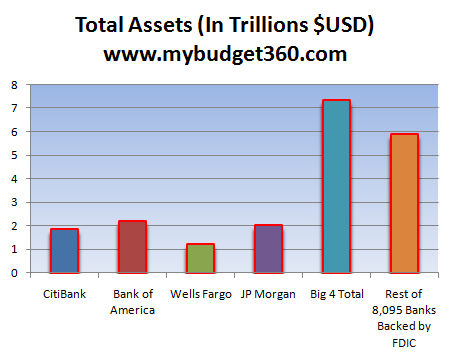
"The top 4 banks of Bank of America, JP Morgan Chase, Wells Fargo, and Citibank make up 55 percent of all banking assets."

And banking assets across the country are enormous. The FDIC backs 8,000 banks that carry over $13 trillion in assets. These big four banks have their hands in over 50 percent of this amount. Who controls the wealth in this country controls the levers of political power. The way the system is currently setup we find that the banks have an incredible amount of power. Actually, it is the biggest banks that have the big power since they are fine with hundreds of little bank failures since that opens up the market for bigger banks to step in and open up shop. Smaller banks don't have access to the easy money Federal Reserve window and certainly did not get handouts like many of the biggest banks did.

Foreclosures remain at record levels and this means banks are facing more and more loans that enter into default. This costs money. As we have mentioned, the FDIC is insolvent so where is this money coming from?

"(US Banker) Treasury likes it, the Federal Deposit Insurance Corp. likes it, and the banking industry likes it—that is, S. 541, introduced last week by Sen. Chris Dodd (D-Conn.) The bill would permanently increase the FDIC's ability to borrow from the Treasury for its Deposit Insurance Fund, raising the cap to $100 billion from $30 billion, the limit set back in 1991. The Depositor Protection Act would also temporarily allow the FDIC to borrow up to $500 billion after consultations with Treasury, the Federal Reserve, and the President.

FDIC chairman Sheila Bair voiced enthusiasm in a letter to Dodd, noting "the FDIC believes it is prudent to adjust the statutory line of credit proportionally to leave no doubt that the FDIC can immediately access the necessary resources to resolve failing banks and provide timely protection to insured depositors." Passage of the increased borrowing ability "would give the FDIC flexibility to reduce the size of the recent special assessment, while still maintaining assessments at a level that supports the DIF with industry funding."

And there you have it. I am certain that the banks are spending large amounts of money creating a way to couch this additional bailout as a helping hand for middle class Americans but in the end if we don't change the system, the money will flow through the same rivers as of those from the last decade. With so many bank failures lined up because of horrible commercial real estate and residential loans, we can expect to bail out indirectly failed casinos in Las Vegas and owning shopping malls in random parts of the country. The FDIC is flashing code red and they are lining up with hat in hand for taxpayer money. If after 29 months you still haven't gotten it, this money is likely to funnel up to the top 1 percent in an incredibly unbalanced fashioned.

Friday, February 19, 2010

MB360: U.S. middle class pays for all our sins

The Middle Class Two Income Trap – Two Breadwinners plus Extra Money to support the Banking Industry. How Middle Class Americans are losing Ground by Supporting the Financial Sector.

Posted by mybudget360

If it isn't enough that average Americans are contending with the rising cost of healthcare, education, and daily necessities like food now additional funds are going directly to the banking sector to keep them propped up like a money loving puppet. Since the Great Depression the rise of the middle class has been the envy of many people around the globe. The ability for hard working Americans to have access to an economy that supported them so long as they worked hard and followed an implicit guarantee with their nation. With this implicit guarantee it was assumed that the government would also protect people to a certain degree especially when it came to their financial well being. This did not assure a winning portfolio but it did mean we wouldn't turn our stock market into a giant game of casino where the connected had a loaded deck. Much of the strong regulatory arm that came from the Great Depression was because of the speculative gambling during the Roaring 1920s. Yet as time went on slowly Wall Street took these structures away and now we are finding ourselves once again with the middle class largely at risk in the United States. It isn't by accident we are in the situation we are in today.

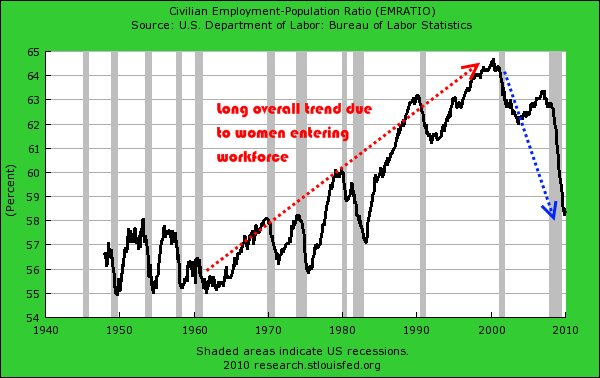
The first important thing to understand is that yes, the income of middle class families has gone up since the 1950s but a large part of this was the rise of the two income households with women entering the workforce:


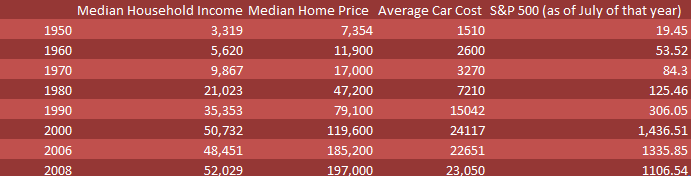
The above chart is disturbing in many ways because it bucks the nearly 50 year long-term trend of employment. Now, even with two income households many with rising job losses are finding they now have to make it with one income while inflation has eroded their buying power over the decades. In this recession 3 out of 4 job losses have been men. If you have any doubt regarding the insidious nature of inflation I put together a chart looking at various costs over the last few decades:


Part of this is due to the Federal Reserve and U.S. Treasury trashing the U.S. dollar over the decades. For example, in 1950 it took the median household income (which was largely a one income household) about 2 times the annual household income to purchase the median priced home. In 2008, it took the median household income (now largely a two income household) four times annual earnings to purchase the median priced home. In fact, the two income household has hidden a large part of how much the middle class has fallen behind in this country. Now with this recession, the deep cracks are now being exposed in the system.

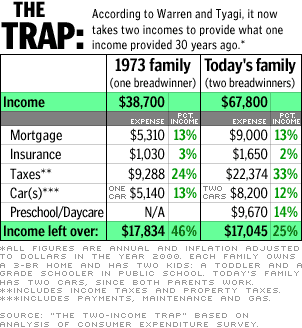
Income inequality has also risen in this country and a large part of it is due to the financial sector. 1 percent of our population control 42 percent of all financial wealth. In fact, in the last decade the only segment of our population that has seen any sizeable gains in true wealth is the top 1 percent. Every other category has seen a loss of housing net worth, wage stagnation, and higher costs for daily items that consume a larger part of their budget. Just take a look at the chart below showing this change:


Source: CNN

The above is looking at a one income household in 1973 versus the two income household in the 2000s. It is interesting to note that in the 1970s Nixon took the dollar into a purely fiat system and since that time, the dollar has lost much of its actual value. This would be expected. The Federal Reserve with its banking lieutenants has been able to put our country so deep into debt that realistically we are in a position of never paying back all our outstanding obligations. The only way out is via inflation and with a fiat system that is the path we are heading down. This is important because when you look at the charts above prices rise for various reasons and inflation is a hidden tax. No need for higher taxes to bailout the banking sector when you can just destroy the purchasing power of middle class Americans by monetizing enormous amounts of debt as we have done.

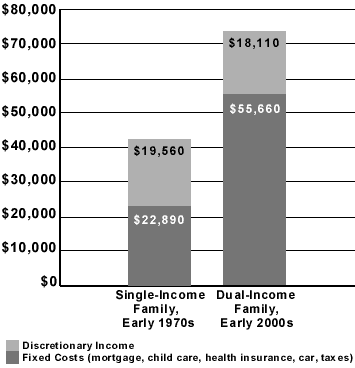
That is why in the next decade, Americans are now working for someone else beyond their immediate household. A large chunk of their money is now going to the banking sector. This can be in absurd payments to credit card companies, loss of purchasing power because of the Fed, or other hidden methods of taxing the public. We are really at a crossroads for the middle class. If we dissect the data further we realize that even though things cost more, much of it has been financed through debt:


Ironically the family in the early 1970s had more discretionary income than the family in the early 2000s even with a dual income. Yet if you look around, it isn't immediately apparent because of the massive debt bubble financed by the banking sector. Sure people bought bigger homes and newer cars but all this was under a phony veneer of success and was financed with debt. All of it was built around a mountain of debt. Yet here is where the big divide hits. Middle class families are now losing their homes through foreclosure. Many are having their cars repossessed because they can't make their payments. Bankruptcy filings are soaring because people cannot service their debt. So middle class Americans are paying the price with the rules that are setup. Yet banks are not. They are sucking the American taxpayer for all their horrible bets and are not dealing with the ramifications of their actions. In other words, the bill is going to the middle class as the middle class is dealing with their own bad decisions. This is part of the system built around the corporatacracy model of government. Losses are socialized while gains are privatized.

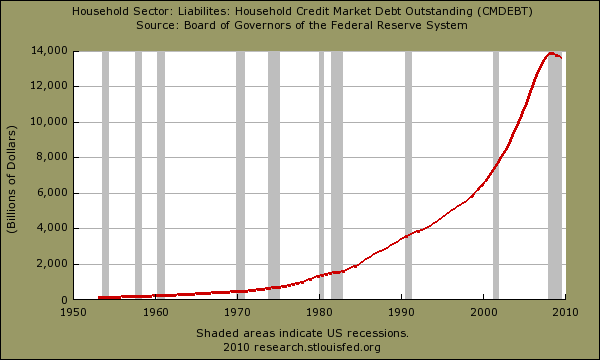
And don't kid yourself, this entire game was financed on debt:


And the small group of banks at the top now control a large portion of all FDIC backed assets in our country:


Source: FDIC, Bank Financial Statements

Forget about the Republican or Democrat parties, we are being governed by the financial sector of this economy. It is amazing how hard it is to get sensible legislation even after this great calamity. To prove this point, in California an insurance company announced they are hiking healthcare premiums by 30 percent in the midst of this recession even though they pulled in billions in profits. The government will sit back and let the middle class get fleeced because they are part of the problem. They speak a good game but are bought by the industry. Prove us wrong if this isn't the case. Enough talk, time for action. From now on we need to focus on who is delivering results. If you can, take your money out of the big banks and put them in local regional banks. Let your local representatives know that their number one priority should be focusing on protecting our struggling middle class. Time to get some real reform or we really risk losing our middle class.