Showing posts with label MB360. Show all posts

Friday, August 8, 2014

News digest / Catching up on news (08.08.2014)

Lately I can't keep up with my re-posting duties. Quickly, here are several stories you might have missed:


Federal Judge Rules Some College Players Are Entitled To Payment:  http://n.pr/V95KJ7 -- SOME JUSTICE!

How Big Is a $16 Billion Bank Fraud Settlement, Really?:  http://huff.to/1A036VM  -- NOT VERY.

FEAR: 11 TOP BANKS STILL TOO BIG TO FAIL:  http://huff.to/1zS8ZnU  -- TBTF HERE TO STAY, BY DESIGN.

Nine myths about the social safety net, annotated:  http://wapo.st/1pF1Cvr  -- OLD PEOPLE ARE THE BIGGEST WELFARE QUEENS?

Unwealthy in America: New study finds that Top 1 percent hold 37 percent of nation’s wealth. A quarter of US families feel they are under economic stress caused by the Great Recession:  http://www.mybudget360.com/unwealthy-in-america-wealth-in-united-states/?utm_source=feedburner&utm_medium=email&utm_campaign=Feed%3A+mybudget360%2FQePx+%28My+Budget+360%29  

The Conflict In Gaza Explained In One Map:  http://huff.to/1ASuhTK  -- UNLESS IT'S A MAP DERIVED FROM THE OLD TESTAMENT, I'M NOT INTERESTED.

Your chicken is about to get more full of feces:  http://gu.com/p/4v9ex  -- YUM!

Sunday, June 8, 2014

Our McJobs economy...and the GOP plan to make it worse

My dear conservative friends will blame the shrinking middle class and more McJobs on Obama, naturally. 

But to see they're wrong you only have to look at their policy "fixes": no minimum wage; no guaranteed health insurance for workers; no right to unionize; and privatizing Medicare.  Oh, and cutting unemployment benefits to motivate more people to compete for low-wage jobs, thereby driving wages down even further. The most radical Tea Partiers even say we should abolish the Department of Education, when U.S. public schools are most people's shot at a better life.  

None of these ideas makes any economic sense.  (It makes a heckuva lot of sense from a class warfare perspective, however.)  And in the case of conservatives' debt fetish, they confuse economic cause and effect: debt causes recessions, not the other way around.

So they can't diagnose the problem, nor can they prescribe any cures.

But wait, they have more great ideas. Cutting "job-killing regulations" and income taxes on the rich should stimulate growth, then all the unemployed could get jobs in the new businesses that Republicans say their hands-off policies would create.  Yet we tried that before and saw how it worked out.  

Conservative talk radio says we can all move to Texas or North Dakota and find high-paying jobs in the shale gas boom, but that's hardly practical. Most people can't just pick up and move their entire lives, like Okies of the Depression era, to where the jobs are.  Doesn't matter. Republicans want to open up even more public lands for oil & gas drilling, even though that oil is sold by multinational corporations on the world market; it's not "ours."

Or as I like to sum it up, the GOP thinks we can cut and burn our way to a better economic future.  


David Nather over at Politico put it thusly in his article, "And the GOP economic plan is...?":


It’s the sixth year of Barack Obama’s presidency, the job market is still sluggish, most Americans say they’re unhappy with the economy, and Obama’s approval ratings are down. So what’s the Republican plan to turn it around?

The answer is, they don’t all think they need one and those who do can’t agree on a unified view.

This is why it's so ominous that Republicans, thanks to gerrymandering and stronger off-election turnout, could take over Congress in November.  I'm not saying they're solely responsible for the Great Recession, (although Phil Gramm could certainly make a case), but they certainly haven't learned any economic lessons from it, and that's scary. This is a party that's pissed off yet feels zero responsibility for its policies -- it's a veritable chimpanzee with a hand grenade.... And they have as many good ideas as a chimp how to grow the middle class and get Americans back to work.


Posted by mybudget360 | June 8, 2014

The US is slowly becoming a McJob nation. While the press jumps up and down that the US is now finally at a breakeven point from the jobs lost since the recession started in 2007, they fail to mention that those not in the labor force is up by nearly 13 million. Even looking into the recent employment report, we continue to find a heavy trend of hiring in low wage employment sectors. For example, 32,000 jobs were added in “leisure and hospitality” bringing the annual total of jobs added to 311,000. Another 21,000 jobs were added in social assistance which pay very little but will grow as demand for health support grows by an aging populationThe system at least in the eyes of Wall Street and the government is working perfectly fine. We have a plentiful supply of low wage labor while laws and bailout mechanisms are in place for the financially and politically connected. The middle class continues to fall off the bandwagon one by one and enters a labor force of permanent low wage labor with very little prospect of a decent retirement. In fact, most will be working until all the wheels come flying off. We also find that 1 out of 4 Americans are working in jobs that pay $10 or less per hour. How about trying to earn the Americans Dream on that McJob salary?

Breaking even and seeing the non-labor force surge

It has taken us 7 slow and painful years simply to recover the jobs we had back in 2007. With the latest jobs number, we finally are back to where we were in 2007. Of course, the population has increased and many of these new jobs come with horrible benefits, lower wages, and very little security. Is it any wonder why home buying in the country continues to be so anemic?

Low wages are also creating an entire nation that is unprepared for retirement. For example, 1 out of 3 Americans has zero dollars in their savings account. Half the country is one paycheck away from a financial avalanche. During the last 7 years, we have added close to 13 million Americans to the “not in the labor force” category:

record jobs in context
Source:  BLS, ZH

A part of this growth is an older population but a large part of it isn’t. We have many digging into college degrees with massive debt to avoid the current economic situation. Others have simply given up looking for work. The low wage recovery has been extremely painful for many Americans and wealth growth has not occurred for 90 percent of the country. These are simply the facts. This is what we find in every piece of data we look at.

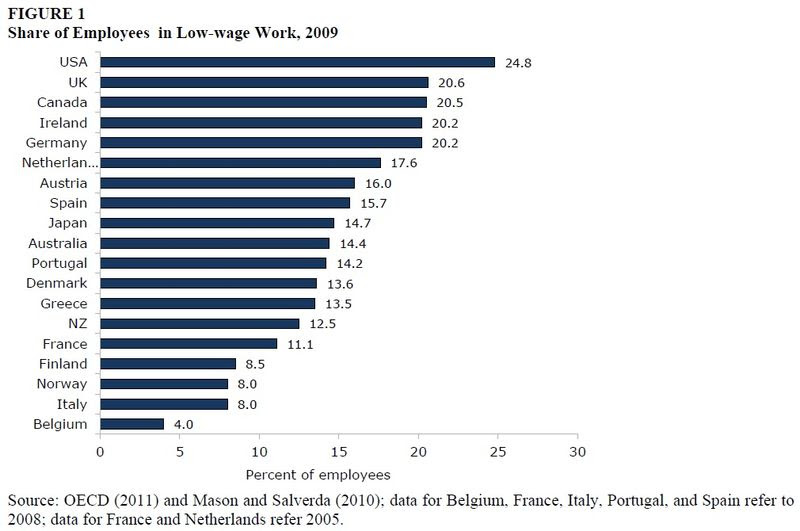
Economist Tim Taylor presented a chart highlighting that the US has a very high portion of its population working in low wage jobs. This is contrary to the image that the US is a land with middle class jobs for many:

low-wage-2
low-wage-2

Low wage work as defined in the data set above is employment that pays less than $10 per hour. Imagine trying to support a family on this. 2,000 hours of work would yield $20,000 which is below the poverty line for a family of three. And then we wonder how we have roughly 47 million Americans on food stamps.

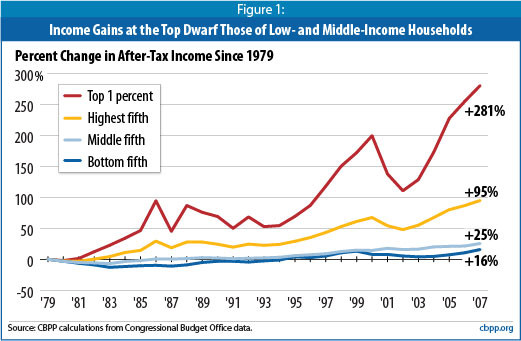
The reason we continue to see this kind of recovery is that all policy made during the collapse was dictated by those in the banking industry that led up to this collapse in the first place. Even former Treasury Secretary Tim Geithner mentioned that if we didn’t do the bailouts exactly as we did (i.e., keep big payouts to banking execs, money for corrupt workers, etc) then the economy would have imploded. Well the economy did implode for most workers and a recovery never happened. Maybe for his closely knit group of people things are looking great:

growth-in-income-inequality

But for the rest of country people are running the Red Queen’s Race by working harder and harder simply to stay in the same place. A McJob recovery is not something to be proud about especially when the middle class in the US continues to dwindle.

Tuesday, March 18, 2014

Tuesday, December 31, 2013

MB360: U.S. income divide is a yawning chasm

Here MB360 reminds us how the U.S. middle class has disappeared in our new Gilded Age of wealth inequality, where the top 10 Percent own 75 percent of all wealth [emphasis mine]:

Since the 1950s the trend has only moved in one direction.  People often talk about top tax brackets and how high income taxes are but if you look at the above chart, the average tax rate for those in the top 1 percent is 23.5 percent.  How is that when the top tax bracket is 39.6 percent?  First, many people have better methods of tax avoidance: IRAs, 401ks, dividend income, real estate deductions, etc.  Since the bulk of wealth is in the hands of the top 10 percent, this group is already lowering their tax burden via these deductions and beneficial tax structures.  Since the typical American is living paycheck to paycheck with little saved for retirement these tax reducers don’t really help.  Besides, their income tax burden share is minimal.  However, their other tax burdens are large as a proportion to their income.  This is usually ignored when people talk about how little the working class pay in this country as they try to scapegoat the disappearing middle class.

More to the point, the middle class by definition should be well, the middle.  In this case, being middle class is a household making $35,000 or more.  We often hear about $250,000 being middle class by the media but by the IRS tax data, this is closer to being in the top 2 percent of AGI.  Not exactly middle class when 98 percent are below you.  Even if we look at the bottom 75 percent, the cutoff here is $70,492; certainly a far away cry from $250,000.  Or even the top 5 percent starting point of $167,728.

Remember the 2012 presidential campaign when Romney said, amazingly, that the middle class was any household making "$200,000 to $250,000 and less"?  And less, indeed. The media didn't put his absurd comment in context, although the IRS income data was right there for them to see -- probably because the Obama campaign's definition of middle class was basically the same. 

Folks, U.S. economic inequality is still the elephant in the room; it was the most under-reported story of 2013.

Happy New Year!  Let's hope it's a more equitable one.


Posted by mybudget360 | December 31, 2013

Sunday, December 1, 2013

MB360: Americans back to spending on credit

Any economist, pundit or politician who tells you that our economy would get better if we could only increase access to credit (debt) or "incentivize" poor people to work while cutting their food stamps and the minimum wage, is either a charlatan or an idiot.

What happens when Americans, as a nation, start saving and stop spending on credit is economic stagnation or recession. So we must increase Americans' household incomes, and/or lower their household expenses to allow them to continue spending. After all, the well-off can buy only so many houses, yachts and luxury goods. Yes, they can save and invest in stocks and other securities... but their investments won't translate into U.S. jobs and economic growth if there is no market (consumer demand) to drive it. 

Indeed, the Dow just hit a record high, corporate profits and U.S. workers' productivity are at all-time highs, and yet... nobody is doing an economic endzone dance right now. Working class Americans feels more economically insecure than ever.

And that's why Obamacare is so necessary, among other federal programs.  

According to a 2013 study by the AARP, over the past 10 years, health care spending for average middle-income households increased 51 percent, compared to only 30 percent growth in household income. Over that same period, healthcare inflation increased three times the rate of growth for all other products and services; and per capita expenditure on health care increased 72 percent! 

We must cut our per capita expenditure on health care while protecting average Americans from treatable illness and medical bankruptcy. Only the Democrats are proposing real solutions to do that.  Republicans keep dawdling while Americans are dying and drowning in debt.  

Under President Obama, the rate of healthcare inflation has finally slowed and is projected to slow further. Coincidence?


Posted by mybudget360 | December 1, 2013

Sunday, September 15, 2013

MB360: Looming U.S. retirement disaster

In this context, cutting Social Security makes even less sense.  Just like with health insurance, the private sector has foisted this responsibility onto its employees, and the federal government.  


Posted by mybudget360 | September 15, 2013

Americans are on the verge of a retirement disaster.  As pension plans slowly go extinct Americans are not saving enough for retirement.  The figures point to a looming pension and retirement disaster.  Retirement for most Americans is largely a mirage.  As organizations switched from pensions to 401ks it was expected that most Americans would save money. This trend started in 1980 and over 30 years have now passed.  We now have enough data to see if this transition has been beneficial to most Americans.  Unfortunately the answer highlights an American population that has not saved enough for retirement.  Most Americans will make Social Security their default retirement plan.  Pension issues also loom as many state governments contend with deep underfunding for retirement benefits.  In the end, there is a disaster looming.

The disappearing pension

Very few Americans now have access to a pension.  This wasn’t always the case:

pensions
Today, less than 10 percent of Americans have access to a pension.  Most however have access to 401k plans and other retirement options.  Unfortunately as the middle class shrinks more Americans are finding it more difficult to save any money.

Social Security unfortunately is going to become the default retirement plan for many.  Many current pension plans are setup with unrealistic returns.  Many states are underfunded in spite of the dramatic returns in the stock market:

underfunded

Keep in mind there is simply no way the stock market can continue producing returns as it has. It is simply impossible and already ratios are getting inflated showing a slight exuberance.  As the chart above highlights, many state pensions are underfunded and if the market even has a slight correction, this will exacerbate the problem.

Beyond the above data that only impacts a small number of Americans, most simply do not have enough (or anything) saved for retirement.

The lack of savings in retirement accounts

Without pensions many Americans are left to fend for themselves via retirement accounts.  How has this worked out?

retirementcrisisJ

These are disturbing figures.  The median amount saved by all Americans is $3,000 for retirement!  Even those nearing retirement in the 55 to 64 age group have roughly $12,000 to get by in their later years.  In other words, many are going to be working deep into old age.

A lot of this can be attributed to the lack of income being made by most Americans.  As we have seen income inequality is at record levels, even higher than it was prior to the Great Depression.  It is simply hard to get by when the per capita wage is $26,000 and the cost of living continues to increase without any wage increases.  Getting by is priority number one, not a far off retirement.

Retirement dreams pushed out

As you would imagine the retirement age is being pushed out:

at what age did you retire

It is becoming tougher for Americans to retire and there is less of a safety net.  Since the retirement amount saved is so low, many are going to depend on Social Security as their main income stream in their later years.  Much of this money is going to be paid by a younger and less affluent generation.  You can already see this disaster lining up.  As young people struggle, how will they feel when they see pensions going out while they struggle to find work?  If you think you have heard the last of this think again.

Thursday, August 29, 2013

MB360: FIRE sector is back, big time

MB360 gives us great stats to illustrate starkly the so-called financialization of the U.S. economy: 

In 1947, the FIRE side of the economy made up roughly 10 percent of GDP. Today it is 21 percent.  On the other hand manufacturing in 1947 made up 25 percent of GDP while today it is closer to 11 percent.

Near-zero interest rates by the Fed and TBTF bank bailouts are direct federal government aid to the FIRE sector.  It's called socializing risk and privatizing rewards.  

Meanwhile, bizzaro conservatives assure us that if only Americans would stop being so lazy and collecting food stamps, then our economy would turn around. [Facepalm].  Foks, this is government-sponsored upward redistribution of wealth.  

If only the Tea Parties would brandish their pitchforks over the real redistribution problem in America!


Posted by mybudget360 
August 27, 2013

The current economy is juiced on the rivers of easy debt.  An addiction that is only getting worse.  Want to go to college?  You’ll very likely go into deep student debt given the rise in college tuition.  Want a home?  Prices are soaring because of speculation but you’ll need a bigger mortgage to buy.  Want a modest car? A basic new car that has four wheels will likely cost $20,000 after taxes after fees are included.  Need gas for that car?  The price of a gallon has quadrupled since 2000.  Combine this with the reality that half of Americans are living paycheck to paycheck and you can understand why the debt markets continue to grow at an unrelenting pace.  Here is some food for thought; in the last 10 years, GDP has gone up $5.2 trillion however, the total credit market has gone up by $24.5 trillion.  An increasingly large part of our economic growth is coming from massive leverage.  This is why the market sits fixated on the Fed’s next move regarding interest rates even though in context, rates are already tantalizingly low.  The FIRE economy is driving a large portion of corporate profits yet most Americans are left in the cold winds of austerity.

GDP being driven by FIRE

More and more of our growth is coming from a massive expansion of debt:

total credit market debt owed

The total credit market is now roughly 4 times the size of our annual GDP (inching closer to $60 trillion in the US).  While some think that this growth is natural and easy, in reality most of it is coming from growth in the financial services side of the economy.  The banking system is currently operating in a way that really does not benefit the typical Americans family.  Take a look at two employment sectors over the last few years:

fire-economy

In 1947, the FIRE side of the economy made up roughly 10 percent of GDP.  Today it is 21 percent.  On the other hand manufacturing in 1947 made up 25 percent of GDP while today it is closer to 11 percent.  It comes as no surprise especially as we now see big banks and hedge funds crowding out the real estate trade.  Prices in real estate continue to rise at levels last seen during the bubble yet the homeownership rate continues to fall.  We keep adding more and more Americans as “non-workers” and then wonder why we have 47 million on food stamps:

not in labor force

The number of Americans not in the labor force is booming because of demographics but also because people are dropping out of the workforce.  This certainly doesn’t coincide with some of the data being produced from other channels.

The reason why most Americans are not feeling the recovery trickle down to them is that the FIRE side of the economy is capturing a large share of the profits (more fuel for the growing income inequality trend).  Just take a look at how much of the recent growth has come courtesy of financial engineering:

Corporate-Profits-GDP-081613

Corporate profits as a percent of GDP are at generation high levels.  Yet GDP growth is weak (especially if you consider how much growth is coming from FIRE activity).  This is reflected in stagnant household income growth and the reality that wealth continues to shift into the hands of a very few Americans.

Redoing the last bubble

The problem with all of this is that we are simply redoing the last bubble.  This is a similar variation of our last bubble (i.e., financial sector deep into speculation, quickly rising real estate, no income growth, leveraging on debt, etc).  The finance and real estate side of the economy is driving profits and speculation, yet we see that for most Americans, the gains are simply not there.  This is just part of the financialization of our current system.  It is odd that big banks and firms are so interested in rental real estate yet they can extract money from Americans via this measure because the Fed is basically offering zero percent rates to member banks.  In other words, it is a riskless trade so why not grab all the real assets you can while the Fed continues to devalue the purchasing power of Americans?

The FIRE economy is back in a big way.  Of course you shouldn’t be surprised that this isn’t helping most Americans prosper.

Wednesday, August 21, 2013

MB360: Americans unprepared for retirement

MB360 brings us some shocking figures on U.S. retirement savings:


retirementcrisisJ


What we find in the above chart is that most Americans are flat broke when it comes to saving for retirement.  You might say that those 25 to 34 years of age have simply avoided dealing with the future.  However, this is the most indebted young cohort of Americans we have ever seen largely due to student debt.  Yet look at the other age brackets.  The median amount saved for those 35 to 44 is $1,400 (one month of rent and food in many parts of the country).  Those 45 to 54 do a little bit better coming in at $10,100.  Those 55 to 64?  About $12,000.

In total, the median saved for retirement by all US households is $3,000.

Even those with retirement accounts (obviously a small figure) have a median amount saved of $40,000.  The $3,000 figure should shock people into realizing that programs like Social Security are going to become the default “retirement plan” for millions.


But should we really be surprised?  How many U.S. generations have experienced what is now considered a real, comfortable retirement, where savings combined with Social Security and Medicare allowed them to live out the last 20 or so years of life in comfort and security?  One generation?  The Baby Boomers are entering retirement now.  Let's see how well they do.  But it doesn't look good for them, not good at all. 

We need to re-think classical retirement, which is not classical at all, just an ideal that one or two generations of Americans managed to enjoy, and which now, thanks to demographics and cuts to Social Security, the Great Recession, fewer pensions and rising health costs, will soon cease to exist entirely.  


Posted by MB360
August 21, 2013

Sunday, June 30, 2013

MB360: Record-high delinquency of student loans

I don't necessarily agree with MB360 that student loan debt is a "bubble" in the sense that speculation is driving up prices beyond any underpinning value.  A few weeks ago, Law professor Charles J. Reid explained why:

Student loans, however, are not like this, for the simple reason that they are non-dischargeable in bankruptcy. They are not a bubble and cannot become one. What they can become -- and show increasing signs of actually becoming -- is an anchor that is sinking the fortunes of an entire generation.

But just because they're not a bubble doesn't mean these levels of indebtedness are not extremely worrying. They are.  These delinquency rates mean that graduates are not getting the kinds of jobs they thought they would get thanks to their expensive degrees.  If higher education is not the key to employment and higher income, then what is?  So far, our nation does not have another answer.


By mybudget360 
June 30, 2013

If the news for college graduates couldn’t get any better.  Our woefully motivated millionaire Congress is unable to figure out what is necessary to stop the doubling of interest rates on student debt.  While the Fed can turn on a dime to rectify zero percent interest rates for member banks, trying to help the youth of the nation well, that is just too hard to do.  Milling around through the data I found that for the first time in history, student debt had the highest delinquency rate of all household debts.  This is a big deal given that Americans now carry over $1 trillion in student debt and most of it is in the hands of the young.  At the nucleus of this argument is that people are going into too much debt to finance their educational pursuits.  Collecting tips at the Olive Garden is not exactly going to payoff that $50,000 in student debt.  How is it that the Fed can subsidize big banks with zero percent rates so they can speculate in real estate and other ventures while college graduates are now faced with the doubling of interest rates?

Half of college graduates not utilizing degree

Part of the problem is the voting power (or lack of it) from younger Americans.  Many simply do not vote.  And the baby boomer cohort is guiding many policies through elected officials although they only serve a tiny pizza slice of the baby boomers at that.  So with that said, the voice of the young is largely drowned out by big business and higher education has turned into a very lucrative private-public venture.  With that as our backdrop, half of college graduates are not utilizing their increasingly more expensive degrees:

college graduates underemployed

Half of recent college graduates are either unemployed or underemployed.  And recently many have given up on pursuing careers where their degrees would be utilized and have taken up other jobs.  Other jobs that would have gone to lower skilled workers.  And of course, these workers get pushed down into a lower level of the economic ladder.  And what a shocker that as we go into the various levels of Dante’s Economic Inferno we find that 47.7 million Americans are on food stamps.

The above chart is rather sobering because many recent graduates are leaving school with high levels of debt.  Incomes for many of these graduates are not justifying the sky high rates of tuition at many schools.  Education is still a worthy venture and that is why people continue to go into high levels of debt for this.  Yet our banking system has been rather obsessed with one sector of our economy since the tech bubble burst in the early 2000s.  Real estate has seemed to dominate every big decision in the last decade to the detriment of creating an economy where millions of jobs are added to meet this more educated workforce.  That has clearly not happened.  Colleges are not going to turn their back on willing students with fresh loans in hand.  And I suppose that is the point.  Easy access to debt is like an aphrodisiac for the industry.  Go to any college campus and you will see palatial stadiums and massive buildings.  Do Olympic sized pools make people discover cures for modern diseases quicker?

What is even more troubling is that the underemployment rate for recent college graduates has trended up in the last few years while the overall unemployment rate has fallen:

recent college grad data

No, we are not looking at a chart of Spain or Greece but a chart of US recent graduates.  A large part of the decline in the unemployment rate has come because the civilian employment population ratio continues to lower:

civilian pop ratio

While many older Americans have dropped off the radar, many recent graduates simply do not have this option.  Many over the last few years have clearly opted to take on jobs that are underutilizing their degrees.  Does that mean they overpaid for their education?  $1 trillion in student debt seems to give us an answer that not only did many overpay, they didn’t even have the funds to afford it in the first place.  Higher tuition would make more sense if wages were also rising but that doesn’t seem to be the case with the new batch of graduates.  And many are falling into student debt quicksand and are unable to pay the loans they now have.

The most delinquent of them all

Student debt before the 2000s hit was typically a safe financial bet.  Delinquencies on student debt reflected this.  Today, we now find ourselves at the precipice of another bubble with student debt having the highest delinquency of any form of household debt:

student loan bad debt

You can see this rate doubling only in the last few years.  Keep in mind this is occurring without the potential doubling of student loan interest rates.  Rates are set to go from 3.4 percent to 6.8 percent if Congress does not act.  Amazingly, they are able to act quickly when it comes to the interest of large banking but to help the young in our nation?  No, let us go on holiday break and see what happens.

The rising delinquency rates are simply the last straw in the student debt bubble.  This is a bubble.  When you have prices soaring without any underlying economic change, you have a big problem on hand.  Keep in mind that what you can afford and the price of something are fully disengaged since the government will lend pretty much whatever is necessary to go to school.  If the cap was $100,000 a year, you can rest assured you will have some for-profits cropping up with $100,000 a year degrees.  Record delinquencies and half of recent graduates working in jobs where a massively expensive degree is not being used does not bode well for higher ed at the moment.  No one has a crystal ball on how this will play out but you can rest assured that something is going to give.  You don’t need a college degree to figure that one out.

Saturday, May 18, 2013

MB360: US student debt grew 284% from 2004-13

The facts behind the mountain of student debt: 13 percent of students owe more than $50,000 and nearly 4 percent owe more than $100,000. Student debt grew by 284 percent from 2004 to 2013.
Posted by mybudget360 
May 18, 2013

Many Americans view a college education as a way to build a better life.  College is seen as an avenue for better prosperity and the ability to pull yourself up beyond your current circumstances.  In fact, after World War II programs like the G.I. Bill allowed many Americans the opportunity to pursue a college degree.  In many cases, the United States at this time developed the largest middle class the world had come to know.  This is still the case today but the economic trends show a shrinking middle class that is largely having a tough time competing in this quickly globalizing economy.  One fact that stands out is that back in 2004, student debt was the smallest portion of all non-housing related debt in the US.  Only a short nine years later, student debt is the largest portion of debt in non-housing related debt.  What happened in this short period of time and what information can we pull from the mountains of student debt information?

Student debt and the decade of massive growth

One could argue that every segment of the economy experienced a growth in debt over the last decade.  That is not true.  Let us examine non-housing related debt carefully:

non-housing debt and student debt

Source:  Federal Reserve, Equifax

This is an interesting chart.  What we find is that Auto debt was the largest debt segment in 2004.  This was followed up by credit card debt and then other debt.  Student loan debt at this time was $260 billion.  In total, student debt made up 12 percent of all non-housing related debt back in 2004.

Fast forward to where we stand today:

non-housing debt and student debt 2

Source:  Federal Reserve, Equifax

Student debt is now by far the largest portion of non-housing related debt in our economy.  Student debt is now well above $1 trillion.  The growth of student debt in this short window was 284 percent.  Student debt now makes up a stunning 36 percent of all non-housing related debt.  What is interesting then is when we compare this to the growth of the other segments of non-housing related debt:

Growth between 2004 and 2013
Non-housing related debt
Auto loans:       9%
Other:              -31%
Credit Card:     4.5%
Student Debt:  284%

In essence, nearly all the growth in non-housing related debt over this time has come from student debt growth.  This makes the following data more troubling regarding the amounts of student debt by tiers but also the rising number of delinquencies:

“(NY Times)  According to the Federal Reserve Bank of New York, almost 13 percent of student-loan borrowers of all ages owe more than $50,000, and nearly 4 percent owe more than $100,000. These debts are beyond students’ ability to repay, (especially in our nearly jobless recovery); this is demonstrated by the fact that delinquency and default rates are soaring. Some 17 percent of student-loan borrowers were 90 days or more behind in payments at the end of 2012. When only those in repayment were counted — in other words, not including borrowers who were in loan deferment or forbearance — more than 30 percent were 90 days or more behind. For federal loans taken out in the 2009 fiscal year, three-year default rates exceeded 13 percent.

America is distinctive among advanced industrialized countries in the burden it places on students and their parents for financing higher education. America is also exceptional among comparable countries for the high cost of a college degree, including at public universities. Average tuition, and room and board, at four-year colleges is just short of $22,000 a year, up from under $9,000 (adjusted for inflation) in 1980-81.”

Averages do hide a lot of the facts but what we can deduct is that the 13 percent that owe more than $50,000 and the 4 percent that owe more than $100,000 have largely come in the recent decade.  While the cost of tuition has soared in this short period of time a large part of it has not corresponded to actual earnings:

college grads and earnings

What is interesting about the above chart is that real tuition is up (with new data) by close to 70 percent while real earnings are roughly the same as they were back in 1991.  So over a 20 year period college costs have soared but the return doesn’t seem to justify the rise.  We also have the proliferation of non-profit schools that target lower income Americans and provide them a questionable level of education.  Yet this is only one small part of the larger issue.  The addiction to debt.  We have discussed how this recession has hit young Americans incredibly hard.  In the current marketplace it has become hyper-competitive and expensive while starting salaries have fallen behind when it comes to inflation.  The rising number of delinquencies also shows that many students are simply unable to pay their debts.

If student debt were to grow at the current rate, we would be at $3.84 trillion in student by 2023.  Do you think that is sustainable?  If not, something has to give.

Tuesday, January 1, 2013

MB360: U.S. income, 'fiscal cliff,' and the Little Guy

These U.S. income stats are important for us Average Joe's to keep in mind during the so-called "fiscal cliff" negotiations that may have been resolved by Congress early this morning.  

To recap: the Republicans have been ready to impose higher income taxes on all Americans in order to exempt households earning between $250,000 and $449,000 -- that's already the top 1-2 percent of income earners -- from paying a 39.6 percent marginal tax rate instead of the current 35 percent.  (For the record, the One Percent includes anybody making more than $350 K a year). 

Meanwhile, the median U.S. wage per person is about $27 K. Sixty-six percent of individual Americans earn less than $42 K a year; and 68 percent of households earn less than $75 K a year.  If the "middle class" means the middle of the U.S. income distribution, then these are the very people we should care about, not the Two Percent!

Think about that: Republicans have been adamant to scrap any deal on taxes and spending -- to the detriment of the middle and working class! -- that raises income taxes on the top Two Percent of all Americans. They show their true colors. The GOP is not the party of the Little Guy, but rather of the selfish elitists.

UPDATE:  Said President Obama at 11:21 EST today, after the GOP-led House voted to pass a 'fiscal cliff bill:'
"I will sign a law that raises taxes on the wealthiest 2% of Americans while preventing a middle class tax hike that could have sent the economy back into recession and obviously had a severe impact on families all across America."
Except we know he's fudging a bit, since this bill saves mostly the One Percent, those making over $350 K a year, keeping the Bush tax cuts in place for anybody making under $400 K a year.

Let's hope our President sticks to his guns and won't let the insane Republicans in the House use the debt ceiling as negotiating leverage when this kick-the-can bill expires two months from now....


Sunday, October 14, 2012

Median, middle and 'moochers'

MB360 has given us some hard income data to mull over:

  • 2011 Census data says the the median U.S. household income is $50,500; that means half of U.S. households make more, and half less than $50,500.
  • 2010 Social Security data says the median worker's income is $26,000.
  • An individual making more than $250,000 is in the top one percent of all earners in the U.S.  
  • A household making more than $250,000 per year is in the top two percent of all U.S. households. 
  • A household making more than $100,000 is in the top 20 percent of all U.S. households.
$250,000 and $100,000 are common cut-off points in political discussions about who is really middle class, and who deserves a tax cut or a tax hike.  

Mitt Romney told ABC that, "Middle income is $200,000 to $250,000 and less."  (A person making $200,000 or more is in the top four percent of U.S. income earners.) Obama more or less agrees with Romney.  By their definition, 96 percent of Americans are middle class.  That's ridiculous on its face.

More to the point, do average Americans believe that the top 1-2 percent need and deserve a tax cut right now?  Both Obama and Romney do.  I don't.  

Does it even make sense to regard a household earning $100,000 -- double the median household income -- as middle class?  Probably not, relatively.  

Meanwhile, we have 46.7 million Americans receiving food stamps, and 56 million receiving Social Security.  That's about one-third of the U.S. population. That's not to mention 48 million Americans on Medicare, and about 4 million on Medicaid.  Meanwhile, 60 percent of those 65 or older receive at least 75 percent of their income from Social Security. How low would U.S. median income be without these programs?  It's frightening to think about how insecure most Americans are, financially.

Here's what these programs cost, or, to put it in Republican terms, how much wealth they redistribute:

          TOTAL:  $1.8 trillion

But what about the deficit?  As a Bloomberg study revealed, "the rise in the deficit -- from an average of 1.9 percent of gross domestic product in the pre-crisis years (2005 to 2007) to 9.3 percent of GDP post- crisis (2009-2011) -- is almost entirely due to the economic decline, which drove down tax receipts and pushed up spending on unemployment, food stamps and other support programs."

But we already knew that, right?  We must know that 33 percent or 47 percent or whatever share of Americans didn't suddenly become lazy moochers while Obama went on a wild spending spree.  No, it's that suddenly our economy got very, very bad: shrinking 6.3 percent in 2008 alone, erasing $15.5 trillion in U.S. wealth, costing 8.8 million U.S. jobs, and dunking 24 percent of houses -- most Americans' most valuable asset -- underwater.  

Given all this, it is madness to suggest that the answer to our economic malaise is to cut spending for needy Americans while reducing taxes for Americans making $200,000 or more.  

Tuesday, August 28, 2012

MB360: Commercial bank deposits hit $9 trillion...

... so why aren't banks lending to businesses and consumers?  And how is the Fed's continued zero-interest rate policy supposed to change things if, combined with the bailouts, it hasn't already?  

Says MB360:  "Banks have the means and ability to lend if they only had the desire to do so.  In spite of the US public bailing out the entire banking edifice, they have little faith in the American public."

Tuesday, June 12, 2012

MB360: 'Austerity for you, social welfare for the connected'

Right on, MB360!:
By the time people wake up from this slumber there will be no middle class.  The propaganda on the media tries to program people to feel guilty about having affordable quality education, access to healthcare, and the ability to purchase a home without going into hock for the rest of their lives.  Apparently what was once considered staples of the middle class is now washed away in the honor of "global competition" while major financial institutions are protected under the shield of government welfare and major paydays for CEOs.  Austerity for you and social welfare for those who know how to work the system.  As the net worth data highlights, not everyone is hurting from this new austerity world.

How to lose 40 percent of your net worth in 3 years – Americans see their net worth collapse during the recession. Federal Reserve survey highlights a case of austerity for the masses and social welfare for the politically connected.
June 12, 2012 | MyBudget360
URL:  http://www.mybudget360.com/american-median-net-worth-2012-net-worth-falls-40-percent-grows-at-top/?utm_source=feedburner&utm_medium=email&utm_campaign=Feed%3A+mybudget360%2FQePx+%28My+Budget+360%29

Monday, February 13, 2012

MB360: United States of Dollar Stores


Posted by mybudget360
February 12, 2012

Before 2000 dollar stores were largely seen as a bazaar of quirky trinkets and plastic oddities. Many sold excess volume of products, even selling old Super Bowl t-shirts of teams that did not win. Yet the dollar store of today is not the one of even one decade ago. The disillusionment of the middle class and the rise of a low-wage American worker base have created a booming business for dollar stores. Customers from more affluent backgrounds are now shopping at these stores because of an economic caution about their declining purchasing power. Even in the midst of the boom in the stock market we still have over 45,000,000+ Americans receiving food assistance. I talked about this large segment of our population in EBT Nation. What does the rise of the dollar store tell us about the future of the American economy?

Dollar Store growth

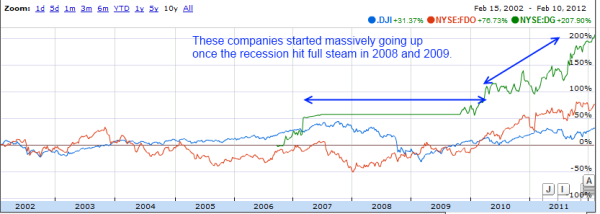
Dollar stores have been around for many decades but the surge in big name dollar stores really hit a full head of steam once the recession arrived:

dollar general and family dollar chart stock

You can see that the two leading dollar stores, Dollar General and Family Dollar hit full stride after 2008. This is a billion dollar business that is benefitting from the weakness in the overall economy. As more income is concentrated in fewer hands, the middle class gets squeezed down and with trillion dollar bailouts targeted at the financial sector, many Americans are seeing their purchasing power dwindle. Yet this compression is not felt as heavily at dollar stores where many can live large with a declining dollar, even if it is only for a brief shopping experience.

Part of this growth also comes from our persistently high unemployment rate:

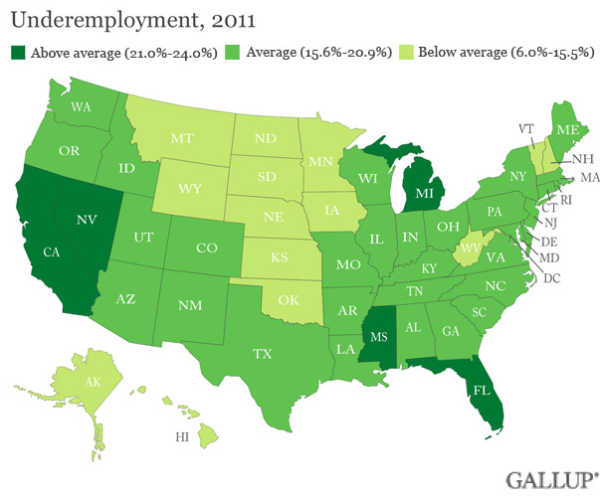
unemployment us 2012

5 states still have underemployment rates that are above 20 percent. So even though jobs are being added many are being added in lower-wage service sector fields. 5 million good paying jobs were lost since the recession hit and only about 1 million have been recovered.

Impact of compressing middle class on dollar stores

One of the surprising trends with dollar store growth comes from more affluent Americans becoming customers:

"(NY Times) Financial anxiety — or the New Consumerism, if you like — has been a boon to dollar stores. Same-store sales, a key measure of a retailer's health, spiked at the three large, publicly traded chains in this year's first quarter — all were up by at least 5 percent — while Wal-Mart had its eighth straight quarterly decline. Dreiling says that much of Dollar General's growth is generated by what he calls "fill-in trips" ­— increasingly made by wealthier people. Why linger in the canyons of Wal-Mart or Target when you can pop into a dollar store? Dreiling says that 22 percent of his customers make more than $70,000 a year and added, "That 22 percent is our fastest-growing segment."

I found this trend intriguing but this stems from the fact that most average Americans are seeing a compression to their real wage growth:

growth-in-income-inequality

The fastest growing segment of dollar store customers are coming from those making $70,000 a year or more. In fact, 1 out of 5 dollar store shoppers come from this group. Keep in mind the median household income in the US is $50,000 and those that make $70,000 a year or more are in the top 35 percent of households.

This also plays into the reality of those lower-wage service sector jobs being added:

"This growth has led to a building campaign. At a time when few businesses seem to be investing in new equipment or ventures or jobs, Dreiling's company announced a few months ago that it would be creating 6,000 new jobs by building 625 new stores this year. Kiley Rawlins, vice president for investor relations at Family Dollar, said her company would add 300 new stores this year, giving it more than 7,000 in 44 states."

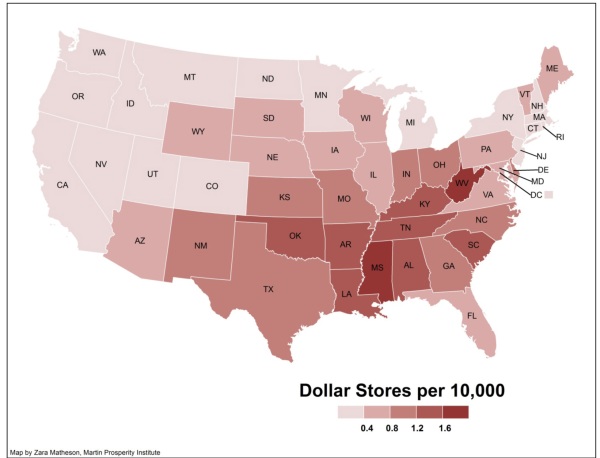
If you look at where dollar stores are most prevalent you will find them all across the country but they are most prevalent in the South:

dollar stores us

The rise of the dollar store goes hand and hand with the loss of the middle class in America. The largest customers at dollar stores are still those with lower incomes, households making $40,000 a year or less make up nearly half the customer base. But when this pool continues to grow you have business growth and that is what we are seeing here. The average per capita income in the US is $25,000 which doesn't go far given the cost of healthcare, energy, and education.

It is also fascinating to see that 40 to 45 percent of dollar store items now come from big name brand companies. This industry is now a multi-billion dollar industry. I've driven around and see Subway and KFC for example now having marketing material showing "EBT accepted here" and dollar stores with a large and growing segment of their aisles made up of by food, are seeing a boon in this economy. I mean think about it with 45,000,000+ Americans receiving food assistance this is a large customer base. You also have many retirees who heavily rely only on Social Security stretching their declining buying power at these stores. Even with low profit margins business can be good. Not sure if we should be thrilled that dollar stores are one business segment that is booming in our modern day economy.