Showing posts with label FDIC. Show all posts

Tuesday, August 6, 2013

Baker: Glass-Steagall now, tomorrow and forever

Here's how Baker sums it up [emphasis mine]:

What is striking about the argument on re-instating Glass-Steagall is that there really is no downside. The banks argue that it will be inconvenient to separate their divisions, but companies sell off divisions all the time.

They also argue that foreign banks are not generally required to adhere to this sort of separation. This is in part true, but irrelevant.

Stronger regulations might lead us to do more business with foreign-owned banks since weaker regulations could give them some competitive edge. That should bother us as much as it does that we buy clothes and toys from Bangladesh and China.

If foreign governments want to subject themselves and their economies to greater risk as a result of bad financial regulation, that is not an argument for us to do the same.  Are we anxious to be the next Iceland or Cyprus?


By Dean Baker
August 5, 2013 | Al Jazeera

Wednesday, July 24, 2013

Black: Conservatives should back Glass-Steagall

My man Bill Black explains why real conservatives should support re-instituting Glass-Steagall.  Bottom line: if President Obama is against it, they ought to be for it!


By William K. Black
July 21, 2013 | New Economic Perspectives

Glass-Steagall prevented a classic conflict of interest that we know frequently arises in the real world.  Commercial banks are subsidized through federal deposit insurance.  Most economists support providing deposit insurance to commercial banks for relatively smaller depositors.  I am not aware of any economists who support federal “deposit” insurance for the customers of investment banks or the creditors of non-financial businesses.

It violates core principles of conservatism and libertarianism to extend the federal subsidy provided to commercial banks via deposit insurance to allow that subsidy to extend to non-banking operations.  Absent Glass-Steagall, banks could purchase anything from an aluminum company to a fast food franchise and (indirectly) fund its acquisitions and operations with federally-subsidized deposits.  If you run an independent aluminum company or fast food franchise do you want to have to compete with a federally-subsidized rival?

Deposit insurance is a material federal subsidy, but it pales in comparison to the implicit federal subsidy we provide to systemically dangerous institutions (SDIs) (so-called “too big to fail” banks).  The SDIs are precisely the banks most likely to purchase non-commercial banks. The general creditors of SDIs are protected against all loss so they funds to SDIs at a substantially lower interest rate than smaller competitors.  The largest SDIs are commercial banks that get both the explicit subsidy of federal deposit insurance and the larger subsidy unique to SDIs.

No conservative or libertarian should want the SDIs to maintain their political and economic dominance.  The SDIs’ dominance comes about not due to their efficiency but their size and the size of their lobbying wallet and force that allows them to extort greater federal subsidies than their rivals.  If conservatives and libertarians have any uncertainty about their position on Glass-Steagall they should consider these facts: (1) President Obama opposes ending the SDIs, (2) has done nothing effective to end the large federal subsidy provided to the SDIs, and (3) opposes bringing back Glass-Steagall and removing the explicit federal subsidy to banks that indirectly provides a competitive advantage to their commercial affiliates.

Sunday, May 12, 2013

Ritholtz: Why Congress might pass 'TBTF' bill

Simplicity, broad ideological support, splitting the banking lobby, and FDIC support -- these are the four reasons Barry Ritholtz gives why Brown-Vitter's "TBTF" bill has a good chance of becoming law.

Here's how Ritholtz sums it up:

The idea that two senators from opposite sides of the ideological spectrum can find common ground to attack a problem with a simple solution is novel in the Senate these days. If Brown and Vitter manage to end the subsidies to banks deemed “too big to fail,” they will have accomplished more than “merely” preventing the next financial crisis. They will have helped to create a blueprint for how to get things done in an era of partisan strife.

That is a worthy goal all Americans should be grateful for.

The truth is, complex bills are not a bad thing, per se, and elegant solutions cannot be found for all policy problems.  Complex bills are bad when they are too abstruse for the public to care about, and then the armies of paid lobbyists who definitely do care march in and skewer and mangle them with loopholes in the rules-making process, which is what has been going on with Dodd-Frank for about two years.  Big banks have been making the law more complex, then turning around and complaining about how complex it is... and wouldn't it just be easier to scrap it altogether, they have the gall to ask us?  

Trying to find a similarly simple, elegant solution to, say, immigration reform would probably be impossible.  Ditto the budget.  Or health care.  A carbon tax is another one of those elegant solutions that would unleash a virtuous cascade of market-driven responses, but it fails Ritholtz's bipartisan test, because conservatives reject any new taxes out of hand, and there is no opposing big industry lobby in favor of it.  

You can try to come up with your own examples.  Talk amongst yourselves....


By Barry Ritholtz
May 12, 2013 | Washington Post

Wednesday, August 3, 2011

Credit rating agencies' conflict of interest

America's slavery to the credit rating agencies is even more lamentable considering that these agencies have a huge conflict of interest: they're lobbying the same U.S. government which they're threatening to downgrade to keep their (private) ratings embedded in U.S. financial regulations.

Even the recent debt ceiling deal has not ended their threats to downgrade America's credit rating. Coincidence? Is there really any doubt among reasonable people that the U.S. Government can't or won't honor its debts? I mean, short-term U.S. Treasury bills are synonymous in finance with risk-free assets.


By Bethany McLean
August 2, 2011 | Slate

Everyone hates the big credit rating agencies—Standard & Poor's, Moody's, and Fitch. Europeans resent the clout that they wield. Democrats hate them for their complicity in expanding the subprime mortgage market that brought down the economy and left us with a 9 percent unemployment rate. Republicans, though they're generally opposed to the Dodd-Frank financial reform legislation, have no love for the credit rating agencies, either. The conservative Wall Street Journal columnist Holman Jenkins, in a July 27 column headlined "Who Elected The Rating Agencies?," called section 939A of Dodd-Frank, which requires federal regulations to be stripped of all references to credit ratings, a "rare useful provision." Citing section 939A, David Zervos, the head of global fixed-income strategy at Jefferies, calls the noise the credit raters are currently making about downgrading U.S. Treasuries a "last gasp of hot air."

Yet the stock performance of the rating agencies doesn't suggest that they're losing their relevance. Moody's stock is one of the best-performing for any big U.S. company this year. There may be a good reason. Last week, the House financial services committee held a hearing about the rating agencies. Much of it was devoted to the possibility that the agencies would downgrade the United States, but the various witnesses brought prepared statements about the progress of section 939A. After reading these, I'm not convinced that this important reform is going to happen.

The ratings agencies would like you to believe that the source of their power is the accuracy of their opinions. But in fact, its true source is the extent to which their ratings have been embedded in various rules and regulations across the financial world. It all started back in 1975, when the Securities and Exchange Commission began to use such ratings to calculate how much capital broker-dealers should be required to hold. To prevent the proliferation of fly-by-night raters, the SEC designated a handful of firms as "nationally recognized statistical rating organizations," or NRSROs. By the time the financial crisis hit, NRSRO ratings were embedded in thousands of regulations and private contracts, if not more, determining what securities money-market funds would be permitted to own, how much collateral counterparties would have to put up in trades, and countless other arcane matters. At the hearing, Mark Van Der Weide of the Federal Reserve testified that Fed regulations contained no fewer than 46 references or requirements regarding credit ratings. In theory, section 939A will bring an end to the NRSROs' regulatory power. Every federal agency is required "to remove any reference to or requirement of reliance on credit ratings and to substitute in such regulations such standard of credit-worthiness as each respective agency shall determine as appropriate."

"With the elimination of regulatory reliance on ratings, the entire NRSRO superstructure should be dismantled," testified Larry White, a professor at New York University and a longtime critic of the agencies. Moody's and S&P themselves say they want to be taken out. The agencies say their ratings should speak for themselves and not carry the force of law. Why they should favor a law that weakens them is a bit of a mystery, but perhaps the answer is that so many others are willing to argue their case for them. Several witnesses at last week's hearing voiced resistance to section 939A taking effect:

"Just as it is not feasible or practical for us or other institutional investors to simply stop using credit ratings altogether, it may not be feasible or practical for federal agencies to strike, in one fell swoop, ratings from all of their rules and regulations," said Gregory Smith, the chief operating officer and general counsel of the Colorado Public Employees' Retirement Association. "We encourage regulators to take a careful, deliberate approach to eliminating references to ratings over time. "

Consider the issue of removing ratings from the process of determining how much capital banks must hold against various exposures. The banks say that there isn't a ready alternative. Smaller banks argue that they don't have the resources to use anything other than credit ratings, which are relatively cheap and easy, and that if forced to find alternatives they'll have a harder time competing against large banks. The large banks argue that if they can't use credit ratings, they'll have a harder time competing against foreign banks, which still use ratings. Indeed, the Federal Reserve reported that replacing credit ratings could "lead to competitive distortions across the global banking system and the domestic banking landscape."

That reference to the "global banking system" gets to another problem: Despite European dislike of the American rating agencies, ratings are ingrained in the global capital standards--even those implemented after the 2008 sub-prime crisis, which exposed the ratings agencies' unreliability. As the OCC's David Wilson pointed out, the latest global regulatory framework ("Basel III") continues to use ratings to judge creditworthiness. "U.S. regulators cannot conform our capital standards to those agreed to internationally if section 939A precludes any reference to or reliance on credit ratings," wrote Wilson in his statement.

One year ago, as U.S. regulators began soliciting comments from the banking industry about what they should use instead of credit ratings, the gist of what they heard back was this: Don't mess with our ratings. "Generally, comments received did not concretely identify or suggest alternative standards of credit-worthiness," the FDIC said in its hearing statement. "Most commenters … argued that credit ratings are valuable tools in evaluating credit risk." The OCC's Wilson reported that "a majority of the commenters said that the OCC should continue to use credit ratings in its regulations."

This lingering attachment to the ratings agencies isn't limited to banks and regulators. Investors—yes, the very same people who got burned relying on the rating agencies three years ago—don't want to see them go. As Gellert, the CEO of Rapid Ratings, put it, "There are many market players who benefit from, and support, the status quo." If investors no longer have ratings to rely on, then they'll have to do the credit analysis themselves. If they're wrong, they won't be able to blame those accursed rating agencies! And as Gellert explained, the allure of ratings goes beyond the avoidance of responsibility. Ratings actually help investors game the system. In what's known on the Street as "ratings arbitrage," funds that are statutorily prohibited from buying non-investment-grade bonds buy the highest yielding bonds with the lowest investment grade rating that they can find, thereby juicing their returns. That creates an artificial demand for securities that don't merit the rating they received, at least by the market's judgment. Ratings arbitrage is what put the most dangerous mortgage-backed securities in greatest demand at the peak of the subprime madness.

Investors don't just want to keep credit ratings around—they want to keep credit ratings from the current big three. After the crisis, in 2010, Jules Kroll, a well-known investigator, formed Kroll Bond Ratings in order to provide investors with an alternative. But Kroll noted in his testimony that investors often require before they'll buy a security that it have not just a rating, but a rating from Moody's, Standard & Poor's, and/or Fitch. Kroll Bond Ratings took an informal survey of the top 100 pension funds, and found that of the 67 that published their guidelines, almost two-thirds required a rating from at least one of the top three firms. "It is self-evident that this practice further entrenches the incumbent rating agencies," wrote Kroll in his prepared remarks.

In fairness, the regulators, or at least the SEC, do still seem to be plodding gamely ahead. In March, the SEC proposed to remove credit ratings from the rules that govern which securities a money market fund may purchase. Gellert says that his business is doing very well, because although investors may still be using ratings from the big three, they're also eager for another opinion. That can only help. And he says that at the hearing he saw bipartisan support for removing ratings from regulations.

Then again, on July 21, in a little-noticed vote, the House financial services committee approved (over the objections of Massachusetts Rep. Barney Frank, ranking Democrat on the committee and one of the named authors of Dodd-Frank) a repeal of the part of Dodd-Frank that (quite reasonably) subjects the credit rating agencies to "expert liability," meaning that if the ratings agencies screw up they'll face the same legal risk as accountants and other third party advisers in bond sales. The July 29 Wall Street Journal reported that various business groups, including the Chamber of Commerce, are suing the government to overturn various parts of Dodd Frank that they don't like. The Journal piece didn't mention section 939A, but it would seem a likely target. According to the OCC's testimony, some in the industry are already recommending a "legislative change" to the section. Loathe them though everyone does, reliance on the credit rating agencies turns out to be a terrible habit that almost no one is willing to break.

Thursday, July 14, 2011

MB360: FDIC staff nearly doubled, troubled banks quadrupled since 2008

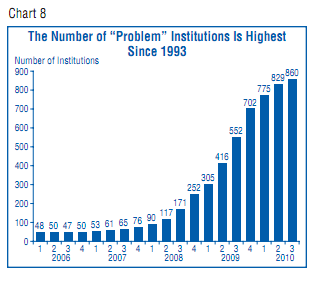
Folks, take note: the FDIC has double its staff compared to 2007 to deal with troubled banks, and the number of troubled banks is higher than ever -- almost 900.

The banking crisis is not behind us, and the bailouts did not "work." Well, actually they accomplished their real goal (in my opinion) of keeping Wall Street's biggest banks in business, but other than that -- FAIL. Remember this was all about keeping credit flowing to small business? Remember October 2008?

MB360 hits the nail on the head what the real problem is:

"Frankly, both parties are beholden to the checkbooks of large financial institutions. On a bigger level, if we want politicians to represent the interests of the people without worrying about financing a campaign we should seek radical reforms in our political financing system. [That means publicly financed federal campaigns! - J] There is little desire to do this from Wall Street investment banks since their return on investment (ROI) has yielded a fantastic sum. Nothing better than guaranteed taxpayer money when all you have to do is funnel a tiny percentage of this back into the political machine every two years."

Assuming we can get Wall Street out of Congress here's what we must do:

"We need to bring Glass-Steagall back. We need to split commercial and investment banking once and for all."

And here's MB360's take on the debt ceiling brouhaha:

"The debt ceiling debate is comical in many ways. After decades of spending like maniacs we all of sudden want to find restraint especially after we've given the banking system trillions of dollars! [$2.84 trillion is currently stored on the Fed's balance sheet. Remember that next time you hear somebody say, "The bailouts (meaning TARP) worked." - J] First, the interest payments would skyrocket so right off the bat we would increase our own interest payments. Not smart at all. We need to be honest and like any household facing tighter times, we need to find more revenues and cut spending."


Posted by mybudget360 | July 13, 2011

Friday, January 7, 2011

MB360: Bailed-out mega-banks destroying U.S. middle class

If you can't see this charts then follow the headline link becaue they're worth studying. If the Tea Parties would mobilize against this kind of thing then they might be relevant and useful.


Posted by mybudget360
January 6, 2010

The US banking system is largely a system based on consumer confidence. You would require the confidence of Zeus if you had $13.3 trillion in assets backed by an FDIC Deposit Insurance Fund (DIF) that is practically insolvent. Even as the stock market solidly recovers to the green the state of the average American's financial health is in jeopardy. 1 out of 3 Americans has zero in retirement savings so the hope is that somehow Social Security will be around or maybe there is no longer term strategy since they are merely struggling with daily financial existence. There seems to be this premature joy about the preliminary jobs report but much of this was based on low wage temporary retail hiring for the holidays. Not much a surprise there and did they not get the memo that 14 million Americans are still unemployed? However the banking industry is still in serious problems. Over 11 percent of all US banks are considered "troubled financial institutions" based on the optimistic FDIC quarterly report. The numbers are of course a lot worse but thanks to the suspension of mark to market banks can pretend empty shopping malls in the barren desert or flailing condos are somehow valuable assets. The FDIC just like much of the big banking industry players is performing a dance of economic delusion.

First, take a look at the number of problem institutions:

fdic problem institutions

Source: FDIC

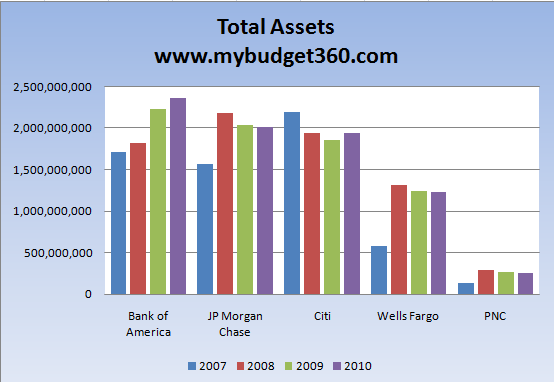
The US currently has 7,760 active banks. So that would put nominally 11 percent of all banks as troubled institutions. This is on par with the number of Americans in the foreclosure process (though there is no correlation but no one is saying that things are healthy when 11 percent of all American mortgages are in some state of foreclosure or have stopped making payments). What is even more disturbing is much of the $13 trillion in "assets" is still in the hands of the too big to fail with a disproportionate of assets in real estate:

total-banking-assets-five-banks

Notice how the big five banks actually increased their assets over a time when the financial worth of average Americans has declined? The big banks really do not serve the retail customer anymore which is odd since it is the retail taxpayer that bailed these banks out. Each one of the above banks received financial assistance in some shape or form.

All of this comes when banks are announcing record profits and consumer bankruptcies are up to record highs posing a stark dichotomy.

Bankruptcies would be even higher but for the 2005 bankruptcy legislation that has made it much harder to file. Even with a tighter collar on the finances of Americans bankruptcies are soaring because there is only so much you can squeeze from a shrinking middle class turnip.

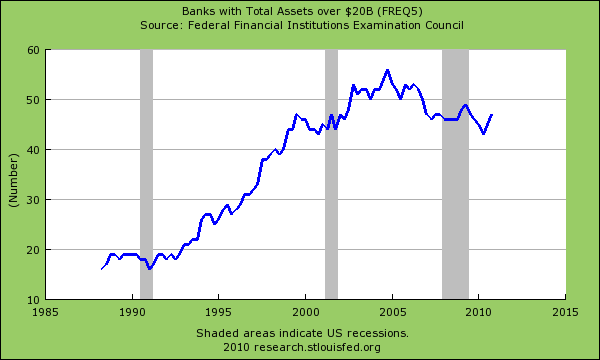
The era of the mega bank is still alive and well:

mega-banks

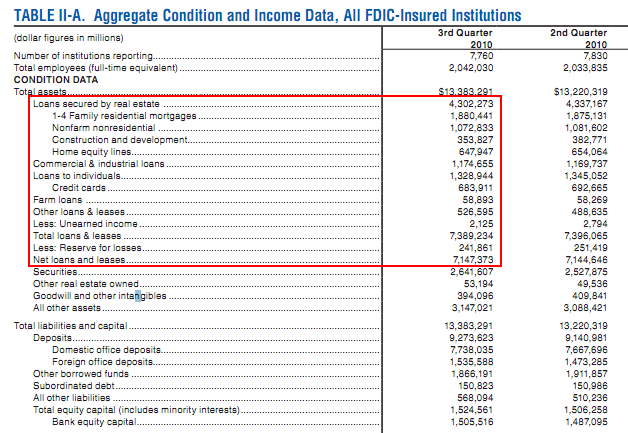
Over 45 US banks have $20 billion or more in assets. And keep in mind what banks consider as assets. For a bank a toxic multi-million dollar loan on a failed strip mall with potholes the size of large dogs in the parking lot is an asset:

banking data

Of the $13 trillion in assets $4.3 trillion is in real estate. Now would it then not be logical to assume with such a horrible real estate market that there would be a major impact here in terms of valuation? Of course it would but suspending prudent accounting practices is the necessary spice to keep this charade up. Banks continue to value real estate at optimistic levels to continue a pretend game that they are solvent while draining taxpayer dollars. The Federal Reserve continues to offer quantitative easing because the economy is solid? Of course not, they are trying to reflate the balance sheet of banks through the slow wealth transfer from the middle class to the top 1 percent.

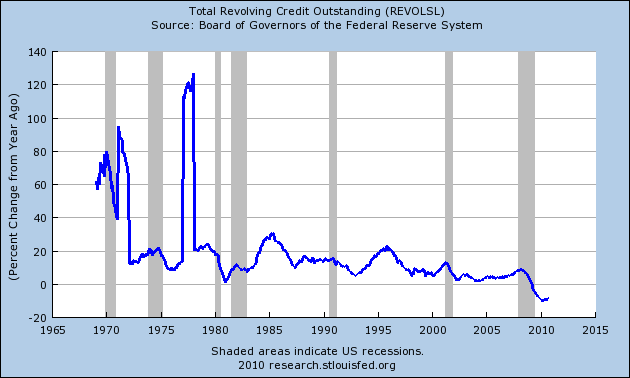
If you want to see how generous FDIC insured banks are to average Americans just look at the amount of credit being extended:

total-revolving-credit

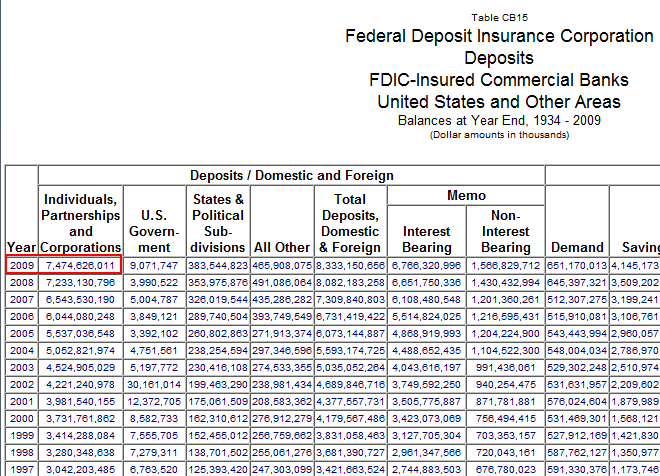
Yet the Federal Reserve is extending unprecedented credit to the banks. There are two financial worlds in the US and many are starting to wake up as to which one they are living in. Americans still have a lot of hard earned money in banks:

deposits-at-fdic-banks

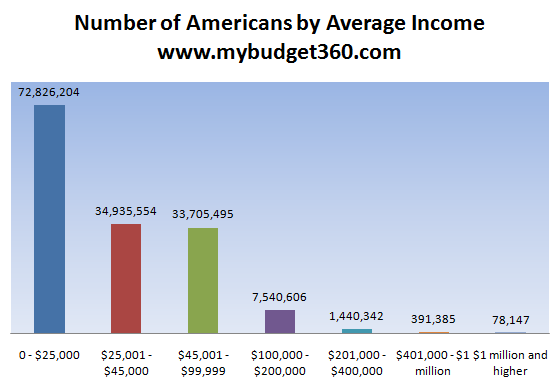
Over $7.4 trillion in deposits are on the banking balance sheets. Keep in mind these are liabilities to banks, not assets. Yet the FDIC with an insolvent fund is backing these up. Banks are also offering close to zero percent in interest rates on savings accounts so this idle money is being slowly devoured by inflation which is a hidden tax by the Federal Reserve. Notice how gas is up over $3 a gallon? Notice how grocery food isn't getting cheaper? How about college costs? Healthcare? Housing has gotten cheaper but it is still too expensive given the amount of money Americans have with 100 million Americans making $39,999 or less a year:

average-income-americans

Source: Social Security

Even more disturbing is the fact that 72 million Americans make $25,000 or less a year. If you want to know what your global business leaders are thinking after the generous bailouts here is a recent comment at a CEO roundtable:

"(MotherJones) His point was that if the transformation of the world economy lifts four people in China and India out of poverty and into the middle class, and meanwhile means one American drops out of the middle class, that's not such a bad trade," the CEO recalled."

This coming from leaders who were in industries that were saved by American taxpayers. Those retail sales that many are clamoring about came because of a middle class in the US. Yet to these companies the only thing that matters is customers even if it means they have to leverage the American middle class and destroy the wealth of Americans in order to gain more customers around the globe. Politicians never brought this up during the election cycle but they continue to protect these industries because politicians are merely another line item for many of these companies.

Sunday, June 20, 2010

MB360: FDIC insolvent, hungry for taxpayers' $$$

Posted by mybudget360

The FDIC which technically supports the nation's banking system is for all practical purposes insolvent. I'm not sure the magnitude of this problem has sunk into the psyche of the American public. The FDIC insures accounts at banks that include checking, saving, and CD accounts from a bank failure. This has occurred with regular frequency since the recession started 29 long months ago. Some 247 banks have failed since 2008 with a total asset base of $616 billion. The government has tried to calm the unsettled waters by raising the regular deposit coverage from $100,000 to $250,000 even though the FDIC deposit insurance fund is in the negative. This seems to have calmed the nerves of people since the days of long lines at IndyMac Bank in California but nothing has really changed at least at the core of the financial system. To the contrary things have worsened for the banking system.

The list of troubled banks continues to grow:


Source: Fortune, FDIC

This chart tells us that we should be gearing up for another round of bank failures. The increase of deposit insurance from $100,000 to $250,000 is largely a charade. 1 out of 3 Americans have absolutely no savings whatsoever. We have 17 percent unemployed or underemployed and another 20 to 25 percent working in the low paying service sector. Nearly 50 percent of Americans have nowhere close to $100,000 in liquid assets to insure, so increasing the insurance to $250,000 is merely a public relations move to show strength.

The current amount of assets at troubled banks is over $400 billion but since the FDIC doesn't list all troubled banks this is much larger:


Source: FDIC

Now the above survey only goes up to the end of 2009. Since the start of the year another 82 banks have failed and the FDIC is probably at some undisclosed location somewhere in the United States right now getting ready to close another few banks since Fridays have become synonymous with bank closings. The list of troubled banks increasing is a reflection of the massive amount of troubled loans. These loans wouldn't be in such deep trouble if the economy was healthy and Americans were servicing their loans. But the middle class isn't really participating in this shadow recovery.

A recent survey by none other than the FDIC shows that a good portion of Americans don't even participate in the banking system:


" A substantial percentage of lower-income households are unbanked. Nearly 20 percent of lower income U.S. households—almost 7 million households earning below $30,000 per year—do not currently have a bank account. Households with earnings below $30,000 account for at least 71 percent of unbanked households.

Not having enough money to feel they need an account is the most common reason why unbanked households are not participating in the mainstream financial system."

Do these people care that accounts are insured up to $250,000? Who are we really protecting here? You also need to ask how we are going to pay for all these additional bank failures if the deposit insurance fund is already in the negative. That is where the Federal Reserve and U.S. Treasury step in with more of your taxpayer money.

The Federal Reserve attempts to paint this image as a government agency but they are not. They serve the purpose to protect the banking system. Even the Fed website gives us a nice little history on this:

"(Fed history) From December 1912 to December 1913, the Glass-Willis proposal was hotly debated, molded and reshaped. By December 23, 1913, when President Woodrow Wilson signed the Federal Reserve Act into law, it stood as a classic example of compromise—a decentralized central bank that balanced the competing interests of private banks and populist sentiment."

There is much more back history to this but suffice it to say that this move helped consolidate the power of banks into a few hands instead of having many more banks competing for your business. Keep in mind when this passed, the public was heavily against it just like the public was against TARP when this crisis rolled around. Yet the Fed listens to their big banks and protects them at all costs even if it means robbing the public blind (a sort of reverse Robin Hood). In the end after nearly 100 years of the Federal Reserve, the main purpose is nearly accomplished:


"The top 4 banks of Bank of America, JP Morgan Chase, Wells Fargo, and Citibank make up 55 percent of all banking assets."

And banking assets across the country are enormous. The FDIC backs 8,000 banks that carry over $13 trillion in assets. These big four banks have their hands in over 50 percent of this amount. Who controls the wealth in this country controls the levers of political power. The way the system is currently setup we find that the banks have an incredible amount of power. Actually, it is the biggest banks that have the big power since they are fine with hundreds of little bank failures since that opens up the market for bigger banks to step in and open up shop. Smaller banks don't have access to the easy money Federal Reserve window and certainly did not get handouts like many of the biggest banks did.

Foreclosures remain at record levels and this means banks are facing more and more loans that enter into default. This costs money. As we have mentioned, the FDIC is insolvent so where is this money coming from?

"(US Banker) Treasury likes it, the Federal Deposit Insurance Corp. likes it, and the banking industry likes it—that is, S. 541, introduced last week by Sen. Chris Dodd (D-Conn.) The bill would permanently increase the FDIC's ability to borrow from the Treasury for its Deposit Insurance Fund, raising the cap to $100 billion from $30 billion, the limit set back in 1991. The Depositor Protection Act would also temporarily allow the FDIC to borrow up to $500 billion after consultations with Treasury, the Federal Reserve, and the President.

FDIC chairman Sheila Bair voiced enthusiasm in a letter to Dodd, noting "the FDIC believes it is prudent to adjust the statutory line of credit proportionally to leave no doubt that the FDIC can immediately access the necessary resources to resolve failing banks and provide timely protection to insured depositors." Passage of the increased borrowing ability "would give the FDIC flexibility to reduce the size of the recent special assessment, while still maintaining assessments at a level that supports the DIF with industry funding."

And there you have it. I am certain that the banks are spending large amounts of money creating a way to couch this additional bailout as a helping hand for middle class Americans but in the end if we don't change the system, the money will flow through the same rivers as of those from the last decade. With so many bank failures lined up because of horrible commercial real estate and residential loans, we can expect to bail out indirectly failed casinos in Las Vegas and owning shopping malls in random parts of the country. The FDIC is flashing code red and they are lining up with hat in hand for taxpayer money. If after 29 months you still haven't gotten it, this money is likely to funnel up to the top 1 percent in an incredibly unbalanced fashioned.