Showing posts with label American Revolution. Show all posts

Thursday, July 4, 2013

Was American Revolution worth it? Revisiting the 'American Dream'

This July 4th we can stop and ponder: was the American Revolution worth it? Here's what NPR had to say about the "American Dream," i.e. social and economic upward mobility:

So, in the 19th century in the U.S., there's unbelievable economic mobility. If your father, for example, was an unskilled laborer, sort of the lowest end of the working hierarchy, then you had an 80 percent chance of doing some more skilled, more highly paid job than your father. At the same time, in the U.K., you had about a 50 percent chance. Half the children of unskilled laborers were unskilled laborers themselves. But by just after World War II, the U.S. and U.K. are converging and the differences start to disappear. And by 1970, the U.K. has pulled ahead. So, by the 1970s, the children of unskilled laborers are more likely to do be doing something higher paying in the U.K. than in the U.S.

Why is that so?  Why is the "American Dream" more alive in Britain today than in America?  There are two basic theories, according to NPR:
  • By the 20th century, the U.S. was a mature economy like Britain, without all the exceptional opportunities for growth that exist in a young, expanding nation.
  • In early-mid 20th century, the welfare state and education in Britain grew at a faster pace.

These two theories are not mutually exclusive.  I would also point out the respective rates of unionization in the U.S. and UK: 11.1 percent vs. 25.8 percent.  The average in OECD countries for trade union density is 17 percent.  Nordic socialist paradises Denmark, Finland, Norway and Sweden, which top almost every global indicator of economic and social well-being, have well over 50 percent of their workers in trade unions.  In the U.S. we blame falling wages all on globalization, but then we should ask why wages aren't falling elsewhere in G-8 countries?  Unions have a lot to do with it.

And then there is the U.S. tax system, which for the past 30 years has discriminated against wages in favor of income earned through interest and financial securities, thereby inflating inequality and crushing the "American Dream."  Remember this chart?:
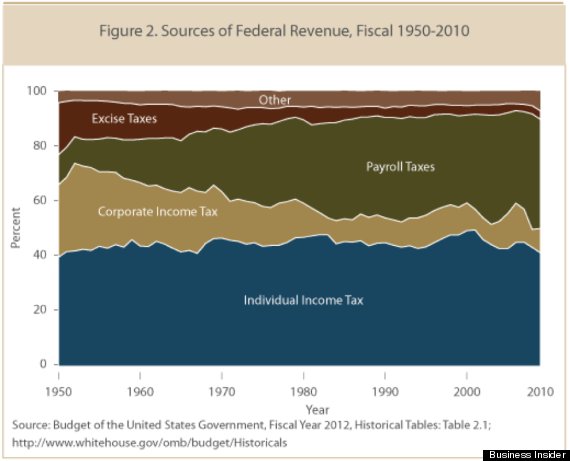
federal revenue

Paul Pirie for WaPo  gives us more socio-economic data to ponder:

Most Americans work longer hours and have fewer paid vacations and benefits — including health care — than their counterparts in most advanced countries. Consider also that in the CIA World Factbook, the United States ranks 51st in life expectancy at birth. Working oneself into an early grave does not do much for one’s happiness quotient. This year the United States tied for 14th in “life satisfaction” on an annual quality-of-life study by the Organization for Economic Cooperation and Development. That puts the United States behind Canada (eighth) and Australia (12th). A report co-authored last year by the economist Jeffrey Sachs ranked the United States 10th in the world for happiness — again behind Canada and Australia. The Sachs study found that the United States has made “striking economic and technological progress over the past half century without gains in the self-reported happiness of the citizenry. Instead, uncertainties and anxieties are high, social and economic inequalities have widened considerably, social trust is in decline, and confidence in government is at an all-time low.”

But the difference is not just in economics or happiness, but also liberty.  Pirie points out that the British Empire (including Canada) abolished slavery in 1833, a full 32 years befoe the U.S. ratification of the 13th Amendment to the Constitution. Today's slavery is the U.S. prison-industrial complex that incarcerates more adults, in both absolute and relative terms, than any other country by a wide margin, including Red China and Russia.  

And speaking of Americans' liberty, I have three words for you: N-S-A.  Do I really need to say more?  It doesn't matter, the spooks are archiving this post anyway.

Today, having mentioned some of these factoids to a Brit, I joked about our reneging the Declaration of Independence.  He said Britons are glad America is no longer their problem; they can't imagine trying to govern the U.S.  I joked back, "Yeah, we have enough trouble dealing with places like Texas!"  Can you imagine British PM David Cameron trying to talk sense to the folks in U.S. flyover country? You start to wonder who got the better end of the deal when the U.S. declared its independence....   

Happy 4th of July, everybody!  Have a hotdog and light off a roman candle for me.

UPDATE: If you think I'm unpatriotic, here's a guy who really can't stand the 4th of July: "Hatetriot's Day: July 4th Is America's Crappiest Holiday."

Tuesday, May 28, 2013

Tea Parties, 9/11 and 'American exceptionalism'

What an insightful and refreshing meditation on 200 years of American history, and meanwhile, Americans' psychological relation to their history!  

To give you an example: Smith's fascinating recognition of the unlikely affinity of two American "losers" who could have re-shaped America's relation to the world: Republican Wendell Wilkie post-WWII; and Democrat Jimmy Carter post-Vietnam.

Now to summarize....

First, Smith argues, as I have, that the Tea Parties are about perpetuating a certain myth about American history, but he goes even further [emphasis and italics mine]:

Whatever the Tea Party’s unconscious motivations and meanings—and I count these significant to an understanding of the group—we can no longer make light of its political influence; it has shifted the entire national conversation rightward—and to an extent backward, indeed. But more fundamentally than this, the movement reveals the strong grip of myth on many Americans—the grip of myth and the fear of change and history. In this, it seems to me, the Tea Party speaks for something more than itself. It is the culmination of the rise in conservatism we can easily trace to the 1980s. What of this conservatism, then? Ever since Reagan’s “Morning in America” campaign slogan in 1984 it has purported to express a new optimism about America. But in the Tea Party we discover the true topic to be the absence of optimism and the conviction that new ideas are impossible. Its object is simply to maintain a belief in belief and an optimism about optimism. These are desperate endeavors. They amount to more expressions of America’s terror in the face of history. To take our country back: Back to its mythological understanding of itself before the birth of its own history is the plainest answer of all.


The Tea Parties' constant harking back to a mythical point in time that never existed is a mark of fear of the future, Smith believes, a fear that all Americans share to some extent, and yet to "win the future" (to stupidly quote Newt Gingrich) we must face this fear:

I do not see that America has any choice now but to face this long terror. America’s founding was unfortunate in the fear and apprehension it engendered, and unfortunate habits and impulses have arisen from it. These are now in need of change—a project of historical proportion. Can we live without our culture of representation, our images and symbols and allusions and references, so casting our gaze forward, not behind us? Can we look ahead expectantly and seek greatness instead of assuming it always lies behind us and must be quoted? Can we learn to see and judge things as they are? Can we understand events and others (and ourselves most of all) in a useful, authentic context? Can we learn, perhaps most of all, to act not out of fear or apprehension but out of confidence and clear vision? In one way or another, the dead end of American politics as I write reminds us that all of these questions now urgently require answers. This is the nature of our moment.

Smith thinks we Americans must face our psychological defeat suffered on 9/11/2001, the realization that they did not like us, and did not want to be like us:

What was it Americans reiterated through all the decades leading to 2001—and, somewhat desperately, beyond that year? It was to remake the world, as Condoleezza Rice so plainly put it. It was to make the world resemble us, such that all of it would have to change and we would not. This dream, this utopia, the prospect of the global society whose imagining made us American, is what perished in 2001. America’s fundamentalist idea of itself was defeated on September 11. To put the point another way, America lost its long war against time. This is as real a defeat as any other on a battlefield or at sea. Osama bin Laden and those who gave their lives for his cause spoke for no one but themselves, surely. But they nonetheless gave substantial, dreadful form to a truth that had been a long time coming:The world does not require America to release it into freedom. Often the world does not even mean the same things when it speaks of “freedom,” “liberty,” and “democracy.” And the world is as aware as some Americans are of the dialectic of promise and self-betrayal that runs as a prominent thread through the long fabric of the American past.

Look upon 2001 in this way, and we begin to understand what it was that truly took its toll on the American consciousness. Those alive then had witnessed the end of a long experiment—a hundred years old if one counts from the Spanish war, two hundred to go back to the revolutionary era, nearly four hundred to count from Winthrop and the Arbella. I know of no one who spoke of 2001 in these terms at the time: It was unspeakable. 


9/11 wasn't about killing, or even creating terror; it was their way of screaming, "We reject you!"

Does America have a democratic mission?  Was it meant to be a shining City on a Hill?  It never did; it never was, argues Smith, convincingly. Which seems obvious to most non-Americans, but a bit frightening for us born-and-bred Amuricans to mull over.  If we were not chosen, if we are not special, if we do not have any special mission -- and with it, special prerogatives -- then what about all that "bad stuff" in our history?  Didn't it mean anything?  Wasn't it all for a greater purpose?.... No, it was just about Power.

And here's what Smith has to say about U.S. power:

Power is a material capability. It is a possession with no intrinsic vitality of its own. It has to do with method as opposed to purpose or ideals—techne as against telos. It is sheer means, deployment. Power tends to discourage authentic reflection and considered thought, and, paradoxically, produces a certain weakness in those who have it. This is the weakness that is born of distance from others. In the simplest terms, it is an inability to see and understand others and to tolerate difference. It also induces a crisis of belief. Over time a powerful democracy’s faith in itself quivers, while its faith in power and prerogative accumulates. 

Power and strength are not the same; we should resolve to possess the latter, Smith avers:

To reflect upon those final years before 2001, it is not difficult to understand in our contemporary terms the distinction between a powerful nation and a strong one. Strength derives from who one is—it is what one has made of oneself by way of vision, desire, and dedication. It has nothing to do with power as we customarily use this term. Paradoxically, it is a form of power greatly more powerful than the possession of power alone. Strength is a way of being, not a possession. Another paradox: Power renders one vulnerable to defeat or failure, and therefore to fear. Strength renders one not invulnerable—no one ever is—but able to recover from defeats and failures. The history of the past century bears out these distinctions very clearly. Most of all, a strong nation is capable of self-examination and of change. It understands where it is in history—its own and humankind’s.

And here's Smith's call to action at the end of his remarkable essay:

I propose the taking of an immense risk. It is the risk of living without things that are linked in the American psyche: the protection of our exceptionalism, the armor of our triumphalist nationalism, our fantastical idea of the individual and his or her subjectivity. For Americans to surrender this universe of belief, emotion, and thought may seem the utmost folly. A century ago Americans flinched at the prospect. What followed was often called heroic, but in many cases it was just the opposite, for the American century was so often an exercise in avoidance of genuinely defined responsibility. True enough, it ended as it began, with uncertainty and choices. But the outcome need not be the same now, for there is too much more to be gained than lost this time.

Are we brave enough to change, or do we prefer to revert to a mythical childhood of ourselves that never was?


By Patrick Smith
May 26, 2013 | Salon

Monday, February 25, 2013

FOX: Could there be a 'Second American Revolution'?

Great journalism!  Fair & Balanced!  (A pro-gun host, an NRA lawyer, and a pro-gun sheriff who threatens violent revolution.)  Nope, no pandering to the NRA at all, just tough, smart reporting.  And anyway, treating what-ifs as if they were real news is is not nearly as dangerous as some kids playing video games in their basements, no sir.

Seriously though, it is totally irresponsible of FOX to debate hypothetical scenarios (government confiscating guns, or a government gun registry) that nobody in government including Obama has proposed, and to scare gun owners and encourage crazies to go over the edge.  

Then again, beating the crazy conservative hornets nest with a rhetorical stick just to see what happens next is what FOX does best.


Friday, February 8, 2013

Only an elite can secure the gains of revolution

I'm not a fan of Anne Applebaum but she makes a good point here, one that I have already mentioned:

As the Arab Spring nations mark their second anniversaries, it’s worth keeping this [post-Soviet] precedent in mind. True, there were dissenters of many kinds in pre-revolutionary Egypt, as one expert told Foreign Policy this week. But “they were largely suppressed, except for the mosque and the soccer pitch. With these two institutions, the numbers were too big and the emotions they evoked were too strong.” The result: The Muslim Brotherhood was the only political “party” with any organizational capacity after 2011. And Egyptian soccer clubs are the only organizations that can reliably be counted on to create major protests, as they have recently. Another alternative elite was not available.

The upshot is that positive change in the Mideast and North Africa is going to take many years, because the erstwhile regimes there brutally suppressed the formation of any kind of local elite, and a civil society in which they could exchange ideas and cooperate:

After all, the time to help create an alternative [in Arab Spring countries] was three, five or, better yet, 10 years ago. But even then, an authentic alternative elite couldn’t have been wholly created on the outside, by exiles or by foreigners: If opposition leaders aren’t the product of an indigenous impulse to create alternative institutions — political parties, charities, newspapers, human rights organizations — then they won’t have the political clout to push through radical reforms when they get the chance. Yet in many Arab states, the opportunity to start doing so arrived only in 2011, and the alternative elite is forming only now.

We Americans especially like to believe the myth that revolutions are mass endeavors. The truth is that our American Revolution, the Bolshevik Revolution and others were carried out by a minority of the population led by a tiny, well-educated, well-connected elite. The People always need leaders -- especially people trying to move on after bad leaders.


By Anne Applebaum
February 7, 2013 | Washington Post

Saturday, December 1, 2012

Lowry: What U.S. did in 200 years, Egypt must do in 2

NRO's Rich Lowry is not utterly stupid so let me use his latest op-ed as an emblem of right-wing wrongness. His criticisms of President Obama's policies vis-a-vis Egypt suffer from several Amero-centric, neo-con fallacies. Namely:

-  Events abroad happen quickly, in cause-and-effect timelines that correspond neatly to U.S. Presidential policies and tenures;
-  The U.S. has the power to shape events abroad; the exercise of that power is simply a function of U.S. willpower and determination, usually in the form of military action; and
-  America's agreeing to talk to foreign leaders = commiseration with those same foreign leaders = a "man crush."

Next, I don't want to compare Egypt to America, but... let me compare today's Egypt to America.  The American Revolution took 8 years.  It was a country of about 2.5 million, not counting slaves and Indians, a majority of which was loyal to King George throughout.  After that we had the destined-to-fail Articles of Confederation that lasted 8 years before being replaced by the U.S. Constitution.  It could be argued that many disputes left unsettled by the Federalists and Anti-Federalists festered and resulted in the American Civil War 72 years later.  That civil war was followed by Reconstruction, Jim Crow, and eventually the Civil Rights movement, culminating in the 1964 Civil Rights Act, adopted 188 years after the Declaration of Independence.

And that all started in a podunk colony on the ass-end of nowhere in the 18th century.  Compare that to today's Egypt, the most populated Arab country in the world with 84 million people.  What Lowry and other conservative pundits are doing is expressing disappointment with Egypt's failure to transition smoothly and non-violently in the span of 2 years from a brutal dictatorship of 30 years to a simulacrum of U.S. republican democracy that was  perfected over some 200 years.

So let me make obvious the absurdity of the criticism laid at President Obama's feet: that in a mere two years since Mubarak was forced to step down during peaceful protests, the failure of Egypt to transform itself into a peaceful, multi-ethnic, multi-confessional state with tolerance and free speech for all, represents a FAILURE of PRESIDENT OBAMA.  Meanwhile, in fact, liberals and non-Muslims in Egypt have been withdrawing from the constitutional convention in protest of the mangled process of its drafting and approval by referendum.  Still, it's Obama's fault that things aren't turning out ideally, now, immediately.

Folks, it doesn't get any more partisan, Amero-centric and short-sighted than this... and all from the editor of the most "intellectual" conservative media outlet around.  So you can imagine what dumber conservatives are saying about U.S. policy vis-a-vis Egypt.  It's completely unmoored from reality.

America needs a huge dose of humility, chased with a swig of its own long and tortured history for study.  Hell, I don't know how things are going to turn out there.  But I sure as hell know that we Americans can't determine the outcome.  That fact may drive many neo-cons and pundits nuts to the point of denial, but that's just the way it is.  


Morsi consolidates his dictatorship while the Obama administration tells itself bedtime stories.
By Rich Lowry
November 30, 2012 | National Review

Sunday, December 17, 2006

'Ex-patriots' renouncing citizenship are TRUE American patriots

Love it and leave it!

In its continuing coverage of the new U.S. tax law sponsored by Sen. Sam Brownback (R)-KA which takes a bigger bite out of more Americans living abroad, The International Herald Tribune on Sunday reported that "some international tax lawyers say they detect rising demand from citizens to renounce ties with United States [i.e. renounce their citizenship] -- the only developed country that taxes its citizens while they are overseas."

In the best journalistic tradition, it's a clever non-story posing as news. By that I mean the reporter, Dareen Carvajal, shills the hypothesis that growing numbers of American expatriates are turning in their passports over Congress's new tax law, while meantime Carvajal covers her bases with the facts, which dispute said hypothesis: the number of renunciations is actually "relatively low" or unchanged from previous years.

Basically, she offers all the reasons that renunciations ought to be up, but then admits that they're not. The hard data won't support it. Still, a quick read of this article would surely leave the reader with the desired impression, the very deceit hammered home by the story's outright lying title: "More Americans abroad giving up citizenship for lower taxes."

Pretty slick, huh?

The reason for this journalistic sleight-of-hand is pretty easy to explain, actually: A large portion of The IHT's readership is expatriate Americans making over $82,400 who are pissed off about their increased tax burden.

So, I'm not so bothered by it. I won't blame this honest deceit on the Lib'rul Media, but rather on the Corporate Media giving its paying readers what they want. Anyway, a careful reader would see right through the article's deceptive structure, and the hype, bluster and conjecture of its "expert" quotes.

But this story did get me to thinkin'.... When it comes to criticizing things like the Iraq War, keeping an arsenal of guns in one's home, or using taxpayers' money to promote Christianity, a certain brand of crass conservative, realizing he's dead center in the inert, dumbass majority, will retort "Love it or leave it!" Which basically signals the end of the discussion. (Everything that he loves is "American," and you're criticizing something he loves, ergo you hate America. Ergo, leave.)

But reading The IHT today I wondered: What could be more American than tax revolt?

After all, our country was formed as an afterthought by tax revolutionaries. Like most people, our Founding Fathers knew what they knew instinctively -- that taxes suck, especially when you're being taxed by an aloof government to fund an empire which you have no say over, and offers you dubious benefits in return. They only bothered to think up the highfalutin justification for their tax revolt later on, when it was already darn nigh official: "We hold these truths to be self-evident, that all men are created equal..." blah, blah, blah.

The Declaration of Independence was baloney. It was brilliantly written PR, and a golden Englightenment treatise, but it was baloney. Because its stated purpose had little to do with the angry motivation which caused it to be written. Namely, that Declaration and the American Revolution were about taxes and expensive wars. And taxes paying for expensive wars. (Sound familiar?)

Which brings me back to the present. My initial reaction to the female ex-Marine quoted by The IHT who is living in Geneva and recently renounced her citizenship because of high taxes was, "Good riddance!" Love it or leave it! (Never mind that she left 16 years ago.) Alas, for her being an American was a mere miserly dollars & cents equation. For shame! Whither patriotism, hot dogs, Chevrolet, and Mom's applie pie?

But then I thought better, and realized that she couldn't be a truer "American" than by renouncing her citizenship. Indeed, she followed in the hallowed footsteps of our Founders: she threw off the yoke of tyranny when it weighed too heavily on her personal finances. So, "Good for her!" was my revised reaction.

Yes, good for her. If only more true Americans like her -- be they "ex-patriots" abroad or patriots residing in the Homeland -- would renounce their citizenship, America would be much better off.