This might be a first: I agree almost completely with conservative pundit Charles Krauthammer.
I'm not sure why it is -- because of Trump? -- most Republicans seem to cheer Brexit, which indisputably harms U.S. influence in Europe, besides its other bad effects.
Brexit: Sovereign Kingdom or little England?
By Charles Krauthammer
July 1, 2016 | Freedom's Back
URL: http://freedomsback.com/charles-krauthammer/brexit-sovereign-kingdom-or-little-england/.
Showing posts with label UK. Show all posts
Showing posts with label UK. Show all posts
Sunday, July 10, 2016


Tuesday, September 16, 2014
Former UK Defence Sec.: ‘Putin as bad as Stalin'
[HT: AU]. Here's the most relevant bit in my view, as it goes for the U.S. as well as EU and NATO [emphasis mine]:
No sensible person wants, in the face of the many other challenges, to be forced to find money for increased spending on arms. No one wants the economic consequences that extensive sanctions against Russia will have on our own economies, but Putin will not be deterred by resolutions passed at Nato or EU summits.So unless we want to gamble that this systematic aggression will fizzle out in the face of inactivity, and history tells us that doesn’t happen, we must find effective ways to deter him.Both Nato and the EU have made a start but the small and reluctant steps taken so far sadly are not likely to be nearly enough.All Nato countries should commit to reverse the recent decline in defence spending.At the European level there is an urgent need to develop a strategy to decrease our heavy dependence on Russian energy.
Finally, Europe is realizing that Russia is not a reliable partner, since there is no separation of business and politics in Russia -- where everything is political, and politics is subordinated to one man, Vladimir Putin. Europe cannot abide the whims of one man in the vain hope of ensuring its economic and military security.
By Paul Dale
September 15, 2014 | The Chamberlain Files
Tuesday, September 9, 2014
Scottish independence would affect the world
And as others have noted, (see: "Why the world should care about Scottish independence"), the UK without Scotland would tip away from Labour toward the Conservative Party; and the UK without Scotland would make Britain more of a Euro-skeptic and less likely to vote "Aye" on a proposed referendum for EU membership.
September 9, 2014 | Stratfor
Polls released today showed for the first time that a majority -- an extremely small majority, but a majority nonetheless -- of Scots favor independence, although other polls suggest the no camp remains in the lead. A poll is not the election, which will be held Sept. 18, but it is still a warning that something extraordinary might happen very soon. The political union between Scotland and England might be abolished after 300 years. The implications of this are enormous and generally ignored.
Obviously, this raises a host of question about how such a divorce might take place, whether the expected time frame -- divorce by 2016 -- will be adhered to, and how state property might be divided. It also raises the question of Scottish foreign policy. Will Scotland remain in NATO? Will it have membership in the European Union? Will it continue to use the pound sterling, and if not, how will it roll out its own currency?
These are important questions, but far more important issues will follow. One of the principles of the postwar world was the inviolability of Europe's borders. Border disputes were the origin of centuries of war, and so Europe's borders were frozen after World War II to avoid discussion. This may have left some people of one nationality on the wrong side of a border, but this was accepted since the risk of opening the door to border redefinition was considered far greater than any discomforts stemming from the borders that were locked in place.
This principle has been weakened since the end of the Cold War. Still, though the disintegration of the Soviet Union created fully independent states, these were recognized republics within the context of the Soviet Union. One could argue that this did not in fact represent border change. Later, the "Velvet Divorce" of Czechoslovakia into Czech and Slovak successor countries represented another shift, but in a country that had only existed since the end of World War I. The separation of Kosovo from Serbia was a more radical shift but was justified by claims of Serbian oppression. Though each shift weakened the principle of inviolable borders, each came with an asterisk -- that is, each had an aspect that stopped it from being the definitive case.
Scotland separating from England, by contrast, can't be minimized. If that centuries-old union can be revised, then anything can be revised. Scottish separatists' reason for splitting is that they are a separate nation, that each nation has the right to its own state and the right to determine its own destiny, and that they no longer choose to be in union. But if they have the right to determine this, why shouldn't others in Europe enjoy the same right?
For example, modern Spain is an amalgam of regions. One, the Catalan region -- which contains Barcelona -- has a strong separatist movement. If Scotland can leave the United Kingdom, then why shouldn't Catalonia be allowed to leave Spain? Farther east, the Treaty of Trianon gave Romania and then-Czechoslovakia large portions of Hungary along with the Hungarians living there. Why shouldn't Hungarians living in those territories have the right to rejoin Hungary? Meanwhile, if French-speaking Belgians and Dutch-speaking Belgians wish to part ways and return their two regions to their respective countries of origin, why should they not be allowed to? And why shouldn't the eastern part of Ukraine be allowed to secede and join Russia?
Raising the stakes, this is an issue that goes far beyond Europe. There are seemingly innumerable separatist movements in India, China, Africa and so forth. If Scotland has the right to leave the nation-state it is part of and form a new one based on ethnic identity, why can't anyone follow suit? And if anyone can do it, but they are blocked by the state they wish to leave, is resorting to violence in pursuit of independence legitimate?
The Scottish issue -- the claim that the Scots are a separate nation and that all nations have a right to self-determination -- simply cannot be asterisked. Having this happen in the heart of Western Europe would set a clear precedent that would expand geographically and conceptually. It would legitimize similar movements globally and force a reconsideration of what a nation is. Ultimately, a nation would be whatever the majority says it is.
It is doubtful that the Scottish precedent could be contained in Europe. And it is hard to imagine how this precedent might not lead to conflict somewhere, not in the British Isles but somewhere where the existing state would be less inclined to grant the right of self-determination to a separatist movement.
Of course, the separatists in Scotland may well lose, sentiment might change in the post-election negotiations, and so on. But if England and Scotland divorce, the right to separate will become an integral part of international custom -- and it will arouse other movements.
Tuesday, March 18, 2014
British gov't. to Russia: Crimea ain't Scotland
Irony can be pretty ironic sometimes: last year Russia passed a law banning "separatist propaganda" -- exactly the kind of propaganda that it funded in Crimea for months.
So now if any newly minted Russian citizens in Crimea have second thoughts about joining up and agitate for returning to Ukraine... they can be legally convicted and thrown in jail.
That door swings only one way, my Crimean friends!
Anyhow, the UK flatly rejected Russia's comparison of the hastily organized and sloppily conducted Crimean referendum -- with no OSCE or UN observers -- to the Scottish referendum that is still six months away, and has the UK government's full blessing.
By Matt Ford
March 17, 2014 | The Atlantic
URL: http://www.theatlantic.com/international/archive/2014/03/uk-to-russia-crimea-isnt-scotland/284455/
Wednesday, February 19, 2014
Financial transaction tax is now cool
I'm glad to see some of my favorite stars getting behind an idea that is so smart, simple and timely!
A financial transaction tax will soon take effect in Europe. The UK and US should get on board with it -- thereby discouraging a race to the bottom.
The tax will only affect high-frequency "robot" traders; 99 percent of investors won't even notice it. But it will help restore our countries' fiscal health, and discourage high-speed trading that has no social value.
By Simon Chouffot
February 19, 2014 | CNN
Thursday, July 4, 2013
Was American Revolution worth it? Revisiting the 'American Dream'
This July 4th we can stop and ponder: was the American Revolution worth it? Here's what NPR had to say about the "American Dream," i.e. social and economic upward mobility:
So, in the 19th century in the U.S., there's unbelievable economic mobility. If your father, for example, was an unskilled laborer, sort of the lowest end of the working hierarchy, then you had an 80 percent chance of doing some more skilled, more highly paid job than your father. At the same time, in the U.K., you had about a 50 percent chance. Half the children of unskilled laborers were unskilled laborers themselves. But by just after World War II, the U.S. and U.K. are converging and the differences start to disappear. And by 1970, the U.K. has pulled ahead. So, by the 1970s, the children of unskilled laborers are more likely to do be doing something higher paying in the U.K. than in the U.S.
Why is that so? Why is the "American Dream" more alive in Britain today than in America? There are two basic theories, according to NPR:
- By the 20th century, the U.S. was a mature economy like Britain, without all the exceptional opportunities for growth that exist in a young, expanding nation.
- In early-mid 20th century, the welfare state and education in Britain grew at a faster pace.
These two theories are not mutually exclusive. I would also point out the respective rates of unionization in the U.S. and UK: 11.1 percent vs. 25.8 percent. The average in OECD countries for trade union density is 17 percent. Nordic socialist paradises Denmark, Finland, Norway and Sweden, which top almost every global indicator of economic and social well-being, have well over 50 percent of their workers in trade unions. In the U.S. we blame falling wages all on globalization, but then we should ask why wages aren't falling elsewhere in G-8 countries? Unions have a lot to do with it.
And then there is the U.S. tax system, which for the past 30 years has discriminated against wages in favor of income earned through interest and financial securities, thereby inflating inequality and crushing the "American Dream." Remember this chart?:
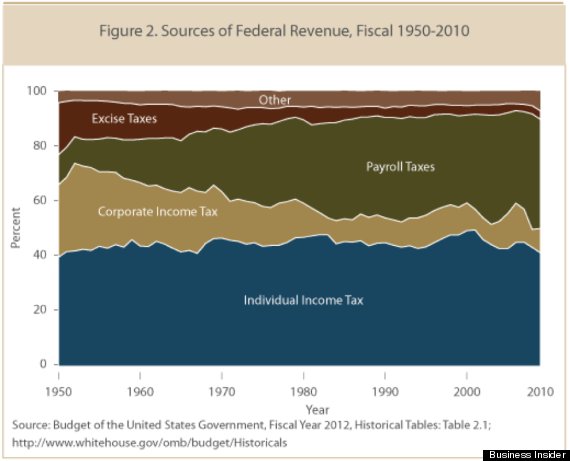
Paul Pirie for WaPo gives us more socio-economic data to ponder:
Most Americans work longer hours and have fewer paid vacations and benefits — including health care — than their counterparts in most advanced countries. Consider also that in the CIA World Factbook, the United States ranks 51st in life expectancy at birth. Working oneself into an early grave does not do much for one’s happiness quotient. This year the United States tied for 14th in “life satisfaction” on an annual quality-of-life study by the Organization for Economic Cooperation and Development. That puts the United States behind Canada (eighth) and Australia (12th). A report co-authored last year by the economist Jeffrey Sachs ranked the United States 10th in the world for happiness — again behind Canada and Australia. The Sachs study found that the United States has made “striking economic and technological progress over the past half century without gains in the self-reported happiness of the citizenry. Instead, uncertainties and anxieties are high, social and economic inequalities have widened considerably, social trust is in decline, and confidence in government is at an all-time low.”
But the difference is not just in economics or happiness, but also liberty. Pirie points out that the British Empire (including Canada) abolished slavery in 1833, a full 32 years befoe the U.S. ratification of the 13th Amendment to the Constitution. Today's slavery is the U.S. prison-industrial complex that incarcerates more adults, in both absolute and relative terms, than any other country by a wide margin, including Red China and Russia.
And speaking of Americans' liberty, I have three words for you: N-S-A. Do I really need to say more? It doesn't matter, the spooks are archiving this post anyway.
Today, having mentioned some of these factoids to a Brit, I joked about our reneging the Declaration of Independence. He said Britons are glad America is no longer their problem; they can't imagine trying to govern the U.S. I joked back, "Yeah, we have enough trouble dealing with places like Texas!" Can you imagine British PM David Cameron trying to talk sense to the folks in U.S. flyover country? You start to wonder who got the better end of the deal when the U.S. declared its independence....
Happy 4th of July, everybody! Have a hotdog and light off a roman candle for me.
Sunday, May 5, 2013
Austerity punks downgrade Britain's debt anyway
Sorry, I missed this story when it happened but it's still worth dwelling on because you won't hear this in the U.S. media. Fitch's downgrade followed Moody's downgrade of Britain's sovereign debt in February.
Let me underline why these downgrades by the independent ratings agencies are so important: this is the exact consequence that advocates of austerity warned Britain to avoid, and yet austerity has made their worst nightmare come true.
For all you Tea Partyers, let me make it simpler: cutting government spending led to a weaker economy and thus higher government debt, which led to ratings downgrades.
Let me also point out the outrageous, self-serving logic of Fitch:
"The current pace of deficit reduction doesn't seem excessive," Fitch analyst David Riley said. "Other countries in Europe are cutting at a similar speed or even faster."
Translation: "As good little neoliberals, we at Fitch agree ideologically with rapid deficit reduction, but we base our ratings on actual results, which have been awful, so... take that."
That's called damned if you do, damned if you don't, folks. It's safer to ignore the austerity punks and strive for a growing economy, because the austerity punks are fair-weather friends of budget-cutting states.
By Christina Fincher and David Milliken
April 19, 2013 | Reuters
Friday, February 22, 2013
Thanks, austerity: Moody's downgrades UK's debts
Let's be very clear: this was not supposed to happen, according to conservatives and financial markets gurus. Great Britain embraced austerity -- it is still embracing austerity -- and yet Moody's has cut its credit rating to AA1. So here is yet more evidence for those who still need it that national governments are not households, and the same rules do not necessarily apply.
Why? Slashing public spending put the UK in a recession that -- get ready, Tea Partyers, this is the part that always gets you -- increased public debt. Here it is again, in case you missed it: slashing spending hurt the economy which increased debt:
“The main driver underpinning Moody’s decision to downgrade the UK’s government bond rating to Aa1 is the increasing clarity that, despite considerable structural economic strengths,” the Moody’s report reads, “the UK’s economic growth will remain sluggish over the next few years due to the anticipated slow growth of the global economy and the drag on the UK economy from the ongoing domestic public- and private-sector deleveraging process.”
The "ongoing deleveraging process" is business-speak for cutting one's debts. And there was an extra "f*** you" from Moody's after it cut the UK's bond rating:
“A combination of political will and medium-term fundamental underlying economic strengths will, in time, allow the government to implement its fiscal consolidation plan and reverse the U.K.’s debt trajectory.”
In other words, Moody's said, "We think you're doing all the right things, and we hope that someday it will work out for you, but in the meantime it's not, so we're downgrading you."
That's called "damned if you do, damned if you don't," folks. But if you want to know what the "confidence fairy" really believes, look at what she does (downgrading), not what she says (cheering on austerity).
That's called "damned if you do, damned if you don't," folks. But if you want to know what the "confidence fairy" really believes, look at what she does (downgrading), not what she says (cheering on austerity).
One final note: the credit ratings agencies do not rate debt levels, they rate the ability to pay one's debts. They're not the same thing. In the U.S., we have a record-high national debt, ($7 trillion of it thanks to Dubya), and yet government spending to pay the interest on that debt is at a record low, thanks to record-low interest rates.
By Jill Lawless
February 22, 2013 | AP
Monday, November 12, 2012
UK gov't. wakes up and smells Starbucks' tax dodge
Imagine! After Reuters published an investigative report in October on how Starbucks paid no corporate tax in Britain, the company has been summoned to testify before the House of Commons public accounts committee!
Now, this may be partly because it's a U.S. company, so it's easy for Brits to pick on Starbucks. On the other hand, other big "American" MNCs such as Amazon, eBay, Facebook and Google pay little or no corporation tax despite large British operations. So probably Starbucks has been targeted because everybody can see how many Starbucks cafes there are and how much business they do, and it's absurd on its face to suppose that Starbucks is not a profitable operation in the UK. The issue is now political. As it should be.
If only the U.S. would follow suit, and at least shame such companies as G.E., Boeing, Verizon and Mattel that pay no corporate tax. If only.
And if only we had a group like "UK Uncut" that protested such tax avoiders as Starbucks, highlighting how many social services could be funded if only the company paid its fair share of tax.
And before you can say the U.S. statutory corporate tax rate is too high, let me remind you that, thanks to legal loopholes and overseas tax avoidance schemes, U.S. corporate tax receipts as a share of profits were "at their lowest level in at least 40 years" in fiscal year 2011, according to WSJ.
Cafe chain executive to face questions from MPs, while protesters plan to turn branches into creches and refuges.
By Simon Neville and Shiv Malik
November 12, 2012 | Guardian
Sunday, October 21, 2012
Starbucks serves up a lesson on tax dodges
Seattle-based Starbucks is one of those ubiquitous consumer products, like iPhones, that I am just way too savvy, original and discerning to endorse. In fact I enjoy taking pot shots at these Giants of Cool.
In the meantime, let's all agree to expand the definition of Corporate Social Responsibility (CSR) to paying your damn taxes in every country where you operate, at least once in a decade, for crying out loud!
Until they pay their taxes... Boycott Starbucks!
Anyway, I don't know if this story is making news in the U.S., but in Britain, Starbucks' brand name is taking a pounding after a Reuters investigation revealed that the chain has declared zero profit and paid zero corporate tax over the past three years on close to $2 billion in gross sales. This is despite Starbucks' assurances to investors and analysts over the years that its UK business is indeed profitable, and its main source of revenue to expand into overseas markets!
So how does Starbucks get away with it, legally? Three accounting gimmicks, according to Reuters. First, by copying Google and Microsoft:
Like those tech firms, Starbucks makes its UK unit and other overseas operations pay a royalty fee - at Starbucks, of six percent of total sales - for the use of its ‘intellectual property' such as its brand and business processes. These payments reduce taxable income in the UK.[...] The fees from Starbucks' European units are paid to Amsterdam-based Starbucks Coffee EMEA BV, described by the company as its European headquarters, although Michelle Gass, the firm's president in Europe, is actually based in London.
Second, like most MNCs, Starbucks by pays "arms length" "transfer prices" to its Starbucks subsidiaries in other countries for its goods like coffee beans and wooden swizzle sticks. This is basically Starbucks' right hand in a higher-tax country (Britain) paying Starbucks' left hand in a lower-tax country (Netherlands, Switzerland, etc.), and the right hand deducting the payment from its gross profit as a "business expense."
Third, Starbucks uses inter-company loans to its subsidiaries in other countries. Ridiculously, on paper, Starbucks' entire UK operation is funded by borrowed money, and to boot Starbucks UK pays its subsidiaries overseas a curiously high interest rate on that debt. Starbucks UK (the right hand) gets to deduct the debt and the interest paid from its tax bill; meanwhile Starbucks overseas (the left hand) is based in a country that doesn't tax interest earned on loans. The money is thus wiped clean.
Meanwhile, mom & pop coffee shops in the UK have no overseas subsidiaries with which to wipe out their tax liability. Thus they compete with this giant on an uneven playing field.
So you see, this game of tax avoidance that we all close our eyes to is not just a U.S. problem. It's everybody's problem. Governments have to start working together across borders to stop these MNCs from gaming the system at their host countries' expense.
In the meantime, let's all agree to expand the definition of Corporate Social Responsibility (CSR) to paying your damn taxes in every country where you operate, at least once in a decade, for crying out loud!
Until they pay their taxes... Boycott Starbucks!
 |
| London mayor Boorish Johnson toasting Starbucks CEO Howard Schultz for running such an unprofitable operation in Great Britain and paying no tax. |
Thursday, October 4, 2012
Brits still laughing at Romney since July
Brits are still making fun of Mitt Romney for his July 2012 visit to England on his Partial World Tour of Complete Excellence, when he called Ed Miliband of the Labour party "Mr. Leader" because he forgot his name:
"Let me tell you my favourite – it was when Mitt Romney came to Britain and called me ‘Mr Leader’. I don’t know about you but I think it has a certain ring to it myself, it’s sort of halfway to North Korea.Miliband, who taught economics at Harvard, added: "Mitt, thanks a lot for that.""I desperately hope Obama will win," he said.
Even Prime Minister and Conservative Party leader David Cameron said at a recent gathering that: "Mitt Romney has that unique distinction of uniting all of England against him with his various remarks."
Clearly, Romney is not prepared to step out on the world stage.
By Ned Simons
October 3, 2012 | Huffington Post UK
Monday, October 1, 2012
Labour wants Glass-Steagall for Britain
So liberals in the UK recognize the need to institute their own version of America's now defunct Glass-Steagall Act, but American liberals and conservatives still haven't come around to re-instituting this commonsense measure that was passed in 1933 after the Great Crash to separate banks' customers' deposits from banks' investment activities.
Miliband said: "Either they can do it themselves – which frankly is not what has happened over the past year – or the next Labour government will, by law, break up retail and investment banks."
Hear, hear! Let's take a lesson from those who have taken a lesson from us!
UPDATE: Ed Miliband is the guy Romney called "Mr. Leader" on his Partial World Tour of Complete Excellence because Romney couldn't remember his name.
UPDATE: Ed Miliband is the guy Romney called "Mr. Leader" on his Partial World Tour of Complete Excellence because Romney couldn't remember his name.
Labour leader gives ultimatum to City and says: 'We will split off casino operations'
By Toby Helm, Andrew Rawnsley, Phillip Inman and Daniel Boffey
September 29, 2012 | Observer
Subscribe to:
Posts (Atom)