Showing posts with label US dollar. Show all posts

Monday, October 1, 2012

Baker: 'Tough on China' = Tough on U.S. business


Good point:

[I]f Romney or any other president were to crack down on China over its currency, not only would he be forced to first overcome the opposition of the firms that directly profit from the over-valued dollar, he would also have to overcome the objections of many powerful corporations who want their own issues with China to be given priority.

In short, the issue is not really one of finding a president who is prepared to stand up and be tough against a cheating China, the issue is finding a president who is prepared to stand up and be tough with US corporate interests. Romney can certainly blame President Obama for not taking the tough stand against US corporations in his first term. The question is whether there is reason to believe that Romney would be any tougher on his friends and former business partners.  


Romney's ads claim that he will declare China to be a currency manipulator and take retaliatory measures.
By Dean Baker
October 1, 2012 | Al Jazeera

Friday, March 4, 2011

What 18th century American economy was really like

Git yerself edumacated about the glorious golden age of America's founding:

Tea Party history insists ordinary, hard-working Americans of the founding era wanted nothing more than to reduce government and keep it out of economic markets. But what those Americans really wanted can be gleaned from their terminology. The rich called them rioters. The people called themselves regulators.


By William Hogeland
March 1, 2011 | AlterNet

[...]

The only real money in 18th-century America was metal — silver and gold coin from England, Spain, and Mexico — and for long, terrible periods, money was rarely seen by ordinary people. Small farmers and artisans, wanting to survive and improve their lot, had to borrow. Merchants, gaining access to metal through imperial trading networks, used their money to make money, becoming lenders. Well before the Revolution, Americans defined themselves in practical terms either as "debtors" — poor and working people in small-scale enterprise — or "creditors" — well-heeled merchants growing their money by lending it.

Workings of the debtor-creditor relationship will sound unpleasantly familiar. Merchants had the money supply conveniently sewn up. Small farmers and artisans had to post the land and shops they hoped to develop as collateral for the credit they needed. Merchants might set interest rates as high as twelve percent — per month. Default, often predictable at the loan's outset, subjected borrowers to foreclosures, which in bad times were epidemic. Families became indigent while their land, tools, and homes were snapped up at bargain prices, often by the merchants themselves, who speculated in land as well, and were building immense parcels. The rich got richer.

Is it any wonder that ordinary people viewed this disastrous economic predicament not as some incidental fallout from vigorous free-market competition, but as an egregious, systemic injustice with political, moral, even spiritual implications? They were being held back, exploited, and even ruined by a monopoly on money and credit. And unlike today's populist right, founding-era Americans did not imagine that government's simply leaving markets alone would create new and exciting opportunities for them. They believed their governments should make laws to restrain the overwhelming power of the creditors' metal and protect those who labored and produced goods from those who planned dynasties of descendants living in luxurious idleness.

And remember: unless people had property in excess of certain amounts, they couldn't vote. Whig elites — the ones who became patriot leaders, lionized today — axiomatically equated the right of representation with property. It took even more property to run for office. Legislatures erected counties to ensure that representation favored the rich and the cities. They placed cash fees on every imaginable transaction, paralyzing working people's efforts to pursue legal recourse and enriching lawmakers' friends and families appointed as collectors and administrators. Roads and other infrastructure built at public expense (and by coerced labor taxes) served the merchant interest, not the people's. Hardly an embryonic American democracy, representative colonial governments were monopolized by forces that small-scale debtors and tenant farmers could only view as a creditor conspiracy to exploit their labor, prevent their participation, and take what stuff they had.

So they organized in vociferous protest. "Mob" is a loaded term; "crowd" is perhaps more fair, and early American crowd action should be understood as a tactic, in the absence of access to the franchise, for pressuring and even changing government. One of the most famous outbreaks occurred in the 1760's in North Carolina, when ordinary people briefly had a few champions in the legislature. They forcibly closed courts, tore down corrupt officials' homes, and finally went to war against the provincial government. Royal Governor William Tryon put that rebellion down — but the King's appointee was more sympathetic to the people's plight than upscale American legislators and merchants were.

Crowds could be flamboyantly scary and even violent, but they did not run amok, merely venting. In carefully organized disruptions, people moved en masse into courthouses where debt cases were heard, shutting down a judicial process they considered unjust. They felled huge trees across roads to prevent sheriffs from repossessing homes. They enforced no-buy covenants when foreclosed property went up for auction. They staged daring rescues of prisoners held on debt charges. Serving on juries in debt cases, they refused to convict. Well before the famous Stamp Act riots and other acts of resistance to new British trade laws, American life involved orchestrated crowd actions to prevent financial injustice and push government to act on behalf of ordinary people. After the Revolution, the event known as Shays' Rebellion became only the most famous of the debtor uprisings that continued the people's struggle in a new political context.

While emulating Shaysite and other debtor crowd actions today would pose an interesting counter-demonstration to Tea Party efforts, the question this history really raises has to do with what Americans want from their government. Do we really want to roll back "nanny state" protections like RESPA, for example, under which an ordinary citizen like Patrick Rodgers was able to interrogate his bank? RESPA is but one detail in a program — and a power — that our ancestors painfully lacked.

Tea Party history insists ordinary, hard-working Americans of the founding era wanted nothing more than to reduce government and keep it out of economic markets. But what those Americans really wanted can be gleaned from their terminology. The rich called them rioters. The people called themselves regulators.

Friday, December 10, 2010

MB360: Beyond TBTF: The era of mega banks

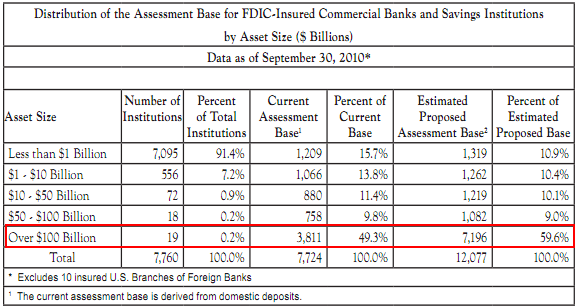
The era of mega banks – The growth of too big to fail. American banking system still backing over $13 trillion in assets with a negative deposit insurance fund. 7,760 banks but 19 banks make up 50 percent of the asset base.

Posted by mybudget360
December 8, 2010

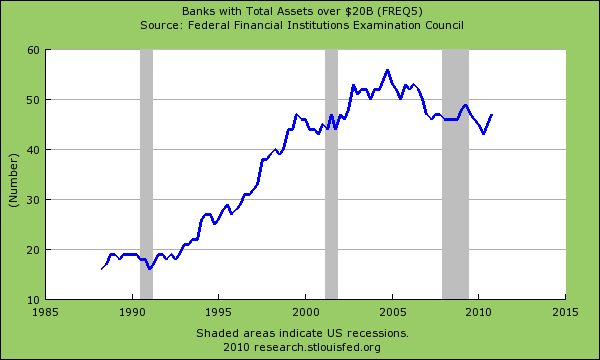
The growth of the too big to fail bank is something that is modern to this era. In the 1990s there were fewer than 40 institutions that had total assets above $20 billion. In the late part of the 1980s and 1990s this number was below 20. The peak was reached in 2005 with 55 institutions having more than $20 billion in total assets. That number has fallen in recent years because of the crisis yet we have a handful of banks that control most of the nation's banking assets. The total U.S. banking system as of today supports over $13 trillion in total assets. The FDIC insures these deposits with a deposit fund that is negative so it might as well be supported by pure faith. What makes up most of these assets are residential and commercial real estate loans. As we have discussed banks have yet to come to terms with the reality that many of these loans are not worth what they claim they are. First, let us look at the growth of too big to fail.

The chart is unmistakable in the modern era growth of mega banks:

You can see that in the mid-1990s the growth in too big to fail took off. It hit its pinnacle in 2005. There is nothing inherently good about massively giant institutions and we have seen the ramifications of failure with Lehman Brothers and Bear Stearns to mention a couple notable collapses. Even though the U.S. banking system has 7,760 banks 19 banks make up 50 percent of the asset base:

Source: FDIC

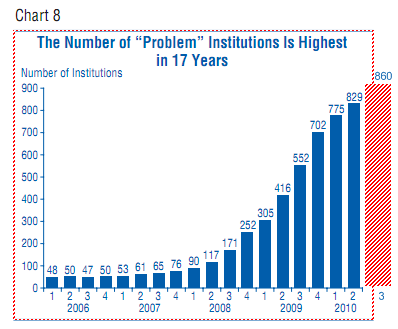
The more disturbing thing is that most of the bigger banks are the institutions with the weaker balance sheets. But look at the above chart. 7,095 banks can completely fail and only 15 percent of the total asset base would disappear. It shouldn't be surprising that the list of troubled smaller banks is growing:

But didn't you say smaller banks were doing better than bigger banks? They are for the most part but many of these smaller banks don't have the same kind of relationship with the Federal Reserve and don't have the leverage of say a JP Morgan or Bank of America. Looking at recent banking profits the bulk of the money being made isn't on a strong U.S. bank customer, but by speculating through their investment units around the world. This can take the form of speculating in commodities, stocks in emerging countries, or anything else. When you can borrow at zero percent it isn't too difficult to turn a profit but it is certainly not benefitting the American economy especially the working and middle class.

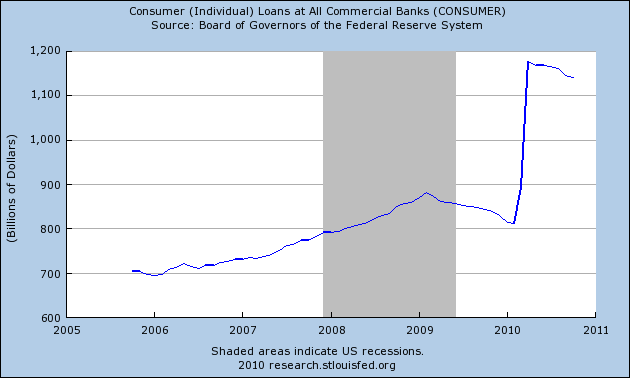
Consumer and individual loans did spike up in 2010 due to easy money and banks being flush with funds. Yet this is now tapering off:

At the same time, is this even something to be happy about? The American consumer is over leveraged so adding more debt doesn't seem to be the solution here. Banks can only make these loans because the Fed is determined to dilute the U.S. dollar and hopefully, in their eyes at least, inflate away current debts including horrific bets on commercial real estate.

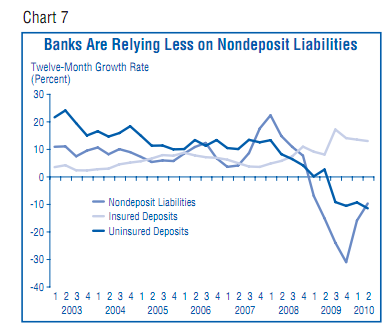
Even in recent years it has become very clear that bankers are relying on more questionable assets to constitute their investment base:

Many observers agree that the current banking system is insolvent and the only thing keeping it afloat is by suspending accounting laws that require mark to market. We have seen this translate into banks moving slowly on bigger priced foreclosures on residential properties but also commercial buildings. The banking system problems of 2007 are still largely present as we end 2010. The only difference now is that they have managed to link up their failure to the U.S. dollar directly. This is why the Federal Reserve is embarking on the quantitative easing path.

Mega banks need to be broken up and a separation between investment and commercial banking is an absolute necessity. It is incredible that no politician (or group of) has taken this up.

"Many Americans are now coming to the stark realization that Washington D.C. and their representatives no longer listen to their voice. They listen to lobbyists and banking interests."

If you recall, the bailouts were largely opposed and the public railed against their constituents. The first vote did not pass the bailout and then politicians used fear and went ahead anyway. This was not the will of the people. Also, it is insulting that nothing was attached to the bailout funds. For example, a stipulation could have been put to break up the banks as a condition of the bailouts. Instead a blank check was given and here we are back with the same system of mega banks and no protection for the people. If our politicians were in a contest for best negotiator they would come in absolute last.

They say this was necessary or the economy would have been even worse. Well let us look at the unemployment rate now versus when the bailouts largely took place:

September 2008: 6.2

November 2010: 9.8

Then we hear the Federal Reserve saying it would have been 25 percent if it weren't for the bailouts. Really? What would it have been if the Fed actually did its job and prevented the housing bubble from taking place to begin with by regulating and enforcing laws against the banks? Do people really trust these guys?

Friday, December 3, 2010

MB360: Fed bailout report reveals 'con of the century'

The con of the century – Federal Reserve made $9 trillion in short-term loans to only 18 financial institutions. Since 2000 the US dollar has fallen by 33 percent. The hidden cost of the bailouts.
Posted by mybudget360 December 3, 2010

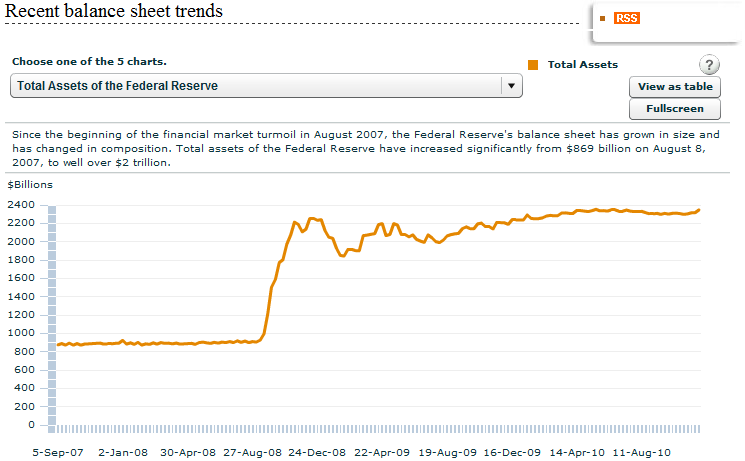
The Federal Reserve released a stunning report showing the details of bailouts that occurred during the peak of the credit crisis. They won't call it "bailouts" but giving money when others won't is exactly that. What the report shows is that the Fed operated as a global pawnshop taking in practically anything the banks had for collateral. What is even more disturbing is that the Federal Reserve did not enact any punitive charges to these borrowers so you had banks like Goldman Sachs utilizing the crisis to siphon off cheap collateral. The Fed is quick to point out that "taxpayers were fully protected" but mention little of the destruction they have caused to the US dollar. This is a hidden cost to Americans and it also didn't help that they were the fuel that set off the biggest global housing bubble ever witnessed by humanity. A total of $9 trillion in short-term loans were made to 18 financial institutions. Still think the banking bailout didn't happen or cost us nothing? Let us first look at the explosion of assets on the Fed balance sheet.

The Fed is still carrying longer term debt on its books that shouldn't be there:

federal reserve assets


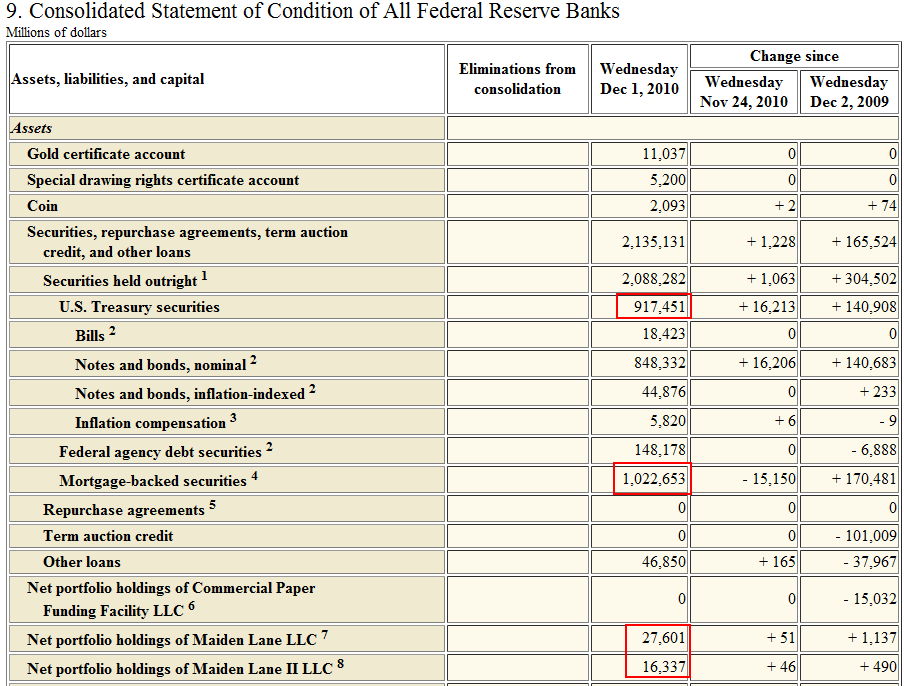
The Fed typically would carry under $900 billion in high quality government Treasuries on its balance sheet. But today it is carrying roughly $2.4 trillion in "assets" and the biggest part of this is made up of questionable mortgages:

federal reserve balance sheet


Over $1 trillion of mortgage backed securities sit on the Fed balance sheet and QE2 is only starting. Other tens of billions of dollars are sitting in the balance sheet as well that include failed commercial real estate projects and defunct shopping centers around the country. Of course the Fed would like to give the appearance that all is well but no one makes $9 trillion in short-term loans without undergoing serious problems. And doesn't it bother the public that an institution that represents our banking system essentially bailed out the world at the expense of US taxpayers (without asking by the way) and now taxpayers are having to deal with a toxic banking system and a jobs market that is hammered into the ground?

This concern was raised:

"(NY Times) But Senator Bernard Sanders, independent of Vermont, who wrote a provision in the law requiring the disclosures by Dec. 1, reached a different conclusion.

"After years of stonewalling by the Fed, the American people are finally learning the incredible and jaw-dropping details of the Fed's multitrillion-dollar bailout of Wall Street and corporate America," he said. "Perhaps most surprising is the huge sum that went to bail out foreign private banks and corporations."

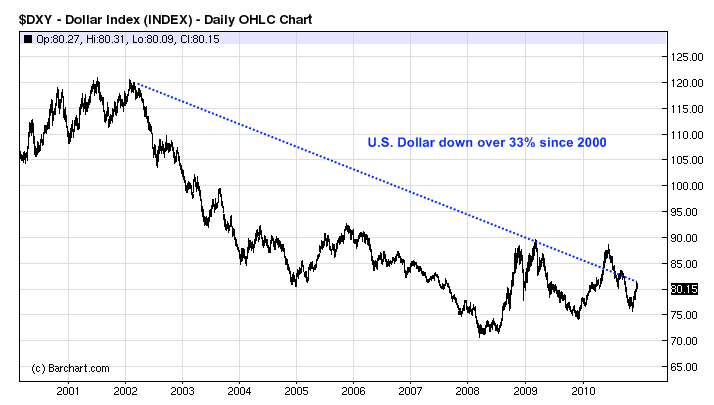
Senator Sanders is absolutely right. Did you also know that billions of dollars went to foreign central banks as well? We all know the issues going on with the European Zone today but the Fed never mentioned this during the bailout frenzy. Don't be fooled when the Fed says there is no cost associated. 26 million Americans are unemployed or underemployed and 44 million Americans are on food assistance. The US dollar has done the following in the last decade:

us dollar index


Yet this is the response:

"In a statement accompanying the disclosure, the Fed said it had fully protected taxpayers. "The Federal Reserve followed sound risk-management practices in administering all of these programs, incurred no credit losses on programs that have been wound down, and expects to incur no credit losses on the few remaining programs," it said."

Sound risk-management? The entire purpose is to destroy the currency in a slow methodical process and inflate away the debt. Yet there is a cost to this born by the many for the few. Over the last decade it has meant the depreciation of the dollar by 33 percent. That is a real cost. It might not be a big deal if you hold money in foreign countries but most Americans only have a paycheck that is issued in US dollars. The actual amount of Fed loans is simply jaw dropping:

"At home, from March 2008 to May 2009, the Fed extended a cumulative total of nearly $9 trillion in short-term loans to 18 financial institutions under a credit program.

Previously, the Fed had only revealed that four financial firms had tapped the special lending program, and did not reveal their identities or the loan amounts.

The data appeared to confirm that Citigroup, Merrill Lynch and Morgan Stanley were under severe strain after the collapse of Lehman Brothers in September 2008. All three tapped the program on more than 100 occasions."

Keep in mind that unemployment insurance will cost roughly $4 billion per month and most of this money will go back into the economy. Congress is stalling on this yet the media is completely silent on the $9 trillion in Federal Reserve loans? This should be the headline story over and over until people realize how big the bailout was (and how this false dichotomy is being used as propaganda in the media as if $4 billion a month is going to bankrupt the system). The banking elites just want to shift the blame to "poor" people while ignoring the elephant in the room which are the trillions of dollars in Fed loans.

Everyone got in the game:

"Big institutional investors, like Pimco, T. Rowe Price and BlackRock, borrowed from the TALF program. So did the California Public Employees Retirement System, the nation's largest public pension fund, and several insurers and university endowments."

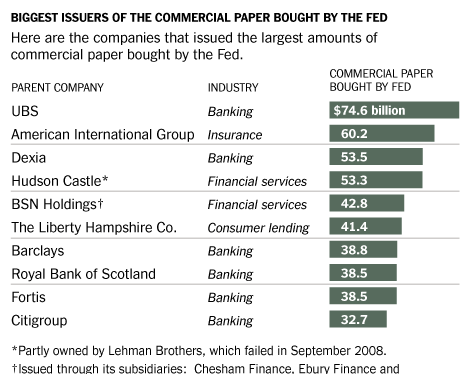
biggest issuers of debt federal reserve bought


Source: New York Times

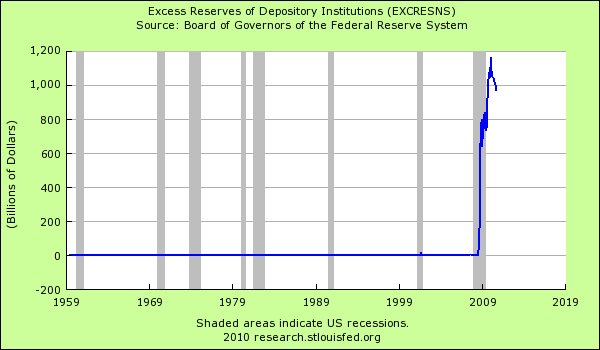
Every big player got into this and you will recall the rhetoric that it was for small businesses and the American consumer. None of that happened. Banks are still sitting on incredibly large excess reserves:

excess reserves


The Fed is operating without any checks and balances from Congress and another trillion dollar exposure has come out with the mainstream media channels like ABC, CBS, and NBC all remaining silent. Can't interrupt Wheel of Fortune right?

Thursday, July 8, 2010

BHO's socialist export & trade liberalization drive

There goes comrade Barack again, trying to destroy capitalism and turn America socialist.

Can't you all see he hates our way of life?!

UPDATE (07.09.2010): Robert Reich said that if all countries follow America's lead it could cause a return to Smoot-Hawley, trade wars, and protectionism. And who has enough money to buy our stuff anyway, especially if American consumers aren't buying theirs?


Expanding Exports To Stimulate The Economy
By Scott Horsley
July 7, 2010 | All Things Considered, NPR

URL: http://www.npr.org/128365800

Tuesday, May 19, 2009

Roubini: Demise of dollar's dominance

Here's red meat for all you rabid anti-stimulus folks. Have at it!

The Almighty Renminbi?
By Nouriel Roubini
May 13, 2009 | New York Times

THE 19th century was dominated by the British Empire, the 20th century by the United States. We may now be entering the Asian century, dominated by a rising China and its currency. While the dollar's status as the major reserve currency will not vanish overnight, we can no longer take it for granted. Sooner than we think, the dollar may be challenged by other currencies, most likely the Chinese renminbi. This would have serious costs for America, as our ability to finance our budget and trade deficits cheaply would disappear.

Traditionally, empires that hold the global reserve currency are also net foreign creditors and net lenders. The British Empire declined — and the pound lost its status as the main global reserve currency — when Britain became a net debtor and a net borrower in World War II. Today, the United States is in a similar position. It is running huge budget and trade deficits, and is relying on the kindness of restless foreign creditors who are starting to feel uneasy about accumulating even more dollar assets. The resulting downfall of the dollar may be only a matter of time.

But what could replace it? The British pound, the Japanese yen and the Swiss franc remain minor reserve currencies, as those countries are not major powers. Gold is still a barbaric relic whose value rises only when inflation is high. The euro is hobbled by concerns about the long-term viability of the European Monetary Union. That leaves the renminbi.

China is a creditor country with large current account surpluses, a small budget deficit, much lower public debt as a share of G.D.P. than the United States, and solid growth. And it is already taking steps toward challenging the supremacy of the dollar. Beijing has called for a new international reserve currency in the form of the International Monetary Fund's special drawing rights (a basket of dollars, euros, pounds and yen). China will soon want to see its own currency included in the basket, as well as the renminbi used as a means of payment in bilateral trade.

At the moment, though, the renminbi is far from ready to achieve reserve currency status. China would first have to ease restrictions on money entering and leaving the country, make its currency fully convertible for such transactions, continue its domestic financial reforms and make its bond markets more liquid. It would take a long time for the renminbi to become a reserve currency, but it could happen. China has already flexed its muscle by setting up currency swaps with several countries (including Argentina, Belarus and Indonesia) and by letting institutions in Hong Kong issue bonds denominated in renminbi, a first step toward creating a deep domestic and international market for its currency.

If China and other countries were to diversify their reserve holdings away from the dollar — and they eventually will — the United States would suffer. We have reaped significant financial benefits from having the dollar as the reserve currency. In particular, the strong market for the dollar allows Americans to borrow at better rates. We have thus been able to finance larger deficits for longer and at lower interest rates, as foreign demand has kept Treasury yields low. We have been able to issue debt in our own currency rather than a foreign one, thus shifting the losses of a fall in the value of the dollar to our creditors. Having commodities priced in dollars has also meant that a fall in the dollar's value doesn't lead to a rise in the price of imports.

Now, imagine a world in which China could borrow and lend internationally in its own currency. The renminbi, rather than the dollar, could eventually become a means of payment in trade and a unit of account in pricing imports and exports, as well as a store of value for wealth by international investors. Americans would pay the price. We would have to shell out more for imported goods, and interest rates on both private and public debt would rise. The higher private cost of borrowing could lead to weaker consumption and investment, and slower growth.

This decline of the dollar might take more than a decade, but it could happen even sooner if we do not get our financial house in order. The United States must rein in spending and borrowing, and pursue growth that is not based on asset and credit bubbles. For the last two decades America has been spending more than its income, increasing its foreign liabilities and amassing debts that have become unsustainable. A system where the dollar was the major global currency allowed us to prolong reckless borrowing.

Now that the dollar's position is no longer so secure, we need to shift our priorities. This will entail investing in our crumbling infrastructure, alternative and renewable resources and productive human capital — rather than in unnecessary housing and toxic financial innovation. This will be the only way to slow down the decline of the dollar, and sustain our influence in global affairs.

Nouriel Roubini is a professor of economics at the New York University Stern School of Business and the chairman of an economic consulting firm.