Gee, if only the party that says it most adores our nation's military would take note!
Showing posts with label Pentagon. Show all posts
Showing posts with label Pentagon. Show all posts
Wednesday, October 22, 2014
Navy Rear Admiral: DoD preparing for climate change
Republicans can call global warming science "political" all they want, but the U.S. Military cannot afford to be so blithe about the real effects of real climate change. Hence they are getting prepared.


Monday, October 13, 2014
Pentagon is planning for global warming
This libertarian, Koch- and Hagel-loving Nazi that I correspond with blamed this story on President Obama, of course. So I told him that he had sorely underestimated our nation's military. Why?
Because our military can't afford to engage in short-term corporate thinking where the C-levels and middle managers still make out if it all goes to shit. We have islands sinking, military bases flooding, unrest and potential wars over fresh water resources... the U.S. military must understand and plan for all of it, regardless of his dumb corporate/FOX news agenda of denying what's happening. They can't afford denial; they must be right.
Incidentally, is it any wonder that rah-rah military guy Sen. John McCain of all Republicans gets it? He said if the scientists are wrong about global warming then the costs are manageable and we get all these wonderful sustainable energy technologies to boot; but if we're wrong, and unprepared, the costs will be ginormous and the consequences unpredictable and unmanageable.
Unlike some other liberals I have a lot of respect for the U.S. military, not least because they are the most forward-thinking, long-term planning organization you will find in the world. Sure, some of the generals have cushy corporate or lobbying jobs waiting for them when they jump ship, but as an organization it's all about the mission, and how they define potential threats and safety are not determined by the POTUS; these are concepts always in flux and under their monitoring.
By Suzanne Goldenberg
October 13, 2014 | Guardian
Sunday, September 7, 2014
Bergen: Americans fighting for ISIS will die over there
We're all gonna diiiiieeeeeeee! Mobilize the army! Scramble the bombers! DEFCON 1! Kill 'em all! Kill, kill, kill! Aaaaaaaaaaa!
Now that I've done the obligatory Scaring The Shit Out Of You, followed by the customary Let's Kill Them All First that you've become accustomed to on cable and talk radio, here's some more sober analysis of the actual threat to America posed by Islamic State, from CNN's resident Islamist terrorism expert Peter Bergen (and some other dude).
By Peter Bergen and David Sterman
September 5, 2014 | CNN
ISIS has Americans worried. Two-thirds of those surveyed in a recent Pew Research poll said they consider the Islamic State in Iraq and Syria to be a "major threat" to this country. But are such fears really justified?
Despite the impression you may have had from listening to U.S. officials in recent weeks, the answer is probably not really.
For a start, U.S. officials have been inflating the numbers of Americans fighting for ISIS, which has muddied the issue for the public. U.S. Secretary of Defense Chuck Hagel, for example, told CNN's Jim Sciutto on Wednesday, "We are aware of over 100 U.S. citizens who have U.S. passports who are fighting in the Middle East with ISIL forces." (ISIS is sometimes referred to as ISIL and now calls itself the Islamic State).
But the Pentagon soon corrected Hagel's comment, saying the 100 count is the total number of Americans fighting for any of the various groups fighting in Syria, some of which are more militant than others -- and some of which are even allied with the U.S. Indeed, Matthew Olsen, the director of the National Counterterrorism Center -- the government office tasked with assessing terrorist threats -- also confirmed that 100 is the total count of the various Americans fighting in Syria and not a count of those fighting for ISIS.
Hagel's comment is only the latest inflated claim regarding the number of Americans fighting with ISIS. Last week, the Washington Times cited anonymous official sources who said there are 300 Americans fighting with ISIS, despite the Pentagon estimating the figure to be more like a dozen.
True, a dozen is still too many. But it is important to remember that just because these Americans are fighting with ISIS, it doesn't necessarily translate into a significant threat to the American homeland.
One need only look at the example of Somalia to see why.
The last sizeable group of Americans who went overseas to fight with an al Qaeda-aligned group are the 29 Americans known to have traveled to fight with the Somali terrorist group Al-Shabaab after the 2006 invasion of Somalia by the Ethiopian army. However, none of those 29 subsequently planned or conducted a terrorist attack inside the United States, according to a survey of more than 240 jihadist terrorism cases since September 11 conducted by the New America Foundation.
Indeed, for more than a third of the American militants who fought with Al-Shabaab, going to Somalia was a one-way ticket. In 2008, a missile strike in Somalia killed Ruben Shumpert, a resident of Seattle. A year later, Burhan Hassan, a 17-year-old from Minneapolis, was killed in the Somali capital, Mogadishu. Abdirizak Bihi, Hassan's uncle, reportedly said at the time, "We believe he was killed because he would have been a key person in the investigation into the recruitment (of young Somali men) here in Minneapolis."
Al-Shabaab militants also are said to have killed Alabama native Omar Hammami, who joined the group in 2006 and took a high-profile position in its media operations before his death last year.
At least two Americans fighting for Al-Shabaab died while conducting suicide attacks in Somalia.
Shirwa Ahmed, a 26-year-old from Minnesota, became the first known American to conduct a suicide bombing for an al Qaeda-associated group when he drove a car packed with bombs into a government compound on October 28, 2008.
In 2011, meanwhile, the FBI confirmed that Farah Mohamed Beledi, a 27-year-old Minnesota man who was born in Somalia and moved to the United States at age 12, was killed while attempting to detonate a suicide bomb in Somalia.
In addition to the American militants who died in Somalia, six were arrested, four when they returned to the West and two in East Africa. Kamal Said Hassan, a 28-year-old Minneapolis man who traveled to Somalia and attended an Al-Shabaab training camp before returning to the United States, was arrested and in 2009 pleaded guilty to supporting Al-Shabaab.
In another case, Mahamud Said Omar, an American resident who helped organize Al-Shabaab's recruitment pipeline and visited a training camp, was arrestedin the Netherlands in 2009. Omar was extradited to the United States and in 2012 was convicted on terrorism charges.
Of course, the fact that 13 of the 29 American militants who fought in Somalia remain at large is a reminder that the CIA and FBI also need to pay attention to the potential threat posed by American foreign fighters in Syria. But this is no reason for U.S. officials to overhype the threat posed by ISIS to the United States.
Yes, Americans should always be mindful of the threats posed by extremists. But as the case of U.S. citizens in Somalia suggests, Syria could very well end up being a graveyard for Americans fighting there rather than a launch pad for attacks on the United States.
Wednesday, January 15, 2014
FOX tries its best to spin Senate BENGHAZI! report
Check out the GOP Spin Zone over at Fox News:

Yet further down in the article it says:
The Senate committee report stressed that the intelligence still suggests the attack was not “highly coordinated,” but rather “opportunistic” – possibly put in place in “short order” after protests over an anti-Islam film elsewhere in the region.“It remains unclear if any group or person exercised overall command and control of the attacks,” the report said.
So those conclusions from the Senate committee's own biased, partisan report refutes two of the Republicans' four main accusations against the Obama Administration: that al Qaeda was behind the attacks (and not just al Qaeda-affiliate groups being "involved"); and that the anti-Islam film had nothing to do with the timing of the attack.
The third main accusation by the GOP is that the State Department and the White House ignored security threats inside Libya. This I won't go into now. It suffices to say that Amb. Stevens alone made the decision to visit Benghazi that day, not Hillary Clinton or President Obama. He was quite aware of the risky post-conflict security situation in Libya. Rep. Grayson made this amply clear in a House hearing on Benghazi, see it here:
The fourth main accusation by the GOP is that Obama and his generals did not come to the rescue of Amb. Stevens and other U.S. personnel in time, for reasons unclear or speculative. I won't respond to this accusation now either, since I've written about it before, and no credible analysts have been able to dispute the actual events or timing.
So there you go. BENGHAZI! has been reduced to plain old Benghazi, a political tempest in a teapot, where brave Americans' lives and memories have been used cynically as political ammunition by the GOP. Moving on.
Thursday, January 9, 2014
Ex-CIA analyst and Army prof.: Don't trust Robert Gates
If you're at all concerned about Robert Gates's "revelations" in his recent memoirs about the Obama Administration then you should definitely read this article.
If you're like me and you see a guy in Gates who admits in his own memoirs that he was a burnout and reluctant SecDef before he even took the job in the Obama Administration, and now doesn't want to be associated with "defeat" in Iraq and Afghanistan (just like Dubya didn't want to -- hence he kept the troops there indefinitely, passing these two shit sandwiches to Obama...), and yet who writes in the same memoirs that he agrees with all Obama's major policy decisions (DWTF?!), then you can skip this one.
But like I said, if you have any doubts, just read this.
By Melvin A. Goodman
January 9, 2014 | CounterPunch
Melvin A. Goodman, a senior fellow at the Center for International Policy and adjunct professor at Johns Hopkins University. He is the author of the recently published National Insecurity: The Cost of American Militarism (City Lights Publishers) and the forthcoming “The Path to Dissent: The Story of a CIA Whistleblower” (City Lights Publisher). Goodman is a former CIA analyst and a professor of international relations at the National War College.
Monday, January 6, 2014
Engelhardt: U.S. National Security State is an insane religious order
Right on! Tom Engelhardt is a lone voice of sanity. Our National Security State (NSS), as he dubs it, has indeed grown out of control. Its reason for being has become self-perpetuation and -aggrandizement.
As I posted back in March, the Department of Homeland Security, which didn't even exist prior to 9/11, has spent about $800 billion since then in order to prevent any more such attacks. Never mind that that plot could have been thwarted if the FBI had simply listened to its field agents. No, we had to go an make a "monstrosity" (in Ron Paul's words), a real "Department of Defense" to rival the Pentagon -- the "Department of Offense."
This is not to forget the outrageous $700 billion Pentagon budget that is bigger than the next 13 biggest military budgets in the world combined; and let's ponder in awe and disgust that the Pentagon employs, directly and via contractors, about 3.3 million Americans, making it the single largest U.S. employer. Finally, let's remember Pentagon's network of hundreds of military bases worldwide. (For comparison, by one estimate, the Roman Empire had about 37 major bases at its height, while the British Empire had 36. So what does that make the United States, Rotary International?!)
And of course we have the NSA. What can I say that hasn't already been said? The NSA assures us that they have foiled some 54 "9/11"-type attacks (but only 13 in the U.S.... maybe we should start charging Europe a fee?) with their ceaseless spying on innocent Americans, but they can't tell us anything about these so-called plots because they're so secret. But the NSA did tell a Presidential task force, which responded, essentially with, "Phooey." So that's more money and liberty down the drain.
Folks, this is all done in our name, ostensibly to protect us. We're not innocent bystanders in all this. We're enablers. We must stop enabling. We must tell our Congressmen -- I'm talking to you, "fiscally responsible" Tea Partiers -- that the NSS has grown out of our control and must be chopped down. This monster now exists to feed itself and make babies, not to protect us.
Read on!...
By Tom Engelhardt
January 5, 2014 | Tom Dispatch
Sunday, October 6, 2013
Pentagon is largest U.S. employer
 Yes, the federal government is too big, and this proves it: the Pentagon has 400,000 civilian employees!
This is not counting the 700,000 or so civilian contractors who also work for the Defense Department.
Nor does it count, of course, our 1.4 million active-duty members of the armed services, and 850,000 reservists and National Guard troops.
So altogether, about one percent of the U.S. population works for the Pentagon.
That may not sound like a lot, but that makes it America's largest employer with about 3.3 million. By comparison, America's largest private employer Walmart has only 1.3 million workers.
Furthermore, the Pentagon's annual "income" from taxpayers dwarfs Walmart's in the U.S. by 25 times: $682 billion vs. $27 billion! (2012 figures).
So why aren't my fellow Americans in the Tea Parties complaining and agitating to shrink America's bloated defense budget?
P.S. -- To head off some predictable retorts, first check out this fact sheet from the Center for International Policy, "Myths vs. Realities of Pentagon Spending."
Thursday, June 23, 2011
10 firms get 25% of all USG contract money
Yep.
By Neil Gordon
June 21, 2011 | Project On Government Oversight
The federal government awarded $537 billion in contracts to more than 300,000 entities last year. However, as AllGov recently reported, about 25 percent of that amount went to just 10 companies –- Lockheed Martin, Boeing, Northrop Grumman, General Dynamics, Raytheon, United Technologies, L-3 Communications, Oshkosh Corporation, SAIC, and BAE Systems -–the top 10 federal contractors in FY2010. The fact that these companies are primarily defense contractors isn't surprising given that the Department of Defense typically accounts for two-thirds to three-quarters of all contract spending each year.
[...]
Explore the misconduct profiles of the top ten federal contractors in POGO's Federal Contractor Misconduct Database.
Monday, September 13, 2010
Zakaria: U.S. overreacted to 9/11
It's always nice when Fareed Zakaria decides to agree with me, albeit late. However I'm very late in posting this, so it kind of evens out.
By Fareed Zakaria
September 4, 2010 | Newsweek
Nine years after 9/11, can anyone doubt that Al Qaeda is simply not that deadly a threat? Since that gruesome day in 2001, once governments everywhere began serious countermeasures, Osama bin Laden's terror network has been unable to launch a single major attack on high-value targets in the United States and Europe. While it has inspired a few much smaller attacks by local jihadis, it has been unable to execute a single one itself. Today, Al Qaeda's best hope is to find a troubled young man who has been radicalized over the Internet, and teach him to stuff his underwear with explosives.
I do not minimize Al Qaeda's intentions, which are barbaric. I question its capabilities. In every recent conflict, the United States has been right about the evil intentions of its adversaries but massively exaggerated their strength. In the 1980s, we thought the Soviet Union was expanding its power and influence when it was on the verge of economic and political bankruptcy. In the 1990s, we were certain that Saddam Hussein had a nuclear arsenal. In fact, his factories could barely make soap.
The error this time is more damaging. September 11 was a shock to the American psyche and the American system. As a result, we overreacted. In a crucially important Washington Post reporting project, "Top Secret America," Dana Priest and William Arkin spent two years gathering information on how 9/11 has really changed America.
Here are some of the highlights. Since September 11, 2001, the U.S. government has created or reconfigured at least 263 organizations to tackle some aspect of the war on terror. The amount of money spent on intelligence has risen by 250 percent, to $75 billion (and that's the public number, which is a gross underestimate). That's more than the rest of the world spends put together. Thirty-three new building complexes have been built for intelligence bureaucracies alone, occupying 17 million square feet—the equivalent of 22 U.S. Capitols or three Pentagons. Five miles southeast of the White House, the largest government site in 50 years is being built—at a cost of $3.4 billion—to house the largest bureaucracy after the Pentagon and the Department of Veterans Affairs: the Department of Homeland Security, which has a workforce of 230,000 people.
This new system produces 50,000 reports a year—136 a day!—which of course means few ever get read. Those senior officials who have read them describe most as banal; one tells me, "Many could be produced in an hour using Google." Fifty-one separate bureaucracies operating in 15 states track the flow of money to and from terrorist organizations, with little information-sharing.
Some 30,000 people are now employed exclusively to listen in on phone conversations and other communications in the United States. And yet no one in Army intelligence noticed that Maj. Nidal Malik Hasan had been making a series of strange threats at the Walter Reed Army Medical Center, where he trained. The father of the Nigerian "Christmas bomber" reported his son's radicalism to the U.S. Embassy. But that message never made its way to the right people in this vast security apparatus. The plot was foiled only by the bomber's own incompetence and some alert passengers.
Such mistakes might be excusable. But the rise of this national-security state has entailed a vast expansion in the government's powers that now touches every aspect of American life, even when seemingly unrelated to terrorism. The most chilling aspect of Dave Eggers's heartbreaking book, Zeitoun, is that the federal government's fastest and most efficient response to Hurricane Katrina was the creation of a Guantánamo-like prison facility (in days!) in which 1,200 American citizens were summarily detained and denied any of their constitutional rights for months, a suspension of habeas corpus that reads like something out of a Kafka novel.
In the past, the U.S. government has built up for wars, assumed emergency authority, and sometimes abused that power, yet always demobilized after the war. But this is a war without end. When do we declare victory? When do the emergency powers cease?
Conservatives are worried about the growing power of the state. Surely this usurpation is more worrisome than a few federal stimulus programs. When James Madison pondered this issue, he came to a simple conclusion: "Of all the enemies to public liberty war is, perhaps, the most to be dreaded, because it comprises and develops the germs of every other … In war, too, the discretionary power of the executive is extended?.?.?.?and all the means of seducing the minds, are added to those of subduing the force, of the people.
"No nation could preserve its freedom in the midst of continual war," Madison concluded.
Friday, July 16, 2010
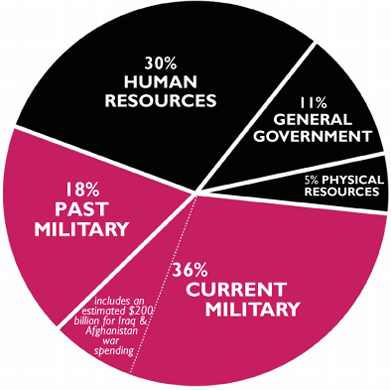
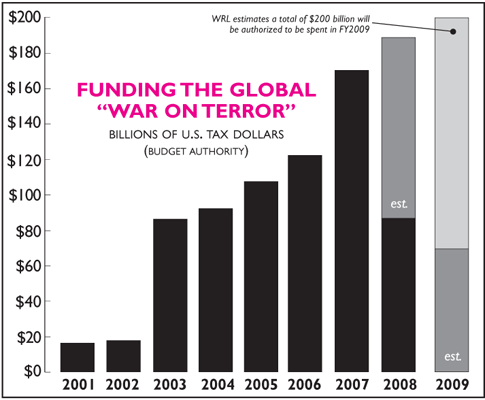
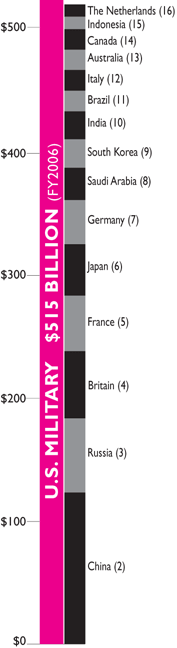
Where your income tax really goes
OK, you fiscally responsible teabaggers, tell us where to cut. But don't you dare touch defense!
 Total Outlays (Federal Funds): $2,650 billion
HOW THESE FIGURES WERE DETERMINED
These figures are from an analysis of detailed tables in the "Analytical Perspectives" book of the Budget of the United States Government, Fiscal Year 2009. The figures are federal funds, which do not include trust funds — such as Social Security — that are raised and spent separately from income taxes. What you pay (or don't pay) by April 15, 2008, goes to the federal funds portion of the budget. The government practice of combining trust and federal funds began during the Vietnam War, thus making the human needs portion of the budget seem larger and the military portion smaller. *Analysts differ on how much of the debt stems from the military; other groups estimate 50% to 60%. We use 80% because we believe if there had been no military spending most (if not all) of the national debt would have been eliminated. For further explanation, please see box at bottom of page. | ||||||||||||||||||||||||
| ||||||||||||||||||||||||


Sunday, July 11, 2010
Frank and Ron Paul: Cut Pentagon by $1 trillion
Why haven't the Tea Parties picked up Ron Paul's banner? He was teabagging before it was hip and cool. Is it their ignorance? Are they afraid of accusations they don't "support our troops?" Or is that they're not against Big Government, per se, just against a government that spends on butter instead of guns?
Whatever the reason, the teabaggers can't be taken seriously on fiscal responsibility until they face the issues of Iraq, Afghanistan, and the hundreds of U.S. military garrisons circling the globe. Moreover, their intentions will be suspect until they start crying just as loudly to cut defense spending as they do to cut spending on health care, unemployment benefits, alternative energies, and other federal stimulus measures. In other words, until they stop acting exactly like Republicans.
By Rep. Barney Frank and Rep. Ron Paul
July 6, 2010 | Huffington Post
As members of opposing political parties, we disagree on a number of important issues. But we must not allow honest disagreement over some issues to interfere with our ability to work together when we do agree.
By far the single most important of these is our current initiative to include substantial reductions in the projected level of American military spending as part of future deficit reduction efforts. For decades, the subject of military expenditures has been glaringly absent from public debate. Yet the Pentagon budget for 2010 is $693 billion -- more than all other discretionary spending programs combined. Even subtracting the cost of the wars in Iraq and Afghanistan, military spending still amounts to over 42% of total spending.
It is irrefutably clear to us that if we do not make substantial cuts in the projected levels of Pentagon spending, we will do substantial damage to our economy and dramatically reduce our quality of life.
We are not talking about cutting the money needed to supply American troops in the field. Once we send our men and women into battle, even in cases where we may have opposed going to war, we have an obligation to make sure that our servicemembers have everything they need. And we are not talking about cutting essential funds for combating terrorism; we must do everything possible to prevent any recurrence of the mass murder of Americans that took place on September 11, 2001.
Immediately after World War II, with much of the world devastated and the Soviet Union becoming increasingly aggressive, America took on the responsibility of protecting virtually every country that asked for it. Sixty-five years later, we continue to play that role long after there is any justification for it, and currently American military spending makes up approximately 44% of all such expenditures worldwide. The nations of Western Europe now collectively have greater resources at their command than we do, yet they continue to depend overwhelmingly on American taxpayers to provide for their defense. According to a recent article in the New York Times, "Europeans have boasted about their social model, with its generous vacations and early retirements, its national health care systems and extensive welfare benefits, contrasting it with the comparative harshness of American capitalism. Europeans have benefited from low military spending, protected by NATO and the American nuclear umbrella."
When our democratic allies are menaced by larger, hostile powers, there is a strong argument to be made for supporting them. But the notion that American taxpayers get some benefit from extending our military might worldwide is deeply flawed. And the idea that as a superpower it is our duty to maintain stability by intervening in civil disorders virtually anywhere in the world often generates anger directed at us and may in the end do more harm than good.
We believe that the time has come for a much quicker withdrawal from Iraq than the President has proposed. We both voted against that war, but even for those who voted for it, there can be no justification for spending over $700 billion dollars of American taxpayers' money on direct military spending in Iraq since the war began, not including the massive, estimated long-term costs of the war. We have essentially taken on a referee role in a civil war, even mediating electoral disputes.
In order to create a systematic approach to reducing military spending, we have convened a Sustainable Defense Task Force consisting of experts on military expenditures that span the ideological spectrum. The task force has produced a detailed report with specific recommendations for cutting Pentagon spending by approximately $1 trillion over a ten year period. It calls for eliminating certain Cold War weapons and scaling back our commitments overseas. Even with these changes, the United States would still be immeasurably stronger than any nation with which we might be engaged, and the plan will in fact enhance our security rather than diminish it.
We are currently working to enlist the support of other members of Congress for our initiative. Along with our colleagues Senator Ron Wyden and Congressman Walter Jones, we have addressed a letter to the President's National Committee on Fiscal Responsibility and Reform, which he has convened to develop concrete recommendations for reducing the budget deficit. We will make it clear to leaders of both parties that substantial reductions in military spending must be included in any future deficit reduction package. We pledge to oppose any proposal that fails to do so.
In the short term, rebuilding our economy and creating jobs will remain our nation's top priority. But it is essential that we begin to address the issue of excessive military spending in order to ensure prosperity in the future. We may not agree on what to do with the estimated $1 trillion in savings, but we do agree that nothing either of us cares deeply about will be possible if we do not begin to face this issue now.
Tuesday, January 19, 2010
'Jesus rifles' aid Our Troops in GWOT
Gee, I guess the War on Terra is a crusade against Islam after all:
"It allows the Mujahedeen, the Taliban, al Qaeda and the insurrectionists and jihadists to claim they're being shot by Jesus rifles."
(Not that I actually believe that; but certainly these 'Jesus rifles' will be used as PR weapons against us by jihadists, who seem to be much more image-savvy than we are).
Pentagon Supplier for Rifle Sights Says It Has 'Always' Added New Testament References
By Joseph Rhee, Tahman Bradley and Brian Ross
January 18, 2010 | ABC News
Sunday, December 20, 2009
Taibbi: Defense earmarks steal from our troops
By Matt Taibbi
December 18, 2009 | True/Slant
The measure also trims personnel and maintenance accounts from previous versions of the measure to pump up weapons procurement for Afghanistan and Iraq by almost $2 billion.
Every year about this time a tiny trickle of little-noticed news stories weeds its way into the papers, usually in the back sections. It's the same narrative every year: Congress lumps all the unpassed appropriations bills together, slaps them full of pork, and quietly passes them (often in the dead of night) while everyone is already thinking about Christmas.
The defense bill is always the worst and most morally reprehensible, and this year is no exception. It should be noted that defense pork is one of America's great bipartisan traditions. The scheme is the same every year, regardless of who is in the majority: Congress quietly shoves in earmarks for unnecessary and ridiculously expensive weapons programs, and pays for them by gutting the existing budgets for actual soldiers.
What most people don't understand about earmarks is that they are not achieved by simply adding to the top number for the whole federal budget. Earmarks have to come out of the approved number for that particular appropriations bill. So if you want a highway earmark, the money has to come out of some other highway program.
In the defense bill, it usually works like this: Congress sticks in a few extra airplanes or ships as a handout to this or that member, usually in exchange for his vote somewhere else on some other issue. To pay for those earmarks, the favored targets for cutting are usually two parts of the defense bill: Personnel (i.e. military pay) and Operations and Maintenance (which includes such things as body armor, equipment, food, training, and fuel). Those of you who wondered over the years how it could be that soldiers in Iraq could somehow be left without body armor, well, here's your explanation. They usually took the armor off those kids in order to pay off some congressman with an extra helicopter or two.
My old friend Winslow Wheeler, a former Senate aide who is now a well-known watchdog on defense spending, points out that this year is no different. There are over 1,700 earmarks in the defense bill that just passed, worth $4.2 billion, but those are
… just the earmarks they will admit to. Not counted in that tally are the 10 C-17s for $2.5 billion, nine F-18s for a half a billion dollars (in the war funding part of the bill), plus the added $465 million for the GE engine…
And where did the money to pay for all that come from? This is another annual trick. Usually if you add up all the earmarks, the total amount spent will roughly mirror the amount of the cuts in personnel and O&M. Wheeler found the following:
- $1.9 billion in gross reductions to the Military Personnel (pay) account based on the arbitrary justification that there was need for an "undistributed adjustment," or in some cases "reimbursables."
- $2.1 billion in net reductions from the O&M account in the base bill; $1.4 billion of that reduction was based on phony justifications (indirectly based on some flimsy GAO analysis never made public), such as "historic underexecution." (If you want to review my analysis of this flimsy GAO analysis , see it at http://www.cdi.org/friendlyversion/printversion.cfm?documentID=4535.)
- The House and Senate Appropriations Committees also raided the direct war fighting O&M account in Title IX of the bill by $1.5 billion.
- Total O&M raids, thus, amount to $3.6 billion.
So, $3.6 billion in O&M cuts added to $1.9 billion in personnel cuts = $5.5 billion.
And $4.2 billion in earmarks added to $3 billion for the F-18s and the C-17s, plus $465 million for the Joint Strike engines (which the administration claims it doesn't want) = $7.66 billion.
It's always amazed me that this stuff isn't more of an issue with the right. We're talking about robbing soldiers to pay defense executives. They pull this scam like clockwork every year and nobody ever says a word — weird stuff.
Tuesday, September 22, 2009
Is America addicted to war?
The answer to this article's rhetorical title is an obvious "yes."
But my fear is, even if most Americans recognized this fact, would it bother them? Probably not. Even America's liberals don't seem very concerned. They advocate cutting the Pentagon budget, sure -- the same way conservatives vaguely advocate cutting "welfare," (which is mostly Medicare and Medicaid). Even liberals don't seem to realize how extensive the American Empire's reach is, how deeply it is committed to so many sovereign nations' security architecture, and how far and freakily our generals are looking into the future of war -- not to ensure America's security, but to create total global U.S. military dominance with things like untouchable orbiting space weapons and killer robots.
As for the conservatives, I'm even more afraid, because their conception of patriotism is so inextricably linked to a muscular, activist, "kick-ass" U.S. military. Arch-neoconservative William Kristol famously asked, in advocating a preventive war against Iraq, what good is having the strongest military in the world if we're not going to use it? Use is the operative word here. What's the use of our military -- I mean, what should it be used for?
Most Americans would probably answer, "For national defense." But the most imminent threat we face is from terrorists, against whom conventional weapons are expensive and useless. Much less likely, but much more dire, is the threat of nuclear war -- most likely, a rogue missile launch, but perhaps also a suitcase nuke. And yet a U.S. military buildup is clearly not the best way to prevent nuclear attack either. (Don't even get me started on missile defense, which is a bad joke). Anti-proliferation efforts like Nunn-Lugar, the ABM treaty (which the Bush Administration voluntarily opted out of), and universal customs screening of all imported goods for nuclear materials are the most cost-effective and plain effective ways to mitigate the nuclear threat, and yet we don't hear about them. Nor do we hear about Russia not having enough money to secure its nuclear stockpile, which could lead to suitcase nukes on U.S. soil, or about Russia's old and failing radar early-warning and control systems, which could lead to an accidental nuclear missile launch.
This quote from Engelhardt is a call to return to true American conservatism. Those who look to venerable dead white men (our Founding Fathers) as the repository of America's eternal governing wisdom should especially take note:
"The early Republic that the most hawkish conservatives love to cite was a land whose leaders looked with suspicion on the very idea of a standing army. They would have viewed our hundreds of global garrisons, our vast network of spies, agents, Special Forces teams, surveillance operatives, interrogators, rent-a-guns and mercenary corporations, as well as our staggering Pentagon budget and the constant future-war gaming and planning that accompanies it, with genuine horror."
By Tom Engelhardt
September 17, 2009 | The Nation
Monday, May 18, 2009
Obama can't ignore Bush Admin.'s past
Part of me wants to ignore all this because it could distract from achieving Obama's legislative priorities. But another part of me wants truth and justice. In any case, it looks like "the truth will out," as the cliche goes.
Obama Can't Turn the Page on Bush
Obama Can't Turn the Page on Bush
TO paraphrase Al Pacino in "Godfather III," just when we thought we were out, the Bush mob keeps pulling us back in. And will keep doing so. No matter how hard President Obama tries to turn the page on the previous administration, he can't. Until there is true transparency and true accountability, revelations of that unresolved eight-year nightmare will keep raining down drip by drip, disrupting the new administration's high ambitions.
That's why the president's flip-flop on the release of detainee abuse photos — whatever his motivation — is a fool's errand. The pictures will eventually emerge anyway, either because of leaks (if they haven't started already) or because the federal appeals court decision upholding their release remains in force. And here's a bet: These images will not prove the most shocking evidence of Bush administration sins still to come.
There are many dots yet to be connected, and not just on torture. This Sunday, GQ magazine is posting on its Web site an article adding new details to the ample dossier on how Donald Rumsfeld's corrupt and incompetent Defense Department cost American lives and compromised national security. The piece is not the work of a partisan but the Texan journalist Robert Draper, author of "Dead Certain," the 2007 Bush biography that had the blessing (and cooperation) of the former president and his top brass. It draws on interviews with more than a dozen high-level Bush loyalists.
Draper reports that Rumsfeld's monomaniacal determination to protect his Pentagon turf led him to hobble and antagonize America's most willing allies in Iraq, Britain and Australia, and even to undermine his own soldiers. But Draper's biggest find is a collection of daily cover sheets that Rumsfeld approved for the Secretary of Defense Worldwide Intelligence Update, a highly classified digest prepared for a tiny audience, including the president, and often delivered by hand to the White House by the defense secretary himself. These cover sheets greeted Bush each day with triumphal color photos of the war headlined by biblical quotations. GQ is posting 11 of them, and they are seriously creepy.
Take the one dated April 3, 2003, two weeks into the invasion, just as Shock and Awe hit its first potholes. Two days earlier, on April 1, a panicky Pentagon had begun spreading its hyped, fictional account of the rescue of Pvt. Jessica Lynch to distract from troubling news of setbacks. On April 2, Gen. Joseph Hoar, the commander in chief of the United States Central Command from 1991-94, had declared on the Times Op-Ed page that Rumsfeld had sent too few troops to Iraq. And so the Worldwide Intelligence Update for April 3 bullied Bush with Joshua 1:9: "Have I not commanded you? Be strong and courageous. Do not be terrified; do not be discouraged, for the LORD your God will be with you wherever you go." (Including, as it happened, into a quagmire.)
What's up with that? As Draper writes, Rumsfeld is not known for ostentatious displays of piety. He was cynically playing the religious angle to seduce and manipulate a president who frequently quoted the Bible. But the secretary's actions were not just oily; he was also taking a risk with national security. If these official daily collages of Crusade-like messaging and war imagery had been leaked, they would have reinforced the Muslim world's apocalyptic fear that America was waging a religious war. As one alarmed Pentagon hand told Draper, the fallout "would be as bad as Abu Ghraib."
The GQ article isn't the only revelation of previously unknown Bush Defense Department misbehavior to emerge this month. Just two weeks ago, the Obama Pentagon revealed that a major cover-up of corruption had taken place at the Bush Pentagon on Jan. 14 of this year — just six days before Bush left office. This strange incident — reported in The Times but largely ignored by Washington correspondents preparing for their annual dinner — deserves far more attention and follow-up.
What happened on Jan. 14 was the release of a report from the Pentagon's internal watchdog, the inspector general. It had been ordered up in response to a scandal uncovered last year by David Barstow, an investigative reporter for The Times. Barstow had found that the Bush Pentagon fielded a clandestine network of retired military officers and defense officials to spread administration talking points on television, radio and in print while posing as objective "military analysts." Many of these propagandists worked for military contractors with billions of dollars of business at stake in Pentagon procurement. Many were recipients of junkets and high-level special briefings unavailable to the legitimate press. Yet the public was never told of these conflicts of interest when these "analysts" appeared on the evening news to provide rosy assessments of what they tended to call "the real situation on the ground in Iraq."
When Barstow's story broke, more than 45 members of Congress demanded an inquiry. The Pentagon's inspector general went to work, and its Jan. 14 report was the result. It found no wrongdoing by the Pentagon. Indeed, when Barstow won the Pulitzer Prize last month, Rumsfeld's current spokesman cited the inspector general's "exoneration" to attack the Times articles as fiction.
But the Pentagon took another look at this exoneration, and announced on May 5 that the inspector general's report, not The Times's reporting, was fiction. The report, it turns out, was riddled with factual errors and included little actual investigation of Barstow's charges. The inspector general's office had barely glanced at the 8,000 pages of e-mail that Barstow had used as evidence, and interviewed only seven of the 70 disputed analysts. In other words, the report was a whitewash. The Obama Pentagon officially rescinded it — an almost unprecedented step — and even removed it from its Web site.
Network news operations ignored the unmasking of this last-minute Bush Pentagon cover-up, as they had the original Barstow articles — surely not because they had been patsies for the Bush P.R. machine. But the story is actually far larger than this one particular incident. If the Pentagon inspector general's office could whitewash this scandal, what else did it whitewash?
In 2005, to take just one example, the same office released a report on how Boeing colluded with low-level Pentagon bad apples on an inflated (and ultimately canceled) $30 billion air-tanker deal. At the time, even John Warner, then the go-to Republican senator on military affairs, didn't buy the heavily redacted report's claim that Rumsfeld and his deputy, Paul Wolfowitz, were ignorant of what Warner called "the most significant defense procurement mismanagement in contemporary history." The Pentagon inspector general who presided over that exoneration soon fled to become an executive at the parent company of another Pentagon contractor, Blackwater.
But the new administration doesn't want to revisit this history any more than it wants to dwell on torture. Once the inspector general's report on the military analysts was rescinded, the Obama Pentagon declared the matter closed. The White House seems to be taking its cues from the Reagan-Bush 41 speechwriter Peggy Noonan. "Sometimes I think just keep walking," she said on ABC's "This Week" as the torture memos surfaced. "Some of life has to be mysterious." Imagine if she'd been at Nuremberg!
The administration can't "just keep walking" because it is losing control of the story. The Beltway punditocracy keeps repeating the cliché that only the A.C.L.U. and the president's "left-wing base" want accountability, but that's not the case. Americans know that the Iraq war is not over. A key revelation in last month's Senate Armed Services Committee report on detainees — that torture was used to try to coerce prisoners into "confirming" a bogus Al Qaeda-Saddam Hussein link to sell that war — is finally attracting attention. The more we learn piecemeal of this history, the more bipartisan and voluble the call for full transparency has become.
And I do mean bipartisan. Both Dick Cheney, hoping to prove that torture "worked," and Nancy Pelosi, fending off accusations of hypocrisy on torture, have now asked for classified C.I.A. documents to be made public. When a duo this unlikely, however inadvertently, is on the same side of an issue, the wave is rising too fast for any White House to control. Court cases, including appeals by the "bad apples" made scapegoats for Abu Ghraib, will yank more secrets into the daylight and enlist more anxious past and present officials into the Cheney-Pelosi demands for disclosure.
It will soon be every man for himself. "Did President Bush know everything you knew?" Bob Schieffer asked Cheney on "Face the Nation" last Sunday. The former vice president's uncharacteristically stumbling and qualified answer — "I certainly, yeah, have every reason to believe he knew..." — suggests that the Bush White House's once-united front is starting to crack under pressure.
I'm not a fan of Washington's blue-ribbon commissions, where political compromises can trump the truth. But the 9/11 investigation did illuminate how, a month after Bush received an intelligence brief titled "Bin Laden Determined to Strike in U.S.," 3,000 Americans were slaughtered on his and Cheney's watch. If the Obama administration really wants to move on from the dark Bush era, it will need a new commission, backed up by serious law enforcement, to shed light on where every body is buried.
Thursday, April 16, 2009
FOX: DHS report on radical right 'offensive'
In any other country on Earth, people who stockpile guns and explosives, talk seriously about violent revolution, and profess a hatred of their government would be considered suspicious characters. It would be stupid not to pay attention to them. But in America, such kooks are called patriots.
Mark my words, these kooks are going to do something violent and bad while Obama is our president. (It's happened once already). Their hatred and suspicion of him started before he was even elected, with right-wing nuts calling him an "America hater," an "Arab," a "communist," a "terrorist," or a "terrorist-sympathizer." Meanwhile, FOX and talk radio continue to egg these nuts on....
Chorus of Protest Grows Over Report Warning of Right Wing Radicalization
April 15, 2009 | FOXNews
The government considers you a terrorist threat if you oppose abortion, own a gun or are a returning war veteran.
[Nice fair & balanced lead sentence there, FOX. I mean, why wait till the body of the article to scare and anger your readers? Immediately go for the jugular. We expect nothing less. - J]
That's what House Judiciary Committee Ranking Member Lamar Smith, R-Texas, said Wednesday in response to a Department of Homeland Security report warning of the rise of right-wing extremist groups.
[Who said what?... Sorry, I'm still angry and scared after reading that lead sentence. I'm worrying about how Obama is going to take my guns away, or start spying on our veterans.... - J]
Smith, who said the report on "right-wing extremism" amounts to "political profiling," said that DHS is "using people's political views to assess an individual's susceptibility to terror recruitment." He joins a growing chorus of protest from irate conservative groups that are protesting the report's findings.
The report, titled "Rightwing Extremism: Current Economic and Political Climate Fueling Resurgence in Radicalization and Recruitment," released last week by DHS' Office of Intelligence and Analysis, said while there is no specific information that domestic right-wing terrorists are planning acts of violence, it suggests acts of violence could come from unnamed "rightwing extremists" concerned about illegal immigration, abortion, increasing federal power and restrictions on firearms -- and it singles out returning war veterans as susceptible to recruitment.
A senior Republican Judiciary Committee aide tells FOX News that the Obama administration "should immediately retract the report and apologize," saying that according to the report, pro-lifers, anyone who lost their jobs or are one of the thousands of military veterans who have fought to prevent another 9/11 could be suspect.
DHS Secretary Janet Napolitano defended the report Wednesday, saying it is part of an ongoing series of assessments to provide information to state, local and tribal law enforcement agencies on "violent radicalization" in the United States.
"Let me be clear: we monitor the risks of violent extremism taking root here in the United States," Napolitano said in a statement. "We don't have the luxury of focusing our efforts on one group; we must protect the country from terrorism whether foreign or homegrown, and regardless of the ideology that motivates its violence."
The report follows a similar report released in January by DHS that detailed left-wing threats, focusing on cyberattacks and radical "eco-terrorist" groups like Earth Liberation Front, accused of firebombing construction sites, logging companies, car dealerships and food science labs. The report notes that left-wing extremists prefer economic damage on businesses to get the message across.
"Their leftwing assessment identifies actual terrorist organizations, like the Earth Liberation Front and Animal Liberation Front. The rightwing report uses broad generalizations about veterans, pro-life groups, federalists and supporters of gun rights," said Smith. "That's like saying if you love puppies you might be susceptible to recruitment by the Animal Liberation Front. It is ridiculous and deeply offensive to millions of Americans."
U.S. Rep. Gus Bilirakis, R-FL, told FOX News he was "offended" by the report's suggestion that returning troops could be potential targets for extremist groups.
"I am very offended and really disturbed that they would even say our military veterans, our returning war heroes would be capable of committing any terrorist acts," he said. "Where do they get off doing that? I demand an apology from [Napolitano] and even the President of the United States."
[Gee, what a surprise, another American getting offended over nothing. Obama should send him a box of pink Kleenex. - J]
Veterans' groups are also taking issue with the report, which says disgruntled vets are considered coveted recruits for groups looking for "combat skills and experience."
"Returning veterans possess combat skills and experience that are attractive to rightwing extremists," the report reads. "[DHS] is concerned that rightwing extremists will attempt to recruit and radicalize returning veterans in order to boost their violent capabilities."
Pete Hegseth, chairman of Vets for Freedom, said the report represents a "gross misunderstanding and oversimplification" of the country's service members.
"It's amazing they would single out veterans as a threat to this country," said Hegseth, an Army veteran who served in Iraq. "It underscores a pervasive belief that some are trying to spread that veterans are victims and we're coming home as damaged goods that need to be coddled instead of celebrated."
The report prompted a harsh and swift reaction for the American Legion on Tuesday. In a letter to Napolitano, American Legion National Commander David Rehbein blasted the report as incomplete and politically-biased.
"The American Legion is well aware and horrified at the pain inflicted during the Oklahoma City bombing, but Timothy McVeigh was only one of more than 42 million veterans who have worn this nation's uniform during wartime," Rehbein wrote. "To continue to use McVeigh as an example of the stereotypical 'disgruntled military veteran' is as unfair as using Osama bin Laden as the sole example of Islam."
Napolitano said in her statement on Wednesday that she was aware of the letter, and plans to meet with Rehbein sometime next week.
"I will tell him face-to-face that we honor veterans at DHS and employ thousands across the department, up to and including the Deputy Secretary."
"We are on the lookout for criminal and terrorist activity but we do not nor will we ever monitor ideology or political beliefs," read Napolitano's statement. "We take seriously our responsibility to protect civil rights and liberties of the American people, including subjecting our activities to rigorous oversight from numerous internal and external sources."
[Unlike Bush, who did spy on groups through the FBI and even the Pentagon (!) based on their ideology and political beliefs, through so-called "threat assessments." - J]
Herb London, president of the Hudson Institute, a Washington-based think tank, said DHS' latest report "clearly appears to censor right-wing opinion," while its earlier assessment of left-wing extremists does not.
"I must say it's chilling, it worries me a great deal," London said. "I never have encountered a time in American life when condemnation of a president is not permitted. This really did strike me as odd, indeed."
London called on President Obama to repudiate the right-wing report.
"What is the message here? That conservative organizations are not permitted to engage in any language that might be described as unfavorable to the president," London said. "Keep in mind this is entirely subjective to begin with."
[The DHS report never mentions censoring anybody. Just like Bush never tried to censor anti-war groups like Raging Grannies, and Gold Star Families for Peace, even as he spied on them and collected dossiers on their members. - J]
FOXNews.com's Joshua Rhett Miller and FOX News Radio's Mike Majchrowitz contributed to this report.
Mark my words, these kooks are going to do something violent and bad while Obama is our president. (It's happened once already). Their hatred and suspicion of him started before he was even elected, with right-wing nuts calling him an "America hater," an "Arab," a "communist," a "terrorist," or a "terrorist-sympathizer." Meanwhile, FOX and talk radio continue to egg these nuts on....
Chorus of Protest Grows Over Report Warning of Right Wing Radicalization
April 15, 2009 | FOXNews
The government considers you a terrorist threat if you oppose abortion, own a gun or are a returning war veteran.
That's what House Judiciary Committee Ranking Member Lamar Smith, R-Texas, said Wednesday in response to a Department of Homeland Security report warning of the rise of right-wing extremist groups.
Smith, who said the report on "right-wing extremism" amounts to "political profiling," said that DHS is "using people's political views to assess an individual's susceptibility to terror recruitment." He joins a growing chorus of protest from irate conservative groups that are protesting the report's findings.
The report, titled "Rightwing Extremism: Current Economic and Political Climate Fueling Resurgence in Radicalization and Recruitment," released last week by DHS' Office of Intelligence and Analysis, said while there is no specific information that domestic right-wing terrorists are planning acts of violence, it suggests acts of violence could come from unnamed "rightwing extremists" concerned about illegal immigration, abortion, increasing federal power and restrictions on firearms -- and it singles out returning war veterans as susceptible to recruitment.
A senior Republican Judiciary Committee aide tells FOX News that the Obama administration "should immediately retract the report and apologize," saying that according to the report, pro-lifers, anyone who lost their jobs or are one of the thousands of military veterans who have fought to prevent another 9/11 could be suspect.
DHS Secretary Janet Napolitano defended the report Wednesday, saying it is part of an ongoing series of assessments to provide information to state, local and tribal law enforcement agencies on "violent radicalization" in the United States.
"Let me be clear: we monitor the risks of violent extremism taking root here in the United States," Napolitano said in a statement. "We don't have the luxury of focusing our efforts on one group; we must protect the country from terrorism whether foreign or homegrown, and regardless of the ideology that motivates its violence."
The report follows a similar report released in January by DHS that detailed left-wing threats, focusing on cyberattacks and radical "eco-terrorist" groups like Earth Liberation Front, accused of firebombing construction sites, logging companies, car dealerships and food science labs. The report notes that left-wing extremists prefer economic damage on businesses to get the message across.
"Their leftwing assessment identifies actual terrorist organizations, like the Earth Liberation Front and Animal Liberation Front. The rightwing report uses broad generalizations about veterans, pro-life groups, federalists and supporters of gun rights," said Smith. "That's like saying if you love puppies you might be susceptible to recruitment by the Animal Liberation Front. It is ridiculous and deeply offensive to millions of Americans."
U.S. Rep. Gus Bilirakis, R-FL, told FOX News he was "offended" by the report's suggestion that returning troops could be potential targets for extremist groups.
"I am very offended and really disturbed that they would even say our military veterans, our returning war heroes would be capable of committing any terrorist acts," he said. "Where do they get off doing that? I demand an apology from [Napolitano] and even the President of the United States."
Veterans' groups are also taking issue with the report, which says disgruntled vets are considered coveted recruits for groups looking for "combat skills and experience."
"Returning veterans possess combat skills and experience that are attractive to rightwing extremists," the report reads. "[DHS] is concerned that rightwing extremists will attempt to recruit and radicalize returning veterans in order to boost their violent capabilities."
Pete Hegseth, chairman of Vets for Freedom, said the report represents a "gross misunderstanding and oversimplification" of the country's service members.
"It's amazing they would single out veterans as a threat to this country," said Hegseth, an Army veteran who served in Iraq. "It underscores a pervasive belief that some are trying to spread that veterans are victims and we're coming home as damaged goods that need to be coddled instead of celebrated."
The report prompted a harsh and swift reaction for the American Legion on Tuesday. In a letter to Napolitano, American Legion National Commander David Rehbein blasted the report as incomplete and politically-biased.
"The American Legion is well aware and horrified at the pain inflicted during the Oklahoma City bombing, but Timothy McVeigh was only one of more than 42 million veterans who have worn this nation's uniform during wartime," Rehbein wrote. "To continue to use McVeigh as an example of the stereotypical 'disgruntled military veteran' is as unfair as using Osama bin Laden as the sole example of Islam."
Napolitano said in her statement on Wednesday that she was aware of the letter, and plans to meet with Rehbein sometime next week.
"I will tell him face-to-face that we honor veterans at DHS and employ thousands across the department, up to and including the Deputy Secretary."
"We are on the lookout for criminal and terrorist activity but we do not nor will we ever monitor ideology or political beliefs," read Napolitano's statement. "We take seriously our responsibility to protect civil rights and liberties of the American people, including subjecting our activities to rigorous oversight from numerous internal and external sources."
Herb London, president of the Hudson Institute, a Washington-based think tank, said DHS' latest report "clearly appears to censor right-wing opinion," while its earlier assessment of left-wing extremists does not.
"I must say it's chilling, it worries me a great deal," London said. "I never have encountered a time in American life when condemnation of a president is not permitted. This really did strike me as odd, indeed."
London called on President Obama to repudiate the right-wing report.
"What is the message here? That conservative organizations are not permitted to engage in any language that might be described as unfavorable to the president," London said. "Keep in mind this is entirely subjective to begin with."
[The DHS report never mentions censoring anybody. Just like Bush never tried to censor anti-war groups like Raging Grannies, and Gold Star Families for Peace, even as he spied on them and collected dossiers on their members. - J]
FOXNews.com's Joshua Rhett Miller and FOX News Radio's Mike Majchrowitz contributed to this report.
Friday, July 4, 2008
Joint Chiefs: U.S. troops needed for Afghanistan busy in Iraq
A Shotrage of Troops in Afghanistan
Iraq War Limits U.S. Options, Says Chairman of Joint Chiefs
By Josh White
July 3, 2008 | Washington Post
Iraq War Limits U.S. Options, Says Chairman of Joint Chiefs
By Josh White
July 3, 2008 | Washington Post
Thursday, June 26, 2008
AARP: 10,000 recent vets rely on parents' care
If you really "Support Our Troops," then you should be calling your Congressmen demanding increased federal spending on medical care for returning vets. Damn the cost. Our wounded heroes shouldn't have to rely on charity, or their parents in retirement, in order to survive. They shouldn't have to fight the Pentagon or VA bureaucracy. Our government should be bending over backwards to serve them.
When Wounded Vets Come Home
As more troops than ever are surviving the fearsome injuries of war, parents are increasingly being thrust into the role of long-term caregivers
By Barry Yeoman
July - August 2008 | AARPmagazine.org
[Excerpt:]
When Wounded Vets Come Home
As more troops than ever are surviving the fearsome injuries of war, parents are increasingly being thrust into the role of long-term caregivers
By Barry Yeoman
July - August 2008 | AARPmagazine.org
[Excerpt:]
At that moment, Cynthia became one of a growing number of parents who are, by necessity, stepping back into the role of caregiver for their children who are returning from the wars in Iraq and Afghanistan with debilitating and often long-term injuries. According to officials from three national organizations—the Wounded Warrior Project, The Military Family Network, and the Coalition to Salute America's Heroes— an estimated 10,000 recent veterans of these conflicts now depend on their parents for their care. Working unheralded, these parents have quit jobs, shelved retirement plans, and relocated so they can be with their injured sons and daughters. Many have become warriors themselves, fighting to make sure this new wave of injured veterans gets the medical care and rehabilitation it needs.
These parent caregivers, many of them boomers and some older, face a 21st-century challenge: their children are coming home in unprecedented numbers with injuries that would have been fatal during earlier conflicts. "This is a war of disability, not a war of deaths," says former Army physician Ronald Glasser, M.D., author of Wounded: Vietnam to Iraq (George Braziller, 2006). "Its legacy is the orthopedics and neurology wards, not the cemetery." Not only have better helmets and body armor saved lives, but battlefield medicine now borders on miraculous. Someone arriving at the Air Force Theater Hospital in Balad, Iraq, has a 96 percent chance of survival. He or she can sometimes be stateside within 36 hours of the injury. As a result, there are just 6 deaths for every 100 injuries in Iraq and Afghanistan, compared with 28 deaths per 100 in Vietnam, and 38 in World War II, according to Linda Bilmes, a researcher at Harvard University's Kennedy School of Government.
If this survival rate is heartening, the flip side is that many of these injuries are fearsome and require extended and complicated care. Part of the reason is that the nature of warfare has changed: today's troops face a constant threat of IEDs. When these makeshift bombs detonate, they throw off pressure waves so intense that bystanders' brains literally bang around in their skulls. "These are enormous explosions," says Glasser. "The physics are astonishing—they will turn over a 70-ton tank. Anyone caught in the blast wave is going to be in trouble." Sometimes injured brain tissue swells so dramatically that part of the skull must be removed to let the brain expand.
As of April 29 the Pentagon counted 31,848 wounded service members in the current conflicts. Independent experts say that is a conservative figure. They estimate the number of brain injuries alone might total 320,000, or 20 percent of the 1.64 million who have served so far—a number that S. Ward Casscells, the assistant secretary of defense for health affairs, calls "plausible." In addition to the physical injuries, there are thousands of cases of depression and posttraumatic stress disorder (PTSD). Last year military screeners detected psychological symptoms in 31 percent of Marines, 38 percent of soldiers, and 49 percent of National Guardsmen returning from war.
Do YOU support our troops?

(Sigh). If only it were that simple.
And just FYI, a magnetic bumper sticker is not able in any way to "Support Our Troops." It takes money, honesty, and commitment from us citizens and our government to support the troops.
Are we really supporting our troops when all that we demand for them (as if we're doing them a favor!) is a continued presence in Iraq? Indeed, the real cost of war starts when they come home.
Our Armies, Ourselves
By Nancy Gibbs
May 15, 2008 | Time.com
Etched onto the wall of a sentry box in Gibraltar is an unsigned indictment from an unknown soldier. You imagine him there many wars ago, keeping watch and weighing his prospects for a normal life.
God and the soldier, all men adore
In time of danger and not before.
When the danger is passed and all things righted,
God is forgotten, and the soldier slighted.
President Kennedy quoted the verse in 1962 to the men of the Army's 1st Armored Division, who had been secretly moved into position during the Cuban missile crisis. "This country does not forget God or the soldier," Kennedy said. "Upon both we now depend."
How we treat returning soldiers once the parades have passed is a measure of a country's character and a government's competence. Often the war shadows the warriors: to the returning victors of World War II came honor and glory and the GI Bill. But for veterans of Korea--"the Forgotten War"--there was silence. Infantryman Fred Downs returned from Vietnam with four Purple Hearts, a Bronze Star and one arm. Back in school, he was asked if he'd lost his arm in the war. Yes, he said. "Serves you right," he was told.
We've grown up since then, embraced complexity: it doesn't matter that nearly two-thirds of Americans say the Iraq war wasn't worth fighting; three-quarters say the government is not doing enough to help returning vets. They protect us when we hand them a rifle and say, "Go fight the enemy." We betray them when we hand them a pencil and say, "Now go fight the bureaucracy."
At least they're not fighting alone: Kennedy's promise to "not forget" is honored by every town that welcomes home its National Guard unit by helping members reconnect; by the ingenuity of groups like Sew Much Comfort, which provides "adaptive clothing" for vets with burns and other injuries, casts and prostheses. Mental-health professionals volunteer through Give an Hour to treat vets for free; pro bono lawyers help them navigate the dense disability-benefits maze. But private charity can't replace a public commitment to finish what we start, to do the long, hard, expensive work of making soldiers whole when they come home.
Wars are like icebergs: much of the cost remains hidden, and the near doubling of the defense budget since 2001 does not cover what lies ahead. Better body armor and trauma care mean new life for thousands of soldiers who would have died in any earlier war. But many are broken or burned or buried in pain from what they saw and did. One in five suffers from major depression or post-traumatic stress, says a new Rand Corp. study; more than 300,000 have suffered traumatic brain injury. The cost of treating them is projected to double over the next 25 years. Four hundred thousand veterans are waiting for cases to be processed. The number seeking assistance for homelessness is up 600% in the past year.
In the face of so much need, too often comes denial. At a May 6 hearing, lawmakers lit into officials from Veterans Affairs after an e-mail surfaced from Ira Katz, its chief of mental health, on suicide rates of soldiers in its care. The subject line: "Shhh." The VA had been insisting there were fewer than 800 suicide attempts a year by vets in its care; the real number was closer to 12,000. "Is this something we should (carefully) address ourselves in some sort of release before someone stumbles on it?" Katz asked. Bob Filner, chair of the House Committee on Veterans' Affairs, saw criminal negligence. "The pattern is deny, deny, deny," he told Veterans Affairs Secretary Jim Peake. "Then when facts seemingly come to disagree with the denial, you cover up, cover up, cover up."
It took a YouTube video to scald the conscience of officials at Fort Bragg, where soldiers returned from 15 months in Afghanistan to a barracks festooned with filth, paint peeling in pages off the walls. "Soldiers should never have to live in such squalor," said Defense Secretary Robert Gates, who saw the video. "Things happen too slowly." But even if the system worked perfectly, it would still take billions of dollars to meet the need.
Memorial Day was designed to honor dead soldiers; the other 364 belong to the living. Of the private efforts there is much to be proud, for they reflect the best traditions of the country the soldiers are fighting for. But the holes they are patching reveal a system in tatters; the very least veterans deserve from their government is honesty about its failures.
Subscribe to:
Comments (Atom)