On this topic, a former U.S. bank regulator told me: "The research shows that their are no economic benefits of mega-banks....in fact they are somewhat LESS efficient than banks of a size less than $10 billion. Efficiency is measured using Federal Reserve's Functional Cost Analysis (FCA) which drills down to determine, for example, how much does it cost a bank to open an account, deposit a check, make a loan, etc."
Personally, I agree with Paul Volcker that the concept of "financial innovation" is baloney. Banking should be boring. In banking, creativity = gambling. And we all know that gambling requires a mark, a sucker, to make it go.
Too Big to Succeed
By Thomas M. Hoenig
December 1, 2010 New York Times
The world has experienced a severe financial crisis and economic recession. The Treasury and the Federal Reserve took actions that saved businesses and jobs and may very well have saved the economy itself from ruin. Still, the public seems ungrateful, expressing anger at these institutions that saved the day. Why?
Americans are angry in part because they sense that the government was as much a cause of the crisis as its cure. They realize that more must be done to address a threat that remains increasingly a part of our economy: financial institutions that are "too big to fail."
During the 1990s, Congress, with encouragement from academics and regulators, repealed the Glass-Steagall Act, the Depression-era law that had barred commercial banks from undertaking the riskier activities of investment banks. Following this action, the regulatory authority significantly reduced capital requirements for the largest investment banks.
Less than a decade after these changes, the investment firm Bear Stearns failed. Bear was the smallest of the "big five" American investment banks. Yet to avoid the damage its failure might cause, billions of dollars in public assistance was provided to support its acquisition by JPMorgan Chase. Soon other large financial institutions were found to also be at risk. These firms were required to accept billions of dollars in capital from the Treasury and were provided hundreds of billions in loans from the Federal Reserve.
In spite of the public assistance required to sustain the industry, little has changed on Wall Street. Two years later, the largest firms are again operating with bonus and compensation schemes that reflect success, not the reality of recent failures. Contrast this with the hundreds of smaller banks and businesses that failed and the millions of people who lost their jobs during the Wall Street-fueled recession.
There is an old saying: lend a business $1,000 and you own it; lend it $1 million and it owns you. This latest crisis confirms that the economic influence of the largest financial institutions is so great that their chief executives cannot manage them, nor can their regulators provide adequate oversight.
Last summer, Congress passed a law to reform our financial system. It offers the promise that in the future there will be no taxpayer-financed bailouts of investors or creditors. However, after this round of bailouts, the five largest financial institutions are 20 percent larger than they were before the crisis. They control $8.6 trillion in financial assets — the equivalent of nearly 60 percent of gross domestic product. Like it or not, these firms remain too big to fail.
How is it possible that post-crisis legislation leaves large financial institutions still in control of our country's economic destiny? One answer is that they have even greater political influence than they had before the crisis. During the past decade, the four largest financial firms spent tens of millions of dollars on lobbying. A member of Congress from the Midwest reluctantly confirmed for me that any candidate who runs for national office must go to New York City, home of the big banks, to raise money.
What can be done to remedy the situation? After the Great Depression and the passage of Glass-Steagall, the largest banks had to spin off certain risky activities, and this created smaller, safer banks. Taking similar actions today to reduce the scope and size of banks, combined with legislatively mandated debt-to-equity requirements, would restore the integrity of the financial system and enhance equity of access to credit for consumers and businesses. Studies show that most operational efficiencies are captured when financial firms are substantially smaller than the largest ones are today.
These firms reached their present size through the subsidies they received because they were too big to fail. Therefore, diminishing their size and scope, thereby reducing or removing this subsidy and the competitive advantage it provides, would restore competitive balance to our economic system.
To do this will require real political will. Those who control the largest banks will argue that such action would undermine financial firms' ability to compete globally.
I am not persuaded by this argument. History suggests that financial strength follows economic strength. A competitive, accountable and successful domestic economic system, supported by many innovative financial firms, would restore the United States' economic strength.
More financial firms — with none too big to fail — would mean less concentrated financial power, less concentrated risk and better access and service for American businesses and the public. Even if they were substantially smaller, the largest firms could continue to meet any global financial demand either directly or through syndication.
Crises will always be a part of our capitalist system. But an absence of accountability and blatant inequities in treatment are why Americans remain angry. Without accountability, we cannot hope to build a national consensus around the sacrifices needed to eliminate our fiscal deficits and rebuild our economy.
Thomas M. Hoenig is the president of the Federal Reserve Bank of Kansas City.
Thursday, December 2, 2010


Wednesday, December 1, 2010
MB360: 2.2 housing:income ratio wrecked since 2000
The magical 2.2 housing ratio between median nationwide home prices and household income – Nationwide home prices still inflated by 30 percent based on 50 years of household data.
Posted by mybudget360
November 30, 2010
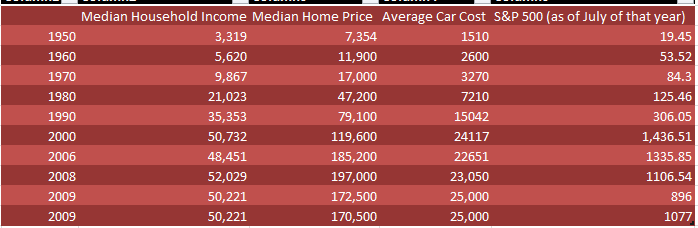
Back in 1950 the median home price cost a little above 2 times the annual median household income:
Just think of what negative equity represents. It represents a household that has over paid for a home. I don't think the desire to own a home has dramatically gone up or down in the last fifty years. Homeownership has always been a big part of the American Dream. But what happened over the last ten years is that banks were able to get their grubby hands on mortgages and convert them into another commodity where they could place large bets and ultimately push losses to taxpayers. People that over paid are paying via foreclosure. What is the penalty that banks are paying? That is why now that banks have raided and had their way with housing, they are looking for other markets to gamble in (with taxpayer money). The above chart shows the millions of homeowners who hold mortgages that are worth more than the homes they are in. Any thinking person realizes that the only way home prices are justified at current levels would be if incomes shot up to make the ratio closer to 2.2. Over half a century of data and never did we have a housing bubble on a nationwide level. All of a sudden Glass-Steagall is repealed in 1999 and a housing bubble takes off with banks leading the way because the line between investment and commercial banking was blurred. Only those who want to deceive themselves would place blame elsewhere.
Posted by mybudget360
November 30, 2010
The typical American family is facing the biggest economic uncertainty since the Great Depression and must feel like their lives are in a washer spin cycle. Many unemployed Americans are now entering a stage where unemployment insurance is being cut off which will send tens of thousands of people into the street. The mainstream media won't cover this because they rather gossip about the next tan face to drink themselves into a gutter at a nightclub. 43 million Americans are receiving some kind of food assistance yet this is some kind of recovery? Many are wondering how banks can produce such large profits without actually producing anything real or of substance in the economy. Yet banks are largely casinos that now operate to siphon off real wealth from the economy through bailouts, frauds, and other activities that harm the overall economy. In a decade where banks were unleashed to do what they may with limited regulation and a cozy Fed, we are now left with an economy in tatters but a banking sector that is still healthy based on oversized bonuses. I wanted to gather data over the last 60 years and measure how most Americans are now fairing. The data shows a largely underwater nation.
Let us look at the data carefully:
Back in 1950 the median home price cost a little above 2 times the annual median household income:
1950: $7354 / $3,319 =2.2
In 1960 the ratio remained roughly the same:
1960: $11,900 / $5,620 = 2.1
In fact, over this ten year period the typical household gained buying power when it came to housing. Even in 1970 the ratio became more favorable to US households:
1970: $17,000 / $9,867 =1.7
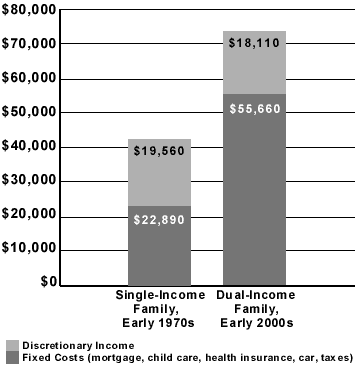
This was the lowest point at the start of any decade in modern history. After this point, with all the push for deregulation and allowing Wall Street to run rampant prices remained fairly stable only because of the two income household (that is until we hit 2000):
1980: $47,200 / $21,023 = 2.2
1990: $79,100 / $35,353 = 2.2
2000: $119,600 / $50,732 = 2.3
This was sustained via the two income household:After this point, things went haywire. Incomes went stagnant or dropped yet home prices sky rocketed. Even today after the severe correction the ratio is still out of sync with 50 years of data:
2010: $170,500 / $50,221 = 3.3
In fact, given the current income levels the median nationwide home price should be down to $119,000 (a 30% drop from current levels). Some will argue that we should factor in for inflation. This would only be the case if we also saw wage growth. For the first time in modern history did we see wages stagnant for an entire decade. So the average American family is still looking at inflated assets and that is why we have millions of people sitting in underwater homes: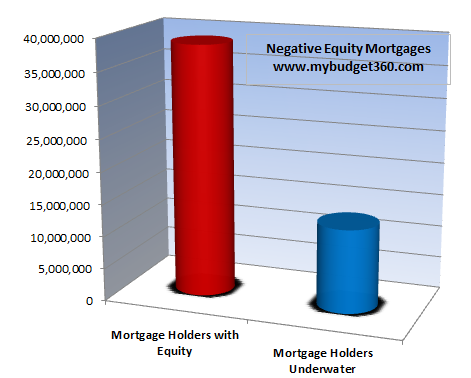
Just think of what negative equity represents. It represents a household that has over paid for a home. I don't think the desire to own a home has dramatically gone up or down in the last fifty years. Homeownership has always been a big part of the American Dream. But what happened over the last ten years is that banks were able to get their grubby hands on mortgages and convert them into another commodity where they could place large bets and ultimately push losses to taxpayers. People that over paid are paying via foreclosure. What is the penalty that banks are paying? That is why now that banks have raided and had their way with housing, they are looking for other markets to gamble in (with taxpayer money). The above chart shows the millions of homeowners who hold mortgages that are worth more than the homes they are in. Any thinking person realizes that the only way home prices are justified at current levels would be if incomes shot up to make the ratio closer to 2.2. Over half a century of data and never did we have a housing bubble on a nationwide level. All of a sudden Glass-Steagall is repealed in 1999 and a housing bubble takes off with banks leading the way because the line between investment and commercial banking was blurred. Only those who want to deceive themselves would place blame elsewhere.
The average American is going to struggle throughout the next decade. It is hard to see how wages will go up so it is likely that home prices will adjust lower given the magnitude of foreclosures in the pipeline. People might be jumping up and down about the recent job growth but they are occurring in lower paying sectors. So this does nothing to justify current prices. Low mortgage rates are merely a gimmick so banks can use cheap money to speculate on a global scale. Even with mortgage rates at levels we've never seen the housing market remains stalled like an old car. Why? Because the actual sticker price is still inflated based on income levels.
We need to reform the banking system, break up investment and commercial banks, and finally restore sanity in the market. There is a reason the metrics are all off but nothing has been done to change this so we are only a short ways away from another crisis. Ireland for example can be likened to a homeowner that took on too much debt with too little income. So the international banking sector idea of a solution is to extend them a credit line? What they should do is tell the IMF and Euro to shove it, default, and start from scratch and learn from their mistake. Otherwise, they'll be in the same position as Americans who bailed out their corrupt banking sector.
GOP playing political games with our lives
This is exactly what teabaggers voted for: rank idiocy.
"Despite what some Democrats in Congress have suggested, voters did not signal they wanted more cooperation on the Democrats' big-government policies that most Americans oppose," McConnell and incoming House Speaker John Boehner, R-Ohio, wrote in an op-ed article published in the Washington Post.
Yeah, big-spending Democratic policies like reducing Russia's nuclear weapons stockpile -- the biggest existential threat to America's security.
That's right, they're playing with U.S. national security just so they can deny any more legislative wins for the Democrat-controlled 111th Congress, even though Republicans in the Senate have vetted the START treaty for months, and Dick Lugar, the GOP's foremost foreign policy expert, supports it. Typical.
GOP Plans to Block Democratic Bills in Senate
December 1, 2010 AP
URL: http://www.foxnews.com/politics/2010/11/30/senate-republicans-plan-block-nearly-bills/
"Despite what some Democrats in Congress have suggested, voters did not signal they wanted more cooperation on the Democrats' big-government policies that most Americans oppose," McConnell and incoming House Speaker John Boehner, R-Ohio, wrote in an op-ed article published in the Washington Post.
Yeah, big-spending Democratic policies like reducing Russia's nuclear weapons stockpile -- the biggest existential threat to America's security.
That's right, they're playing with U.S. national security just so they can deny any more legislative wins for the Democrat-controlled 111th Congress, even though Republicans in the Senate have vetted the START treaty for months, and Dick Lugar, the GOP's foremost foreign policy expert, supports it. Typical.
GOP Plans to Block Democratic Bills in Senate
December 1, 2010 AP
URL: http://www.foxnews.com/politics/2010/11/30/senate-republicans-plan-block-nearly-bills/
SCOTUS scores one for sanity
Monday was a bad day for nutjobs, when the Dubya-stacked conservative Supreme Court refused to hear another one of their crazy birther lawsuits.
Even worse for nutjobs was CNN's Anderson Cooper taking chief birther and Texas state representative Leo Berman out to the woodshed on live TV.
I stand in awe of the total lack of shame of birthers like Berman who claim they "don't know anything about Obama," and at the same time claim to "know" about his real, secret radical agenda, hatred of the U.S., love of socialism, etc. If we don't know anything about him, then he really could be the Messiah -- or a Martian, or the Tooth Fairy. Who knows? Because we don't know anything about Obama. He's a total mystery.
Justices turn aside another challenge over Obama's citizenship
By Bill Mears
November 30, 2010 CNN
URL: http://edition.cnn.com/2010/POLITICS/11/29/scotus.birther.appeal/index.html
Friday, November 26, 2010
Poll: Teabaggers are a definite minority
So what do we know? We know that maximum 40 percent of Americans are Tea Partiers. Meanwhile, 67 percent of Republicans support the Tea Parties.
We also know that 70 percent of self-identified "independents" do not support the Tea Parties.
What does it all add up to? A huge majority of the electorate whose interests are not being served. Obama, the Democrats, Mayor Bloomberg, or somebody ought to take notice.
By Alan Fram
November 23, 2010 | Huffington Post
Subscribe to:
Posts (Atom)