Friday, January 7, 2011

Desperate Facebook suicides: OMG! 4COL!

Another last cry for help in vain on Facebook. Sad.

Here's a thought: next National UnFriend Day, maybe you should perform a little test by posting your intention to kill yourself and see which of your hundreds of "friends" bothers to try and stop you. Anybody that doesn't post at least a lazy "Stop! LOL," "Oh no! LMFAO" or "2BZ4UQT" should be un-friended that very day.

Or better yet, stop using Facebook and Twitter altogether. As I've said before, I just don't get them. And if I don't get it, it must not be that cool.


January 5, 2011 | Huffington Post

Reich: Anti-union rhetoric is class warfare

Great points by Reich. I would add only two things. First, if you want to cut salaries and benefits of public employees, then get ready to receive worse public services. That is, if you want to pay them like fry cooks at McDonald's, then that's the calibre of employee you're going to get. This truth should be self-evident to "free-market" types who believe that people respond to incentives.

Second, it's also self-evident that some people make the rational choice to forgo a higher salary in the private sector in exchange for greater job security and a secure pension (or any kind of pension, nowadays) in the public sector. That is, if public-sector jobs were as low-paying and insecure as private-sector jobs, there would be little or no incentive for people to man our gov't bureaucracy. Going down that path, we'd end up lowering standards and hiring fry cooks simply to staff our gov't agencies.


By Robert Reich
January 5, 2011 | Huffington Post

In 1968, 1,300 sanitation workers in Memphis went on strike. The Rev. Martin Luther King, Jr. came to support them. That was where he lost his life. Eventually Memphis heard the grievances of its sanitation workers. And in subsequent years millions of public employees across the nation have benefited from the job protections they've earned.

But now the right is going after public employees.

Public servants are convenient scapegoats. Republicans would rather deflect attention from corporate executive pay that continues to rise as corporate profits soar, even as corporations refuse to hire more workers. They don't want stories about Wall Street bonuses, now higher than before taxpayers bailed out the Street. And they'd like to avoid a spotlight on the billions raked in by hedge-fund and private-equity managers whose income is treated as capital gains and subject to only a 15 percent tax, due to a loophole in the tax laws designed specifically for them.

It's far more convenient to go after people who are doing the public's work -- sanitation workers, police officers, fire fighters, teachers, social workers, federal employees -- to call them "faceless bureaucrats" and portray them as hooligans who are making off with your money and crippling federal and state budgets. The story fits better with the Republican's Big Lie that our problems are due to a government that's too big.

Above all, Republicans don't want to have to justify continued tax cuts for the rich. As quietly as possible, they want to make them permanent.

But the right's argument is shot-through with bad data, twisted evidence, and unsupported assertions.

They say public employees earn far more than private-sector workers. That's untrue when you take account of level of education. Matched by education, public sector workers actually earn less than their private-sector counterparts.

The Republican trick is to compare apples with oranges -- the average wage of public employees with the average wage of all private-sector employees. But only 23 percent of private-sector employees have college degrees; 48 percent of government workers do. Teachers, social workers, public lawyers who bring companies to justice, government accountants who try to make sure money is spent as it should be -- all need at least four years of college.

Compare apples to apples and and you'd see that over the last fifteen years the pay of public sector workers has dropped relative to private-sector employees with the same level of education. Public sector workers now earn 11 percent less than comparable workers in the private sector, and local workers 12 percent less. (Even if you include health and retirement benefits, government employees still earn less than their private-sector counterparts with similar educations.)

Here's another whopper. Republicans say public-sector pensions are crippling the nation. They say politicians have given in to the demands of public unions who want only to fatten their members' retirement benefits without the public noticing. They charge that public-employee pensions obligations are out of control.

Some reforms do need to be made. Loopholes that allow public sector workers to "spike" their final salaries in order to get higher annuities must be closed. And no retired public employee should be allowed to "double dip," collecting more than one public pension.

But these are the exceptions. Most public employees don't have generous pensions. After a career with annual pay averaging less than $45,000, the typical newly-retired public employee receives a pension of $19,000 a year. Few would call that overly generous.

And most of that $19,000 isn't even on taxpayers' shoulders. While they're working, most public employees contribute a portion of their salaries into their pension plans. Taxpayers are directly responsible for only about 14 percent of public retirement benefits. Remember also that many public workers aren't covered by Social Security, so the government isn't contributing 6.25 of their pay into the Social Security fund as private employers would.

Yes, there's cause for concern about unfunded pension liabilities in future years. They're way too big. But it's much the same in the private sector. The main reason for underfunded pensions in both public and private sectors is investment losses that occurred during the Great Recession. Before then, public pension funds had an average of 86 percent of all the assets they needed to pay future benefits -- better than many private pension plans.
The solution is no less to slash public pensions than it is to slash private ones. It's for all employers to fully fund their pension plans.

The final Republican canard is that bargaining rights for public employees have caused state deficits to explode. In fact there's no relationship between states whose employees have bargaining rights and states with big deficits. Some states that deny their employees bargaining rights -- Nevada, North Carolina, and Arizona, for example, are running giant deficits of over 30 percent of spending. Many that give employees bargaining rights -- Massachusetts, New Mexico, and Montana -- have small deficits of less than 10 percent.

Public employees should have the right to bargain for better wages and working conditions, just like all employees do. They shouldn't have the right to strike if striking would imperil the public, but they should at least have a voice. They often know more about whether public programs are working, or how to make them work better, than political appointees who hold their offices for only a few years.

Don't get me wrong. When times are tough, public employees should have to make the same sacrifices as everyone else. And they are right now. Pay has been frozen for federal workers, and for many state workers across the country as well.

But isn't it curious that when it comes to sacrifice, Republicans don't include the richest people in America? To the contrary, they insist the rich should sacrifice even less, enjoying even larger tax cuts that expand public-sector deficits. That means fewer public services, and even more pressure on the wages and benefits of public employees.

It's only average workers -- both in the public and the private sectors -- who are being called upon to sacrifice.

This is what the current Republican attack on public-sector workers is really all about. Their version of class warfare is to pit private-sector workers against public servants. They'd rather set average working people against one another -- comparing one group's modest incomes and benefits with another group's modest incomes and benefits -- than have Americans see that the top 1 percent is now raking in a bigger share of national income than at any time since 1928, and paying at a lower tax rate. And Republicans would rather you didn't know they want to cut taxes on the rich even more.

This post originally appeared at RobertReich.org.

Simon Johnson: Goldman creating new bubble with taxpayer cash

"Goldman is not a venture capital fund or primarily an equity-financed investment fund. It is a highly leveraged bank, meaning that it borrows through the capital markets most of the money that it puts to work." And where does Goldman borrow that money? From you and me -- the Fed Reserve.

Some people say Goldman is the smartest. I say they're the most brazen. They pay off whom they can, and bully the rest.


By Simon Johnson
January 6, 2011 | New York Times

Goldman Sachs is investing $450 million of its own money in Facebook, at a valuation that implies the social-networking company is now worth $50 billion. Goldman is also creating a fund that will offer its high-net-worth clients an opportunity to invest in Facebook.

On the face of it, this might seem just like what the financial sector is supposed to be doing – channeling money into productive enterprise. The Securities and Exchange Commission is reportedly looking at the way private investors will be involved, but there are more deeply unsettling factors at work here.

Remember that Goldman Sachs is now a bank-holding company – a status it received in September 2008, at the height of the financial crisis, in order to avoid collapse (see Andrew Ross Sorkin's blow-by-blow account in "Too Big to Fail" for the details.)

This means that it has essentially unfettered access to the Federal Reserve's discount window – that is, it can borrow against all kinds of assets in its portfolio, effectively ensuring it has government-provided liquidity at any time.

Any financial institution with such access to such government support is likely to take on excessive risk – this is the heart of what is commonly referred to as the problem of "moral hazard." If you are fully insured against adverse events, you will be less careful.

Goldman Sachs is undoubtedly too big to fail – in the sense that if it were on the brink of failure now or in the near future, it would receive extraordinary government support and its creditors (at the very least) would be fully protected.

In all likelihood, under the current administration and its foreseeable successors, shareholders, executives, and traders would also receive generous help at the moment of duress. No one wants to experience another "Lehman moment."

This means that Goldman Sachs's cost of financing is cheaper than it would be otherwise – because creditors feel that they have substantial "downside protection" from the government.

How much cheaper is a matter of some debate, but estimates by my colleague James Kwak (in a paper presented at a Fordham Law School conference last February) put this at around 50 basis points (0.5 percentage points), for banks with more than $100 billion in total assets.

In private, I have suggested to leading members of the Obama administration and Congress that the "too big to fail" subsidy be studied and measured more officially and in a transparent manner that is open to public scrutiny – for example, as a key parameter to be monitored by the newly established Financial Stability Oversight Council.

Unfortunately, so far no one has taken up this approach.

However, there is consensus that the implicit government backing afforded to Fannie Mae and Freddie Mac in recent decades allowed them to borrow at least 25 basis points (0.25 percent) below what they would otherwise have had to pay – a significant difference in modern financial markets.

In "13 Bankers," Mr. Kwak and I refuted the view that these government sponsored enterprises were the primary drivers of subprime lending and the 2007-8 financial crisis – that debacle was much more about extreme deregulation and private-sector financial institutions seeking to take on crazy risks.

Nonetheless, Fannie and Freddie were badly mismanaged – and followed the market in 2005-7 with bad bets based on excessive leverage – in large part because they had an implicit government subsidy. Those institutions should be euthanized as soon as possible.

Goldman Sachs now enjoys exactly the same kind of unfair, nontransparent and dangerous subsidy: it has effectively become a new form of government-sponsored enterprise. Goldman is not a venture capital fund or primarily an equity-financed investment fund. It is a highly leveraged bank, meaning that it borrows through the capital markets most of the money that it puts to work.

As Anat Admati of Stanford University and her colleagues tirelessly point out, the central vulnerability in our modern financial system is excessive reliance on borrowed money, particularly by the biggest players.

Goldman Sachs is a perfect example. Most of its operations could be funded with equity – after all, it is not in the retail deposit business. But issuing debt is attractive to shareholders because of the subsidies associated with debt financing for banks and to bank executives because their compensation is based on return on equity — as measured, that increases with leverage.

If banks have more debt relative to equity, this increases the potential upside for investors. It also increases the probability that the firm could fail — unless you believe, as the market does, that Goldman is too big to fail.

Social-networking companies should be able to attract risk capital and compete intensely. They do not need subsidies in the form of cheaper financing, or in any other form.

Social networking is a bubble in the sense that e-mail was a bubble. The technology will without doubt change forever how we communicate with each other, and this may have profound effects on the nature of our society. But investors will get carried away, valuations will become too high and some people will lose a lot of money.

If those losses are entirely equity-financed, there may be negative effects, but they are likely be small – in the revised data after the 2001 dot-com crash, there isn't even a recession (there were not two consecutive negative quarters for gross domestic product).

But if the losses follow the broader Goldman Sachs structure and are largely debt-financed, then the American taxpayer will have helped create another major financial crisis.

And if you think that sophisticated investors at the heart of our financial system can't get carried away and lose money on Internet-related investments, remember Webvan: "During the dot-com bubble, Goldman invested about $100 million in Webvan, the online grocer that never got off the ground and eventually collapsed in bankruptcy."

MB360: Bailed-out mega-banks destroying U.S. middle class

If you can't see this charts then follow the headline link becaue they're worth studying. If the Tea Parties would mobilize against this kind of thing then they might be relevant and useful.


Posted by mybudget360
January 6, 2010

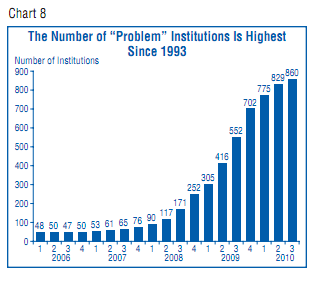
The US banking system is largely a system based on consumer confidence. You would require the confidence of Zeus if you had $13.3 trillion in assets backed by an FDIC Deposit Insurance Fund (DIF) that is practically insolvent. Even as the stock market solidly recovers to the green the state of the average American's financial health is in jeopardy. 1 out of 3 Americans has zero in retirement savings so the hope is that somehow Social Security will be around or maybe there is no longer term strategy since they are merely struggling with daily financial existence. There seems to be this premature joy about the preliminary jobs report but much of this was based on low wage temporary retail hiring for the holidays. Not much a surprise there and did they not get the memo that 14 million Americans are still unemployed? However the banking industry is still in serious problems. Over 11 percent of all US banks are considered "troubled financial institutions" based on the optimistic FDIC quarterly report. The numbers are of course a lot worse but thanks to the suspension of mark to market banks can pretend empty shopping malls in the barren desert or flailing condos are somehow valuable assets. The FDIC just like much of the big banking industry players is performing a dance of economic delusion.

First, take a look at the number of problem institutions:

fdic problem institutions

Source: FDIC

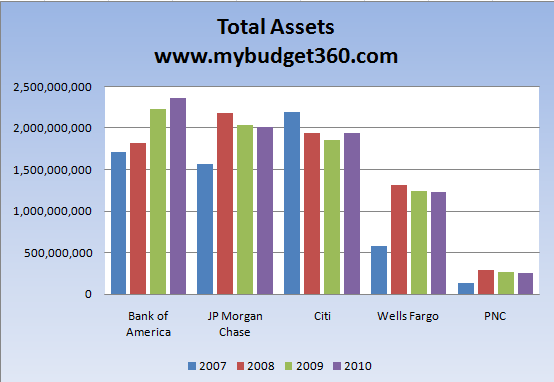
The US currently has 7,760 active banks. So that would put nominally 11 percent of all banks as troubled institutions. This is on par with the number of Americans in the foreclosure process (though there is no correlation but no one is saying that things are healthy when 11 percent of all American mortgages are in some state of foreclosure or have stopped making payments). What is even more disturbing is much of the $13 trillion in "assets" is still in the hands of the too big to fail with a disproportionate of assets in real estate:

total-banking-assets-five-banks

Notice how the big five banks actually increased their assets over a time when the financial worth of average Americans has declined? The big banks really do not serve the retail customer anymore which is odd since it is the retail taxpayer that bailed these banks out. Each one of the above banks received financial assistance in some shape or form.

All of this comes when banks are announcing record profits and consumer bankruptcies are up to record highs posing a stark dichotomy.

Bankruptcies would be even higher but for the 2005 bankruptcy legislation that has made it much harder to file. Even with a tighter collar on the finances of Americans bankruptcies are soaring because there is only so much you can squeeze from a shrinking middle class turnip.

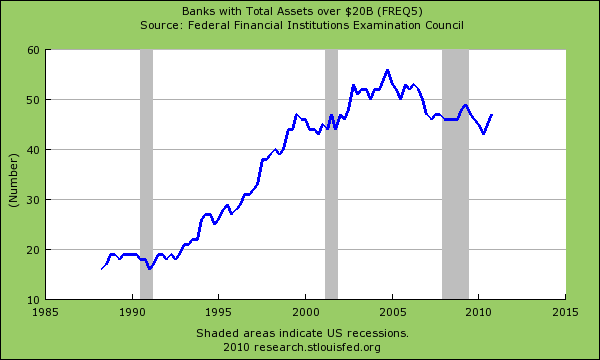
The era of the mega bank is still alive and well:

mega-banks

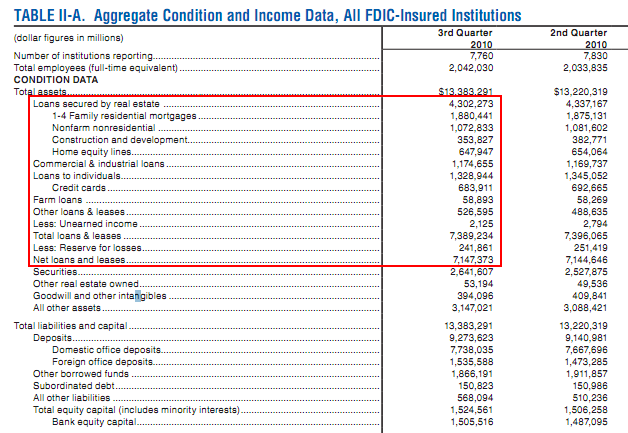
Over 45 US banks have $20 billion or more in assets. And keep in mind what banks consider as assets. For a bank a toxic multi-million dollar loan on a failed strip mall with potholes the size of large dogs in the parking lot is an asset:

banking data

Of the $13 trillion in assets $4.3 trillion is in real estate. Now would it then not be logical to assume with such a horrible real estate market that there would be a major impact here in terms of valuation? Of course it would but suspending prudent accounting practices is the necessary spice to keep this charade up. Banks continue to value real estate at optimistic levels to continue a pretend game that they are solvent while draining taxpayer dollars. The Federal Reserve continues to offer quantitative easing because the economy is solid? Of course not, they are trying to reflate the balance sheet of banks through the slow wealth transfer from the middle class to the top 1 percent.

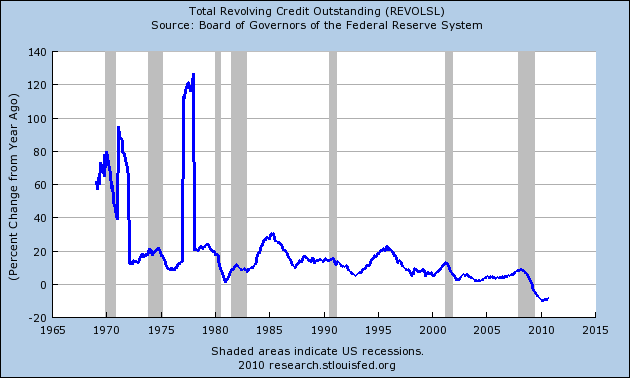
If you want to see how generous FDIC insured banks are to average Americans just look at the amount of credit being extended:

total-revolving-credit

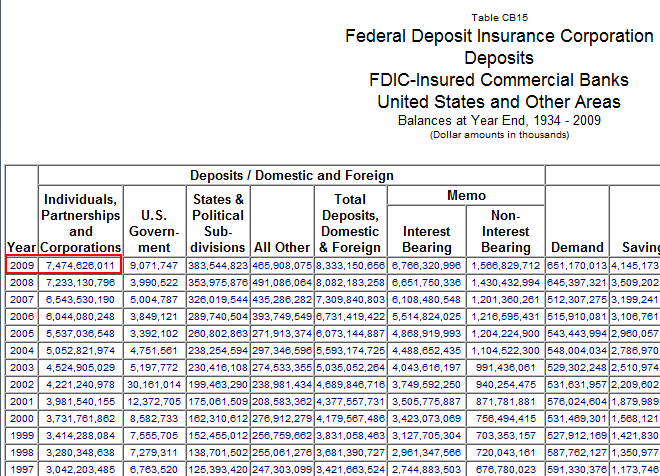
Yet the Federal Reserve is extending unprecedented credit to the banks. There are two financial worlds in the US and many are starting to wake up as to which one they are living in. Americans still have a lot of hard earned money in banks:

deposits-at-fdic-banks

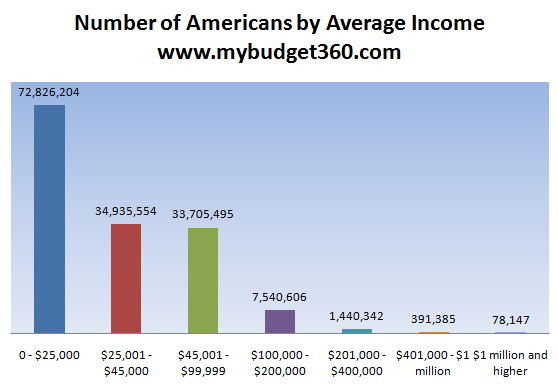
Over $7.4 trillion in deposits are on the banking balance sheets. Keep in mind these are liabilities to banks, not assets. Yet the FDIC with an insolvent fund is backing these up. Banks are also offering close to zero percent in interest rates on savings accounts so this idle money is being slowly devoured by inflation which is a hidden tax by the Federal Reserve. Notice how gas is up over $3 a gallon? Notice how grocery food isn't getting cheaper? How about college costs? Healthcare? Housing has gotten cheaper but it is still too expensive given the amount of money Americans have with 100 million Americans making $39,999 or less a year:

average-income-americans

Source: Social Security

Even more disturbing is the fact that 72 million Americans make $25,000 or less a year. If you want to know what your global business leaders are thinking after the generous bailouts here is a recent comment at a CEO roundtable:

"(MotherJones) His point was that if the transformation of the world economy lifts four people in China and India out of poverty and into the middle class, and meanwhile means one American drops out of the middle class, that's not such a bad trade," the CEO recalled."

This coming from leaders who were in industries that were saved by American taxpayers. Those retail sales that many are clamoring about came because of a middle class in the US. Yet to these companies the only thing that matters is customers even if it means they have to leverage the American middle class and destroy the wealth of Americans in order to gain more customers around the globe. Politicians never brought this up during the election cycle but they continue to protect these industries because politicians are merely another line item for many of these companies.

GOP's Teddy Roosevelt: Estate tax visionary

I meant to send this earlier.  If only today's Republicans were more like TR and Lincoln, then a man could really get behind them, instead of getting it in the behind by them!
 
 
By Tim Rutten
December 18, 2010 | Los Angeles Times
 
Of the several objectionable provisions included in the tax compromise that congressional Republicans extorted from the Obama administration, none is more noxious than the one that all but guts the estate tax.
 
Even the needless and unfair continuation of tax reductions for families making more than a quarter of a million dollars a year merely extends a benefit already enjoyed by affluent households. Estate tax cuts, by contrast, create a whole new windfall for those who already enjoy privileges and security undreamed of by the vast majority of Americans.
 
The provision is the work of Arizona's John Kyl, the Senate's second-ranking Republican and a longtime advocate of abolishing the estate tax.  To most eyes, the former estate levy didn't look like much of a burden; it allowed couples to leave their heirs $7 million tax free and taxed any additional inheritance at 45%.  Kyl's plan, which he has crowed is as good as abolition, increases the exemption to $10 million for couples and reduces the tax rate on the rest to just 35%.  The average windfall for the approximately 6,600 wealthy taxpayers annually affected by the estate duty will top $1.5 million.
 
Abolishing the estate tax has been a goal of some conservative Republicans since the 1940s, so it's easy to forget that its modern champion was a president the GOP used to regard as among the greatest the party has produced — Theodore Roosevelt. Like many thoughtful Americans of his era, he believed the disproportionate accumulation of wealth in the hands of a few would make a mockery of our meritocracy and, ultimately, of our democracy. In 1910, he summed up those feelings:
 
"We grudge no man a fortune in civil life if it is honorably obtained and well used," Roosevelt said. "It is not even enough that it should have been gained without doing damage to the community. We should permit it to be gained only so long as the gaining represents benefit to the community.... The really big fortune, the swollen fortune, by the mere fact of its size, acquires qualities which differentiate it in kind as well as in degree from what is possessed by men of relatively small means. Therefore, I believe in a graduated income tax on big fortunes, and … a graduated inheritance tax on big fortunes, properly safeguarded against evasion, and increasing rapidly in amount with the size of the estate."
 
In 1916, eight years after Roosevelt left office, Congress finally recognized the justice of his case and incorporated a levy on estates into the tax code.
 
In fact, American governments have taxed estates, at least on a temporary basis, since the founding.  The first estate duty was imposed by the Federalists to finance the undeclared war with France; Abraham Lincoln imposed a temporary inheritance tax during the Civil War.  It clearly is a pillar of any rationally progressive tax system, and it is no accident that it's under assault in what amounts to a new Gilded Age in which wealth is accumulating with ever-greater rapidity in a smaller and smaller number of hands. The hereditary advantage such unchecked concentration confers undermines our notions of equal opportunity and turns the American dream into little more than a genetic lottery.
 
Arguments that the existing estate tax frustrates initiative simply are nonsense. Has anybody noticed a shortage of rich people lately?
 
It's also no mystery how such advantages are obtained. Again, Roosevelt's appraisal of the first Gilded Age is sadly resonant. "The man of great wealth owes a particular obligation to the state," he said, "because he derives special advantages from the mere existence of government."
 
It is particularly grotesque that, in this instance, those who derive their special advantage from the government by reason of the wealth they've amassed have secured this benefit by holding hostage the meager assistance Washington affords the one in 10 Americans who currently are jobless. In California, 12.4% of the workers are unemployed; in L.A. County, where bankruptcies have risen by 30% over the last year, nearly 13% are jobless. Of the 15 million Americans who are without work, 42% have been looking for a job for more than five months. An additional 9 million have been forced to accept part-time work, though they'd like full-time employment.
 
Those are the people the Republicans held hostage, so that the children of the rich might grow fatter still.