Showing posts with label unions. Show all posts

Friday, June 27, 2014

'Sharing-economy' workers moving toward unions

The more things change.... Uber's business model of making taxi drivers into "independent contractors" is -- surprise, surprise! --leading more and more of those drivers to the conclusion that they must unionize and organize to protect their rights and wages [emphasis mine]:

Uber’s disruption of the cab industry has been welcomed by nearly everyone except those who rely on the cab industry for their livelihoods. It’s arguably made on-demand car rides easier, cleaner, safer, more accessible and, in some cases, even cheaper.

Indeed, such disruption is overdue. The high prices of regulated taxi medallions have kept a small number of bosses in control, while drivers pay high gate fees in order to access their cars and wages. Uber is right that the traditional system is not well suited to drivers’ or customers’ needs.

But the new boss is not so different from the old boss. Uber’s revolution is not actually its technology but its market power. It has disrupted the cab industry in ways so many others can only dream of by leveraging the labor of thousands of workers who are exceptionally underprotected. 

[...] Only four years after the service debuted in San Francisco, Uber drivers nationwide are getting organized and demanding better treatment.  And this could have huge implications for the trajectory of the peer-to-peer economy. As work changes, so will the ways workers seek to protect themselves and their livelihood.

Recently, one of my main bearded liberal economists Dean Baker wrote about the new "sharing economy" embodied by Uber and Airbnb that may seem like a good deal for consumers but is actually a net ripoff.

Thankfully, it seems that just as fast as Uber has disrupted the old model, actual workers and common sense are moving to disrupt Uber.


By Susie Cagle
June 27, 2014 | Al Jazeera

Thursday, June 19, 2014

The backwards South is moving backward

It's strange and pathetic how the today's Southern states promotes themselves to businesses and investors as a kind of third-world enclave within the United States -- not only low-tax but also low-wage, and of course no unions.

Maybe that strategy is OK for Bangladesh, but touting oneself as low-wage is not a long-term winning strategy for the US of A.  Lower wages and incomes mean a lower tax base, leading to poorer schools, less infrastructure and hence weaker long-term economic growth.

Indeed, the poorest and most miserable U.S. states are located in the South.


By Nelson Lichtenstein
June 18, 2014 | Reuters

We used to call it the “New South.” That was the era after Reconstruction and before the Civil Rights laws — when the states of the old Confederacy seemed most determined to preserve a social and economic order that encouraged low-wage industrialization as they fought to maintain Jim Crow.

What was then distinctive about the South had almost as much to do with economic inequality as racial segregation. Between roughly 1877 and 1965, the region was marked by low-wages, little government, short lives and lousy health — not just for African-Americans but for white workers and farmers.

The Civil Rights revolution and the rise of an economically dynamic Sun Belt in the 1970s and ‘80s seemed to end that oppressive and insular era. The Research Triangle in North Carolina, for example, has more in common with California’s Silicon Valley than with Rust Belt manufacturing. The distinctive American region known as the South had truly begun to vanish.

This is the thesis of economic historian Gavin Wright’s new book on the economic consequences of the civil rights revolution,Sharing the Prize. Ending segregation, Wright argues, improved the economic and social status of both white and black workers The South became far less distinctive as wages and government-provided benefits increased to roughly the national level.

But the New South has returned with a vengeance, led by a ruling white caste now putting in place policies likely to create a vast economic and social gap between most Southern states and those in the North, upper Midwest and Pacific region. As in the late 19th century, the Southern elite appears to believe that the only way their region can persuade companies to relocate there is by taking the low road: keeping wages down and social benefits skimpy. They seem to regard any trade union as the vanguard of a Northern army of occupation.  

Exhibit A is the refusal of every Southern state except Kentucky and Arkansas to expand Medicaid under the Affordable Care Act. Senator David Vitter (R-La.), running to replace Bobby Jindal as Louisiana’s governor, made headlines Monday when he announced he would consider adopting the Medicaid expansion.

In 2012 the Supreme Court gave states the right to back out of this part of Obamacare. The South rushed to take this opportunity — despite the loss of billions in federal dollars. Now 5 million poor Southerners are consigned to health insurance purgatory

The Republican Party as a whole has made opposition to Obamacare virtually a fetish. But outside the South, Republican governors from Arizona and Nevada in the West to Iowa, Ohio, and New Jersey further East, have seen the economic logic and social utility of taking the federal money. After the 2014 elections, when Democrats look likely to oust Republicans from statehouses in Pennsylvania and Maine, those states will do the same. 

Southern states also keep wages low by neglecting to raise their state minimum wage standards. In the North and West, a movement to dramatically increase wages — to $10, $12 or even $15 dollars an hour — has caught fire. Seattle just mandated a $15 minimum wage that will kick in over the next few years.

Today 21 states have raised minimum wages higher than that of the federal standard of $7.25 an hour. But only two of these states, Missouri and Florida, border on the South.  As in the New South era, when textile factories were enticed to flee the North for the low-wage Piedmont region, Southern states now trumpet not just low taxes and an absence of trade unions, but low wages.

Although Oklahoma joined the Union in 1907, it immediately joined the ranks of the Jim Crow South with its strong segregation and anti-union policies. This continues today. In April, for example, when Oklahoma City residents sought to put a municipal wage increase on the November ballot, the state legislature quickly enacted a law banning any city or town from raising the local minimum wage or requiring that employees have a right to sick days or vacation, either paid or unpaid.

Of course, such regressive social policies, including voting rights limitations, are supported by a fierce white partisanship. The solid South has returned in full force. Black voters there are overwhelmingly Democratic, whites of almost every income level equally determined to vote Republican.

The presence of an African-American in the White House plays a large role in this racial-political polarization on the ground in Dixie. But not even Southern-born white Democrats, like former President Bill Clinton and former Vice President Al Gore, have been able to transcend this Southern partisanship. Despite for their cultural affinities and Southern accents, they could not persuade Southern whites to vote Democratic.

This is, however, not just a product of racial fears and resentments. Instead it appears to reflect an increasingly inbred Southern hostility to the exercise of economic regulatory power on virtually any level.  As in the 19th century, many in the South, including a considerable proportion of the white working-class, have been persuaded that the federal government is their enemy.   

As in the New South era, Southern whites, both elite and plebian, have adopted an insular and defensive posture toward the rest of the nation and toward newcomers in their own region. Echoing the Jim Crow election laws promulgated by Southern states at the turn of the 20th century, the new wave of 21st century voting restrictions promise to sharply curb the Southern franchise, white, black, and brown.

The new New South rejects not only the cosmopolitanism of a multiracial, religiously pluralist society, but the legitimacy of government, both federal and state, that seeks to ameliorate the poverty and inequality that has been a hallmark of Southern distinctiveness for more than two centuries.

The Civil War has yet to be won.

Monday, February 3, 2014

Ames: Apple, Google, Adobe, Pixar colluded to depress tech wages

Ever trenchant muckracker Mark Ames reveals here that tech giants like Apple and Google not only outsource their manufacturing to suicidal sweatshops in China that revolt against their masters, not only do they avoid U.S. taxes by registering in Ireland, they also conspired to hold down wages for U.S. tech workers, the alleged winners in this whole globalized, "We got the brains, you got the brawn" value chain. 

Tell me again why we celebrate these "American" companies?  


By Mark Ames
January 23, 2014 | Pando Daily


UPDATE: There's this far-right libertarian Nazi that I correspond with, he says he's a millionaire, let's call him Old Dirty Bastard, who responded to this post. I think this thread is pretty instructive for all you not-so-crazy folks, and shows why we need unions and collective bargaining to protect us from the ODBs of the "free market":

(ODB): Wake up and smell the coffee---it's been happening forever. They are dumb if they don't get their best deal. They do it to states by incorporating in states like Nevada also.

(Me): Employers have always colluded to keep wages down in a given sector? Did you read the article?  You don't even believe your own libertarian mumbo-jumbo!  What a cynic you are! Don't preach to me anymore about your free-market beliefs, etc. because you believe in the Law of the Jungle, where Might Makes Right. 

(ODB): Explain the difference between free market and the law of the jungle. I do not see it

(Me): That's your definition of libertarianism.  The Sherman Anti-Trust Act, Teddy Roosevelt, Grover Cleveland... they were all long-haired hippy commies "ruining" the free market.  There's no use arguing with you, you are so far to the right that you're back on the left with Hitler and Pinochet. 

UPDATE (20.02.2014): Mark Ames followed up his original report with more court documents and e-mails, this time between Apple's Steve Jobs -- "an American hero" -- and Palm's Edward Colligan: "Steve Jobs threatened Palm’s CEO, plainly and directly, court documents reveal."

Tuesday, January 7, 2014

Reich: 2013 saw huge wealth redistribution

Trickle-down economic theory vs. trickle-up economic fact.

I can't say it any better than this. Read the whole thing and get back to me with any questions!


By Robert Reich
January 5, 2014 | Huffington Post

One of the worst epithets that can be leveled at a politician these days is to call him a "redistributionist." Yet 2013 marked one of the biggest redistributions in recent American history. It was a redistribution upward, from average working people to the owners of America.

The stock market ended 2013 at an all-time high -- giving stockholders their biggest annual gain in almost two decades. Most Americans didn't share in those gains, however, because most people haven't been able to save enough to invest in the stock market. More than two-thirds of Americans live from paycheck to paycheck.

Even if you include the value of IRA's, most shares of stock are owned by the very wealthy. The richest 1 percent of Americans owns 35 percent of the value of American-owned shares. The richest 10 percent owns over 80 percent. So in the bull market of 2013, America's rich hit the jackpot.

What does this have to do with redistribution? Some might argue the stock market is just a giant casino. Since it's owned mostly by the wealthy, a rise in stock prices simply reflects a transfer of wealth from some of the rich (who cashed in their shares too early) to others of the rich (who bought shares early enough and held on to them long enough to reap the big gains).

But this neglects the fact that stock prices track corporate profits. The relationship isn't exact, and price-earnings ratios move up and down in the short term. Yet over the slightly longer term, share prices do correlate with profits. And 2013 was a banner year for profits.

Where did those profits come from? Here's where redistribution comes in. American corporations didn't make most of their money from increased sales (although their foreign sales did increase). They made their big bucks mostly by reducing their costs -- especially their biggest single cost: wages.

They push wages down because most workers no longer have any bargaining power when it comes to determining pay. The continuing high rate of unemployment -- including a record number of long-term jobless, and a large number who have given up looking for work altogether -- has allowed employers to set the terms.

For years, the bargaining power of American workers has also been eroding due to ever-more efficient means of outsourcing abroad, new computer software that can replace almost any routine job, and an ongoing shift of full-time to part-time and contract work. And unions have been decimated. In the 1950s, over a third of private-sector workers were members of labor unions. Now, fewer than 7 percent are unionized.

All this helps explain why corporate profits have been increasing throughout this recovery (they grew over 18 percent in 2013 alone) while wages have been dropping. Corporate earnings now represent the largest share of the gross domestic product -- and wages the smallest share of GDP -- than at any time since records have been kept.

Hence, the Great Redistribution.

Some might say this doesn't really amount to a "redistribution" as we normally define that term, because government isn't redistributing anything. By this view, the declining wages, higher profits, and the surging bull market simply reflect the workings of the free market.

But this overlooks the fact that government sets the rules of the game. Federal and state budgets have been cut, for example -- thereby reducing overall demand and keeping unemployment higher than otherwise. Congress has repeatedly rejected tax incentives designed to encourage more hiring. States have adopted "right-to-work" laws that undercut unions. And so on.

If all this weren't enough, the tax system is rigged in favor of the owners of wealth, and against people whose income comes from wages. Wealth is taxed at a lower rate than labor.

Capital gains, dividends, and debt all get favorable treatment in the tax code - which is why Mitt Romney, Warren Buffet, and other billionaires and multimillionaires continue to pay around 12 percent of their income in taxes each year, while most of the rest of us pay at least twice that rate.

Among the biggest winners are top executives and Wall Street traders whose year-end bonuses are tied to the stock market, and hedge-fund and private-equity managers whose special "carried interest" tax loophole allows their income to be treated as capital gains. The wild bull market of 2013 has given them all fabulous after-tax windfalls.

America has been redistributing upward for some time -- after all, "trickle-down" economics turned out to be trickle up -- but we outdid ourselves in 2013. At a time of record inequality and decreasing mobility, America conducted a Great Redistribution upward.

Tuesday, November 26, 2013

Baker: Technology didn't kill middle class jobs, public policy did

Baker doesn't mention other advanced countries like Germany that did not lose their middle class and manufacturing jobs, even though they are subject to the same global, technological forces that ostensibly destroyed U.S. wages and jobs. Why? Because their politicians protected their unions and domestic manufacturers, among other things.


By Dean Baker
November 25, 2013 | Guardian

Sunday, September 22, 2013

U.S. middle class & unions fall together

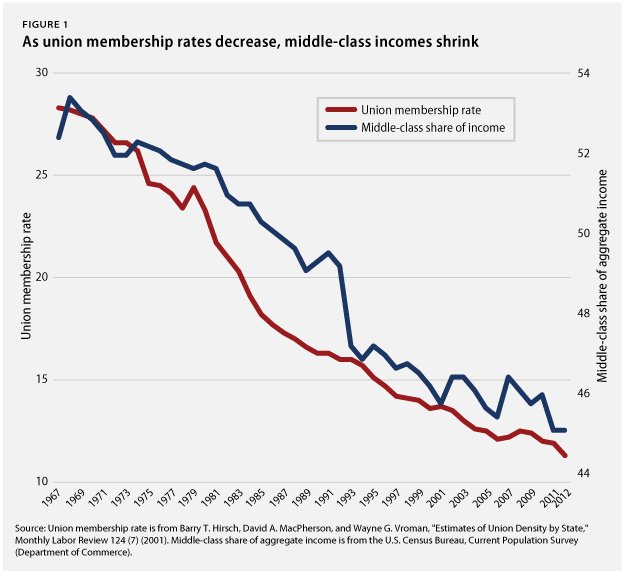
Correlation ain't necessarily causation, but... check out below how those red and blue lines have fallen in sync!

Big Business and Republican politicians who have taken swings at unions as "lazy" and "corrupt" and cut private union membership have in fact kneecapped America's middle class.  

With the exception of France, with its socialist welfare system and already strong labor laws, there is not a developed Western country with a lower rate of unionization than the U.S. at 11.3 percent.  The OECD average is 17 percent.

Meanwhile, Red State conservatives, many of them America's economic losers, swallow the GOP-talk radio explanation for falling U.S. incomes: Obamacare (yet to be enacted) and food stamps.  

Among the 254 counties where food stamp recipients doubled between 2007 and 2011, Republican Mitt Romney won 213 of them in last year’s presidential election, according to U.S. Department of Agriculture data compiled by Bloomberg.

These poor suckers don't know what's best for themselves or others.  There cannot be a strong U.S. middle class without unions.  End of story. 


By Caroline Fairchild
September 18, 2013 | Huffington Post  

This week the Census Bureau reported the latest depressing decline in middle-class incomes during the so-called economic recovery. But it may have missed an important factor in this story.

A report on Wednesday from the left-leaning think tank Center For American Progress notes that as middle-class incomes have steadily fallen, so have union membership rates. The middle 60 percent of households earned 53.2 percent of national income in 1968. That number has fallen to just 45.7 percent. During that same period, nationwide union membership fell from 28.3 percent to a record-low 11.3 percent of all workers.

Put these two economic trends together, and a striking image appears: 

unions middle income

Indeed, declining labor-union participation is not the only factor killing middle-class income growth. But increased union participation would likely mean more income for the middle class, the left-leaning think tank Economic Policy Institute argued in a 2009 report. Unions typically increase the wages of their workers while also raising pay for nonunion workers in industries with a strong union presence.

Higher union participation rates might also reduce income inequality. The U.S. has the worst income inequality of any county in the developed world, and the nation's top earners continue to see their pay rise as median incomes fall. Union participation could counteract this trend, according to the EPI.

So why is union participation declining so rapidly? Private sector union membership reached a peak of about 35 percent of the labor force in the 1950s, The New York Times reports. Since then, labor unions have steadily become smaller as many states have rolled out new laws limiting union power.

Young millennials' disenchantment with organized labor may also be an important contributor to its decline. From 2002 to 2012, union members ages 16 to 24 fell by 26 percent. That's double the decline in union membership for all workers, according to Quartz.

That said, younger generations may have a good reason to be less than eager to join a union. Studies have discovered that during the economic recovery, non-union workers fared considerably better than union workers in fields like manufacturing and private construction. Also, during the 1982 and 1991 recessions, states with fewer union members were found to recover more quickly than states with a strong union presence.

Thursday, July 4, 2013

Was American Revolution worth it? Revisiting the 'American Dream'

This July 4th we can stop and ponder: was the American Revolution worth it? Here's what NPR had to say about the "American Dream," i.e. social and economic upward mobility:

So, in the 19th century in the U.S., there's unbelievable economic mobility. If your father, for example, was an unskilled laborer, sort of the lowest end of the working hierarchy, then you had an 80 percent chance of doing some more skilled, more highly paid job than your father. At the same time, in the U.K., you had about a 50 percent chance. Half the children of unskilled laborers were unskilled laborers themselves. But by just after World War II, the U.S. and U.K. are converging and the differences start to disappear. And by 1970, the U.K. has pulled ahead. So, by the 1970s, the children of unskilled laborers are more likely to do be doing something higher paying in the U.K. than in the U.S.

Why is that so?  Why is the "American Dream" more alive in Britain today than in America?  There are two basic theories, according to NPR:
  • By the 20th century, the U.S. was a mature economy like Britain, without all the exceptional opportunities for growth that exist in a young, expanding nation.
  • In early-mid 20th century, the welfare state and education in Britain grew at a faster pace.

These two theories are not mutually exclusive.  I would also point out the respective rates of unionization in the U.S. and UK: 11.1 percent vs. 25.8 percent.  The average in OECD countries for trade union density is 17 percent.  Nordic socialist paradises Denmark, Finland, Norway and Sweden, which top almost every global indicator of economic and social well-being, have well over 50 percent of their workers in trade unions.  In the U.S. we blame falling wages all on globalization, but then we should ask why wages aren't falling elsewhere in G-8 countries?  Unions have a lot to do with it.

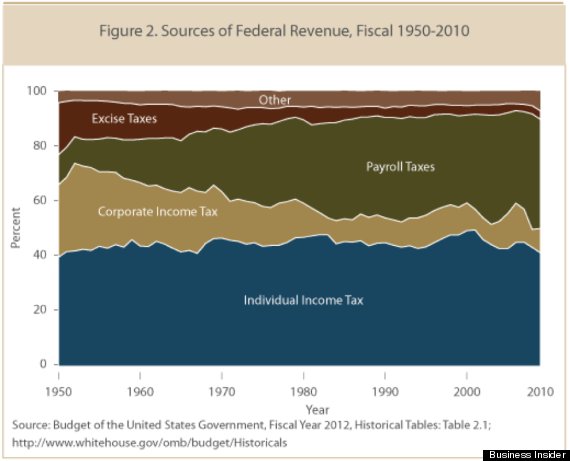
And then there is the U.S. tax system, which for the past 30 years has discriminated against wages in favor of income earned through interest and financial securities, thereby inflating inequality and crushing the "American Dream."  Remember this chart?:

federal revenue

Paul Pirie for WaPo  gives us more socio-economic data to ponder:

Most Americans work longer hours and have fewer paid vacations and benefits — including health care — than their counterparts in most advanced countries. Consider also that in the CIA World Factbook, the United States ranks 51st in life expectancy at birth. Working oneself into an early grave does not do much for one’s happiness quotient. This year the United States tied for 14th in “life satisfaction” on an annual quality-of-life study by the Organization for Economic Cooperation and Development. That puts the United States behind Canada (eighth) and Australia (12th). A report co-authored last year by the economist Jeffrey Sachs ranked the United States 10th in the world for happiness — again behind Canada and Australia. The Sachs study found that the United States has made “striking economic and technological progress over the past half century without gains in the self-reported happiness of the citizenry. Instead, uncertainties and anxieties are high, social and economic inequalities have widened considerably, social trust is in decline, and confidence in government is at an all-time low.”

But the difference is not just in economics or happiness, but also liberty.  Pirie points out that the British Empire (including Canada) abolished slavery in 1833, a full 32 years befoe the U.S. ratification of the 13th Amendment to the Constitution. Today's slavery is the U.S. prison-industrial complex that incarcerates more adults, in both absolute and relative terms, than any other country by a wide margin, including Red China and Russia.  

And speaking of Americans' liberty, I have three words for you: N-S-A.  Do I really need to say more?  It doesn't matter, the spooks are archiving this post anyway.

Today, having mentioned some of these factoids to a Brit, I joked about our reneging the Declaration of Independence.  He said Britons are glad America is no longer their problem; they can't imagine trying to govern the U.S.  I joked back, "Yeah, we have enough trouble dealing with places like Texas!"  Can you imagine British PM David Cameron trying to talk sense to the folks in U.S. flyover country? You start to wonder who got the better end of the deal when the U.S. declared its independence....   

Happy 4th of July, everybody!  Have a hotdog and light off a roman candle for me.

UPDATE: If you think I'm unpatriotic, here's a guy who really can't stand the 4th of July: "Hatetriot's Day: July 4th Is America's Crappiest Holiday."

Saturday, June 29, 2013

USA! USA! We're # 27! USA!


Does anybody else see the irony?  We went to war in 1991 to liberate Kuwait and today their middle class is richer than ours.  Maybe Kuwait should come and save us?  

Les Leopold tells us why the U.S. middle class is so poor:

The International Labor organization produced a remarkable study, (Global Wage Report 2012-13) that sorts out the causes of why wages have remained stagnant while elite incomes have soared. The report compares key causal explanations like declining bargaining power of unions, porous social safety nets, globalization, new technologies and financialization.

Guess which one had the biggest impact on the growing split between the one percent and the 99 percent?

Financialization!

I've shown you this chart before:


All the growth in U.S. wealth over the past 30 years has been financial wealth and the growth of Too Big Too Fail Banks.  Obviously this is no way to grow our middle class or ensure economic growth for Americans who are not bankers and who do not derive most of their wealth from financial securities.  


Thursday, December 13, 2012

How Chinese and U.S. labor are alike

And as fellow WaPo columnist E.J. Dionne pointed out

... the way Gov. Rick Snyder (R) and the Republican Michigan Legislature rushed right-to-work through a lame-duck session was insidious. The anti-union crowd waited until after the election to pass it. Snyder had avoided taking a stand on right-to-work until just last week, when he miraculously discovered that it would be a first-rate economic development measure. The law was included as part of an appropriations bill to make it much harder for voters to challenge it in a referendum.

As we all know, U.S. wages have been stagnant in real terms since the 1970s. And this freeze in workers' wages corresponds suspiciously to the decline in power of labor unions. Meanwhile, U.S. workers' productivity has gone up considerably, along with stock prices and corporate profits, which hit an all-time high under President Obama. This is the very definition of redistribution of wealth, folks -- from the pockets of workers to managers and shareholders.


By Harold Myerson
December 11, 2012 | Washington Post

China has a problem: rising inequality. The gap between profits and wages is soaring. Although elements of the government have sought to boost workers’ incomes, they have been thwarted by major companies and banks “that don’t want to give more profit to the country and let the government distribute it,” Qi Jingmei, a research fellow for a government think tank, told the Wall Street Journal.

Of course, if China permitted the establishment of unions, wages would rise. But for fundamentally political reasons — independent unions would undermine the Communist Party’s authority — unions are out of the question.

Meanwhile, the United States also has a problem of a rising gap between profits and wages. The stagnation of wages has become an accepted fact across the political spectrum; conservative columnists such as Michael Gerson and David Brooks have acknowledged that workers’ incomes seem to be stuck.

What conservatives haven’t acknowledged, and what even most liberal commentators fail to appreciate, is how central the collapse of collective bargaining is to American workers’ inability to win themselves a raise. Yes, globalizing and mechanizing jobs has cut into the livelihoods of millions of U.S. workers, but that is far from the whole story. Roughly 100 million of the nation’s 143 million employed workers have jobs that can’t be shipped abroad, that aren’t in competition with steel workers in Sao Paulo or iPod assemblers in Shenzhen. Sales clerks, waiters, librarians and carpenters all utilize technology in their jobs, but not to the point that they’ve become dispensable.

Yet while they can’t be dispensed with, neither can they bargain for a raise. Today fewer than 7 percent of private-sector workers are union members. That figure may shrink a little more with new “right to work” laws in Michigan — the propagandistic term for statutes that allow workers to benefit from union contracts without having to pay union dues.

Defenders of right-to-work laws argue that they improve a state’s economy by creating more jobs. But an exhaustive study by economist Lonnie K. Stevans of Hofstra University found that states that have enacted such laws reported no increase in business start-ups or rates of employment.Wages and personal income are lower in those states than in those without such laws, Stevans concluded, though proprietors’ incomes are higher. In short, right-to-work laws simply redistribute income from workers to owners.

Why, then, are such laws being enacted? The gap between U.S. capital income and labor income hasn’t been this great since before the New Deal; why widen it still more? The answer, in Lansing no less than in Beijing, is political. The Republicans who took control of the Michigan statehouse in 2010 understand that Democrats’ foot soldiers come disproportionately from labor. GOP efforts to reduce labor’s clout help Republicans politically far more than they help any Michigan-based businesses or local governments. (The legislation, which Gov. Rick Snyder (R) signed into law Tuesday evening, establishes right-to-work requirements for the public sector, too.)

Those who doubt that the intent of Michigan’s laws is more political than economic should consider the two kinds of unions exempted from its reach: police and firefighter unions. Their contracts are among the costliest that local governments confront: Police and firefighters generally (and rightly) retire earlier than do other public employees, with relatively generous pension benefits. But in Michigan, police and firefighter unions often endorse Republicans. Shrinking their treasuries and political power by subjecting them to right-to-work strictures would only damage Republicans’ electoral prospects (and may well play poorly to voters).

With Snyder’s signature, Michigan becomes the second state in the once-heavily unionized, industrial Midwest to adopt such a statute; hitherto, such laws had largely been confined to states in the South, the Plains and the Mountain West. The United Auto Workers (UAW) was once the colossus of Michigan politics, but the union’s membership has shrunk to 381,000 — roughly one-quarter of its size 35 years ago — a casualty of globalization and the legal and cultural obstacles the UAW has encountered to organizing new members.

Michigan Republicans have seen a chance to weaken the UAW and labor’s power at election time. Doing so further diminishes the number of workers who can bargain for a raise. It’s nice that conservatives are finally acknowledging that workers’ incomes are stagnating. But workers don’t get raises if they can’t bargain collectively, and all the hand-wringing about our rising rates of inequality will be so much empty rhetoric unless we insist — in Lansing and Beijing — on workers’ right to form powerful unions.

Thursday, October 4, 2012

Solidarity with people of Walmart!

People of Walmart, we stand with you!  (Not you people of Walmart, them.)


Granted, it's only about 70 Walmart employees across several stores in the LA area... so far. Nevertheless, it's the first employee strike in Walmart's 50-year history. And none of them are unionized, since Walmart has thwarted unionization of its people at every turn.  These employees have guts.

What's interesting is that Walmart somehow continues to do business overseas, but over there, its employees are mostly unionized:

"Anyone who goes against management, you're pretty much putting a target on your back. They intimidate you by cutting hours or picking on you in any way they can," [one employee, a single mother of five children] said.

On the same day as the strike, about 80 foreign Walmart workers gathered in downtown LA to launch the UNI Walmart Global Union Alliance.... While Walmart in the U.S. remains free of labor unions, the retailer's workers elsewhere in the world are largely unionized.

Hmmm.... So what's good for Walmart's employees outside the U.S. is too good for its U.S. employees?  


By Kathleen Miles
October 4, 2012 | Huffington Post

Wednesday, September 19, 2012

Chicago teachers strike 'hurting the kids'?


By Corey Robin | September 18, 2012

Though the final contract has not yet been hammered out, here are just some of the things the Chicago Teachers Union have won with their seven-day strike [pdf]:

  • Almost 600 new art, music, and gym teachers
  • Guaranteed textbooks in the first day of class
  • $1.5 million for new special education teachers
  • $.5 million for reductions in class size
  • More than twice as much money for classroom supplies
No question: they’re hurting the kids.

Sunday, August 5, 2012

Study: Education is no silver bullet for workers

I'm glad there is more and more serious scientific research that gives the lie to the bipartisan, faith-based assumption that more and better education is the cure for America's competitiveness and joblessness woes.

For a few years now I've been debunking the STEM education myth, emphasizing the vital role of unions, and calling for more vocational training and professional apprenticeships in lieu of college to create skilled workers.


By Richard Kirsch
August 3, 2012 | Huffington Post

Tuesday, July 10, 2012

July 4th, unions, and immigrant labor

According to Mr. Wikipedia, the 4th of July was not even a federal paid holiday until 1938.  John Adams predicted to his wife that July 2 would go down in history as "the great anniversary festival."  He died on July 4, just like Tom Jefferson and James Monroe, making it 3 POTUSes in a row.

Anyway, in light of our nation's birthday, Yves Smith at Naked Capitalism makes an interesting discussion of Big Business's support of immigration from 1890 to 1920 as a counterweight to pernicious unionization.

She suggest that instead we celebrate March 1, 1781, the signing date of the Articles of Confederation, or better yet, March 4, 1789, the signing date of the Constitution.

Nowadays, big business very quietly (and sometimes not so quietly) advocates for illegal immigration, or at least gaming the system of the U.S. temporary visa program, to employ cheap, no-benefits foreign labor.

It's funny how things change, and how they stay the same.


By Yves Smith
July  , 2012 | Naked Capitalism

Wednesday, April 18, 2012

Unions matter... everywhere

For those of you who think unions aren't necessary, and at the same time bemoan how U.S. unions make our manufacturers non-competitive compared to low-cost Asian producers, keep in mind this story from Bangladesh, where they pay garment workers 21 cents an hour.  The United States used to harrass and murder its labor leaders with impunity, too, as recently as a few decades ago.

Next time you're buying Tommy Hilfiger and wondering why it's made over there instead of over here, remember that it's partly because they can still torture and kill labor leaders over there, and not over here.

Unions are still relevant, and still a necessary check on the power of impersonal corporations. Everywhere.


By Sarath Kumara 
April 17, 2012 | World Socialist Web Site

Saturday, January 7, 2012

Canada & U.S. in 'race to the bottom'

This is the "race to the bottom" in action, folks. Guess what? Canada's not going to win it; neither will we. That's why it's a fool's game; we shouldn't play it. Germany has found a better way.


By Alexander Eichler
January 6, 2012 | Huffington Post

Tuesday, December 27, 2011

How German automakers double U.S. production AND wages

Great quote:

"So, if I believed what the neo-liberals are arguing, we [Germany] would have to be bankrupt, but apparently this is not the case. Despite high wages... despite our possibility to influence companies, the economy is working well in Germany."

I can tell you, collaborative work by management and labor is definitely not what is taught in U.S. business schools, nor is it the practice, obviously. Tellingly, BMW and Mercedes plants in the U.S. pay much worse wages and probably produce lower-quality cars, because even German producers in the U.S. succumb to America's race-to-the-bottom industrial ethos.

Wednesday, November 23, 2011

OWS already has a win -- in Ohio

OWS has successfully changed the debate from the federal debt and deficit reduction, to reducing inequality and consumer debt and improving the welfare of the bottom 99 percent. We owe them a big thank-you.

"Nonetheless, it's undeniable that a mood change had hit Ohio -- and in a major way. Pro-worker organizers and volunteers benefited from something their peers in Wisconsin lacked: the wind of public opinion at their backs. Polls conducted in the run-up to Ohio's November 8th vote showed large majorities of Ohioans agreeing that income inequality was a problem. What's more, 60% of respondents in a Washington Post-ABC poll said the federal government should act to close that gap. Behind those changing numbers was the influence of Occupy Wall Street and other Occupy protests."


Wednesday, August 3, 2011

Study: Deunionization explains U.S. wage cuts since 1970s

July 21, 2011 | Newswise

Union membership in America has declined significantly since the early 1970s, and that plunge explains approximately a fifth of the increase in hourly wage inequality among women and about a third among men, according to a new study in the August issue of the American Sociological Review.

"Our study underscores the role of unions as an equalizing force in the labor market," said study author Bruce Western, a professor of sociology at Harvard University. "Most researchers studying wage inequality have focused on the effects of educational stratification—pay differences based on level of education—and have generally under-emphasized the impact of unions."

From 1973 to 2007, wage inequality in the private sector increased by more than 40 percent among men, and by about 50 percent among women. In their study, Western and co-author Jake Rosenfeld, a professor of sociology at the University of Washington, examine the effects of union decline on both between-group inequality and within-group inequality. Between-group compares people from different demographics and industries, while within-group looks at people from the same demographics and industries.

Focusing on full-time, private sector workers, Western and Rosenfeld find that deunionization—the decline in the percentage of the labor force that is unionized—and educational stratification each explain about 33 percent of the rise in within-group wage inequality among men. Among women, deunionization explains about 20 percent of the increase in wage inequality, whereas education explains more than 40 percent.

Part of the reason for this gender discrepancy is that men have experienced a much larger decline in private sector union membership—from 34 percent in 1973 to 8 percent in 2007—than women (who went from 16 percent to 6 percent during the same period).

"For generations, unions were the core institution advocating for more equitable wage distribution," said Rosenfeld. "Today, when unions—at least in the private sector—have largely disappeared, that means that this voice for equity has faded dramatically. People now have very different ideas about what's acceptable in terms of pay distribution."

Interestingly, the study finds that union decline explains little of the rise in between-group inequality.

"Unions standardize wages so that people with similar characteristics—if they're union members—tend to have similar wages," Western said. "So, it makes sense that deunionization has little impact on between-group inequality, which, by definition, exists between groups of people that are different."

While the purpose of unions is to standardize wages for their members, Western and Rosenfeld find that even nonunion workers, if they're in highly unionized industries, tend to have fairly equal wages, partly because nonunion employers will raise wages to the union level to discourage unionization.

[In other words, unions benefit even non-union workers - J]

In terms of policy implications, Western and Rosenfeld think their study could help reignite the dialogue on labor unions, which they believe has disappeared from economic debates in recent years.

"In the early 1970s, unions were important for delivering middle class incomes to working class families, and they enlivened politics by speaking out against inequality," said Western. "These days, there just aren't big institutional actors who are making the case for greater economic equality in America."

The study relies on data from the Current Population Survey (CPS) from 1973 to 2007. A monthly survey conducted by the Bureau of Census, the CPS provides data from about 60,000 U.S. households representative of the U.S. population as a whole.

Tuesday, June 28, 2011

Hip, cool Apple employees fed up, want a union

Think unionization in a retail- and service-based economy is irrelevant? If employees at a hip and cool place like Apple stores want to unionize, then unions are relevant everywhere.


Apple Store Workers Share Why They Want to 'Work Different'

By Josh Eidelson
June 24, 2011 | In These Times

URL: http://inthesetimes.com/working/entry/11557/apple_store_workers_share_why_they_want_to_work_different/

Sunday, May 15, 2011

M. Moore (not him, the WNBA star): Labor deserves fair pay

This is one of the best summaries of fair pay and the role of unions which I have read, and it's from a female basketball player of all people. I am not a fan of the WNBA or any other women's sport that I can think of, but... when she's right, she's right.

And although she didn't say it I will: college athletes who make $ millions for their schools deserve some kind of monetary compensation, even if it's deferred or held in trust, not just a "free education."


WNBA's Maya Moore Speaks about Pay, Labor and Going Pro (EXCLUSIVE)

By Laura Gottesdiener
May 12, 2011 | Huffington Post

[...]

Professional sports, like any business, seek to maximize profits. As always, there are an infinite number of ways to cut costs and increase profits, yet, as always, it's labor that takes the cut. Whether you're in Wisconsin, the NFL or the NBA, labor gets the (sharp) spikey end of the stick.

Whether you're a player in the WNBA or NFL or a farm worker, the fundamental issue is the same: Workers want to be paid fairly for their labors. I want to be paid fairly for my work. Because so many of the salaries in professional sports are higher than the average working American's, athletes are seen as out of touch and prima donnas when our unions ask for more. But when we are painted as greedy and mercenary, as with any message, we must look behind the curtain at who is controlling that perception.

Owners have made players "the bad guys." This isn't taxpayer money. It's discretionary money that individuals choose to spend to come and watch players play and be entertained. It's not as if better salaries and benefits take money out of our schools. The only thing players' wages affect is owners' bottom line. Like agricultural workers, our jobs are arduous and have long-term effects on our bodies. Like agricultural workers, not every athlete is getting rich off his or her labor: Some MLS soccer players take make $32,000 a year. I have colleagues in the WNBA making $36,570.

Some of us do make a lot -- and those are the names you hear touted in newspapers and on TV -- but many athletes will labor in obscurity until they are no longer strong enough, fast enough, young enough to keep up. The average pro-athlete is as disposable to management as the average farm worker. Yes, we get paid better and for that, there is no lack of gratitude, but the fundamental unfairness still stings.

The question to ask -- across all these labor disputes -- is: How much of the profits of their labor do laborers deserve to earn? Unsurprisingly, owners and laborers fall on different sides of this issue, and I find myself empathizing with any union that seeks safer, healthier and fairer working conditions for its members. I realize that as a player in the WNBA, I am among the most privileged union members and that my working conditions are enviable. I am grateful for that. But just because I'm blessed doesn't mean that I can forget the plight of my fellow laborers, hardworking athletes and non-athletes alike.

The labor negotiations between players and owners, between unions and management, is a negotiation going on across the country and across the world. The specifics are different, but the argument is the same. We, laborers, believe we deserve a fair share of the profits that are made off of our efforts.

I hope, as negotiations continue to unfold between players' unions and management, that those watching will connect what is happening in pro sports to what is happening across the country. As the economy contracts and profits shrink, there appears an organized and systematic attack against labor, whether the attack is against auto workers or basketball players. The size of the salary may be different but the principle is the same: everyone deserves to be paid a fair percentage of the profits that are made off our labor.