Thursday, May 8, 2014

Oops! Russian gov't. admits Crimea vote turnout inflated

This is the first U.S. media outlet I've seen that picked up on this story that was broken by TSN.ua in Ukraine [emphasis mine]:
Yesterday, however, according to a major Ukrainian news site, TSN.ua, the website of the President of Russia’s Council on Civil Society and Human Rights (shortened to President’s Human Rights Council) posted a report that was quickly taken down as if it were toxic radioactive waste. According to this purported report about the March referendum to annex Crimea, the turnout of Crimean voters was only 30 percent. And of these, only half voted for the referendum–meaning only 15 percent of Crimean citizens voted for annexation.

The TSN report does not link to a copy of the cited report. However, there is a report of the Human Rights Council, entitled “Problems of Crimean Residents,” still up on the
president-sovet.ru website, which discusses the Council’s estimates of the results of the March 16 referendum. Quoting from that report: “In Crimea, according to various indicators, 50-60% voted for unification with Russia with a voter turnout (yavka) of 30-50%.” This leads to a range of between 15 percent (50% x 30%) and 30 percent (60% x 50%) voting for annexation. The turnout in the Crimean district of Sevastopol, according to the Council, was higher: 50-80%.

Does the truth about Crimea's sham referendum matter at this point?  Probably not, only the "facts on the ground."  It's a shame.


Putin's 'Human Rights Council' Accidentally Posts Real Crimean Election Results
By Paul Roderick Gregory
May 5, 2014 | Forbes

URL: http://www.forbes.com/sites/paulroderickgregory/2014/05/05/putins-human-rights-council-accidentally-posts-real-crimean-election-results-only-15-voted-for-annexation/

Who is to blame for 46 Odessa deaths? (Kyiv Post)

Now the Kyiv Post is saying that there were no foreigners who died in the Trades House, although presidential candidate Petro Poroshenko still insists this is true.

Ukraine's security service (SBU) says they discovered that many of the AntiMaidan activists were paid by the Russian Federal Security Service (FSB).

I realize that some people will believe or disbelieve what suits them, but the rest of us should try to discover the facts. Those who believe the government of Ukraine is "fascist" will not believe a word it says; they'll believe SBU is fabricating evidence. I myself have zero belief in anything coming from the Russian government; it is a Putin propaganda machine.

What seems clear to me is that part of this conflict was planned by the * 400 or so AntiMaidan thugs who came armed with guns, clubs, etc. and wearing body armor. But what happened after that was chaos and reaction. I don't see how anybody from Kyiv or elsewhere could have "planned" the movements, actions and reactions of opposing sides exceeding a few thousand people. 

At least one film on YouTube shows an AntiMaidan protester shooting a machine gun from behind a wall of police, i.e. under their protection. This was outrageous and must be punished.

My friend in Odessa witnessed two men killed in front of his office by AntiMaidan thugs: one with an ice pick; and one shot by a sniper.  I believe his word 100%.

Again, people will believe what they want, but I'm hoping there is still room for facts and sober analysis.

In Odessa, Slovyansk and elsewhere, we keep seeing similar figures: 200 to 400 fighters/activists/thugs whatever you want to call them. This seems like the key number. I don't know why. (Maybe it's too difficult for Russia to arm and support more men than that?...)  But it shows that a lot of havoc can be wreaked by just a few individuals. It also shows that not "millions" of Ukrainian citizens in the East support such violence. 

Indeed, let's not forget a a recent Pew Research poll showed that 70 percent in the East -- including 58 percent of Russian speakers -- want Ukraine to maintain its current borders.


By Lily Hyde and Olga Rudenko
May 7, 2014 | Kyiv Post

In the bloodiest day in Ukraine since government snipers claimed more than 50 lives during the EuroMaidan Revolution on Feb. 20, 46 people were killed in Odessa on May 2. The violence started when an armed group of pro-Russian activists attacked a peaceful pro-Ukrainian rally, whose participants, uncharacteristically, fought back.

But nearly a week later, many questions remain about who died, how they died, why so many perished and who is responsible for their deaths amid accusations from Ukraine’s leading presidential candidate, Petro Poroshenko, that a toxic chemical was used in the building where most lost their lives.

Pro-Russians came armed, ready to attack

Some 1,000 pro-Ukrainian citizens and football fans from Odessa and Kharkiv gathered at Soborna Square in central Odessa on 3 p.m. to march for Ukraine’s unity, a tradition that began during the EuroMaidan Revolution that toppled former President Viktor Yanukovych on Feb. 22. Metalist Kharkiv’s fan club, however, denied they took part.

Before the march, some 400 pro-Russian protesters approached the square from Hrecheska Street; many of them were armed with guns, bats and sticks and wore bulletproof vests and helmets, while most of the Ukrainian patriots on Soborna Square were unarmed.

After the group of mostly Ukrainian football fans came under attack, they responded by throwing rocks at the AntiMaidan crowd of pro-Russians. Soon the fighting escalated, as both sides threw Molotov cocktails and fired automatic weapons. Police were seen either shielding the pro-Russians or not taking action to keep the two crowds apart. Masked, pro-Russians were also een shooting from the rooftop of the Afina shopping mall in the central square.

The fighting lasted for hours and left six men dead before it moved to an even deadlier phase.
Pro-Ukrainian activists vastly outnumbered the pro-Russian crowd and eventually chased them away. They then descended on Kulikove Pole Square, where the AntiMaidan protesters had set up an encampment, and destroyed the tents near the Trade Union House that had been the headquarters of the pro-Russian protesters in Odessa since February.

When the activists set the tents on fire, Odessa Oblast council member Oleksiy Alba called on some 200 pro-Russians in the camp to flee to the nearby Trade Union House.

The pro-Ukrainians threw rocks and Molotov cocktails at the building, while the AntiMaidan supporters threw Molotov cocktails from the rooftop. Several bottles broke inside the front entrance and the windows of the second and fourth floor, where a fire spread quickly.

The burning building trapped people inside. Police said eight of them died after jumping from the upper floors of the tall, stately five-story building as they tried to escape from the fire, while 32 died of smoke inhalation. The rest went to the rooftop or hid in areas of the building not consumed by fire.

The victims

The death toll unofficially stands at 46. As of May 7, only 38 of the victims were identified, 19 of whom have been buried. Despite rumors that there were Russian citizens among the dead, all the identified victims turned out to be from Odessa. Five participants of the clashes went missing. Some 200 people sought medical aid after the clashes. Of identified victims, six are women.

One of the women was Khrystyna Berzhanytska, 22. A blonde young woman of Russian origin and an AntiMaidan activist in Odesa, she died of smoke inhalation inside the Trade Unions House. In early November 2013, she participated in a talk show on local TV, defending the idea of Slavic unity and criticizing the West.

“I don’t understand why everyone is so pro-Western now. What comes from West kills our culture, our traditions. It’s wrong to take after someone; everyone should have their own way. Otherwise, we can turn into a herd,” Berzhanytska said then.

Most of the bodies in Trade Unions House were found lying in the stairwell and upstairs rooms.

How the fire started

The official version given by the Interior Ministry is that the Trade Unions House could have caught on fire from the Molotov cocktails that some of the AntiMaidan protesters were throwing from the rooftop.

But even eyewitnesses are not sure what started the deadly inferno. Many videos shot at the scene show the building on fire from Molotov cocktails thrown by pro-Ukrainian protesters. But at least one video shows a fire burning in the room on the fourth floor while the room’s window is closed and unbroken.

People try to escape from a fire at the House of Trade Unions in Odessa on May 2.

Minyayev, who witnessed the tragedy, says he saw pro-Ukrainian activists beating those who jumped from the windows, but he does not believe there was any intent to kill those inside. The activists helped save many lives by bringing scaffolding any other rescue devices to the building.

The pro-Ukrainian fighters “didn’t know there were people inside who had died. People were shouting until the end – ‘Come out!’ ‘Give up!’ Until the very end, when the emergency services people came out and said, “Guys, there are only corpses in there,” Minyayev said.

Some allege that the victims died from a deadly gas, or toxic chemicals, not smoke. Poroshenko, the billionaire front-runner in the presidential election on May 25, thinks this version may be true.

“New details of the Odesa tragedy are now being disclosed. There were terrorists brought from Transnistria and Russia who fired at the pro-Ukrainian march and there were also special toxic substances placed in the Trade Union house. It was a scenario developed in advance to make the number of victims higher,” Poroshenko told journalists in parliament on May 6 after lawmakers listened to a report by law enforcement officials.

The investigation

The unrest in Odesa was financed by members of ex-President Viktor Yanukovych’s inner circle, said Valentyn Nalyvaichenko, the head of the Security Service of Ukraine (SBU) on May 7. He added that Russia’s KGB-successor agency, the Federal Security Service, organized the unrest and backed the pro-Russian crowd.

Clashes between participants of the march “For the unity of Ukraine” and pro-Russian activists in Odessa on May 2.

According to him, the SBU discovered that the people who attacked the pro-Ukrainian rally in Odessa were paid from a money conversion center in Odessa. The center was associated with former Prime Minister Serhiy Arbuzov and former Deputy Prime Minister Oleksandr Klymenko, both part of Yanukovych’s inner circle. They, along with Yanukovych, are among the coterie of former high officials who fled Ukraine and are believed to be hiding out in Russia.

On May 7 Klymenko was summoned to the General Prosecutor’s Office to be questioned, but didn’t appear.

There were other, peaceful rallies in Odessa as recently as May 1, when AntiMaidan activists and left-wing parties held a march.

The next day, AntiMaidan groups on the Russian-controlled Vkontakte social network suddenly shared calls to forcefully stop the pro-Ukrainian march and “take after Donetsk,” a reference to the bloody attacks by Kremlin-backed, pro-Russian demonstrators on pro-Ukrainians on April 27.

During the clashes in Odessa, many were surprised and outraged by the inaction of police.

Police didn’t prevent the hundreds of armed AntiMaidan supporters from attacking the pro-Ukrainian rally, even though several dozens of the officers were present at the AntiMaidan supporters’ gathering spot. When the fight started, the police formed a line to protect AntiMaidan people from the pro-Ukrainian football fans.

Witnesses say and videos show the police shielded the AntiMaidan crowd and even let some from their ranks launch attacks. At least one protester on the AntiMaidan side was seen shooting a machine gun from behind rows of police, using them as a shield.

“What for me was the worst thing was that the firing came from behind the police line, from behind their shields,” Minyayev said. “They couldn’t have not seen it. It’s proof to me that they didn’t just let it happen, they supported it.”

Ukraine’s Prosecutor General Oleh Makhnitskiy agrees.

“We can speak of not just (police) inactivity, but of collaboration,” Makhnitskiy told Channel 5 on May 6.

Two criminal investigations of the Odessa events have been opened – one of the police actions and the other of the violent riots. Meanwhile, a range of Odessa top officials have been fired and replaced, including the chief of regional police and the governor of Odessa Oblast.

Kyiv Post editor Mark Rachkevych, Kyiv Post staff writer Oksana Grytsenko, journalist Sergiy Dibrov from Odessa contributed to this story.

Thursday, May 1, 2014

Ukraine's 'most dangerous 10 days'...and beyond

NATO said that they must re-think their strategic posture in Europe in light of Russia's actions in Ukraine, and especially how to deal with the technique of using covert agents provocateurs (if you can call Russian mercenaries and military officers self-identifying "covert").

Ukrainian Prime Minster Arseniy Yatseniuk is right, Ukraine's interim government is in a "damned if they do, damned if they don't" situation with Russian-orchestrated terrorist-separatist actions in eastern Ukraine: 

"On the one hand, the majority of Ukrainians are pressing on the acting president and security service to conduct the anti-terrorist operation and to bring these terrorists to justice. On the other hand, if you start this kind of very tough operation, you will definitely have civilian casualties. And this is the perfect excuse for President Putin to say look, these ultranationalists kill Russian-speaking people. We need to protect them." 

So far, Ukraine has been opting for "damned if we don't." We'll see how that plays out...

My gut feeling is that the situation in eastern Ukraine is still fluid and President Putin hasn't made up his mind yet whether to invade. As others have noted, the position of eastern Ukrainian oligarchs such as Rinat Akhmetov, not to mention local mafia groups, could be decisive -- perhaps contrary to Putin's calculus.  

My view is that Putin doesn't necessarily need to invade Ukraine. "All politics is local" as a truism is subject to the exclusions of any absolutist statement. Nevertheless, Putin cares mostly, or perhaps exclusively at this point, about Russian public opinion, which now, after annexing Crimea, he has solidly on his side. Does he need to invade eastern Ukraine to keep Russians on his side?  Probably not.  But he does need to appear stronger, more stalwart and "smarter" than the West to his people in the short term.

My biggest concern, beyond Putin's decision whether to invade in the next few weeks, is how much local political mileage will Putin get in the longer term from annexing and destabilizing Ukraine, i.e. standing up to the US and EU?  When the nationalist euphoria in Russia fades, and the Western sanctions and visa bans remain, will Putin's popularity rating dip again, requiring him to initiate a new, more dangerous international crisis?  

Indeed let's not forget how Putin became Putin: by mercilessly cracking down on Chechen separatists and alleged terrorists in other parts of Russia to the delight of the rest of Russia watching it on their TVs. This is a ruthless leader who needs public enemies, who thrives on enemies.

(Maybe that's why Dubya, the invader of two countries, said he looked into Putin's eyes and saw a man he could deal with?....)


By Roman Olearchyk
May 1, 2014 | Financial Times

Kerry: We know who Russian agents in Ukraine are and what they're saying

I've never heard U.S. diplomats talk about another major country in these terms, just flat-out calling Russia's government liars and thugs. 

Said Sec. of State John Kerry:

"We know exactly who's giving those orders, we know where they are coming from. Intel is producing taped conversations of intelligence operatives taking their orders from Moscow and everybody can tell the difference in the accents, in the idioms, in the language.

"It's not an accident that you have some of the same people identified who were in Crimea and in Georgia and who are now in east Ukraine. This is insulting to everybody's intelligence, let alone to our notions about how we ought to be behaving in the 21st century. It's thuggism, it's rogue state-ism. It's the worst order of behavior."


By Aileen Graef
May 1, 2014 | UPI

2 Americas when it comes to health care

So, once again we see Southern conservatives love to be poor and sick, and continually vote against their own best interests. Boy, talk radio and FOX have sure done a number on them!....

What's really a shame are the poor blacks "imprisoned" in these mostly Southern states, who can't get decent health care like their fellow Americans in other parts of the country, because of white conservative voters in the majority.


By Jillian Berman
April 30, 2014 | Huffington Post

When it comes to the quality of health care, there are two Americas.

In one America, infant mortality, avoidable deaths, health-care costs and other measures are far worse than in the other America, according to a new study by the Commonwealth Fund, a health policy research firm. And thanks to Republican lawmakers and the Supreme Court, the gulf between them may only get wider.

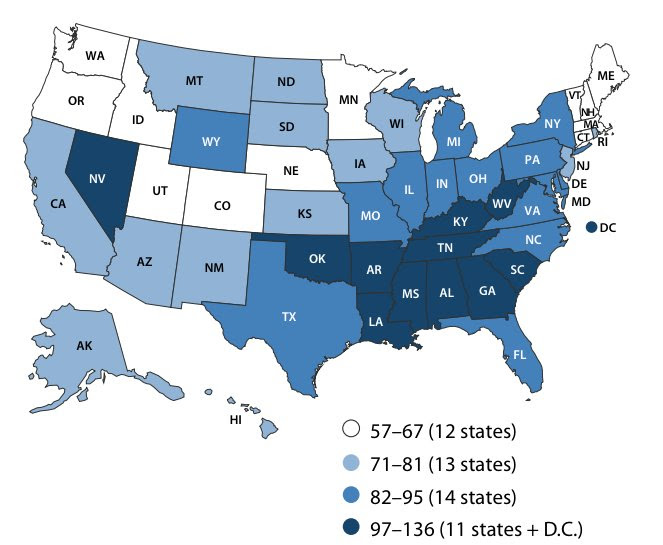
The map below from the Commonwealth Fund shows the stark divide. States with the worst overall health care systems -- as measured by factors like the number of insured adults and children, avoidable emergency room visits and access to affordable care -- are dark blue. States with better health-care systems are white.

map 1

When it comes to things like health care access, quality and cost, certain states can be as much as eight times better than others, the report found.

“We continue to see this very wide geographic spread,” said Commonwealth Fund senior vice president Cathy Schoen, a coauthor of the report. Millions of lives could be saved if the low-performing states could close just half the gap with the top states, Schoen said. "We really need to stay focused on aiming higher.”

Many of the lower-performing states have higher rates of early deaths that could have been prevented by access to quality health care. The Commonwealth map below shows the number of avoidable deaths per 100,000 in each state.

map 2

Many of the worst states for health care have several things in common. They’re mostly in the South and are more likely to be among the poorest in the nation. Many of them have long had unusually tight standards for applicants to qualify for Medicaid, said Schoen, and many have been slow to expand children’s health insurance.

What's more, 16 of the 26 states at the bottom of the Commonwealth Fund’s scorecard aren’t expanding Medicaid under the Affordable Care Act, also known as Obamacare.

map

The states in grey aren't expanding Medicaid. Many of these are also states in which overall health systems are worse.

One of Obamacare’s major tools for giving the poor better access to health care is expanding Medicaid to those making 133 percent of the federal poverty limit -- about $15,521 for a single person -- or less.

But the Supreme Court ruled in 2012 that states could opt out of joining the Medicaid expansion and the extra federal money that came with it. Many states with Republican governors or majority Republican legislators have done just that, leaving millions of their residents out of the national effort to cover the uninsured.

Increasing access to Medicaid isn't a cure-all for low-performing states, and improving health care outcomes overall will require more than just expanding Medicaid. But it could help, Schoen said. For one, it will extend health coverage to more people, making it less likely that poor patients will head to the emergency room for things other than emergencies. And if more low-income residents can pay for health care, more doctors might be convinced to move to poor or rural areas.

"The states that stay out could fail to improve, or fail to improve as fast as other states that choose to participate,” Schoen said. “In some of these states, staying where you are is not very good performance.”

Black Americans are likely to suffer disproportionately from these policies. More than two-thirds of poor, uninsured blacks live in states not expanding Medicaid, according to a December 2013 New York Times report. Already, the rate of avoidable early deaths among blacks is twice as high as among whites in many states, Commonwealth found. That gap is even wider in states with higher early death rates overall.

chart 3

The difference in avoidable death rates in white and black populations in different states.

Still, there is some hope: Kentucky, Arkansas and Nevada, which all rank in the bottom quarter of the Commonwealth Fund's scorecard, are expanding Medicaid. That could help them catch up.

"You could see a few states start to improve quickly," Schoen said.