Showing posts with label South. Show all posts

Wednesday, November 26, 2014

War Nerd: Praise Gen. Sherman for burning Atlanta!

For personal reasons I've been remiss not to post this sooner. Without further ado, here is Gary Brecher, aka the War Nerd, at his best. I admit it, I love his sentiments [emphasis mine]:

Sherman was trying, in everything he did, to wake these idiots from their delusion. That’s why they hate Sherman so much, 150 years after his campaign ended in total success: Because he interrupted their silly and sadistic dreams, humiliated them in the most vulnerable part of their weird anatomy, their sense of valorous superiority. Sherman didn’t wipe out the white South, though he could easily have done so; he was, in fact, very mild toward a treasonous population that regularly sniped at and ambushed his troops. But what he did was demonstrate the impotence of the South’s Planter males.


And here's what Sherman said of himself at the time in his "Letter to Atlanta," quoted by Gary:


“You cannot qualify war in harsher terms than I will. War is cruelty, and you cannot refine it; and those who brought war into our country deserve all the curses and maledictions a people can pour out. I know I had no hand in making this war, and I know I will make more sacrifices to-day than any of you to secure peace. But you cannot have peace and a division of our country…

The only way the people of Atlanta can hope once more to live in peace and quiet at home, is to stop the war, which can only be done by admitting that it began in error and is perpetuated in pride.

“You have heretofore read public sentiment in your newspapers, that live by falsehood and excitement; and the quicker you seek for truth in other quarters, the better. I repeat then that, by the original compact of government, the United States had certain rights in Georgia, which have never been relinquished and never will be; that the South began the war by seizing forts, arsenals, mints, custom-houses, etc., etc., long before Mr. Lincoln was installed, and before the South had one jot or tittle of provocation. I myself have seen in Missouri, Kentucky, Tennessee, and Mississippi, hundreds and thousands of women and children fleeing from your armies and desperadoes, hungry and with bleeding feet…But these comparisons are idle. I want peace, and believe it can only be reached through union and war, and I will ever conduct war with a view to perfect an early success.”


And then there's this golden nugget of truth from Gary, still apropos today, (I'm thinking of Ferguson, MO and many, many other places...):


Of course, this is all lost on the Phil Leighs of the world, who—for reasons that cut deep into the ideology of the American right wing—always take burnt houses too seriously, and dead people far too lightly. To them, burning a house is a crime, while shooting a Yankee soldier in the eye is just part of war’s rich tapestry. 

Unlike most other "Northerners" today who don't give the Civil War a thought, I am so, so glad that we beat the Confederacy and preserved the Union, aka the United States of America, and sent those pompous Foghorn Leghorns home in caskets or with their traitorous tails between their legs. I tip my hat to Sherman, Grant, et al and the 300,000 truest American patriots who ever lived and kept the USA the USA by facing down and defeating the greatest existential threat we ever faced: our meaner, more prideful selves.


By Gary Brecher
November 20, 2014 | Pando Daily

Tuesday, July 1, 2014

And the states with most gun violence are...

... Surprise, surprise: the pro-gun states.

This fact is nothing new but the right-wing media would lie and tell you the exact opposite. Moreover, the most violent gun states are all Red States. Finally, the most violent gun states are also among the poorest -- but if you read me often then you already know there's a strong correlation between poverty and Red States:

Gun-related homicide rates in all but three of the 10 states with the most firearm death rates were above the national rate of 3.6 homicides per 100,000 residents. Louisiana, the only state on this list where homicide accounted for more gun-related deaths than suicides, reported 9.4 homicides per 100,000 residents in 2011, more than in any other state.

So here are the top 10 most violent gun states:

10. South Carolina  (also 9th poorest state)
9.   New Mexico  (2nd poorest state)
8.   Alabama  (7th poorest state)
7.   Arkansas  (4th poorest state)
6.   Montana
5.   Oklahoma  (15th poorest state)
4.   Wyoming  
3.   Alaska
2.   Mississippi  (the poorest U.S. state)
1.   Louisiana  (3rd poorest state)

So Fox and talk radio would like to sell you the lie that guns are only a problem in inner cities like Chicago, DC, New York and LA, when in fact the most gun violence happens in less populated, more rural, poorer, conservative Red States.  (We can just say "Red States" for short.)  


By Thomas C. Frohlich
June 26, 2014 | 24/7 Wall St.

Thursday, June 19, 2014

The backwards South is moving backward

It's strange and pathetic how the today's Southern states promotes themselves to businesses and investors as a kind of third-world enclave within the United States -- not only low-tax but also low-wage, and of course no unions.

Maybe that strategy is OK for Bangladesh, but touting oneself as low-wage is not a long-term winning strategy for the US of A.  Lower wages and incomes mean a lower tax base, leading to poorer schools, less infrastructure and hence weaker long-term economic growth.

Indeed, the poorest and most miserable U.S. states are located in the South.


By Nelson Lichtenstein
June 18, 2014 | Reuters

We used to call it the “New South.” That was the era after Reconstruction and before the Civil Rights laws — when the states of the old Confederacy seemed most determined to preserve a social and economic order that encouraged low-wage industrialization as they fought to maintain Jim Crow.

What was then distinctive about the South had almost as much to do with economic inequality as racial segregation. Between roughly 1877 and 1965, the region was marked by low-wages, little government, short lives and lousy health — not just for African-Americans but for white workers and farmers.

The Civil Rights revolution and the rise of an economically dynamic Sun Belt in the 1970s and ‘80s seemed to end that oppressive and insular era. The Research Triangle in North Carolina, for example, has more in common with California’s Silicon Valley than with Rust Belt manufacturing. The distinctive American region known as the South had truly begun to vanish.

This is the thesis of economic historian Gavin Wright’s new book on the economic consequences of the civil rights revolution,Sharing the Prize. Ending segregation, Wright argues, improved the economic and social status of both white and black workers The South became far less distinctive as wages and government-provided benefits increased to roughly the national level.

But the New South has returned with a vengeance, led by a ruling white caste now putting in place policies likely to create a vast economic and social gap between most Southern states and those in the North, upper Midwest and Pacific region. As in the late 19th century, the Southern elite appears to believe that the only way their region can persuade companies to relocate there is by taking the low road: keeping wages down and social benefits skimpy. They seem to regard any trade union as the vanguard of a Northern army of occupation.  

Exhibit A is the refusal of every Southern state except Kentucky and Arkansas to expand Medicaid under the Affordable Care Act. Senator David Vitter (R-La.), running to replace Bobby Jindal as Louisiana’s governor, made headlines Monday when he announced he would consider adopting the Medicaid expansion.

In 2012 the Supreme Court gave states the right to back out of this part of Obamacare. The South rushed to take this opportunity — despite the loss of billions in federal dollars. Now 5 million poor Southerners are consigned to health insurance purgatory

The Republican Party as a whole has made opposition to Obamacare virtually a fetish. But outside the South, Republican governors from Arizona and Nevada in the West to Iowa, Ohio, and New Jersey further East, have seen the economic logic and social utility of taking the federal money. After the 2014 elections, when Democrats look likely to oust Republicans from statehouses in Pennsylvania and Maine, those states will do the same. 

Southern states also keep wages low by neglecting to raise their state minimum wage standards. In the North and West, a movement to dramatically increase wages — to $10, $12 or even $15 dollars an hour — has caught fire. Seattle just mandated a $15 minimum wage that will kick in over the next few years.

Today 21 states have raised minimum wages higher than that of the federal standard of $7.25 an hour. But only two of these states, Missouri and Florida, border on the South.  As in the New South era, when textile factories were enticed to flee the North for the low-wage Piedmont region, Southern states now trumpet not just low taxes and an absence of trade unions, but low wages.

Although Oklahoma joined the Union in 1907, it immediately joined the ranks of the Jim Crow South with its strong segregation and anti-union policies. This continues today. In April, for example, when Oklahoma City residents sought to put a municipal wage increase on the November ballot, the state legislature quickly enacted a law banning any city or town from raising the local minimum wage or requiring that employees have a right to sick days or vacation, either paid or unpaid.

Of course, such regressive social policies, including voting rights limitations, are supported by a fierce white partisanship. The solid South has returned in full force. Black voters there are overwhelmingly Democratic, whites of almost every income level equally determined to vote Republican.

The presence of an African-American in the White House plays a large role in this racial-political polarization on the ground in Dixie. But not even Southern-born white Democrats, like former President Bill Clinton and former Vice President Al Gore, have been able to transcend this Southern partisanship. Despite for their cultural affinities and Southern accents, they could not persuade Southern whites to vote Democratic.

This is, however, not just a product of racial fears and resentments. Instead it appears to reflect an increasingly inbred Southern hostility to the exercise of economic regulatory power on virtually any level.  As in the 19th century, many in the South, including a considerable proportion of the white working-class, have been persuaded that the federal government is their enemy.   

As in the New South era, Southern whites, both elite and plebian, have adopted an insular and defensive posture toward the rest of the nation and toward newcomers in their own region. Echoing the Jim Crow election laws promulgated by Southern states at the turn of the 20th century, the new wave of 21st century voting restrictions promise to sharply curb the Southern franchise, white, black, and brown.

The new New South rejects not only the cosmopolitanism of a multiracial, religiously pluralist society, but the legitimacy of government, both federal and state, that seeks to ameliorate the poverty and inequality that has been a hallmark of Southern distinctiveness for more than two centuries.

The Civil War has yet to be won.

Thursday, May 22, 2014

Coates: The case for reparations

This landmark essay is long, I know. But so is American history. Maybe not in years, relatively, but in certainly in events -- and in inventive injustices against blacks.

Some of my Republican friends will snap back at me without reading this, or just ignore it,  but really, REALLY, you need to read this. If nothing else, it's a fascinating history lesson that -- no, sorry Common Core -- our lib'rul public education system still doesn't teach us.

To quote Coates's essay selectively to discourage reading it would be a further injustice.  Still I can't resist quoting this, taken out of context, but still wonderful rhetoric:

Indeed, in America there is a strange and powerful belief that if you stab a black person 10 times, the bleeding stops and the healing begins the moment the assailant drops the knife. We believe white dominance to be a fact of the inert past, a delinquent debt that can be made to disappear if only we don’t look.

And this statistic: think about the wealth created, with compound interest, and what it would be worth today!:  "By 1840, cotton produced by slave labor constituted 59 percent of the country’s exports."

And this:

“In 1860, slaves as an asset were worth more than all of America’s manufacturing, all of the railroads, all of the productive capacity of the United States put together,” the Yale historian David W. Blight has noted. “Slaves were the single largest, by far, financial asset of property in the entire American economy.”

Before we leap from justice to practicalities, let's consider Coates' compelling -- I daresay spiritual -- definition of reparations:

Reparations—by which I mean the full acceptance of our collective biography and its consequences—is the price we must pay to see ourselves squarely. The recovering alcoholic may well have to live with his illness for the rest of his life. But at least he is not living a drunken lie. Reparations beckons us to reject the intoxication of hubris and see America as it is—the work of fallible humans.

Won’t reparations divide us? Not any more than we are already divided. The wealth gap merely puts a number on something we feel but cannot say—that American prosperity was ill-gotten and selective in its distribution. What is needed is an airing of family secrets, a settling with old ghosts. What is needed is a healing of the American psyche and the banishment of white guilt.

What I’m talking about is more than recompense for past injustices—more than a handout, a payoff, hush money, or a reluctant bribe. What I’m talking about is a national reckoning that would lead to spiritual renewal. Reparations would mean the end of scarfing hot dogs on the Fourth of July while denying the facts of our heritage. Reparations would mean the end of yelling “patriotism” while waving a Confederate flag. Reparations would mean a revolution of the American consciousness, a reconciling of our self-image as the great democratizer with the facts of our history.

And without quoting, I can guess why Coates spends so much of his essay on the history of Chicago, because our President was a community organizer there. For all you whites who think cities like Chicago and Detroit "just happen," you need to read this.

Additionally, Coates offers us the amazing example of the turnaround effect German reparations had on the economy -- and morale -- of the state of Israel.

Finally, if you'd dismiss Coates's essay because it was written by a black guy, then I'd urge you to read these two articles at Bloomberg and Slate, respectively. 

UPDATE: So my Republican buddy wrote back almost immediately, and predictably, with this:
I actually believe reparations would be just.  But I also know it wouldn't fix our race problems, nor would it fix the wealth gap long term.  The black family has been broken down by leftism.  They abort 40% of their babies, and the left has done everything to teach them they can't help themselves.  They are stuck in schools run by Democrats where they will be lucky to learn to read.
If you give an uneducated person a lot of money, they will blow it.  The white man will convince the people who get the money that they need to spend it on making their ride look phat.  The money will end up back where it started because the only thing they were taught in school was that the glaciers are going to melt and that Obama rides Unicorns and shoots rainbows from his wrists.
To which I replied:
This is what Coates meant, when I said not "to leap from justice to practicalities." Cash payments might not be the only form of reparations.  Read the article. For example, off the top of my head, taking Coates's example of how FHA loans discriminated against blacks while doubling the rate of white home ownership, part of reparations could be for black home ownership -- and not just guaranteed loans, but something more tailored and smart.
Reparations could be for special job training centers, special black enterprise zones, special black small business loans... use your creativity....  

UPDATE (03.06.2014): Ta-Nehisi Coates replies to critic Kevin D. Williaomson at National Review of his essay "The Case for Reparations" with "The Case for American History." Here's my favorite excerpt:
The governments of the United States of America—local, state and federal—are deeply implicated in enslavement, Jim Crow, redlining, New Deal racism, terrorism, ghettoization, housing segregation. The fact that one's ancestors were not slave-traders or that one arrived here in 1980 is irrelevant. I did not live in New York when the city railroaded the Central Park Five. But my tax dollars will pay for the settlement. That is because a state is more than the natural lives, or occupancy, of its citizens. People who object to reparations for African-Americans because they, individually, did nothing should also object to reparations to Japanese-Americans, but they should not stop there. They should object to the Fourth of July, since they, individually, did nothing to aid the American Revolution. They should object to the payment of pensions for the Spanish-American War, a war fought before they were alive. Indeed they should object to government and society itself, because its existence depends on outliving its individual citizens.
A sovereignty that dies with every generation is a failed state. The United States, whatever its problems, is not in that league. The United States' success as a state extends out from several factors, some of them good and others not so much. The mature citizen understands this. The immature citizen claims credit for all national accolades, while disavowing responsibility for all demerits. This specimen of patriotism is at the core of many (not all) arguments against reparations.
And this, Coates's conclusion:
"The people to whom reparations were owed," Williamson concludes. "Are long dead." Only because we need them to be. Mr. Clyde Ross is very much alive—as are many of the victims of redlining. And it is not hard to identify them. We know where redlining took place and where it didn't. We have the maps. We know who lived there and who didn't.
This was American policy. We have never accounted for it, and it is unlikely that we ever will. That is not because of any African-American's life-span but because of a powerful desire to run out the clock. Reparations claims were made within the natural lifetimes of emancipated African-Americans. They were unsuccessful. They were not unsuccessful because they lacked merit. They were unsuccessful because their country lacked the courage to dispense with creationism. 


By Ta-Nehisi Coates
May 21, 2014 | The Atlantic

Thursday, May 1, 2014

2 Americas when it comes to health care

So, once again we see Southern conservatives love to be poor and sick, and continually vote against their own best interests. Boy, talk radio and FOX have sure done a number on them!....

What's really a shame are the poor blacks "imprisoned" in these mostly Southern states, who can't get decent health care like their fellow Americans in other parts of the country, because of white conservative voters in the majority.


By Jillian Berman
April 30, 2014 | Huffington Post

When it comes to the quality of health care, there are two Americas.

In one America, infant mortality, avoidable deaths, health-care costs and other measures are far worse than in the other America, according to a new study by the Commonwealth Fund, a health policy research firm. And thanks to Republican lawmakers and the Supreme Court, the gulf between them may only get wider.

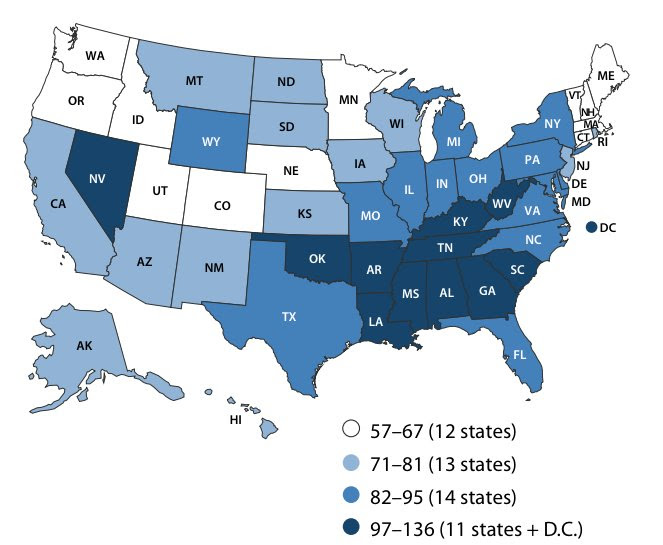
The map below from the Commonwealth Fund shows the stark divide. States with the worst overall health care systems -- as measured by factors like the number of insured adults and children, avoidable emergency room visits and access to affordable care -- are dark blue. States with better health-care systems are white.

map 1

When it comes to things like health care access, quality and cost, certain states can be as much as eight times better than others, the report found.

“We continue to see this very wide geographic spread,” said Commonwealth Fund senior vice president Cathy Schoen, a coauthor of the report. Millions of lives could be saved if the low-performing states could close just half the gap with the top states, Schoen said. "We really need to stay focused on aiming higher.”

Many of the lower-performing states have higher rates of early deaths that could have been prevented by access to quality health care. The Commonwealth map below shows the number of avoidable deaths per 100,000 in each state.

map 2

Many of the worst states for health care have several things in common. They’re mostly in the South and are more likely to be among the poorest in the nation. Many of them have long had unusually tight standards for applicants to qualify for Medicaid, said Schoen, and many have been slow to expand children’s health insurance.

What's more, 16 of the 26 states at the bottom of the Commonwealth Fund’s scorecard aren’t expanding Medicaid under the Affordable Care Act, also known as Obamacare.

map

The states in grey aren't expanding Medicaid. Many of these are also states in which overall health systems are worse.

One of Obamacare’s major tools for giving the poor better access to health care is expanding Medicaid to those making 133 percent of the federal poverty limit -- about $15,521 for a single person -- or less.

But the Supreme Court ruled in 2012 that states could opt out of joining the Medicaid expansion and the extra federal money that came with it. Many states with Republican governors or majority Republican legislators have done just that, leaving millions of their residents out of the national effort to cover the uninsured.

Increasing access to Medicaid isn't a cure-all for low-performing states, and improving health care outcomes overall will require more than just expanding Medicaid. But it could help, Schoen said. For one, it will extend health coverage to more people, making it less likely that poor patients will head to the emergency room for things other than emergencies. And if more low-income residents can pay for health care, more doctors might be convinced to move to poor or rural areas.

"The states that stay out could fail to improve, or fail to improve as fast as other states that choose to participate,” Schoen said. “In some of these states, staying where you are is not very good performance.”

Black Americans are likely to suffer disproportionately from these policies. More than two-thirds of poor, uninsured blacks live in states not expanding Medicaid, according to a December 2013 New York Times report. Already, the rate of avoidable early deaths among blacks is twice as high as among whites in many states, Commonwealth found. That gap is even wider in states with higher early death rates overall.

chart 3

The difference in avoidable death rates in white and black populations in different states.

Still, there is some hope: Kentucky, Arkansas and Nevada, which all rank in the bottom quarter of the Commonwealth Fund's scorecard, are expanding Medicaid. That could help them catch up.

"You could see a few states start to improve quickly," Schoen said.

Wednesday, April 30, 2014

Friday, October 4, 2013

GOP governors leave 8 million uninsured

We shouldn't be surprised.  The GOP despises poor people, especially if they're black.

Also check out this interactive map that displays the full ruthlessness of Republican states.


By Sabrina Tavernise and Robert Gebeloff
October 2, 2013 | New York Times

A sweeping national effort to extend health coverage to millions of Americans will leave out two-thirds of the poor blacks and single mothers and more than half of the low-wage workers who do not have insurance, the very kinds of people that the program was intended to help, according to an analysis of census data by The New York Times.

Because they live in states largely controlled by Republicans that have declined to participate in a vast expansion of Medicaid, the medical insurance program for the poor, they are among the eight million Americans who are impoverished, uninsured and ineligible for help. The federal government will pay for the expansion through 2016 and no less than 90 percent of costs in later years.

[...]

The 26 states that have rejected the Medicaid expansion are home to about half of the country’s population, but about 68 percent of poor, uninsured blacks and single mothers. About 60 percent of the country’s uninsured working poor are in those states. Among those excluded are about 435,000 cashiers, 341,000 cooks and 253,000 nurses’ aides.

“The irony is that these states that are rejecting Medicaid expansion — many of them Southern — are the very places where the concentration of poverty and lack of health insurance are the most acute,” said Dr. H. Jack Geiger, a founder of the community health center model. “It is their populations that have the highest burden of illness and costs to the entire health care system.”

The disproportionate impact on poor blacks introduces the prickly issue of race into the already politically charged atmosphere around the health care law. Race was rarely, if ever, mentioned in the state-level debates about the Medicaid expansion. But the issue courses just below the surface, civil rights leaders say, pointing to the pattern of exclusion.

Every state in the Deep South, with the exception of Arkansas, has rejected the expansion. Opponents of the expansion say they are against it on exclusively economic grounds, and that the demographics of the South — with its large share of poor blacks — make it easy to say race is an issue when it is not.

[...]

Sunday, August 4, 2013

Civil War redux over Southern voting rights

Yeah, well, this pretty much says it:

[W]hite southern Republicans enact voter ID laws because they do not want Democratic constituencies to vote, particularly people of color. Rather than embrace the changing demographics in the US and adopt platforms to address the needs and concerns of voters of color, Republicans have chosen to eschew these voters and wage an assault on civil rights, immigration and policies of diversity and inclusion. This is the endgame for the Republican Southern Strategy of race card politics. The GOP was able to win elections on the margins by appealing to the racial insecurities of disaffected working class whites. In the process, southern whites fled the Democratic party, and the GOP became the party of the white South. Now, this marginalized base of angry white voters is all that is left of the Republican strategy and of the GOP as well, so Republicans must remove the segments of the electorate that will not vote for them.

What the GOP is doing to itself, employing short-term, racist fixes like gerrymandering, voter ID and anti-immigration, reminds me of one of those over-injured, desperate, ageing athletes who keeps on taking cortisone and steroid shots in the hopes of eking out one more winning season, but in the process is destroying his bones, rupturing his tendons, and basically killing himself.

This voter ID thing may work for the GOP in 2014, but blacks and Latinos will remember it; and birthrate wins. They won't trust the GOP for another generation, at least. The Republican Party is killing itself to save itself for one more go-round.


By David A. Love
August 2, 2013 | Guardian

Wednesday, July 17, 2013

Meyerson: Cities resist the 'Wal-Mart-ization of work'

Meyerson's point about Southern regional wages being imposed on Northern workers is especially interesting: "Wal-Mart’s goal is to erase that North-South difference by making every place the South."

For what it's worth, I'm 110% behind the DC city council's decision to require big box stores to pay their workers a living wage!  Where Wal-Mart go, wages go down.  It's been proven.  Let's hope DC's mayor doesn't veto the council's profile in courage!


By Harold Meyerson
July 16, 2013 | Washington Post

For Republicans who want to cut the number of food stamp recipients, here’s a helpful suggestion: Support the ordinance passed last week by the D.C. Council, which required big-box stores like Wal-Mart to pay their employees at least $12.50 an hour.

On average, Wal-Mart pays its workers $12.67 an hour — which means that a huge number of its 1.4 million U.S. employees make a good deal less than that. By paying so little, the Bentonville behemoth compels thousands of its employees to use food stamps to feed their families and Medicaid to pay their doctor bills. It compels taxpayers to pick up a tab that wouldn’t even exist if the company paid its workers enough to get them out of poverty.

How many such workers go on the public rolls? Some states occasionally survey where those employees work, and Wal-Mart almost invariably tops their lists. An Ohio tally in 2009, for instance, found that 15,246 Wal-Mart workers were Medicaid recipients and 12,731 were on food stamps. (McDonald’s came in second in each category.)

Last week’s vote by the D.C. Council was just the latest round in the ongoing battle over whether Wal-Mart can open stores in the nation’s largest Northeastern and West Coast cities. The chain has encountered fierce resistance as it has sought to move into New York, Los Angeles, Chicago, Boston, San Francisco and now the nation’s capital. Elected officials in those cities have feared that America’s largest low-wage employer would compel long-established local retailers — most particularly, unionized supermarkets — to lower their wages.

study by the Center for Labor Research and Education at the Berkeley campus of the University of California found that the opening of just one Wal-Mart store in a county where there previously had been none lowered the wages of general merchandise employees in that county by 1 percent, and grocery employees by 1.5 percent. The counties surveyed did not include those that encompassed the largest East and West Coast cities, where the gap between Wal-Mart’s wages and those of other supermarkets is greatest. But just the possibility that Wal-Mart might receive the go-ahead to open stores in Los Angeles in 2004 compelled that city’s supermarket employee union to accept a management demand to establish a markedly lower pay scale for new hires. When subsequent public opposition to Wal-Mart’s entry kept the chain largely out of L.A., the lower pay scale was eliminated the next time the union’s contract was renegotiated.

With Wal-Mart repeatedly failing to gain entry into the nation’s largest and most lucrative consumer markets, its investors might wonder why the company insists on maintaining its one-size-fits-all pay scale. Sam Walton founded and built the business in the rural South, where both the cost of living and the average pay levels were the lowest in the nation. However, it has not significantly adjusted its pay levels to accommodate the higher costs of living that workers in the nation’s priciest cities must bear. Twelve bucks an hour goes a lot farther in Bentonville than it does in Brooklyn. The executives at Costco, Wal-Mart’s closest competitor, know how to run a profitable discount chain that pays workers well: Its average hourly wage is just over $19. That’s why there are Costco outlets in the cities where Wal-Mart is still on the outside looking in.

By one measure, Wal-Mart’s insistence on bringing Southern wages north contradicts the spirit of Southern regionalism on which many of America’s (and now, the world’s) largest companies have come to rely. Knowing that both the cost of living and wage scales are lower in the South, and that Southern states’ right-to-work laws effectively blocked workers’ efforts to form unions, Northern manufacturers began opening plants there decades ago.

Wal-Mart’s goal is to erase that North-South difference by making every place the South. It commands such a large share of the nation’s retail sector that it has compelled its suppliers to lower their own pay scales all along its supply chain to provide lower-cost products.

So, high-wage manufacturers say they have to go south, while low-wage retailers say they have to go north. In aggregate, the corporate message to Northern workers is: Heads, I win; tails, you lose.

That’s why last week’s vote by the D.C. Council has more than just local importance. Requiring the District’s big-box stores to pay a living wage ensures that incomes in this high-cost city won’t be dragged down to the level of those in the low-cost rural South. The council’s vote isn’t the final word: D.C. Mayor Vincent Gray still could veto the measure. But with working-class incomes everywhere spiraling downward, he might conclude that the Wal-Mart-ization of work — and income — must be stopped at the District line.

Monday, May 6, 2013

NRA and the next Civil War

[Sigh].  I debated with myself whether to comment on the first speech of new NRA President and Alabama good old boy Jim Porter.

I mean, he's obviously following the new NRA playbook which is to sound as inflammatory as possible, scare as many gun owners as possible, in order to sell as many expensive, militarized firearms as possible to a shrinking pool of gun-owning households.

But Big Jim went over the top.  He flirted with Birtherism.  He sided with Iran, N. Korea and Syria in opposing the UN small arms treaty that concerns arms dealers, not citizens.  But worst of all, he brought up the Civil War.  That tore it.

Sure, give a crusty old Alabaman a mic and a national audience and he's going to mention either Bear Bryant or the Civil War. I get it.

But he told a bald lie: that "down South," they call the Civil War the "War of Northern Aggression."  I'm from the South, I lived 4 years in Alabama, and I never heard anybody call it that, not even a so-called Professor of Southern Studies.  

But even worse was his obvious implication: that another Civil War is coming. Between North and South, or Blue and Red states, or urban and rural counties, or a disappearing white majority and everybody else.  It's being fought on all those fronts and more.

This is indeed where we're headed, folks.  And remember, 29 percent of Americans think armed insurrection against our government may be necessary.

Understand, I'm not terribly worried about real armed rebellion, although enough violent kooks will take matters into their own hands.  No, such polls are a testament to the violence being committed against our political culture, our sense of national unity.  Our nation is being torn apart, politically, and increasingly, culturally.  It was already divided economically and ethnically.    

What's going to hold us all together?  What do we all agree on anymore?  How are we going to solve our real problems, like persistent unemployment (especially youth unemployment), ballooning student debt, caring for our elderly, addressing the rising cost of health care and education, wrapping up two disastrous wars, and having a long-term plan for our budget and national debt?  And when will we ever have a chance to talk about all this without killing each other?

Partly, I think it's the media's fault; they've been divided for a long time, because sensation and shouting is better for their ratings.  The media, especially cable news and talk radio, spend hours a day trying to get us all riled up about stupid shit like birth certificates so that there's no time left to talk about substance.  It's a distraction technique, it creates an addiction to anger and a belief in quick, easy answers, and it works terribly well.  That's why I was hesitant to even comment on Jim Porter's buffoonish remarks that were meant to divide us.

But it's also our fault.  Or mostly our fault.  Yes, ordinary Americans.  When there is no occasion or need for liberals, conservatives and independent to talk to each other anymore, then rigid stereotypes and political caricatures replace "the other guy," the cable-radio echo chamber replaces citizens' dialog and debate, and civility breaks down.  

When I'm at home in the South, which isn't often these days, and politics comes up at a gathering of polite semi-strangers, (for me, that's usually in a bar), at the first opportunity I tell the other guys, usually Republicans, "I have to admit, I'm a big lefty liberal and I voted for Obama twice."  After they get over the shock of my admitting that so openly on "enemy" territory, with a smile on my face, the conversation usually goes pretty well.  Nobody has yet spit on the ground and walked away.  

We usually end up agreeing we share most of the same values, like the importance of family, hard work, liberty, tolerance and neighborliness... as well as taking care of our weak and unfortunate brothers and sisters.  

What we certainly disagree about is how our common values should be expressed in terms of government policy.  But it makes for an entirely different and more productive conversation when we seek to define common ground, and don't start the discussion with "liberals hate America," or "conservatives are Nazis."  

The point is that it's OK to be partisan, it's OK to have strong opinions, as long as we're honest, forthright, fair and we listen.  That's the essence of civility.  We used to have that in America.  I hope we haven't lost it, myself included.


By Rick Ungar
May 3, 2013 | Forbes

Saturday, February 9, 2013

The South's final defeat

First they lost the Civil War, then they lost the battle against civil rights, and now comes this, the white South's last defeat: demographics.

[I]t is difficult, if not impossible, for many white Southerners to disentangle regional culture (Southern) from race (white) and ethnicity (British Protestant). The historical memory of white Southerners is not of ethnic coexistence and melting-pot pluralism but of ethnic homogeneity and racial privilege. Small wonder that going from the status of local Herrenvolk to local minority in only a generation or two is causing much of the white South to freak out.

The demographic demise of the white South is going to be traumatic for the nation as a whole. [...] 

[T]he old-stock Yankees in the Northeast and Midwest did not accept their diminished status in their own regions without decades of hysteria and aggression and political gerrymandering. The third and final defeat of the white South, its demographic defeat, is likely to be equally prolonged and turbulent. Fasten your seat belts.

If only for white Southerners intolerable whining, it will be traumatic for all of us.


By Michael Lind
February 5, 2013 | Salon

Saturday, December 22, 2012

Legal WMD that we love and die to keep

Focusing on mental health or our "culture" in an attempt to stop more shooting rampages is a red herring meant to distract us. (And if you want to give all America's mentally ill proper medical care -- support Obamacare or shut up about it.)  Writes WaPo's Caputo:

Since the Newtown, Conn., massacre, there has been a good deal of vague chatter suggesting that people like Purdy or Lanza or Jared Loughner can be identified before they act on their monstrous fantasies and can be prohibited from purchasing firearms. A kind of early-warning radar will detect a disturbed personality on a trajectory toward slaughter.

How would this be accomplished? Are disgruntled workers, loners or anyone who says or does bizarre things going to be examined by psychiatric boards? If it’s determined that they are potential dangers to themselves or others, would they be placed on some sort of national watch list? Compelled to undergo treatment? Locked up?

Even if such a system had been in place, it would not have stopped Lanza, who, as we all know, obtained his weapons by stealing them from the collection of his gun-enthusiast mother.

Again, it comes back to the guns themselves. And no, more guns or armed security guards in our 100,000 schools (as the NRA lamely suggests) are not the answer: recall that an armed security guard traded shots with Klebold and Harris before they shot and killed 13 people and shot and wounded 24 others at Columbine High School in 1999. The school security guard's main safety contribution that day was calling in local police. 

But what’s more wrong are the guns themselves. A 9 mm semiautomatic handgun with a 30-round clip isn’t a pistol; it’s a weapon of mass destruction. Jared Loughner proved that by killing six people and wounding 13 others in not much more time than it took you to read this sentence.

Today, tens of millions of such firearms are in circulation in the United States. If it were up to me, they would be regulated as strictly as fully automatic weapons, such as machine guns, have been for decades. All citizens, except those with federal firearms licenses, would be required to surrender them to law enforcement authorities (with fair compensation). And then I’d destroy them.

But sensible gun buy-back like what happened in Australia won't ever be attempted in the U.S. Why? It's our dirty little open secret. We all know that the backwards Red States would be in uproar, especially the South. There would be individual and organized acts of terrorism. Officially, some states might seek to secede.  And all this to defend the right of Americans to commit the equivalent of three September 11th attacks against each other every year!


By Philip Caputo
December 21, 2012 | Washington Post

Sunday, November 4, 2012

Today's racial parallels to Reconstruction era

This is worth reading, especially if you are a white Republican.  The 1865 parallel to Obamacare is especially interesting.  It's absurd and sad at the same time that freed blacks were accused of relying on handouts only a year after their emancipation: the 19th century version of Reagan's "welfare queen" myth.  

The more things change....


By John Blake
November 1, 2012 | CNN

Monday, October 15, 2012

Fundamentalists the same everywhere?

You know, if you replace the words "God" and "Jesus Christ" in these people's quotes with "Allah" then they sound just like the Muslim Brotherhood.  Just for fun, I've taken some quotes from this story to show you what I mean:

One indignant worshiper raised his voice, and demanded to know: “Am I trying to start a revolution?  The answer is ‘yes’,” he continued. “I’m not trying to get our guns to march on Washington, but we need to do two things: Get on our knees … and spread the Koran to our fellow men.”


Others responded with: “If we don’t do something now ... We need to get over our fear”, as well as a warning that “America is gonna have Allah coming after her”.


In a chaotic group discussion, I was repeatedly bombarded with a chorus of: “The only answer is Allah."

Brother Jerry said the value of the dollar was affecting his retirement savings, before reaffirming, “We’re fundamental Muslims, and Allah is in control of the economy."

Kevin, a telecom installer, then explained, “When we push Allah aside, he curses the economy. The whole world is suffering because we’ve been disobedient to Allah.”

“When we all get right with Allah, then the economy is gonna be fixed, the country is gonna be fixed, and the world is gonna be fixed.”

"I’m going to vote for Mitt Romney," Kevin said. "But the answer is not Democrat or Republican - it’s Allah.”


Gee, I guess Bible-thumping American fundamentalists aren't that different than religious fundamentalists anywhere else.

P.S. -- But seriously though, the answer really is Allah.


By Ben Piven
October 10, 2012 | Al Jazeera

Tuesday, September 25, 2012

An annual ritual: And the poorest states are...

So now is the time when I point out, again, how all the poorest U.S. states are in the South and vote Republican.  

Next comes the part where I remind you how 8 of the top 10 biggest welfare states -- those that take more from the federal budget than they pay in taxes -- vote Republican.

Then we argue about who is worse: those condescending, bi-coastal liberal elites who think they know what's best for everybody; or those hypocritical, poor reactionaries in Flyover Country who vote against their own economic interests.

Finally we agree to disagree and call a truce... until the next year's Census data comes out so we can do it all over again.

OK, let's get started!...


By Michael B. Sauter, Samuel Weigley, Brian Zajac and Alexander E. M. Hess 
September 23, 2012 | Huffington Post