Showing posts with label Republicans. Show all posts

Sunday, December 17, 2017

No sugarcoating it: Trump is a traitor

I was just listening to Bill Cunningham advancing the conspiracy theory that the Justice Dept. and the FBI conspired to get Hillary in office, and after that failed, to nullify the 2016 Presidential election and get Trump out of the White House. Fox and other conservative outlets are all saying the same thing; it's not clear if they are wagging Trump's tail or vice-versa.
First, do people realize there hasn’t been a Democratic FBI director ever? EVER. Carter, Clinton and Obama all appointed Republicans. And what did that say about their confidence in the professionalism of our highest law enforcement body to do that? Can you imagine Trump doing that today?? Hell no. ‘Nuf said. What's more, Robert Mueller is a Vietnam vet (while Trump dodged the draft) and a registered Republican!
Second, just like other law enforcement, the FBI has a bias for Republicans. To protect himself, President Trump is throwing thousands of FBI staff under the bus, intimating they are traitors or so politically biased that they cannot be just law enforcement officers. Republicans, don’t believe for a second the FBI is going to forget this; Trump may have flipped the Republican-leaning FBI Democratic for a generation. And for what? To advance a conspiracy theory with no evidence to save his own orange skin. For shame!
Third, I heard Willy ask, what can ordinary people do when law enforcement and prosecutors won’t do what’s right? He was talking about Hillary’s emails, etc. (which have been investigated ad nauseam). Do these people not understand how Black Lives Matter and other protest movements started, for just this reason? And we’re not talking for one orange President, we’re talking hundreds of people shot or killed by police over decades! Their blinders and hypocrisy are breathtaking: the second their president is under the eye of law enforcement, they are ready to throw our institutions under the bus – the same people they once praised as heroes!
This is scary, folks. What this tells me is a large portion of Republicans are actively tearing down law enforcement and our institutions, all to protect Donald Trump, whose team we already know has lied about multiple suspicious and inappropriate (to say the least) contacts with Russia, who refuses to say anything bad about the murderous invading dictator Putin, and who refuses to act to protect our elections from further Russian meddling. Who is outraged by intelligence briefings that even mention Russian meddling. This isn’t a what-if, this is happening NOW. We are already AT RISK.
We have a traitor in the White House, my fellow Americans. Out of his own ego and self-interest and his family’s, he has sold out his country. This is the nightmare scenario for our republic. It is happening NOW. The adults and the patriots in the room must take control from this money-grubbing, egomaniacal, sociopathic traitor.
I won’t sugarcoat it: either you love America, or you love Trump. There is no middle ground anymore. Choose sides. I for one am not going to pretend this isn’t happening. Call me partisan, call me crazy, call me a “hater,” I don’t care. Trump does NOT put America first. Not as long as he owes this odd allegiance to Vladimir Putin and Russia.

Saturday, May 30, 2015

A few more lessons from Bernie Sanders' run for President

I don't disagree with Jeb Lund on the positivity of Sen. Bernie Sanders' run for President, but there's a bit more to say here.

First, about being the right-looking "blowdried" candidate with a red tie: yes, true, alas. But let's not swoon over Bernie just because he "doesn't give a f--k" about his image. Let's swoon over him because he does give a f--k about the right things. And he actually proposes good legislation: on the minimum wage; regulating the Wall Street fraudsters; and on and on.

I mean, image is a terrible thing nowadays. The Republicans' version of the perfect-image candidate is Ben Carson: a black identity politician whose positions are indistinguishable from anybody else's (insofar as he has stated positions on anything). His bona fides are that he pulled himself up by his bootstraps despite being black and poor, can't stand his fellow African-American Barack Obama, and most importantly, rails against Obamacare. Beyond that, Ben Carson is a cipher... or an empty suit. He doesn't have many policy ideas because, as is blindingly obvious -- and this only adds to his appeal among Republicans -- it never occurred to him to run for President until quite recently, at the urging of Republicans who were out to prove they didn't distrust black people... as long as they believed all the "right" things.  

Second, Bernie's humble economic station is a good thing nowadays; but a politician's wealth or privileged background was not always a predictor of his political leanings or his performance in office. FDR, an all-time top 3 U.S. President and blueblood patrician, proved that. What Roosevelt had was a sense of old-money, old-fashioned noblesse oblige. With the recent departure of Sen. Jay Rockefeller, the closest things we have to old money in U.S. politics today are Jeb Bush and Donald Trump.  

In fact, running for President today -- the GOP presidential nomination, that is -- is not a result of a candidate's wealth and privilege, necessarily, it is a path to wealth and privilege: as a FOX contributor / talk radio host / author / highly-paid guest speaker. Never before was political loserdom a path to anything but a ticket to retirement.  Now with enough Super PAC money and a favorable audience with Sheldon Anderson, a nominee can be plucked from political obscurity and made a front-runner, with his guaranteed payday at the end, whatever the result.

Third, there's something different about a Bernie Sanders or Ralph Nader running for the Democratic nomination, knowing he's going to lose, in the hopes of nudging (or embarrassing) the eventual nominee to move slightly to the Left, and the gaggle of Republican candidates trying to outrun each other to the Right, eastward beyond the horizon.  Because many Democratic voters would be uncomfortable with a Bernie Sanders as a nominee -- "too liberal!" -- whereas, no matter who gets nominated by the GOP, most Republican voters will be dissatisfied -- "he's not conservative enough" -- or even bestow the worst insult imaginable -- "he's a RINO."  

Most Republicans probably don't stop to think why there's no equivalent of the "RINO" label among Democrats. (I wish there were). But if they did, they might realize that we Democrats are a pretty diverse bunch who can't even agree among ourselves what a true Democrat is. On the Republican side, talk radio settled that issue at least 15 years ago; and the media masters of the GOP police their ideological purity mercilessly...even at the expense of losing elections. (Which I grudgingly give them credit for; although they have convinced themselves that they speak for America's "Silent Majority," and when they lose, it is thanks to George Soros and the Lib'rul Media conspiracy, not their ideology). 


By Jeb Lund
May 27, 2015 | Guardian

Tuesday, December 9, 2014

Godspeed, Ebola 'czar' Ron Klain!

Am I missing something or is the "unqualified" Ebola czar Ron Klain the most successful "czar" under any U.S. President? No Americans died, Ebola is off the TV and out of the papers, we're all breathing easy again.... I mean, the only possible retort I can think of is that Ebola wasn't that big a deal to begin with; that the CDC had it under control all along; that maybe the GOP and its colleagues on Fox and talk radio just made it erupt into a pants-shitting crisis to win votes and then promptly dropped it mid-November as soon as they had what they wanted -- a Congressional majority...

..But no, no. I can't accept that cynical explanation. I prefer the more positive explanation: that Ron Klain is public health genius on par with Albert Sabin and a saint on par with Mother Teresa.

Godspeed, Mr. Klain!  We thank you for your selfless service to our country!


By Anita Kumar
December 8, 2014  | McClatchy Washington Bureau

Saturday, October 25, 2014

Being an 'indispensable nation' is killing America

This op-ed is worth re-posting in full.

Never let it be said I'm a partisan hack: I support Borosage's indictment of President Obama's executive overreach in conducting military operations without Congressional approval for war. 

More damning to my mind has been President Obama's failure to articulate to the nation (and Congress) a national security-military doctrine/vision (call it what you will) that makes it clear when he thinks the United States should send its troops into battle, and when we shouldn't. Granted, this may be the most difficult job of any POTUS in an ever-changing world, and with inherited conflicts of past presidents.

Is it because Obama and his team doesn't have the strategic capacity to develop such a vision? Is it because Obaama is too arrogant to articulate it for us, we're just supposed to trust him not to do "stupid shit"? Or, most likely, is it because a timid Obama fears that no matter what he says, it will be parsed and pilloried by Republicans -- who also can't agree among themselves on a foreign policy -- looking to score partisan political points?

Borosage is right to point out that the opportunity cost of U.S. military adventures abroad is investment in piss-poor education and crumbling infrastructure at home. Maybe our government can buy guns and butter... but not forever, not at a sustainable cost. This is where the "fiscally responsible" yet "pro-military" Tea Parties and Republicans have fallen on their faces as an opposition, by refusing to specify just what they are willing to give up to achieve their stated top priority of fiscal balance.


By Robert L. Borosage
October 20, 2014 | Reuters


America — proudly dubbed the “indispensable nation” by its national-security managers — is now the entangled nation enmeshed in conflicts across the globe.

President Barack Obama, scorned by his Republican critics as an “isolationist” who wants to “withdraw from the world,” is waging the longest war in U.S. history in Afghanistan, boasts of toppling the Muammar Gaddafi regime in Libya, launches airstrikes in Iraq and Syria against Islamic State and picks targets for drones to attack in as many as eight countries, while dispatching planes to the Russian border in reaction to its machinations in Ukraine, and a fleet to the South China Sea as the conflict over control of islands and waters escalates between China and its neighbors.

The indispensable nation is permanently engaged across the globe. But endless war undermines the Constitution. Democracy requires openness; war justifies secrecy. Democracy forces attention be paid to the common welfare; war demands attention and resources be spent on distant conflicts. Democracy involves forging coalitions to get action in the Congress; war is waged on executive order. The Constitution restrains the executive in times of peace; constitutional strictures are trampled in times of war.

When the founders wrote the Constitution, they worried about the tendency of kings, or presidents, to make war for personal aggrandizement or national glory.  So they gave Congress the power to declare war, intent on “clogging, not facilitating” the rush to war.  For the Republic, peace would be the normal state of affairs. War was a disruption — entered into only with prior debate and consideration by  Congress, the elected body whose members best reflected the attitudes of their constituents.

The United States, in the words of conservative John Quincy Adams, would provide a shining example of liberty as long as “she goes not abroad in search of monsters to destroy. She is the well-wisher to the freedom and independence of all. She is the champion and vindicator only of her own.”

But now the pursuit of monsters to destroy is unrelenting. Almost inevitably, it seems, the restraints of the Constitution are being trampled. With little debate, U.S. leaders have chosen permanent global intervention even at the cost of undermining the Republic.

For the cost of war can be measured in dollars not spent here at home.

An educated citizenry is the foundation of a robust democracy. Yet from the absence of free, full-day pre-K to affordable colleges to advanced training, the United States is skimping on investment in educating its citizens. A modern infrastructure is also essential to a competitive, high-wage economy. But while Washington spends $3 trillion on Iraq, there hasn’t been a serious discussion about bringing America’s aged infrastructure, including our roads, bridges and airports, up to standard — which would cost about the same. 

A bridge to somewhere... now a bridge to nowhere.

Instead of this funding, the United States and its North Atlantic Treaty Organization allies spend more on their militaries than the rest of the world combined. Washington maintains more than 1,000 bases, called “military sites,” across the globe, plus 11 aircraft-carrier task forces that are essentially moveable bases. U.S. conventional and nuclear forces are unrivaled — yet Washington plans to spend another trillion dollars over the next 30 years modernizing nuclear weapons that the United States aims never to use. U.S. intelligence and covert forces are permanently engaged, often secretly creating the implicit commitments that will force the next intervention.

It is only America, as the president said in a speech announcing his intention to “degrade and ultimately defeat” Islamic State, which he refers to as ISIL, the Islamic State in Iraq and the Levant, that “has the capacity and the will to mobilize the world against terrorism … against Russian aggression … to contain … Ebola and more.”

This president, more than his predecessors, understands the perils of being the “indispensable nation.” Elected in large part to get the United States out of the seemingly endless wars in the Middle East, he now finds himself forced into another open-ended commitment.

In his speech to the National Defense University in 2013, Obama argued, “We must define the nature and scope of this struggle, or else it will define us, mindful of James Madison’s warning that ‘No nation could preserve its freedom in the midst of continual warfare.’ ” Obama warned specifically about this. “The choice we make about war,” the president said, “can impact —  in sometimes unintended ways — the openness and freedom on which our way of life depends.”

Yet even with this awareness, and no reelection race facing him, Obama could not escape the imperatives of America’s role as the indispensable nation. The commitments are too many,  the engagement too permanent, the capacity unrivalled — seemingly making all things possible.  As a result, this former professor of constitutional law has governed over the greatest assertion of executive authority — claiming the power to make war, to surveil, arrest, detain and even kill Americans without prior judicial review or due process.

Ike warned us about the growing "military-industrial complex" that sought to feed itself at the federal trough.

His Justice Department has used espionage laws against reporters and whistleblowers.  The secrecy shields massive waste, fraud and abuse, as the military-industrial complex that President Dwight D. Eisenhower warned against consumes the bulk of the national budget, aside from payments on the national debt and the insurance programs of Social Security and Medicare.

When President George W. Bush was about to launch the war in Iraq, millions of Americans – as well as many people around the globe — marched in protest. The large demonstrations against war led the New York Times to dub world public opinion a second superpower. Bush sought authority from Congress and a dramatic congressional debate took place, with strong dissent against the war.


When Obama committed the United States to the fight against Islamic State, he claimed the authority to act without Congress, though adding he would “welcome” congressional support. Yet with the midterm elections then a few months away, both Republicans and Democrats in Congress chose to postpone the debate and the vote.

The bombing began on presidential order. Americans accepted their role as spectators, registering no significant objection to this presidential war-making.  The indispensable nation is not only spending lives and resources on endless wars abroad, it is shredding its Constitution at home.

Ironically, America’s democracy is still strong enough to render it less than competent as a global policeman. Our military is the finest in the world, but still finds it hard to win a war. Korea, Vietnam, Afghanistan and Iraq demonstrate that while presidents can commit the nation virtually anywhere, Americans sour on long, costly interventions on the other side of the world.

This leads to strategies like “no boots on the ground” — designed not to rouse public opposition but almost certain to fail. Polls show that Americans have no interest in policing the globe. If the Constitution no longer constrains the president from making war, the public still limits his ability to wage it.

Thursday, October 23, 2014

Blackwater gets U.S. justice for 2007 Iraq killings

Sedulous readers will recall my opposition to private military contractors, (aka mercenaries), or at least our increasing reliance on them to do jobs the U.S. Military used to do for itself, such as security, logistics and even intelligence.

Why? Because in Iraq and Afghanistan, they haven't been subject to local law, military discipline or the chain of command. They are almost a law unto themselves. 

I also argue they're bad for morale, what with their fat paychecks while our troops' families back home depend on food stamps to survive. And strategically, it's dangerous for our military to lose capabilities it once had and become dependent on outside contractors. 

We do know why the explosive growth in mercenaries though, since 2001: 

  1) They don't count as "troops" that we should care about when generals or politicians talk about U.S. forces overseas; 

  2) None of us has to mourn them when they die or hang a yellow ribbon to keep them safe; 

  3) They are a great way for Republicans to hand out government cheese and re-collect it in the form of campaign contributions (Blackwater alone has collected more than $1 billion in U.S. Government contracts, many of them non-compete); and

  4) There isn't a single government service that Republicans don't want to privatize or outsource, as the eight year of Dubya-Cheney's regime proved.

U.S. mercenaries caused tragedy in September 2007, when a group of Americans from Blackwater, LLC opened fire at a crowded Baghdad intersection and killed 17 innocent Iraqi civilians and seriously wounded 20 others. I posted about it then, writing:

When Blackwater's highly-paid mercenaries indiscriminately shoot and kill innocent Iraqis, the Iraqi people don't know it was mercenaries who did it, they think it was U.S. soldiers. Mercenaries in Iraq are harming the mission of our real troops by turning the Iraqis against America.

Blackwater is a deadly menace, and yet another blight on America's image as our real soldiers try to win hearts and minds in Iraq. 

Or as I've said before in more sanguine terms, it's hard to "win hearts and minds" when you're shooting them in the head and chest. This has always been the fundamental contradiction of America's occupations, er, counter-insurgency efforts  in Afghanistan and Iraq. We call these places "wars" but we also "liberated" their people who we're trying to help while fighting them. 

Even now I hear hot-air pundits like Limbaugh and Hannity say we "lost" Iraq after gaining territory here or there, as if it was a conventional fight to take and hold ground from the Nazis. 

Anyhow... finally justice has been done for some of the Blackwater killers, in the U.S.: Three were found guilty of manslaughter and one of first-degree murder.

And as for Blackwater, well... like many PMCs, they change their name as often as most people change jobs. It went from Blackwater Worldwide to Xe Services, LLC to Academi, LLC and most recently, through a merger with a rival, to Constellis Holdings. Check out Blackwater's detailed but murky history here, including other U.S. federal charges against Blackwater, and its cozy connections with Republicans and even the Family Research Council! 

I'll leave you with this this beaut [emphasis mine]:

[T]he State Department's chief investigator [of Blackwater] reported being threatened by a Blackwater official in Iraq in August 2007. The investigator said project manager Daniel Carroll told him "that he could kill me at that very moment and no one could or would do anything about it as we were in Iraq."

With such an attitude, it's not surprising that a few weeks later Blackwater killed and wounded all those Iraqis. Good thing somebody could and did do something about it!


By Dan Roberts 
October 22, 2014 | Guardian

Wednesday, October 22, 2014

Voter-ID laws are a good ole fashioned poll tax

Rank-and-filed Republicans can never be convinced that there has never been an incidence of group voter fraud, much less an incidence that swayed an election. (Republican leaders know it's a sham to give them an excuse to suppress voting.)

So my conservative friends, just read this parallel in Hong Kong that Beinart found. It blew me away, because this Leung guy is speaking aloud what Republican leaders are saying behind closed doors:

If Hong Kong’s pro-democracy protesters succeed in booting C.Y. Leung from power, the city’s unelected chief executive should consider coming to the United States. He might fit in well in the Republican Party.

In an interview Monday with The New York Times and other foreign newspapers, Leung explained that Beijing cannot permit the direct election of Hong Kong’s leaders because doing so would empower “the people in Hong Kong who earn less than $1,800 a month.” Leung instead defended the current plan to have a committee of roughly 1,200 eminent citizens vet potential contenders because doing so, in the Times’ words, “would insulate candidates from popular pressure to create a welfare state, and would allow the city government to follow more business-friendly policies.”

And for those who say getting a new photo-ID just to vote (not for any other use by the voter) isn't a poll tax, consider this:

Acquiring that free ID requires showing another form of identification—and those cost money. In the states with voter-ID laws, notes a report by the Brennan Center for Justice at NYU Law School, “Birth certificates can cost between $8 and $25. Marriage licenses, required for married women whose birth certificates include a maiden name, can cost between $8 and $20. By comparison, the notorious poll tax—outlawed during the civil rights era—cost $10.64 in current dollars.”

It's not like poll taxes are OK if they are "affordable" by somebody else's standards. No. Poll taxes are forbidden, period. 


By Peter Beinart
October 22, 2014 | The Atlantic

Tuesday, July 22, 2014

The GOP insurgent who heralded the Progressive Era and paved the way for the Tea Parties (Atlantic)

"He’s a fanatic," charged a corporate attorney, "and the way that man goes around spreading discontent is a menace to law, property, business, and all American institutions. If we don’t stop him here he will go out and agitate all over the United States. We’re getting him now; you’ll get him next. That man must be blocked."

"Yes," added an indignant banker, "La Follette will spread socialism all over the world."

Well, according to Glenn Beck, that's just what La Follette and others did in the early 1900s -- by starting the Progressive Movement.

In fact, the Progressives, who were born out of the corrupt 19th century GOP, saved capitalism and American democracy for almost a century. What do I mean? Let me quote myself from 2007:

Progressives wanted government to take action against rising economic inequality, discrimination against freed blacks, child labor, squalid living conditions and "slumlords," price discrimination and monopolies; high protective tariffs; and in general, gov't serving Big Business.

Progressive reforms included: breaking up trusts and interlocking directorates; new food safety standards (Meat Inspection Act and Pure Food and Drug Act); sanitation codes for sweatshops; reform of "reform" schools and prisons; workmen's compensation laws; use of the political referendum; direct election of U.S. Senators via the 17th Amendment (they called the Senate the "Millionaires Club" even back then!); regulation of the railroads through the 1903 Elkins Act and local public utilities commissions; and state corrupt-practices acts. They also campaigned for women's suffrage, the 8-hour workday, and prohibition, but weren't successful until the 1920s.

Sounds like a bunch of stuff straight outta Marx, huh?  In fact it's the America we know today, a country we wouldn't want to give up.

Says Wolraich in The Atlantic  of La Follette:

If "Fighting Bob" were alive today, he’d be howling in the Capitol. A hundred years before the Tea Parties, Senator Bob La Follette of Wisconsin was the original Republican insurgent. In the early 1900s, he led a grassroots revolt against the GOP establishment and pioneered the ferocious tactics that the Tea Parties use today—long-shot primary challenges, sensational filibusters, uncompromising ideology, and populist rhetoric. But there was a crucial difference between La Follette and today’s right-wing insurgents: “Fighting Bob” was a founding father of the progressive movement.

Git yerselves edumacated and read on!....


By Michael Wolraich
July 22, 2014 | The Atlantic

Thursday, July 17, 2014

Cox: Gerrymandering and voter-ID laws are systemic racism

I'll say it again: I'm not necessarily against voter ID in order to vote, although I think it's an extravagant non-necessity.  But any such ID should be a national  ID; it should be free of charge (because voting must be free/poll taxes are illegal); it should have a very long duration (at least 10 years) and be renewed at any number of places; and any kind of photo-ID law should be grandfathered in, along with state and national outreach programs, hotlines, etc.  

But really, given modern technology, voting doesn't require a photo-ID to avoid the rare case of fraud. Voting can and should be as easy and secure as using an ATM. Polling stations, while they should always probably exist in some quantity to serve poor areas, are as outdated as tricorn hats.

If the true goal was to prevent voter fraud (even though there is none to begin with) while preserving citizens' most sacred democratic right -- the right to vote -- then we would certainly go about it otherwise, not making people who are lifelong eligible voters suddenly ineligible, as Republican state legislatures have. 

Voter-ID laws are a cynical and desperate ploy coordinated by the national GOP; and they a prime example of systemic racism that conservatives deny even exists.


By Ana Marie Cox
July 16, 2014 | Guardian

This week, the US Department of Justice and the state of Texas started arguments in the first of what will be a summer-long dance between the two authorities over voting rights. There are three suits being tried in two districts over gerrymandering and Texas's voter identification law – both of which are said to be racially motivated. In its filing, the DoJ describes the law as "exceed[ing] the requirements imposed by any other state" at the time that it passed. If the DoJ can prove the arguments in its filing, it won't just defeat an unjust law: it could put the fiction of "voter fraud" to rest once and for all.

These battles, plus parallel cases proceeding in North Carolina, hinge on proving that the states acted with explicitly exclusionary intent toward minority voters – a higher standard was necessary prior to the Supreme Court's gutting of Section 3 of the Voting Rights Act (VRA) back in January. Under Section 3, the DoJ had wide latitude to look at possible consequences of voting regulation before they were even passed – the "preclearance" provision. Ironically, because the states held to preclearance had histories of racial discrimination, some of the messier aspects of the laws' current intentions escaped comment.

But meeting that higher standard of explicit exclusionary intent comes with the opportunity to show some of the many skeptical Americans the ugly racism behind Republican appeals to "fairness" and warnings about fraud. Progressives have tried, and mostly failed, to show the institutional racism underpinning the sordid history behind voter ID laws; that may have been too subtle. In courts in Texas and North Carolina, the DoJ will make the jump from accusations that laws have a racial impact to straight-up calling voter ID laws racist.

This ought to be interesting.

The DoJ filing in Texas lays it all out pretty clearly, putting the voter ID law in context of a concerted legislative strategy to deny representation to the state's growing Hispanic population, including Republicans advancing more and more aggressive voter ID bills over the years. The filing points to the anti-immigrant rhetoric that laced the floor debates over the law, and to the measures taken by the Republican-controlled state house to limit the participation of Democratic minority lawmakers in considering or amending the legislation (the bill was heard in front of a special committee selected by the governor, on an expedited schedule). And, the DoJ notes, lawmakers produced "virtually no evidence during or after enactment of SB 14 that in-person voter impersonation – the only form of election fraud addressed by the identification requirements of SB 14 – was a serious problem."

Perhaps the most significant piece of context in the voter ID suit is how Texas's voter ID law came on the heels of the redistricting that the DoJ claims was also racially motivated. In the redistricting cases, DoJ's allegations of malicious intent have been helped along by the admission of the state that it had malicious political intent. The Texas attorney general, Greg Abbott, chose as his defense in that case what only can be called the Lesser Evil Strategy – stating up front that the state's GOP legislators had ulterior motives, but not the ones that the VRA outlaws:

[R]edistricting decisions were designed to increase the Republican Party's electoral prospects at the expense of the Democrats ... [They] were motivated by partisan rather than racial considerations and the plaintiffs and DOJ have zero evidence to prove the contrary.

Abbott's smugness – and his apparent faith in partisanship as a permissible and distinct form of discrimination – will take center stage as the DoJ presses on with both suits. In court, Abbott will be asked to prove his ignorance of demographics for the very state in which he is currently running for governor. Out of court, other GOP defenders of the law will have to do more or less the same. And they will need to defend the outrageous details of the law – such has how a concealed carry permit is a permissible form of voter ID but a federally-issued Medicare card carried by an elderly woman is not.

Some people of Texas may support the kind of bullying Abbott has prepared to defend, and most progressive activists are hardened to it, but I think average Americans hate it. Putting malice under a national spotlight might be the best way to turn people against voter ID laws in general.

Right now, Americans support the idea of voter ID laws by huge margins: polls show favorable attitudes toward a generic "ID requirement" to be between 70 and 80%. Approval exists across all demographic groups – even among black voters (51%), one of the groups that is, of course, disproportionately disenfranchised by these laws.

But the reasons that the public supports such laws aren't the same as the GOP's reasons for pursuing them: Republicans want to prevent specific types of people from voting; the American public wants voting to be fair.  That's why conservatives have had to hammer so hard on the false narrative of "voter fraud" – to convince everyone that it's what the laws are really about.

Add context to the "ID requirement" poll question that Americans get behind, though, and public support changes dramatically. Asurvey in North Carolina (taken as the state was considering taking up an amendment on the issue) found initial support for voter ID to be 71%. Pollsters then drilled further down and came up with numbers that speak to a truly democratic impulse:
  • 72% say it's wrong to pass laws that make it harder for certain people to vote.
  • 62% say they oppose a law that makes it harder for people of one party to vote.
  • 74% say there should be demonstrated problems before legislators apply a fix.
If nothing else, these results suggests that Abbott's argument that supposedly party-based redistricting isn't the free pass – at least, from the public's standpoint, if not the court's – that he thinks it is.

In North Carolina, pollsters found that support for the law decreased as the 2012 election neared and voters started to pay attention and become educated on the issue. Voting rights advocates filled yet another suit based on disenfranchising young voters, which could make a further difference. (Way to keep pissing off millennials, GOP!)

That context effect is true nationwide. A different survey found that informing respondents that "Opponents of voters ID laws argue they can actually prevent people who are eligible to vote from voting" brought support for voter ID down by 12 points.

Pollsters have not publicly investigated whether Texan voters would show a similar shift, though it could be significant that support in the state for voter ID has remained at around 66% for the past two years, less than its support nationwide. Of course, 77% of Texasbelieve "voter ID laws are mainly used to prevent fraud," an alternate-reality bubble that attention to these cases may just yet pop.

It's the Department of Justice that'll have to bring this to pass. The GOP has always easily waved away "systemic" racism charges, like those made under the non-gutted VRA, as either outright inventions or the result of looking for equal outcomes rather than equal opportunities. Making clear the racist intent of voter ID laws will bring the discussion back to where it belongs: on equal opportunities, in the voting booth.

Tuesday, July 8, 2014

Pew: How Americans fall out politically

Lemme summarize this summary of a Pew Research survey of Americans' political leanings:
  • More Americans than in the past claim they are independent, but they're actually lying about it;
  • Those who call themselves politically moderate are more likely to be independent, but they're not really moderates -- 
    • "Being in the center of the ideological spectrum means only that a person has a mix of liberal and conservative values, not that they take moderate positions on all issues," and
    • Thus, the political middle "does not form a potentially coherent coalition around which some political entrepreneur might build a centrist party;"
  • Moderates are less politically active;
  • Ipso facto, those that do claim a party affiliation are more politically active, and they are more polarized than in years past;
  • More Americans nowadays are calling themselves liberal, and fewer conservative, even though a plurality still calls itself conservative.

So I don't often quote polls, since this blog is about the issues and my opinion, not public opinion.  But this data is significant because it shows that many Americans are either confused, or not entirely honest, about their political leanings.  

Anecdotally, in my own life, I have seen it often with so-called "Independents" who are really just Republicans or Democrats according to how they vote, yet they want to retain the self-myth that no party can contain their maverick political spirit.  Yeah, right.


By Dan Balz
July 5, 2014 | Washington Post

Thursday, June 19, 2014

The backwards South is moving backward

It's strange and pathetic how the today's Southern states promotes themselves to businesses and investors as a kind of third-world enclave within the United States -- not only low-tax but also low-wage, and of course no unions.

Maybe that strategy is OK for Bangladesh, but touting oneself as low-wage is not a long-term winning strategy for the US of A.  Lower wages and incomes mean a lower tax base, leading to poorer schools, less infrastructure and hence weaker long-term economic growth.

Indeed, the poorest and most miserable U.S. states are located in the South.


By Nelson Lichtenstein
June 18, 2014 | Reuters

We used to call it the “New South.” That was the era after Reconstruction and before the Civil Rights laws — when the states of the old Confederacy seemed most determined to preserve a social and economic order that encouraged low-wage industrialization as they fought to maintain Jim Crow.

What was then distinctive about the South had almost as much to do with economic inequality as racial segregation. Between roughly 1877 and 1965, the region was marked by low-wages, little government, short lives and lousy health — not just for African-Americans but for white workers and farmers.

The Civil Rights revolution and the rise of an economically dynamic Sun Belt in the 1970s and ‘80s seemed to end that oppressive and insular era. The Research Triangle in North Carolina, for example, has more in common with California’s Silicon Valley than with Rust Belt manufacturing. The distinctive American region known as the South had truly begun to vanish.

This is the thesis of economic historian Gavin Wright’s new book on the economic consequences of the civil rights revolution,Sharing the Prize. Ending segregation, Wright argues, improved the economic and social status of both white and black workers The South became far less distinctive as wages and government-provided benefits increased to roughly the national level.

But the New South has returned with a vengeance, led by a ruling white caste now putting in place policies likely to create a vast economic and social gap between most Southern states and those in the North, upper Midwest and Pacific region. As in the late 19th century, the Southern elite appears to believe that the only way their region can persuade companies to relocate there is by taking the low road: keeping wages down and social benefits skimpy. They seem to regard any trade union as the vanguard of a Northern army of occupation.  

Exhibit A is the refusal of every Southern state except Kentucky and Arkansas to expand Medicaid under the Affordable Care Act. Senator David Vitter (R-La.), running to replace Bobby Jindal as Louisiana’s governor, made headlines Monday when he announced he would consider adopting the Medicaid expansion.

In 2012 the Supreme Court gave states the right to back out of this part of Obamacare. The South rushed to take this opportunity — despite the loss of billions in federal dollars. Now 5 million poor Southerners are consigned to health insurance purgatory. 

The Republican Party as a whole has made opposition to Obamacare virtually a fetish. But outside the South, Republican governors from Arizona and Nevada in the West to Iowa, Ohio, and New Jersey further East, have seen the economic logic and social utility of taking the federal money. After the 2014 elections, when Democrats look likely to oust Republicans from statehouses in Pennsylvania and Maine, those states will do the same. 

Southern states also keep wages low by neglecting to raise their state minimum wage standards. In the North and West, a movement to dramatically increase wages — to $10, $12 or even $15 dollars an hour — has caught fire. Seattle just mandated a $15 minimum wage that will kick in over the next few years.

Today 21 states have raised minimum wages higher than that of the federal standard of $7.25 an hour. But only two of these states, Missouri and Florida, border on the South.  As in the New South era, when textile factories were enticed to flee the North for the low-wage Piedmont region, Southern states now trumpet not just low taxes and an absence of trade unions, but low wages.

Although Oklahoma joined the Union in 1907, it immediately joined the ranks of the Jim Crow South with its strong segregation and anti-union policies. This continues today. In April, for example, when Oklahoma City residents sought to put a municipal wage increase on the November ballot, the state legislature quickly enacted a law banning any city or town from raising the local minimum wage or requiring that employees have a right to sick days or vacation, either paid or unpaid.

Of course, such regressive social policies, including voting rights limitations, are supported by a fierce white partisanship. The solid South has returned in full force. Black voters there are overwhelmingly Democratic, whites of almost every income level equally determined to vote Republican.

The presence of an African-American in the White House plays a large role in this racial-political polarization on the ground in Dixie. But not even Southern-born white Democrats, like former President Bill Clinton and former Vice President Al Gore, have been able to transcend this Southern partisanship. Despite for their cultural affinities and Southern accents, they could not persuade Southern whites to vote Democratic.

This is, however, not just a product of racial fears and resentments. Instead it appears to reflect an increasingly inbred Southern hostility to the exercise of economic regulatory power on virtually any level.  As in the 19th century, many in the South, including a considerable proportion of the white working-class, have been persuaded that the federal government is their enemy.   

As in the New South era, Southern whites, both elite and plebian, have adopted an insular and defensive posture toward the rest of the nation and toward newcomers in their own region. Echoing the Jim Crow election laws promulgated by Southern states at the turn of the 20th century, the new wave of 21st century voting restrictions promise to sharply curb the Southern franchise, white, black, and brown.

The new New South rejects not only the cosmopolitanism of a multiracial, religiously pluralist society, but the legitimacy of government, both federal and state, that seeks to ameliorate the poverty and inequality that has been a hallmark of Southern distinctiveness for more than two centuries.

The Civil War has yet to be won.

Tuesday, June 17, 2014

Dems propose Net Neutrality bill that has not a chance in hell

I'd proudly call this a class warfare bill.  Net neutrality is one of those issues that separates the wheat from the chaff.  

So why isn't talk radio and Fox News going nuts over this bill, which should be known as the "Keep the Internet the Way It's Always Been Act"? 

Well, you see, it's much easier for conservative bloviators to foam at the mouth over alleged denials of tax-exempt status by the IRS for clearly political Tea Party groups that are most certainly not "social welfare organizations."  

Yeah, that's the ticket. None of these Tea Partiers are engaged in politics, no sir!....


By Elise Hu
June 17, 2014 | NPR

Sunday, June 8, 2014

Our McJobs economy...and the GOP plan to make it worse

My dear conservative friends will blame the shrinking middle class and more McJobs on Obama, naturally. 

But to see they're wrong you only have to look at their policy "fixes": no minimum wage; no guaranteed health insurance for workers; no right to unionize; and privatizing Medicare.  Oh, and cutting unemployment benefits to motivate more people to compete for low-wage jobs, thereby driving wages down even further. The most radical Tea Partiers even say we should abolish the Department of Education, when U.S. public schools are most people's shot at a better life.  

None of these ideas makes any economic sense.  (It makes a heckuva lot of sense from a class warfare perspective, however.)  And in the case of conservatives' debt fetish, they confuse economic cause and effect: debt causes recessions, not the other way around.

So they can't diagnose the problem, nor can they prescribe any cures.

But wait, they have more great ideas. Cutting "job-killing regulations" and income taxes on the rich should stimulate growth, then all the unemployed could get jobs in the new businesses that Republicans say their hands-off policies would create.  Yet we tried that before and saw how it worked out.  

Conservative talk radio says we can all move to Texas or North Dakota and find high-paying jobs in the shale gas boom, but that's hardly practical. Most people can't just pick up and move their entire lives, like Okies of the Depression era, to where the jobs are.  Doesn't matter. Republicans want to open up even more public lands for oil & gas drilling, even though that oil is sold by multinational corporations on the world market; it's not "ours."

Or as I like to sum it up, the GOP thinks we can cut and burn our way to a better economic future.  


David Nather over at Politico put it thusly in his article, "And the GOP economic plan is...?":


It’s the sixth year of Barack Obama’s presidency, the job market is still sluggish, most Americans say they’re unhappy with the economy, and Obama’s approval ratings are down. So what’s the Republican plan to turn it around?

The answer is, they don’t all think they need one and those who do can’t agree on a unified view.

This is why it's so ominous that Republicans, thanks to gerrymandering and stronger off-election turnout, could take over Congress in November.  I'm not saying they're solely responsible for the Great Recession, (although Phil Gramm could certainly make a case), but they certainly haven't learned any economic lessons from it, and that's scary. This is a party that's pissed off yet feels zero responsibility for its policies -- it's a veritable chimpanzee with a hand grenade.... And they have as many good ideas as a chimp how to grow the middle class and get Americans back to work.


Posted by mybudget360 | June 8, 2014

The US is slowly becoming a McJob nation. While the press jumps up and down that the US is now finally at a breakeven point from the jobs lost since the recession started in 2007, they fail to mention that those not in the labor force is up by nearly 13 million. Even looking into the recent employment report, we continue to find a heavy trend of hiring in low wage employment sectors. For example, 32,000 jobs were added in “leisure and hospitality” bringing the annual total of jobs added to 311,000. Another 21,000 jobs were added in social assistance which pay very little but will grow as demand for health support grows by an aging population. The system at least in the eyes of Wall Street and the government is working perfectly fine. We have a plentiful supply of low wage labor while laws and bailout mechanisms are in place for the financially and politically connected. The middle class continues to fall off the bandwagon one by one and enters a labor force of permanent low wage labor with very little prospect of a decent retirement. In fact, most will be working until all the wheels come flying off. We also find that 1 out of 4 Americans are working in jobs that pay $10 or less per hour. How about trying to earn the Americans Dream on that McJob salary?

Breaking even and seeing the non-labor force surge

It has taken us 7 slow and painful years simply to recover the jobs we had back in 2007. With the latest jobs number, we finally are back to where we were in 2007. Of course, the population has increased and many of these new jobs come with horrible benefits, lower wages, and very little security. Is it any wonder why home buying in the country continues to be so anemic?

Low wages are also creating an entire nation that is unprepared for retirement. For example, 1 out of 3 Americans has zero dollars in their savings account. Half the country is one paycheck away from a financial avalanche. During the last 7 years, we have added close to 13 million Americans to the “not in the labor force” category:

record jobs in context
Source:  BLS, ZH

A part of this growth is an older population but a large part of it isn’t. We have many digging into college degrees with massive debt to avoid the current economic situation. Others have simply given up looking for work. The low wage recovery has been extremely painful for many Americans and wealth growth has not occurred for 90 percent of the country. These are simply the facts. This is what we find in every piece of data we look at.

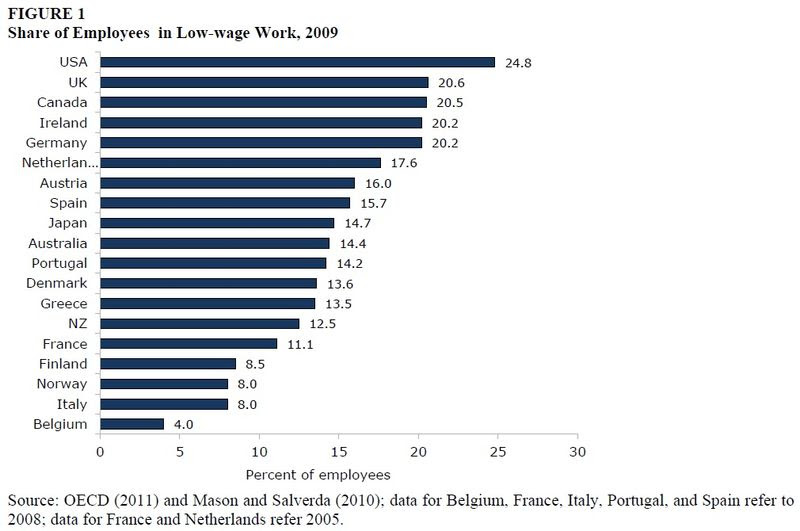
Economist Tim Taylor presented a chart highlighting that the US has a very high portion of its population working in low wage jobs. This is contrary to the image that the US is a land with middle class jobs for many:

low-wage-2
low-wage-2

Low wage work as defined in the data set above is employment that pays less than $10 per hour. Imagine trying to support a family on this. 2,000 hours of work would yield $20,000 which is below the poverty line for a family of three. And then we wonder how we have roughly 47 million Americans on food stamps.

The reason we continue to see this kind of recovery is that all policy made during the collapse was dictated by those in the banking industry that led up to this collapse in the first place. Even former Treasury Secretary Tim Geithner mentioned that if we didn’t do the bailouts exactly as we did (i.e., keep big payouts to banking execs, money for corrupt workers, etc) then the economy would have imploded. Well the economy did implode for most workers and a recovery never happened. Maybe for his closely knit group of people things are looking great:

growth-in-income-inequality

But for the rest of country people are running the Red Queen’s Race by working harder and harder simply to stay in the same place. A McJob recovery is not something to be proud about especially when the middle class in the US continues to dwindle.