Showing posts with label Medicaid. Show all posts

Thursday, May 1, 2014

2 Americas when it comes to health care

So, once again we see Southern conservatives love to be poor and sick, and continually vote against their own best interests. Boy, talk radio and FOX have sure done a number on them!....

What's really a shame are the poor blacks "imprisoned" in these mostly Southern states, who can't get decent health care like their fellow Americans in other parts of the country, because of white conservative voters in the majority.


By Jillian Berman
April 30, 2014 | Huffington Post

When it comes to the quality of health care, there are two Americas.

In one America, infant mortality, avoidable deaths, health-care costs and other measures are far worse than in the other America, according to a new study by the Commonwealth Fund, a health policy research firm. And thanks to Republican lawmakers and the Supreme Court, the gulf between them may only get wider.

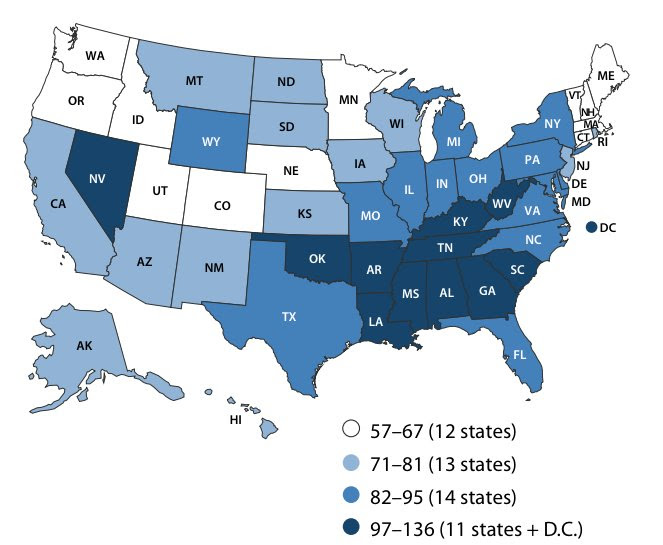
The map below from the Commonwealth Fund shows the stark divide. States with the worst overall health care systems -- as measured by factors like the number of insured adults and children, avoidable emergency room visits and access to affordable care -- are dark blue. States with better health-care systems are white.

map 1

When it comes to things like health care access, quality and cost, certain states can be as much as eight times better than others, the report found.

“We continue to see this very wide geographic spread,” said Commonwealth Fund senior vice president Cathy Schoen, a coauthor of the report. Millions of lives could be saved if the low-performing states could close just half the gap with the top states, Schoen said. "We really need to stay focused on aiming higher.”

Many of the lower-performing states have higher rates of early deaths that could have been prevented by access to quality health care. The Commonwealth map below shows the number of avoidable deaths per 100,000 in each state.
map 2

Many of the worst states for health care have several things in common. They’re mostly in the South and are more likely to be among the poorest in the nation. Many of them have long had unusually tight standards for applicants to qualify for Medicaid, said Schoen, and many have been slow to expand children’s health insurance.

What's more, 16 of the 26 states at the bottom of the Commonwealth Fund’s scorecard aren’t expanding Medicaid under the Affordable Care Act, also known as Obamacare.

map

The states in grey aren't expanding Medicaid. Many of these are also states in which overall health systems are worse.

One of Obamacare’s major tools for giving the poor better access to health care is expanding Medicaid to those making 133 percent of the federal poverty limit -- about $15,521 for a single person -- or less.

But the Supreme Court ruled in 2012 that states could opt out of joining the Medicaid expansion and the extra federal money that came with it. Many states with Republican governors or majority Republican legislators have done just that, leaving millions of their residents out of the national effort to cover the uninsured.

Increasing access to Medicaid isn't a cure-all for low-performing states, and improving health care outcomes overall will require more than just expanding Medicaid. But it could help, Schoen said. For one, it will extend health coverage to more people, making it less likely that poor patients will head to the emergency room for things other than emergencies. And if more low-income residents can pay for health care, more doctors might be convinced to move to poor or rural areas.

"The states that stay out could fail to improve, or fail to improve as fast as other states that choose to participate,” Schoen said. “In some of these states, staying where you are is not very good performance.”

Black Americans are likely to suffer disproportionately from these policies. More than two-thirds of poor, uninsured blacks live in states not expanding Medicaid, according to a December 2013 New York Times report. Already, the rate of avoidable early deaths among blacks is twice as high as among whites in many states, Commonwealth found. That gap is even wider in states with higher early death rates overall.

chart 3

The difference in avoidable death rates in white and black populations in different states.

Still, there is some hope: Kentucky, Arkansas and Nevada, which all rank in the bottom quarter of the Commonwealth Fund's scorecard, are expanding Medicaid. That could help them catch up.

"You could see a few states start to improve quickly," Schoen said.

Thursday, November 21, 2013

Obamacare IS working...especially in McConnell's Kentucky!

California, the most populous state in America, is on track to hit its Obamacare enrollment targets for 2014!

"But," said MSNBC host Chris Hayes, "the most fascinating Obamacare success story comes from the state of Kentucky. It is the only state in the South both expanding Medicaid and operating a fully state-based exchange."

The irony of Kentucky being Sen. Majority Leader Mitch McConnell's home state was not lost on Hayes. McConnell "just happens to be up for re-election next year, a race he will now have to run from a state where health reform is working."


All In With Chris Hayes
November 19, 2013 | MSNBC

Monday, November 11, 2013

Obamacare: Another conservative-lite idea

As I've said before, Obamacare was not what real liberals and progressives wanted: single-payer. In today's op-ed, Zelizer laments that, and warns liberals against "half-baked" liberal policies that are really just conservative-lite ideas.

Obamacare is the classic example. It was first proposed by the uber-conservative Heritage Foundation in the early 90s, then supported by uber-conservative economist Milton Friedman and Republican Speaker of the House Newt Gingrich, among 25 conservative leaders, then implemented on the state level by a Republican governor.  

The only problem is that the conservative party in the U.S. has gone farther to the Right since the 90s.  Now its "best & brightest" like Rush Limbaugh believe that the answer is to get rid of health insurance altogether. We should return to the 19th century. Idiots!

Before Obamacare, Obama never even put the single-payer option on the table. Congress never voted on it. Obama began with closed-door negotiations with insurance companies and drug makers to see what they'd agree to. Obamacare is what we got. Now their revenues are hitting all-time highs and projected to rise in 2014 as well, so don't cry for them.

Nevertheless, there are those on the Right today who ridiculously view Obamacare as a big, elaborate socialist conspiracy to usher in single-payer health care. Talk about a disconnect!  On one side, we have dissatisfied liberals lamenting that Obama missed a once-in-a-generation chance to change the healthcare game. On the other side, we have dissatisfied conservatives who say the liberals are pulling a fast one to get what they want eventually. Eventually, in some distant future.... It's as if paranoid conservatives have more faith in the inevitability of liberal ideals than liberals do!

There are two variants on this conspiracy theory, as far as I can pick up. The first variant goes: expanding Medicaid for the poor is just one more step toward single-payer, since the government already pays for more than half of all healthcare in America.  The second one goes: Obamacare is intended to be such a disaster that Americans will throw up their hands, decide private insurance is a mess, and demand single-payer instead.  

I'll give both versions more time than they deserve, if only because millions of talk radio/Tea Party Republicans really believe in them. As for expanding Medicaid, conservatives can breathe a partial sigh of relief, because their Republicans governors already blocked Medicaid expansion to 8 million Americans in their respective states. There is a problem here though, and it's real. GOP governors also refused to set up their own health insurance markets, thus shifting the burden to the federal Healthcare.gov website. This is delaying people getting health insurance who want it, and they might just give up entirely. 

Rick Moran summed up the self-defeating idiocy of Republicans' spiteful, partisan refusal to establish state health insurance exchanges:

[W]hile conservatives think the Obamacare exchanges are overregulated and oversubsidized, they are actually closer to the right-of-center vision for health care reform than the Obamacare Medicaid expansion, which is happening no matter what transpires with Healthcare.gov. So if the exchanges fail and the Medicaid expansion takes effect (and, inevitably, becomes difficult to roll back), we’ll be left with an individual market that’s completely dysfunctional and a more socialized system over all.

The second variant on this conspiracy theory might end up being true... but only by accident, not by design. I mean, do conservatives really believe that Obama is such a secret, selfless socialist ideologue that he has intended all along for his signature piece of eponymous legislation to be a total failure -- a failure that would define his presidential legacy? Talk about taking one for the team!  

Furthermore, if conservatives really believe Obamacare was designed to fail, then... why do they take such glee at every opportunity to declare it a failure?  Aren't they playing right into Obama's diabolical hands?  But ah, says the tinfoil hat crew, Obama didn't intend for it to fail so soon. Because he's so darn incompetent, see? He can't even screw up right. They say Obama intended for us to get good and used to Obamacare first, so that it could fail several years from now, just when we were about to... so that we would... you see then.... Oh, I can't follow this wacky line of reasoning any further.  


By Julian Zelizer
November 11, 2013 | CNN

Friday, October 4, 2013

GOP governors leave 8 million uninsured

We shouldn't be surprised.  The GOP despises poor people, especially if they're black.

Also check out this interactive map that displays the full ruthlessness of Republican states.


By Sabrina Tavernise and Robert Gebeloff
October 2, 2013 | New York Times

A sweeping national effort to extend health coverage to millions of Americans will leave out two-thirds of the poor blacks and single mothers and more than half of the low-wage workers who do not have insurance, the very kinds of people that the program was intended to help, according to an analysis of census data by The New York Times.

Because they live in states largely controlled by Republicans that have declined to participate in a vast expansion of Medicaid, the medical insurance program for the poor, they are among the eight million Americans who are impoverished, uninsured and ineligible for help. The federal government will pay for the expansion through 2016 and no less than 90 percent of costs in later years.

[...]

The 26 states that have rejected the Medicaid expansion are home to about half of the country’s population, but about 68 percent of poor, uninsured blacks and single mothers. About 60 percent of the country’s uninsured working poor are in those states. Among those excluded are about 435,000 cashiers, 341,000 cooks and 253,000 nurses’ aides.

“The irony is that these states that are rejecting Medicaid expansion — many of them Southern — are the very places where the concentration of poverty and lack of health insurance are the most acute,” said Dr. H. Jack Geiger, a founder of the community health center model. “It is their populations that have the highest burden of illness and costs to the entire health care system.”

The disproportionate impact on poor blacks introduces the prickly issue of race into the already politically charged atmosphere around the health care law. Race was rarely, if ever, mentioned in the state-level debates about the Medicaid expansion. But the issue courses just below the surface, civil rights leaders say, pointing to the pattern of exclusion.

Every state in the Deep South, with the exception of Arkansas, has rejected the expansion. Opponents of the expansion say they are against it on exclusively economic grounds, and that the demographics of the South — with its large share of poor blacks — make it easy to say race is an issue when it is not.

[...]

Wednesday, July 17, 2013

Meyerson: Cities resist the 'Wal-Mart-ization of work'

Meyerson's point about Southern regional wages being imposed on Northern workers is especially interesting: "Wal-Mart’s goal is to erase that North-South difference by making every place the South."

For what it's worth, I'm 110% behind the DC city council's decision to require big box stores to pay their workers a living wage!  Where Wal-Mart go, wages go down.  It's been proven.  Let's hope DC's mayor doesn't veto the council's profile in courage!


By Harold Meyerson
July 16, 2013 | Washington Post

For Republicans who want to cut the number of food stamp recipients, here’s a helpful suggestion: Support the ordinance passed last week by the D.C. Council, which required big-box stores like Wal-Mart to pay their employees at least $12.50 an hour.

On average, Wal-Mart pays its workers $12.67 an hour — which means that a huge number of its 1.4 million U.S. employees make a good deal less than that. By paying so little, the Bentonville behemoth compels thousands of its employees to use food stamps to feed their families and Medicaid to pay their doctor bills. It compels taxpayers to pick up a tab that wouldn’t even exist if the company paid its workers enough to get them out of poverty.

How many such workers go on the public rolls? Some states occasionally survey where those employees work, and Wal-Mart almost invariably tops their lists. An Ohio tally in 2009, for instance, found that 15,246 Wal-Mart workers were Medicaid recipients and 12,731 were on food stamps. (McDonald’s came in second in each category.)

Last week’s vote by the D.C. Council was just the latest round in the ongoing battle over whether Wal-Mart can open stores in the nation’s largest Northeastern and West Coast cities. The chain has encountered fierce resistance as it has sought to move into New York, Los Angeles, Chicago, Boston, San Francisco and now the nation’s capital. Elected officials in those cities have feared that America’s largest low-wage employer would compel long-established local retailers — most particularly, unionized supermarkets — to lower their wages.

A study by the Center for Labor Research and Education at the Berkeley campus of the University of California found that the opening of just one Wal-Mart store in a county where there previously had been none lowered the wages of general merchandise employees in that county by 1 percent, and grocery employees by 1.5 percent. The counties surveyed did not include those that encompassed the largest East and West Coast cities, where the gap between Wal-Mart’s wages and those of other supermarkets is greatest. But just the possibility that Wal-Mart might receive the go-ahead to open stores in Los Angeles in 2004 compelled that city’s supermarket employee union to accept a management demand to establish a markedly lower pay scale for new hires. When subsequent public opposition to Wal-Mart’s entry kept the chain largely out of L.A., the lower pay scale was eliminated the next time the union’s contract was renegotiated.

With Wal-Mart repeatedly failing to gain entry into the nation’s largest and most lucrative consumer markets, its investors might wonder why the company insists on maintaining its one-size-fits-all pay scale. Sam Walton founded and built the business in the rural South, where both the cost of living and the average pay levels were the lowest in the nation. However, it has not significantly adjusted its pay levels to accommodate the higher costs of living that workers in the nation’s priciest cities must bear. Twelve bucks an hour goes a lot farther in Bentonville than it does in Brooklyn. The executives at Costco, Wal-Mart’s closest competitor, know how to run a profitable discount chain that pays workers well: Its average hourly wage is just over $19. That’s why there are Costco outlets in the cities where Wal-Mart is still on the outside looking in.

By one measure, Wal-Mart’s insistence on bringing Southern wages north contradicts the spirit of Southern regionalism on which many of America’s (and now, the world’s) largest companies have come to rely. Knowing that both the cost of living and wage scales are lower in the South, and that Southern states’ right-to-work laws effectively blocked workers’ efforts to form unions, Northern manufacturers began opening plants there decades ago.

Wal-Mart’s goal is to erase that North-South difference by making every place the South. It commands such a large share of the nation’s retail sector that it has compelled its suppliers to lower their own pay scales all along its supply chain to provide lower-cost products.

So, high-wage manufacturers say they have to go south, while low-wage retailers say they have to go north. In aggregate, the corporate message to Northern workers is: Heads, I win; tails, you lose.

That’s why last week’s vote by the D.C. Council has more than just local importance. Requiring the District’s big-box stores to pay a living wage ensures that incomes in this high-cost city won’t be dragged down to the level of those in the low-cost rural South. The council’s vote isn’t the final word: D.C. Mayor Vincent Gray still could veto the measure. But with working-class incomes everywhere spiraling downward, he might conclude that the Wal-Mart-ization of work — and income — must be stopped at the District line.

Saturday, January 19, 2013

The irony of Walmart's health exchanges

Irony can be pretty ironic sometimes. Take Walmart. Its profitable business model requires hiring only part-time workers and paying them minimum wage with no benefits -- including no health insurance.

Now Walmart wants to open its own "health insurance exchange" under Obamacare. Walmart already runs its own medical clinics and pharmacies.

When it comes to using Walmart's buying power and marketing power to negotiate with insurance companies to give its customers a good deal on health insurance, that's just dandy and a valid reason for Walmart to flex its free-market muscles.

So why can't Walmart do the same for its own employees' benefit? In state after state, impoverished Walmart employees receive more Medicaid and food stamp benefits than any other company. That's right: U.S. taxpayers subsidize health coverage for Walmart's employees by Walmart's design; meanwhile, Walmart plans to turn around and sell health coverage to U.S. taxpayers. Huh-what?!

And Walmart's opening health insurance exchanges at its stores is doubly ironic, because the same "free-market" forces that allow it to negotiate cheaper insurance for its customers, are exactly the same forces that would allow the U.S. Government, under a single-payer health insurance system, to win even better deals for all of us. But then that would be goddamn "socialism."  Whereas it's "capitalistic" to overpay for the same thing.

And oh, by the way, the Walton family that controls Walmart is wealthier than the bottom 40 percent of Americans, combined. God bless America!  

P.S.  Read Ralph Nader's recent wonderful open letter to Walmart CEO Mark Duke here.


Thursday, December 6, 2012

Simpson debases himself before kids for his CEO paymasters

Hey, you kids, get hip to the national debt, yo!  'Cos nothing is more ironically cool than an old fogey lecturing at you while pretending to care about youth culture!

That's right, get with it, and then "start using those precious social media skills" to convince everybody to slash Grandma's Medicare/Medicaid and cut their Social Security benefits and hand them over to Wall St.  

And don't forget to Instagram it for ex-Senator Alan Simpson as you throw Grandma from the train!


December 6, 2012 | FoxNews

Former Sen. Alan Simpson is going to new lengths to wake up Washington to the need for a debt deal -- this time, dancing to "Gangnam Style" in a viral YouTube video. 

The sharp-witted, sharp-tongued, 81-year-old budget guru played along for a video by The Can Kicks Back, a group that aims to enlist young Americans in pressuring Washington to reach a deficit-reduction deal by July 2013. 

In the video, Simpson tells today's youth: "Stop Instagramming your breakfast and tweeting your firstworldproblems and getting on YouTube so you can see Gangnam Style." 

Nothing if not a good sport, Simpson proceeds to imitate the limber moves of South Korean rapping sensation PSY while his "Gangnam Style" hit plays in the background. 

Simpson urges young American to put "those precious social media skills" to good use. "Take part or get taken apart," he says. 

Simpson co-chaired President Obama's deficit-reduction commission, whose findings were left on the shelf by the White House and Congress. He has since expressed frustration at the virtual standstill in Washington when it comes to striking a meaningful debt deal.

Sunday, October 14, 2012

Median, middle and 'moochers'

MB360 has given us some hard income data to mull over:

  • 2011 Census data says the the median U.S. household income is $50,500; that means half of U.S. households make more, and half less than $50,500.
  • 2010 Social Security data says the median worker's income is $26,000.
  • An individual making more than $250,000 is in the top one percent of all earners in the U.S.  
  • A household making more than $250,000 per year is in the top two percent of all U.S. households. 
  • A household making more than $100,000 is in the top 20 percent of all U.S. households.
$250,000 and $100,000 are common cut-off points in political discussions about who is really middle class, and who deserves a tax cut or a tax hike.  

Mitt Romney told ABC that, "Middle income is $200,000 to $250,000 and less."  (A person making $200,000 or more is in the top four percent of U.S. income earners.) Obama more or less agrees with Romney.  By their definition, 96 percent of Americans are middle class.  That's ridiculous on its face.

More to the point, do average Americans believe that the top 1-2 percent need and deserve a tax cut right now?  Both Obama and Romney do.  I don't.  

Does it even make sense to regard a household earning $100,000 -- double the median household income -- as middle class?  Probably not, relatively.  

Meanwhile, we have 46.7 million Americans receiving food stamps, and 56 million receiving Social Security.  That's about one-third of the U.S. population. That's not to mention 48 million Americans on Medicare, and about 4 million on Medicaid.  Meanwhile, 60 percent of those 65 or older receive at least 75 percent of their income from Social Security. How low would U.S. median income be without these programs?  It's frightening to think about how insecure most Americans are, financially.

Here's what these programs cost, or, to put it in Republican terms, how much wealth they redistribute:

          TOTAL:  $1.8 trillion

But what about the deficit?  As a Bloomberg study revealed, "the rise in the deficit -- from an average of 1.9 percent of gross domestic product in the pre-crisis years (2005 to 2007) to 9.3 percent of GDP post- crisis (2009-2011) -- is almost entirely due to the economic decline, which drove down tax receipts and pushed up spending on unemployment, food stamps and other support programs."

But we already knew that, right?  We must know that 33 percent or 47 percent or whatever share of Americans didn't suddenly become lazy moochers while Obama went on a wild spending spree.  No, it's that suddenly our economy got very, very bad: shrinking 6.3 percent in 2008 alone, erasing $15.5 trillion in U.S. wealth, costing 8.8 million U.S. jobs, and dunking 24 percent of houses -- most Americans' most valuable asset -- underwater.  

Given all this, it is madness to suggest that the answer to our economic malaise is to cut spending for needy Americans while reducing taxes for Americans making $200,000 or more.  

Tuesday, August 21, 2012

Dean Baker: The $1.2 trillion healthcare tax

We Americans overpay $1.2 trillion a year for our medical care.  Whether it's paid to a private insurer or paid to the IRS for Medicare/Medicaid, it's still overspending.  


By Dean Baker
August 21, 2012 | Al Jazeera

Economists tend not to be very good at economics, which is one of the main reasons that the world is facing such a prolonged downturn. Few economists were able to recognise the enormous imbalances created by housing bubbles in the United States and elsewhere, or to understand that the collapse of these bubbles would lead to a prolonged period of stagnation in the absence of a vigorous response by governments.

Economists' grasp of economics has not improved since the start of the downturn. There is little agreement within the profession on the appropriate way to bring the economy back to its potential level of output. Nor is there even agreement as to whether this is possible.

Instead, many economists are running around like chickens with their heads cut off, yelling that we have to do something about budget deficits. This concern is bizarre since it is easy to show that the current deficit in the United States is almost entirely due to the collapse of the housing bubble. The loss of revenue from this collapse, coupled with the measures taken to offset the impact of the downturn, explain almost all of the rise in the deficit since 2007, when it was just 1.2 per cent of GDP.

The financial markets presumably recognise this fact, which is why the interest rate in 10-year Treasury bonds remains near a 70-year low. The more serious among the deficit hawks will acknowledge that current deficits don't pose a problem, but then point to scary projections of large deficits 10 years and further down the road.

While some of these projections can look scary these projections are driven almost entirely by projections of exploding health care costs. If the United States paid the same amount per capita for its health care as people in Canada, Germany or any other wealthy country we would be looking at long-term budget surpluses, not deficits.       

This is where the response of the deficit hawks is truly bizarre and shows their poor grasp of economics. They invariably complain that health care costs are hard to control, so instead we must rely on cutbacks to public sector health care programmes, like Medicare and Medicaid.

The reason why this response is bizarre is that a bloated health care sector has pretty much the same impact on the economy whether or not the government pays for it. The bloated payments for health care have pretty much the same impact regardless of who pays the bill.

To be concrete, imagine that because of their ability to use licensing restrictions to limit the supply of doctors, physicians in the United States can charge twice as much as their counterparts in Germany or Canada (that's pretty close to the reality). These excess fees have roughly the same impact on the economy as if doctors got German or Canadian salaries and the government imposed a tax of $100,000 a year on each physician. In both cases, patients would have an excessive amount of money drained from their pockets to pay for their doctors' services.

It would be the same story with an insurance industry that adds $200 billion a year or more to the cost of health care in the United States. From the standpoint of the economy, there is little difference between a situation in which insurers drive up the cost of care by $200 billion and a situation in which we have a more efficient system of health care delivery and the government imposes a tax on health care of $200 billion.

The same can be said of all the other areas where the enormous inefficiency of the US health care system drives up costs: drugs, medical equipment and supplies, and hospital services. In total, the difference between the cost of care in the United States and the cost in countries with comparable care, like Germany or Canada, comes to more than $1.2 trillion dollars a year.  According to the OECD's health care data, this would be the annual savings to the United States if its per person health care costs were equal to those in either of these countries.

You would think that economists would be upset over a $1.2 trillion annual tax due to the inefficiency of our health care system. This is at least an order of magnitude larger than most issues that economists spend their time worrying over. Yet there are few economists who make this obvious point when debates over the budget come up. Instead, they typically chime in with the choir saying that we need to cut the budget, not fix health care.

The cynical among us might point out that fixing the budget mostly means beating up on older people getting Social Security and Medicare benefits. Fixing health care means going after powerful lobbies like the insurers, the drug industry, and doctors. But whatever their motive, the facts are clear. The vast majority of economists in the United States are not especially concerned about a $1.2 trillion annual health care tax; they have much less important matters to take up their time. 

Monday, August 13, 2012

Cutting 'welfare' won't fix the deficit

It has become an article of faith among many of you conservatives that "welfare" is driving our federal deficit.  Peter Goodman points out, however:

Between 2001 and 2011, the tax cuts delivered by George W. Bush and continued under Obama have cost roughly $2.8 trillion.  That is about 17 times the roughly $165 billion that has been spent on the primary federal grant that funds welfare.

Indeed, conservatives don't understand how we spend our money or why we have such a big deficit.  My man Paul Krugman calls the U.S. "an insurance company with an army" because "the vast bulk of its spending goes to the big five: Social Security, Medicare, Medicaid, defense, and interest on the debt."  

Prof. Krugman instructs conservatives: "if you want smaller government, either you're talking about cuts in the big five, or you have no idea what you're talking about."


By Peter S. Goodman
August 13, 2012 | Huffington Post

Wednesday, June 20, 2012

The coming crisis of elderly poverty

It's good that older teabaggers suck at imposing their political views on younger generations; otherwise, we would slash their Socia Security, Medicare and Medicaid and make them spend their golden years in squalor and indignity.

But we're not gonna do that, because our progressive principles are too strong.  Sorry to break it to you, old-timers, but because of you, "Social Security and Medicare are going to have to be more generous, not less, than these programs are today."


By David Callahan
June 19, 2012 | Huffington Post

Most of the coverage last week of the Fed study on household wealth focused on the gigantic financial hit taken by nearly all Americans since 2007. Dig deeper into the report, though, and it makes for even scarier reading, as many of those people losing lots of wealth are older and don't have much time to recover before retiring.

In 2007, near the boom's height, older households (between 55 and 64) had a median net worth of $266,200. That figure included everything -- home equity, savings, 401(k)s, etc. -- and is hardly the kind of money people need to get through their golden years. By 2010, though, the nest eggs of Americans approaching retirement had shrunk dramatically, falling to $179,400 -- a 33 percent drop. The main reason for this, of course, was the collapse of the housing market, with home equity accounting for the lion's share of older Americans' net worth.

Older workers also experienced a drop in earnings, making it harder for them to stash away cash and make up for losses to their net worth. Indeed, barely over half of all families in the 55 to 64 group reported to the Fed that they saved money in 2010. You heard that right: Half of all workers hurtling toward retirement aren't putting away for the future. Yikes.

Another scary finding of the study: Only 60 percent of families, 55 to 64, even have a retirement account where they take advantage of tax breaks for retirement savings. And the median amount of money in such accounts is $100,000.

Of course, that's no surprise to us here at Demos, as we have recently been documenting the many shortcomings of the 401(k) system. Foremost among the faults of 401(k)s is that so many employers don't offer such plans to their workers. Another major problem: most workers don't build up a very big nest egg, even after decades in the labor force thanks to low contribution levels, stock market meltdowns, and loans taken out against their 401(k)s.

Not surprisingly, also, there is a huge disparity in who has access to a 401(k). According to the Fed report, 70 percent of Americans with a college degree have a retirement account -- compared to just 41 percent of those with only a high school diploma. The report shows, moreover, that such coverage for all groups declined somewhat between 2007 and 2010 -- reflecting a broader trend of more employers choosing not to offer 401(k)s.

Beyond the paltry assets of many older Americans, there is also the problem of debt among those in their fifties and early sixties. The Fed report shows that a great many older Americans carry credit card debt -- a worrisome trend that Demos documented a while back in our report, Retiring in the Red. Needless to say, it's not good to be scrambling to pay off your Amex bill when you should be putting away money for retirement.

Again, no big surprises from this data. Just more warning signs that the 401(k) system isn't working and that America is facing an epidemic of elderly poverty in the decades ahead -- a crisis that will make it very difficult to cut the big entitlement programs for seniors, which tends to be the linchpin of most centrist and conservative deficit reduction plans.

Indeed, it's hard to look at the data on how the broke the Baby Boomers are without concluding that Social Security and Medicare are going to have to be more generous, not less, than these programs are today. Strangely, few leaders in Washington seem to be tuned in to this grim reality -- or ready to deal with it.

Friday, August 13, 2010

U.S is long-term bankrupt

Teabaggers will like what Kotlikoff has to say about cutting entitlement programs (just not their entitlements), but they'll hate what he has to say about raising taxes.

The truth is that we can't reduce our national debt without a combination of spending cuts and tax hikes. Anybody who tells you different is a political hack.

So the real questions are: (1) what programs do you cut and how much; and (2) whose taxes do you raise and how much? Any ideologue who won't get specific on those two questions is a hack.

When it comes to spending we're not talking about just cutting "pork." We must cut red meat & bone: Defense, Social Security, Medicare, and Medicaid. And when it comes to cutting taxes we're not talking about just closing loopholes. We're talking about massive tax increases (14% of GDP, according to the IMF) on corporations and the richest 1-5% of Americans.


U.S. Is Bankrupt and We Don't Even Know It
By Laurence Kotlikoff
August 11, 2010 Bloomberg

URL: http://www.bloomberg.com/news/2010-08-11/u-s-is-bankrupt-and-we-don-t-even-know-commentary-by-laurence-kotlikoff.html

Friday, February 19, 2010

15% of Americans on Medicaid

Here's more evidence that hands-off government regulation of Wall St. combined with hands-on bailouts of TBTF banks has led by default to the growing socialist welfare state that laissez-faire, pro-business types wanted to avoid all along.

46.8 million Americans are enrolled in Medicaid, and growing.

Who needs socialist health care reform? The bad economy is forcing Big Guvmint's hand.


Medicaid enrollment rises nationwide, analysis finds
By Amy Goldstein
February 19, 2010 | Washington Post

URL: http://www.washingtonpost.com/wp-dyn/content/article/2010/02/18/AR2010021805609.html?hpid=moreheadlines