Trump just said in New Hampshire that he's going to unleash competition on U.S. healthcare after he repeals Obamacare, specifically by allowing Americans to buy health insurance across state lines.
Trump said the insurance companies are making a killing on Obamacare. The fact is, insurance companies are taking about 3 cents of every healthcare dollar in profit.
The problem is that U.S. medical care is too damn expensive. Insurance companies chip away at the edges and screw us in the process, through recission, yes, but they aren't the real problem.
Buying a cracker-jack health policy from a rinky-dink insurance provider in Rhode Island isn't going to do a thing for the cost of your care at home; it's only going to hit you when you actually need it that your insurance policy doesn't cover s**t.
Showing posts with label health care. Show all posts
Showing posts with label health care. Show all posts
Saturday, February 6, 2016


Tuesday, November 11, 2014
On Jonathan Gruber's comments 'bashing' Obamacare
Further to Jonathan Gruber's comments from 2013 on YouTube,
which have talk radio, Fox and Republicans publicly all aflutter. So check this out:
"Healthy people pay, sick people get money," is the way all health insurance works, I'm afraid. It's the way insurance works, period: "Unsunken ships pay; sunken ships get money;" "Undamaged homes pay; damaged homes get money;" "Safe drivers pay; unsafe drivers get money," and so on.
Nevertheless the insurance companies through rescission have tried, illegally, to mitigate the economics of health insurance, retroactively; but PHSA, HIPPA and Obamacare have restricted that underhanded business practice.
No, Obamacare isn't "something for nothing." It's not "free healthcare." More people have to pay in by buying private insurance, or having their employer pay part of their insurance cost, but the economics are sound, there is no other way. The other side of the ledger, (which any accountant should acknowledge), is that having more people insured will lower health spending overall. That's what the CBO has said consistently.
In the U.S. we're spending nearly 20 percent of GDP on health care, and that's not sustainable. It's also not competitive. Check this out from the World Bank,health expenditure, total (% of GDP):
Australia -- 9.1 percentCanada -- 10.9 percentFrance -- 11.1 percentGermany -- 11.3 percentGreat Britain -- 9.4 percentJapan -- 10.1 percent... and so on.
Next, take a deep breath and check this out: "Revisions to CBO's Projections of Federal Health Care Spending" from July 2014. Upshot: The U.S. economy, at least the federal government'share of it, is projected to spend less on health care in the long term, which is exactly what we liberal-progressives wanted, to bend the cost curve:
But how can that be, my conservative interlocutor will ask? How can the government be spending more on [Obamacare] subsidies yet projected to spend less, overall?CBO now projects that, if current laws remained generally unchanged, net federal spending for the government’s major health care programs in 2039 would equal 8.0 percent of gross domestic product (GDP)—1.6 percentage points, or about 15 percent, less than the 9.6 percent the agency projected in 2010 (see the figure below). That revision stems in large part from the observed slowdown in health care spending in recent years, but it also includes the effects of other factors; some of those factors reduced projected spending, and others increased it.The programs included in the calculations are Medicare, Medicaid, the Children’s Health Insurance Program, and subsidies for insurance purchased through exchanges.
The answer, (not to get too wonky), if you read between the lines of the CBO's revised estimate, is that growth in healthcare spending, including on Medicare, has been slowing down faster than anybody projected.
Indeed, noted conservative Forbes, "The current numbers represent the slowest rate of growth since the government began tracking the data in 1960."
And why is that? Apparently nobody knows yet. But for four years running, the rate of spending on health care in America has slowed... just coincidentally under President Obama, under an Obamacare regime.
Harvard economist David Cutler argued in the Washington Post a few days ago that, in fact, we do indeed have Obamacare to thank for it.
Probably it's still premature to say for sure, but the signs are good. Yet one more reason not to "repeal and replace" Obamacare when it's doing what it was designed to do -- covering about 7 million more Americans in its first full year; and lowering -- or at least not increasing -- healthcare costs for four years running.
UPDATE (11.15.2014): Here's kind of a fair and balanced analysis of what Jonathan Gruber said (on multiple occasions, unfortunately), from none other than CNN: "Obamacare: Voters, are you stupid?"
Thursday, November 6, 2014
Don't you need prices for a health care 'market'?
LOL, man. LOL:
The average person is not an expert at ferreting out and haggling over health care prices. It is unfair to expect them to be. The onus for clear prices on health care should fall on the providers, and the insurance companies. Get together and work that shit out. Do this one little thing to protect the morons like me. We're already sick. We're about to be broke. At least let us know how broke we're going to be in advance.
Seriously though, now that I'm done LOL, I've made this same point many times before. The fact that "free-market" conservatives never mention this little problem while praising our health system as the best in the world leads me to believe that they are either: 1) complete morons who don't know what markets are; or 2) total deceivers in the pockets of the insurance companies and health systems.
Moreover, as I've remarked before, people in ER situations don't have time to "shop around" for healthcare and the EMTs decide what hospital to take them to anyway.
By Hamilton Nolan
November 6, 2014 | Gawker
Tuesday, September 9, 2014
DC Johnston: End insurance co-payments
Here's another one from David Cay Johnston, this time on the outrageous inefficiency of U.S. hospitals:
American hospitals spend a huge and growing share of their revenue on overhead, a study published today in Health Affairs shows. Getting those costs down should be a national priority.U.S. hospitals on average spend 25.3 cents out of each dollar of revenue on overhead, with for-profit hospitals spending 27 percent and nonprofits a bit below the average.By contrast, the Netherlands and England, which have the next highest overhead costs, spend 19.8 percent and 15.5 percent, respectively. Both are moving toward market-based financial models, so, as with the U.S., overhead costs are likely to rise.[...] The new study helps explain why for every $1 the 33 other countries with advanced economies spend per person on universal health care, the United States spends $2.64 — and yet more than one-fifth of Americans have no or poor health insurance. A significant reason the U.S. health care system is so expensive and inefficient turns out to be those annoying co-pays.
Here's one suggestion: eliminate co-pays. Here's why:
In economics “rational” is a term of art. It means groups of people consistently making choices that maximize their benefits and minimize their costs.By this definition, the promotion of co-pays by employers and insurers fails the rationality test. Why? Because co-pays discourage people, especially those with meager incomes, from seeing doctors and obtaining medications. That reduces immediate spending on doctor visits and drugs but not total costs over the longer term. Instead, when people who are squeezed financially do not pick up their medications, thus avoiding the co-pay, they later will need more intensive and costly care, which drives up total costs for health care as well as increasing human misery and shortening lives.When co-pays discourage getting drugs and visiting doctors, which results in more costly medical problems later, the system is irrational. When those payments eat up as much as or even more than they bring in, the system is more so.Here is a suggestion: Get rid of co-pays. Instead let’s just add a prominent line on paycheck stubs that reads, “Your health care is paid separately, and it cost X dollars this pay period.” That would help make the American economy more efficient and more humane.
By David Cay Johnston
September 8, 2014 | Aljazeera
Sunday, August 17, 2014
Study: Healthcare prices 'irrational'
Here's yet more evidence to prove what I've been saying all along: healthcare does not, and cannot, operate like a business. "The charging system and payment system are irrational," i.e. not based on any known criteria, concluded a recent study:
One California hospital charged $10 for a blood cholesterol test, while another hospital that ran the same test charged $10,169 — over 1,000 times more.For another common blood test called a basic metabolic panel, the average hospital charge was $371, but prices ranged from a low of $35 to a high of $7,303, more than 200 times more.[...] Earlier studies by [Dr. Renee] Hsia [the study's leading author] identified variations in listed charges for labor and deliveries and for appendectomies in California, with labor and delivery charges varying eight to 11-fold between hospitals, and charges for a routine appendectomy ranging from $1,500 to $182,955.
So what does the healthcare industry have to say for itself?
Officials with the California Hospital Association dismissed the report as irrelevant, saying that the vast majority of patients pay discounted rates that have been negotiated by their insurance plans."Charges are meaningless data — virtually no one pays charges," said Jan Emerson-Shea, the association's vice president for external affairs.
That's right, my free market-loving, Tea Partying friends: prices are meaningless. That's the way it was before Obamacare, and that's the way it is now.
But if the hospitals aren't the problem, then private health insurance must be. What's the answer? Make private health insurance unnecessary, (or an added luxury for those who want it), by introducing a single-payer insurance system, aka "Medicare for everybody."
Medicare already negotiates the best prices on health care and prescription drugs, better prices than you or I can get, or our insurance providers. That's why this year the Obama Administration was the first ever to publicize the prices that Medicare pays for all kinds of health services, in the vain, (let's say misguided) hope that it would spur health "consumers" to ask tough questions of their providers and insurers and *shop around.
(*Just to illustrate the absurdity of "shopping" for healthcare, let's take the above-mentioned example of an appendectomy that could cost anywhere from $1,500 to $183,000. Nobody in the world researches prices on an appendectomy when they are healthy and able to choose where they get medical care; it is almost always an emergency procedure performed amid searing abdominal pain and the life-threatening risk of organ rupture. Anyway, the local EMT decides what hospital to go to, not the patient!)
By Roni Caryn Rabin
August 15, 2014 | NPR
URL: http://n.pr/1pRcvKP
Saturday, June 7, 2014
VA scandal is an indictment of US health care, not Big Government
Bravo, Mr. Wapshott! Conservatives too often employ a version of the following syllogism: John is bad; John is a government employee; thus all government employees are bad.
Here's a good 'graph:
Cannot those employed on salaries by private companies, particularly employees of corporate behemoths who operate near-monopolies, also ration their customers and say they have been put them on waitlists that do not exist? Can employees of commercial firms not also be corrupt and lazy? Does the free market not employ salaried workers? This muddled thinking is simply partisanship posing as intellectual rigor.
Intellectual rigor mortis, yes, but intellectual rigor among conservatives? Heck, no!
Waitlists, Charles Krauthammer laments? Gee, I called my primary care physician in January; he said the earliest he could see me was April. Rationing, he says? Gee, what do you call preferred providers networks, approved lists of procedures, payment ceilings, and the whole list of restrictions that private insurance companies put on our health care to cut costs and increase their profits?Private health insurance is all about rationing, because that's the only way they make money!
By Nicholas Wapshott
June 3, 2014 | Reuters
For some, the veterans hospitals scandal is a human tragedy pure and simple. Those who loyally served their nation in uniform, putting their lives on the line, were shunned when they sought medical help.
For others, however, the troubles at the Department of Veterans Affairs have provided what one pundit called “A gift from God.”
For those commentators, the scandal confirmed their worst fears. The logic runs like this: The VA provides a government-run health service; the failures of the VA are a disgrace; ipso facto, all government-run health systems are a disgrace; proving that all government-run bodies are a disgrace. So all government should be sharply reduced — if not abandoned altogether.
The VA troubles, however, prove no such thing. The poor treatment of veterans has nothing to do with funding and everything to do with administrative incompetence combined with craven deceit.
Anyone who has been kept waiting inordinately by a doctor or hospital, or who has had their treatment or prescription drugs denied by their health insurance company, knows that. Anyone kept hanging on the line for an ill-named “customer service representative” and told by an automaton, “Your call is important to us,” knows that private companies treat customers with equal disdain.
The difference is that in the VA scandal, democratic accountability eventually — it took far too long, we know — kicked in. The top man resigned and top managers who presided over the incompetence and subterfuge were fired. It is a further scandal that it took President Barack Obama himself to push the wrongdoers into admitting responsibility. But at least the problem was ultimately addressed.
When can you remember a chief executive officer of an aberrant cable TV company or phone or utility company or even a health insurance company — fill in your favorite offender here — falling on their sword for keeping their customers waiting?
This is the full quote from the “Gift from God” analyst, former neurosurgeon Ben Carson: “What’s happening with the veterans is a gift from God to show us what happens when you take layers and layers of bureaucracy and place them between the patients and the healthcare provider.”
Perhaps, as a brain surgeon, Carson is given special treatment when he visits the doctor. But the rest of us endure “layers and layers of bureaucracy” whenever we try to access the healthcare we have so expensively bought.
One reason American healthcare is two-and-a-half times more expensive than in comparable countries is because of the “layers and layers” of insurance sales agents, ID checkers, referral faxers, hospital debt collectors from insurance companies and all the other expensive bureaucrats with no medical knowledge who are employed to administer and police the system. Add to that routine over-charging by doctors and Americans seeking healthcare are being ruthlessly abused and exploited by a commercial scheme that offers them little real choice.
Why do even the smartest free-market dogmatists, who like to paint the world in black and white, fail to see the flaws in commercial companies? Here is the dean of conservative commentators, Charles Krauthammer: “If there’s ever been evidence that a government-run system of healthcare is a disaster, it’s here,” he said. “It’s rationing, it’s waitlists, and corruption and laziness — as you get when people are salaried, rather than working in the free market.”
Cannot those employed on salaries by private companies, particularly employees of corporate behemoths who operate near-monopolies, also ration their customers and say they have been put them on waitlists that do not exist? Can employees of commercial firms not also be corrupt and lazy? Does the free market not employ salaried workers? This muddled thinking is simply partisanship posing as intellectual rigor.
The public-private divide is a red herring that used to distract the left from clear thinking. For a century or more, socialists and communists believed that the world’s problems would be solved if only the “commanding heights” of an economy and the “means of production” were brought into state ownership. Many otherwise smart people fell for an ideology that failed to fulfil its promise the second it was put into practice.
State socialism is now as extinct as the broad-faced potoroo and few except die-hard ideologues dare suggest the government should run everything. Yet the government, tempered by democracy, still has an important role to play when the private sector is found wanting.
It is not merely in treating veterans — whose profound mental and physical wounds can often be so expensive to treat that private insurance companies cannot offer an affordable rate. In many Western European countries taxpayer-funded health systems keep down the skyrocketing costs of treating their ageing populations, just as here in the United States the Social Security system provides an equitable, and relatively inexpensive, way of providing a decent standard of living for retirees.
Other essential services, too, are best administered by the state. Such as the armed services and the police. Schooling, too, is too important to the nation to be left solely to the private sector. State education too often fails, but it is not because taxpayers fund it — it is because the money is spent unwisely.
The question is not whether to have the government provide services the private sector cannot supply. It is a matter of where to draw the line between public and private.
Friday, May 30, 2014
Gov. Beshear to Mitch McConnell: Obamacare is working
Excellent! This is from a Democratic governor in a Red State who isn't afraid to tell it like it is to his conservative constituents:
[O]ver 421,000 Kentuckians have signed up for health insurance through "kynect" -- about 75 percent of whom didn't previously have insurance and about 52 percent of whom were under age 35.That's almost 1 in 10 Kentuckians....[I]f each of the over 421,000 people who signed up via "kynect" could grab 10 minutes of Sen. McConnell's time to explain what health care coverage means for their families, and if the Senator had the endurance to listen 24/7, it would take eight years to hear from each enrollee.
I'll say it again, "Big Government" programs like ACA and Social Security aren't just debits, they aren't just financial obligations, they represent real assets -- because they sustain and improve millions of real Americans' lives. Somebody living longer and being more productive -- that's harder to quantify in dollars and cents the same way we can track federal spending, but heck if it isn't just as real.
(Every other corporation says, "Our people are our most important asset;" and this is even truer for the U.S. Government of its citizens!)
It's high time Republicans stopped ignoring half our nation's balance sheet, i.e. ignoring the assets that government produces and sustains all around us.
P.S. -- Unless something changes soon, I'll become an Obamacare "customer" in June. I've already shopped for plans and consulted on the telephone with kynect representatives, who were very friendly, helpful and knew their stuff. I was impressed, especially compared to the experience of calling an insurance provider for answers!
P.S. -- Unless something changes soon, I'll become an Obamacare "customer" in June. I've already shopped for plans and consulted on the telephone with kynect representatives, who were very friendly, helpful and knew their stuff. I was impressed, especially compared to the experience of calling an insurance provider for answers!
By Gov. Steve Beshear
May 29, 2014 | Huffington Post
Friday, May 9, 2014
How we suddenly got taller. (Not evolution)
Several times I've heard people say knowingly that today's taller children are proof of evolution.
In reply, I point to second- and third-generation children of Asian immigrants who tower over their parents. Evolution doesn't work that fast. Evolution is a scientific fact, but it doesn't become manifest in only a few generations. This is all nurture, not nature.
Notes Olga Khazan, "The average European man became about 11 centimeters taller between 1870 and 1970, gaining about a centimeter per decade. A mid-19th century British man stood just five feet, four inches tall, but he was five-foot-eight by 1980."
So I urge everybody to read this article. The upshot: lack of disease and better nutrition, especially in the early years, make children taller. Fewer children/smaller families mean less disease in families; hence smaller families in the West has led to taller children as well. Literate parents and cleaner cities also increase average height.
This may be especially interesting to Americans:
For centuries, Americans were the NBA players of the world. We were two inches taller than the Red Coats we squared off against in the American Revolution. In 1850, Americans had about two and a half inches on people from every European country. But our stature plateaued after World War II, and since then, other countries shot past us. White Americans have grown a bit taller since the early 1980s, but African Americans haven’t.
Today Danes, Germans and Norwegians are all taller than us. Why? Better health care and nutrition than in the U.S. Of course, immigrants are most probably bringing down our average, as this year's visit to my local Latin Festival showed me.
By Olga Khazan
May 9, 2014 | The Atlantic
Thursday, May 1, 2014
2 Americas when it comes to health care
So, once again we see Southern conservatives love to be poor and sick, and continually vote against their own best interests. Boy, talk radio and FOX have sure done a number on them!....
What's really a shame are the poor blacks "imprisoned" in these mostly Southern states, who can't get decent health care like their fellow Americans in other parts of the country, because of white conservative voters in the majority.
By Jillian Berman
April 30, 2014 | Huffington Post
When it comes to the quality of health care, there are two Americas.
In one America, infant mortality, avoidable deaths, health-care costs and other measures are far worse than in the other America, according to a new study by the Commonwealth Fund, a health policy research firm. And thanks to Republican lawmakers and the Supreme Court, the gulf between them may only get wider.
The map below from the Commonwealth Fund shows the stark divide. States with the worst overall health care systems -- as measured by factors like the number of insured adults and children, avoidable emergency room visits and access to affordable care -- are dark blue. States with better health-care systems are white.

When it comes to things like health care access, quality and cost, certain states can be as much as eight times better than others, the report found.
“We continue to see this very wide geographic spread,” said Commonwealth Fund senior vice president Cathy Schoen, a coauthor of the report. Millions of lives could be saved if the low-performing states could close just half the gap with the top states, Schoen said. "We really need to stay focused on aiming higher.”
Many of the lower-performing states have higher rates of early deaths that could have been prevented by access to quality health care. The Commonwealth map below shows the number of avoidable deaths per 100,000 in each state.
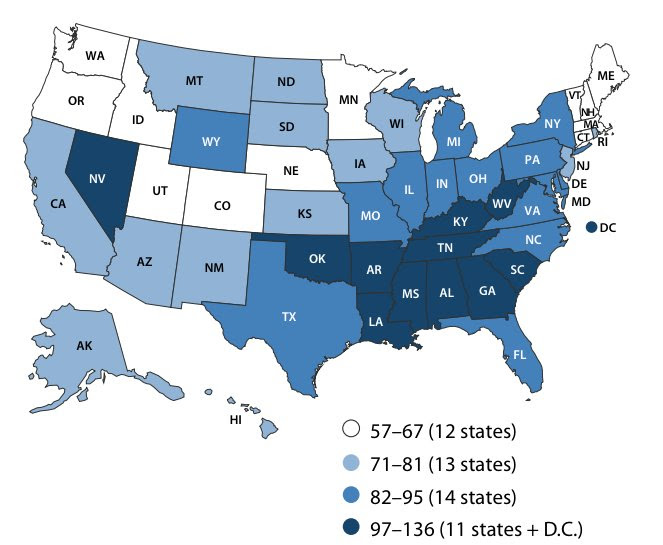
Many of the worst states for health care have several things in common. They’re mostly in the South and are more likely to be among the poorest in the nation. Many of them have long had unusually tight standards for applicants to qualify for Medicaid, said Schoen, and many have been slow to expand children’s health insurance.
What's more, 16 of the 26 states at the bottom of the Commonwealth Fund’s scorecard aren’t expanding Medicaid under the Affordable Care Act, also known as Obamacare.

The states in grey aren't expanding Medicaid. Many of these are also states in which overall health systems are worse.
One of Obamacare’s major tools for giving the poor better access to health care is expanding Medicaid to those making 133 percent of the federal poverty limit -- about $15,521 for a single person -- or less.
But the Supreme Court ruled in 2012 that states could opt out of joining the Medicaid expansion and the extra federal money that came with it. Many states with Republican governors or majority Republican legislators have done just that, leaving millions of their residents out of the national effort to cover the uninsured.
Increasing access to Medicaid isn't a cure-all for low-performing states, and improving health care outcomes overall will require more than just expanding Medicaid. But it could help, Schoen said. For one, it will extend health coverage to more people, making it less likely that poor patients will head to the emergency room for things other than emergencies. And if more low-income residents can pay for health care, more doctors might be convinced to move to poor or rural areas.
"The states that stay out could fail to improve, or fail to improve as fast as other states that choose to participate,” Schoen said. “In some of these states, staying where you are is not very good performance.”
Black Americans are likely to suffer disproportionately from these policies. More than two-thirds of poor, uninsured blacks live in states not expanding Medicaid, according to a December 2013 New York Times report. Already, the rate of avoidable early deaths among blacks is twice as high as among whites in many states, Commonwealth found. That gap is even wider in states with higher early death rates overall.

Map via The Advisory Board.
The difference in avoidable death rates in white and black populations in different states.
Still, there is some hope: Kentucky, Arkansas and Nevada, which all rank in the bottom quarter of the Commonwealth Fund's scorecard, are expanding Medicaid. That could help them catch up.
"You could see a few states start to improve quickly," Schoen said.
Saturday, March 8, 2014
Tuesday, December 3, 2013
U.S. is off the chart on health care
Wow. The best health care system in the world, huh? That's exactly what it is, according to Sen. Mitch McConnell and Speaker John Boehner!
By Matthew O'Brien
November 22, 2013 | The Atlantic
We are an exceptional nation. At least when it comes to healthcare spending.
We spend much more than any other rich country, but we certainly don't get more for it. We get less. We get about the same health outcomes, but don't cover everybody like other rich countries do. Now, there are a lot of statistics that show how singularly wasteful our healthcare system is, but the chart below, via Aaron Carroll, is maybe the most visually arresting. It compares life expectancies with healthcare spending per capita for rich and near-rich countries. There's a pretty predictable relationship, with diminishing returns for more spending—and then there's the U.S.
See that dot that's almost off the chart? We spend more than four times as much as the Czech Republic does per persona, and live about just as long.

The problem is everybody wants the system to change, but nobody wants their corner of it to change. Doctors don't want their pay to change. And patients don't want their coverage to change. Obamacare tries to change both at the margins, and even that is politically fraught.
Sunday, December 1, 2013
MB360: Americans back to spending on credit
Any economist, pundit or politician who tells you that our economy would get better if we could only increase access to credit (debt) or "incentivize" poor people to work while cutting their food stamps and the minimum wage, is either a charlatan or an idiot.
What happens when Americans, as a nation, start saving and stop spending on credit is economic stagnation or recession. So we must increase Americans' household incomes, and/or lower their household expenses to allow them to continue spending. After all, the well-off can buy only so many houses, yachts and luxury goods. Yes, they can save and invest in stocks and other securities... but their investments won't translate into U.S. jobs and economic growth if there is no market (consumer demand) to drive it.
Indeed, the Dow just hit a record high, corporate profits and U.S. workers' productivity are at all-time highs, and yet... nobody is doing an economic endzone dance right now. Working class Americans feels more economically insecure than ever.
And that's why Obamacare is so necessary, among other federal programs.
According to a 2013 study by the AARP, over the past 10 years, health care spending for average middle-income households increased 51 percent, compared to only 30 percent growth in household income. Over that same period, healthcare inflation increased three times the rate of growth for all other products and services; and per capita expenditure on health care increased 72 percent!
We must cut our per capita expenditure on health care while protecting average Americans from treatable illness and medical bankruptcy. Only the Democrats are proposing real solutions to do that. Republicans keep dawdling while Americans are dying and drowning in debt.
Under President Obama, the rate of healthcare inflation has finally slowed and is projected to slow further. Coincidence?
Posted by mybudget360 | December 1, 2013
Sunday, November 17, 2013
Geezers not to blame for high medical costs
 |
| "Stop blaming us!" |
Good news, old folks! Now you can feel less guilty about being a burden on society. (You were feeling guilty, right?) Don your reading glasses and check this out:
[A] new study published Tuesday in the Journal of the American Medical Association strongly undercuts the assertion that an aging population is primarily to blame for soaring health care costs. Instead, the study concludes, the overwhelming share of increased health expenditures can be traced to the higher prices that hospitals, medical professionals and drug companies charge to treat a wide swath of illnesses, from cancer to depression.[...] All told, costs incurred from treating patients who suffer from chronic illnesses account for 84 percent of all health expenditures in the U.S."The attention given to rising Medicare costs is warranted, but chronic disease at all ages, not just those over 65, account for the lion's share of higher costs," said Hamilton Moses, a physician and management consultant who co-authored the report, in an interview.
Despite those high costs, we still have the finest health care system in the world, with the best delivery, right? It's because of all our innovative drugs and newfangled medical technology that let us live longer, right? Wrong and wrong again:
Since 1980, costs have tripled, in real terms. Yet price increases have not translated into better care, the study found. By the starkest possible measure of health care success -- mortality rate -- the U.S. is slipping behind its peer countries.Americans in almost every corner of the country die earlier, on average, than residents of other developed countries, with the difference most pronounced in the South, the study found.
And, very importantly, we must note that, "The U.S. also has relatively few doctors, at least as compared to other wealthy nations, ranking 19th out of 25 peer countries in terms of primary care physicians as a percentage of the population."
According to the OECD, in 2011, "the United States had 2.5 practising physicians per 1000 population, below the OECD average of 3.2."
We can thank the AMA, the authors of the abovementioned study, for that. As many have noted, it acts like a cartel to limit the number of medical schools (thus making fewer doctors) and hospitals, thereby keeping medical schools and hospitals more expensive and physicians' salaries higher. In 1962, uber-conservative economist Milton Friedman called the AMA “the strongest trade union in the United States." Also, the AMA's "RUC" committee strongly influences the prices for Medicare.
By Ben Hallman
November 12, 2013 | Huffington Post
Wednesday, October 30, 2013
Heritage's Mike Lee: What's next for conservatives?
You know me, I'm all about equal time and the Fairness Doctrine, so I'm linking here in full a speech on October 29 by former Senator Mike Lee, the director of the Heritage Foundation.
Very quickly, Lee has taken Heritage from a right-wing think tank to an activist wing of the Tea Party; and many on the Right call Lee the leader of the Tea Party movement. He very much positions himself as outside the "Republican establishment," whatever that is.
(Everybody except John Boehner and Mitch McConnell? I guess "outside the establishment" is what you call yourself instead of "outside the Beltway" when you're actually located inside the Beltway, like Heritage is.)
Very quickly, Lee has taken Heritage from a right-wing think tank to an activist wing of the Tea Party; and many on the Right call Lee the leader of the Tea Party movement. He very much positions himself as outside the "Republican establishment," whatever that is.
(Everybody except John Boehner and Mitch McConnell? I guess "outside the establishment" is what you call yourself instead of "outside the Beltway" when you're actually located inside the Beltway, like Heritage is.)
Just a few interesting lines I'd like to point out that sound OK on the surface, until you get to the ideas part. Such as:
It’s hard to believe, but by the time we reach November 2016, we will be about as far – chronologically speaking – from Reagan’s election as Reagan’s election was from D-Day! Yet as the decades pass and a new generation of Americans faces a new generation of problems, the party establishment clings to its 1970s agenda like a security blanket.The result is that to many Americans today, especially to the underprivileged and middle class, or those who have come of age or immigrated since Reagan left office the Republican Party may not seem to have much of a relevant reform message at all.This is the reason the G.O.P. can seem so out of touch. And it is also the reason we find ourselves in such internal disarray.
And here's Lee's guidepost:
OK, so far, so good. Sounds like good 'ole liberal rhetoric, I'm liking it.Where do we begin? A generation ago, conservatives forged an agenda to meet the great challenges facing Americans in the late 1970s: inflation, poor growth, Soviet aggression,along with a dispiriting pessimism about the future of the nation and their own families.I submit that the great challenge of our generation is America’s growing crisis of stagnation and sclerosis – a crisis that comes down to a shortage of opportunities.This opportunity crisis presents itself in three principal ways: immobility among the poor, trapped in poverty; insecurity in the middle class, where families just can’t seem to get ahead; and cronyist privilege at the top, where political and economic elites unfairly profit at everyone else’s expense.
Lee goes on to talk about breaking up corrupt cronyism of business and government elites, of backing the "little guy" again, and helping the middle class with one of its biggest expenses: health care. (Lee supports "a comprehensive health reform plan proposed by Representatives Steve Scalise and Phil Roe" that I'm sure you all heard about when it was rolled out in September...?)
Lee says there are, "[F]our leading challenges facing middle-class families today: the cost of raising children; the difficulties of work-life balance; the time Americans lose away from work and home, stuck in traffic; and the rising costs of and restricted access to quality higher education."
OK, maybe those aren't America's top four problems, but they're definitely up there, so I'm liking the rhetoric.
OK, maybe those aren't America's top four problems, but they're definitely up there, so I'm liking the rhetoric.
He says the Republicans have proposed legislation to address these four challenges. Now we get into the problems....
To address the cost of raising children -- about $300,000 per child, cites Lee -- he proposes (yep, you guessed it), a tax cut for the middle class. Yet more right-wing social engineering through the tax system. I'm against trying to do policy through the tax code. That's what our tax code is so darn complicated. Moreover, what's to say the right won't turn around and call these same middle-class families "moochers" and part of the "47 percent" that doesn't pay net income tax?
Anyhow, Mike Lee says the middle class should keep more of its own money, "not give parents more of other people's money." That's just dandy, but the median U.S. income is $25,000. Double that and a two-income family with two children would owe only about $500 in income tax anyway. So what good would a $5,000 tax cut do them?
Mike Lee has the answer: a $2,500 per-child tax credit that can offset income and payroll taxes. Now he's talking about taking the 47 percent of moochers and exempting them from the only taxes they do pay, Social Security and Medicare. What about our yawning deficits? What about, "You should pay taxes if you want to participate in our democracy"? No answer. It's just more conservative voodoo economics: cut everybody's taxes, then cry about deficits. And then call the middle-class beneficiaries of this tax system a bunch of moochers.
Next, Lee proposes old-school liberal policies: mandatory flex-time for working parents; and more investment in infrastructure and mass transit, so that people don't spend so much time in traffic. Fine! Great! Welcome to the Democratic Party.
But there's always a "but." Mike Lee proposes to to build new highways and mass transit... but by cutting taxes (you knew that had to be part of it!) and shifting responsibility for infrastructure projects to the states. That's not a solution; that's passing the buck. That's magical thinking.
Finally, Lee proposes opening up the accreditation system for higher education and vocational training. This is a pretty complicated subject and I won't go into it now, except to say that accreditation for alternative forms of education like apprenticeships and e-learning matters because only accredited institutions are eligible to participate in federal student loan programs. In other words, Lee wants to allow more educational-training providers to benefit from federally subsidized student loans. This could be good or bad -- bad if it ends up as a federal subsidy for businesses to provide training to their employees, which would not really be the intention.
Lee concludes in very un-Tea Party-like fashion [emphasis mine]:
Especially in the wake of recent controversies, many conservatives are more frustrated with the establishment than ever before. And we have every reason to be. But however justified, frustration is not a platform. Anger is not an agenda. And outrage, as a habit, is not even conservative. Outrage, resentment, and intolerance are gargoyles of the Left. For us, optimism is not just a message – it’s a principle. American conservatism, at its core, is about gratitude, and cooperation, and trust, and above all hope. It is also about inclusion. [Ha! -- That made me LOL. -- J] Successful political movements are about identifying converts, not heretics.
But anger sure can pack a town hall meeting! A message of exclusion -- of welfare-mooching minorities, gate-crashing illegals, and culture-subverting gays and intellectuals -- sure turns 'em out at the polls! Indeed, Lee's message here is not hopeful -- it's hypocritical and delusional. Anger and fear are the real drivers of today's Republican Party, not optimism.
Interestingly, in a recent highly quoted interview about politics, English comedian Russell Brand quoted the same phrase: that the Left's problem is that it is always looking for heretics -- those who are not pure enough -- while the Right is looking for allies. That may be true of Britain, but the opposite is true in the U.S. right now. The Tea Party is on a perpetual RINO hunt; whereas Democrats are too embarrassed to even call themselves "liberal" anymore; they're grateful to let any politician put a [D] behind his name, even he's a Republican by 1991 standards.
Monday, September 2, 2013
Bloomberg: U.S. heath system least efficient in the world
Speaker John Boehner and Majority Leader Mitch McConnell both called the U.S. health care system the best in the world.
What were they thinking?! The U.S. has the most expensive (in absolute terms) and the least efficient health care system (in relative terms) in the world! Check it out.
By Kavitha A. Davidson
August 29, 2013 | Huffington Post
As supporters and opponents of the Affordable Care Act debate the best way to overhaul a clearly broken health care system, it's perhaps helpful to put American medicine in a global perspective.
The infographic below is based on a recent Bloomberg ranking of the most efficient countries for health care, and highlights enormous gap between the soaring cost of treatment in the U.S. and its quality and effectiveness. To paraphrase Ricky Ricardo, the American health care system has a lot of 'splainin' to do.

It's remarkable how low America places in health care efficiency: among the 48 countries included in the Bloomberg study, the U.S. ranks 46th, outpacing just Serbia and Brazil. Once that sinks in, try this one on for size: the U.S. ranks worse than China, Algeria, and Iran.
But the sheer numbers are really what's humbling about this list: the U.S. ranks second in health care cost per capita ($8,608), only to be outspent by Switzerland ($9,121) -- which, for the record, boasts a top-10 health care system in terms of efficiency. Furthermore, the U.S. is tops in terms of health care cost relative to GDP, with 17.2 percent of the country's wealth spent on medical care for every American.
In other words, the world's richest country spends more of its money on health care while getting less than almost every other nation in return.
It's important to note that this data doesn't necessarily reflect the best health care in the world; it is simply a measure of overall quality as a function of cost. Bloomberg explains its methodology as such:
Each country was ranked on three criteria: life expectancy (weighted 60%), relative per capita cost of health care (30%); and absolute per capita cost of health care (10%). Countries were scored on each criterion and the scores were weighted and summed to obtain their efficiency scores. Relative cost is health cost per capita as a percentage of GDP per capita. Absolute cost is total health expenditure, which covers preventive and curative health services, family planning, nutrition activities and emergency aid. Included were countries with populations of at least five million, GDP per capita of at least $5,000 and life expectancy of at least 70 years.

So what can the U.S. learn from the many countries that get more bang for their health care buck? Unsurprisingly, there is no one formula for success when it comes to efficient medical care. The systems that rank highly on Bloomberg's list are as diverse as the nations to which they belong. The unifying factor seems to be tight government control over a universal system, which may take many shapes and forms -- a fact evident in the top-three most efficient health care systems in the world: Hong Kong, Singapore, and Japan.
Ranking third on Bloomberg's list, the Japanese system involves universal health care with mandatory participation funded by payroll taxes paid by both employer and employee, or income-based premiums by the self-employed. Long-term care insurance is also required for those older than 40. As Dr. John W. Traphagan notes in The Diplomat, Japan controls costs by setting flat rates for everything from medications to procedures, thus eliminating competition among insurance providers. While most of the country's hospitals are privately owned and operated, the government implements smart regulations to ensure that the system remains universal and egalitarian.
Meanwhile, Singapore's health care system is largely funded by individual contributions, and is often hailed by conservatives as a beacon of personal responsibility. But as conservative David Frum notes, the system is actually fueled by the invisible hand of the public sector: individuals are required to contribute a percentage of their monthly salary based on age to a personal fund to pay for treatments and hospital expenditures. In addition, the government provides a safety net to cover expenses for which these personal savings are inadequate. Private health care still plays a role in Singapore's system, but takes a backseat to public offerings, which boast the majority of doctors, nurses, and procedures performed.
Despite being considered by some as having the freest economy in the world, Hong Kong's universal health care system involves heavy government participation; its own health secretary calls public medicine the "cornerstone" of the system. Public hospitals account for 90 percent of in-patient procedures, while the numerous private options are mostly used by the wealthy.
All this government care isn't taking much of a bite out of the state's bustling economy: According to Bloomberg, Hong Kong spends just 3.8 percent of GDP on health care per capita, tied for the third-lowest among nations surveyed and good for the most efficient health care system in the world.
Friday, August 30, 2013
'McJobs' lead to middle class?!

Never say I don't give equal time. To wit, here's the chairman of the National Restaurant Association Phil Hickey carrying water (er, super-size soda?) for America's "McJobs" creators:
The truth is that both part-time and full-time positions make the restaurant industry a versatile career option for a variety of workers. From underemployed or hard-to-employ workers to college graduates, the industry provides a pathway to the middle class and often beyond.Efforts to devalue the industry and mandate changes, like raising the minimum wage, hurt workers by preventing businesses of all sizes from creating more jobs.
Hickey argues that the $7.25 federal minimum wage doesn't need to be raised because... hardly anybody earns minimum wage:
According to the Bureau of Labor Statistics, 71% of minimum-wage employees in the restaurant industry are under the age of 25; 47% are teenagers.
So why is Hickey wrong? First, Hickey is actually admitting that 53 percent of fast-food workers earning minimum wage are adults. He is also admitting, indirectly, that the current minimum wage sucks and people don't deserve it.
In fact, according to USA Today, the average non-management fast-food employee currently earns $9.09 per hour or $18,886 per year. Though that is still below the 2013 federal poverty threshold of $19,530 for a family of three.
Moreover, "Eighty-eight percent of workers in jobs paying less than $10 an hour are older than 20, and a third are older than 40, according to the Economic Policy Institute."
Granted, two adults working full-time in fast food could make for a (barely) middle-class household... but don't forget that most fast food joints don't offer their employees health insurance or other benefits. BTW, who's taking care of their kid(s)? And if a family is paying its health costs out of pocket without insurance then God help them, because one medical emergency could bankrupt them. As indeed will happen to 2 million Americans this year.
And if a family of three elects to buy health insurance on their own, either HSA or HDHP, then chances are their annual deductible + monthly costs will be $10,000 and up, or about 1/3 of that fast-food family's gross income.
Next fact: in the U.S., workers' wages make up 25 to 35 percent of the cost of fast food, according to experts. Meanwhile, the norm in Europe where the minimum wage is higher is about 45 percent; and yet somehow, McDonald's manages to operate more than 7,400 restaurants in Europe. This indicates there is room for higher U.S. wages. Still, the cost of fast food would probably go up, since restaurant owners, whose average profit margins hover around 4 percent, would pass on all or most of a wage increase to customers.
"That's terrible, higher prices must be avoided at all costs!" my conservative interlocutor will object. To them inflation is the biggest bogeyman next to taxes. But you know what? I'm cool with it. Poorer people would do well to eat less fast food anyway, and prepare their own meals; and wealthier people could afford to pay a little more.
It reminds me how "Papa" John Schnatter warned in dire terms that Papa John's restaurants would have to raise their prices 14 cents per pizza to give their employees health insurance to comply with Obamacare. But what's 14 cents to a customer who can afford to buy a pizza instead of groceries? Plus it's customary to tip the deliver guy at least a couple bucks.
(BTW, President Obama's proposal in February to raise the minimum wage to $9 and tie it to the cost of living was projected to raise the price of fast food 3 percent. With a $9 minimum wage, the average cost of a McDonald's Extra Value Meal would then increase from $4.45 to $4.58. Hardly noticeable. Doing a little algebra -- although I have no idea if this is economically sound -- at the same ratio, a $15 minimum wage would increase the cost of fast food by 13.3 percent, for a Value Meal price of $5.03. Heck, let's suppose a $15 wage would raise the price 40 percent: the Value Meal would still cost only $6.23. Not exactly hyperinflation.)
According to economic theory, there is a big benefit to higher wages: lower employee turnover. Lower turnover leads to higher productivity (output per employee per hour). U.S. workers, incidentally, are already the most productive in the world, although you wouldn't guess it, considering real U.S. incomes have been stagnant since the 1970s; and the median male is especially worse off today, earning as much in real dollars as a man in 1964!
Next problem with Hickey's apologia: McDonald's, Walmart and most other retailers employ few full-time workers anyway; workers are not permitted to work full time. So we're really talking about workers below the U.S. poverty line unless they work two part-time jobs. That is, assuming they can get those part-time jobs: there are still 3 applicants for every job opening.
To protest this sad state of affairs, yesterday fast-food workers in about 60 U.S. cities carried out a one-day strike for a minimum hourly wage of $15.
Theirs is the next great struggle for organized labor and fair compensation. But it's not their struggle alone. Even the middle and upper classes stand to lose -- or gain -- along with the lowest-paid Americans.
Theirs is the next great struggle for organized labor and fair compensation. But it's not their struggle alone. Even the middle and upper classes stand to lose -- or gain -- along with the lowest-paid Americans.
"There is a spillover effect from raising the minimum wage, and those who are currently earning [just] above it will also benefit, as many employers will raise their wages too," said Lawrence Mishel of the Economic Policy Institute.
Furthermore, as entrepreneur Nick Hanauer explained in his Bloomberg op-ed, "The Capitalist’s Case for a $15 Minimum Wage":
Raising the minimum wage to $15 an hour* would inject about $450 billion into the economy each year. That would give more purchasing power to millions of poor and lower-middle-class Americans, and would stimulate buying, production and hiring.
Studies by the Economic Policy Institute show that a $15 minimum wage would directly affect 51 million workers and indirectly benefit an additional 30 million. That’s 81 million people, or about 64 percent of the workforce, and their families who would be more able to buy cars, clothing and food from our nation’s businesses.
... [C]ontrary to conventional economic orthodoxy, increases in the minimum wage increase employment. In 60 percent of the states that raised the minimum wage during periods of high unemployment, job growth was faster than the national average.
Some business people oppose an increase in the minimum wage as needless government interference in the workings of the market. In fact, a big increase would substantially reduce government intervention and dependency on public assistance programs.
(*Here's yet more equal time for crusty conservatives, a very long argument why "A $15 minimum wage is a terrible idea" by Dylan Matthews over at WaPo's Wonkblog.)
Regardless of whether the new minimum wage should be $9 or a few bucks more, $7.25 'MCJobs' just aren't cutting it for our economy. And 'McJobs' are certainly not "a pathway to the middle class and often beyond" -- not unless something changes.
Eric Liu, a former speechwriter for Bill Clinton, summed it up best in his TIME piece, "McDonald’s and the Fate of the Middle Class":
Eric Liu, a former speechwriter for Bill Clinton, summed it up best in his TIME piece, "McDonald’s and the Fate of the Middle Class":
Too many American think that the plight of the low-wage worker has nothing to do with them. In fact it is both a preview and a parable. The fate of the middle class rests, in part, on whether more Americans learn to see the fate of fry cooks as their own.
We must all rise or fall together!
Subscribe to:
Posts (Atom)