Showing posts with label blacks. Show all posts

Friday, December 5, 2014

News digest / Catching up on news (12.06.2014)

I've been way too busy and there's way too much catching up to do, so here's a selection of important stories from the past month. If you read them then you'll know some of what I do:


"Ebola control: the Cuban approach." By Shah Ebrahim, et al, December 6, 2014, The Lancet. URL: http://www.thelancet.com/journals/lancet/article/PIIS0140-6736(14)62329-1/fulltext

"Judge Allows Glenn Beck Boston Marathon Defamation Lawsuit To Move Forward." By Kyle Mantyla, December 2, 2014, Right Wing Watch. URL:  http://www.rightwingwatch.org/content/judge-allows-glenn-beck-boston-marathon-defamation-lawsuit-move-forward#sthash.Gu8a2LEd.dpuf

"Driessen: Corporate Tax Fate May Hinge on Modeling Omission." By Paul Caron, December 2, 2014, TaxProfBlog. URL: http://taxprof.typepad.com/taxprof_blog/2014/12/driessen.html

"Russia Warns Of Recession In 2015 Amid Sanctions And Low Oil Prices." By Nataliya Vasilyeva, December 2, 2014, AP. URL:http://www.huffingtonpost.com/2014/12/02/russia-recession_n_6255810.html?utm_hp_ref=tw

"Study: Campaign Cash Brings Tax Benefits On Capitol Hill." By Peter Oberby, December 2, 2014, NPR. URL: http://www.npr.org/blogs/itsallpolitics/2014/12/02/368010428/study-campaign-cash-brings-tax-benefits-on-capitol-hill?sc=tw

"Whites greatly overestimate the share of crimes committed by black people." By Ana Swanson, December 1, 2014, Washington Post. URL:http://www.washingtonpost.com/blogs/wonkblog/wp/2014/12/01/whites-greatly-overestimate-the-share-of-crimes-committed-by-black-people/?Post+generic=%3Ftid%3Dsm_twitter_washingtonpost

"Capital controls feared as Russian rouble collapses." By Ambrose Evans-Pritchard, December 1, 2014, The Telegraph. URL:http://www.telegraph.co.uk/finance/economics/11266746/Capital-controls-feared-as-Russian-rouble-collapses.html

"Real world contradicts right-wing tax theories." By David Cay Johnston, December 1, 2014, Al Jazeera. URL: http://america.aljazeera.com/opinions/2014/12/laffer-curve-taxcutshikeseconomics.html 

"Which past is prologue for Putin’s Russia?" By Hannah Thoburn, November 30, 2014, Reuters. URL: http://www.reuters.com/article/2014/11/30/idUS318808040420141130

"Let's talk about 'black on black' crime." By Leonard Pitts Jr., November 30, 2014, Miami Herald. URL: http://www.mcclatchydc.com/2014/11/30/248504/leonard-pitts-jr-lets-talk-about.html 

"In America, black children don’t get to be children." By Stacey Patton, November 26, 2014, Washington Post. URL: http://www.washingtonpost.com/opinions/in-america-black-children-dont-get-to-be-children/2014/11/26/a9e24756-74ee-11e4-a755-e32227229e7b_story.html

"Keynes Is Slowly Winning." By Paul Krugman, November 26, 2014, New York Times. URL: http://krugman.blogs.nytimes.com/2014/11/26/keynes-is-slowly-winning/?smid=tw-NytimesKrugman&seid=auto

"Why Interstellar Should Be Taken Seriously -- Very Seriously." By Paul Stefanski, November 26, 2014, Huffington Post. URL:http://www.huffingtonpost.com/paul-stefanski/why-interstellar-should-b_b_6213002.html?utm_hp_ref=tw

"An Open Letter of Apology to the United States of America [about Benghazi]." By Brian Joyce, November 25, 2014, Huffington Post. URL:http://www.huffingtonpost.com/brian-joyce/an-open-letter-of-apology_b_6219340.html?utm_hp_ref=tw

"Should Putin fear the man who ‘pulled the trigger of war’ in Ukraine?" By Lucian Kim, November 25, 2014, Reuters. URL: http://www.reuters.com/article/idUS368525725520141125

"Why America may be set for success." By Fareed Zakaria, November 24, 2014, CNN. URL: http://globalpublicsquare.blogs.cnn.com/2014/11/24/why-america-may-be-set-for-success/

"Falling apart: America's neglected infrastructure." By Stefe Kroft, November 23, 2014, CBS News. URL: http://www.cbsnews.com/videos/falling-apart-americas-neglected-infrastructure/

"Ukraine gave up its nuclear weapons potential for reassurances it would be defended." By Bennett Ramberg, November 22, 2014, Guelph Mercury. URL: http://www.guelphmercury.com/opinion-story/5151036-ukraine-gave-up-its-nuclear-weapons-potential-for-reassurances-it-would-be-defended/

"Special Report: Crimean savers ask: Where's our money?" By Steve Stecklow, Elizabeth Piper and Oleksandr Akymenko, November 20, 2014, Reuters. URL: http://www.reuters.com/article/idUSKCN0J40FJ20141120

"Enough Is Enough: The President's Latest Wall Street Nominee." By Sen. Elizabeth Warren, November 20, 2014, Huffington Post. URL:http://huff.to/1uKQUYB

"Top Obama official: Ky. not ready on new bridge." By Deirdre Shesgreen, November 19, 2014, Cincinnati. URL: http://www.cincinnati.com/story/news/politics/2014/11/19/top-obama-official-ky-ready-new-bridge/19286625/

"Clarke and Dawe - Growth first. Then these other things can be dealt with, whatever they are." ClarkeAndDawe, November 19, 2014, YouTube. URL: http://youtu.be/OTfSZ0D39AI

"Sen. Bernie Sanders On How Democrats Lost White Voters." By Steve Inskeep, November 19, 2014, NPR. URL: http://n.pr/1wUqrVb

"Legal Panel At [Conservative] Federalist Society Begrudgingly Accepts Obama's Immigration Powers." By Sam Stein, November 19, 2014, Huffington Post. URL: http://huff.to/1qVW6DJ

"Stop calling me 'the Ebola nurse'." By Kaci Hickox, November 17, 2014, Guardian. URL: http://gu.com/p/43bqe

"US voter turnout is an international embarrassment. Here's how to fix it." By Bernie Sanders, November 10, 2014, Guardian. URL:http://gu.com/p/436mm

"Про що мовчать розумні українці." By Stanislav Bilchenko, November 9, 2014, Ukraininska Pravda. URL: http://www.pravda.com.ua/columns/2014/07/9/7031378/?attempt=1

"Beyond The Unemployment Rate: Look At These 5 Labor Indicators." By Sonari Glinton, November 7, 2014, NPR. URL: http://n.pr/1vVVOyf

"Capitalism Is Making China Richer, But Not Democratic." By Frank Langfitt, November 7, 2014, NPR. URL: http://n.pr/1qtMeAD

"Fewer Babies Are Born Prematurely, But Many Still Suffer." By Nancy Shute, Novebmer 6, 2014, NPR. URL: http://n.pr/1tgMCT4

"Interstellar Travel? Nah! (Part 2)." By Dr. Sten Odenwald, November 5, 2014, Huffington Post. URL: http://huff.to/1qq537W

Saturday, November 15, 2014

A 'Cosby' dad's rules for his kids couldn't shield them from racism


This Cosby-eqsue Ivy League black father did everything -- and more -- that conservative Republicans said he should do to raise his privileged black kids... and yet white racism still got to them.

Reading his "rules" for his kids was a real shock to me. Black readers won't be surprised, but I think most white readers would share wonderment at just how far blacks must go not to trigger our prejudices:

My wife and I used our knowledge of white upper-class life to envelop our sons and daughter in a social armor that we felt would repel discriminatory attacks. We outfitted them in uniforms that we hoped would help them escape profiling in stores and public areas: pastel-colored, non-hooded sweatshirts; cleanly pressed, belted, non-baggy khaki pants; tightly-laced white tennis sneakers; Top-Sider shoes; conservative blazers; rep ties; closely cropped hair; and no sunglasses. Never any sunglasses.

[...] [W]e came up with even more rules for our three children:

1. Never run while in the view of a police officer or security person unless it is apparent that you are jogging for exercise, because a cynical observer might think you are fleeing a crime or about to assault someone.

2. Carry a small tape recorder in the car, and when you are the driver or passenger (even in the back seat) and the vehicle has been stopped by the police, keep your hands high where they can be seen, and maintain a friendly and non-questioning demeanor.

3. Always zip your backpack firmly closed or leave it in the car or with the cashier so that you will not be suspected of shoplifting.

4. Never leave a shop without a receipt, no matter how small the purchase, so that you can’t be accused unfairly of theft.

5. If going separate ways after a get-together with friends and you are using taxis, ask your white friend to hail your cab first, so that you will not be left stranded without transportation.

6. When unsure about the proper attire for a play date or party, err on the side of being more formal in your clothing selection.

7. Do not go for pleasure walks in any residential neighborhood after sundown, and never carry any dark-colored or metallic object that could be mistaken as a weapon, even a non-illuminated flashlight.

8. If you must wear a T-shirt to an outdoor play event or on a public street, it should have the name of a respected and recognizable school emblazoned on its front.

9. When entering a small store of any type, immediately make friendly eye contact with the shopkeeper or cashier, smile, and say “good morning” or “good afternoon.”

These are just a few of the humbling rules that my wife and I have enforced to keep our children safer while living integrated lives. 

So as it turns out, to avoid white judgment and racism, well-heeled black kids must learn not only not "act black," not only to "act white," but also to act better than white.

(UPDATE: 12.06.2014): Not to disparage Mr. Graham, I meant "Cosby" dad in the sense of the 1980s TV show with the well-adjusted black upper-middle class family interacting easily with whites. I wrote this just before all the recent accusations about rape came out about Bill Cosby. I meant no disrespect to Mr. Graham or his family, in fact the opposite. So I'm keeping the original title of this post because I think it still conveys succinctly the essence of my (well actually, his) argument.


By Lawrence Otis Graham
November 6, 2014 | Washington Post

Tuesday, August 19, 2014

VIDEO: John Oliver critiques U.S. police militarization

I've been posting against police militarization since 2012, following the reporting of Radley Balko at HuffPo and WaPo. So I'm glad to see it's finally getting national (actually global) attention, and Balko is recognized as the foremost expert.

As Oliver notes, the big issue is not small-town police's Pentagon-provided equipment,  but rather how police have come to see those whom they are supposed to serve and protect as a hostile Other, and see themselves as armed Occupiers.


Friday, June 27, 2014

Eric Liu: Coates is right, we need a study on reparations

Hear, hear!  For those who didn't bother to read Ta-Nehisi Coates' provocative, thought-provoking essay on reparations in The Atlantic,  Eric Liu underscores Coates' main point [emphasis mine]:

Coates is not quite making a case for reparations. He's making a case for a discussion of reparations. He doesn't pretend to spell out all the operational policy choices that would have to be made to put reparations into effect. The closest he comes to a legislative recommendation is to tout a perennially neglected bill that Rep. John Conyers, D-Michigan, introduces every session of Congress, which calls simply for a public study of the possibility of reparations.

This isn't a shortcoming of Coates' argument; it is its purpose. What we need to do is to study the issue in earnest. To have a hearing, in the deepest sense. To listen to the difference between Americanness and whiteness, and to notice the manifold ways that whiteness was (and is) an identity fabricated from the myth of blackness.

To be sure, every ethnic group that's not called white has experienced suffering in American life. But the experience of African-Americans is exceptional in its systematic, multigenerational, reverberating effects.  And it's exceptional in its centrality to the founding and building of our nation.  No experience reveals more than the African-American experience both the hypocrisy and the possibility of our national creed.

I characterized the way most critics have jumped on Coates' essay a case of "leaping from justice to practicalities," as in, some would like to anticipate and dismiss the possible terms of a settlement on reparations, and so doing, dismiss the case for reparations itself.  

Recently on The Colbert Report, Ta-Nehisi Coates half-jokingly told Colbert he would forget about reparations for slavery if the U.S. would seriously study and consider a reckoning for Jim Crow and everything that happened after, including FHA "redlining policies," etc.  Indeed, it's a further injustice to African-Americans to say that the injustices stopped with the emancipation of black slaves. That was just the beginning of a long journey for black equality that continues to this day.


UPDATE:  My conservative friends and family just couldn't let it go, they immediately asked me, "Well, how much would you be willing to pay?"  That was my Uncle T.  So here's what I wrote him:
Oh, please. You want me to name a dollar figure, as if that's the key issue here? OK, fine.  Seventy-two percent of Americans are of European ancestry, let's say 30% of them are adults, that's more than 68 million white adults.  If each of them was asked to give $200, that would be a fund of almost $14 billion.  Put partially in trust, and partially into targeted scholarships, housing loans, job training programs, etc., that money could do a hell of a lot of good.  And that's just me throwing out a dollar figure, since that seems to matter to you more than anything.
Believe it or not, (you'll choose not to), there are very rich families and companies still living well on the money made from slavery. No less than Bloomberg said it, if you recall: 
http://what-is-is.blogspot.com/2012/01/bloomberg-us-economy-powered-by-slavery.html
So I for one would be in favor of companies that made money off slavery that still exist today paying more than I would as an individual.  
I'm aware that a fund of about $14 billion would break down to a bit over $350 for every African-American alive today. That "small" sum is not an argument against reparations, to my mind; rather -- and this is just my opinion -- I think that money would be better spent pooled and targeted to specific programs over which blacks would have significant or total say-so in how it was spent.

And my Republican buddy Rusty asked me, "Do you agree that the only people who should be required to pay them are the descendants of slave owners?"  

To which I replied: "No, I think we all should pay it, everybody except blacks, but that's just my opinion. You're still jumping from the verdict (=reparations are morally warranted) to the settlement terms (= $$??), and then using that hypothetical settlement to determine the justice of of the verdict, which is not the way American justice should or does work in any kind of class-action suit."

To which I should have added that many Northerners and non-slave owners benefited from slavery, including the Lehman Bros. and JP Morgans, et al, of the financial community, as described by Bloomberg. And to a great extent slaves and Jim Crow-era blacks built this country, and so all citizens of the U.S owe them a debt of gratitude.

Rusty thought the idea of asking Mexicans and Asian-Americans to pay reparations was "truly insulting," but I don't necessarily agree, since all Americans today benefit from the country that slaves and Jim-Crow era second-class citizens built for us.  


By Eric Liu
June 27, 2014 | CNN

Thursday, May 22, 2014

Coates: The case for reparations

This landmark essay is long, I know. But so is American history. Maybe not in years, relatively, but in certainly in events -- and in inventive injustices against blacks.

Some of my Republican friends will snap back at me without reading this, or just ignore it,  but really, REALLY, you need to read this. If nothing else, it's a fascinating history lesson that -- no, sorry Common Core -- our lib'rul public education system still doesn't teach us.

To quote Coates's essay selectively to discourage reading it would be a further injustice.  Still I can't resist quoting this, taken out of context, but still wonderful rhetoric:

Indeed, in America there is a strange and powerful belief that if you stab a black person 10 times, the bleeding stops and the healing begins the moment the assailant drops the knife. We believe white dominance to be a fact of the inert past, a delinquent debt that can be made to disappear if only we don’t look.

And this statistic: think about the wealth created, with compound interest, and what it would be worth today!:  "By 1840, cotton produced by slave labor constituted 59 percent of the country’s exports."

And this:

“In 1860, slaves as an asset were worth more than all of America’s manufacturing, all of the railroads, all of the productive capacity of the United States put together,” the Yale historian David W. Blight has noted. “Slaves were the single largest, by far, financial asset of property in the entire American economy.”

Before we leap from justice to practicalities, let's consider Coates' compelling -- I daresay spiritual -- definition of reparations:

Reparations—by which I mean the full acceptance of our collective biography and its consequences—is the price we must pay to see ourselves squarely. The recovering alcoholic may well have to live with his illness for the rest of his life. But at least he is not living a drunken lie. Reparations beckons us to reject the intoxication of hubris and see America as it is—the work of fallible humans.

Won’t reparations divide us? Not any more than we are already divided. The wealth gap merely puts a number on something we feel but cannot say—that American prosperity was ill-gotten and selective in its distribution. What is needed is an airing of family secrets, a settling with old ghosts. What is needed is a healing of the American psyche and the banishment of white guilt.

What I’m talking about is more than recompense for past injustices—more than a handout, a payoff, hush money, or a reluctant bribe. What I’m talking about is a national reckoning that would lead to spiritual renewal. Reparations would mean the end of scarfing hot dogs on the Fourth of July while denying the facts of our heritage. Reparations would mean the end of yelling “patriotism” while waving a Confederate flag. Reparations would mean a revolution of the American consciousness, a reconciling of our self-image as the great democratizer with the facts of our history.

And without quoting, I can guess why Coates spends so much of his essay on the history of Chicago, because our President was a community organizer there. For all you whites who think cities like Chicago and Detroit "just happen," you need to read this.

Additionally, Coates offers us the amazing example of the turnaround effect German reparations had on the economy -- and morale -- of the state of Israel.

Finally, if you'd dismiss Coates's essay because it was written by a black guy, then I'd urge you to read these two articles at Bloomberg and Slate, respectively. 

UPDATE: So my Republican buddy wrote back almost immediately, and predictably, with this:
I actually believe reparations would be just.  But I also know it wouldn't fix our race problems, nor would it fix the wealth gap long term.  The black family has been broken down by leftism.  They abort 40% of their babies, and the left has done everything to teach them they can't help themselves.  They are stuck in schools run by Democrats where they will be lucky to learn to read.
If you give an uneducated person a lot of money, they will blow it.  The white man will convince the people who get the money that they need to spend it on making their ride look phat.  The money will end up back where it started because the only thing they were taught in school was that the glaciers are going to melt and that Obama rides Unicorns and shoots rainbows from his wrists.
To which I replied:
This is what Coates meant, when I said not "to leap from justice to practicalities." Cash payments might not be the only form of reparations.  Read the article. For example, off the top of my head, taking Coates's example of how FHA loans discriminated against blacks while doubling the rate of white home ownership, part of reparations could be for black home ownership -- and not just guaranteed loans, but something more tailored and smart.
Reparations could be for special job training centers, special black enterprise zones, special black small business loans... use your creativity....  

UPDATE (03.06.2014): Ta-Nehisi Coates replies to critic Kevin D. Williaomson at National Review of his essay "The Case for Reparations" with "The Case for American History." Here's my favorite excerpt:
The governments of the United States of America—local, state and federal—are deeply implicated in enslavement, Jim Crow, redlining, New Deal racism, terrorism, ghettoization, housing segregation. The fact that one's ancestors were not slave-traders or that one arrived here in 1980 is irrelevant. I did not live in New York when the city railroaded the Central Park Five. But my tax dollars will pay for the settlement. That is because a state is more than the natural lives, or occupancy, of its citizens. People who object to reparations for African-Americans because they, individually, did nothing should also object to reparations to Japanese-Americans, but they should not stop there. They should object to the Fourth of July, since they, individually, did nothing to aid the American Revolution. They should object to the payment of pensions for the Spanish-American War, a war fought before they were alive. Indeed they should object to government and society itself, because its existence depends on outliving its individual citizens.
A sovereignty that dies with every generation is a failed state. The United States, whatever its problems, is not in that league. The United States' success as a state extends out from several factors, some of them good and others not so much. The mature citizen understands this. The immature citizen claims credit for all national accolades, while disavowing responsibility for all demerits. This specimen of patriotism is at the core of many (not all) arguments against reparations.
And this, Coates's conclusion:
"The people to whom reparations were owed," Williamson concludes. "Are long dead." Only because we need them to be. Mr. Clyde Ross is very much alive—as are many of the victims of redlining. And it is not hard to identify them. We know where redlining took place and where it didn't. We have the maps. We know who lived there and who didn't.
This was American policy. We have never accounted for it, and it is unlikely that we ever will. That is not because of any African-American's life-span but because of a powerful desire to run out the clock. Reparations claims were made within the natural lifetimes of emancipated African-Americans. They were unsuccessful. They were not unsuccessful because they lacked merit. They were unsuccessful because their country lacked the courage to dispense with creationism. 


By Ta-Nehisi Coates
May 21, 2014 | The Atlantic

Thursday, May 1, 2014

2 Americas when it comes to health care

So, once again we see Southern conservatives love to be poor and sick, and continually vote against their own best interests. Boy, talk radio and FOX have sure done a number on them!....

What's really a shame are the poor blacks "imprisoned" in these mostly Southern states, who can't get decent health care like their fellow Americans in other parts of the country, because of white conservative voters in the majority.


By Jillian Berman
April 30, 2014 | Huffington Post

When it comes to the quality of health care, there are two Americas.

In one America, infant mortality, avoidable deaths, health-care costs and other measures are far worse than in the other America, according to a new study by the Commonwealth Fund, a health policy research firm. And thanks to Republican lawmakers and the Supreme Court, the gulf between them may only get wider.

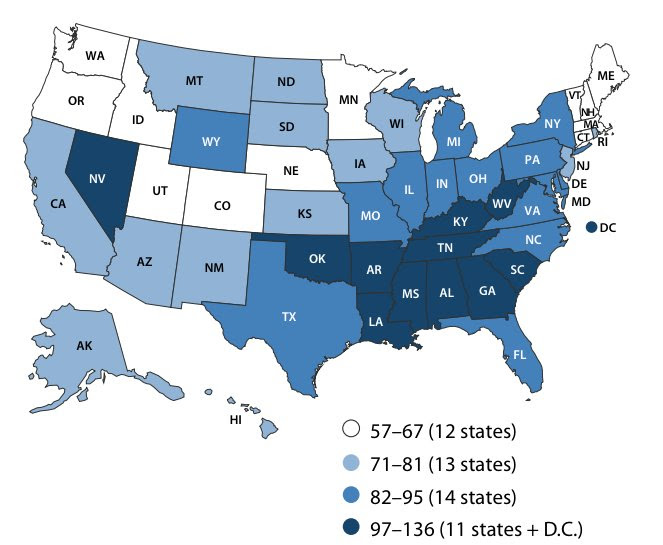
The map below from the Commonwealth Fund shows the stark divide. States with the worst overall health care systems -- as measured by factors like the number of insured adults and children, avoidable emergency room visits and access to affordable care -- are dark blue. States with better health-care systems are white.

map 1

When it comes to things like health care access, quality and cost, certain states can be as much as eight times better than others, the report found.

“We continue to see this very wide geographic spread,” said Commonwealth Fund senior vice president Cathy Schoen, a coauthor of the report. Millions of lives could be saved if the low-performing states could close just half the gap with the top states, Schoen said. "We really need to stay focused on aiming higher.”

Many of the lower-performing states have higher rates of early deaths that could have been prevented by access to quality health care. The Commonwealth map below shows the number of avoidable deaths per 100,000 in each state.

map 2

Many of the worst states for health care have several things in common. They’re mostly in the South and are more likely to be among the poorest in the nation. Many of them have long had unusually tight standards for applicants to qualify for Medicaid, said Schoen, and many have been slow to expand children’s health insurance.

What's more, 16 of the 26 states at the bottom of the Commonwealth Fund’s scorecard aren’t expanding Medicaid under the Affordable Care Act, also known as Obamacare.

map

The states in grey aren't expanding Medicaid. Many of these are also states in which overall health systems are worse.

One of Obamacare’s major tools for giving the poor better access to health care is expanding Medicaid to those making 133 percent of the federal poverty limit -- about $15,521 for a single person -- or less.

But the Supreme Court ruled in 2012 that states could opt out of joining the Medicaid expansion and the extra federal money that came with it. Many states with Republican governors or majority Republican legislators have done just that, leaving millions of their residents out of the national effort to cover the uninsured.

Increasing access to Medicaid isn't a cure-all for low-performing states, and improving health care outcomes overall will require more than just expanding Medicaid. But it could help, Schoen said. For one, it will extend health coverage to more people, making it less likely that poor patients will head to the emergency room for things other than emergencies. And if more low-income residents can pay for health care, more doctors might be convinced to move to poor or rural areas.

"The states that stay out could fail to improve, or fail to improve as fast as other states that choose to participate,” Schoen said. “In some of these states, staying where you are is not very good performance.”

Black Americans are likely to suffer disproportionately from these policies. More than two-thirds of poor, uninsured blacks live in states not expanding Medicaid, according to a December 2013 New York Times report. Already, the rate of avoidable early deaths among blacks is twice as high as among whites in many states, Commonwealth found. That gap is even wider in states with higher early death rates overall.

chart 3

The difference in avoidable death rates in white and black populations in different states.

Still, there is some hope: Kentucky, Arkansas and Nevada, which all rank in the bottom quarter of the Commonwealth Fund's scorecard, are expanding Medicaid. That could help them catch up.

"You could see a few states start to improve quickly," Schoen said.

Sunday, February 2, 2014

Preaching 'personal responsibility' to African-Americans

With the audacity of hope, I encourage you -- and my conservative friends especially -- to read Coates's article about how African-Americans struggle to relate to President Obama as "The Man" and his calls for blacks to exercise personal responsibility. Try to understand in particular the last three sentences quoted here [emphasis mine]:

"I am not raising 'nothing niggers," my mother used to tell me. "I am not raising niggers to stand on the corner." My mother did not know her father. In my life, I've loved four women. One of them did not know her father and two, very often, wished they didn't. It's not very hard to look at that, and seethe. It's not very hard to look at that and see a surrender, while you are out here at war, and seethe. It's not hard to look around at your community and feel that you are afflicted by quitters, that your family—in particular—is afflicted by a weakness. And so great is this weakness that the experience of black fatherlessness can connect Barack Obama in Hawaii to young black boys on the South Side, and that fact—whatever the charts, graphs, and histories may show—is bracing. When Barack Obama steps into a room and attacks people for presumably using poverty or bigotry as an excuse to not parent, he is channeling a feeling deep in the heart of all black people, a frustration, a rage at ourselves for letting this happen, for allowing our community to descend into the basement of America, and dwell there seemingly forever. 

My mother's admonishings had their place. God forbid I ever embarrass her. God forbid I be like my grandfather, like the fathers of my friends and girlfriends and wife. God forbid I ever stand in front of these white folks and embarrass my ancestors, my people, my dead. And God forbid I ever confuse that creed, which I took from my mother, which I pass on to my son, with a wise and intelligent analysis of my community. My religion can never be science. This is the difference between navigating the world and explaining it

In other words, we should not expect to hear the lessons that we teach our children repeated back to us by our elected leaders, as if we are children.  We don't elect them to be our parents or pastors; we elect them to solve problems that we as individuals or individual communities cannot.  As for the rest of us, as a body politic, we cannot preach "personal responsibility" to each other and thereby wash our hands of our society's problems. If only it were that easy.

(And if you don't believe there are any problems that individuals or communities cannot solve by themselves, as many Tea Party conservatives say, then you should really consider not voting in federal elections at all, since basically all Washington does or can do is "meddle" in our lives.)  
  
The above applies to the socio-economic strife of blacks especially. 


By Ta-Nehisi Coates
January 31, 2014 | The Atlantic

Friday, October 4, 2013

GOP governors leave 8 million uninsured

We shouldn't be surprised.  The GOP despises poor people, especially if they're black.

Also check out this interactive map that displays the full ruthlessness of Republican states.


By Sabrina Tavernise and Robert Gebeloff
October 2, 2013 | New York Times

A sweeping national effort to extend health coverage to millions of Americans will leave out two-thirds of the poor blacks and single mothers and more than half of the low-wage workers who do not have insurance, the very kinds of people that the program was intended to help, according to an analysis of census data by The New York Times.

Because they live in states largely controlled by Republicans that have declined to participate in a vast expansion of Medicaid, the medical insurance program for the poor, they are among the eight million Americans who are impoverished, uninsured and ineligible for help. The federal government will pay for the expansion through 2016 and no less than 90 percent of costs in later years.

[...]

The 26 states that have rejected the Medicaid expansion are home to about half of the country’s population, but about 68 percent of poor, uninsured blacks and single mothers. About 60 percent of the country’s uninsured working poor are in those states. Among those excluded are about 435,000 cashiers, 341,000 cooks and 253,000 nurses’ aides.

“The irony is that these states that are rejecting Medicaid expansion — many of them Southern — are the very places where the concentration of poverty and lack of health insurance are the most acute,” said Dr. H. Jack Geiger, a founder of the community health center model. “It is their populations that have the highest burden of illness and costs to the entire health care system.”

The disproportionate impact on poor blacks introduces the prickly issue of race into the already politically charged atmosphere around the health care law. Race was rarely, if ever, mentioned in the state-level debates about the Medicaid expansion. But the issue courses just below the surface, civil rights leaders say, pointing to the pattern of exclusion.

Every state in the Deep South, with the exception of Arkansas, has rejected the expansion. Opponents of the expansion say they are against it on exclusively economic grounds, and that the demographics of the South — with its large share of poor blacks — make it easy to say race is an issue when it is not.

[...]

Thursday, August 22, 2013

Racial media parity?

In an "ah-ha!" tone, my Republican agents have been feeding me recent news stories about the Australian white guy murdered, and the Oklahoma white guy murdered, both by "racists." Even though there is no indication these were racially motivated crimes.

Then we have FOX rushing to the scene, asking if the media coverage of the Oklahoma murder of Christopher Lane compares to the media coverage of the murder of Trayvon Martin.

None of this makes rational sense to me, I'm sorry.  I'm not being partisan here; this is just dumb.

It seems that we've moved on from insisting on some kind of "objective" left-right balance in news coverage of events, to insisting that we establish a black-white balance of media coverage of crime.

Why is this utterly pointless and stupid?

First, because you and I don't control the media.  But of course FOX and talk radio know that.  They play up the black-on-white crime, then accuse the "liberal" media of downplaying it.  Do I have to explain how self-serving and slanted that is?

Second, because so many thousands of murders escape the national media. We had more than 11,000 firearm homicides and more than 16,000 total homicides in the U.S. in 2012.  How many of them can you recall hearing about on the evening news or talk radio?  Exactly.

Third, these stories on FOX, the Blaze, etc. always mention Trayvon Martin, as in, "The media was so obsessed with Trayvon Martin... but they ignore THIS?!"  

First, refer to point #1.  Second, I challenge you to show me the black George Zimmerman. That's right, show me the case of the black man who murdered an unarmed white man and claimed it was in self-defense, despite police dispatchers telling the black man to leave that white man alone. Then the black man is set free, despite no contest that he shot and killed that white man, a white man who never bothered him or sought him out.

Yes, please, send me the link to that story, my Republican friends.  I can't wait to read all about it.

But until then, please do me a favor and shut up about race.

And fourth, most black crime is black-on-black.  That's a tragedy. Just like all crime is a tragedy. But what the hell does this have to do with the media or political correctness?

White people, stop pretending whites are an aggrieved minority and not an entitled majority who hold the keys to everything valuable in American life. Whining is un-American.

None of you whining whities would trade places with a black or Hispanic American for a minute, and that's all you need to know about race relations in the U.S.  

UPDATE (08.23.2013): OMG, this is so outrageously dumb: "A dead Australian is just the price you pay to be politically correct."  Yep, FOX's Greg Gutfeld said it.  

Oh no, I'd better stop being so liberal and PC, or else piles of dead Australians are going to start washing up on U.S. shores!....

Wednesday, July 31, 2013

AP: Poor white people

Uh-oh!  In America, "uppity" blacks feeling more confident + poor, dispirited whites =  trouble.


By Hope Yen
July 29, 2013 | AP

Four out of 5 U.S. adults struggle with joblessness, near poverty or reliance on welfare for at least parts of their lives, a sign of deteriorating economic security and an elusive American dream.

Survey data exclusive to The Associated Press points to an increasingly globalized U.S. economy, the widening gap between rich and poor and loss of good-paying manufacturing jobs as reasons for the trend.

The findings come as President Barack Obama tries to renew his administration's emphasis on the economy, saying in recent speeches that his highest priority is to "rebuild ladders of opportunity" and reverse income inequality.

Hardship is particularly on the rise among whites, based on several measures. Pessimism among that racial group about their families' economic futures has climbed to the highest point since at least 1987. In the most recent AP-GfK poll, 63 percent of whites called the economy "poor."

"I think it's going to get worse," said Irene Salyers, 52, of Buchanan County, Va., a declining coal region in Appalachia. Married and divorced three times, Salyers now helps run a fruit and vegetable stand with her boyfriend, but it doesn't generate much income. They live mostly off government disability checks.

"If you do try to go apply for a job, they're not hiring people, and they're not paying that much to even go to work," she said. Children, she said, have "nothing better to do than to get on drugs."

While racial and ethnic minorities are more likely to live in poverty, race disparities in the poverty rate have narrowed substantially since the 1970s, census data show. Economic insecurity among whites also is more pervasive than is shown in government data, engulfing more than 76 percent of white adults by the time they turn 60, according to a new economic gauge being published next year by the Oxford University Press.

The gauge defines "economic insecurity" as experiencing unemployment at some point in their working lives, or a year or more of reliance on government aid such as food stamps or income below 150 percent of the poverty line. Measured across all races, the risk of economic insecurity rises to 79 percent.

"It's time that America comes to understand that many of the nation's biggest disparities, from education and life expectancy to poverty, are increasingly due to economic class position," said William Julius Wilson, a Harvard professor who specializes in race and poverty.

He noted that despite continuing economic difficulties, minorities have more optimism about the future after Obama's election, while struggling whites do not.

"There is the real possibility that white alienation will increase if steps are not taken to highlight and address inequality on a broad front," Wilson said.
___

Sometimes termed "the invisible poor" by demographers, lower-income whites are generally dispersed in suburbs as well as small rural towns, where more than 60 percent of the poor are white. Concentrated in Appalachia in the East, they are also numerous in the industrial Midwest and spread across America's heartland, from Missouri, Arkansas and Oklahoma up through the Great Plains.

More than 19 million whites fall below the poverty line of $23,021 for a family of four, accounting for more than 41 percent of the nation's destitute, nearly double the number of poor blacks.

Still, while census figures provide an official measure of poverty, they're only a temporary snapshot. The numbers don't capture the makeup of those who cycle in and out of poverty at different points in their lives. They may be suburbanites, for example, or the working poor or the laid off.

In 2011 that snapshot showed 12.6 percent of adults in their prime working-age years of 25-60 lived in poverty. But measured in terms of a person's lifetime risk, a much higher number — 4 in 10 adults — falls into poverty for at least a year of their lives.

The risks of poverty also have been increasing in recent decades, particularly among people ages 35-55, coinciding with widening income inequality. For instance, people ages 35-45 had a 17 percent risk of encountering poverty during the 1969-1989 time period; that risk increased to 23 percent during the 1989-2009 period. For those ages 45-55, the risk of poverty jumped from 11.8 percent to 17.7 percent.

By race, nonwhites still have a higher risk of being economically insecure, at 90 percent. But compared with the official poverty rate, some of the biggest jumps under the newer measure are among whites, with more than 76 percent enduring periods of joblessness, life on welfare or near-poverty.

By 2030, based on the current trend of widening income inequality, close to 85 percent of all working-age adults in the U.S. will experience bouts of economic insecurity.

"Poverty is no longer an issue of 'them', it's an issue of 'us'," says Mark Rank, a professor at Washington University in St. Louis who calculated the numbers. "Only when poverty is thought of as a mainstream event, rather than a fringe experience that just affects blacks and Hispanics, can we really begin to build broader support for programs that lift people in need."

Rank's analysis is supplemented with figures provided by Tom Hirschl, a professor at Cornell University; John Iceland, a sociology professor at Penn State University; the University of New Hampshire's Carsey Institute; the Census Bureau; and the Population Reference Bureau.

Among the findings:

— For the first time since 1975, the number of white single-mother households who were living in poverty with children surpassed or equaled black ones in the past decade, spurred by job losses and faster rates of out-of-wedlock births among whites. White single-mother families in poverty stood at nearly 1.5 million in 2011, comparable to the number for blacks. Hispanic single-mother families in poverty trailed at 1.2 million.

— The share of children living in high-poverty neighborhoods — those with poverty rates of 30 percent or more — has increased to 1 in 10, putting them at higher risk of teen pregnancy or dropping out of school. Non-Hispanic whites accounted for 17 percent of the child population in such neighborhoods, up from 13 percent in 2000, even though the overall proportion of white children in the U.S. has been declining.

The share of black children in high-poverty neighborhoods dropped sharply, from 43 percent to 37 percent, while the share of Latino children ticked higher, from 38 to 39 percent.
___

Going back to the 1980s, never have whites been so pessimistic about their futures, according to the General Social Survey, which is conducted by NORC at the University of Chicago. Just 45 percent say their family will have a good chance of improving their economic position based on the way things are in America.

The divide is especially evident among those whites who self-identify as working class: 49 percent say they think their children will do better than them, compared with 67 percent of non-whites who consider themselves working class.

In November, Obama won the votes of just 36 percent of those noncollege whites, the worst performance of any Democratic nominee among that group since 1984.

Some Democratic analysts have urged renewed efforts to bring working-class whites into the political fold, calling them a potential "decisive swing voter group" if minority and youth turnout level off in future elections.

"They don't trust big government, but it doesn't mean they want no government," says Republican pollster Ed Goeas, who agrees that working-class whites will remain an important electoral group. "They feel that politicians are giving attention to other people and not them."

Wednesday, July 24, 2013

Cornel West: Obama's racism speech hypocritical, too late

Brother West was having none of President Obama's bland and measured post-post-trial statement on the "not guilty" verdict of George Zimmerman, the killer of Trayvon Martin:  

I think we have to recognize that [President Obama] has been able to hide and conceal that criminalizing of the black poor as what I call the re-niggerizing of the black professional class. You’ve got these black leaders on the Obama plantation, won’t say a criminal word about the master in the big house, will only try to tame the field folk so that they’re not critical of the master in the big house. That’s why I think even Brother Sharpton is going to be in trouble. Why? Because he has unleashed—and I agree with him—the rage. And the rage is always on the road to self-determination. But the rage is going to hit up against a stone wall. Why? Because Obama and Holder, will they come through at the federal level for Trayvon Martin? We hope so. Don’t hold your breath. And when they don’t, they’re going to have to somehow contain that rage. And in containing that rage, there’s going to be many people who say, "No, we see, this president is not serious about the criminalizing of poor people." We’ve got a black leadership that is deferential to Obama, that is subservient to Obama, and that’s what niggerizing is. You keep folks so scared. You keep folks so intimidated. You can give them money, access, but they’re still scared. And as long as you’re scared, you’re on the plantation.

Most liberal and moderate pundits gave Obama high marks for his unprepared remarks last week about being a black man in America.  Nevertheless, it's kind of pathetic that we need our President to interpret the African-American experience for us.  If you're black, you already know about it. If you're white, and you don't acknowledge your own prejudices, then you're kidding yourself and lying to everybody else.  So who was Obama addressing, the history books?


Interview with Amy Goodman
July 22, 2013 | Democracy Now!

Thursday, June 27, 2013

Voting Rights ruling was 'legislating from the bench'

I don't often comment on Supreme Court decisions because they are so blatantly political to me, albeit dressed up in pomp and black robes as something serious, deliberative and solomonic.  As my Uncle T., a lawyer and dyed-in-the-wool conservative, once told me, he can't see much that's legal or constitutional in the way the Supreme Court operates.  I tend to agree with him.  

It's because they are all utterly political appointees, justices whom the appointing President thinks he can rely on to interpret the Constitution with a particular ideological bent, the facts be damned.  Most of the time the Supreme Court's majority can't wait for certain controversial cases to hit their docket so that they can affect the political direction of our country.

That said, I think the SCOTUS went way too far on Tuesday by striking down Section 4 of the 1965 Voting Rights Act.  This time they clearly usurped the powers of Congress.

The power of Congress vested in them by the Constitution is not the power to be right, it's the power to be wrong. One can argue that Congress was wrong to overwhelmingly uphold the Voting Rights Act "coverage formula" in 2006, but then it was wrong with serious bipartisan conviction: 390-33 in the House and 98-0 in the Senate.  Congress provided 15,000 pages of documentation in 2006 to show that voter discrimination was still happening in the jurisdictions that the coverage formula designated for pre-clearance.

This week the U.S. Supreme Court said to hell with that.  The high court majority went beyond the Constitution to examine what it felt were facts on the ground that made the law unnecessary.  I'm sorry, but that's not the high court's job.  We have lots of unnecessary and stupid laws.  That's Congress's prerogative to make them; it's our job every 2 years to vote out the bums to replace or repeal them.  What the "anti-activist judges" majority did on Tuesday was to "legislate from the bench," pure and simple.  In doing so they are were not only hyper-partisan, they werehypocrites against their own judicial philosophy!

Even so, those facts on the ground are debatable, even without study, therefore the SCOTUS should not have so cavalierly struck down a law passed by Congress. What do I mean, without study?  Well, the majority said that the Voting Rights Act has clearly achieved its goal, therefore it was no longer needed. Yet one could argue that without it, racial discrimination against minority voters could easily spring up again.  This possibility is certainly imaginable, and certainly not possible to exclude, logically, yet the Supreme Court majority did just that and excluded it.  "We know everything's going to be fine from now on," they basically said.  

Also, Chief Justice Roberts said the SCOTUS "warned" Congress in 2009 to update the formula by which it determines a history of voter discrimination, and that with case of Shelby County [Alabama] v. Holder hitting the court's docket in 2013 without any action by Congress, the high court had no choice but to strike down the law.  But think about that for a second.  We have an historically gridlocked Congress and Republican majority that wants the Voting Rights Act to remain struck down... but wasn't dumb enough, politically, to offer up a bill to do so.  

Now surely the Republican House will not offer up a new bill now to update the pre-clearance formula that would require the DOJ's approval for any changes in state's voting laws.  (If you think they will, the Supreme Court needs to ban that medical marijuana you're smoking).  And the GOP majority's inevitable inaction in the coming weeks/months -- I would love it if they proved me wrong -- will prove just how absurd was Justice Roberts' utterly political premise for usurping the will of Congress in 2006 that was the law of the land.  

Furthermore, the majority cited states' rights (federalism) as its main justification for striking down the will of Congress.  However, Section 4 of the Voting Rights Act allows individual counties in affected states to "bail out" of the law if they can prove there is no recent history of racial discrimination against voters, as dozens of counties have since 1967.    

All that constitutional stuff aside, I agree with Dr. Martin Luther King that the arc of history bends toward justice... and obviously I agree with the U.S. Census that the arc of demography bends towards a non-white U.S. majority.  Politically, in the long run, this conservative SCOTUS decision -- and the inevitable inaction from a GOP-majority House that will follow it -- will be good for Democrats.  

I predict that this SCOTUS decision and Congress's almost certain failure to respond, combined with Republicans' likely continued inaction on immigration reform, will spur minority turnout rates in 2014 that will exceed 2012.  Republicans are showing once again they just can't get out of their rut... as they shoot themselves in the foot that's stuck in that rut.  

Wednesday, June 19, 2013

Racist joke shows whites' real beef with 'welfare'

Pardon me for forwarding the ugly "joke" below that was forwarded to me by an old Tea Partyer, but it's a clear admission by white conservatives what their real beef is with "welfare" and a teachable moment for the rest of us: they really believe these federal programs are deliberate wealth redistribution from hardworking whites to lazy blacks.  (Or to "lazy brown-skinned people who speak gibberish, hate work and wipe their asses with American flags," to quote a true genius.)

In his recent op-ed "Why white America thinks ‘too much welfare’ is a black thing," Dr. Jason Johnson sums it up pretty well:

First, most social science research shows that to white Americans welfare automatically conjures up images of lazy promiscuous black women in the inner city, popping out babies like rabbits and turning government cheese vouchers into gold chains and plasma screen televisions.

Consequently for many Americans any question about welfare and the economy is really a question about race. This is not new, but in fact a longstanding narrative in American politics where during times of economic stress business and political elites have ‘protected’ the majority of whites from swallowing the harsh realities of American economics with a sugary dose of racial distraction.

The actual facts about welfare have always been pretty clear; whites and children are the greatest recipients and beneficiaries of various programs, but that’s not good fodder for talk radio.  From the beginning of government sponsored welfare programs, discriminatory policies were enacted to keep blacks off the rolls (like excluding farm workers and domestics in the 1950’s) and even once those policies were removed media and politicians, especially on the right, insisted on maintaining the myth that the face of poverty in America was a black thing.

In fact the racist joke below was told by Arkansas Tea Party leader Inge Marler at at an Ozark Tea Party rally in June 2012, although perhaps it's been around even longer.  The TP crowd loved it.  


From:
To:
Subject: Fw: Racism Explained
Date: Tue, 18 Jun 2013 19:15:53 -0400
Subject: Racism Explained
RACISM EXPLAINED

A black kid asks his mother, "Mama, what's a Democracy?" 

"Well, son, that's when white folks work every day so we can get all our benefits, you knows, like free cell phones, rent subsidy, food stamps, welfare, school breakfasts and lunches, free healthcare, utility subsidy, & the list goes on & on, you knows."

"But mama, don't the white people get pissed off about all that?

"Sure they do, son, and that's called racism."