Tuesday, December 3, 2013

U.S. is off the chart on health care

Wow.  The best health care system in the world, huh?  That's exactly what it is, according to Sen. Mitch McConnell and Speaker John Boehner!


By Matthew O'Brien
November 22, 2013 | The Atlantic

We are an exceptional nation. At least when it comes to healthcare spending.

We spend much more than any other rich country, but we certainly don't get more for it. We get less. We get about the same health outcomes, but don't cover everybody like other rich countries do. Now, there are a lot of statistics that show how singularly wasteful our healthcare system is, but the chart below, via Aaron Carroll, is maybe the most visually arresting. It compares life expectancies with healthcare spending per capita for rich and near-rich countries. There's a pretty predictable relationship, with diminishing returns for more spending—and then there's the U.S.

See that dot that's almost off the chart? We spend more than four times as much as the Czech Republic does per persona, and live about just as long.


The problem is everybody wants the system to change, but nobody wants their corner of it to change. Doctors don't want their pay to change. And patients don't want their coverage to change. Obamacare tries to change both at the margins, and even that is politically fraught.

Monday, December 2, 2013

Frum: Fate of Europe at stake in Ukraine

I realize that the most important thing in the world right now to Americans is a government website that doesn't work right, but... David Frum is right: a superpower needs a super attention span, and we must urgently turn our attention now to Ukraine, where the future of Europe and a potentially democratic Russia is being decided.  That's the better part of the world.


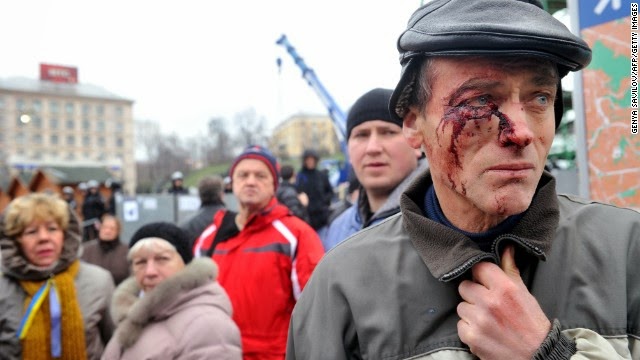
Maidan Nezalezhnosti in Kyiv, Ukraine: pro-EU protests.

By David Frum
December 2, 2013 | CNN

A superpower needs a super attention span. Unfortunately, Americans seem to take little interest in the troubles of the world around them, even when those troubles threaten soon to vex Americans themselves.

Americans fought two world wars -- and faced nuclear annihilation in a protracted Cold War -- to defend the freedom of Europe. In the thrilling days of 1989-91, four generations of American sacrifice were magnificently vindicated. The communist regimes of central Europe collapsed. The Soviet Union itself broke apart into smaller and less threatening pieces.

For four centuries, the rulers of Russia had sought security for themselves by dominating first their own people, then their neighbors, then their neighbors' neighbors, then their neighbors' neighbors' neighbors ... until their power extended from Berlin to the Pacific Ocean.

Then, abruptly, that imperial project broke apart. Subject nations regained their freedom. The Russians themselves gained a new opportunity -- perhaps the first in their national existence -- to choose a government that served its people.

The former rulers, unfortunately, had other ideas. Democracy did not take root in Russia after 1991. How and why it failed is a long story, with many villains, but let's cut to the end result: A former top officer of the KGB maneuvered his way into the Russian presidency in 1999-2000. Vladimir Putin restored to power the old secret police apparatus.

Since then, Putin and his coterie have attempted to reconstitute as much of the old Soviet Union as they could, while plundering Russia's wealth for themselves.

One step to that reconstitution of the Soviet Union was absolutely indispensable: Reasserting Moscow's power over Ukraine.

No nation suffered more from Soviet communism than the Ukrainians. Ukrainian farmers lost their lands and homes to Soviet collectivization in the 1920s; millions died in the man-made famine that followed in the 1930s. Their language and culture were stunted under Moscow rule; their intellectuals and writers were suppressed, banished, murdered, and defamed. In 1991, Ukrainians seized their chance to build a country of their own.

Ukrainian independence liberated not only the Ukrainian people, but all Europe. Russia without the nearly 46 million people and vast natural resources of the Ukraine is a large and powerful country, but it is no superpower.

Since Putin's entry into power, Russia minus Ukraine has sought to influence and corrupt the democracies of Europe. A Russia that reintegrated Ukraine would possess the power -- like the Soviet Union of old -- to intimidate and bully democratic Europe. Russia minus Ukraine can aspire to become a normal nation state, a democracy, even a liberal democracy. A Russia that holds Ukraine by force must forever be a militarized authoritarian regime, a menace to its own people as much as to the rest of the European continent and the democratic world.

Upholding Ukrainian independence is thus a deep concern, not only to the Ukrainians, but to all the free countries of Europe -- and thus to the United States, free-Europe's security and trading partner.

Vladimir Putin understands all this too, and he doesn't like any of it. Since he came to power, he's worked to undermine and subvert Ukrainian independence. He has been successful. Ukraine imports its oil and natural gas from Russia, and Putin has used energy dependency to sway Ukrainian politics and bribe Ukraine's dauntingly corrupt leaders.

But every once in a while, Putin goes too far. He went too far in 2004, collaborating with Ukrainian former communists to rig a presidential election. Blatant fraud inspired Ukraine's famous "Orange Revolution" -- and a temporary swing in Ukraine's political orientation to the West.

Now Putin is trying again -- and again he is meeting massive resistance in the Ukrainian streets. Over the past years, the European Union negotiated a trade pact with Ukraine. The pact would enrich ordinary Ukrainians, today the third poorest people in Europe, after the Kosovars and Moldovans. The pact would lessen Ukraine's economic dependence on Russia -- and prepare the way for Ukraine's own eventual membership in the EU.

Under extreme Russian pressure, the Ukrainian president -- the very same man whose election fraud triggered the Orange Revolution nine years ago -- has repudiated his own treaty, and his country's best hopes.

Tens of thousands of protesters have filled the streets and squares of the capital, Kiev, two weekends in a row. Police have suppressed the protests brutally, injuring many people. The regime's controlled courts have banned any further public demonstrations until January.

German Chancellor Angela Merkel expressed disappointment in muted tones after a November 28 summit with the Ukrainian leadership: "Unfortunately not all expectations have been fulfilled. We will make very clear here that the EU is ready to accept Ukraine as an associate member, to sign the association treaty. Then we will see. We have no hope that it will happen this time, but the door is open."

Don't be fooled by the muted words, however. What's at stake in the streets of Kiev is the future of the European continent -- and American prosperity and security. An inward-looking America is averting its attention from its own most important interests and highest ideals.

Sunday, December 1, 2013

What is a 'U.S.' corporation and why it matters

I stumbled upon this old article below but it's still fresh and new. You should read the whole thing, but this part jumps out at me [emphasis mine]:

Other countries see themselves as countries, and compete with us as a country, for their benefit and the benefit of their peopleAs much as some of us might want a world in which we all cooperate and share and have "free trade" and other ideals and dreams, the fact is that other countries understand themselves as countries. Companies and industries located in other countries are operated to benefit their people. Their governments give them special benefits to help them compete with our companies. And then they are taxed so their country can have good schools and infrastructure and all the rest of the benefits of the modern world, for them.

And if we do not respond in kind, then their people end up better off at the expense of our people.

Anybody who's taken Econ 101 or Political Economy has surely learned that protectionism is bad; it leads to higher prices for consumers, can often escalate to beggar-thy-neighbor policies, etc. This is the economic theory, and it's sound as far as it goes. But it is not political-economic reality. 

When every other country -- including China -- is looking out for its own corporations' best interests while we preach "free trade," it is tantamount to America's unilateral disarmament.  

Moreover, in the history of the modern world there has never been free trade.  As an ideal, free trade is about as realistic as communist utopia.  In a few hundred years, yes, when we're all wearing Star Trek-style unitards that come in three colors and speaking Esperanto, then maybe we will have free trade. But before then we will probably have invented a better economic system than capitalism. So free trade is a silly ideal. The best we can hope for is freer trade, mostly achieved on a bilateral basis, with friendly countries that we trust.

Nor can we look at trade in isolation. Yes, Americans pay very cheap prices, compared to other countries, for goods like flat screen TVs and automobiles. However, fewer and fewer Americans these days have jobs or sufficient income to pay even these "reduced" prices that are thanks to "free trade." Yet many working-class Americans have lost their manufacturing jobs because of free trade and globalization. So what good are cheaper goods if they are still not affordable for the un- and underemployed?  

And there is more to global trade -- and the economics that drives it -- than tariffs.  For instance, taxes.  Most people don't realize that about one-third of global trade is intra-company trade, i.e. trade in intermediate goods between parts of the same company. There is also inter-company trade, i.e. trade between two or more internal business entities that results in a legal transfer of prices. 

To make things even more complicated, there is also trade in financial products between internal entities of one company, or related entities (with the same beneficial owner), such as inter-company loans.

This year, the conservative publication Forbes estimated that 95 percent of America's trade deficit comes from intra-company trade; and much of this intra-firm trade is designed precisely to avoid and evade taxes, that's its only purpose. And so instead of discussing ideal concepts like free trade, we ought to be discussing real things like "arm's-length transfer pricing."  

There are positive signs of change in the G20 countries and the OECD, however. With most of the world in recession, fiscally ailing national governments everywhere are trying to prevent tax base erosion and profit shifting (BEPS). They realize that many multinational corporations (MNCs) are playing a shell game with their operations, sales, and tax declarations to lower their overall (global) tax bill. Such tax shenanigans are corporations' "responsibility" in order to maximize returns for their shareholders, say business groups, economists and the financial press. They say "double taxation" of their firms in different countries is unfair and economically inefficient. 

(Conspicuously, U.S. businesses say little about their moral, patriotic obligations to the USA, where their corporate HQ are located. Thus companies like Google and Apple may call themselves "American" -- falsely so, in my view -- although any Middle Eastern sheikh may own their stock; and meanwhile they pay most of their taxes in places like Ireland and employ most of their workers overseas).

At the same time, it is governments' responsibility to maximize tax receipts to provide for the welfare of their citizens; and governments argue that "double non-taxation" is just as economically inefficient and harmful. It is in governments' collective interest to stop a global "race to the bottom" where MNCs are registered for tax purposes in tiny havens like the Caymans, Bahamas and Ireland.  

And governments require tax revenues to re-train workers who lost their jobs to overseas low-cost competition, through programs like U.S. Trade Adjustment Assistance.

Keep alert and informed as events unfold, because the global debate on BEPS -- and the inevitable push-back from international Big Business lobbies -- is only going to get more intense....


By Dave Johnson
April 26, 2013 | Crooks and Liars

What does it mean to be an American? What does it mean to be an American corporation? An article in the Wall Street Journal the other day should trigger questions like these.


Multinational companies based in the U.S. boosted their global work forces in 2011 almost entirely by hiring workers overseas, underscoring the slow growth in the U.S. job market.

... The paltry hiring at home reflects where multinational companies are focusing their attention. Stronger economic growth in overseas markets in Asia and Latin America is driving their expansion, reinforcing their shift toward cheaper labor or closer access to customers.

The U.S. parents of multinational firms account for about one-fifth of total private U.S. employment. Since 1999, employment by U.S. multinationals is down by 1.1 million inside the U.S., while it is up by 3.8 million overseas.

The hiring by American companies is not happening in the U.S. At the same time these companies are holding $1.7 trillion of profits outside of the country, away from their own shareholders and our economy to avoid their taxes, while pushing to dramatically lower the taxes they pay us – and even to get out of paying any taxes at all on money they make outside of the country!

Why Do We Have Corporations?

Why do We the People even have laws that allow corporations and give them special benefits? The answer obviously is for our common benefit -- why else would we do it? The corporate form of a business enables the company to easily obtain capital from investors, in order to accomplish large-scale projects that benefit us. To encourage this we give these entities special privileges. For example, we limit liability which means the investors are not held liable for the actions of the company – they won't lose more than their investment if the company gets sued for some reason. We provide a system that helps them obtain financing, insurance, market liquidity and all kinds of things to help those investors get a good return on their money.

Benefit: We the People want railroads, but it takes a lot of money to build and operate a railroad. And our system wants private companies to do the work of building and operating railroads instead us just doing it ourselves. So we set up a way for a private company to gather investment from lots of people.

Why Do We Want "American" Corporations?

Why don't we just contract with any old corporation that comes along to get things done for us? Who cares what country these entities are from? Why should we as a country want to encourage and support our American corporations? Because American corporations make money for us. That is the whole point.

Other countries see themselves as countries, and compete with us as a country, for their benefit and the benefit of their people. As much as some of us might want a world in which we all cooperate and share and have "free trade" and other ideals and dreams, the fact is that other countries understand themselves as countries. Companies and industries located in other countries are operated to benefit their people. Their governments give them special benefits to help them compete with our companies. And then they are taxed so their country can have good schools and infrastructure and all the rest of the benefits of the modern world, for them.

And if we do not respond in kind, then their people end up better off at the expense of our people.

As long as other countries operate for the benefit of their people, it is our job to keep up our end of the bargain as it exists and operate as a country for the benefit of our people. This means that we support our companies, and expect them to bring the money they make back here, and share the returns with us.

We The People Used To Understand Who Is The Boss

We the People (used to) understand that these companies exist for our common benefit and (used to) expect certain things back from these corporations. We (used to) expect them to provide high-quality products and services and not engage in fraud and trickery. We (used to) expect them to provide a safe and fair work environment with good wages and benefits. We (used to) expect them to be good citizens that benefit the communities where they operate. And our laws and enforcement (used to) make sure they operated that way – for our common benefit.

These understandings and expectations have disappeared. An Apple executive articulated the new corporate understanding to The New York Times. He said giant multinationals like Apple "don't have an obligation to solve America's problems." And to prove it, American corporations are holding $1.7 trillion in profits outside the country – just sitting there – rather than bringing that money home, paying the taxes due and then paying it out to shareholders or using it to "create jobs" with new factories, research facilities and equipment.

We The People Have Forgotten

Citizens, elected officials and corporate management have forgotten why we have corporations and who they are supposed to serve. We have instead developed a system in which corporations exist for their own sake, doing anything they want to do, and doing these things only to enrich the few who own and manage them.

There is no longer an understanding and expectation that these entities – creations entirely of We, the People -- are supposed to exist for the common good of We, the People. They no longer try to provide high-quality goods and services. They no longer feel they must avoid fraud and trickery – and without enforcement of rules are able to gain advantage over others that do not operate this way. They no longer provide a safe and fair work environment with good wages and benefits. They are not good citizens that benefit the communities and country where they operate.

They are no longer under the control of We the People.

Are American Multinationals Really American?

For all intents and purposes giant "American" multinational corporations have transformed into entities with completely different interests from their American workers, customers, communities, citizens and government. These corporations are no longer operating in the interest of America or any country, while claiming the benefits of being American corporations (when it suits them.)

For example, the giant American multinational corporations are now set up and structured to avoid paying taxes here, or to any country. They set countries against each other in their hunt for low-wage labor, subsidies and advantages in markets.

Some companies are even "American" when it suits them, and not "American" when it does not. The post, Unraveling The Romney/Bain Tax Story drew on a New York Times report, Offshore Tactics Helped Increase Romneys’ Wealth. From the post:

Why is part of the same company set up based in Delaware, and part in the Cayman Islands or Luxemburg or Bermuda? Because the functions of the American-based company are those functions that avoid taxes on foreign entities, and the functions of the Caymans-based part are the functions that would have to pay US taxes if it was in the US. But in reality it is the same company -- except for tax purposes! Here is the explanation of the foreign-based parts, from the Times article:

Had those funds been set up in the United States, the Romneys and other American investors would probably have been subject to certain federal taxes for their ownership of “controlled foreign corporations.” Setting up the funds in the Caymans allowed them to avoid those taxes.

Here is an explanation of the American-based parts,

Another appeal of offshore funds is that they help private equity attract investment from deep-pocketed big institutions like pension funds and university endowments. While these are generally tax-exempt, they are liable for taxes on “unrelated business taxable income” if they put money in funds that use debt financing to make investments.

So why aren't they all just foreign-based? Why do they need to have an American-based part? One reason is that making the loans that run up the debt that enables these companies to get the interest deductions (more tax avoidance) would incur income taxes if the loans came from a foreign entity,

Beyond their tax advantages, however, offshore funds controlled by American money managers can also create new tax problems. Those funds are limited in their ability to make loans without triggering corporate income taxes — an issue for Sankaty funds. Therefore, they usually have a parallel domestic fund that makes the loans, holds them for a period before selling a portion to the offshore fund, a practice known as “season and sell.”

And, of course, the American-based entities enable the low "carried interest" tax rate that hedge fund managers enjoy. The company paying Romney can't be foreign-based,

So-called carried interest, the cut of a fund’s investment gains earned by its managers, enjoys a favorable tax treatment. But under I.R.S. rules, carried interest cannot be derived from a corporation, like the offshore blockers used by Sankaty.

The American-based entities can buy American companies without incurring "foreign-based" obligations. Then the foreign-based entities can avoid the taxes that the American-based buyers of companies would have to pay. And the foreign-based investors can be in the foreign-based parts of the company, avoiding US tax obligations. Also American entities like pension funds can avoid US taxes they would otherwise have to pay.

To put it another way, the same company can pretend it is US-based when that is what it needs to be, and foreign-based when that is what it needs to be.

What Can We Do?

First of all, we want and need corporations, for the reasons outlines above. For our common benefit, to accomplish large-scale projects, and as a result to bring shared prosperity to our citizens.

But we have to be the boss of them. We have to understand again that We the People set up this system of corporations for our common benefit. (Why else would we set up these things?) And we have to again call ourselves a country.

Can we align the interests of these giant corporations with our national, American interest? If we cannot, they should be stripped of their American corporate privileges and be required to do the same things as other entities that are not wedded to the national interest. And then We the People can build and support American companies that are.

MB360: Americans back to spending on credit

Any economist, pundit or politician who tells you that our economy would get better if we could only increase access to credit (debt) or "incentivize" poor people to work while cutting their food stamps and the minimum wage, is either a charlatan or an idiot.

What happens when Americans, as a nation, start saving and stop spending on credit is economic stagnation or recession. So we must increase Americans' household incomes, and/or lower their household expenses to allow them to continue spending. After all, the well-off can buy only so many houses, yachts and luxury goods. Yes, they can save and invest in stocks and other securities... but their investments won't translate into U.S. jobs and economic growth if there is no market (consumer demand) to drive it. 

Indeed, the Dow just hit a record high, corporate profits and U.S. workers' productivity are at all-time highs, and yet... nobody is doing an economic endzone dance right now. Working class Americans feels more economically insecure than ever.

And that's why Obamacare is so necessary, among other federal programs.  

According to a 2013 study by the AARP, over the past 10 years, health care spending for average middle-income households increased 51 percent, compared to only 30 percent growth in household income. Over that same period, healthcare inflation increased three times the rate of growth for all other products and services; and per capita expenditure on health care increased 72 percent! 

We must cut our per capita expenditure on health care while protecting average Americans from treatable illness and medical bankruptcy. Only the Democrats are proposing real solutions to do that.  Republicans keep dawdling while Americans are dying and drowning in debt.  

Under President Obama, the rate of healthcare inflation has finally slowed and is projected to slow further. Coincidence?


Posted by mybudget360 | December 1, 2013

JFK's prophetic speech against Tea Party nihilism

[HT: Tim Dickinson at Rolling Stone]. Wow, the more things change, the more they stay the same!

Below I edited out [...] several sentences and paragraphs of JFK's final, undelivered speech, on November 22, 1963, which is mostly about Cold War nuclear preparedness, the space race, and fighting Soviet encroachment. You can read the entire text here.


[...]

This link between leadership and learning is not only essential at the community level. It is even more indispensable in world affairs. Ignorance and misinformation can handicap the progress of a city or a company, but they can, if allowed to prevail in foreign policy, handicap this country's security. In a world of complex and continuing problems, in a world full of frustrations and irritations, America's leadership must be guided by the lights of learning and reason -- or else those who confuse rhetoric with reality and the plausible with the possible will gain the popular ascendancy with their seemingly swift and simple solutions to every world problem.

There will always be dissident voices heard in the land, expressing opposition without alternative, finding fault but never favor, perceiving gloom on every side and seeking influence without responsibility. Those voices are inevitable.

But today other voices are heard in the land -- voices preaching doctrines wholly unrelated to reality, wholly unsuited to the sixties, doctrines which apparently assume that words will suffice without weapons, that vituperation is as good as victory and that peace is a sign of weakness. At a time when the national debt is steadily being reduced in terms of its burden on our economy, they see that debt as the single greatest threat to our security.  At a time when we are steadily reducing the number of Federal employees serving every thousand citizens, they fear those supposed hordes of civil servants far more than the actual hordes of opposing armies.

We cannot expect that everyone, to use the phrase of a decade ago, will "talk sense to the American people." But we can hope that fewer people will listen to nonsense. And the notion that this Nation is headed for defeat through deficit, or that strength is but a matter of slogans, is nothing but just plain nonsense.

[...]

Our foreign aid program is not growing in size, it is, on the contrary, smaller now than in previous years. It has had its weaknesses, but we have undertaken to correct them. And the proper way of treating weaknesses is to replace them with strength, not to increase those weaknesses by emasculating essential programs. Dollar for dollar, in or out of government, there is no better form of investment in our national security than our much-abused foreign aid program. We cannot afford to lose it. We can afford to maintain it. we can surely afford, for example, to do as much for our 19 needy neighbors of Latin America as the Communist bloc is sending to the island of Cuba alone.

[...]

This effort is expensive -- but it pays its own way, for freedom and for America. [...] There is no longer any doubt about the strength and skill of American science, American industry, American education, and the American free enterprise system. In short, our nation space effort represents a great gain in, and a great resource of, our national strength -- and both Texas and Texans are contributing greatly to this strength.

Finally, it should be clear by now that a nation can be no stronger abroad than she is at home. Only an America which practices what it preaches about equal rights and social justice will be respected by those whose choice affects our future. Only an America which has fully educated its citizens is fully capable of tackling the complex problems and perceiving the hidden dangers of the world in which we live. And only an America which is growing and prospering economically can sustain the worldwide defenses of freedom, while demonstrating to all concerned the opportunities of our system and society.

[...]

We, in this country, in this generation, are -- by destiny rather than by choice -- the watchmen on the walls of world freedom. We ask, therefore, that we may be worthy of our power and responsibility, that we may exercise our strength with wisdom and restraint, and that we may achieve in our time and for all time the ancient vision of "peace on earth, good will toward men." That must always be our goal, and the righteousness of our cause must always underlie our strength. For as was written long ago: "except the Lord keep the city, the watchmen waketh but in vain."