Showing posts with label federal debt. Show all posts

Thursday, July 17, 2014

Needless economic damage of the 'sequester'

Just in case you forgot how much damage the idiotic, Tea Party-inspired budget sequestration did to the U.S. economy, here's a reminder: at least $351 billion

"Less austerity in the short term would have meant more growth, less unemployment and an even faster-shrinking deficit in the long term," concludes Mark Gongloff.

We should never again allow conservative debt fetishists to impose their confusion about cause (economic downturn) and effect (rising deficits) on the rest of us.  


By Mark Gongloff
July 16, 2014 | Huffington Post

Austerity is like a bad tattoo: It's going to be with us, causing misery, for years to come.

The broad spending cuts that were the fruits of the Republican Congress' budget obsession of the past few years have already cost the U.S. economy $351 billion in lost economic activity, according to a new study by the Center for American Progress. This austerity will cost a total of $633 billion by the year 2020, according to the study. Here's a chart from CAP to help put it in perspective:

600 billion

"Congress has severely damaged the economy with deep spending cuts in a misguided attempt to solve a short-term debt crisis that simply does not exist," wrote CAP economists Harry Stein and Adam Hersh.

The progressive think tank's analysis is based on the latest budget outlook from the Congressional Budget Office, the nonpartisan congressional research group, which was released on Tuesday.

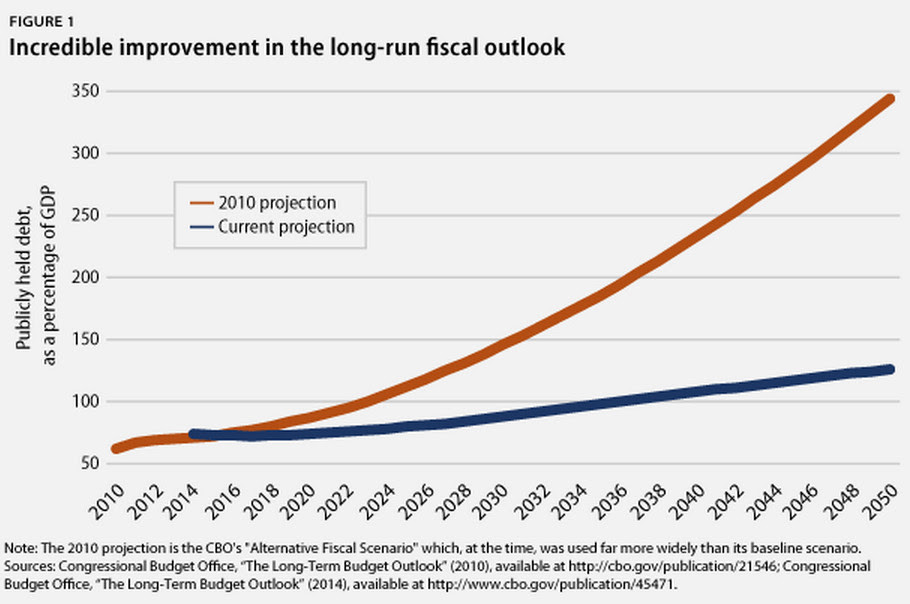
The CBO found that, despite relentless panic about supposedly out-of-control government spending, the long-term path of federal debt has dramatically improved lately. You can see that in this second CAP chart, showing the CBO forecast for the ratio of federal debt to gross domestic product:

debt outlook

Budget cuts have probably helped bring down the long-term debt outlook a bit. But an improving economy has helped much more, by raising tax revenue and dramatically shrinking the government's annual budget deficit.

The CAP study is the latest in a series of studies tallying the costs of austerity. The long and short of it: Less austerity in the short term would have meant more growth, less unemployment and an even faster-shrinking deficit in the long term.

Sunday, December 1, 2013

JFK's prophetic speech against Tea Party nihilism

[HT: Tim Dickinson at Rolling Stone]. Wow, the more things change, the more they stay the same!

Below I edited out [...] several sentences and paragraphs of JFK's final, undelivered speech, on November 22, 1963, which is mostly about Cold War nuclear preparedness, the space race, and fighting Soviet encroachment. You can read the entire text here.


[...]

This link between leadership and learning is not only essential at the community level. It is even more indispensable in world affairs. Ignorance and misinformation can handicap the progress of a city or a company, but they can, if allowed to prevail in foreign policy, handicap this country's security. In a world of complex and continuing problems, in a world full of frustrations and irritations, America's leadership must be guided by the lights of learning and reason -- or else those who confuse rhetoric with reality and the plausible with the possible will gain the popular ascendancy with their seemingly swift and simple solutions to every world problem.

There will always be dissident voices heard in the land, expressing opposition without alternative, finding fault but never favor, perceiving gloom on every side and seeking influence without responsibility. Those voices are inevitable.

But today other voices are heard in the land -- voices preaching doctrines wholly unrelated to reality, wholly unsuited to the sixties, doctrines which apparently assume that words will suffice without weapons, that vituperation is as good as victory and that peace is a sign of weakness. At a time when the national debt is steadily being reduced in terms of its burden on our economy, they see that debt as the single greatest threat to our security.  At a time when we are steadily reducing the number of Federal employees serving every thousand citizens, they fear those supposed hordes of civil servants far more than the actual hordes of opposing armies.

We cannot expect that everyone, to use the phrase of a decade ago, will "talk sense to the American people." But we can hope that fewer people will listen to nonsense. And the notion that this Nation is headed for defeat through deficit, or that strength is but a matter of slogans, is nothing but just plain nonsense.

[...]

Our foreign aid program is not growing in size, it is, on the contrary, smaller now than in previous years. It has had its weaknesses, but we have undertaken to correct them. And the proper way of treating weaknesses is to replace them with strength, not to increase those weaknesses by emasculating essential programs. Dollar for dollar, in or out of government, there is no better form of investment in our national security than our much-abused foreign aid program. We cannot afford to lose it. We can afford to maintain it. we can surely afford, for example, to do as much for our 19 needy neighbors of Latin America as the Communist bloc is sending to the island of Cuba alone.

[...]

This effort is expensive -- but it pays its own way, for freedom and for America. [...] There is no longer any doubt about the strength and skill of American science, American industry, American education, and the American free enterprise system. In short, our nation space effort represents a great gain in, and a great resource of, our national strength -- and both Texas and Texans are contributing greatly to this strength.

Finally, it should be clear by now that a nation can be no stronger abroad than she is at home. Only an America which practices what it preaches about equal rights and social justice will be respected by those whose choice affects our future. Only an America which has fully educated its citizens is fully capable of tackling the complex problems and perceiving the hidden dangers of the world in which we live. And only an America which is growing and prospering economically can sustain the worldwide defenses of freedom, while demonstrating to all concerned the opportunities of our system and society.

[...]

We, in this country, in this generation, are -- by destiny rather than by choice -- the watchmen on the walls of world freedom. We ask, therefore, that we may be worthy of our power and responsibility, that we may exercise our strength with wisdom and restraint, and that we may achieve in our time and for all time the ancient vision of "peace on earth, good will toward men." That must always be our goal, and the righteousness of our cause must always underlie our strength. For as was written long ago: "except the Lord keep the city, the watchmen waketh but in vain."

Thursday, October 17, 2013

GOP cost U.S. nearly 1 million jobs in 3 years

Before my Republican friends roll their eyes and dismiss this study as some lib'rul media/Media Matters hack job, please note that this study was commissioned by the Peterson Foundation, the founder of the "Fix the Debt CEOs" group that wants to cut the U.S. federal safety net in order to decrease the national debt.  

Republicans can't be trusted as stewards of the U.S. economy. They've got two tricks in their bag: tax cuts and deregulation. But after they've cut taxes to the bone and given business license to do anything, anywhere, to anybody... they're worthless.


By Mark Gongloff
October 15, 2013 | Huffington Post

Saturday, April 20, 2013

Have historians been unfair to Dubya?

Prof. Stephen Knott argues that Dubya has been treated unfairly by historians making their Best & Worst Presidents lists.  (As if their lists matter to anybody, but let's forget that for now....)

There are two ways to evaluate the success of a U.S. president: by what the evaluator thinks a president did right or wrong; or by how effectively a president got what he wanted; furthermore, one could evaluate how enduring were the gains a president won.

By the first measure, many people, including many Republicans, think Bush was a failure. But partisanship, ideology and ego affect our judgment, so it's one of those things best left to argue over beers. By the second measure, however, I'd argue that Bush was pretty darn successful, unfortunately. And his "achievements" endure.

Why do I say "unfortunately"? We had a recent example. Last night, when noting the nation's reaction to the apprehension of the Boston bombers and their alleged Islamist beliefs, I posted"It's still Dubya's America and we're just living in it... including President Obama."

That is, I meant that Dubya and his team (including his team at FOX News and Clear Channel) have been extremely successful in framing our view of Muslims, so successful that even President Obama seems prisoner to our prejudices.  The Left is silent while Obama is under constant pressure by the Right to link the entire religion of Islam to terrorism.

Here's the latest bulletin from the conservative GWOT Language Police: "The language of terror," by Charles Krauthammer.  You have to read through a lot of nothing to get to Krauthammer's point at the very end:

Obama has performed admirably during the Boston crisis, speaking both reassuringly and with determination. But he continues to be linguistically uneasy. His wavering over the word terrorism is telling, though in this case unimportant. The real test will come when we learn the motive for the attack.

As of this writing, we don’t know. It could be Islamist, white supremacist, anarchist, anything. What words will Obama use? It is a measure of the emptiness of Obama’s preferred description — “violent extremists” — that, even as we know nothing, it can already be applied to the Boston bomber(s). Which means, the designation is meaningless.

You see, it makes all the difference in the world that the Boston bombers' alleged motivation was Islamist beliefs, and that our President says so. Why? Well, it's obvious, isn't it? Because it's ammunition for those who want to categorize all Muslims, including legal U.S. residents and citizens, as suspected terrorists. There's no other reason for the Right to police this language issue so severely. 

And as George Orwell warned us, language controls our thoughts. Control our language, control our thoughts. That is just one "achievement" of the successful George W. Bush "imperial" presidency, but it's a mighty one.

How about some more?  Bush's Great War on Terra (GWOT) continues and even escalates: with drone attacks, G'itmo, sanctioned rendition and torture, domestic spying and Internet surveillance, prosecuting government whistle blowers, and assassinating U.S. citizens when they are overseas. Obama continues Bush's extra-constitutional practice of presidential signing statements. Bush's occupations of choice in Afghanistan and Iraq are inexorable; Obama cannot or will not get out of them. Deregulated Wall Street banks may still gamble, legally, with depositors' and taxpayers' free money and are now Too Bigger To Fail. Deregulated for-profit colleges that live on government-backed student loans still hold the majority of student debt, now at $1 trillion. The budget of Bush's Department of Homeland Security now rivals the Pentagon's. Bush's unfunded Medicare Advantage entitlement is still wildly popular even among seniors in the Tea Parties... yet to put Medicare's finances back in order requires cutting or reforming Medicare Advantage, giving Republicans the opportunity to accuse Democrats of "cutting Medicare." Clinton's federal assault-weapons ban was allowed to expire in 2004; meanwhile right-to-carry and concealed-carry laws were passed in most states with Bush's encouragement, even as mass shootings increased.  And speaking of guns, Obama ironically got blamed for Bush's "Fast and Furious" "gunwalking"/drug-interdiction program by the ATF. And finally, Bush's unaffordable tax cuts on the very wealthy are now sacrosanct even among Democrats who once fought them, even in the worst economic climate since the Great Depression, with the two aforementioned wars still on the nation's credit card, unpaid for.  

As a result of all this and more, Bush increased our national debt 91 percent ($5.9 trillion), and yet somehow escapes blame for it; meanwhile spineless Democrats are ready to apologize for Obama's deficits (totaling $4.9 trillion or a 41 percent increase over FY 2009) caused by Bush's Great Recession and two unfinished wars. For that political magic act, we are compelled to acknowledge that Dubya was a brilliant politician. Obama is a dunderhead by comparison.

I haven't read Knott's book, but based on its title, Rush to Judgment: George W. Bush, the War on Terror, and His Critics, it probably highlights Bush's achievements in fighting terrorism.  If that's so, then Knott has an excellent case to make that Bush got everything he wanted and more, i.e. he was pretty darn successful. Too bad for us. 

UPDATE (04.24.2013): Ralph Nader repeats a lot of what I've said in his op-ed: "Obama Is Comfortable With Bush's Inferno." 

UPDATE (04.26.2013):  Here's an acerbic take on Dubya's strategy of "Keep Quiet and Hope They Forget" by Alexandra Petri: "George W. Bush was the greatest president of all time, ever."  It's working.  Dumbo has outsmarted us again.  [Facepalm.]


By Stephen F. Knott
April 20, 2013 | Washington Post

Sunday, March 24, 2013

'Inconclusive' link between public debt, interest rates

Empirical data refutes the conservative mantra that higher government debt always leads to higher interest rates, thereby "crowding out" private investment:  

In a paper published by the National Bureau of Economic Research in April 2005, Columbia University economist R. Glenn Hubbard and Federal Reserve economist Eric Engen declared as “inconclusive” the link between government debt and interest rates. Hubbard headed George W. Bush’s White House Council of Economic Advisers from 2001 to 2003.

“While analysis of the effects of government debt on interest rates has been ongoing for more than two decades, there is little empirical consensus about the magnitude of the effect, and the difference in views held on this issue can be quite stark,” they wrote.

In fact just the opposite can happen:

Deficits as a share of the U.S. economy have risen sharply at times with little to no discernible impact on the level of U.S. interest rates. In fact, just a cursory look at periods when the U.S. ran large deficits as a share of (the total economy) – 1983, 1991-92, 2008-2012 – we actually saw declines in nominal long-term (lending) rates,” said [Scott] Anderson [chief economist for Bank of the West in San Francisco].

He noted that the yield, or return on investment for bondholders, has not and did not rise sharply. “So the link between high levels of government spending and borrowing does not appear to raise the cost of money during these periods and therefore would not crowd out private consumption and investment,” Anderson said.

Just to show how fair & balanced I am, here's a recent WSJ op-ed that warns against a "fiscal dominance" scenario in the U.S., where debt-to-GDP consistently exceeds 80 percent, interest rates shoot up, debt increases even more, interest rates shoot up even higher, and a "fiscal death spiral" ensues.  Theoretically this is possible, but since this scenario depends a lot on "investor confidence," that means everything is relative.  Take Japan for example. Its debt-to-GDP ratio has been over 150 percent for years. It's now 225 percent. Yet Japan's borrowing costs remain low because of real deflation and the relative strength of the Japanese yen.  


By Kevin G. Hall
March 20, 2013 | McClatchy Newspapers

Saturday, March 23, 2013

Shiller: Higher taxes + stimulus to fix U.S. debt

Debt-Friendly Stimulus
By Robert J. Shiller
March 20, 2013 | Project Syndicate

With much of the global economy apparently trapped in a long and painful austerity-induced slump, it is time to admit that the trap is entirely of our own making. We have constructed it from unfortunate habits of thought about how to handle spiraling public debt.

People developed these habits on the basis of the experiences of their families and friends: when in debt trouble, one must cut spending and pass through a period of austerity until the burden (debt relative to income) is reduced. That means no meals out for a while, no new cars, and no new clothes. It seems like common sense – even moral virtue – to respond this way.

But, while that approach to debt works well for a single household in trouble, it does not work well for an entire economy, for the spending cuts only worsen the problem.  This is the paradox of thrift: belt-tightening causes people to lose their jobs, because other people are not buying what they produce, so their debt burden rises rather than falls.

There is a way out of this trap, but only if we tilt the discussion about how to lower the debt/GDP ratio away from austerity – higher taxes and lower spending – toward debt-friendly stimulus: increasing taxes even more and raising government expenditure in the same proportion. That way, the debt/GDP ratio declines because the denominator (economic output) increases, not because the numerator (the total the government has borrowed) declines.

This kind of enlightened stimulus runs into strong prejudices. For starters, people tend to think of taxes as a loathsome infringement on their freedom, as if petty bureaucrats will inevitably squander the increased revenue on useless and ineffective government employees and programs. But the additional work done does not necessarily involve only government employees, and citizens can have some voice in how the expenditure is directed.

People also believe that tax increases cannot realistically be purely temporary expedients in an economic crisis, and that they must be regarded as an opening wedge that should be avoided at all costs. History shows, however, that tax increases, if expressly designated as temporary, are indeed reversed later. That is what happens after major wars, for example.

We need to consider such issues in trying to understand why, for example, Italian voters last month rejected the sober economist Mario Monti, who forced austerity on them, notably by raising property taxes. Italians are in the habit of thinking that tax increases necessarily go only to paying off rich investors, rather than to paying for government services like better roads and schools.

Keynesian stimulus policy is habitually described as deficit spending, not tax-financed spending. Stimulus by tax cuts might almost seem to be built on deception, for its effect on consumption and investment expenditure seems to require individuals to forget that they will be taxed later for public spending today, when the government repays the debt with interest.  If individuals were rational and well informed, they might conclude that they should not spend more, despite tax cuts, since the cuts are not real.

[BTW, out of $788 billion paid out under the Recovery Act, aka stimulus bill, $291 billion of it went to tax cuts and credits that were not very stimulative. This was done at the GOP's insistence. - J]

We do not need to rely on such tricks to stimulate the economy and reduce the ratio of debt to income. The fundamental economic problem that currently troubles much of the world is insufficient demand. Businesses are not investing enough in new plants and equipment, or adding jobs, largely because people are not spending enough – or are not expected to spend enough in the future – to keep the economy going at full tilt.

Debt-friendly stimulus might be regarded as nothing more than a collective decision by all of us to spend more to jump-start the economy. It has nothing to do with taking on debt or tricking people about future taxes. If left to individual decisions, people would not spend more on consumption, but maybe we can vote for a government that will compel us all to do that collectively, thereby creating enough demand to put the economy on an even keel in short order.

Simply put, Keynesian stimulus does not necessarily entail more government debt, as popular discourse seems continually to assume. Rather, stimulus is about collective decisions to get aggregate spending back on track. Because it is a collective decision, the spending naturally involves different kinds of consumption than we would make individually – say, better highways, rather than more dinners out. But that should be okay, especially if we all have jobs.

Balanced-budget stimulus was first advocated in the early 1940’s by William Salant, an economist in President Franklin Roosevelt’s administration, and by Paul Samuelson, then a young economics professor at the Massachusetts Institute of Technology. They argued that, because any government stimulus implies higher taxes sooner or later, the increase might as well come immediately. For the average person, the higher taxes do not mean lower after-tax income, because the stimulus will have the immediate effect of raising incomes. And no one is deceived.

Many believe that balanced-budget stimulus – tax increases at a time of economic distress – is politically impossible. After all, French President François Hollande retreated under immense political pressure from his campaign promises to implement debt-friendly stimulus. But, given the shortage of good alternatives, we must not assume that bad habits of thought can never be broken, and we should keep the possibility of more enlightened policy constantly in mind.

Some form of debt-friendly stimulus might ultimately appeal to voters if they could be convinced that raising taxes does not necessarily mean hardship or increased centralization of decision-making. If and when people understand that it means the same average level of take-home pay after taxes, plus the benefits of more jobs and of the products of additional government expenditure (such as new highways), they may well wonder why they ever tried stimulus any other way.

Friday, February 22, 2013

Thanks, austerity: Moody's downgrades UK's debts

Let's be very clear: this was not supposed to happen, according to conservatives and financial markets gurus. Great Britain embraced austerity -- it is still embracing austerity -- and yet Moody's has cut its credit rating to AA1.  So here is yet more evidence for those who still need it that national governments are not households, and the same rules do not necessarily apply.

Why?  Slashing public spending put the UK in a recession that -- get ready, Tea Partyers, this is the part that always gets you -- increased public debt. Here it is again, in case you missed it: slashing spending hurt the economy which increased debt:

“The main driver underpinning Moody’s decision to downgrade the UK’s government bond rating to Aa1 is the increasing clarity that, despite considerable structural economic strengths,” the Moody’s report reads, “the UK’s economic growth will remain sluggish over the next few years due to the anticipated slow growth of the global economy and the drag on the UK economy from the ongoing domestic public- and private-sector deleveraging process.”

The "ongoing deleveraging process" is business-speak for cutting one's debts. And there was an extra "f*** you" from Moody's after it cut the UK's bond rating:

“A combination of political will and medium-term fundamental underlying economic strengths will, in time, allow the government to implement its fiscal consolidation plan and reverse the U.K.’s debt trajectory.”

In other words, Moody's said, "We think you're doing all the right things, and we hope that someday it will work out for you, but in the meantime it's not, so we're downgrading you."  

That's called "damned if you do, damned if you don't," folks. But if you want to know what the "confidence fairy" really believes, look at what she does (downgrading), not what she says (cheering on austerity).

One final note: the credit ratings agencies do not rate debt levels, they rate the ability to pay one's debts. They're not the same thing. In the U.S., we have a record-high national debt, ($7 trillion of it thanks to Dubya), and yet government spending to pay the interest on that debt is at a record low, thanks to record-low interest rates. 


By Jill Lawless
February 22, 2013 | AP

Saturday, February 16, 2013

Deficits are not a problem; actuaries are not oracles

Worrying about U.S. federal deficits in this down economy is like worrying about what your lawn will look like in 20 years when you're house is on fire right now.


By Derek Thompson
February 15, 2013 | The Atlantic

The showdown between Joe Scarborough and Paul Krugman over our debt is interesting and important, not merely as a media skirmish, but also as a keyhole into the way deficit "hawks" and deficit "doves" misunderstand and talk past each other. A great deal of the animosity and confusion between both sides of the debate would be improved with an honest assessment today's economy and tomorrow's debt. 

Basically, this is a discussion about (a) what we know about the economy and (b) what we think we know about the economy.

WHAT WE KNOW

Here are six things we know about the economy. [1] We know that unemployment is still high. [2] We know that inflation is low. [3] We know that 4 million people have been out of work, and looking, for more than a year. [4] We know that GDP growth has been fine for normal times, but awfully weak for a recovery following a steep recession. [5] We know that cutting government spending takes money out of an economy. [6] We know that government spending cuts in the last few years have coincided with hundreds of thousands of lost government jobs, which has kept our unemployment rate from falling further.

And here are four things we know about our debt. [1] We know that government borrowing rates are low. [2] We know that global appetite for our debt is high. [3] We know we borrow in our own currency, and not, like Europe, in a common currency that we don't control. [4] And we know that makes us less vulnerable (but not invincible) from a debt crisis.

Out of these ten things we know, how many of them suggest that we should cut our deficits today? Basically, zero. And that's Paul Krugman's point. Everything we know about the economy today provides a clear argument for elevated deficits.

WHAT WE DON'T KNOW

Joe Scarborough understands this. He says he wants higher deficits and a game-plan for cutting our long-term debt (which is the accumulation of our deficits). But he doesn't fully understand -- or properly communicate -- how the argument for long-term debt reduction rests on assumptions about the future that are exquisitely sensitive to change. The precise dimensions of our 2020 debt are calculated from a matrix of variables (e.g. immigration, productivity growth, hospital construction growth, MRI inflation rates) whose very nature is to fluctuate, sometimes dramatically, on a quarterly or annual basis.

Here are four things we think we know about our future debt -- which is almost entirely a health care spending problem. [1] We think we know that the cost of caring for Americans will continue to grow faster than the economy. [2] We think we know that demand for this increasingly expensive care will grow along with our aging boomer population. [3] We think we know that tax revenue will grow about in line with the economy. [4] Thus, we think we know what the gap between future taxes and future spending will be, and how much we have to start saving today to cover it.

It's possible that the deficit hawks have it 100 percent right. But it would also take a rather astonishing clairvoyance for anybody to foresee the next ten years with even slightly useful clarity. Scarborough and Mika Brzezinski often talk about "math" when they talk about debt ...

... and our debt projections look like math, what with all of those numbers. But math is a law. Actuarial projections are not. They are smart guesswork facilitated by multiplying current trends over many years. There's an important difference.

For example, what if health care inflation slows down?

Actually, that's not a "what-if." Two weeks ago, CBO revealed that health care spending has "grown much more slowly than historical rates would have predicted." It cut estimates of federal spending on Medicaid and Medicare in 2020 by "about $200 billion." That's a lot of money. It is much more than Washington would save by raising the Medicare eligibility age from 65 to 67. If you thought raising the retirement age was enough to calm the market's appetite for debt reduction, then guess what? We just got 2X those savings by doing nothing.

It's generally considered goofy for somebody to pretend he can see the next 75 years in robotics, or software, or bio-sciences.  But somehow it's not goofy for Joe Scarborough, Steven Rattner and other serious, well-intentioned media people point out that we have $60+ trillion in "unfunded liabilities" to Social Security, Medicare, and federal pensions in the next seven decades. That statistic isn't wrong. It's just kinda ... goofy. Medicare actuaries are legally obligated to predict the future of their program past 2070.But the press [and the public! - J] is not legally obligated to pretend that our actuaries are oracles.

Paul Krugman isn't an oracle either. He's just a very smart economist with an astonishingly good track record. And even he isn't saying that debts don't matter. In fact, he's saying almost exactly what Alan Blinder -- an economist Scarborough cites approvingly -- wrote in The AtlanticDon't worry too much about deficits now, and put aside some worry about the future total cost of health care.

Deficit reduction is sometimes framed as stimulus. It's not. It's insurance -- insurance against the possibility that the market will turn against U.S. debt and drive up interest rates and badly hurt the country. Insurance isn't bad. But it's expensive. And money taken out of the economy too soon could prolong an unemployment crisis that is creating structural deficiencies in our atrophying workforce. Deficit doves should concede that there is a risk to doing nothing for too long. But deficit hawks must concede that there is also a risk to taking out that insurance policy too soon -- or distracting attention from everything we know about the economy.
_______________________

Please don't say that our debt is exactly like global warming. It is true that both global warming and debt are arguably subtle and gathering forces whose impact on the world could surprise us somewhere down the line. But unlike our 2020 debt, global warming isn't just an actuarial projection. It's a scientific finding about the world right now. And whereas even deficit hawks allow that there is good debt (right now) and bad debt (in ten years), there is no analogous argument I'm aware of that says global warming is great for the world today -- or that we actually we need more of it! -- but bad for the world tomorrow. 

Thursday, December 6, 2012

Simpson debases himself before kids for his CEO paymasters

Hey, you kids, get hip to the national debt, yo!  'Cos nothing is more ironically cool than an old fogey lecturing at you while pretending to care about youth culture!

That's right, get with it, and then "start using those precious social media skills" to convince everybody to slash Grandma's Medicare/Medicaid and cut their Social Security benefits and hand them over to Wall St.  

And don't forget to Instagram it for ex-Senator Alan Simpson as you throw Grandma from the train!


December 6, 2012 | FoxNews

Former Sen. Alan Simpson is going to new lengths to wake up Washington to the need for a debt deal -- this time, dancing to "Gangnam Style" in a viral YouTube video

The sharp-witted, sharp-tongued, 81-year-old budget guru played along for a video by The Can Kicks Back, a group that aims to enlist young Americans in pressuring Washington to reach a deficit-reduction deal by July 2013. 

In the video, Simpson tells today's youth: "Stop Instagramming your breakfast and tweeting your firstworldproblems and getting on YouTube so you can see Gangnam Style." 

Nothing if not a good sport, Simpson proceeds to imitate the limber moves of South Korean rapping sensation PSY while his "Gangnam Style" hit plays in the background. 

Simpson urges young American to put "those precious social media skills" to good use. "Take part or get taken apart," he says. 

Simpson co-chaired President Obama's deficit-reduction commission, whose findings were left on the shelf by the White House and Congress. He has since expressed frustration at the virtual standstill in Washington when it comes to striking a meaningful debt deal.

Thursday, November 29, 2012

Reagan on Social Security and the deficit

Even a broken clock is right twice a day.  Here's what the Gipper had to say on October 7, 1984 in Louisville, KY:

"Social Security has nothing to do with balancing a budget or erasing or lowering the deficit."  

Quick, somebody tell Erskine Bowles, Alan Simpson and the "Fix the Debt" CEOs!  
[HT: Exiled]. 


uploaded by WeAreSocialSecurity
November 5, 2012 | YouTube

Friday, October 5, 2012

What else is Romney 'completely wrong' about?

Gee, maybe Romney's also wrong about his denial that extending Dubya's tax cuts, plus another 20 percent cut across the board, will increase our national debt by about $4.8 trillion over 10 years? (This is not to mention $2.1 trillion in extra military spending he can't pay for either).  

Romney could make his campaign about anything and have a great shot at winning.  He could say he's in favor of rainbows and ice cream and probably win. But no, he had to propose two big-ass tax cuts that he knows he can't pay for. Why? What on earth?! Either somebody's pulling his strings, or he's mentally retarded, or both. There is no reason for him to go out on a limb with a lie like this, embarrassing himself, and insulting our intelligence. 

And all you "fiscal conservatives," all you Tea Partyers out there who are supposedly so worried about our national debt: you should all be ashamed of yourselves for letting him put this over on you, in your Party's name, as if you've forgotten elementary school arithmetic.  Stand with Romney now and you've lost all credibility (if you had any left).  


By Ashley Killough
October 4, 2012 | CNN

Thursday, October 4, 2012

Romney was a lying sack of s--t last night

Romney may have "won" last night's debate according to snap polls, (I watched the first 15:00 then I couldn't take Romney's lying anymore), but he proved once again that he's willing to say anything to get elected, promising us that we can have our cake ($4.8 trillion in tax cuts) and eat it too (zero deficits).

Welcome back, Big Government Conservatism!  How ya been, Voodoo Economics!


Seriously, we've been through this GOP charade how many times already?  And Republicans just keep on trying it.  You know, like when Dubya cut taxes and it was supposed to grow our economy, not the deficit.  Instead, from 2002-2009, Dubya increased our national debt 91 percent or  $5.9 trillion!

Now here's the truth. This is what the non-partisan Tax Policy Center said in August about Romney's proposed 20 percent across-the-board tax cuts, on top of a permanent extension of Bush's tax cuts:

The basic arithmetic of revenue neutrality requires eliminating $360 billion worth of tax expenditures [in 2013] to offset $360 billion of [Romney's proposed] tax cuts. [...] Thus, in order to offset $360 billion in cuts, one must eliminate 65 percent of all of the available $551 billion in tax expenditures.

TPC says these cuts will total $480 billion by 2015.  Total this up over 10 years, as the Obama campaign did, and you get $4.8 trillion that must be made up for somehow.  PolitiFact confirmed it.  

Romney refuses again and again to tell us what tax expenditures he'll end and which loopholes he'll close.  Where's the money going to come from?  Don't worry, he's a business pro, he'll find it, that's what we're supposed to believe!  (Maybe it's hiding in Romney's couch cushions... or in the couches in his offshore banks).  

And it gets worse: Romney wants to increase military spending by $2.1 trillion. That brings the total of unfunded tax cuts and spending hikes to $6.9 trillion, as President Obama correctly pointed out last night.  

(I guess when you calmly call somebody on his B.S. like Obama did to Romney last night, it's considered a losing tactic.  I suppose Obama should have been screaming, jumping up and down, and accusing Romney of being a pants-on-fire charlatan while doing the "you're crazy" finger twirl next to his temple?....)


Anyhow, here's how Romney responded to Obama's telling it like it is:  

I'm not looking for a $5 trillion tax cut.  What I've said is I won't put in place a tax cut that adds to the deficit.  That's part one.  So there's no economist can say Mitt Romney's tax plan adds $5 trillion if I say 'I will not add to the deficit with my tax plan.'  Number two, I will not reduce the share paid by high-income individuals.  [...Romney makes a joke about how often his own children lie to him...]  I will not reduce the taxes paid by high-income Americans.  And number three, I will not under any circumstances raise taxes on middle-income families.  I will lower taxes on middle-income families.  

Exactly.  I mean... huh-what?!?  [Double take.]  Mitt Romney just promised us that he would reject his own tax plan!

The Tax Policy Center's Howard Gleckman summed it up thus: "Romney’s problem is he cannot possibly achieve all of these goals. He is doomed by both political reality and simple mathematics."

Folks, seriously, do the arithmetic.  It's not hard.  Then decide if you want to be deceived or not.  If you want to be lied to then, by all means, vote for Romney.  This guy is an empty suit stuffed with deceit and calumny.  

UPDATE:  Paul Krugman pointed out in the NYT how Mitt also lied his ass off that his healthcare plan covers pre-existing medical conditions, which is just flat untrue. Romney lied many, many more times during the night, but I'd say these were the biggest two whoppers.

Wednesday, October 3, 2012

U.S. taxes & spending: Key facts

Here are somewhat random but indisputable facts on U.S. federal taxes and spending, all of it hyperlinked:


Corporate tax:
·        The U.S. collects less corporate tax relative to the overall economy than almost any other country in the world:  about 1.3 % of GDP in 2010, compared to 5 % in the 1950s.
·        WSJ citing the CBO: Corporate federal taxes paid fell to 12.1 % of profits earned from activities within the U.S. in fiscal 2011, the lowest % since 1972.
·        26 Fortune 500 companies paid no net federal income tax from 2008-2011.
·        WSJ:  More than 60 % of U.S. businesses with profits over $1 million pay zero corporate tax, since they are structured as pass-throughs.
·        Citizens for Tax Justice: From 2008-2010, 280 profitable Fortune 500 companies collectively paid an income tax rate of 18.5 % vs. the statutory 35 % rate, while receiving $223 billion in tax subsidies.  And at least 22 companies used offshore tax havens like the Cayman Islands (like Mitt Romney does).

Individual taxes:
·        CBO:  In 2009, the same year the Tea (Taxed Enough Already) Party was born, Americans paid the lowest average federal tax rate (17.4 %) in 30 years.
·        Bush tax cuts will cost $5.4 trillion if extended in full from 2013-2022. Romney-Ryan claim they will close tax loopholes and broaden the tax base, but repeatedly refuse to give specifics, most recently on FoxNews.
·        DC Johnston/Reuters: Per capita federal tax revenue was 31.5 % less in real terms in 2011 than in 2001, because of the recession but also Bush’s tax cuts.
·        On the “47 % who pay no income tax:”
o   Only about 17 % of households did not pay any federal income tax or payroll tax in 2009, despite the high unemployment and temporary tax cuts; in 2007, it was 14 %.
o   CBO: the poorest fifth of households paid an average of 4 % of income in federal taxes in 2007, the latest year for which these data are available.
·        Institute on Taxation and Economic Policy:  The bottom 20 % of U.S. households pay more of their income in state and local taxes than does the top 1 %.
·        Tax Policy Center: Romney’s tax plan would result in "large tax cuts to high-income households, and increase the tax burdens on middle- and/or lower-income taxpayers."
·        The Estate (“Death”) Tax affects only 0.6 % of Americans whose death would lead to the payment of any estate taxes.  Only 2.7 % of Americans receive an inheritance over $50,000.  However, elimination of the Estate Tax would cost $253 billion from 2012-2022. 
·        David Stockman, Reagan’s director of the OMB, told CNBC: "We couldn't afford those tax cuts back when they were implemented by Bush. We can't afford them now."
  
Spending and deficits:
·        NYT:  Before President Obama even took office, the CBO projected a $1.2 trillion deficit for 2009 and deficits in subsequent years, based on continuing Bush’s spending and tax policies. (The actual deficit in FY 2009 was $1.4 trillion.)
·        NYT: Only 17 percent of the increase in government debt in 2009 and 2010 was because of discretionary spending of any kind, including the stimulus bill.
·        More than 1/3 of the Recovery Act’s (stimulus bill) cost to-date has been for tax credits: $298 billion.
·        PolitiFact:  Growth in government spending under Obama is lower than at any time since President Eisenhower (adjusted for inflation).  Deficits have increased, nevertheless, because of a down economy and resulting lower tax receipts – and the Bush tax cuts.
·        OMB: Contrary to Romney’s claims, defense spending increased under President Obama, from $661 billion in 2009 to $693 billion in 2010 to $705 billion in 2011.
·        GAO:  Interest paid on the federal debt as a percentage of annual federal spending is lower under Obama – 6.4 % in 2011 – that at any time since the 1970s.  And the interest paid on federal debt as a percentage of GDP is at its lowest since WWII.
·        OMB:  As a result of recessionary unemployment, "income security" payments built into our system before Obama took office, such as unemployment insurance, disability pay, food stamps and housing assistance, increased from $431 billion in 2008 to $533 billion in 2009 to $622 billion in 2010 and slightly decreased to $597 billion in 2011. 
·        OMB federal debt figures (p. 140):  2009: $ 11.88 trillion; 2010:  $ 13.53 trillion; 2011: $14.76 trillion. That was a $2.88 trillion increase, or 24 %, over 3 years for President Obama.  Meanwhile, from 2002 to 2009, the federal debt increased from $6.2 trillion to $11.88 trillion.  That was a $5.88 trillion increase, or 91 %, over 8 years for President Bush.
·        Taken together, tax credits in the Recovery Act (stimulus bill) , and the payroll tax reduction for 160 million Americans in 2011 and 2012, both passed by President Obama, gave Americans $298 + $240 billion = $538 billion in tax relief.    
·        The non-partisan Committee For a Responsible Federal Budget projects that, without offsets that Romney’s campaign refuses to explain, his tax plan would increase the federal debt by $2.6 trillion.
·        Non-defense discretionary spending totaled 18 % of the federal budget in 2012. It includes: border control, education, environment, food safety, infrastructure, housing, veterans' healthcare, disaster relief, public safety, scientific research, etc.  

Tuesday, September 25, 2012

Baker: Failing arithmetic on national debt

Baker is the first pundit I know of who has made this point:  

While our debt to GDP ratio is approaching levels not seen since the years immediately following World War II, there is another key ratio that has been going in the opposite direction. This is the ratio of interest payments to GDP. This fell to 1.3 percent of GDP in 2009, its lowest level since World War II. While it has risen slightly in the last couple of years, the ratio of interest payments to GDP is still near a post-war low.

This gives us yet another example how the U.S. Government is not like a household.  How many of us can pay a lower interest rate as our debts grow bigger?  You and I can't.  But the USG can and does.    

Baker goes on to illustrate how interest owed on the national debt is more important than the absolute dollar value of outstanding debt, or the debt-to-GDP ratio:

Suppose that we issue $4 trillion in 30 year bonds at or near the current interest rate of 2.75 percent. Let's imagine that in 3 years the economy has largely recovered and that long-term interest rates are back at a more normal level; let's say 6.0 percent for a 30-year bond.

In this case the bond price would fall by over 40 percent meaning, in principle, that it would be possible for the government to buy up the $4 trillion in debt that it issued in 2012 for just $2.4 trillion, instantly lowering our debt burden by $1.6 trillion, almost 10 percentage points of GDP. If we had been flirting with the magic 90 percent debt to GDP ratio before the bond purchase, we will have given ourselves a huge amount of leeway by buying up these bonds.

Of course, this would be silly. The interest burden of the debt would not have changed; the only thing that would have changed is the dollar value of the outstanding debt. Fans of the 90 percent debt-to-GDP twilight zone theory may think that the debt burden by itself could slow the economy, but in the real world this doesn't make any sense.

Let's recall that America's debt-to-GDP ratio was nearly 120 percent after WWII.  "Yeah, but that was WWII!" you might say, "And after the Great Depression! No comparison!"

Well, yeah, it's hard to compare a war that lasted four years with two simultaneous wars that have lasted about 10 years and counting.  Meanwhile, the Great Recession wiped out $15.5 trillion in U.S. wealth -- about equal, coincidentally, to one year of U.S. GDP, and our total federal debt.  

And Dubya's Great Recession cost us 8.8 million jobs (more than the previous four recessions combined); as a result, many of those jobless people have qualified for "income security" payments built into our system that didn't exist in the 1930s, such as unemployment insurance, disability pay, food stamps, housing assistance, etc. Income security outlays increased from $431 billion in 2008 to $533 billion in 2009 to $622 billion in 2010 to $597 billion in 2011.  Next, more people opted for early Social Security benefits, plus they got a 5.8 percent cost of living increase in 2009, and for the first time the program ran a deficit.  Social Security outlays jumped from $617 billion in 2008 to $683 billion in 2009 to $706 billion in 2010 to $731 billion in 2011.  And let's not forget national defense spending, which increased from $616 billion in 2008 to $661 billion in 2009 to $693 billion in 2010 to $705 billion in 2011.

Finally -- and this is the factor so many people, especially on the right, overlook -- decreased economic activity -- combined with an extension of Dubya's tax cuts -- led to lower income and corporate tax receipts (and FICA receipts): down $419 billion in 2009 and $360 billion in 2010, compared to 2008.  


Meanwhile, overall spending increased $535 billion in 2009 (most of it thanks to Dubya) and $475 billion in 2010, compared to 2008.  

(See all the OMB's historical spending and revenue data here.)

So there are objective reasons why our deficits and debt have climbed.  It's ludicrous to blame it all on $475 billion in stimulus spending.

Next, let's look at the GAO's historical picture of annual net interest paid on the federal debt as a percentage of annual federal spending.  In 2011, interest payments were 6.4 percent of federal outlays.  From Reagan thru Dubya, that figure never fell below 7 percent.  In the decadent '80s it never fell below 8.9 percent.  In the dot-com '90s it never fell below 13.5 percent.  

Sure, interest rates will eventually go up as the economy recovers.  But first it has to recover.  Economic recovery should be our top priority right now, not paying off our debt when we enjoy historically low interest rates and suffer historically high unemployment.  Debt reduction now, which would cut GDP and raise unemployment, is putting the cart before the horse.

Just trying to put things in perspective.  Not that my Tea Partying friends will care....


By Dean Baker
September 24, 2012 | Huffington Post