Showing posts with label income tax. Show all posts

Monday, February 17, 2014

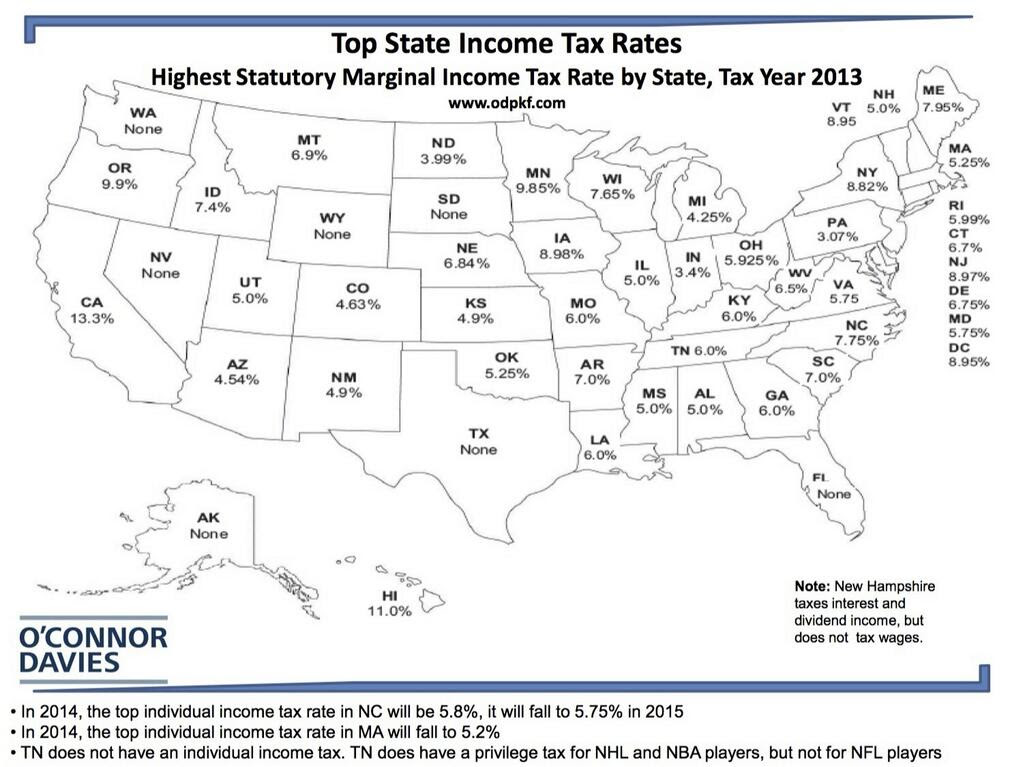
U.S. map of income tax: Blue States walk the talk

This map shows that Blue States practice what they preach: they want government to do more, and they tax income at a higher rate in order to do it:

Using the 2012 election results to measure that, we find the average state income tax rate in states (plus D.C.) that Obama won is 6.4 percent, while the average rate in states Mitt Romney won is 4.9 percent.

tumblr_n09mr3WwQZ1rasnq9o1_1280


By Sean Sullivan
February 16, 2014 | Washington Post

Monday, September 9, 2013

A history of 'rich people's movements'

This historical-political study by Martin is long and somewhat academic (not surprising since it's excerpted from a book), but it's nevertheless worth reading in full.

My dear Tea Parties, realize two things: 1) a lot of your "grassroots" ideas were recycled from previous rich people's movements more than a half-century ago when taxes were a heckuva lot higher than they are today; and 2) the original rich people's movements of the early 20th century learned their tactics and style from the Progressive Era reformers.

That's right, you got your modus operandi from Progressives!  Oh, the shame in it!


Friday, May 10, 2013

U.S. workers and the real 'freeloaders'

Huffington Post featured three excellent articles in two days about the plight of America's workers, who struggle to work enough hours to pay their bills, while not getting any paid leave or health insurance.

This week a Republican friend was complaining to me about "freeloaders" in America who don't pay any income taxes and thus feel no responsibility for our government; they just want to take, take, take.  This was his version of Mitt Romney's secretly taped complaint about the "47 percent" -- a moment of candor that likely cost Romney the 2012 U.S. presidential election.  (Such complaints are bald assertion: there is no indication that a large number of our fellow citizens feel this way; and people who make such accusations don't feel any need to offer evidence for such a conclusion.)

I replied to my friend, first, that Romney's 47 percent by definition includes millions of Red State Republicans.  Second, I said that nobody who works in America is a freeloader, even if they don't pay income tax.  Why?

The article about KFC provides a pretty good example.  A young man worked hard and was promoted by his boss and given extra hours and responsibilities, with a promise that a raise was just around the corner, but the raise never came. When he said he didn't want to be a manager anymore, it was too much stress for a poverty wage, his boss accused him of being "selfish."  Meanwhile, from 2007 to 2011, KFC (part of Yum!Brands) saw its profits rise 45 percent. 

This is true nationwide, where U.S. corporate profits are at an all-time high, while workers' wages are at an all-time low.  Yes, companies are getting more efficient and workers are getting more productive, but the profit gains from all that increased productivity are not going to workers.  

So just who is freeloading off of whom?  I don't mean to sound like a Marxist, but obviously, that guy working his tail off at KFC while living in his uncle's basement is not seeing any of that 45 percent in profits; it's all going to the corporate managers and shareholders.  His story has been repeated millions of times at other fast-food and retail joints around the country.

Or take the article about Amazon that, like many companies, outsources many aspects of its operations to temp agencies that don't give their workers any job security, full-time hours or benefits. Similarly, the U.S. Government's contractors often employ temp and part-time workers who earn below-poverty wages who then must rely partly on government benefits.  

This is not to mention Wal-Mart, the nation's #1 employer, whose average employee earns less than $9 an hour (less than $19,000 a year, full-time), and who has the most employees receiving federal welfare benefits.

Knowing all this, I don't see how anybody can have the gall to complain about the "selfishness" of U.S. workers who don't pay income tax.  Paying income tax is an elite privilege; and I'm sure these poor working Americans would love to be members of that elite club, earning enough money on salary with benefits to qualify for the "burden" of paying income taxes... while still enjoying all the other tax expenditures that middle- and upper-class Americans receive, which, according to Bloomberg, make up the largest category of government spending$1.3 trillion:


Middle-class families get an average benefit from the mortgage interest deduction of $139, while families in the top 1 percent get $3,752.


Taken together, individual income tax expenditures are the equivalent of sending $686 each year to those in the bottom fifth of the income distribution, $3,175 to those in the middle fifth, and $30,714 to those in the upper fifth. The average member of the top 1 percent gets nearly a quarter of a million dollars a year -- a statistic that might have proved useful for the folks protesting in Zuccotti Park.


By Saki Knafo
May 7, 2013 | Huffington Post

By Jillian Berman
May 8, 2013 | Huffington Post

By Dave Jamieson
May 8, 2013 | Huffington Post

Tuesday, January 1, 2013

MB360: U.S. income, 'fiscal cliff,' and the Little Guy

These U.S. income stats are important for us Average Joe's to keep in mind during the so-called "fiscal cliff" negotiations that may have been resolved by Congress early this morning.  

To recap: the Republicans have been ready to impose higher income taxes on all Americans in order to exempt households earning between $250,000 and $449,000 -- that's already the top 1-2 percent of income earners -- from paying a 39.6 percent marginal tax rate instead of the current 35 percent.  (For the record, the One Percent includes anybody making more than $350 K a year). 

Meanwhile, the median U.S. wage per person is about $27 K. Sixty-six percent of individual Americans earn less than $42 K a year; and 68 percent of households earn less than $75 K a year.  If the "middle class" means the middle of the U.S. income distribution, then these are the very people we should care about, not the Two Percent!

Think about that: Republicans have been adamant to scrap any deal on taxes and spending -- to the detriment of the middle and working class! -- that raises income taxes on the top Two Percent of all Americans. They show their true colors. The GOP is not the party of the Little Guy, but rather of the selfish elitists.

UPDATE:  Said President Obama at 11:21 EST today, after the GOP-led House voted to pass a 'fiscal cliff bill:'
"I will sign a law that raises taxes on the wealthiest 2% of Americans while preventing a middle class tax hike that could have sent the economy back into recession and obviously had a severe impact on families all across America."
Except we know he's fudging a bit, since this bill saves mostly the One Percent, those making over $350 K a year, keeping the Bush tax cuts in place for anybody making under $400 K a year.

Let's hope our President sticks to his guns and won't let the insane Republicans in the House use the debt ceiling as negotiating leverage when this kick-the-can bill expires two months from now....


Monday, December 31, 2012

5 myths about U.S. charities

Below is a must-read article for all you far-right conservatives who believe the U.S. safety net should be torn down... and then magically replaced, somehow, by a flood of charitable, Christian giving that will meet the needs of the poor instead.

Herein I'm re-stating Stern's 5 myths in my own words, with comments that may seem very bah-humbug and un-Christian, but so be it:

1.  Charities and non-profits are founded, primarily, to meet the ego needs of the rich and emotional needs of the aggrieved, and secondarily, to help the needy. 

How many celebrities and professional athletes have their own charities? How good do you think most of them are? Enough said.

And then think about what happens when a tragedy like a deadly illness strikes a well-to-do family: they immediately establish a memorial foundation or charity to help fight that illness, or help other victims of that illness. It's more about making those people feel like their loss wasn't in vain, and that they must save somebody else since they couldn't save their loved one. Sorry for being so un-PC; and I acknowledge that such charities do some good; but such non-profits are usually more about the grief and "making sense of it all" of the aggrieved family than they are about curing diseases and social ills. The government is better at both -- the Centers for Disease Control, government-funded research universities, passing commonsense laws, etc.

2.  It doesn't really matter what your charity does, as long as it's "good," or how effective it is in its stated mission, as long as it does it cheaply (i.e., low overhead).

We don't judge businesses or government agencies by this yardstick, so why should we think that a charity's primary mission is to do things on the cheap?  I'll tell you why: because we're cheapskates who are quite comfortable with our (mostly small) private charities working on the fringes and margins of our society, making feel-good, good-faith efforts to do things but not really succeeding. 

If we really cared about effectiveness, we would acknowledge that there is way too much overlap/redundancy in charities, and that size and economies of scale matter -- and we would actually demand monitoring of results by charities! ... But if we were to acknowledge that economies of scale matter and demand accounting for results, then we'd be forced to acknowledge that our government is better in both regards.

3.  It is a truism that higher income taxes discourage charitable giving; and charitable giving should be deducted from the giver's income taxes because he is partially replacing the government safety net (that depends on his income taxes) with his wise and effective choice in how to help the poor.

Except both of these assumptions are empirically false.

4.  It's OK for a charity to have hundreds of millions of dollars in the bank as long as it's not-for-profit; meanwhile, the median salary of a U.S. charity's executive director is $133,000.

I'm not actually saying that big charities are bad, I'm just saying that most charitable givers don't like to think about it. In fact, many prefer giving to "small" charities for the exact reason that they are resource-starved. But think about that logic for a moment. Does "smaller is better" make any sense if the idea is to muster a lot of resources and deploy them in the most efficient way to achieve desired results?

Again, neither business nor governments tend to think this way. Very few analysts say that McDonald's needs to be smaller in order to feed more people cheaply. The Pentagon doesn't tell Congress it can keep us safer if our armed forces are "leaner" and "hungrier."

5.  Good luck finding an effective and worthwhile charity to support -- it ain't easy!

Since there are so many registered charities out there and scant data on their effectiveness (because no donors demand it), unless you know the charity personally and its work... you're probably just shooting in the dark, making yourself feel good.


By Ken Stern
December 27, 2012 | Washington Post

The last few days of the year may be a time of celebration and indulgence, but it is also when many people think about helping others. Though much of the roughly $240 billion in individual charitable contributions comes in December, these donations are often made hastily, based on poor information. Before writing those end-of-the-year checks, here are some things to remember about how charities work and how to evaluate them.

1. Charities are principally dedicated to serving the poor and needy.

The term “charity” is associated with helping the poor and downtrodden, but American charities — 1.1 million organizations with $1.5 trillion in annual revenue — make up a large, rapidly growing economic sector that includes health care, higher education, scientific research, social services and the arts. There is incredible diversity among charities, from tiny neighborhood food banks to multi-state hospital chains boasting lavish concierge services and million-dollar salaries for executives. In fact, hospitals are the largest component of the U.S. charitable sector, but they are more likely to be profitable than for-profit hospitals and aren’t much more likely to serve the needy.

It’s also astonishingly easy to start a charity. The Internal Revenue Service approves more than 99.5 percent of charitable applications, often in very short order. Because of this, the sector includes more than a few organizations that have little connection to common notions of doing good: the Sugar Bowl, the U.S. Golf Association, the Renegade Roller Derby team in Bend, Ore., and the All Colorado Beer Festival, just to name a few.

2. Donors should reward charities that have low overhead.

The notion that charities should put as much money as possible into services and as little as possible into overhead expenses is widely accepted. Overhead ratios, which measure the relationship between a charity’s income and expenses, are one factor in popular rating systems such as Charity Navigator and the Better Business Bureau’s Wise Giving Alliance. Charity Navigator, for example, suggests that administrative spending greater than 30 percent is unreasonable, and it rewards its highest ranking to organizations that put less than 15 percent of their resources toward such costs.

Low overhead has become a point of pride — and marketing — for charities such as the Brother’s Brother Foundation, a Pittsburgh-based relief organization whose Web site boasts that “less than 1% of the value of donations [is] used for overhead.”

But charities need to spend on research, training and financial systems, all classified as “overhead,” to be effective. Those that shortchange these investments — and many do — are less likely to achieve their goals. The American Red Cross, for instance, struggled during Hurricanes Katrina and Sandy in part because it hadn’t invested enough in the infrastructure necessary to handle complex emergency relief.

That lack of investment is partly due to public pressure, rather than a shortage of funding. When then-Red Cross chief executive Bernadine Healy tried to appropriate unused money from the 9/11 Liberty Fund to correct weaknesses in the group’s broader emergency response capacity, she was forced to resign.

3. Tax incentives are critical to charitable giving.

People with income in the lowest quintile give a higher percentage of their earnings to charity than do more wealthy Americans. This pattern persists despite the fact that low earners have less disposable income and rarely take advantage of itemized tax deductions for charitable donations. Sure, some contributions are tax-driven: Almost a quarter of online giving occurs in the last two days of the year as taxpayers rush to qualify for deductions. But Americans’ generosity may be more resistant to changes in the tax laws than most people think.

According to Congress’s Joint Committee on Taxation, the charitable tax deduction will cost the federal government $230 billion from 2010 to 2014. Some economists believe that charities would lose less than that amount if the exemption were eliminated or modified, since people give for many reasons unrelated to tax incentives. Because of the perceived unfairness and inefficiency of the current system, many analysts, including at the Congressional Budget Office, have begun to look at substantial changes, from establishing floors or ceilings for deductions (sometimes in combination with making incentives available to non-itemizers) all the way up to eliminating the deduction.

4. Nonprofits are not profitable.

In 2010, U.S. charities reported more than $2.7 trillion in assets. Even putting aside the multibillion-dollar endowments of Harvard and Yale universities, many lesser-known charities have substantial war chests. In 2007, Ascension Health, a large Midwest charity hospital chain, reported reserves of $7.4 billion, more than twice the cash on hand at the Walt Disney Co.

Some donors look for small, underfunded charities, thinking their gifts will make a bigger difference. But that is not necessarily an effective strategy. Many of the charities with strong track records in delivering results — organizations such as Youth Villages of Memphis and the Nature Conservancy — are also quite good at building financial reserves. Charities like these identify clear goals and have third parties evaluate their work, practices that are more important than how much they have in the bank.

5. It is easy to find a good charity to support.

In fact, it is enormously difficult. Not only is there considerable confusion among charities — for example, there are more than 60,000 with the word “veteran” in their names — there is little information on groups’ effectiveness. The mutual fund industry employs 159,000 people to help investors make good choices. But there are fewer than 100 people nationwide whose jobs are to help the giving public make wise donations. So what is a conscientious donor to do?

Put in the work. On average, Americans spend more time watching television in one day than they do researching charities in an entire year. Finding good charities takes time. It means using the few organizations, such as GiveWell, that do in-depth studies of charities’ effectiveness. And it means remembering that the best organizations, charitable or otherwise, are built on more than a good story or a charismatic leader.

As Warren Buffett once said: “I try to buy stock in businesses that are so wonderful that an idiot can run them. Because sooner or later, one will.” That’s good advice when trying to make sure donated dollars actually do good.
Wednesday, October 3, 2012

U.S. taxes & spending: Key facts

Here are somewhat random but indisputable facts on U.S. federal taxes and spending, all of it hyperlinked:


Corporate tax:
·        The U.S. collects less corporate tax relative to the overall economy than almost any other country in the world:  about 1.3 % of GDP in 2010, compared to 5 % in the 1950s.
·        WSJ citing the CBO: Corporate federal taxes paid fell to 12.1 % of profits earned from activities within the U.S. in fiscal 2011, the lowest % since 1972.
·        26 Fortune 500 companies paid no net federal income tax from 2008-2011.
·        WSJ:  More than 60 % of U.S. businesses with profits over $1 million pay zero corporate tax, since they are structured as pass-throughs.
·        Citizens for Tax Justice: From 2008-2010, 280 profitable Fortune 500 companies collectively paid an income tax rate of 18.5 % vs. the statutory 35 % rate, while receiving $223 billion in tax subsidies.  And at least 22 companies used offshore tax havens like the Cayman Islands (like Mitt Romney does).

Individual taxes:
·        CBO:  In 2009, the same year the Tea (Taxed Enough Already) Party was born, Americans paid the lowest average federal tax rate (17.4 %) in 30 years.
·        Bush tax cuts will cost $5.4 trillion if extended in full from 2013-2022. Romney-Ryan claim they will close tax loopholes and broaden the tax base, but repeatedly refuse to give specifics, most recently on FoxNews.
·        DC Johnston/Reuters: Per capita federal tax revenue was 31.5 % less in real terms in 2011 than in 2001, because of the recession but also Bush’s tax cuts.
·        On the “47 % who pay no income tax:”
o   Only about 17 % of households did not pay any federal income tax or payroll tax in 2009, despite the high unemployment and temporary tax cuts; in 2007, it was 14 %.
o   CBO: the poorest fifth of households paid an average of 4 % of income in federal taxes in 2007, the latest year for which these data are available.
·        Institute on Taxation and Economic Policy:  The bottom 20 % of U.S. households pay more of their income in state and local taxes than does the top 1 %.
·        Tax Policy Center: Romney’s tax plan would result in "large tax cuts to high-income households, and increase the tax burdens on middle- and/or lower-income taxpayers."
·        The Estate (“Death”) Tax affects only 0.6 % of Americans whose death would lead to the payment of any estate taxes.  Only 2.7 % of Americans receive an inheritance over $50,000.  However, elimination of the Estate Tax would cost $253 billion from 2012-2022. 
·        David Stockman, Reagan’s director of the OMB, told CNBC: "We couldn't afford those tax cuts back when they were implemented by Bush. We can't afford them now."
  
Spending and deficits:
·        NYT:  Before President Obama even took office, the CBO projected a $1.2 trillion deficit for 2009 and deficits in subsequent years, based on continuing Bush’s spending and tax policies. (The actual deficit in FY 2009 was $1.4 trillion.)
·        NYT: Only 17 percent of the increase in government debt in 2009 and 2010 was because of discretionary spending of any kind, including the stimulus bill.
·        More than 1/3 of the Recovery Act’s (stimulus bill) cost to-date has been for tax credits: $298 billion.
·        PolitiFact:  Growth in government spending under Obama is lower than at any time since President Eisenhower (adjusted for inflation).  Deficits have increased, nevertheless, because of a down economy and resulting lower tax receipts – and the Bush tax cuts.
·        OMB: Contrary to Romney’s claims, defense spending increased under President Obama, from $661 billion in 2009 to $693 billion in 2010 to $705 billion in 2011.
·        GAO:  Interest paid on the federal debt as a percentage of annual federal spending is lower under Obama – 6.4 % in 2011 – that at any time since the 1970s.  And the interest paid on federal debt as a percentage of GDP is at its lowest since WWII.
·        OMB:  As a result of recessionary unemployment, "income security" payments built into our system before Obama took office, such as unemployment insurance, disability pay, food stamps and housing assistance, increased from $431 billion in 2008 to $533 billion in 2009 to $622 billion in 2010 and slightly decreased to $597 billion in 2011. 
·        OMB federal debt figures (p. 140):  2009: $ 11.88 trillion; 2010:  $ 13.53 trillion; 2011: $14.76 trillion. That was a $2.88 trillion increase, or 24 %, over 3 years for President Obama.  Meanwhile, from 2002 to 2009, the federal debt increased from $6.2 trillion to $11.88 trillion.  That was a $5.88 trillion increase, or 91 %, over 8 years for President Bush.
·        Taken together, tax credits in the Recovery Act (stimulus bill) , and the payroll tax reduction for 160 million Americans in 2011 and 2012, both passed by President Obama, gave Americans $298 + $240 billion = $538 billion in tax relief.    
·        The non-partisan Committee For a Responsible Federal Budget projects that, without offsets that Romney’s campaign refuses to explain, his tax plan would increase the federal debt by $2.6 trillion.
·        Non-defense discretionary spending totaled 18 % of the federal budget in 2012. It includes: border control, education, environment, food safety, infrastructure, housing, veterans' healthcare, disaster relief, public safety, scientific research, etc.  

Saturday, September 29, 2012

Paying income tax is an elite privilege?


Ravi Agarwal notes that only 1.7 percent of people in China and 2.8 percent in India make enough money to pay income tax.  That's about 1/3 of humanity living income tax-free.

In fact, "in much of the world – across Asia, Africa, and South America – it turns out that not paying income tax is not unusual; paying taxes is unusual."

So here's his big blasphemous idea that would probably get anybody killed for saying it at a Tea Party townhall meeting:

We tend to think of income tax as a burden. Perhaps we should see it as a privilege, a luxury to have an income level that makes us eligible to pay it. Look around the world and you’ll see that income tax payers are part of an elite club. More people want into this club than out.


By Ravi Agrawal
September 26, 2012 | CNN