Showing posts with label deficit. Show all posts

Thursday, July 17, 2014

Needless economic damage of the 'sequester'

Just in case you forgot how much damage the idiotic, Tea Party-inspired budget sequestration did to the U.S. economy, here's a reminder: at least $351 billion

"Less austerity in the short term would have meant more growth, less unemployment and an even faster-shrinking deficit in the long term," concludes Mark Gongloff.

We should never again allow conservative debt fetishists to impose their confusion about cause (economic downturn) and effect (rising deficits) on the rest of us.  


By Mark Gongloff
July 16, 2014 | Huffington Post

Austerity is like a bad tattoo: It's going to be with us, causing misery, for years to come.

The broad spending cuts that were the fruits of the Republican Congress' budget obsession of the past few years have already cost the U.S. economy $351 billion in lost economic activity, according to a new study by the Center for American Progress. This austerity will cost a total of $633 billion by the year 2020, according to the study. Here's a chart from CAP to help put it in perspective:

600 billion

"Congress has severely damaged the economy with deep spending cuts in a misguided attempt to solve a short-term debt crisis that simply does not exist," wrote CAP economists Harry Stein and Adam Hersh.

The progressive think tank's analysis is based on the latest budget outlook from the Congressional Budget Office, the nonpartisan congressional research group, which was released on Tuesday.

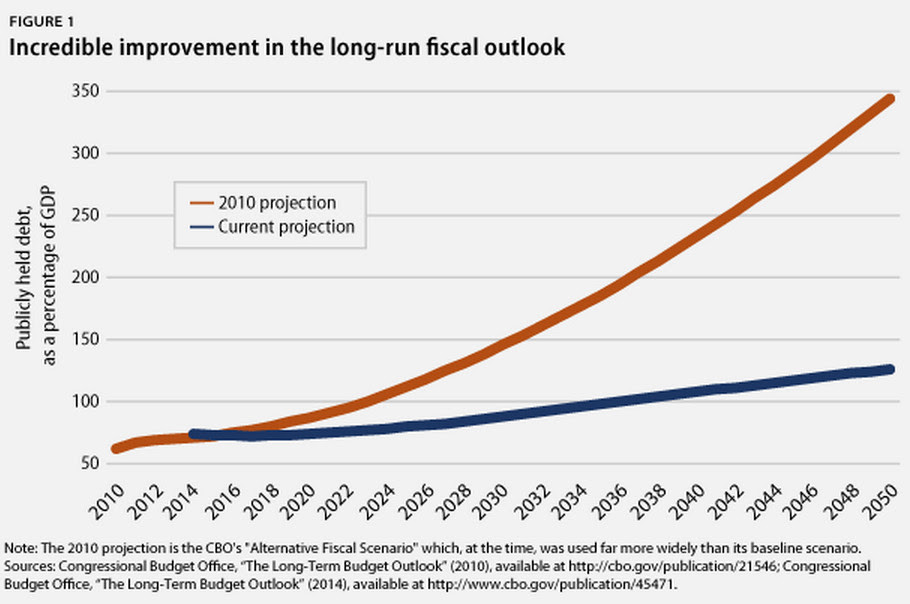
The CBO found that, despite relentless panic about supposedly out-of-control government spending, the long-term path of federal debt has dramatically improved lately. You can see that in this second CAP chart, showing the CBO forecast for the ratio of federal debt to gross domestic product:

debt outlook

Budget cuts have probably helped bring down the long-term debt outlook a bit. But an improving economy has helped much more, by raising tax revenue and dramatically shrinking the government's annual budget deficit.

The CAP study is the latest in a series of studies tallying the costs of austerity. The long and short of it: Less austerity in the short term would have meant more growth, less unemployment and an even faster-shrinking deficit in the long term.

Friday, March 21, 2014

Guerilla class warfare: IRS audits fewer rich, more poor people

Channeling the spirit of my man David Cay Johnston, I'm gonna tell you why this mundane story matters.

See, Republicans in Congress cynically under-fund the IRS year in, year out. So an undermanned, undertrained IRS makes do and does what comes easier, relatively -- auditing people with lower incomes. Because higher-income filers have lawyers and complicated returns and it requires more manpower to check them.  

What this works out to, in reality, is a calculated game of probability by rich filers: if you're wealthy, and you're lawyered up, chances are you'll come away unaudited; and even if you are audited, you'll come away unscathed.  

And so wealth inequality is a double-whammy for the poor and working class: earning so much less, they are still more likely to be audited. 

BECAUSE THAT'S THE WAY THE GOP WANTS IT.  Don't be naive and believe otherwise.

Finally, do I really have to explain how this makes no business sense?  As every auditor knows, you focus your attention on the weakest control points with the highest potential for losses. The potential for losses among poor filers is minimal, almost nil.  

All the Tea Partyers who are serious about fiscal health should cheer on  the IRS, because every dollar spent on the IRS  brings in $255 to the U.S. Treasury. Just by enforcing existing tax laws passed by Congress, nothing more. No other government agency can boast of such efficiency!  And so it's time for the TPs to put up or shut up about the IRS, the only government agency that reduces the federal deficit.


By  Patrick Temple-West
March 21, 2014 | Reuters

The U.S. Internal Revenue Service said on Friday that it audited fewer high-income Americans in 2013 than it did in 2012 or 2011, while it conducted more audits of people with no income.

Total audits fell by 5 percent from 2012 to reach the lowest level since 2008 as the IRS said it coped with budget cuts.

For the fiscal year that ended September 30, 2013, the IRS said it audited 24.2 percent of individual tax returns with adjusted gross income of $10 million or more. That was down from 27 percent in 2012 and 30 percent in 2011.

There were also fewer individual tax returns audited in the $5 million to $10 million gross income band, the IRS said.

In total, the IRS audited about 1.4 million individual returns. IRS Commissioner John Koskinen said in a statement that budget cuts at the agency have "presented challenges."

Wealthy Americans historically are the likeliest to be audited. The IRS a few years ago started a "Global High Wealth Industry Group" to audit high-wealth individuals more efficiently.

But Congress in January cut the IRS's fiscal 2014 budget by about 4 percent to $11.3 billion.

The funding cuts have forced the IRS to cut the number of customer service representatives it employs during tax season, Colleen Kelley, president of the National Treasury Employees Union said in a statement. "Both taxpayers and employees are frustrated."

Last year, audits were done on 6 percent of individual tax returns reporting no gross income, up from 2.7 percent in 2012 and 3.4 percent in 2011.

Sunday, December 22, 2013

America's 'age of unprecedented austerity'

You won't hear this from the mainstream media!

The greatest trick austerians ever pulled was convincing people that it was stimulus that had failed.

And the greatest trick the Koch brothers ever pulled was convincing Tea Party Republicans that deficits are a cause, not an effect.


By Matthew O'Brien
December 20, 2013 | The Atlantic

We're living in an age of unprecedented austerity.

Now, that sounds impossible to conservatives who know, just know, that government has exploded under Obama's socialist watch. And that we have trillion dollar deficits—dun, dun, dun—as far as the eye can see. But I have some good news for them (though not the economy). They're wrong. Government employment has actually fallen under Obama, and the deficit is falling fast too

As Ben Bernanke put it, "people don't appreciate how tight fiscal policy has been." And how much that's knee-capped the economy. Take jobs. Bernanke points out that total public sector employment—local, state, and federal—has fallen by over 600,000 during the recovery alone. As point of comparison, it rose by 400,000 during the previous one.

But even this million person job swing doesn't tell us how historic austerity has been this time. You have to look at the chart below to see that. It shows government job growth during every recovery on record, going back to 1945. This is the least there's ever been.


How is it possible that government added more jobs after World War II demobilization than now? Or after the 1980 recession, which was followed by another recession a year later? Well, it's what Paul Krugman calls the 50 Herbert Hoovers effect. See, state governments are required to (mostly) run balanced budgets, even during a recession. That's usually not too much of a problem as long as the slump is quick or shallow.

But the Great Recession was neither. The crisis hit and tax revenue disappeared—and didn't come back. Now, the federal government did use the stimulus to fill some of these state budget holes, which is why public sector employment didn't fall much in the first year of the recovery. But then the stimulus money ran out—really, it did—and states were left on their own. Like Hoover in the 1930s, they tried to balance their books amidst a depressed economy. And like Hoover in the 1930s, it didn't work out too well. They went on a cops-and-teachers firing spree the likes of which we've never seen before. And one that was the difference between unemployment being 6 instead of 7 percent today.

The greatest trick austerians ever pulled was convincing people that it was stimulus that had failed.

Wednesday, December 4, 2013

Lower corporate tax rate doesn't create jobs

(HT: Peter).  Isn't it funny how all the axioms of Republican economics turn out to be shibboleths?  

Tax cuts on the rich?  Don't trickle down; increase inequality.

Deregulation?  Hurts real people; passes the $ bill onto all of us.

Austerity as a cure for recession?  Increases deficits, hurts job creation.

Work or starve?  ... Well, that one's in play right now. Personally, I think we're going to have more starving and less working, but time will tell. Time will tell. And then so will I, you can bet on it!


By Linda Beale
December 3, 2013  | A Taxing Matter

Friday, September 6, 2013

Fund the IRS to reduce the deficit

This story will drive my dear Republican friends crazy because it's true:

The Internal Revenue Service’s limited, focused exams of federal tax filings—known as correspondence exams—can yield a $7 return for every dollar spent, the Government Accountability Office found in a December report. Even more complex face-to-face investigations yielded a return of $1.8 for every dollar spent.

My man David Cay Johnston mentioned similar stats in his well-researched books Perfectly Legal and Free Lunch and in his articles on tax policy. Recently, Johnston cited a report by Citizens for Tax Justice that found that, [emphasis mine]:

Every dollar invested in the IRS’s enforcement, modernization and management system reduces the federal budget deficit by $200. Here’s another metric. Every dollar the IRS “spends for audits, liens and seizing property from tax cheats” garners ten dollars back.

And as WaPo describes, Mississippi, one of our 50 "laboratories of democracy," increased its spending on tax collection at the state level and got an even better return: $23 for every dollar spent on tax collection!

So why isn't the Grand Old Tea Party demanding that the IRS and every state do the same, to shore up our deficits and restore our fiscal health? Could it be they don't really care about budget deficits at all, only lowering taxes for themselves?.... 


By Niraj Chokshi
September 5, 2013 | Washington Post

Thursday, June 27, 2013

Inequality should matter to conservatives, too

We all know that conservatives don't worry about equality of outcomes; they care about equality of opportunity.  Actually, they don't care about outcomes at all; they only care about establishing rules of the game.  That's a values question, that's conservatives moral bent, although personally I think they're wrong.  We'll never agree.

However, what Bernstein's and other economists' research is showing us is that growing income equality actually diminishes equality of opportunity.  Bernstein talks about it herehereherehere.  This should worry conservatives.  The economic playing field will never be level; but we should be concerned when it's getting more unbalanced every year.

In addition, Bernstein plans to prove that income inequality leads to lower economic growthThat should concern us all, including deficit hawks who want to shore up our federal deficit.  


By Jared Bernstein
June 26, 2013 | Huffington Post

Monday, June 3, 2013

Sanders: Don't accept the 'new normal'

Too bad Bernie's retiring.  He'll be difficult to replace:  

The American people get the economic realities. According to a Gallup poll, nearly six out of 10 believe that money and wealth should be more evenly distributed among a larger percentage of the people in the US, while only a third of Americans think the current distribution is fair. A record-breaking 52% of the American people believe that the federal "government should redistribute wealth by heavy taxes on the rich".

The United States Congress and the president must begin listening to the American people. While there clearly has been some improvement in the economy over the last five years, much more needs to be done. We need a major jobs program which puts millions back to work rebuilding our crumbling infrastructure. We need to tackle the planetary crisis of global warming by creating jobs transforming our energy system away from fossil fuels and into energy efficiency and sustainable energy.

We need to end the scandal of one of four corporations paying nothing in federal taxes while we balance the budget on the backs of the elderly, the children, the sick and the poor.

What we have now is upwards wealth redistribution, from the pockets of workers to the corporate managers and stockholders.  Then these same people tell us we need to balance our federal budget.  They should be run out of town with torches and pitchforks!


By Senator Bernie Sanders
June 2, 2013 | Guardian

Thursday, May 23, 2013

Simple chart shows unfairness of U.S. tax system

What's a fair amount of tax for corporations to pay?  I can't tell you because the answer might change over time, and everything is relative.

However, what's certain is that corporate taxes as a share of total U.S. tax revenue have gone down since the golden era of the 1950s, 60s and 70s.  This is a strong indication that something is out of whack.

Meanwhile, payroll taxes that hit the low and middle class the hardest have ballooned in size, relatively.

What I also find interesting is how individual income tax as a source of federal revenue has remained fairly steady, despite the fact that many businesses are now allowed to pay tax as individuals. You might think, for example, that as corporate tax receipts went down, individual income tax receipts would go up, but that is not the case.  This chart doesn't tell us enough to say why.  But recessions and Dubya's tax cuts probably have something to do with it.

federal revenue


By Mark Gongloff
May 22, 2013 | Huffington Post

Saturday, April 20, 2013

Have historians been unfair to Dubya?

Prof. Stephen Knott argues that Dubya has been treated unfairly by historians making their Best & Worst Presidents lists.  (As if their lists matter to anybody, but let's forget that for now....)

There are two ways to evaluate the success of a U.S. president: by what the evaluator thinks a president did right or wrong; or by how effectively a president got what he wanted; furthermore, one could evaluate how enduring were the gains a president won.

By the first measure, many people, including many Republicans, think Bush was a failure. But partisanship, ideology and ego affect our judgment, so it's one of those things best left to argue over beers. By the second measure, however, I'd argue that Bush was pretty darn successful, unfortunately. And his "achievements" endure.

Why do I say "unfortunately"? We had a recent example. Last night, when noting the nation's reaction to the apprehension of the Boston bombers and their alleged Islamist beliefs, I posted"It's still Dubya's America and we're just living in it... including President Obama."

That is, I meant that Dubya and his team (including his team at FOX News and Clear Channel) have been extremely successful in framing our view of Muslims, so successful that even President Obama seems prisoner to our prejudices.  The Left is silent while Obama is under constant pressure by the Right to link the entire religion of Islam to terrorism.

Here's the latest bulletin from the conservative GWOT Language Police: "The language of terror," by Charles Krauthammer.  You have to read through a lot of nothing to get to Krauthammer's point at the very end:

Obama has performed admirably during the Boston crisis, speaking both reassuringly and with determination. But he continues to be linguistically uneasy. His wavering over the word terrorism is telling, though in this case unimportant. The real test will come when we learn the motive for the attack.

As of this writing, we don’t know. It could be Islamist, white supremacist, anarchist, anything. What words will Obama use? It is a measure of the emptiness of Obama’s preferred description — “violent extremists” — that, even as we know nothing, it can already be applied to the Boston bomber(s). Which means, the designation is meaningless.

You see, it makes all the difference in the world that the Boston bombers' alleged motivation was Islamist beliefs, and that our President says so. Why? Well, it's obvious, isn't it? Because it's ammunition for those who want to categorize all Muslims, including legal U.S. residents and citizens, as suspected terrorists. There's no other reason for the Right to police this language issue so severely. 

And as George Orwell warned us, language controls our thoughts. Control our language, control our thoughts. That is just one "achievement" of the successful George W. Bush "imperial" presidency, but it's a mighty one.

How about some more?  Bush's Great War on Terra (GWOT) continues and even escalates: with drone attacks, G'itmo, sanctioned rendition and torture, domestic spying and Internet surveillance, prosecuting government whistle blowers, and assassinating U.S. citizens when they are overseas. Obama continues Bush's extra-constitutional practice of presidential signing statements. Bush's occupations of choice in Afghanistan and Iraq are inexorable; Obama cannot or will not get out of them. Deregulated Wall Street banks may still gamble, legally, with depositors' and taxpayers' free money and are now Too Bigger To Fail. Deregulated for-profit colleges that live on government-backed student loans still hold the majority of student debt, now at $1 trillion. The budget of Bush's Department of Homeland Security now rivals the Pentagon's. Bush's unfunded Medicare Advantage entitlement is still wildly popular even among seniors in the Tea Parties... yet to put Medicare's finances back in order requires cutting or reforming Medicare Advantage, giving Republicans the opportunity to accuse Democrats of "cutting Medicare." Clinton's federal assault-weapons ban was allowed to expire in 2004; meanwhile right-to-carry and concealed-carry laws were passed in most states with Bush's encouragement, even as mass shootings increased.  And speaking of guns, Obama ironically got blamed for Bush's "Fast and Furious" "gunwalking"/drug-interdiction program by the ATF. And finally, Bush's unaffordable tax cuts on the very wealthy are now sacrosanct even among Democrats who once fought them, even in the worst economic climate since the Great Depression, with the two aforementioned wars still on the nation's credit card, unpaid for.  

As a result of all this and more, Bush increased our national debt 91 percent ($5.9 trillion), and yet somehow escapes blame for it; meanwhile spineless Democrats are ready to apologize for Obama's deficits (totaling $4.9 trillion or a 41 percent increase over FY 2009) caused by Bush's Great Recession and two unfinished wars. For that political magic act, we are compelled to acknowledge that Dubya was a brilliant politician. Obama is a dunderhead by comparison.

I haven't read Knott's book, but based on its title, Rush to Judgment: George W. Bush, the War on Terror, and His Critics, it probably highlights Bush's achievements in fighting terrorism.  If that's so, then Knott has an excellent case to make that Bush got everything he wanted and more, i.e. he was pretty darn successful. Too bad for us. 

UPDATE (04.24.2013): Ralph Nader repeats a lot of what I've said in his op-ed: "Obama Is Comfortable With Bush's Inferno." 

UPDATE (04.26.2013):  Here's an acerbic take on Dubya's strategy of "Keep Quiet and Hope They Forget" by Alexandra Petri: "George W. Bush was the greatest president of all time, ever."  It's working.  Dumbo has outsmarted us again.  [Facepalm.]


By Stephen F. Knott
April 20, 2013 | Washington Post

Thursday, April 18, 2013

Baker: Errors by deficit-hawk economists cost how many jobs?

[HT: Vern.]  This is a somewhat technical piece, but it suffices to say that it takes down one of the principle economic arguments for austerity and deficit reduction.

How much real-world damage was caused by policy makers acting on R&R's flawed economic analysis by cutting public expenditures during an economic crisis thereby exacerbating the economic downturn?

Getting economics right matters to millions of real people!


By Dean Baker
April 16, 2013 | CEPR

Sunday, March 24, 2013

'Inconclusive' link between public debt, interest rates

Empirical data refutes the conservative mantra that higher government debt always leads to higher interest rates, thereby "crowding out" private investment:  

In a paper published by the National Bureau of Economic Research in April 2005, Columbia University economist R. Glenn Hubbard and Federal Reserve economist Eric Engen declared as “inconclusive” the link between government debt and interest rates. Hubbard headed George W. Bush’s White House Council of Economic Advisers from 2001 to 2003.

“While analysis of the effects of government debt on interest rates has been ongoing for more than two decades, there is little empirical consensus about the magnitude of the effect, and the difference in views held on this issue can be quite stark,” they wrote.

In fact just the opposite can happen:

Deficits as a share of the U.S. economy have risen sharply at times with little to no discernible impact on the level of U.S. interest rates. In fact, just a cursory look at periods when the U.S. ran large deficits as a share of (the total economy) – 1983, 1991-92, 2008-2012 – we actually saw declines in nominal long-term (lending) rates,” said [Scott] Anderson [chief economist for Bank of the West in San Francisco].

He noted that the yield, or return on investment for bondholders, has not and did not rise sharply. “So the link between high levels of government spending and borrowing does not appear to raise the cost of money during these periods and therefore would not crowd out private consumption and investment,” Anderson said.

Just to show how fair & balanced I am, here's a recent WSJ op-ed that warns against a "fiscal dominance" scenario in the U.S., where debt-to-GDP consistently exceeds 80 percent, interest rates shoot up, debt increases even more, interest rates shoot up even higher, and a "fiscal death spiral" ensues.  Theoretically this is possible, but since this scenario depends a lot on "investor confidence," that means everything is relative.  Take Japan for example. Its debt-to-GDP ratio has been over 150 percent for years. It's now 225 percent. Yet Japan's borrowing costs remain low because of real deflation and the relative strength of the Japanese yen.  


By Kevin G. Hall
March 20, 2013 | McClatchy Newspapers

Sunday, March 17, 2013

The morality of capitalism v. redistribution

Where to begin with the question "Is capitalism moral"? Let's start with the title. Kind of a loaded question. Anyway let's be precise. Pearlstein is really discussing political economy, i.e. how our laws and governance influence commerce and the general welfare. Pearlstein means to debate the role that government should play in the economy. 

To start, Pearlstein correctly notes that, "For most of the past 30 years, the world has been moving in the direction of markets," and yet increasingly over that same period we have "stagnant incomes, gaping inequality, a string of crippling financial crises and 20-somethings still living in their parents’ basements."

Thus Republicans have pivoted, Pearlstein says, to focusing on capitalism's moral superiority because they certainly can't make a prima facie case for capitalism's benefits. Unfortunately, Pearlstein takes their bait and tries to analyze, more or less objectively, which side -- the "free-market capitalists" or the "redistributionists" -- is indeed morally superior, and the flaws with each.

The truth, as with most things, is muddled and complicated.  But I want to lay down a few markers. First, very few liberals/progressives/Democrats insist on having this "moral" debate. Why? Because we liberals are outcome-based. By contrast, conservatives and free-marketeers believe that one's moral principles should determine the rules of the game, and if one's moral principles are sound, then ipso facto, the results will take care of themselves. More precisely, conservatives believe that economic results are morality-free; only our political economics must be morally sound.

Let's admit though that his whole debate has been predicated by recent shitty economic outcomes. For a liberal, a more appropriate question would be to ask: whose political economy is the most responsible for the shitty state of today's economy?  True liberals would be even more precise: what specific policies have led us to these terrible outcomes? Conservatives would obviously like to dodge this question, and instead talk in philosophical or moral abstractions, parables and anecdotes, because the facts -- the results -- of their 30 years of neo-liberal rule do not support the morality of their political economy.

Second marker: to quote Paul Rosenberg: "economics used to be called 'political economy', because the great classical economists never lost sight of the fact that economics was a thoroughly political activity, not something outside of the life of a political community." In other words, economics never, ever, ever happens in a political vacuum. Thus, the notion that, in some ideal country, the free-market capitalism of Adam Smith hums and churns along for the betterment of all, unfettered by and independent of government, is naive and silly. Government has a role to play, it sets the rules of the economic game, we all know that.  To what extent government is involved is a matter of degrees. 

Again, liberals believe that government's role should be evidence- or outcomes-based, i.e. tweaked according to the outcomes achieved, whereas conservatives believe that outcomes, like people, should take care of themselves. What's important for them is to set up a system of rigid, unchanging moral conditions under which people operate.

Third marker: noting the terrible results of recent deregulation, privatization-outsourcing and tax cutting is not the same as saying "capitalism is bad." Conservatives and perhaps Pearlstein would like to provoke us liberals into saying that. It's not necessary, or rather, it's an academic argument rather than a real one, since we have not had a "free-market" system for a very long time, if ever. Indeed the U.S. Government has been "meddling" in the economy for a very long time, just in different ways and to varying degrees. 

The recent political-economic bag is mixed: just as union membership has been plummeting, charter schools have been blooming, taxes on the One Percent were being cut, and regulations on Too Big To Fail banks were being torn down, so was USG spending on the military-industrial complex going through the roof (Afghanistan, Iraq, and the Department of Homeland Security apparatus), not to mention Dubya's tremendous addition to the Medicare entitlement -- altogether resulting in a 91 percent increase in our national debt from 2002-2009. 

To be sure, we also had the Great Recession from 2007-2009 that is almost entirely to blame for our persistently high unemployment and deficits since then. This begs the question: what political-economic philosophy was more responsible for the Great Recession? Because we wouldn't be having this discussion right now if it weren't for the Great Recession. You could skip all the junk I wrote above and below, and if you answer this one question correctly, then you are nearly at the truth....


But anyway, back to Pearlstein. He critiques liberals because "they have yet to articulate the moral principles with which to determine how far the evening-up [redistribution] should go -- not just with education but with child care, health care, nutrition, after-school and summer programs, training, and a host of other social services."  There are two big problems with where Pearlstein is going with this.

First, his critique is simply untrue. Liberals have laid out their moral principles, most eloquently in President Roosevelt's 1941 "Four Freedoms" speech that included the "freedom from want," and then in President Johnson's "Great Society" initiatives in the 1960s.  


In fact, our moral calculus is much easier to understand than conservatives'. We believe that, in the richest, most powerful nation in the history of the world, nobody should go hungry, uneducated or without health care. Furthermore, we believe that our nation's children, elderly and disabled deserve special care and protection, including additional food, medical and housing assistance. This is pretty easy to understand, and to verify. Can a child perform well in school relative to his peers? Does a person go hungry or malnourished? Does a child have a roof over his head? And so on. Depending on the answer, we have a moral obligation to do something. It couldn't be easier to understand.

Second problem: Pearlstein asks liberals to lay out: 1) our moral principles [check]; but also, unfairly, 2) a formula for government redistribution that is clear and will work forever and ever, amen. That's just childishly naive, I'm sorry. Pearlstein needs to get real. First, he ignores political reality that demands compromise. Nobody gets his way all the time, 100%. And let's just remind ourselves why this matters: if tomorrow President Obama would say that a "fair share" of taxes on the One Percent was, say, 30 percent, then this would be all anybody could talk about. Conservatives and their armies in think tanks, cable and talk radio would parse and mince it to death for weeks and months. When in fact it's all relative; and liberals don't care what the number is, as long as it generates sufficient revenues and ensures economic growth. (But historically, until the 1980s, the top marginal rate didn't fall below 70%).  At the end of his essay, Pearlstein admits as much:

Moral philosophers since Adam Smith have understood that free-market economies are not theoretical constructs -- they are embedded in different political, cultural and social contexts that significantly affect how they operate. If there can be no pure free market, then it follows that there cannot be only one neutral or morally correct distribution of market income.

Second, Pearlstein fails to acknowledge that liberals, unlike conservatives, think and act according to feedback loops: from problem/result --> intervention --> result/problem, and so on. Therefore, without observations of actual events, we cannot tell you what will be a fair and equitable taxation rate 5, 10 or 50 years from now, or a fair distribution of wealth. We won't even hazard a guess. 

Such tolerance for uncertainty drives doctrinaire conservatives to conniption. But that's a fundamental difference between us.  Therefore, a real liberal would start with our current and projected expenditures and sources of revenue and go from there; he wouldn't start the analysis with, "Well, it's just plain unfair and immoral for somebody to pay more than x percent of his gross income in taxes."  And besides, if that is my "moral" conviction, then how in the world can we debate that? We'd start at an impasse.

Pearlstein does argue that the distribution of economic rewards will shift over time, but liberals already know this:

[T]he way markets distribute rewards is neither divinely determined nor purely the result of the “invisible hand.” It is determined by laws, regulations, technology, norms of behavior, power relationships, and the ways that labor and financial markets operate and interact. These arrangements change over time and can dramatically affect market outcomes and incomes.

Pearlstein's next critique of liberals is that they "have been able to create a welfare state only by addicting a middle-class majority to government subsidies -- subsidies that now can be financed only by taking more and more money from the rich." 

Do I really need to cite statistics about tax and income inequality and the disappearing U.S. middle class?  If so, read thisthisthisthis and this. And don't even get me started about the $29 trillion bank bailouts, that primarily went to save financial markets in which the top One Percent owns 42 percent of all financial wealth, and the top 20 percent owns about 90 percent. The TBTF bank bailouts clearly demonstrate who is really "addicted" to Big Government and to what degree! 

Overall, although Pearlstein leans conservative, he touches on most of the important questions. The main take-aways from our debate are these:

  • Pure capitalism (or socialism, for that matter) has never existed anywhere, nor can it;
  • We are only worried about rising deficits and redistribution payments because of the Great Recession that in turn resulted from financial deregulation that conservatives support, even to this day;
  • Liberals should never feel obligated to justify the morality of their political economy, when if fact we are much clearer on this than conservatives who claim to care about the poor just as much as we do, yet have no idea how to remedy persistent poverty;
  • Liberals should not fall into conservatives' trap of naming "ideal" marginal tax rates, debt:GDP ratios, or anything of the kind, because 1) it's unwise tactically, in a political system that demands compromise, and 2) the correct answers will change over time.

A final note on political-economic morality: Pearlstein doesn't mention it but I will: conservatives' economic morality depends on personal pain and suffering. They firmly believe that pain teaches us lessons and can be personally redeeming; therefore, for redistributionist Big Government to deny a person the pain that he "deserves" is to deny him the chance to learn and improve himself.  

There is also a religious conservative variant of this belief: even if one's suffering wasn't caused by one's poor decisions, it may still be part of God's plan for that person; therefore, for redistributionist Big Government to prevent that pain and suffering is to interfere with God's plan for that person. Moreover, government assistance to a suffering person denies true Christians the opportunity to curry favor with God by performing charitable works for that suffering person. 

I hope I don't have to explain how sick and twisted such moral reasoning is, much less why it cannot be the basis for our country's political economy....

Finally, a note on redistribution. I will take the liberty here of quoting myself at length:

[L]et's recall for a minute what the U.S. Government -- any government from the dawn of human civilization -- actually does, in pure basics: it collects taxes from the people how it sees fit, and then spends that money how it wants. It does not, for example, say, "Mr. David Koch, since you contributed 0.01 percent of federal income tax revenues in FY 2011, we are allocating 0.01 percent of the FY 2012 federal budget to you."  

Since our government doesn't do this -- since no government has ever done this, ever -- then by definitionwhat our government does is redistribute wealth.  Moreover, sooner or later all government spending ends up in private hands -- just not necessarily (and not usually) in the hands that gave it its money in the first place.  If that's not redistribution then I don't know what is.

By Steven Pearlstein
March 15, 2013 | Washington Post

Saturday, March 16, 2013

Study: Millionaires ARE different

Shocker: millionaires care the more about capital gains taxes and the federal deficit than they do about jobs and a living wage for their fellow Americans. Well knock me over with a feather.


By Joshua Holland
March 11, 2013 | AlterNet

Friday, March 15, 2013

Iraq cost $2 trillion so far, $6 trillion, total

Yet more proof, by their years of silence, that Tea Partyers don't care about useless spending and deficits, they just can't stand poor Americans. That's the very definition of "class warfare."


By Daniel Trotta
March 14, 2013 | Reuters

Ryan's budget either dumb or disingenuous

BOO-ya! Miller can't miss with this shot at the demographically challenged Congressional GOP:

Did I mention that Ronald Reagan ran the federal government at 22 percent of GDP when the country’s population was much younger, and health care consumed about 11 percent of GDP?

Now Paul Ryan says we can run the federal government at 19 percent of GDP as the massive baby-boom generation retires and when health costs (largely for seniors) have already soared to 18 percent of GDP.

Sorry, but Ryan is either deeply confused or doing his best to snooker us.

Miller puts in other words, same upshot:

In 1989, when President Reagan left office, there were 34 million people on Medicare and 39 million on Social Security. In 2025, according to these programs’ trustees, there will be 73 million on Medicare and 78 million on Social Security.

This is not happening because we’re stringing up the “hammock of dependency” that Ryan often invokes. It’s happening because our famously big postwar birth cohort is getting older.

Ryan obviously knows these facts. This means he’s disingenuously trying to use the aging of America to force a severe cutback in the non-elderly, non-defense portion of government, which is already headed toward historic lows as a share of GDP.

And here's what would happen if Ryan got his way:

At 19 percent, Ryan’s vision is an America with 50 million uninsured ... forever. Of infrastructure and R&D investment that trails other advanced nations ... in perpetuity. Of a nation that assigns its least effective teachers to poor children . . . permanently. (Amazingly, Senate Democrats have fallen prey to Ryan’s gravitational pull, with the budget they put out Wednesday coming in at 21.7 percent of GDP in the years ahead, a tad below Reagan-era spending.)

Ryan thinks we’re too dumb to see what he’s up to.

Well I'm not that dumb. Are you? 


By Matt Miller
March 14, 2013 | Washington Post

Teabaggers, turn your knives on the DHS!

If budget-cutting Tea Partyers could only harness their negative energy for good, then they would surely be protesting in Washington and raising a ruckus at town hall meetings in order to abolish the Department of Homeland Security.

Think about it. They are deathly afraid of Big Government tyranny. They routinely make up non-existent threats like Obama's private army and FEMA concentration camps. Meanwhile, right in front of their faces is this enormous, amorphous DHS and they ignore it. Why? Because it was Dubya's monster?

Kramer and Hellman are right to point out the DHS's' similarities with the Department of Defense -- verily, the Department of Offense. They call the DHS another rabbit hole down which billions of taxpayer dollars disappear with scant oversight.

Teabaggers, get your act together and do something useful for a change!  P.S. -- Here's a 2002 op-ed by proto-teabagger Ron Paul entitled "The Homeland Security Monstrosity."  Enjoy.


By Matte Kramer and Chris Hellman
March 14, 2013 | Al Jazeera

Saturday, February 16, 2013

Deficits are not a problem; actuaries are not oracles

Worrying about U.S. federal deficits in this down economy is like worrying about what your lawn will look like in 20 years when you're house is on fire right now.


By Derek Thompson
February 15, 2013 | The Atlantic

The showdown between Joe Scarborough and Paul Krugman over our debt is interesting and important, not merely as a media skirmish, but also as a keyhole into the way deficit "hawks" and deficit "doves" misunderstand and talk past each other. A great deal of the animosity and confusion between both sides of the debate would be improved with an honest assessment today's economy and tomorrow's debt. 

Basically, this is a discussion about (a) what we know about the economy and (b) what we think we know about the economy.

WHAT WE KNOW

Here are six things we know about the economy. [1] We know that unemployment is still high. [2] We know that inflation is low. [3] We know that 4 million people have been out of work, and looking, for more than a year. [4] We know that GDP growth has been fine for normal times, but awfully weak for a recovery following a steep recession. [5] We know that cutting government spending takes money out of an economy. [6] We know that government spending cuts in the last few years have coincided with hundreds of thousands of lost government jobs, which has kept our unemployment rate from falling further.

And here are four things we know about our debt. [1] We know that government borrowing rates are low. [2] We know that global appetite for our debt is high. [3] We know we borrow in our own currency, and not, like Europe, in a common currency that we don't control. [4] And we know that makes us less vulnerable (but not invincible) from a debt crisis.

Out of these ten things we know, how many of them suggest that we should cut our deficits today? Basically, zero. And that's Paul Krugman's point. Everything we know about the economy today provides a clear argument for elevated deficits.

WHAT WE DON'T KNOW

Joe Scarborough understands this. He says he wants higher deficits and a game-plan for cutting our long-term debt (which is the accumulation of our deficits). But he doesn't fully understand -- or properly communicate -- how the argument for long-term debt reduction rests on assumptions about the future that are exquisitely sensitive to change. The precise dimensions of our 2020 debt are calculated from a matrix of variables (e.g. immigration, productivity growth, hospital construction growth, MRI inflation rates) whose very nature is to fluctuate, sometimes dramatically, on a quarterly or annual basis.

Here are four things we think we know about our future debt -- which is almost entirely a health care spending problem. [1] We think we know that the cost of caring for Americans will continue to grow faster than the economy. [2] We think we know that demand for this increasingly expensive care will grow along with our aging boomer population. [3] We think we know that tax revenue will grow about in line with the economy. [4] Thus, we think we know what the gap between future taxes and future spending will be, and how much we have to start saving today to cover it.

It's possible that the deficit hawks have it 100 percent right. But it would also take a rather astonishing clairvoyance for anybody to foresee the next ten years with even slightly useful clarity. Scarborough and Mika Brzezinski often talk about "math" when they talk about debt ...

... and our debt projections look like math, what with all of those numbers. But math is a law. Actuarial projections are not. They are smart guesswork facilitated by multiplying current trends over many years. There's an important difference.

For example, what if health care inflation slows down?

Actually, that's not a "what-if." Two weeks ago, CBO revealed that health care spending has "grown much more slowly than historical rates would have predicted." It cut estimates of federal spending on Medicaid and Medicare in 2020 by "about $200 billion." That's a lot of money. It is much more than Washington would save by raising the Medicare eligibility age from 65 to 67. If you thought raising the retirement age was enough to calm the market's appetite for debt reduction, then guess what? We just got 2X those savings by doing nothing.

It's generally considered goofy for somebody to pretend he can see the next 75 years in robotics, or software, or bio-sciences.  But somehow it's not goofy for Joe Scarborough, Steven Rattner and other serious, well-intentioned media people point out that we have $60+ trillion in "unfunded liabilities" to Social Security, Medicare, and federal pensions in the next seven decades. That statistic isn't wrong. It's just kinda ... goofy. Medicare actuaries are legally obligated to predict the future of their program past 2070.But the press [and the public! - J] is not legally obligated to pretend that our actuaries are oracles.

Paul Krugman isn't an oracle either. He's just a very smart economist with an astonishingly good track record. And even he isn't saying that debts don't matter. In fact, he's saying almost exactly what Alan Blinder -- an economist Scarborough cites approvingly -- wrote in The AtlanticDon't worry too much about deficits now, and put aside some worry about the future total cost of health care.

Deficit reduction is sometimes framed as stimulus. It's not. It's insurance -- insurance against the possibility that the market will turn against U.S. debt and drive up interest rates and badly hurt the country. Insurance isn't bad. But it's expensive. And money taken out of the economy too soon could prolong an unemployment crisis that is creating structural deficiencies in our atrophying workforce. Deficit doves should concede that there is a risk to doing nothing for too long. But deficit hawks must concede that there is also a risk to taking out that insurance policy too soon -- or distracting attention from everything we know about the economy.
_______________________

Please don't say that our debt is exactly like global warming. It is true that both global warming and debt are arguably subtle and gathering forces whose impact on the world could surprise us somewhere down the line. But unlike our 2020 debt, global warming isn't just an actuarial projection. It's a scientific finding about the world right now. And whereas even deficit hawks allow that there is good debt (right now) and bad debt (in ten years), there is no analogous argument I'm aware of that says global warming is great for the world today -- or that we actually we need more of it! -- but bad for the world tomorrow.