Showing posts with label corporate profits. Show all posts

Monday, September 8, 2014

Harvard survey: Businesses don't want to hire

What about Obamacare?  What about "uncertainty?"  This Harvard competitiveness survey can't be right. I'd rather trust one of those instant click-on surveys on Fox News' homepage.


By Mark Gongloff
September 8, 2014 | Huffington Post

America's capitalists take every chance they get to remind us that they are our "job creators," but it turns out that their least-favorite thing on earth to do is create jobs.

Most U.S. business leaders would rather build robots, outsource work or use part-time employees than hire workers full-time, according to a new Harvard Business School survey. Here's a nice infuriating graphic from the smarty-pantses at Harvard Business School, who are educating all of our future non-job-creators in the art of not creating jobs:

hiring decisions

As you can see from the chart, 46 percent of our job creators would rather spend money on technology than employ humans, compared with a sad 26 percent who prefer people to robots, and another 29 percent who were confused or indifferent about the question or fell asleep while the survey taker was talking. Forty-nine percent would rather outsource than hire, compared with 30 percent who'd rather hire.

Ever notice how the stock market and corporate profits are at all-time highs, while our wages are flat and roughly half of us still think the economy is in recession? This chart helps explain it, and helps explain why workers' share of those corporate profits is near its lowest since the Truman administration.

This is also bad news for the future of the economy because it means fewer workers are getting the training they need for our super-awesome, high-tech, no-job economy, Harvard pointed out:

"Firms invest most deeply in full-time employees, so preferences for automation, outsourcing, and part-time hires are likely to lead to less skills development," the study authors wrote.

This will give business leaders, who already think we lack the necessary skills for their precious jobs, even less reason to hire us in the future.

Tuesday, January 7, 2014

Reich: 2013 saw huge wealth redistribution

Trickle-down economic theory vs. trickle-up economic fact.

I can't say it any better than this. Read the whole thing and get back to me with any questions!


By Robert Reich
January 5, 2014 | Huffington Post

One of the worst epithets that can be leveled at a politician these days is to call him a "redistributionist." Yet 2013 marked one of the biggest redistributions in recent American history. It was a redistribution upward, from average working people to the owners of America.

The stock market ended 2013 at an all-time high -- giving stockholders their biggest annual gain in almost two decades. Most Americans didn't share in those gains, however, because most people haven't been able to save enough to invest in the stock market. More than two-thirds of Americans live from paycheck to paycheck.

Even if you include the value of IRA's, most shares of stock are owned by the very wealthy. The richest 1 percent of Americans owns 35 percent of the value of American-owned shares. The richest 10 percent owns over 80 percent. So in the bull market of 2013, America's rich hit the jackpot.

What does this have to do with redistribution? Some might argue the stock market is just a giant casino. Since it's owned mostly by the wealthy, a rise in stock prices simply reflects a transfer of wealth from some of the rich (who cashed in their shares too early) to others of the rich (who bought shares early enough and held on to them long enough to reap the big gains).

But this neglects the fact that stock prices track corporate profits. The relationship isn't exact, and price-earnings ratios move up and down in the short term. Yet over the slightly longer term, share prices do correlate with profits. And 2013 was a banner year for profits.

Where did those profits come from? Here's where redistribution comes in. American corporations didn't make most of their money from increased sales (although their foreign sales did increase). They made their big bucks mostly by reducing their costs -- especially their biggest single cost: wages.

They push wages down because most workers no longer have any bargaining power when it comes to determining pay. The continuing high rate of unemployment -- including a record number of long-term jobless, and a large number who have given up looking for work altogether -- has allowed employers to set the terms.

For years, the bargaining power of American workers has also been eroding due to ever-more efficient means of outsourcing abroad, new computer software that can replace almost any routine job, and an ongoing shift of full-time to part-time and contract work. And unions have been decimated. In the 1950s, over a third of private-sector workers were members of labor unions. Now, fewer than 7 percent are unionized.

All this helps explain why corporate profits have been increasing throughout this recovery (they grew over 18 percent in 2013 alone) while wages have been dropping. Corporate earnings now represent the largest share of the gross domestic product -- and wages the smallest share of GDP -- than at any time since records have been kept.

Hence, the Great Redistribution.

Some might say this doesn't really amount to a "redistribution" as we normally define that term, because government isn't redistributing anything. By this view, the declining wages, higher profits, and the surging bull market simply reflect the workings of the free market.

But this overlooks the fact that government sets the rules of the game. Federal and state budgets have been cut, for example -- thereby reducing overall demand and keeping unemployment higher than otherwise. Congress has repeatedly rejected tax incentives designed to encourage more hiring. States have adopted "right-to-work" laws that undercut unions. And so on.

If all this weren't enough, the tax system is rigged in favor of the owners of wealth, and against people whose income comes from wages. Wealth is taxed at a lower rate than labor.

Capital gains, dividends, and debt all get favorable treatment in the tax code - which is why Mitt Romney, Warren Buffet, and other billionaires and multimillionaires continue to pay around 12 percent of their income in taxes each year, while most of the rest of us pay at least twice that rate.

Among the biggest winners are top executives and Wall Street traders whose year-end bonuses are tied to the stock market, and hedge-fund and private-equity managers whose special "carried interest" tax loophole allows their income to be treated as capital gains. The wild bull market of 2013 has given them all fabulous after-tax windfalls.

America has been redistributing upward for some time -- after all, "trickle-down" economics turned out to be trickle up -- but we outdid ourselves in 2013. At a time of record inequality and decreasing mobility, America conducted a Great Redistribution upward.

Thursday, August 29, 2013

MB360: FIRE sector is back, big time

MB360 gives us great stats to illustrate starkly the so-called financialization of the U.S. economy: 

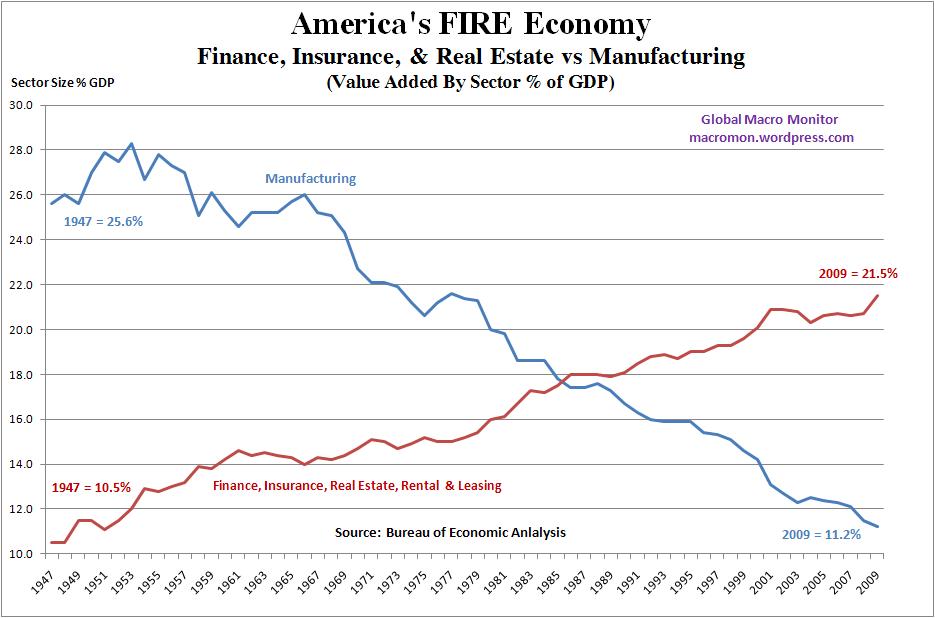
In 1947, the FIRE side of the economy made up roughly 10 percent of GDP. Today it is 21 percent.  On the other hand manufacturing in 1947 made up 25 percent of GDP while today it is closer to 11 percent.

Near-zero interest rates by the Fed and TBTF bank bailouts are direct federal government aid to the FIRE sector.  It's called socializing risk and privatizing rewards.  

Meanwhile, bizzaro conservatives assure us that if only Americans would stop being so lazy and collecting food stamps, then our economy would turn around. [Facepalm].  Foks, this is government-sponsored upward redistribution of wealth.  

If only the Tea Parties would brandish their pitchforks over the real redistribution problem in America!


Posted by mybudget360 
August 27, 2013

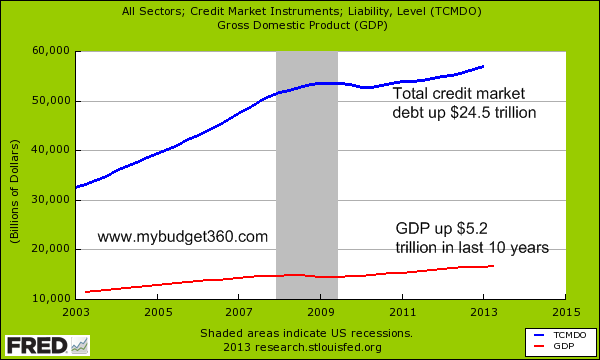
The current economy is juiced on the rivers of easy debt.  An addiction that is only getting worse.  Want to go to college?  You’ll very likely go into deep student debt given the rise in college tuition.  Want a home?  Prices are soaring because of speculation but you’ll need a bigger mortgage to buy.  Want a modest car? A basic new car that has four wheels will likely cost $20,000 after taxes after fees are included.  Need gas for that car?  The price of a gallon has quadrupled since 2000.  Combine this with the reality that half of Americans are living paycheck to paycheck and you can understand why the debt markets continue to grow at an unrelenting pace.  Here is some food for thought; in the last 10 years, GDP has gone up $5.2 trillion however, the total credit market has gone up by $24.5 trillion.  An increasingly large part of our economic growth is coming from massive leverage.  This is why the market sits fixated on the Fed’s next move regarding interest rates even though in context, rates are already tantalizingly low.  The FIRE economy is driving a large portion of corporate profits yet most Americans are left in the cold winds of austerity.

GDP being driven by FIRE

More and more of our growth is coming from a massive expansion of debt:

total credit market debt owed

The total credit market is now roughly 4 times the size of our annual GDP (inching closer to $60 trillion in the US).  While some think that this growth is natural and easy, in reality most of it is coming from growth in the financial services side of the economy.  The banking system is currently operating in a way that really does not benefit the typical Americans family.  Take a look at two employment sectors over the last few years:

fire-economy

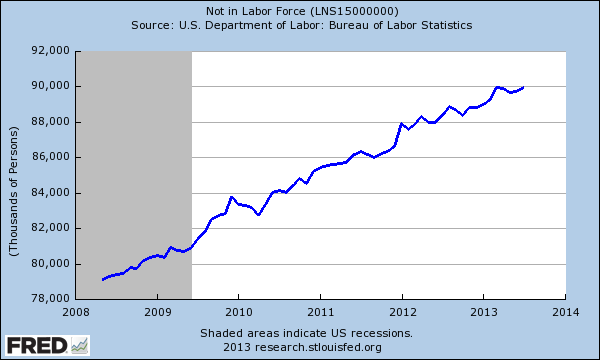
In 1947, the FIRE side of the economy made up roughly 10 percent of GDP.  Today it is 21 percent.  On the other hand manufacturing in 1947 made up 25 percent of GDP while today it is closer to 11 percent.  It comes as no surprise especially as we now see big banks and hedge funds crowding out the real estate trade.  Prices in real estate continue to rise at levels last seen during the bubble yet the homeownership rate continues to fall.  We keep adding more and more Americans as “non-workers” and then wonder why we have 47 million on food stamps:

not in labor force

The number of Americans not in the labor force is booming because of demographics but also because people are dropping out of the workforce.  This certainly doesn’t coincide with some of the data being produced from other channels.

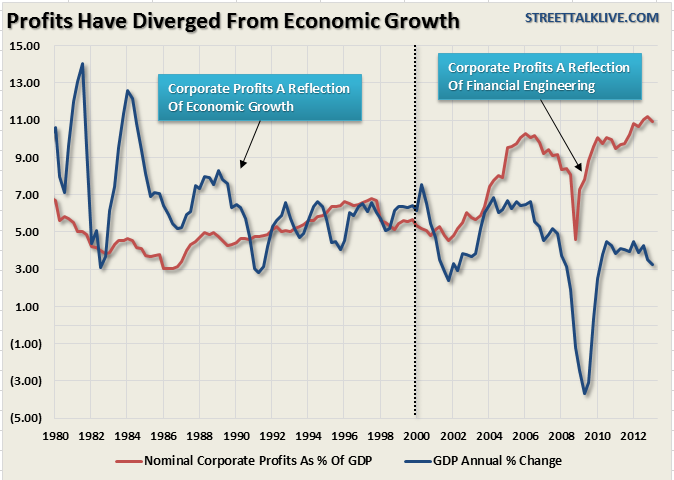
The reason why most Americans are not feeling the recovery trickle down to them is that the FIRE side of the economy is capturing a large share of the profits (more fuel for the growing income inequality trend).  Just take a look at how much of the recent growth has come courtesy of financial engineering:

Corporate-Profits-GDP-081613

Corporate profits as a percent of GDP are at generation high levels.  Yet GDP growth is weak (especially if you consider how much growth is coming from FIRE activity).  This is reflected in stagnant household income growth and the reality that wealth continues to shift into the hands of a very few Americans.

Redoing the last bubble

The problem with all of this is that we are simply redoing the last bubble.  This is a similar variation of our last bubble (i.e., financial sector deep into speculation, quickly rising real estate, no income growth, leveraging on debt, etc).  The finance and real estate side of the economy is driving profits and speculation, yet we see that for most Americans, the gains are simply not there.  This is just part of the financialization of our current system.  It is odd that big banks and firms are so interested in rental real estate yet they can extract money from Americans via this measure because the Fed is basically offering zero percent rates to member banks.  In other words, it is a riskless trade so why not grab all the real assets you can while the Fed continues to devalue the purchasing power of Americans?

The FIRE economy is back in a big way.  Of course you shouldn’t be surprised that this isn’t helping most Americans prosper.

Saturday, May 25, 2013

Obama is a total failure

Obama is a total failure... as a crypto-Marxist.  We all know, despite his lies to the contrary, that he hates business deep down in his heart of hearts, that he really does everything he can to kill America's private enterprise, and yet, and yet... this.  Epic fail.

He gives us far-left ultra-liberals a bad name.  He desperately needs to brush up on his Engels and Saul Alinsky 101.
May 25, 2013 | Huffington Post