Showing posts with label GDP. Show all posts

Thursday, August 21, 2014

U.S. economy stinks because of greedy corporations?

Blodget accurately uses the word "greedy" and "short term" to describe how U.S. corporations are acting -- by cutting back staff, freezing most workers' wages, and buying back stock. 

Yet there's another way to look at these trends: from an orthodox business perspective. Indeed, in my finance course in business school, we were taught that corporate decisions such as buying back shares and issuing big dividends may be popular among investors; yet such actions must also be eyed skeptically by long-term investors, since they are a signal that the corporation can currently find no better use of its profit, such as R&D or capital investment.

 Now jump to the "job creators" myth, and you'll understand why this is relevant: every time Wall Street cheers these short-term gains in stock price, U.S. workers are losing out again, because either somebody's not getting hired or somebody's not getting a raise. And this means less consumption and economic activity (about 70 percent of U.S. GDP).  

And this gets back to the idea of depressed aggregate demand, and why the "job creators" myth is bullshit, because the capitalists (people with money) and the corporate owners (shareholders) and officers, when acting rationally in a system where their customers don't have as much money as they once did to buy their products, stop investing and producing as much, because this seems like the sensible thing to do. And they all do this at once. They are prisoners in the same system that wage-earners and consumers inhabit; they're not divorced from it, at least not in the long term. 

So this idea that job creators, if government would only get out of their way and/or cut their taxes, would behave much differently than they are now, is totally bogus and irrational, because although they are at the top, they are not the commanders of the system, nor do they stand apart from it. 

In fact, as Paul Krugman pointed out back in 2010, and just about every business survey since then has supported, lack of demand (sluggish sales) is the key business problem, not taxes or regulation or general "uncertainty."  


By Henry Blodget
August 19, 2014 | Business Insider


GDP Growth
Business Insider, St. Louis Fed
GDP growth.
The U.S. economy is still sputtering. (See GDP growth chart above.)
Why is growth so slow and weak?
One reason is that average American consumers, who account for the vast majority of the spending in the economy, are still strapped.
The reason average American consumers are still strapped, meanwhile, is that America's companies and company owners — the small group of Americans who own and control America's corporations — are hogging a record percentage of the country's wealth for themselves.
In the past five years, American corporations have boosted their profits and share prices by cutting costs (firing people) and buying back stock. As a result, unemployment remains high. And wage growth for the Americans who are lucky enough to be working has been pathetic — the slowest since World War II.
Meanwhile, America's corporations and their owners have never had it better. Corporate profits just hit another all-time high, both in absolute dollars and as a percent of the economy. And U.S. stocks are at record highs.
Scrooge
Even Scrooge would be appalled.
Many people seem confused by this juxtaposition. If corporations and shareholders are doing so well, why is the economy so crappy?
The answer is that one company's wages are other companies' revenues. Americans save almost nothing, so every dollar we earn in wages gets spent on products and services (including, in some cases, those of the companies we work for). The less that American companies pay their workers, the less American consumers have to spend. And the less American consumers have to spend, the slower the economy grows.
This isn't a complex concept. We're all in this together. People make it complicated by casting it as a political issue and inflaming partisan tensions. But it has nothing to do with politics.
Importantly, it doesn't have to be this way.
There's no "law of capitalism" that says that companies have to pay their employees as little as possible. There's no law of capitalism that says companies have to "maximize short-term profits." That's just a story that America's owners made up to justify taking as much of the company's wealth as possible for themselves.
Ironically, this short-term greed on the part of America's owners is most likely reducing their long-term wealth: Companies can't grow profits by cutting costs forever, because their profits can't grow higher than their revenues. At some point, revenue growth needs to accelerate. But that won't happen until companies start sharing more of the wealth they create with the folks who create it — their employees.
Let's go to the charts ...
1) Corporate profit margins just hit another all-time high. Companies are making more per dollar of sales than they ever have before. (Some people are still blaming economic weakness on "too much regulation" and "too many taxes." That's crap. Maybe little companies are getting smothered by regulation and taxes, but big ones certainly aren't. What they're suffering from is a myopic obsession with short-term profits at the expense of long-term value creation.)
Corporate profits
Business Insider, St. Louis Fed

Profits as a percent of the economy.
2) Wages as a percent of the economy just hit another all-time low. Why are corporate profits so high? One reason is that companies are paying employees less than they ever have as a share of GDP. And that, in turn, is one reason the economy is so weak: Those "wages" represent spending power for consumers. And consumer spending is "revenue" for other companies. So the profit obsession is actually starving the rest of the economy of revenue growth.
Wages
Business Insider, St. Louis Fed
Wages as a percent of the economy.
In short, our obsession with "maximizing profits" is creating a country of a few million overlords and 300+ million serfs.
Don't believe it?

Tuesday, June 24, 2014

Russia's corrupt resource economy behaves opposite Western expectations

It runs absolutely counter to our Western intuition and sense of justice, but as Vladislav Inozemtsev points out, Russia's corrupt officials actually benefit in times of global economic crisis, both in terms of their personal wealth and public support.

Concludes Prof. Inozemtsev in this op-ed in the Moscow Times [emphasis mine]:

Today's Russia is not a normal country. A significant portion of people who can adequately assess the situation either left the country or are leaving it right now. Many entrepreneurs sold their businesses to bureaucrats and pulled money out of the country, realizing the futility of their labors.

[...]   Of course, the problems are piling up — so sometimes they will come out. But both the speciality of Russia's situation and its difference from these in democratic market economies lies in the fact that the first alarm signals will sound when it will be too late to react. We will probably see a repetition of the dramatic events of the late 1980s — but, of course, this may not happen for awhile. Time during which economic problems will not preoccupy the Russian president — leaving him free to surprise the world once and again with his political follies.

It's well worth reading in its entirety to understand today's very strange Russia!


By Vladislav Inozemtsev
June 24, 2014 | The Moscow Times

Saturday, June 7, 2014

HBR blogs: Western malaise spawns extremist parties

Mr. Haque at Harvard Business Review offers us as good a summary as any of the Western economic malaise [emphasis mine]:

While the super-rich are vastly disproportionately enjoying the fruits of global prosperity, too many are being left behind. What is common in societies with extremists on the rise? The poor and the middle feel cheated — because they are. In the sterile parlance of economics, their wages aren’t comparable to their productivity — but more deeply, their lives are literally not valued in this system. And so they turn, in anger and frustration and resignation, to those who promise them more.

In all these societies, social contracts prize growth over real human development. Economies “grow”; but the benefits of growth are enjoyed vastly disproportionately by a small coterie of people — usually those politically connected; at the very top of a socially constrained pecking order; a caste society. We are told this is capitalism; in fact, it’s a perversion of free markets I call “growthism.”

Indeed, we were never meant to worship at the altar of GDP, the DOW or Nasdaq as real indicators of people's well-being.  

And as I've remarked before, U.S. workers are the most productive in the world; meanwhile, U.S. labor practices are among the most efficient (meaning, hands-off) -- 4th in the 2013-14 WEF rankings -- in the globalized economy. So why do U.S. workers feel so insecure and put-upon?  

As before, John Maynard Keynes foresaw this and pointed the way [emphasis mine]:

Yet, today, the situation Keynes foresaw is repeating itself — only more subtly. The problem today isn’t a small number of creditor nations, to whom the vast benefits of global wealth are flowing. It is a small number of super rich individuals: oligarchs, monopolists, scions. In a sense, the same problem, of vast, unjust imbalances, has reemerged; this time beyond national boundaries. Today, the super-rich and their empires span multiple nation-states; whisked from home to home and country to country by private transport, they use different infrastructure (who cares if roads and airports are crumbling when you’ve got a helipad?), play by different rules (do tax laws really matter if your assets are all offshore?), and even different methods of wielding political influence (why knock on doors when you can fund your own super-PAC?).

Here's how Haque sums it up:

The paradox of prosperity is this. It is at times of little that we must plant the seeds of plenty; not fight another for handfuls of dust. And it is at times of plenty when we must harvest our fields; and give generously to all those who enjoy the singular privilege of the miracle we call life.

(Nope, extremists; that’s not communism — not government redistribution of dust. It is, as Keynes foresaw, just common sense).

Once again I tip my hat to Keynes, a giant among men.


By Umair Haque
June 5, 2014 | HBR Blog Network

Thursday, May 15, 2014

Russians hang an Iron Curtain in their minds

There is another aspect to Russians' mistrust of the West, including some of their ex-Soviet neighbors. Many Russians are envious of countries living better than they do, especially former Soviet states.    

Even with its vast wealth of natural resources, Russia's GDP per capita of $18,100 is lower than in EU members and ex-Soviet satellites Poland, Estonia, Lithuania, Slovakia, Slovenia and Czech Republic.  Even EU "basket case" Greece has a higher GDP per capita, $23,600. The EU average GDP per capita is almost double Russia's. That's part of it.

The other part is the aftermath of the Second World War.  My first Victory Day (May 9) celebration in Russia illustrates what I mean. One man started a toast that became a long complaint about the "fritzes" (Germans).  He concluded, "We [meaning Russians] saved the world from German fascism, and now look how they live, and how we live!" His point was obvious to everybody, but without any analysis why it turned out so -- the Soviet Union's planned military-industrial economy; the Iron Curtain and the USSR's withdrawal into isolation; repression by the Soviet state against its own people, and so on.

In his mind -- in millions of Russians' minds-- their victory in WWII and subsequent superpower status entitled them to live better, but it never materialized. Many Russians see this outcome as colossally unfair, and at least partly attributable to a Western conspiracy to keep Russia down. This was a young Russian: he never saw battle, never fought Nazis; nevertheless he was convinced that Europe owed him a Victory Day birthright. 

On top of this historical sleight, a newly united Europe went and admitted Russia's "little brothers" into NATO and the EU, leaving Russia out of the club.  

So WWII and distrust of Europe continue to have an extremely powerful effect on Russians; and the Putin regime amplifies this effect with relentless state propaganda.


By Georgy Bovt
May 13, 2014 | The Moscow Times

The Ukrainian crisis is far from over and might yet get worse. At times, it seems as if this is only a bad dream, but when we wake up, we realize that it is real.

But things will never be the same again. Russia's relationship with the West has been destroyed for a long time. Most likely, normal relations will not be restored until a new generation of leaders comes to power in Russia and the West.

The West prefers to speak to Russia via sanctions and "teach it a hard lesson." But even the harshest sanctions against Russia will not likely cause the economy or the regime to collapse. In fact, sanctions have rarely proven effective against another country. They generally cause more hardship for ordinary citizens than the ruling elite.

Many hawks in the West sense the same old drumbeat of the Cold War in the current confrontation with Moscow. Similarly, old Cold War-era hawks — as well as younger versions of them — have reappeared everywhere in Russia as well. That Cold War-era generation of Russians is familiar with living in state of confrontation with the West and also in isolation from the rest of the world.

Russians have never been citizens of the world. Efforts by a broader cross-­section of Russian society to integrate with European society began in the late 19th and early 20th centuries. The Russian Empire was poised to finally end its provincialism and shake free of its status as the backwoods of Europe. But the thin layer of pro-Western Russians who had been nurtured since the time of Peter the Great were all but eliminated or driven out of the country after the Bolshevik Revolution. After the revolution, the Bolsheviks tried to develop ties with Europe by organizing a global proletariat revolution, but those efforts failed. In its place, the Soviet Union drove itself into isolation from the outside world.

About 80 percent of Russians have never left the Commonwealth of Independent States and have no plans to do so. Of those who have visited the West, many were disappointed to learn that it was not the "heaven on Earth" they had expected. Life there can be difficult and stressful, and the laws are unfamiliar. Many Russians find themselves asking, "Why fill your head with strange rules and regulations and struggle to learn a foreign language?" Only about 5 percent of Russians speak a foreign language at conversational level. The authorities have already prohibited the siloviki from traveling abroad on the far-fetched pretext that 150 different countries might arrest them and extradite them to the U.S. If you add the families members of those siloviki, this means that about 5 million Russians are essentially banned from traveling abroad.

The West will have little luck frightening Russians with the prospect of a new Iron Curtain because Russians themselves already built one long ago — in their minds. And that barrier is higher and more formidable than any physical Berlin Wall. Any information you want is now available on the Internet, but few have the desire and time to search for it, analyze it and compare it to the official propaganda. There is lots of talk that the authorities are planning to build a "cyber firewall" to isolate the Russian Internet as much as possible from "corrupting influences" both within Russia and abroad — including, perhaps, banning Facebook, Twitter and Google from Russia by year's end. But these steps may not be necessary. After all, the widespread anti-Americanism among Russians today arose in an environment in which information offering an alternative to the official propaganda was freely available on the Internet.

Most Russians are comfortable with the limited information they receive from official sources, just as they are comfortable with the growing provincialism of the country as a whole. Everything is simpler that way. What does make them uncomfortable is differing opinions that challenge their provincial world view. And that explains the increasingly hostile attitude toward the West. Never having seen the West, with its more prosperous and democratic societies, those who promote Russia's isolation are attempting to avoid the temptations and feelings of inferiority. That is an infantile reaction, but it is real, giving state propaganda a free hand to manipulate Russians pretty much as it wants.

It is not even necessary anymore to require exit visas to leave the country, as the Soviet Union did. Most Russians don't want to leave, are scared off by the challenges of starting a new life from scratch in a foreign country, or simply do have no financial means to leave. As for the more innovative, creative and independent-thinking Russians, the authorities have never regretted their emigration from Russia. Recall when prominent economist Sergei Guriev left Russia a year ago. In response, Kremlin spokesman Dmitry Peskov said, "If he wants to leave Russia, let him leave."

But this increasing brain drain only serves to widen Russia's gap with the developed world in the areas of education, technology, information and culture. All of this, coupled with the loss of technological competence, make Russia and individual Russians less competitive and adapted to the modern world.

This new isolation will lead to the same results as the Soviet-era isolation did. Any system that so severely limits communication with the outside world, takes pride in its "unique" form of provincialism and lacks a free exchange of ideas, information, technology and scientific research is doomed to fail. But like the passengers on a boat approaching a waterfall, the overwhelming majority of Russians living in this system will remain blissfully unaware of what is happening and, right up until the very last minute, where they are headed.

Sunday, January 5, 2014

Does drop in trade mark the limit of globalization?

Interesting. This is not something most people are paying attention to. Is the "dramatic" drop in global trade a fluke, or the start of a new trend?  


By Jason Miks
January 4, 2014 | CNN

At the start of 2014, let's take a look at one of the great trends of the last century. You could be sitting in Chicago, Illinois right now, but your TV was probably made in Japan, your sneakers were likely manufactured in China and your coffee might be from Kenya. 

Globalization impacts every single thing around us. So here’s the big question: have we reached the end of globalization?

For much of the last thirty years there has been a steady trend in commerce: global trade has expanded at about twice the pace of the global economy. For example, between 1988 and 2007, global trade grew on average by 6.2 percent a year according to the World Trade Organization. During the same period, the world’s GDP was growing at nearly half that pace: 3.7 percent.

But a strange thing has taken place in the last two years. Growth in global trade has dropped dramatically, to even less than GDP growth. The change leaves one wondering: has the incredible transfer of goods around the world reached some sort of pinnacle? Have we exhausted the drive toward ever-more-globalization?

It's a fascinating thesis. The world has seen historic developments in the last few decades: the internet, China's opening up, the rise of emerging markets, fast and cheap travel…all of these trends led to a massive acceleration in global trade.

But have those trends peaked? Could the next big invention, say, 3-D printers, end the need for more and more trade? Imagine a world where you need a new faucet in your restroom. Instead of going to the local store that sells faucets made in China (which contributes to global trade) now you just print out your own faucet, sitting at home or at a local store. Are people also getting more interested in local products compared to global brands.

Joshua Cooper Ramo points out in an essay in Fortune that localism is one the rise – local banking, local manufacturing, and even local sourcing for food and restaurants. Is this simply a pause or could it be more than that? The answer will depend on politics.

The last time the world saw a consistent period where the growth of global trade lagged behind global growth was in the 1920s, 30s, and 40s. One factor was the rise in protectionist policies - as a response in many cases to the Great Depression and the disruption of the gold standard. At one point, under what was known as the Smoot-Hawley tariff, the United States government began imposing import duties of around 60 percent. The move was aimed at protecting domestic farmers, but instead, it exacerbated the depression. It led to a steep drop in
trade, and a wave of counter protectionist measures by other countries.

The world has learned its lessons from the Great Depression. But perhaps not as well as it should have.

According to the independent think tank Global Trade Alert, we’re in the midst of a great rise in protectionism. In the 12 months preceding May 2013, governments around the world imposed three times as many protectionist measures than moves to open up. Anti-trade policies are at their highest point since the 2008 financial crisis. According to the Petersen Institute, the rise of these measures cost global trade 93 billion dollars in 2010.

There might be some good news on this front. Last month, the World Trade Organization passed a deal to cut red tape in customs. It’s a small start, and there is a lot more to accomplish. Globalization and trade have produced huge benefits for people, especially the poor, who have been able to make their way out of poverty in a faster growing and more connected global economy. But globalization won’t continue by accident or stealth – politicians will have to help make it happen.

Saturday, December 28, 2013

GDP, full-time jobs up despite Obamacare

Gee, whaddya know? Obamacare's employer mandate hasn't cratered growth or employment as predicted by naysayers. Somehow, the U.S. economy grew by 4.1 percent in the third quarter of 2013. Writes business professor Anthony Orlando [emphasis mine]:

For one thing, the cost of Obamacare has been greatly exaggerated. The law states companies with more than 50 workers must offer health insurance to their full-time employees or pay a fine of $2,000 per employee. That may sound like a lot, but it's a heck of a lot less than most companies are already paying for health insurance, which costs an average of $15,073 per worker.

"You've got 5.7 million firms in the U.S.," says health economist Mark Duggan. "Only 210,000 have more than 50 employees. So 96 percent of firms aren't affected. Then if you look among those firms with 50 or more employees, something on the order of 95 percent offer health insurance."

When you add it all up, the "employer mandate" probably affects less than 1 percent of the workforce.

Definitely not enough to make a dent in the economy.

So it shouldn't come as a surprise there is no evidence Obamacare is turning us into a "part-time" economy. Since President Obama signed the law, the economy has added millions of full-time jobs, while part-time jobs have actually declined. A lower percentage of workers are part-time than they were under President Reagan in the 1980s.

It's a similar situation with the individual mandate. If you recall, the maximum number of potential Obamacare "victims" -- those paying paying higher prices for lesser coverage -- is 2.4 million people, but most likely much fewer. That's less than 1 percent of the U.S. population.

The upshot: those most irate about the employer and individual mandates are journalists, politicians, pundits and cranks who themselves aren't affected by it. Their apparent concern for the plight of others is almost... liberal.


By Anthony W. Orlando
December 27, 2013 |  South Florida Sun-Sentinel

Monday, September 2, 2013

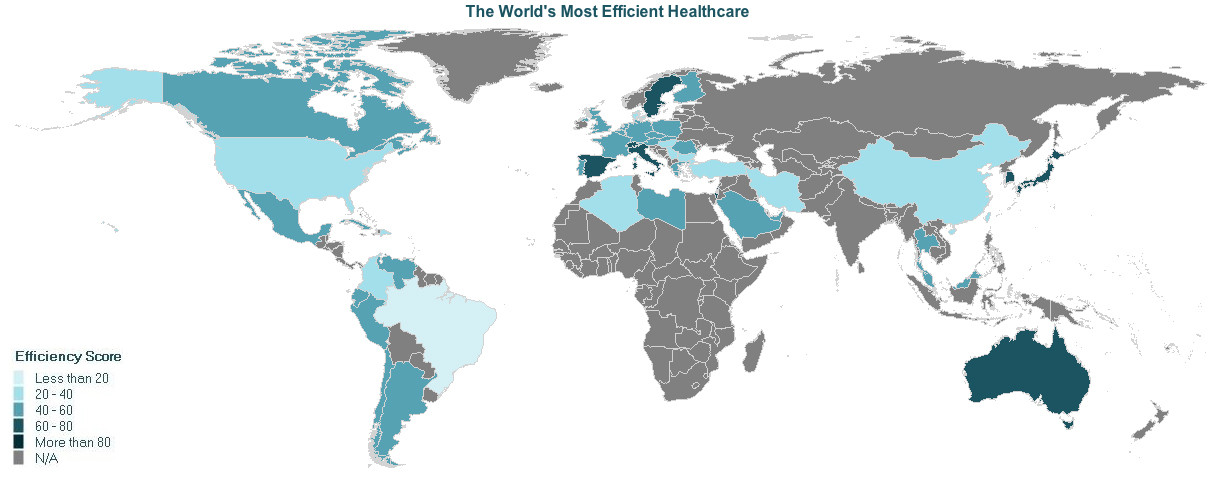
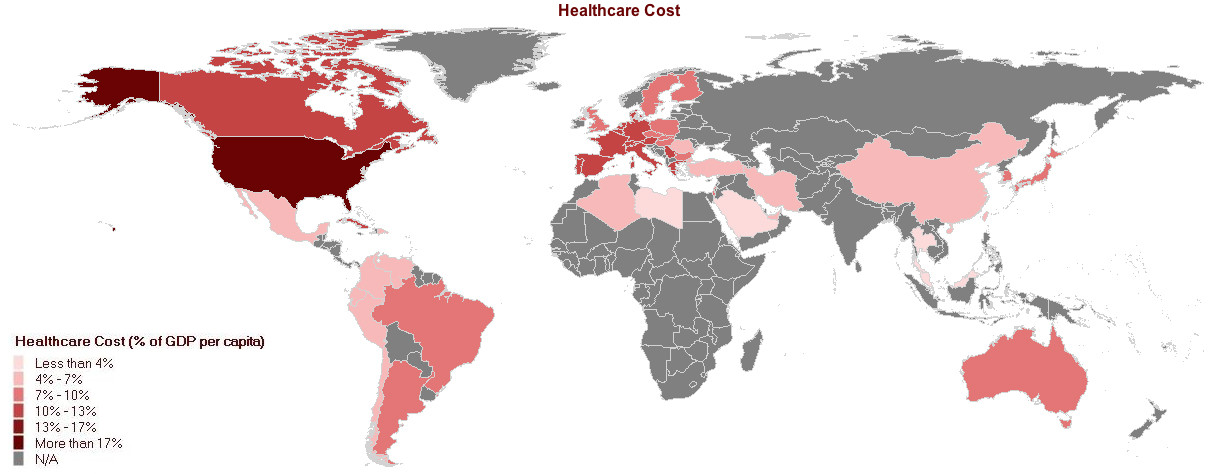
Bloomberg: U.S. heath system least efficient in the world

Speaker John Boehner and Majority Leader Mitch McConnell both called the U.S. health care system the best in the world.

What were they thinking?!  The U.S. has the most expensive (in absolute terms) and the least efficient health care system (in relative terms) in the world! Check it out.


By Kavitha A. Davidson
August 29, 2013 | Huffington Post

As supporters and opponents of the Affordable Care Act debate the best way to overhaul a clearly broken health care system, it's perhaps helpful to put American medicine in a global perspective.

The infographic below is based on a recent Bloomberg ranking of the most efficient countries for health care, and highlights enormous gap between the soaring cost of treatment in the U.S. and its quality and effectiveness. To paraphrase Ricky Ricardo, the American health care system has a lot of 'splainin' to do.

skdf

It's remarkable how low America places in health care efficiency: among the 48 countries included in the Bloomberg study, the U.S. ranks 46th, outpacing just Serbia and Brazil. Once that sinks in, try this one on for size: the U.S. ranks worse than China, Algeria, and Iran.

But the sheer numbers are really what's humbling about this list: the U.S. ranks second in health care cost per capita ($8,608), only to be outspent by Switzerland ($9,121) -- which, for the record, boasts a top-10 health care system in terms of efficiency. Furthermore, the U.S. is tops in terms of health care cost relative to GDP, with 17.2 percent of the country's wealth spent on medical care for every American.

In other words, the world's richest country spends more of its money on health care while getting less than almost every other nation in return.

It's important to note that this data doesn't necessarily reflect the best health care in the world; it is simply a measure of overall quality as a function of cost. Bloomberg explains its methodology as such:

Each country was ranked on three criteria: life expectancy (weighted 60%), relative per capita cost of health care (30%); and absolute per capita cost of health care (10%). Countries were scored on each criterion and the scores were weighted and summed to obtain their efficiency scores. Relative cost is health cost per capita as a percentage of GDP per capita. Absolute cost is total health expenditure, which covers preventive and curative health services, family planning, nutrition activities and emergency aid. Included were countries with populations of at least five million, GDP per capita of at least $5,000 and life expectancy of at least 70 years.

dsrfgsdf

So what can the U.S. learn from the many countries that get more bang for their health care buck? Unsurprisingly, there is no one formula for success when it comes to efficient medical care. The systems that rank highly on Bloomberg's list are as diverse as the nations to which they belong. The unifying factor seems to be tight government control over a universal system, which may take many shapes and forms -- a fact evident in the top-three most efficient health care systems in the world: Hong Kong, Singapore, and Japan.

Ranking third on Bloomberg's list, the Japanese system involves universal health care with mandatory participation funded by payroll taxes paid by both employer and employee, or income-based premiums by the self-employed. Long-term care insurance is also required for those older than 40. As Dr. John W. Traphagan notes in The Diplomat, Japan controls costs by setting flat rates for everything from medications to procedures, thus eliminating competition among insurance providers. While most of the country's hospitals are privately owned and operated, the government implements smart regulations to ensure that the system remains universal and egalitarian.

Meanwhile, Singapore's health care system is largely funded by individual contributions, and is often hailed by conservatives as a beacon of personal responsibility. But as conservative David Frum notes, the system is actually fueled by the invisible hand of the public sector: individuals are required to contribute a percentage of their monthly salary based on age to a personal fund to pay for treatments and hospital expenditures. In addition, the government provides a safety net to cover expenses for which these personal savings are inadequate. Private health care still plays a role in Singapore's system, but takes a backseat to public offerings, which boast the majority of doctors, nurses, and procedures performed.

Despite being considered by some as having the freest economy in the worldHong Kong's universal health care system involves heavy government participation; its own health secretary calls public medicine the "cornerstone" of the system. Public hospitals account for 90 percent of in-patient procedures, while the numerous private options are mostly used by the wealthy.

All this government care isn't taking much of a bite out of the state's bustling economy: According to Bloomberg, Hong Kong spends just 3.8 percent of GDP on health care per capita, tied for the third-lowest among nations surveyed and good for the most efficient health care system in the world.

Thursday, August 29, 2013

MB360: FIRE sector is back, big time

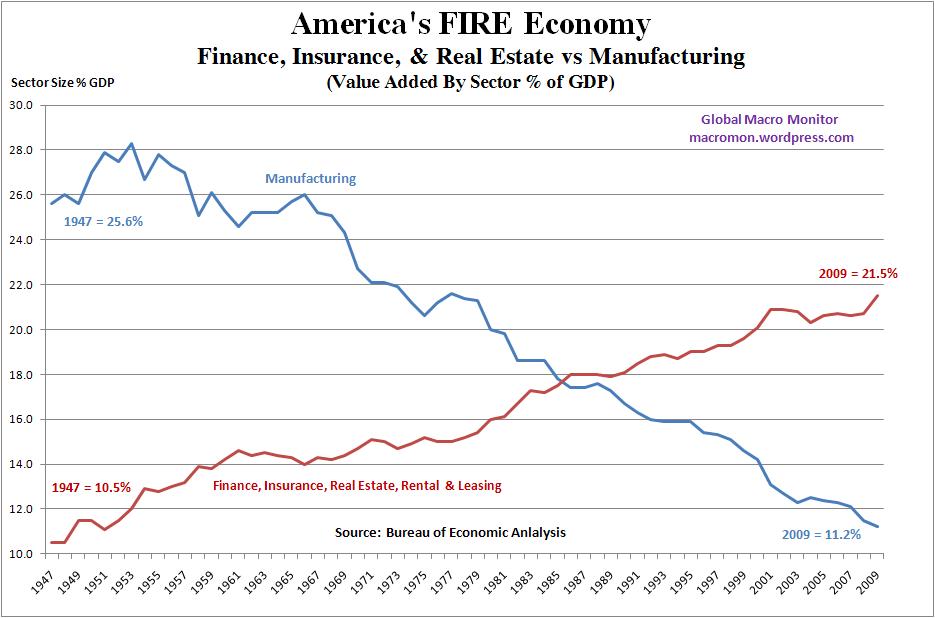
MB360 gives us great stats to illustrate starkly the so-called financialization of the U.S. economy: 

In 1947, the FIRE side of the economy made up roughly 10 percent of GDP. Today it is 21 percent.  On the other hand manufacturing in 1947 made up 25 percent of GDP while today it is closer to 11 percent.

Near-zero interest rates by the Fed and TBTF bank bailouts are direct federal government aid to the FIRE sector.  It's called socializing risk and privatizing rewards.  

Meanwhile, bizzaro conservatives assure us that if only Americans would stop being so lazy and collecting food stamps, then our economy would turn around. [Facepalm].  Foks, this is government-sponsored upward redistribution of wealth.  

If only the Tea Parties would brandish their pitchforks over the real redistribution problem in America!


Posted by mybudget360 
August 27, 2013

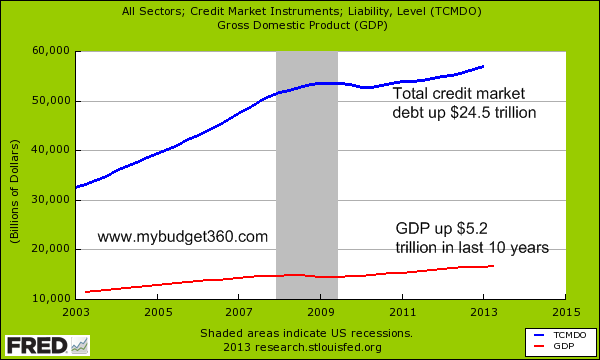
The current economy is juiced on the rivers of easy debt.  An addiction that is only getting worse.  Want to go to college?  You’ll very likely go into deep student debt given the rise in college tuition.  Want a home?  Prices are soaring because of speculation but you’ll need a bigger mortgage to buy.  Want a modest car? A basic new car that has four wheels will likely cost $20,000 after taxes after fees are included.  Need gas for that car?  The price of a gallon has quadrupled since 2000.  Combine this with the reality that half of Americans are living paycheck to paycheck and you can understand why the debt markets continue to grow at an unrelenting pace.  Here is some food for thought; in the last 10 years, GDP has gone up $5.2 trillion however, the total credit market has gone up by $24.5 trillion.  An increasingly large part of our economic growth is coming from massive leverage.  This is why the market sits fixated on the Fed’s next move regarding interest rates even though in context, rates are already tantalizingly low.  The FIRE economy is driving a large portion of corporate profits yet most Americans are left in the cold winds of austerity.

GDP being driven by FIRE

More and more of our growth is coming from a massive expansion of debt:

total credit market debt owed

The total credit market is now roughly 4 times the size of our annual GDP (inching closer to $60 trillion in the US).  While some think that this growth is natural and easy, in reality most of it is coming from growth in the financial services side of the economy.  The banking system is currently operating in a way that really does not benefit the typical Americans family.  Take a look at two employment sectors over the last few years:

fire-economy

In 1947, the FIRE side of the economy made up roughly 10 percent of GDP.  Today it is 21 percent.  On the other hand manufacturing in 1947 made up 25 percent of GDP while today it is closer to 11 percent.  It comes as no surprise especially as we now see big banks and hedge funds crowding out the real estate trade.  Prices in real estate continue to rise at levels last seen during the bubble yet the homeownership rate continues to fall.  We keep adding more and more Americans as “non-workers” and then wonder why we have 47 million on food stamps:

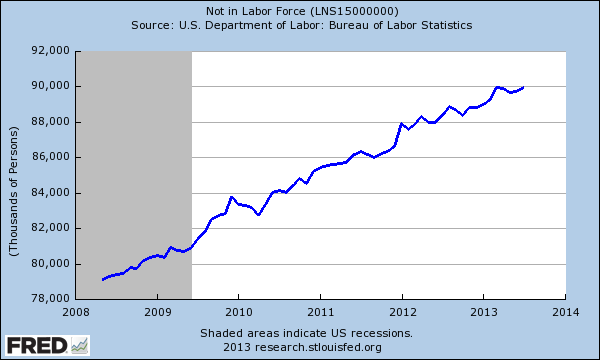
not in labor force

The number of Americans not in the labor force is booming because of demographics but also because people are dropping out of the workforce.  This certainly doesn’t coincide with some of the data being produced from other channels.

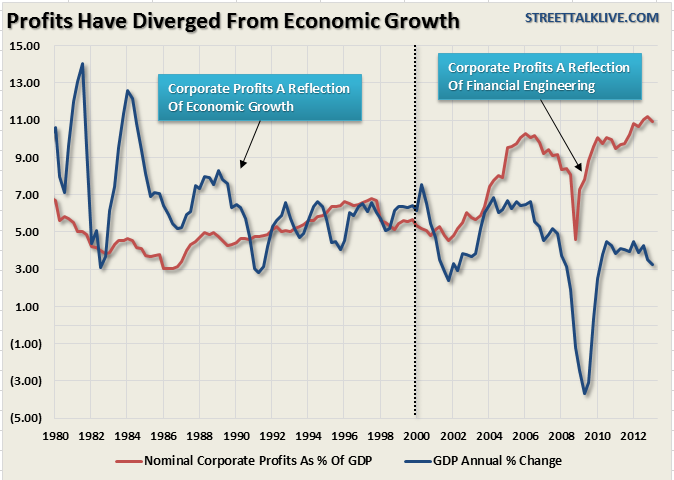
The reason why most Americans are not feeling the recovery trickle down to them is that the FIRE side of the economy is capturing a large share of the profits (more fuel for the growing income inequality trend).  Just take a look at how much of the recent growth has come courtesy of financial engineering:

Corporate-Profits-GDP-081613

Corporate profits as a percent of GDP are at generation high levels.  Yet GDP growth is weak (especially if you consider how much growth is coming from FIRE activity).  This is reflected in stagnant household income growth and the reality that wealth continues to shift into the hands of a very few Americans.

Redoing the last bubble

The problem with all of this is that we are simply redoing the last bubble.  This is a similar variation of our last bubble (i.e., financial sector deep into speculation, quickly rising real estate, no income growth, leveraging on debt, etc).  The finance and real estate side of the economy is driving profits and speculation, yet we see that for most Americans, the gains are simply not there.  This is just part of the financialization of our current system.  It is odd that big banks and firms are so interested in rental real estate yet they can extract money from Americans via this measure because the Fed is basically offering zero percent rates to member banks.  In other words, it is a riskless trade so why not grab all the real assets you can while the Fed continues to devalue the purchasing power of Americans?

The FIRE economy is back in a big way.  Of course you shouldn’t be surprised that this isn’t helping most Americans prosper.

Monday, November 5, 2012

Bennett: Why vote for Romney - WHY NOT!

I'll repeat myself a little here but it seems warranted, because Romney's main backer, Bill "The Gambler" Bennett, makes the case for Romney trotting out qual's that are actually disqualifications.

First, he holds up Romney's experience at Bain Capital as the primary reason that Romney could turn around the ailing U.S. economy (that has posted 25 straight months of job growth and 13 straight quarters of GDP growth, incidentally, after losing jobs for 25 straight months from February 2008.)  In October, Ronald Reagan's budget director, a private equity guy himself, destroyed Romney's Bain qual's better than anybody.  As he described in meticulous detail, deal by deal, Romney's experience at Bain of buying ailing companies, loading them up with debt, laying off workers and/or exporting jobs overseas, and making questionable mergers to achieve questionable "synergies" that never panned out but temporarily pumped up stock prices, all the while collecting huge fees for himself and his buddies before this businesses went bust, is the exact opposite of what America's economy needs right now.  

Here's how David Stockman summed up his analysis:

The Bain Capital investments here reviewed accounted for $1.4 billion or 60 percent of the fund’s profits over 15 years, by my calculations. Four of them ended in bankruptcy; one was an inside job and fast flip; one was essentially a massive M&A brokerage fee; and the seventh and largest gain—the Italian Job—amounted to a veritable freak of financial nature.

Only trouble is, there is nobody to whom Romney can pawn off this hot potato we call America in 4 years.  We can't take a 57 percent chance that America won't be a going concern post-Romney.  

Next, Bill Bennett cites Romney's experience turning around the Salt Lake City Winter Olympics.  OK, sure, he deserves some credit for that.  But so does Big Government, which bailed out Salt Lake City at Romney's request:  

"The $1.5 billion in taxpayer dollars that Congress is pouring into Utah is 1.5 times the amount spent by lawmakers to support all seven Olympic Games held in the U.S. since 1904 —combined," Donald Barlett and James Steele reported for Sports Illustrated in 2001.

But let's give Romney credit -- back then -- for giving Big Government credit where credit was due:

In his own 2004 book, Turnaround, Romney acknowledged the central role of the federal government in making the Olympics possible. "No matter how well we did cutting costs and raising revenue, we couldn't have Games without the support of the federal government."

Next, Bennett cites Romney's success as governor of Massachusetts.  Yet he curiously leaves out Romney's signature accomplishment: Romneycare.  That he alternately praises and disowns.  A health care plan based on plans by the Heritage Foundation and endorsed by Newt Gingrinch no less -- twice.  Can you say, "Media bias?"  

Next, Bennett cites Romney's moral character.  I don't need to dispute whether Romney cares about his friends and family, or humanity in the abstract.  He's not a monster.  But then again, neither is Obama, who is by all indications an extremely nice person with a lovely family, a guy who -- to his own detriment -- refuses to say bad things about his political opponents.  

Finally, Bennett cites Romney's "plans" if he is elected.  This gets back to the moral character issue.  How can we trust anything Romney says if he has flip-flopped so many times, from his $5 trillion tax cut plan (that he publicly disowned in the first 15 minutes of the first presidential debate when Obama challenged him on it) to Obama's saving the U.S. auto industry?  The guy simply cannot be honest about his own record.  "Etch A Sketch" will forever be etched into our political discourse thanks to Romney.  Some moral character!

So this is the best Romney's most eloquent spokesman could come up with.  Too bad.

In conclusion, I leave you with some of my favorite lines from Kingsley Amis's Lucky Jim, something I remember when I'm hiring somebody: 

However. I think you'll do the job all right, Dixon. It's not that you've got the qualifications, for this or any other work, but there are plenty who have. You haven't got the disqualifications, though, and that's much rarer. 

You may find that truth insufficiently inspiring.  I don't.  Any number of Democrats would make a better POTUS than Obama.  But those guys didn't make it this far.  Romney and Obama did.  Obama ain't perfect, not by a long shot. He's not nearly liberal enough; or, at least, he doesn't have the courage of his liberal convictions. But his lack of disqualifications makes him the clear choice.

(I suppose this quote could be turned on Obama if you think caring about the general welfare and believing "we're all in this together" is a disqualification. Vote your conscience.)


By William J. Bennett
November 5, 2012 | CNN

Wednesday, October 31, 2012

Dems must fight any 'grand bargain' (aka austerity)

As Bill Black notes, it can only be Obama's "vanity" making him promise a "grand bargain" on spending and tax cuts if he is re-elected.  In fact, we are now in a classic period of debt-deflation, the only answer to which is more public spending.

Sadly, it sounds like Obama has swallowed the Republican Kool-Aid that we're facing a fiscal "crisis," and that something must be done now to dismantle or privatize Social Security, Medicare, SNAP and a host of federal agencies, or else somebody's grandchildren will have to pay higher taxes.  

(In fact, the CBO estimates that the Budget Control Act that the Right so desperately wanted will turn about 4.4 percent projected GDP growth in 2013 into a recession in 1H 2013 with measly 0.5 percent GDP growth for the year. Much like what is happening in Europe: see below).  

In other words, Obama seems to have embraced austerity, even though the U.S., which partially embraced fiscal stimulus, has been growing consistently since July 2009 (albeit slowly), and partly because of the stimulus and not despite it.  By contrast, the EU is sadly realizing that austerity has been self-defeating: in the EU, debt-to-GDP ratios are growingGDP is shrinking; and unemployment is growing.

If you still don't understand how that could be so, read this:

Why is [the EU's] fiscal consolidation so much more damaging now? Under normal circumstances a tightening in fiscal policy would also lead to a relaxation in monetary policy. However, with interest rates already at exceptionally low levels, this is unlikely or infeasible. Moreover, during a downturn, when unemployment is high and job security low, a greater percentage of households and firms are likely to find themselves liquidity constrained. Finally, with all countries consolidating simultaneously, output in each country is reduced not just by fiscal consolidation domestically, but by that in other countries, because of trade. In the EU, such spillover effects are likely to be large.

[...] The result of coordinated fiscal consolidation is a rise in the debt-GDP ratio of approximately five percentage points.  


P.S. - This makes 2001 posts to my blog, all-time, not counting the shit I deleted. So cue Strauss's Sunrise!:  "Buuum-buuum-buuuuuuuuuuum BUM-BUM! Boom-boom boom-boom boom-boom boom-boom boom-boom boom-boom boom!"

Saturday, October 20, 2012

'Business experience' loses on POTUS scoreboard

This post is for the reality-based community, for that sliver of the American electorate still concerned with facts, not gut feelings, blind ideology and personal anecdotes.  I.e, the smarts.  All you stupids, take a FoxNews break.  Go check SporstCenter.

Here are the real stats (oh, wait, all you mind-numbed sports fans are supposed to be obsessed with stats, but anyway...):

The startling bottom line is that the nation’s GDP has grown more than 45 times faster under presidents with little or no business experience than it has under presidents with successful business careers. And on average, when there has been a successful businessman in the Oval Office (so, Truman is excluded), GDP growth has been negligible.

On average, under presidents with successful business experience, GDP has increased 0.12 percent. And under presidents with little or no business experience, GDP has grown 5.46 percent.

That's right, sports fans, it gets even worse for the Red Team:

The most startling figures emerge when we combine party and business experience. Historically, a Democrat without business experience has been extraordinarily better for the economy and the stock market than a Republican who had a career in business. In the past 84 years, GDP has grown 7 percent per year under Democrats without business experience (FDR, JFK, LBJ, Clinton and Obama) and fallen by 0.2 percent per year under Republicans with business experience (Hoover and the two Bushes). The Dow has risen an average of 16.8 percent per year under Democrats without business experience and has fallen by 3.7 percent per year under Republicans with business experience.

I would yell "Scooorebooooard!" except Republicans don't care about the scoreboard unless it's a black or Hispanic athlete doing the scoring in a meaningless socialistic sporting event that is subsidized by taxpayers.  Go figure.


By Robert S. McElvaine
October 20, 2012 | Washington Post

Wednesday, September 19, 2012

Romney's anti-Obama bombshell goes 'pfffft-sizzle-poof!'

Romney's campaign has obviously been holding back this "bombshell" audio recording of Obama for the right moment, and they decided that now was the time, in light of the campaign-killing secret recording of Romney's remarks to a group of rich private donors in Florida in May.

Here's what Obama said 14 years ago that is supposedly so damning (note that it was edited for "shock effect" on Rush Limbaugh's program, while I'm giving you an unedited excerpt here):


What we’re going to have to do is somehow resuscitate the notion that government action can be effective at all.  There has been a systematic -- I don’t think it’s too strong to call it a propaganda campaign, against the possibility of government action and its efficacy.  [The next few sentences were deleted by Rush for obvious reasons. - J]  And I think some of it has been deserved. The Chicago Housing Authority has not been a good model of good policy-making. And neither necessarily have been the Chicago public schools.  Uh, what that means then, is that as we try to resuscitate this notion that, uh, we're all in this thing together, leave nobody behind, we do have to be innovative in thinking in, how, what are the delivery systems that are actually effective and meet people where they live. Uh, and, and my suggestion, I guess would be, that the trick -- and this is one of the few areas where there I think there are technical issues that have to be dealt with as opposed to just political issues -- I think the trick is figuring out how do we structure government systems that pool resources and hence facilitate some redistribution -- because I actually believe in redistribution -- uh, at least at a certain level to make sure that everybody’s got a shot.


This is indeed a teachable moment, but not for the reason Rush Limbaugh says.  

Context: Obama said this in 1998, when Bill Clinton was our President, presiding over a budget surplus and a booming economy, but just weeks before a hyper-partisan Republican-majority House of Representatives impeached him, and a few months before the Senate acquitted him.  Like today, Republicans back then were attacking the role of government, saying, like they always do, that it cannot do anything right and must be cut to the bone.  Like today, they were hysterical about Clinton's imminent diabolical plans to make the U.S. socialistic, take away our guns, hand over U.S. sovereignty to the UN, appease every country except our allies, you name it.

Irregardless (that's not a word, but I still use it) of the context of Obama's remarks, let's recall for a minute what the U.S. Government -- any government from the dawn of human civilization -- actually does, in pure basics: it collects taxes from the people how it sees fit, and then spends that money how it wants. It does not, for example, say, "Mr. David Koch, since you contributed 0.01 percent of federal income tax revenues in FY 2011, we are allocating 0.01 percent of the FY 2012 federal budget to you."  

Since our government doesn't do this -- since no government has ever done this, ever -- then by definitionwhat our government does is redistribute wealth.  Because, sooner or later all government spending ends up in private hands -- just not necessarily (and not usually) in the hands that gave it its money in the first place.  If that's not redistribution then I don't know what is.

And let's remember that Big Government is part of the GDP formula that everybody learns in Economics 101:  GDP = private consumption + gross investment + government spending + (exports − imports), or GDP = C + I + G + (X-M).

So let me put hammer a big fat nail in the coffin of the idea that government redistribution is somehow new, or controversial, or evil, or conceived by American Democrats.  In fact, that's pretty much all the government does, for good or ill. Chew on that epiphany, then try to come up with an example to prove me wrong.  I'll be waiting....

(Irregardless, we all know that America has become a Socialistic country after almost four years of Obama. That's just a fact.  We all wear government-issued gray pajamas and march each morning to work in the People's National iPhone Factory to the tune of revolutionary hymns and munch on moldy government cheese and sawdust-fortified bread 3x a day.  Right.)


September 19, 2012 | The Rush Limbaugh Show