Showing posts with label food stamps. Show all posts

Monday, June 16, 2014

The true life of a 'welfare queen'

My dear conservative friends love personal anecdotes over cold statistics -- which we lib'ruls just fake anyway.

So here's a real "welfare queen's" experience of what it takes to qualify for, and keep, welfare assistance [emphasis mine]:

The first step in the food-stamp application process was turning in every imaginable document regarding my identity, housing, assets and personal finances. I was photographed and fingerprinted, which made me feel like everyone thought I was a criminal. After winding my way through the byzantine bureaucracy, including several hours-long appointments during which I obviously couldn't be looking for work, I was finally approved; the monthly allotment worked out to about $5 per day.

To keep receiving food stamp benefits, I had to spend every "work day" at a Human Resources Administration work-search office – my presence there was mandatory from Monday through Friday and from 9am to 5pm. The office was more than an hour from my apartment (that is, when public transportation – which I had to pay for myself – was functioning properly), but arriving even five minutes late earned a strike against my record for "non-compliance".

Two strikes, and I would have been out: the US system automatically revokes all benefits for rule-breakers, who then have to start the application process all over again. It's not a pleasant thing to discover when you're attempting to pay for groceries and your EBT card suddenly no longer works. The only excusable absences are job interviews – which required asking the interviewer for a mortifying letter of verification – or for illness with a doctor's note.

I asked about what would happen if I'd had a cold but couldn't afford to go to a doctor just for a note about it. My caseworker shrugged and said I'd have to go to the ER.

As I've told my conservative friends, and Gray emphasizes, "No one wants to be on welfare":

No one wants to worry about being judged as "wasteful" by pundits and policymakers and the people behind you in line for using your Electronic Benefits Transfer card at the grocery store to buy your prepackaged food, because you're too exhausted from 12 hours on your feet at a retail job and you don't have the time or the energy to cook.

No one wants to fear buying cake mix for a child's birthday celebration, only to receive scornful glares from other shoppers because they aren't buying rice and beans.

No one wants to explain for the fiftieth time that, Yes, my EBT card only works at grocery stores, and only for food – and, no, it can't be used for paper towels or beer.

Welfare-to-work, even if well-intended, has become overly bureaucratic and outdated:

The reality of meeting workfare requirements, however, is different from the idealized bargain of "will work for food". The bureaucracy today is mind-numbingly difficult to navigate and ultimately serves to block welfare recipients from access to better jobs and educational opportunities. [...]

Annie Hollis, a Baltimore-based social worker who has worked in urban settings for over 10 years, explained why the Clinton-era reforms were flawed and discriminatory from the start. "The problem with workfare is that in the wake of globalization, most of the jobs available to people without postsecondary education are increasingly part-time and minimum wage," she told me.

Policy hasn't caught up to that reality because recipients are only permitted to receive vocational training for a maximum of 12 months. Based on my personal experience working with single mothers leaving domestic violence situations, most jobs that pay a living wage require much more than one year of post-secondary education.

If federal workfare requirements weren't already stringent enough, states such as Florida, Georgia and Maine have pushed to expand the hoops that applicants must jump through to avoid sanctions – including eliminating waivers for job training absences due to illness to forcing recipients to pay for their own unconstitutional drug testing


By Stefanie Gray
June 15, 2014 | Guardian

Tuesday, April 15, 2014

Tuesday, November 5, 2013

GOP's 'Work or Starve' economic program in effect

This food stamp cut should start boosting employment any day now, since the GOTP has given America's millions of hungry children, disabled vets and seniors the best motivation of all: work or starve

Indeed, as Rep. Paul Ryan cautioned us, "We don't want to turn the safety net into a hammock that lulls able-bodied people into lives of dependency and complacency." 

Yep, we've cut those hammock strings, and now all we have to do is sit back and wait for those BLS employment figures to start ticking up as the free market works its magic....


By Gary Younge
November 4, 2013 | Guardian

Sunday, September 22, 2013

U.S. middle class & unions fall together

Correlation ain't necessarily causation, but... check out below how those red and blue lines have fallen in sync!

Big Business and Republican politicians who have taken swings at unions as "lazy" and "corrupt" and cut private union membership have in fact kneecapped America's middle class.  

With the exception of France, with its socialist welfare system and already strong labor laws, there is not a developed Western country with a lower rate of unionization than the U.S. at 11.3 percent.  The OECD average is 17 percent.

Meanwhile, Red State conservatives, many of them America's economic losers, swallow the GOP-talk radio explanation for falling U.S. incomes: Obamacare (yet to be enacted) and food stamps.  

Among the 254 counties where food stamp recipients doubled between 2007 and 2011, Republican Mitt Romney won 213 of them in last year’s presidential election, according to U.S. Department of Agriculture data compiled by Bloomberg.

These poor suckers don't know what's best for themselves or others.  There cannot be a strong U.S. middle class without unions.  End of story. 


By Caroline Fairchild
September 18, 2013 | Huffington Post  

This week the Census Bureau reported the latest depressing decline in middle-class incomes during the so-called economic recovery. But it may have missed an important factor in this story.

A report on Wednesday from the left-leaning think tank Center For American Progress notes that as middle-class incomes have steadily fallen, so have union membership rates. The middle 60 percent of households earned 53.2 percent of national income in 1968. That number has fallen to just 45.7 percent. During that same period, nationwide union membership fell from 28.3 percent to a record-low 11.3 percent of all workers.

Put these two economic trends together, and a striking image appears: 

unions middle income

Indeed, declining labor-union participation is not the only factor killing middle-class income growth. But increased union participation would likely mean more income for the middle class, the left-leaning think tank Economic Policy Institute argued in a 2009 report. Unions typically increase the wages of their workers while also raising pay for nonunion workers in industries with a strong union presence.

Higher union participation rates might also reduce income inequality. The U.S. has the worst income inequality of any county in the developed world, and the nation's top earners continue to see their pay rise as median incomes fall. Union participation could counteract this trend, according to the EPI.

So why is union participation declining so rapidly? Private sector union membership reached a peak of about 35 percent of the labor force in the 1950s, The New York Times reports. Since then, labor unions have steadily become smaller as many states have rolled out new laws limiting union power.

Young millennials' disenchantment with organized labor may also be an important contributor to its decline. From 2002 to 2012, union members ages 16 to 24 fell by 26 percent. That's double the decline in union membership for all workers, according to Quartz.

That said, younger generations may have a good reason to be less than eager to join a union. Studies have discovered that during the economic recovery, non-union workers fared considerably better than union workers in fields like manufacturing and private construction. Also, during the 1982 and 1991 recessions, states with fewer union members were found to recover more quickly than states with a strong union presence.

Problem solved?: GOP cuts food stamps

In case you weren't paying attention, the House GOP's vote on the annual farm bill showed us two things: 1) food stamps for hungry people are bad; and 2) agricultural subsidies for Congressmen and rich farmers are good. What do those two things tell us?

It’s the juxtaposition of the two programs that so clearly exposes the party’s agenda. Anti-government ideology can justify even the most vicious cuts to the safety net. It can’t justify the massive socialist scheme that is agriculture policy. And, to be fair, conservative intellectuals generally don’t justify agriculture socialism. But the Republican Party certainly does. The ultraconservative Republican Study Committee recently banned the Heritage Foundation from its meetings because Heritage denounced the GOP’s farm subsidies. There is a grim hilarity here: Republicans punished Heritage for its one technocratically sane position.

The GOP's stance on these two issues also belies their hypocrisy on social spending:

Obama has attacked the GOP farm-subsidy bill for spending too much. Here is the one chunk of social spending where Republicans are not only failing to issue hostage threats to secure the cuts they demand, they are also refusing to cut spending as much as Barack Obama asks. And the program they pick to defend is, on the substantive merits, the most unjustifiable program of any significant scale in the federal budget.

But that's OK, because this wasteful federal spending doesn't go to black ghetto queens: 

It is also one that accrues to disproportionately wealthy and overwhelmingly white recipients. (As opposed to Obamacare, whose beneficiaries are disproportionately poor and non-white.) 

That's really the only thing that matters to Republicans nowadays. Because it's clearly not about the numbers. It's simply a question of: could this federal spending possibly benefit a single brown-skinned person who games the system, no matter how many people genuinely need it? 

More broadly, Republicans' present meme that, If only we could repeal Obamacare and reduce food stamps, our economy would take off!, is completely asinine and without economic merit.  We liberals and Democrats must not let such idiotic thinking go unchallenged as a "credible" policy alternative!


By Jonathan Chait
September 20, 2013 | New York Magazine

Wednesday, August 21, 2013

It's about total compensation

Today it's a three-fer, since each story is about the same thing: the consequences of low U.S. wages and the absence of benefits.

First, my man Harold Meyerson notes that low wages paid by big retailers and fast-food joints are now hurting big retailers and fast-food joints, because low-paid workers don't have money to buy stuff.  (Duh).  Furthermore, Meyerson makes the interesting observation that we've gone back to the pre-WWII era, before big retailers like Federated and Macy's actively backed New Deal-era reforms like the minimum wage, unemployment insurance, 5-day workweek, unions, and co-op banks. Back then, businessmen understood that a healthy middle class was in their own best interest. 

It seems we've forgotten, once again, what actually makes America go. (I blame this all on the historically amnesiac Tea Parties, who don't care about anything that happened in America between 1789 and 1980.)

Next, Heidi Moore reminds us that our recent focus on the minimum wage, while correct, actually obscures the key issue: total compensation.  Wages could theoretically stay flat, but if more employers were to offer health insurance, paid sick leave, vacation and a retirement plan, then wages wouldn't need to be as high.    

Moore also observes that low total compensation, historically speaking, has put a record-high strain on government poverty programs such as food stamps. So, with corporate profits at an all-time high and compensation at an all-time low, welfare becomes a subsidy for Big Business.  (Wal-Mart has long been the national poster child for forcing its employees to go on welfare).

Finally, Sarah Kendzior points out that the feminist debate over whether women should work or stay at home is all rather quaint, considering that women, just like everybody else, make such decisions based on hard economic realities. Paradoxically, due to the high cost of child care, it is often cheaper for a woman to stay at home rather than work; yet staying at home allows her skills to degrade, or at the very least carries a stigma with potential employers when she tries to re-enter the workforce. Educated, qualified women excluded from our workforce reduces our nation's overall productivity. 

So once again, the answer is for Big Government to step in and mandate paternity leave, provide free or subsidized daycare, and make giving birth at a hospital cheaper, so that young families don't start off in debt.  Because the free market has failed to address these failures.


By Harold Meyerson
August 21, 2013 | Washington Post

By Heidi Moore
August 20, 2013 | Guardian

By Sarah Kendzior
August 19, 2013 | Al Jazeera

Wednesday, June 19, 2013

Racist joke shows whites' real beef with 'welfare'

Pardon me for forwarding the ugly "joke" below that was forwarded to me by an old Tea Partyer, but it's a clear admission by white conservatives what their real beef is with "welfare" and a teachable moment for the rest of us: they really believe these federal programs are deliberate wealth redistribution from hardworking whites to lazy blacks.  (Or to "lazy brown-skinned people who speak gibberish, hate work and wipe their asses with American flags," to quote a true genius.)

In his recent op-ed "Why white America thinks ‘too much welfare’ is a black thing," Dr. Jason Johnson sums it up pretty well:

First, most social science research shows that to white Americans welfare automatically conjures up images of lazy promiscuous black women in the inner city, popping out babies like rabbits and turning government cheese vouchers into gold chains and plasma screen televisions.

Consequently for many Americans any question about welfare and the economy is really a question about race. This is not new, but in fact a longstanding narrative in American politics where during times of economic stress business and political elites have ‘protected’ the majority of whites from swallowing the harsh realities of American economics with a sugary dose of racial distraction.

The actual facts about welfare have always been pretty clear; whites and children are the greatest recipients and beneficiaries of various programs, but that’s not good fodder for talk radio.  From the beginning of government sponsored welfare programs, discriminatory policies were enacted to keep blacks off the rolls (like excluding farm workers and domestics in the 1950’s) and even once those policies were removed media and politicians, especially on the right, insisted on maintaining the myth that the face of poverty in America was a black thing.

In fact the racist joke below was told by Arkansas Tea Party leader Inge Marler at at an Ozark Tea Party rally in June 2012, although perhaps it's been around even longer.  The TP crowd loved it.  


From:
To:
Subject: Fw: Racism Explained
Date: Tue, 18 Jun 2013 19:15:53 -0400
Subject: Racism Explained
RACISM EXPLAINED

A black kid asks his mother, "Mama, what's a Democracy?" 

"Well, son, that's when white folks work every day so we can get all our benefits, you knows, like free cell phones, rent subsidy, food stamps, welfare, school breakfasts and lunches, free healthcare, utility subsidy, & the list goes on & on, you knows."

"But mama, don't the white people get pissed off about all that?

"Sure they do, son, and that's called racism." 

Saturday, January 19, 2013

The irony of Walmart's health exchanges

Irony can be pretty ironic sometimes. Take Walmart. Its profitable business model requires hiring only part-time workers and paying them minimum wage with no benefits -- including no health insurance.

Now Walmart wants to open its own "health insurance exchange" under Obamacare. Walmart already runs its own medical clinics and pharmacies.

When it comes to using Walmart's buying power and marketing power to negotiate with insurance companies to give its customers a good deal on health insurance, that's just dandy and a valid reason for Walmart to flex its free-market muscles.

So why can't Walmart do the same for its own employees' benefit? In state after state, impoverished Walmart employees receive more Medicaid and food stamp benefits than any other company. That's right: U.S. taxpayers subsidize health coverage for Walmart's employees by Walmart's design; meanwhile, Walmart plans to turn around and sell health coverage to U.S. taxpayers. Huh-what?!

And Walmart's opening health insurance exchanges at its stores is doubly ironic, because the same "free-market" forces that allow it to negotiate cheaper insurance for its customers, are exactly the same forces that would allow the U.S. Government, under a single-payer health insurance system, to win even better deals for all of us. But then that would be goddamn "socialism."  Whereas it's "capitalistic" to overpay for the same thing.

And oh, by the way, the Walton family that controls Walmart is wealthier than the bottom 40 percent of Americans, combined. God bless America!  

P.S.  Read Ralph Nader's recent wonderful open letter to Walmart CEO Mark Duke here.


Tuesday, November 6, 2012

GOP counties eating up more food stamps

This isn't funny anymore.  The hypocrisy and cognitive dissonance on the Right have reached critical mass.  There is a good chance these Republicans don't even realize that the food stamps they collect are "welfare."


By Frank Bass
November 5, 2012 | Bloomberg

Sunday, October 14, 2012

Median, middle and 'moochers'

MB360 has given us some hard income data to mull over:

  • 2011 Census data says the the median U.S. household income is $50,500; that means half of U.S. households make more, and half less than $50,500.
  • 2010 Social Security data says the median worker's income is $26,000.
  • An individual making more than $250,000 is in the top one percent of all earners in the U.S.  
  • A household making more than $250,000 per year is in the top two percent of all U.S. households. 
  • A household making more than $100,000 is in the top 20 percent of all U.S. households.
$250,000 and $100,000 are common cut-off points in political discussions about who is really middle class, and who deserves a tax cut or a tax hike.  

Mitt Romney told ABC that, "Middle income is $200,000 to $250,000 and less."  (A person making $200,000 or more is in the top four percent of U.S. income earners.) Obama more or less agrees with Romney.  By their definition, 96 percent of Americans are middle class.  That's ridiculous on its face.

More to the point, do average Americans believe that the top 1-2 percent need and deserve a tax cut right now?  Both Obama and Romney do.  I don't.  

Does it even make sense to regard a household earning $100,000 -- double the median household income -- as middle class?  Probably not, relatively.  

Meanwhile, we have 46.7 million Americans receiving food stamps, and 56 million receiving Social Security.  That's about one-third of the U.S. population. That's not to mention 48 million Americans on Medicare, and about 4 million on Medicaid.  Meanwhile, 60 percent of those 65 or older receive at least 75 percent of their income from Social Security. How low would U.S. median income be without these programs?  It's frightening to think about how insecure most Americans are, financially.

Here's what these programs cost, or, to put it in Republican terms, how much wealth they redistribute:

          TOTAL:  $1.8 trillion

But what about the deficit?  As a Bloomberg study revealed, "the rise in the deficit -- from an average of 1.9 percent of gross domestic product in the pre-crisis years (2005 to 2007) to 9.3 percent of GDP post- crisis (2009-2011) -- is almost entirely due to the economic decline, which drove down tax receipts and pushed up spending on unemployment, food stamps and other support programs."

But we already knew that, right?  We must know that 33 percent or 47 percent or whatever share of Americans didn't suddenly become lazy moochers while Obama went on a wild spending spree.  No, it's that suddenly our economy got very, very bad: shrinking 6.3 percent in 2008 alone, erasing $15.5 trillion in U.S. wealth, costing 8.8 million U.S. jobs, and dunking 24 percent of houses -- most Americans' most valuable asset -- underwater.  

Given all this, it is madness to suggest that the answer to our economic malaise is to cut spending for needy Americans while reducing taxes for Americans making $200,000 or more.  

Tuesday, February 7, 2012

Obama cracking down on food stamp fraud

So, at the most food stamp fraud constitutes 1 percent of total spending, a not insignificant $750 million.

But what we often forget is that it's not just "welfare queens" abusing the system, it's businesses. According to Reuters:

"From Oct. 1 through Dec. 31, the USDA sanctioned more than 225 stores found to be violating program rules and permanently disqualified 350 stores for trafficking in SNAP benefits , a roughly 14 percent increase in disciplinary actions overall."

We should also keep in mind that the states have some authority to regulate eligibility for food stamps.


By Lisa Baertlein
February 6, 2012 | Reuters

Monday, January 16, 2012

MB360: Food stamp nation

I know ya'll want to blame this on 'Bama, but c'mon, you know it's not true. He's been adding private sector jobs almost every month since the end of the recession in mid-2009. But he's still digging us out of 7-million jobs hole.

(Yeah, yeah, I know: the POTUS, no matter who he is, doesn't sit in the Oval Office pulling the levers of the U.S. economy, but then that's just more reason not to blame BHO).

The point is that most new jobs suck. They certainly aren't "bloated" government paychecks; and they don't pay the bills. And this has been happening since before the Great Recession in 2008-09; it just accelerated when the housing bubble burst and average Americans couldn't use their mortgaged houses as a piggy bank anymore, in effect covering up for their declining wages with more debt.

Who's going to have the cajones to address this truth in the 2012 elections? Anyone? Anyone? Bueller?....

UPDATE (01.20.2012): My statement that Obama has been adding private sector jobs ever since August 2009 was inaccurate. I re-checked the BLS data. So, the recession officially ended in June 2009. That month, there were 107,936,000 private sector jobs. It actually took the economy until August 2010 to exceed that number. Ever since August 2010, the economy has been adding private sector jobs.

So, my statement was wrong. I should have said, it took a year after the end of the recession to start adding private sector jobs, which the economy has been doing steadily every month ever since.


Posted by mybudget360
January 13, 2012

Tuesday, August 23, 2011

1/3 of Alabamans on food stamps

This makes perfect sense (?!?) because Alabamans hate lazy welfare queens and Big Government, and love the GOP and Tea Parties.


August 7, 2011 | Associated Press

Nearly one-third of Alabama's residents received food stamps in May.

The state Department of Human Resources reports there were a record 1.43 million Alabamians in the Supplemental Nutritional Assistance Program. The number was higher than normal because 43 of Alabama's 67 counties were receiving disaster assistance due to the deadly tornadoes in April.

While the tornadoes had a big effect, the number of Alabamians on food stamps has been growing in recent years. Department spokesman Barry Spear told the Montgomery Advertiser (http://bit.ly/quyHuy ) that the number of Alabamians in the program grew from more than 546,000 in fiscal year 2006 to 805,000 in fiscal year 2010.

Spear said rising unemployment is a factor, along with efforts to make more people aware that they can qualify for the assistance.

Thursday, December 16, 2010

MB360: Wall St. flush while middle class disappears

Posted by mybudget360

The shrinking of the American middle class is painful to watch. Shopping at the grocery store I've noticed more and more people with unique debit cards that don't look like your typical debit or credit card. These are actually the modern day food stamps and help to take away the stigma of pulling out a pile of paper coupons. My anecdotal observations are confirmed by the data.

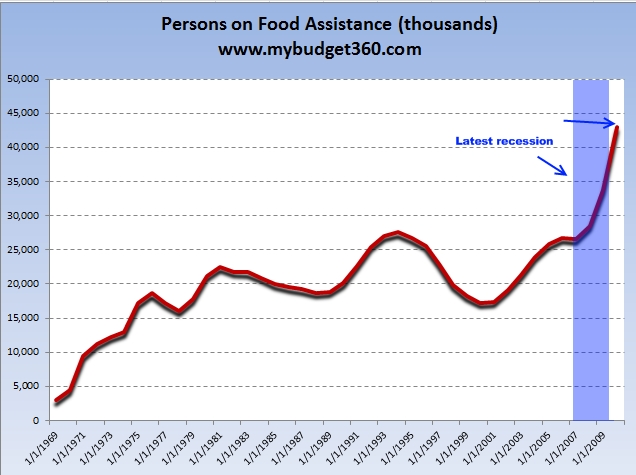
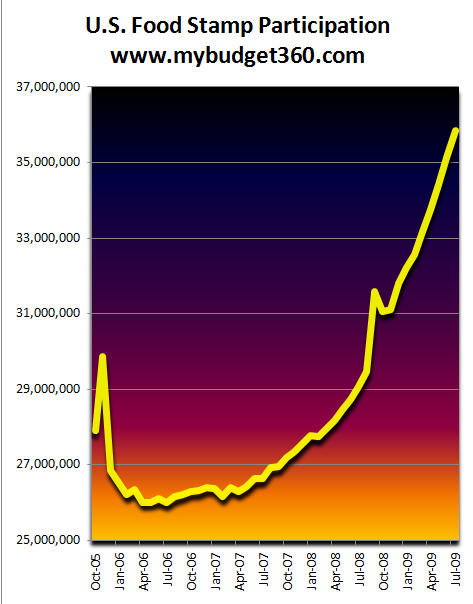
Since September of 2009 we have added a stunning 6,000,000 Americans to the nationwide food assistance program. In fact, even as some are touting how great things are in the last month we added 521,000 more Americans to the food assistance program. Let me reiterate, we added half a million Americans to the food assistance program in the latest month of data. Is this really what we have in mind as a recovery? The latest data shows 43,000,000 Americans now receive food assistance. When we chart this data out it is rather startling.

You will notice that from 2000 onward the growth in food assistance participation has shot directly up:

food stamp chart

Source: SNAP

To put this in context, 13.8 percent of all Americans (1 out of 7) are now on some sort of food assistance. If we go back to the deep recession of the 1980s the rate was slightly above 10 percent. We are in all-time record territory here and the numbers just keep on expanding. What is more troubling is many more Americans that were once in the middle class are being thrown out of their homes, losing their jobs, and finding themselves in the unfortunate spot of needing to seek food assistance. An almost seamless transition from the American Dream to being one paycheck away from living in a car. It isn't for want of working. Delta Airlines recently was hiring 1,000 flight attendants and had over 100,000 people apply:

"(ABC) All this for a job where passengers are often rude, hours can be unpredictable and the starting salary is in the upper $20,000s. But flight attendants say they wouldn't trade it in for any other job. (Delta's flight attendants recently voted down a push to unionize.)"

As we've noted before, the chasm between the very rich and the poor has never been this big. We would have to go back to the Great Depression to find similar income inequality.

72,000,000 wage earning Americans make between $0 and $25,000 per year. The top 72 wage earners in the US in 2009 made an average of $84 million. The stock market has certainly recovered but how much of an impact has this had on improving the economic prospects of typical Americans? What we are seeing is a rather common attribute of many Latin American countries. A stunningly wealthy upper crust of society and the large working poor majority. The middle class is virtually non-existent. Clearly we are nowhere near that given we are still the number one global economy. Yet we have now put the car in reverse and the above chart of food stamp participation shows you where we are heading if we do not change course.
We can even see this split in purchasing behavior this holiday season:

"(WaPo) This holiday season, those two worlds have been thrown into stark relief: At Tiffany's, executives report that sales of their most expensive merchandise have grown by double digits. At Wal-Mart, executives point to shoppers flooding the stores at midnight every two weeks to buy baby formula the minute their unemployment checks hit their accounts. Neiman Marcus brought back $1.5 million fantasy gifts in its annual Christmas Wish Book. Family Dollar is making more room on its shelves for staples like groceries, the one category its customers reliably shop."

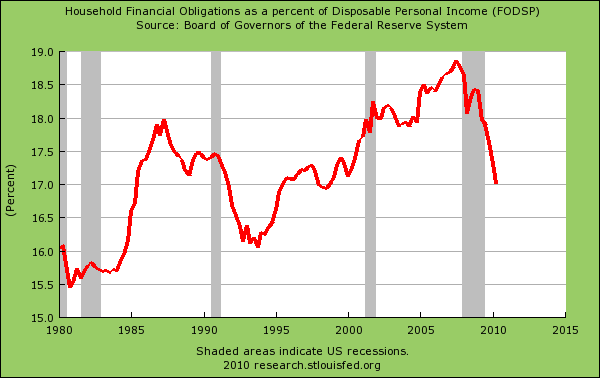
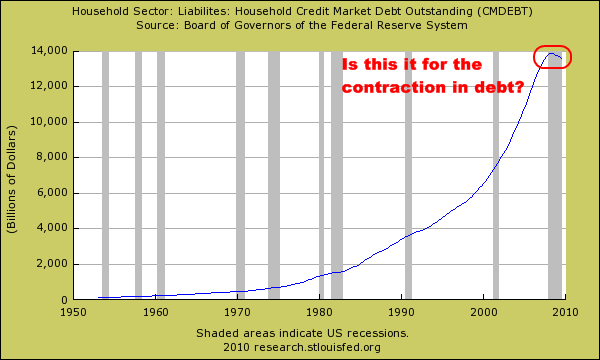
So you have the top of the top doing well once again and we have seen this with a resurgence of banking profits thanks to the generous taxpayer bailouts. At the lower end, organizations like Family Dollar are doing well in a market that is finding many new customers. Customers that may have once shopped at say a Target are going to lower priced places either out of necessity or out of a new sense of austerity. In fact, we have seen the debt burden Americans carry decrease because of bankruptcies, foreclosures, and simply paying down debts:

household debt obligations

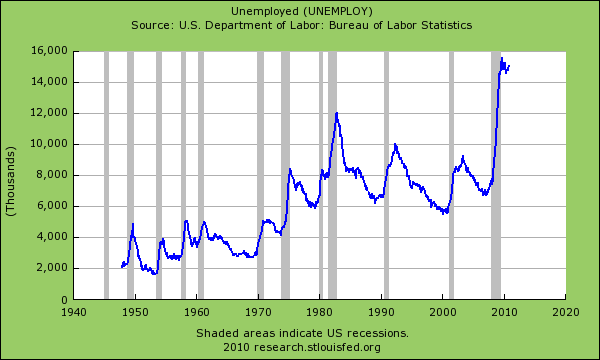
The above would be better news if the major decrease was due to paying down already accumulated debts. Yet the problem of course is much of this is happening via debts being written off (i.e., foreclosures). But you have to ask what is happening at a deeper level here. The once standard of the American Dream, owning a home is now being retracted and the blanket is being pulled slowly back. Many Americans cannot afford to own a home because of an employment market that has been sold off to the global market over the past few decades. Some of it is inevitable but a lot isn't. It is naïve to think that there was truly a need to bailout the banking industry instead of actual employment sectors that can give jobs to the 15 million unemployed Americans or the other 9 million who are working part-time but want full-time work. It was also a giant banking pretense regarding toxic mortgages because Wall Street knew full well of the junk they were selling but wanted to milk the game as long as possible and once it blew up, it would hand over the hot potato to taxpayers.

The employment situation for households making less than $50,000 (aka half the population) is still deep in a recession:

"Economists say the biggest obstacle to a robust recovery is the high unemployment rate, which has hit workers with little education and low household income the hardest. The jobless rate for workers without a high school diploma is 15.7 percent – well above the national average and triple the rate for college graduates, according to government data. Meanwhile, the unemployment rate among households that had been making less than $50,000 is 15 percent, well above the national average of 9.8 percent, according to consulting firm Bain & Co."
And this is reflected in the unemployment charts:

unemployment unemployed

Where is the recovery? It isn't happening for working and middle class Americans. The bailouts in fact where a methodical mechanism that shifted resources and money from the vast majority to the few at the top. Many extremely wealthy organizations have earned their keep by fair competition. Yet the banking sector has created the biggest moral hazard in this country with outrageous profits and bonuses that only exist because of the cronyism between Wall Street and D.C. The fact that we are adding hundreds of thousands of Americans to the food assistance program on a monthly basis shows us the disappearing middle class. That is why you don't hear any economists or "analysts" on CNBC talking about the booming middle class. You don't hear about it because it isn't happening. In fact, they are too busy to look at how many of their fellow Americans are paying for daily necessities.

Monday, May 10, 2010

1 in 8 Americans on food stamps -- FOR SHAME!


This is obviously Obama's fault. If he hadn't spent so much money on the stimulus then, well... Anyway, it's Obama's fault. He's the president.

America's becoming a nation of free-lunchers. Why can't these people proudly starve, or at least depend on private soup kitchens and Christian charities which are ready to feed them and their families because charity works and gov't handouts don't? Why can't these deadbeats rely on their fellow man instead of asking all us taxpayers for a handout? They just don't get it!


By Charles Abbott
May 7, 2010 | Reuters

Nearly 40 million Americans received food stamps -- the latest in an ever-higher string of record enrollment that dates from December 2008 and the U.S. recession, according to a government update.

Food stamps are the primary federal anti-hunger program, helping poor people buy food. Enrollment is highest during times of economic distress. The jobless rate was 9.9 percent, the government said on Friday.

The Agriculture Department said 39.68 million people, or 1 in 8 Americans, were enrolled for food stamps during February, an increase of 260,000 from January. USDA updated its figures on Wednesday.

"This is the highest share of the U.S. population on SNAP/food stamps," said the anti-hunger group Food Research and Action Center, using the new name for food stamps, Supplemental Nutrition Assistance Program (SNAP). "Research suggests that one in three eligible people are not receiving ... benefits."

Enrollment has set a record each month since reaching 31.78 million in December 2008. USDA estimates enrollment will average 40.5 million people this fiscal year, which ends Sept 30, at a cost of up to $59 billion. For fiscal 2011, average enrollment is forecast for 43.3 million people.

Tuesday, February 9, 2010

Wall St. is the best thing for socialism ever

Like I said before, Wall Street is to blame for burgeoning "socialism" in America, not dastardly lib'ruls. Greedy, gambling bankers caused this mess, and now primarily state governments, aided by the federal gov't (the lender of last resort), have to deal with the aftermath.

Obama and the Democrats didn't have to do a darn thing, this is happening at the state level all by itself: more Americans are collecting unemployment benefits and food stamps than ever before, and both are managed at the state level.

Live-free-or-die Texas has borrowed $1.6 billion so far from the federal government to pay residents' soaring unemployment benefits.

The much-criticized federal stimulus, by the way, went a long way toward plugging gaps in state budgets. The stimulus was much less effective than it should have been because (1) it was too small, (2) 37 percent of it was tax cuts, (which, oddly, we don't hear anything about from our angry teabagging/GOP friends) and (3) the federal fiscal expansion was matched by states' fiscal contraction, since most of them have passed balanced budget amendments -- making the national stimulus, in effect, much smaller. Automatic state tax increases on business to cover growing unemployment benefits is a result of the states' pay-as-you-go mandate.

If you weigh the states' budget cuts and tax hikes against the federal stimulus's spending and tax cuts, the net effect was about $246 billion pumped into the economy. Good, but not nearly enough. Thanks, Republicans!


Unemployment taxes slam businesses

By Tami Luhby
February 9, 2010 | CNNMoney.com

URL: http://money.cnn.com/2010/02/09/news/economy/unemployment_taxes/index.htm?hpt=Sbin

Monday, February 8, 2010

MB360: 10% on food stamps, yet Wall St. is TBTF

I love this guy. If you Repubs & teabaggers can read & understand this, then you realize why you need to point your guns and pitchforks in the opposite direction.


Banking and Housing Payments Devoured the Middle Class Income – 1 out of 10 Americans on Food Stamps and how the Fed Slowly Devalued the Dollars in your Wallet.

Posted by mybudget360 February 7, 2010

It is a challenge to say that things are getting better when every month that goes by more Americans are losing their jobs or needing to apply for food assistance. In the latest data for food assistance through SNAP we find that 200,000 more Americans were added to the program. That now brings the total number of Americans on food assistance to 38,183,000. 1 out of 10 Americans are receiving food assistance. For 2009 this cost the government $50 billion, up from $34 billion in 2008 and $30 billion in 2007. It should be no surprise then that average Americans are questioning the viability of a middle class in the upcoming decade.

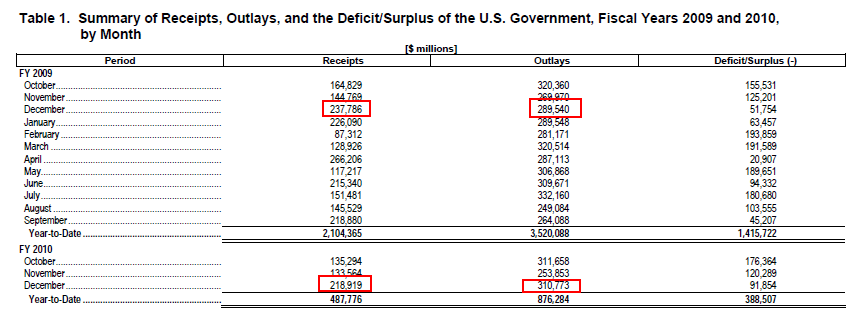
But even when we look at the balance sheet of the government, things are still not improving:


Source: U.S. Treasury

Take a look at the amount of revenue (taxes) the government brought in for the month of December. $218 billion was taken in. But look at data from December of 2008. The government at the peak of the crisis brought in $237 billion. So this December was even worse than the one ending 2008. How is this a sign of recovery? You would assume that receipts would be going up if things were in fact getting better. All we see is the spending side of the equation going up and the only sector in the economy turning a solid profit is the banking sector that is now running a new form of corporatocracy. It would be one thing if we were adding jobs each and every month but even the massive amounts of bailouts have yet to yield any visible help for average Americans.

In the past few decades Americans have seen more and more of their income being eaten up by the housing sector of the economy:


This latest decade saw a much larger share of income going to housing than any in the past. Unlike stocks, every American needs to live somewhere and will need to either pay a mortgage if they own or pay rent. The banking sector found a method of siphoning off wealth from the biggest asset Americans hold. We have seen this occur slowly over the decades:

1950
Median household income: $3,319
Median home price: $7,354
Home price / income = Percent of 221

1960
Median household income: $5,620
Median home price: $11,900
Home price / income = 211 percent

Running those numbers today, we find that nationwide the cost of a home eats up more and more income:

Median Household income: $52,029
Median U.S. home price: $172,600
Home price / income = 331 percent

The above data is pulled from years of Census data but shows clearly that housing has eaten more and more into the income of average Americans. In a purely fiat money system, banks can create money out of thin air. The Federal Reserve has done this through the monetization of debt. Now think about this, if a participating member bank borrows say $1 million from the Fed it can then turn around and lend the money out through loans up to $9 million courtesy of fractional reserve banking. With current interest rates, if it borrows from the Fed at near zero even a 5 percent return on bread and butter mortgages would yield $450,000 a year for doing absolutely nothing but being a middleman. And some banks have gone ahead and issued credit cards with 79.9 percent rates. When Bear Stearns and Lehman Brothers failed their leverage was even higher at 20 and even 30 to 1. The other investment banks are near those levels even today yet with full government support.

So why bring this up? In the United States debt is treated as money. In fact, without debt we wouldn't have money. I think this is lost on many. When someone goes to a bank and takes out a mortgage with virtually no money down, all of a sudden a liability and asset of a few hundred thousand is created out of financial alchemy. So when this housing bubble burst trillions of dollars evaporated from the system but it was nothing more than erasing previous debt that really had no actual backing.

So if the Fed can create money out of thin air through their banking web why is the economy still faltering? In boom and bust cycles we see a love and revulsion towards debt. Banks can be willing to lend out money but you can't force average Americans to borrow. This past decade we saw the absolute disregard for prudent debt lending and now, many Americans are averse to taking out loans. In fact, now that banks are actually checking and verifying incomes it turns out that many middle class Americans really don't qualify for additional debt.

This brings us to our next chart looking at household debt:


Even after the stock market recovery, it is estimated that average Americans have seen their household net worth decline by $11 trillion since the peak of this bubble. Yet take a look at the chart above. Household debt still remains near the peak. And keep in mind that real estate was the biggest item of net worth for Americans and this has fallen by roughly $6 trillion. Yet the loans remain the same. And that is largely a reason for the flood of foreclosures and bankruptcies. While banks still have mortgages valued at peak levels the actual market value is much less. The U.S. Treasury and Federal Reserve made a troubling bet during the early days of the crisis that things would correct quickly. Actually, I tend to believe that the Fed knew all along that when push came to shove, the entire banking sector would be bailed out by the U.S. taxpayer since the Fed is simply the lender of first and last resort for member banks.

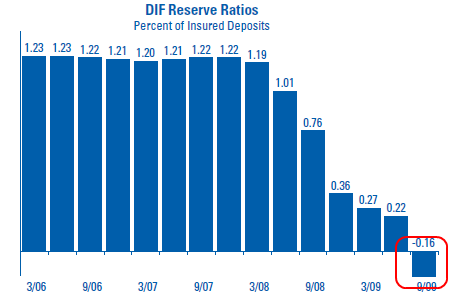
So this leaves Americans contenting with debt amounts that no longer reflect the value of their underlying asset. Yet the banking sector is now fully supported by the taxpayer. So with the current system in place, if banks do fail taxpayers are on the hook. The Fed has setup the perfect trap for middle class Americans. If average Americans decide to walk away from their underwater mortgages then the bill will be paid by taxpayers. After all, we are already told that the too big to fail by definition won't fail. And the other option is to continue paying a mortgage on a home that is no longer worth its value. Many Americans simply cannot afford to do this. Do you notice how in no scenario the banks lose? This is another characteristic of the corporatocracy. And the FDIC which insures bank deposits is essentially insolvent:


And the FDIC backs $13 trillion in total assets with a fund that is insolvent! Now that is maximum leverage.

Over the past decade as the financial sector gained more and more power many Americans saw more and more money go to their housing payment. The housing bubble was merely the end product of the banking sector through Wall Street flooding the system with debt. If we live in a world where only one house is on the block and you have $1,000 and I have $1,000 and we both want the house the maximum we can pay for the home is $1,000 given our resources. But enter a bank that is willing to create debt of $10,000 in the form of a mortgage and say we are obsessed with the house; it is very likely we would be willing to pay $11,000 for the home. Is the home really worth $10,000 more? Of course not. But our $1,000 just got a lot less valuable. And this is the crux of a fiat money system. The government can force it as legal tender but if the value continues to erode people will begin questioning the system. It is only valuable to the point that people have faith in it. And right now many Americans are losing faith in the system.

Sunday, November 29, 2009

Thanks, Obama: 12% of Americans on food stamps

Look what BHO has reduced us to: 1 out of 8 Americans is a helpless welfare junkie dependent on gov't cheese.

Meanwhile, the states, like drug dealers, are pushing food stamps on more and more erstwhile honest, hard-working, self-sufficient Americans, because unlike cash welfare payments, food stamps are 100% federally funded.

Even conservative and once proud Warren County, Ohio, which turned down federal stimulus funds on principle, has lately doubled its dependence on food stamps. Said proud, principled, Warren County Commissioner Dave Young [R]: "As soon as people figure out they can vote representatives in to give them benefits, that's the end of democracy. More and more people will be taking, and fewer will be producing." You tell 'em, Dave! ... I mean, wait! Don't tell them! You just helped the people figure it out! Nooooooo!.....

Seriously though, the following excerpt so neatly encapsulates everything that's wrong with white, middle-class, conservative Americans, who are getting beaten over the head by economic forces they can't control and yet oppose any programs or reforms designed to help them or their compatriots:

While Mr. Dawson, the electrician, has kept his job, the drive to distant work sites has doubled his gas bill, food prices rose sharply last year and his health insurance premiums have soared. His monthly expenses have risen by about $400, and the elimination of overtime has cost him $200 a month. Food stamps help fill the gap.

Like many new beneficiaries here, Mr. Dawson argues that people often abuse the program and is quick to say he is different. While some people "choose not to get married, just so they can apply for benefits," he is a married, churchgoing man who works and owns his home. While "some people put piles of steaks in their carts," he will not use the government's money for luxuries like coffee or soda. "To me, that's just morally wrong," he said.

He has noticed crowds of midnight shoppers once a month when benefits get renewed. While policy analysts, spotting similar crowds nationwide, have called them a sign of increased hunger, he sees idleness. "Generally, if you're up at that hour and not working, what are you into?" he said.

Note how even as he receives welfare, he can't overcome his hardwired angry-white-guy programming to criticize other people on welfare. Classic.