Showing posts with label unemployment. Show all posts

Wednesday, December 31, 2014

A Year That Did Truly Suck

2014 sucked. That's pretty much the consensus. Here's an (incomplete) list why, in no particular order:

> Russia attempted to host the Winter Olympics in Sochi and dark comedy ensued... 

> ...Including Russia's re-drawing Europe's borders for the first time since World War II (HA! HA! Who's laughing now, decadent West!)

> Commercial airplanes were shot down (with no repercussions), or just disappeared without a trace. 

Global warming is definitely happening and it's probably unrealistic to do anything about it now.

> Foreign tax inversions to avoid U.S taxes officially became a cool "thing" in the corporate world.

> Old wars became young and bloody again in Syria and Iraq.

> Ebola scared the shit out of us -- no deaths though -- and killed from 5 to 15 thousand of them, over there, where they tend to be scared less and die more.

> ISIS / ISIL / Islamic State / Daesh / Those Crazy Murderers In Two Countries Where Lots of People Get Murdered.

> It became news to us (but not to them, or the people they've been shooting) that U.S. police can shoot just about anybody and get away with it.

> Although the U.S. unemployment rate dropped to 5.8 percent of the labor force in November 2014, the lowest since July 2008, the labor force participation rate (i.e. excluding those too young, old, sick or beaten down by failure to work) is still below 63 percent; and wages were up only 2 percent for the year.

> Congress did not raise the minimum wage, again.

Voter ID laws are still in effect (mainly in the South) and still doing what they're intended to do: suppress youth and minority votes.

> Red Lobster (a fav of ur's truly) became an economic bellwether instead of that place with the cheesy biscuits.

> We found out (but weren't really surprised) that up to 18 percent of NCAA revenue sports athletes read like children.

> We discovered that sandwich makers earning minimum wage are being asked to sign non-compete agreements.

> We found out the CIA is filled with sadistic, sicko torturers (and their defenders) who are nonetheless incompetent.

> The GOP held onto the House and took over the Senate.

> The GOP put taxpayers on the hook in the amount of $300 trillion in bailouts for Wall Street's derivatives bets.

> U.S. corporations are even more, uh, endowed with personhood than ever.

> Likewise, robots (AI) continued their exponential Moore's-rate progress toward enslaving humanity... or just taking all humanity's jobs.

> Still no federal prosecutions of Wall Street banks that committed securities fraud, wire fraud, perjury during Congressional testimony.... (Thanks, Obama and Eric Holder)

> Stephen Colbert put to rest The Colbert Report -- and worse -- his genius farcical Bill O'Reilly persona.

> Dick Cheney managed to stay alive -- and stay on FOX -- for another year.

Did I miss anything?


2014 sucked for conservatives as well. I hear their whining so I know. Yet few of these will sound like victories to liberals (and notice that most involve Obama):

> Obamacare remains the law of the land (because the federal government remains funded).

> 44 states have adopted Common Core standards.

> Obama escaped an impeachment vote on (take your pick).

> The Keystone XL pipeline is still not approved.

> Obama remains extremely popular abroad.

> Uppity blacks (no, they don't use that adjective anymore!) protested and rioted about police all over the country and didn't seem to be punished for it.

> The Tea Parties' power in the GOP diminished and the Establishment came back.

> The gay marriage steamroller is unstoppable.

> Obama's Ebola "czar" wasn't qualified to thwart an Ebola epidemic that wasn't coming anyway.

> Obama granted "amnesty" to approx. 11 million illegals.

> Unlike the last guy, this Pope is a flaming lib.

> Obama's Attorney General Eric Holder got to leave his job at the time and manner of his own choosing.

> Obama tightened rules for US coal power plants and made a deal with China on greenhouse gas emissions.

> And all of Obama's other "tyrannical" executive orders (yeah, you know the ones, don't get me started).

> White conservatives lost their best black spokesman for personal responsibility among African-American males when it was revealed he was a serial rapist. (On the other side, liberals lost a great stand-up comedian).

> The latest (the 10th?) GOP Congressional report on Benghazi! did not conclude that Hillary Clinton murdered those four Americans with her bare hands.

> And Hillary seems like an unbeatable juggernaut in 2016 when compared to (insert RINO or TP wacko's name here).


2014 sucked for me as well. Maybe the worst year ever. For instance, being unemployed for most of it. Of course there are always silver linings, silver linings...

Begone and good riddance, 2014!  2015, you'll have to try really hard to suck worse. Talk to you next year, folks!

Sunday, July 27, 2014

Unemployed don't need job training, they need jobs

Peter Van Buren's view is pretty controversial. Then again, anything that refutes accepted wisdom usually is controversial.

On Van Buren's side though is economics: supply and demand. Giving unemployed people job skills or even training in trades is like working only on the (labor) supply side, while ignoring whether those skills or trades are demanded by employers.

"So the $18 billion question is: If job training is not the answer, what is?" asks Van Buren.

The obvious answers, grounded in tested economics, will make self-styled "free-marketers" uncomfortable [emphasis mine]:

Jobs. Jobs that pay a living wage. The 2008 recession wiped out primarily high- and middle-wage jobs, with the strongestemployment growth in the recovery taking place in low-wage employment, to the point where the United States has the highest number of workers in low-wage jobs of all industrialized nations.

There are many possible paths to better-paying jobs in the United States where consumer spending alone has the power to spark a “virtuous cycle.” That would mean more employment leading to more spending and more demand, followed by more hiring. One kickstarter is simply higher wages in the jobs we do have. For example, recent Department of Labor studies show that the 13 states that raised their minimum wages added jobs (at higher wages of course) at a faster pace than those that did not. On a larger, albeit more contentious scale, are options such as a WPA-like program, changes to tax and import laws to promote domestic manufacturing, infrastructure grants and the like. There’s the $18 billion being spent on job training that could be repurposed for a start.

No matter the path forward, the bottom line remains unchanged: Training does not create jobs. Jobs create the need for training. Anything else is just politics.

Nevertheless, I imagine that Democrats and Republicans wouldn't be willing to give up the promising-sounding idea of jobs training. Therefore my suggestion is for the government to pay for job training only when it is tied to a real job offer at a real company. I mean, first a company must say, "I promise, before the government spends a cent on training, to hire x  number of workers who have mastered a, b and c  skills."  That might work. Then the government would have to hold them to it. 

But I doubt that many companies would go for it; they'd want to retain right of refusal.


By Peter Van Buren
July 23, 2014 | Reuters

Thursday, July 17, 2014

Waldman: Kansas is a Tea Party lesson for the rest of US

Me and a Democrat buddy of mine (notice I omit the -ic at the end of Democrat to pander to my conservative friends) were complaining about Republican politicians when he said in frustration, "We should just elect all their Tea Party guys and let them run the country into the ground so people can see once and for all what happens."

I admit I'm tempted by that possibility sometimes; then I remember that we're talking about millions of people's lives and well being at stake, including innocent children who would probably lose their food stamps, school meals, libraries, health care, etc. if the Grand Old Tea Party got its way.

Instead we can look to Kansas, one of our 50 "laboratories of democracy," to see what happens when extreme right-wing ideologues take power.  Paul Waldman is Kansas' herald of doom [emphasis mine]:

In 2012 and 2013, [Governor] Brownback and Republicans in the legislature cut income taxes twice, eliminated taxes on corporate profits that are “passed through” to individuals (making it the only state that does this), and since they’re Republicans, made changes to the tax code that had the effect of raising taxes on the poor (the Center on Budget and Policy Priorities has agood explanation of the tax changes and their effects). The governor has said his goal is to eventually eliminate the income tax completely.

And what happened? At a time when most states are seeing higher revenues as the country recovers economically, Kansas’ revenues have plummeted. The result has been cuts to schools, cuts to higher education, cuts to libraries, and cuts to local health centers.  Kansas’ job growth and income growth are lagging the nation’s.  In response to the fiscal difficulties, Moody’s recently lowered the state’s bond rating.

Waldman should also have noted that Kansas was not that bad off to begin with in 2012 when the GOP took over. Relatively speaking, Kansas was in the middle. And in terms of economic security as an index of factors, Kansas was one of the most secure economically, post-recession.  

So, based on ideology not fiscal or economic necessity, Gov. Sam Brownback and his GOP super-majority, said basically, "If it ain't broke let's fix it."  

Thankfully, their toxic experiment was contained to relatively isolated and sparsely populated Kansas. The only good results are, as I said, a warning to the rest of us, and that the Kansas GOP is now in a state of "civil war" between Tea Party extremists and everybody else.


By Paul Waldman
July 16, 2014 | Washington Post

Sunday, June 8, 2014

Half the U.S. makes under $27 K, and other signs the middle class is dying

Submitted by Tyler Durden
June 5, 2014 | Zero Hedge

Submitted by Michael Snyder of The Economic Collapse blog,

If you make more than $27,520 a year at your job, you are doing better than half the country is.  But you don't have to take my word for it, you can check out the latest wage statistics from the Social Security administration right here.  But of course $27,520 a year will not allow you to live "the American Dream" in this day and age. After taxes, that breaks down to a good bit less than $2,000 a month.  You can't realistically pay a mortgage, make a car payment, afford health insurance and provide food, clothing and everything else your family needs for that much money.  That is one of the reasons why both parents are working in most families today.  In fact, sometimes both parents are working multiple jobs in a desperate attempt to make ends meet.  Over the years, the cost of living has risen steadily but our paychecks have not.  This has resulted in a steady erosion of the middle class.  Once upon a time, most American families could afford a nice home, a couple of cars and a nice vacation every year.  When I was growing up, it seemed like almost everyone was middle class.  But now "the American Dream" is out of reach for more Americans than ever, and the middle class is dying right in front of our eyes.

One of the things that was great about America in the post-World War II era was that we developed a large, thriving middle class.  Until recent times, it always seemed like there were plenty of good jobs for people that were willing to be responsible and work hard.  That was one of the big reasons why people wanted to come here from all over the world.  They wanted to have a chance to live "the American Dream" too.

But now the American Dream is becoming a mirage for most people.  No matter how hard they try, they just can't seem to achieve it.

And here are some hard numbers to back that assertion up.  The following are 15 more signs that the middle class is dying...

#1 According to a brand new CNN poll, 59 percent of Americans believe that it has become impossible for most people to achieve the American Dream...

The American Dream is impossible to achieve in this country.
 
So say nearly 6 in 10 people who responded to CNNMoney's American Dream Poll, conducted by ORC International. They feel the dream -- however they define it -- is out of reach.
 
Young adults, age 18 to 34, are most likely to feel the dream is unattainable, with 63% saying it's impossible. This age group has suffered in the wake of the Great Recession, finding it hard to get good jobs.

#2 More Americans than ever believe that homeownership is not a key to long-term wealth and prosperity...

The great American Dream is dying. Even though many Americans still desire to own a home, they are losing faith in homeownership as a key to prosperity.
 
Nearly two-thirds of Americans, or 64%, believe they are less likely to build wealth by buying a home today than they were 20 or 30 years ago, according to a survey sponsored by non-profit MacArthur Foundation. And nearly 43% said buying a home is no longer a good long-term investment.

#3 Overall, the rate of homeownership in the United States has fallen for eight years in a row, and it has now dropped to the lowest level in 19 years.

#4 52 percent of Americans cannot even afford the house that they are living in right now...

"Over half of Americans (52%) have had to make at least one major sacrifice in order to cover their rent or mortgage over the last three years, according to the “How Housing Matters Survey,” which was commissioned by the nonprofit John D. and Catherine T. MacArthur Foundation and carried out by Hart Research Associates. These sacrifices include getting a second job, deferring saving for retirement, cutting back on health care, running up credit card debt, or even moving to a less safe neighborhood or one with worse schools."

#5 According to the U.S. Census Bureau, only 36 percent of Americans under the age of 35 own a home.  That is the lowest level that has ever been measured.

#6 Right now, approximately one out of every six men in the United States that are in their prime working years (25 to 54) do not have a job.

#7 The labor force participation rate for Americans from the age of 25 to the age of 29 has fallen to an all-time record low.

#8 The number of working age Americans that are not employed has increased by 27 million since the year 2000.

#9 According to the government's own numbers, about 20 percent of the families in the entire country do not have a single member that is employed at this point.

#10 This may sound crazy, but 25 percent of all American adults do not even have a single penny saved up for retirement.

#11 As I noted in one recent article, total consumer credit in the United States has increased by 22 percent over the past three years, and 56 percent of all Americans have "subprime credit" at this point.

#12 Major retailers are shutting down stores at the fastest pace that we have seen since the collapse of Lehman Brothers.

#13 It is hard to believe, but more than one out of every five children in the United States is living in poverty in 2014.

#14 According to one recent report, there are 49 million Americans that are dealing with food insecurity right now.

#15 Overall, the U.S. poverty rate is up more than 30 percent since 1966.  It looks like LBJ's war on poverty didn't work out too well after all.

Sadly, it does not appear that there is much hope on the horizon for the middle class.  More good jobs are being shipped out of the country and are being lost to technology every single day, and our politicians seem convinced that "business as usual" is the right course of action for our nation.

Unless something dramatic happens, it is going to become increasingly difficult to eke out a middle class existence as a "worker bee" in American society.  The truth is that most big companies these days do not have any loyalty to their workers and really do not care what ends up happening to them.

To thrive in this kind of environment, new and different thinking is required.  The paradigm of "go to college, get a job, stay loyal and retire after 30 years" has been shattered.  The business world is more unstable now than it has been during any point in the post-World War II era, and we are all going to have to adjust.

Our McJobs economy...and the GOP plan to make it worse

My dear conservative friends will blame the shrinking middle class and more McJobs on Obama, naturally. 

But to see they're wrong you only have to look at their policy "fixes": no minimum wage; no guaranteed health insurance for workers; no right to unionize; and privatizing Medicare.  Oh, and cutting unemployment benefits to motivate more people to compete for low-wage jobs, thereby driving wages down even further. The most radical Tea Partiers even say we should abolish the Department of Education, when U.S. public schools are most people's shot at a better life.  

None of these ideas makes any economic sense.  (It makes a heckuva lot of sense from a class warfare perspective, however.)  And in the case of conservatives' debt fetish, they confuse economic cause and effect: debt causes recessions, not the other way around.

So they can't diagnose the problem, nor can they prescribe any cures.

But wait, they have more great ideas. Cutting "job-killing regulations" and income taxes on the rich should stimulate growth, then all the unemployed could get jobs in the new businesses that Republicans say their hands-off policies would create.  Yet we tried that before and saw how it worked out.  

Conservative talk radio says we can all move to Texas or North Dakota and find high-paying jobs in the shale gas boom, but that's hardly practical. Most people can't just pick up and move their entire lives, like Okies of the Depression era, to where the jobs are.  Doesn't matter. Republicans want to open up even more public lands for oil & gas drilling, even though that oil is sold by multinational corporations on the world market; it's not "ours."

Or as I like to sum it up, the GOP thinks we can cut and burn our way to a better economic future.  


David Nather over at Politico put it thusly in his article, "And the GOP economic plan is...?":


It’s the sixth year of Barack Obama’s presidency, the job market is still sluggish, most Americans say they’re unhappy with the economy, and Obama’s approval ratings are down. So what’s the Republican plan to turn it around?

The answer is, they don’t all think they need one and those who do can’t agree on a unified view.

This is why it's so ominous that Republicans, thanks to gerrymandering and stronger off-election turnout, could take over Congress in November.  I'm not saying they're solely responsible for the Great Recession, (although Phil Gramm could certainly make a case), but they certainly haven't learned any economic lessons from it, and that's scary. This is a party that's pissed off yet feels zero responsibility for its policies -- it's a veritable chimpanzee with a hand grenade.... And they have as many good ideas as a chimp how to grow the middle class and get Americans back to work.


Posted by mybudget360 | June 8, 2014

The US is slowly becoming a McJob nation. While the press jumps up and down that the US is now finally at a breakeven point from the jobs lost since the recession started in 2007, they fail to mention that those not in the labor force is up by nearly 13 million. Even looking into the recent employment report, we continue to find a heavy trend of hiring in low wage employment sectors. For example, 32,000 jobs were added in “leisure and hospitality” bringing the annual total of jobs added to 311,000. Another 21,000 jobs were added in social assistance which pay very little but will grow as demand for health support grows by an aging populationThe system at least in the eyes of Wall Street and the government is working perfectly fine. We have a plentiful supply of low wage labor while laws and bailout mechanisms are in place for the financially and politically connected. The middle class continues to fall off the bandwagon one by one and enters a labor force of permanent low wage labor with very little prospect of a decent retirement. In fact, most will be working until all the wheels come flying off. We also find that 1 out of 4 Americans are working in jobs that pay $10 or less per hour. How about trying to earn the Americans Dream on that McJob salary?

Breaking even and seeing the non-labor force surge

It has taken us 7 slow and painful years simply to recover the jobs we had back in 2007. With the latest jobs number, we finally are back to where we were in 2007. Of course, the population has increased and many of these new jobs come with horrible benefits, lower wages, and very little security. Is it any wonder why home buying in the country continues to be so anemic?

Low wages are also creating an entire nation that is unprepared for retirement. For example, 1 out of 3 Americans has zero dollars in their savings account. Half the country is one paycheck away from a financial avalanche. During the last 7 years, we have added close to 13 million Americans to the “not in the labor force” category:

record jobs in context
Source:  BLS, ZH

A part of this growth is an older population but a large part of it isn’t. We have many digging into college degrees with massive debt to avoid the current economic situation. Others have simply given up looking for work. The low wage recovery has been extremely painful for many Americans and wealth growth has not occurred for 90 percent of the country. These are simply the facts. This is what we find in every piece of data we look at.

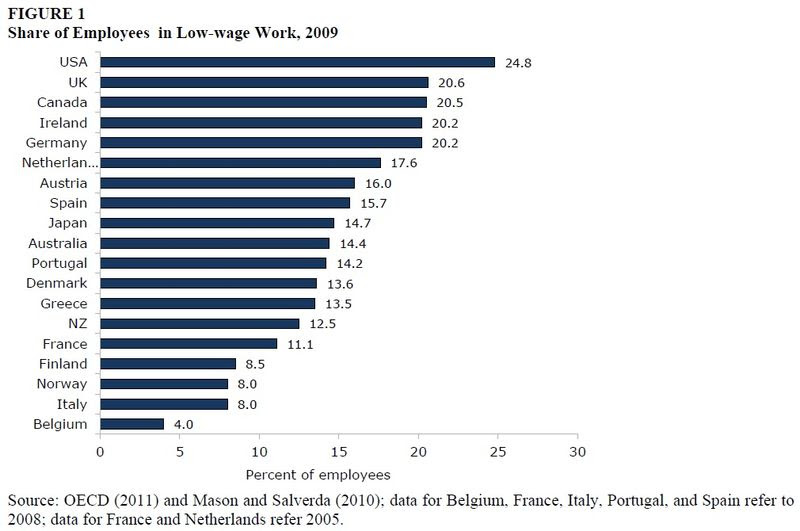
Economist Tim Taylor presented a chart highlighting that the US has a very high portion of its population working in low wage jobs. This is contrary to the image that the US is a land with middle class jobs for many:

low-wage-2
low-wage-2

Low wage work as defined in the data set above is employment that pays less than $10 per hour. Imagine trying to support a family on this. 2,000 hours of work would yield $20,000 which is below the poverty line for a family of three. And then we wonder how we have roughly 47 million Americans on food stamps.

The reason we continue to see this kind of recovery is that all policy made during the collapse was dictated by those in the banking industry that led up to this collapse in the first place. Even former Treasury Secretary Tim Geithner mentioned that if we didn’t do the bailouts exactly as we did (i.e., keep big payouts to banking execs, money for corrupt workers, etc) then the economy would have imploded. Well the economy did implode for most workers and a recovery never happened. Maybe for his closely knit group of people things are looking great:

growth-in-income-inequality

But for the rest of country people are running the Red Queen’s Race by working harder and harder simply to stay in the same place. A McJob recovery is not something to be proud about especially when the middle class in the US continues to dwindle.

Tuesday, March 18, 2014

Thursday, February 20, 2014

Baker: Stimulus worked, but it was too small

Two-fisted liberal pride!  Don't ever back down!  The GOP watered down the stimulus with 1/3 tax cuts and cut the overall amount from more than $1 trillion that was required to about $700 billion.  

Sums up Dean Baker: "In other words, we were trying offset a loss of $1.4 trillion in annual demand with a stimulus package of $300 billion a year. Surprise! This was not enough."

Even so, the stimulus helped avoid a second Great Depression.  

My progressive comrades: don't ever apologize, don't ever make excuses. THE STIMULUS WORKED.  The fact that it couldn't do more is entirely the fault of Republicans.

Now read below to get the numbers.


By Dean Baker
February 20, 2014 | CNN

When President Obama proposed his stimulus in January 2009, the economy was in a freefall, losing more than 700,000 jobs a month. The immediate cause of the plunge was the freezing up of the financial system after the collapse of Lehman Brothers, but the deeper cause was the loss of demand after the collapse of the housing bubble.

The bubble had been driving the economy both directly and indirectly. The unprecedented run-up in house prices led to a record rate of construction, with about 2 million homes built at the peak in 2005.

In addition, the $8 trillion in housing equity created by the bubble led to an enormous consumption boom. People saw little reason to save for retirement when their home was doing it for them. The banks also made it very easy to borrow against bubble-generated equity, which many people did. As a result, the personal saving rate fell to 3% in the years 2002-07.

The bubble also indirectly enriched state and local governments with higher tax revenue. And there was a mini-bubble in nonresidential real estate, but that came to an end in 2008 as well.

The economy had already been in recession for nine months before the collapse of Lehman because the bubble was deflating, but the Lehman bankruptcy hugely accelerated the pace of decline. This was the context in which Obama planned his stimulus package before he even entered the White House.

At that point, most economists still did not recognize the severity of the downturn, just as they had not seen the dangers of the housing bubble that had been building over the previous six years.

The Congressional Budget Office projections, which were very much in the mainstream of the economics profession, showed a combined drop in GDP for 2008 and 2009 of 1%, before the economy resumed growth again in 2010. This is with no stimulus. By contrast, the economy actually shrank by 3.1% in those years, even with the stimulus beginning to kick in by the spring of 2009.

Given this background, it was easy to see that the stimulus was far too small.  It was designed to create about 3 million jobs, which might have been adequate given the Budget Office projections. Since the package Congress approved was considerably smaller than the one requested, the final version probably created about 2 million jobs. This was a very important boost to the economy at the time, but we needed 10 million to 12 million jobs to make up for jobs lost to the collapse of the bubble.

The arithmetic on this is straightforward. With the collapse of the bubble, we suddenly had a huge glut of unsold homes. As a result, housing construction plunged from record highs to 50-year lows. The loss in annual construction demand was more than $600 billion. Similarly, the loss of $8 trillion in housing equity sent consumption plunging. People no longer had equity in their homes against which to borrow, and even the people who did would face considerably tougher lending conditions. The drop in annual consumption was on the order of $500 billion.

The collapse of the bubble in nonresidential real estate cost the economy another $150 billion in annual demand, as did the cutbacks in state and local government spending as a result of lost tax revenue. This brings the loss in annual demand as a result of the collapse of the bubble to $1.4 trillion.

Compared with this loss of private sector demand, the stimulus was about $700 billion, excluding some technical tax fixes that are done every year and have nothing to do with stimulus. Roughly $300 billion of this was for 2009 and another $300 billion for 2010, with the rest of the spending spread over later years.

In other words, we were trying offset a loss of $1.4 trillion in annual demand with a stimulus package of $300 billion a year. Surprise! This was not enough.

That is not 20/20 hindsight; some of us were yelling this as loudly as we could at the time.  It was easy to see that the stimulus package was not large enough to make up for the massive shortfall in private sector demand. It was going to leave millions unemployed and an economy still operating far below its potential level of output.

We are still facing the consequences of an inadequate stimulus. The reality is that we have no simple formula for getting the private sector to replace the demand lost from the collapse of the bubble.

Contrary to what Republican politicians tell us, private businesses don't run out and create jobs just because we throw tax breaks at them and profess our love.  If the government doesn't create demand, then we will be doomed to a long period of high unemployment -- just as we saw in the Great Depression. The government could fill the demand gap by spending on infrastructure, education and other areas, but in a political world where higher spending is strictly verboten, that doesn't seem likely.

The one alternative, which has been successfully pursued by Germany, is to reduce the supply of labor through work sharing. Companies reduce all their employees' hours and pay so everyone keeps their jobs. The government then pays the workers part-time unemployment benefits -- cheaper than paying someone full-time unemployment.

Germans have used this route to lower their unemployment rate to 5.2%, even though their nation's growth has been slower than ours.

Some bipartisan baby steps have been taken in this direction; we will need much more if we are to get back to near full employment any time soon. In a world where politics makes further stimulus impossible, work sharing is our best hope.

Saturday, December 28, 2013

GDP, full-time jobs up despite Obamacare

Gee, whaddya know? Obamacare's employer mandate hasn't cratered growth or employment as predicted by naysayers. Somehow, the U.S. economy grew by 4.1 percent in the third quarter of 2013. Writes business professor Anthony Orlando [emphasis mine]:

For one thing, the cost of Obamacare has been greatly exaggerated. The law states companies with more than 50 workers must offer health insurance to their full-time employees or pay a fine of $2,000 per employee. That may sound like a lot, but it's a heck of a lot less than most companies are already paying for health insurance, which costs an average of $15,073 per worker.

"You've got 5.7 million firms in the U.S.," says health economist Mark Duggan. "Only 210,000 have more than 50 employees. So 96 percent of firms aren't affected. Then if you look among those firms with 50 or more employees, something on the order of 95 percent offer health insurance."

When you add it all up, the "employer mandate" probably affects less than 1 percent of the workforce.

Definitely not enough to make a dent in the economy.

So it shouldn't come as a surprise there is no evidence Obamacare is turning us into a "part-time" economy. Since President Obama signed the law, the economy has added millions of full-time jobs, while part-time jobs have actually declined. A lower percentage of workers are part-time than they were under President Reagan in the 1980s.

It's a similar situation with the individual mandate. If you recall, the maximum number of potential Obamacare "victims" -- those paying paying higher prices for lesser coverage -- is 2.4 million people, but most likely much fewer. That's less than 1 percent of the U.S. population.

The upshot: those most irate about the employer and individual mandates are journalists, politicians, pundits and cranks who themselves aren't affected by it. Their apparent concern for the plight of others is almost... liberal.


By Anthony W. Orlando
December 27, 2013 |  South Florida Sun-Sentinel

Wednesday, December 11, 2013

Rand Paul, GOP endorse 'Work or Starve' economics

Yep, as any FOX host or talk radio jock will tell you, the real problem holding back America's economy is lazy welfare moochers. 

(That's what they say on Wednesdays. On Mondays it's job-killing regulations; on Tuesdays it's the Affordable Care Act; Thursdays it's too-high corporate taxes; and on Friday it's "general uncertainty." On weekends they relax and blame everything on Obama.)

Seriously though, as Ruth Marcus points out below, "Of 4.1 million in the ranks of the long-term unemployed, only 1.3 million are still receiving the unemployment checks that Paul asserts are holding them back." 

[Insert nail in coffin]. 


By Ruth Marcus
December 11, 2013 | Washington Post

The year’s not over, but it’s not too early to declare the hands-down winner of this year’s Scrooge award: Sen. Rand Paul.

The Kentucky Republican wants to cut off people’s unemployment benefits — not to save taxpayers’ money from being frittered away by loafers unwilling to haul themselves out of their comfy hammocks to look for work. No, Sen. Scrooge wants to cut them out of solicitude for the long-term unemployed.

Because, as the kindly doctor explained (correctly) on “Fox News Sunday,” it is clear that the longer people are unemployed the more difficulty they have finding work. Ergo, says Paul, the obvious solution: Limit the length of unemployment benefits — even if no jobs are available.

“I do support unemployment benefits for the 26 weeks that they’re paid for. If you extend it beyond that, you do a disservice to these workers,” Paul said. “When you allow people to be on unemployment insurance for 99 weeks, you’re causing them to become part of this perpetual unemployed group in our economy.”

Paul is wrong, by the way, about the 99 weeks — the longest combined state and federal benefits can now last is 73 weeks, and then only in three states where unemployment has hovered above 9 percent. Elsewhere, depending on the severity of unemployment, the maximum duration is between 40 and 63 weeks.

But Paul is more fundamentally wrong with his diagnosis that the best way to help this unfortunate group is to terminate their benefits. Talk about burning down the village in order to save it. Long-term unemployment benefits don’t cause long-term unemployment; they ameliorate it in hard economic times. (States generally cover benefits for the first 26 weeks, but during downturns the federal government has long stepped in to subsidize extended help.)

Yes, I know about moral hazard. In a well-functioning economy, overly generous unemployment benefits may dissuade people from taking new jobs. But this is not a well-functioning economy. Even with unemployment at a five-year low, nearly four of 10 jobless workers count as long-term unemployed, out of work for 27 weeks or longer. In October, there were nearly three people unemployed for every available job.

One relevant data point: When President Bush signed an extension of unemployment benefits in June 2008, the unemployment rate was 5.6 percent, the long-term unemployment rate was 1 percent and the average duration of unemployment was 17.1 weeks. Today those numbers are 7 percent unemployment, 2.6 percent long-term unemployedand 37.2 weeks in duration.

Another point: This could easily be you. According to a new report by the White House Council of Economic Advisers, 40 percent of the long-term unemployed had a household income, prior to job loss, between $30,000 and $75,000. One in five has a bachelor’s degree or higher. The more education you have, the less likely you are to fall into unemployment. But once you’re unemployed, your education offers no shield against joining the ranks of the long-term unemployed.

And about those overly generous benefits. They average $300 a week. Would that be enough to keep you on the unemployment rolls? Ironically, long-term benefits help keep people in the job market — looking for work is a condition of receiving help — rather than simply giving up. Cutting them off would likely cause the unemployment rate to fall, but only because they would be out of the workforce.

Another indication that correlation is not causality: Most of those in the ranks of the long-term unemployed have exhausted their benefits. Of 4.1 million in the ranks of the long-term unemployed, only 1.3 million are still receiving the unemployment checks that Paul asserts are holding them back.

Republicans cite two recent studies as proof that, as the House Ways and Means Committee put it, emergency benefits are “the cause of the painfully slow labor market recovery.” But the bulk of academic research suggests that extended benefits only slightly increase the length of time people are out of work, mostly because of flexibility to find a suitable job rather than grasping at the first offered.

As researchers at the Federal Reserve Bank of San Francisco recently concluded, “Our estimates suggest that extending unemployment insurance benefits in weak labor markets has virtually no effect on the rate of job finding.”

If Paul and fellow Republicans had their way, 1.3 million jobless would be cut off by year’s end, another 1.9 million in the first half of 2014. Two words suffice in response: Bah! Humbug!

Tuesday, November 26, 2013

Survey: U.S. workers suffer unprecedented anxiety


And it's all because of Obamacare and federal regulations.... Oh, and too-high taxes on corporations, can't forget that one.

Seriously though, Republicans are out of answers and Democrats are too pussy to do what's necessary, like expanding unemployment benefits, raising the minimum wage, expanding Social Security, offering real child care, etc.:


More than six in 10 workers in a recent Washington Post-Miller Center poll worry that they will lose their jobs to the economy, surpassing concerns in more than a dozen surveys dating to the 1970s. Nearly one in three, 32 percent, say they worry “a lot” about losing their jobs, also a record high, according to the joint survey, which explores Americans’ changing definition of success and their confidence in the country’s future. 

And this worry is especially strong among the working poor, aka the Little Guys:

Fifty-four percent of workers making $35,000 or less now worry “a lot” about losing their jobs, compared with 37 percent of ­lower-income workers in 1992 and an identical number in 1975, according to surveys by Time magazine, CNN and Yankelovich, a market research firm. Intense worry is far lower, 29 percent, among workers with incomes between $35,000 and $75,000, and it drops to 17 percent among those with incomes above that level.

Lower-paid workers also worry far more about making ends meet. Fully 85 percent of them fear that their families’ income will not be enough to meet expenses, up 25 points from a 1971 survey asking an identical question. Thirty-two percent say they worry all the time about meeting expenses, a number that has almost tripled since the 1970s.

And it's not even polite to talk about the health and social effects of such anxiety among the working poor, that often clouds their judgment and leads to depression. We haven't even attempted, as a society, to feel that level of empathy with our fellow Americans.


By Jim Tankersley and Scott Clement
November 26, 2013 | Washington Post

Sunday, November 10, 2013

Putting vets on a pedestal doesn't help them

On Veteran's Day, let's resolve to help our returning troops do what the WWII generation did after war: get back on with civilian life.  

Applause, "hero worship" and movie theater discounts aren't what they need from us right now. They need education, training and job opportunities. They need patient assistance with reintegrating into society.


By Alex Horton
November 10, 2013 | Atlantic

Thursday, October 17, 2013

GOP cost U.S. nearly 1 million jobs in 3 years

Before my Republican friends roll their eyes and dismiss this study as some lib'rul media/Media Matters hack job, please note that this study was commissioned by the Peterson Foundation, the founder of the "Fix the Debt CEOs" group that wants to cut the U.S. federal safety net in order to decrease the national debt.  

Republicans can't be trusted as stewards of the U.S. economy. They've got two tricks in their bag: tax cuts and deregulation. But after they've cut taxes to the bone and given business license to do anything, anywhere, to anybody... they're worthless.


By Mark Gongloff
October 15, 2013 | Huffington Post

Wednesday, July 31, 2013

AP: Poor white people

Uh-oh!  In America, "uppity" blacks feeling more confident + poor, dispirited whites =  trouble.


By Hope Yen
July 29, 2013 | AP

Four out of 5 U.S. adults struggle with joblessness, near poverty or reliance on welfare for at least parts of their lives, a sign of deteriorating economic security and an elusive American dream.

Survey data exclusive to The Associated Press points to an increasingly globalized U.S. economy, the widening gap between rich and poor and loss of good-paying manufacturing jobs as reasons for the trend.

The findings come as President Barack Obama tries to renew his administration's emphasis on the economy, saying in recent speeches that his highest priority is to "rebuild ladders of opportunity" and reverse income inequality.

Hardship is particularly on the rise among whites, based on several measures. Pessimism among that racial group about their families' economic futures has climbed to the highest point since at least 1987. In the most recent AP-GfK poll, 63 percent of whites called the economy "poor."

"I think it's going to get worse," said Irene Salyers, 52, of Buchanan County, Va., a declining coal region in Appalachia. Married and divorced three times, Salyers now helps run a fruit and vegetable stand with her boyfriend, but it doesn't generate much income. They live mostly off government disability checks.

"If you do try to go apply for a job, they're not hiring people, and they're not paying that much to even go to work," she said. Children, she said, have "nothing better to do than to get on drugs."

While racial and ethnic minorities are more likely to live in poverty, race disparities in the poverty rate have narrowed substantially since the 1970s, census data show. Economic insecurity among whites also is more pervasive than is shown in government data, engulfing more than 76 percent of white adults by the time they turn 60, according to a new economic gauge being published next year by the Oxford University Press.

The gauge defines "economic insecurity" as experiencing unemployment at some point in their working lives, or a year or more of reliance on government aid such as food stamps or income below 150 percent of the poverty line. Measured across all races, the risk of economic insecurity rises to 79 percent.

"It's time that America comes to understand that many of the nation's biggest disparities, from education and life expectancy to poverty, are increasingly due to economic class position," said William Julius Wilson, a Harvard professor who specializes in race and poverty.

He noted that despite continuing economic difficulties, minorities have more optimism about the future after Obama's election, while struggling whites do not.

"There is the real possibility that white alienation will increase if steps are not taken to highlight and address inequality on a broad front," Wilson said.
___

Sometimes termed "the invisible poor" by demographers, lower-income whites are generally dispersed in suburbs as well as small rural towns, where more than 60 percent of the poor are white. Concentrated in Appalachia in the East, they are also numerous in the industrial Midwest and spread across America's heartland, from Missouri, Arkansas and Oklahoma up through the Great Plains.

More than 19 million whites fall below the poverty line of $23,021 for a family of four, accounting for more than 41 percent of the nation's destitute, nearly double the number of poor blacks.

Still, while census figures provide an official measure of poverty, they're only a temporary snapshot. The numbers don't capture the makeup of those who cycle in and out of poverty at different points in their lives. They may be suburbanites, for example, or the working poor or the laid off.

In 2011 that snapshot showed 12.6 percent of adults in their prime working-age years of 25-60 lived in poverty. But measured in terms of a person's lifetime risk, a much higher number — 4 in 10 adults — falls into poverty for at least a year of their lives.

The risks of poverty also have been increasing in recent decades, particularly among people ages 35-55, coinciding with widening income inequality. For instance, people ages 35-45 had a 17 percent risk of encountering poverty during the 1969-1989 time period; that risk increased to 23 percent during the 1989-2009 period. For those ages 45-55, the risk of poverty jumped from 11.8 percent to 17.7 percent.

By race, nonwhites still have a higher risk of being economically insecure, at 90 percent. But compared with the official poverty rate, some of the biggest jumps under the newer measure are among whites, with more than 76 percent enduring periods of joblessness, life on welfare or near-poverty.

By 2030, based on the current trend of widening income inequality, close to 85 percent of all working-age adults in the U.S. will experience bouts of economic insecurity.

"Poverty is no longer an issue of 'them', it's an issue of 'us'," says Mark Rank, a professor at Washington University in St. Louis who calculated the numbers. "Only when poverty is thought of as a mainstream event, rather than a fringe experience that just affects blacks and Hispanics, can we really begin to build broader support for programs that lift people in need."

Rank's analysis is supplemented with figures provided by Tom Hirschl, a professor at Cornell University; John Iceland, a sociology professor at Penn State University; the University of New Hampshire's Carsey Institute; the Census Bureau; and the Population Reference Bureau.

Among the findings:

— For the first time since 1975, the number of white single-mother households who were living in poverty with children surpassed or equaled black ones in the past decade, spurred by job losses and faster rates of out-of-wedlock births among whites. White single-mother families in poverty stood at nearly 1.5 million in 2011, comparable to the number for blacks. Hispanic single-mother families in poverty trailed at 1.2 million.

— The share of children living in high-poverty neighborhoods — those with poverty rates of 30 percent or more — has increased to 1 in 10, putting them at higher risk of teen pregnancy or dropping out of school. Non-Hispanic whites accounted for 17 percent of the child population in such neighborhoods, up from 13 percent in 2000, even though the overall proportion of white children in the U.S. has been declining.

The share of black children in high-poverty neighborhoods dropped sharply, from 43 percent to 37 percent, while the share of Latino children ticked higher, from 38 to 39 percent.
___

Going back to the 1980s, never have whites been so pessimistic about their futures, according to the General Social Survey, which is conducted by NORC at the University of Chicago. Just 45 percent say their family will have a good chance of improving their economic position based on the way things are in America.

The divide is especially evident among those whites who self-identify as working class: 49 percent say they think their children will do better than them, compared with 67 percent of non-whites who consider themselves working class.

In November, Obama won the votes of just 36 percent of those noncollege whites, the worst performance of any Democratic nominee among that group since 1984.

Some Democratic analysts have urged renewed efforts to bring working-class whites into the political fold, calling them a potential "decisive swing voter group" if minority and youth turnout level off in future elections.

"They don't trust big government, but it doesn't mean they want no government," says Republican pollster Ed Goeas, who agrees that working-class whites will remain an important electoral group. "They feel that politicians are giving attention to other people and not them."