Showing posts with label job-killing regulations. Show all posts

Sunday, June 8, 2014

Our McJobs economy...and the GOP plan to make it worse

My dear conservative friends will blame the shrinking middle class and more McJobs on Obama, naturally. 

But to see they're wrong you only have to look at their policy "fixes": no minimum wage; no guaranteed health insurance for workers; no right to unionize; and privatizing Medicare.  Oh, and cutting unemployment benefits to motivate more people to compete for low-wage jobs, thereby driving wages down even further. The most radical Tea Partiers even say we should abolish the Department of Education, when U.S. public schools are most people's shot at a better life.  

None of these ideas makes any economic sense.  (It makes a heckuva lot of sense from a class warfare perspective, however.)  And in the case of conservatives' debt fetish, they confuse economic cause and effect: debt causes recessions, not the other way around.

So they can't diagnose the problem, nor can they prescribe any cures.

But wait, they have more great ideas. Cutting "job-killing regulations" and income taxes on the rich should stimulate growth, then all the unemployed could get jobs in the new businesses that Republicans say their hands-off policies would create.  Yet we tried that before and saw how it worked out.  

Conservative talk radio says we can all move to Texas or North Dakota and find high-paying jobs in the shale gas boom, but that's hardly practical. Most people can't just pick up and move their entire lives, like Okies of the Depression era, to where the jobs are.  Doesn't matter. Republicans want to open up even more public lands for oil & gas drilling, even though that oil is sold by multinational corporations on the world market; it's not "ours."

Or as I like to sum it up, the GOP thinks we can cut and burn our way to a better economic future.  


David Nather over at Politico put it thusly in his article, "And the GOP economic plan is...?":


It’s the sixth year of Barack Obama’s presidency, the job market is still sluggish, most Americans say they’re unhappy with the economy, and Obama’s approval ratings are down. So what’s the Republican plan to turn it around?

The answer is, they don’t all think they need one and those who do can’t agree on a unified view.

This is why it's so ominous that Republicans, thanks to gerrymandering and stronger off-election turnout, could take over Congress in November.  I'm not saying they're solely responsible for the Great Recession, (although Phil Gramm could certainly make a case), but they certainly haven't learned any economic lessons from it, and that's scary. This is a party that's pissed off yet feels zero responsibility for its policies -- it's a veritable chimpanzee with a hand grenade.... And they have as many good ideas as a chimp how to grow the middle class and get Americans back to work.


Posted by mybudget360 | June 8, 2014

The US is slowly becoming a McJob nation. While the press jumps up and down that the US is now finally at a breakeven point from the jobs lost since the recession started in 2007, they fail to mention that those not in the labor force is up by nearly 13 million. Even looking into the recent employment report, we continue to find a heavy trend of hiring in low wage employment sectors. For example, 32,000 jobs were added in “leisure and hospitality” bringing the annual total of jobs added to 311,000. Another 21,000 jobs were added in social assistance which pay very little but will grow as demand for health support grows by an aging population. The system at least in the eyes of Wall Street and the government is working perfectly fine. We have a plentiful supply of low wage labor while laws and bailout mechanisms are in place for the financially and politically connected. The middle class continues to fall off the bandwagon one by one and enters a labor force of permanent low wage labor with very little prospect of a decent retirement. In fact, most will be working until all the wheels come flying off. We also find that 1 out of 4 Americans are working in jobs that pay $10 or less per hour. How about trying to earn the Americans Dream on that McJob salary?

Breaking even and seeing the non-labor force surge

It has taken us 7 slow and painful years simply to recover the jobs we had back in 2007. With the latest jobs number, we finally are back to where we were in 2007. Of course, the population has increased and many of these new jobs come with horrible benefits, lower wages, and very little security. Is it any wonder why home buying in the country continues to be so anemic?

Low wages are also creating an entire nation that is unprepared for retirement. For example, 1 out of 3 Americans has zero dollars in their savings account. Half the country is one paycheck away from a financial avalanche. During the last 7 years, we have added close to 13 million Americans to the “not in the labor force” category:

record jobs in context
Source:  BLS, ZH

A part of this growth is an older population but a large part of it isn’t. We have many digging into college degrees with massive debt to avoid the current economic situation. Others have simply given up looking for work. The low wage recovery has been extremely painful for many Americans and wealth growth has not occurred for 90 percent of the country. These are simply the facts. This is what we find in every piece of data we look at.

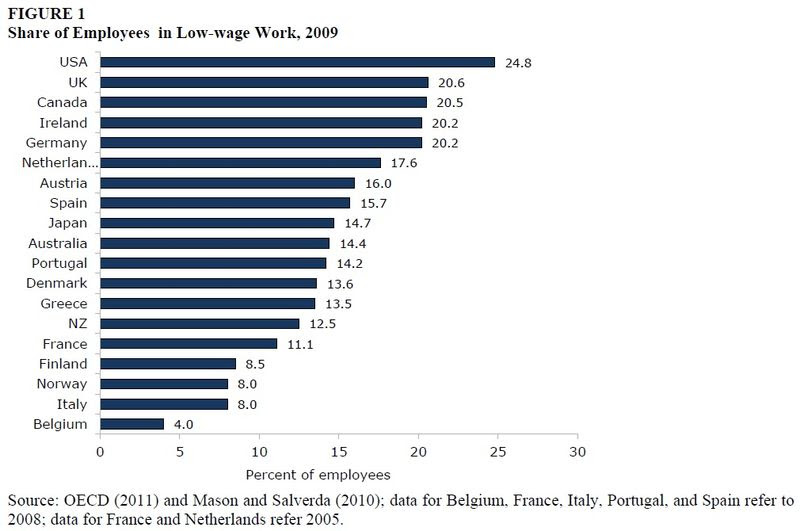
Economist Tim Taylor presented a chart highlighting that the US has a very high portion of its population working in low wage jobs. This is contrary to the image that the US is a land with middle class jobs for many:
low-wage-2
low-wage-2

Low wage work as defined in the data set above is employment that pays less than $10 per hour. Imagine trying to support a family on this. 2,000 hours of work would yield $20,000 which is below the poverty line for a family of three. And then we wonder how we have roughly 47 million Americans on food stamps.

The reason we continue to see this kind of recovery is that all policy made during the collapse was dictated by those in the banking industry that led up to this collapse in the first place. Even former Treasury Secretary Tim Geithner mentioned that if we didn’t do the bailouts exactly as we did (i.e., keep big payouts to banking execs, money for corrupt workers, etc) then the economy would have imploded. Well the economy did implode for most workers and a recovery never happened. Maybe for his closely knit group of people things are looking great:

growth-in-income-inequality

But for the rest of country people are running the Red Queen’s Race by working harder and harder simply to stay in the same place. A McJob recovery is not something to be proud about especially when the middle class in the US continues to dwindle.

Wednesday, December 4, 2013

Debunking 'job-killing regulations'

A new study shows that, when it comes to the economy, the modern Republican party has one leg less to stand on. 

To wit, we have proof that "job-killing regulations" are just a myth propagated by companies and their lobbyists who want to pass on the real economic costs of their pollution, dangerous operations, and unfair business practices to society at large. 

Ironically, as this study debunking "job-killing regulations" is coming out, the U.S. Chamber of Commerce (a glorified wing of the Republican Party) is pledging a "war" on "the vast regulatory state" and an "unprecedented flow of regulations" because, says the Chamber's President, "We must lift the veil of uncertainty hanging over every business and investor if we want to revive our economy."

Another leg of the GOP fell off long ago: tax cuts on the rich (aka trickle-down, voodoo economics and Reaganomics) have never proven effective in growing the economy, jobs and incomes, as even Pope Francis recently noted. 

So now that those two legs of the GOP's three-legged economic stool are gone, what's left? Cutting entitlements. That's right: "Work or Starve." (Official 2014 GOP campaign motto). Well, Republicans have gone ahead and cut food stamps and other forms of "welfare," and we'll have plenty of time to see how badly that works out for Americans and the economy before next November.  

Methinks by then the GOP will be sitting on the floor.

(Now to get a bit wonkish. The true cost of regulations may be hard to calculate; nevertheless, we can compare the U.S. to other countries. After all, everything is relative and businesses can't re-locate to Mars. The World Bank's annual Doing Business survey compares countries on a range of indicators, like ease of starting a business and ease of paying taxes. In 2013, even in the dark depths of the Obama Regime, the U.S. ranks 4th in the world out of 189 countries. As in past years, we are topped only by tiny islands Singapore, Hong Kong and New Zealand. So the United States is still the place to do business, with the best climate for investment and the biggest consumer market in the world. Anybody who says otherwise is a crank or a charlatan.)

UPDATE (06.12.2013): Right on cue, our fair & balanced friends at FOX gave us this big headline: "Regulation Nation: Gov't regs estimated to pound private sector with $1.8 T in costs." On FOX's home page they rounded that estimate, courtesy of the right-wing Competitive Enterprise Institute, up to $2 trillion. (What's $200 billion nowadays anyway? Just rounding.)  FOX doesn't offer any dissenting opinions on that estimate, or even information how it was derived; it's just presented as fact. Nor does FOX mention that CEI is a libertarian think tank that has defended Big Tobacco, opposed fuel efficiency standards, and disputed global warming science. It's all in day's work shilling for corporate interests.


By Sean McElwee
December 2, 2013 | Salon 

It’s one of the oldest right-wing claims: “Excessive” regulation will harm job creators and kill the economy. But is it based on sound economics?

One new study, which examines this particular argument, finds it absurd on its face. Taylor Lincoln, who authored the report for Public Citizen, tells Salon the goal was to “point out hypocrisy and contradictions and the chasms between rhetoric and reality.” To that end, the report cites one Heritage Foundation study which asserted that a more efficient regulatory system could create 9.6 million jobs. The problem, as Washington Post columnist Steven Pearlstein noted: “there are only 7 million unemployed Americans.”

Heritage isn’t the only one making this argument. A Phoenix Foundation study claimed that, “a 5 percent reduction in the federal regulatory budget would yield 5.9 million new jobs over five years.” But the Public Citizen report points out that this leads to a ludicrous conclusion: “a 16 percent decrease (a figure the authors chose to parallel the amount by which they say federal spending had exceeded revenue since 2000) would result in the creation of 18.8 million new jobs over five years. In contrast, there are only about 11.3 million unemployed Americans.”

Dr. Thomas McGarity, a University of Texas professor who has studied regulation for decades, finds the right-wing argument wanting. As to whether cutting regulation could increase economic growth, he tells Salon, “it’s a silly argument. The impact of regulation, particularly in this era when it’s so darn hard to write a regulation, is nothing compared to what the Fed does each meeting.” His most recent book, Freedom to Harm, details how a decade-long assault on regulation threatens workers and the environment.

In fact, the OMB estimates that regulations provide huge economic benefits. They find that major regulations benefit the economy between $193 billion and $800 billion a year at a cost of $57 to $84 billion. McGarity confirms this, telling Salon, “The thing that is most troubling to me is, when the right-wing think-tanks or the government estimates the cost of regulation, they never go back and see how much it did cost. The few retrospective studies that have been done have shown uniformly that the cost estimates have been higher, much higher than the actual cost of the regulation. The reason is that once the regulations are in place companies are able to adapt to them very quickly.”

The irony is that Republicans always hail the ability of businesses to innovate and adapt, but their anti-regulatory stance is premised on the idea the businesses cannot adapt to new regulation.

Both McGarity and Lincoln noted that Nixon, Ford and H.W. Bush were all very pro-regulation. McGarity tells Salon that “there used to be strong environmentally conscious Republicans in the House and Senate, [but] you can’t point to one Republican now who is a strong environmental advocate.” Lincoln says the anti-regulatory impulse is tied to the economy. When the economy is strong, businesses quickly adapt to regulation, but in hard times, regulation appears as a scapegoat for the weak economy. Both feared that the Republican party is now ruled largely by business interests unconcerned with the common good.

But it’s not just right-wing think tanks and demagogues claiming that cutting regulation will somehow magically create jobs. The Economist claimed this year: “But red tape in America is no laughing matter. The problem is not the rules that are self-evidently absurd. It is the ones that sound reasonable on their own but impose a huge burden collectively.” The article concludes that regulation may “crush the life out of America’s economy.”

In the New York Times earlier this month, Tyler Cowen wrote:

We don’t really know the total regulatory burden in our economy today, in part because there are too many rules and side effects to add up all the costs. Nonetheless, we are continually increasing the obstacles to doing business. America has lost the robust productivity growth of much of the postwar era, and the share of start-ups in the economy has been falling each decade since the 1980s. Although overregulation is hardly the only culprit, it is very likely contributing to the problem.

When arguing to gut America’s regulatory regime, one doesn’t need data or statistics, just a general feeling that regulation is probably harming economic growth.

Opponents of regulation often suggest that regulations create uncertainty and therefore stymie growth, but in truth they do the opposite. To understand why, imagine a world without regulation, one in which railroad track gauges are divergent, food and drugs are released without trials and buildings are built on a whim.  Americans who visit countries with a weak governance are often surprised to find that the stairs aren’t of equal height. By establishing a minimum standard for environmental degradation, customer safety and worker treatment, regulation can change entire industries.

The auto industry is a quintessential example. Today’s advertisements focus on fuel efficiency and safety, and we take air bags and seat belts for granted, but cars were once death traps. Lincoln explains, “Their market research showed that adding seat belts didn’t help and they’re not seeing profit it it, they’re not seeing dollar signs.” All of that began to change with Ralph Nader’s famous “Unsafe at Any Speed.” Customers didn’t know that cars could be safer and more fuel-efficient until the government began enforcing the regulations. Henry Ford once said, “If I had asked people what they wanted, they would have said faster horses.”

Consumers are naturally conservative and they are heavily influenced by advertising. George McGovern, echoing the arguments of J. K. Galbraith, said that advertising can “brainwash the consumer” because “no one was ever born with the taste for huge automobiles.” Companies were stuck on producing slick fancy cars, not safe cars. Regulation upended the industry and entirely changed the way that customers and society viewed the car: not a luxury toy, but a utilitarian mode of transportation. This changed the way customers thought about safety and companies thought about advertising.

The report shows how regulations we now take for granted — catalytic converters, unleaded gasoline, fuel efficiency standards, worker safety protection, minimum wages, environmental protections — were once denounced by industry shills as “job killing” or “economy strangling.” Industry experts predicted that worker safety regulations would destroy jobs and tank industries. The day before the bills would pass they would shout Cassandra-like warnings and hold up Mayan calendars. But the next day the air was cleaner, workers were safer and the economy chugged along.

Even Tom Donohue, the President of the U.S. Chamber of Commerce, is forced to concede, “I think we need a strong public sector. We have about a $1.7 trillion a year regulatory bill. Seventy-five, 80 percent of that is very useful. You’ve got to have air traffic control. You’ve got to have food safety.”

Today, the same absurd claims once raised about now banal regulations are being tossed about again. Already industry experts have predicted 12.9 million job losses from Dodd-Frank, the Affordable Care Act and Obama’s GHG regulation proposals. Lincoln’s goal is simple: “We are trying to lay down a record of what they’re saying now, because they are going to be wrong again.”

Monday, March 11, 2013

Fed: Lack of demand, not red tape & taxes, is the problem

Here's some interesting research from the Fed, based on National Federation of Independent Businesses monthly surveys of small business, that disproves what conservative pundits and economists have been saying about "burdensome regulations" and "uncertainty" holding back the U.S. economic recovery.

Read their executive summary and weep, teabaggers!

What explains the sharp decline in U.S. employment from 2007 to 2009? Why has employment remained stubbornly low? Survey data from the National Federation of Independent Businesses show that the decline in state-level employment is strongly correlated with the increase in the percentage of businesses complaining about lack of demand. While business concerns about government regulation and taxes also rose steadily from 2008 to 2011, there is no evidence that job losses were larger in states where businesses were more worried about these factors.

These findings support what Paul Krugman, et al have been saying all along.  Don't get me wrong, it's good to be a liberal, it's great to be right most of the time, but it's really sad and frustrating that the truth is so easily dismissed. Getting this stuff right affects the lives of millions!

UPDATE: Just to be fair & balanced, here's a link to an article by economist Jeffrey Sachs on why Paul Krugman is wrong, why he is a "crude Keynsian." Maybe later I'll refute Sachs in a separate post, although I will say that the major points he offers are special pleading, not backed up by data.


By Atif Mian and Amir Sufi
February 11, 2013 | FRBSF Economic Letter

Monday, October 15, 2012

'Weed whack' EPA regulations? Not so fast

'Weed whacker'?! What a terrible analogy! Everybody knows no-string lawn trimmers are superior. Romney obviously doesn't know his way around a man's yard.

Ironically, many of the U.S. environmental regulations that the GOP says are "strangling business" stretch back to Richard Nixon and George Bush, Sr.  

Anyway, if elected, could Romney fulfill his promise to take a "weed whacker" to President Obama's newer regulations on coal and other industries?  Not so fast:

But even if he's elected, Romney couldn't just snap his fingers and get rid of those regulations. His EPA appointees would have to propose rule changes, give the public time to comment on them, and present detailed scientific and legal justifications to prove that undoing or weakening the rules make sense.

"I think that will certainly be done. But it's not something that can be done overnight," says Jeff Holmstead, an industry lawyer who headed EPA's air pollution programs under the second President Bush.

Even if Romney were to undo the regulations, there would be another hurdle: Environmental groups surely would sue. Lawsuits from environmental groups effectively blocked the second President Bush's EPA from weakening some clean air rules.

"If you take a hard right turn on an environmental rule — or for that matter, a hard left turn — you've got strict constructionist judges who are going to say no, and they're on the federal courts today," says Kevin Book, director of ClearView Energy Partners, a Washington-based energy consulting firm.

Book says the federal judges who oversee EPA rules most likely would prevent big changes, regardless of who wins the election.

So if Romney can't keep his campaign promise then what could he do?  The classic GOP approach to regulatory (non-)enforcement:

"A President Romney could starve the agencies of money needed to enforce existing public health safeguards — in effect, take the environmental cop off the beat," says Dan Weiss, a volunteer adviser to the Obama campaign and a fellow at the action fund for the Center for American Progress, a left-leaning think tank.

Voila, problem solved, right?  Well, it means firms would still be breaking the law, they just wouldn't get caught.  But that's all that matters to Big Business and Republicans, I suppose.


Tuesday, May 8, 2012

Bloomberg: Dem presidents create twice as many jobs

"...since Democrat John F. Kennedy took office in January 1961, non-government payrolls in the U.S. swelled by almost 42 million jobs under Democrats, compared with 24 million for Republican presidents...."

What more do I need to say?  Well, this: even our America-hating, crypto-Marxist President Obama has created over 3 million private sector jobs since Dubya's Great Recession officially ended in June 2009.  To put that in perspective, compare him to Dubya, who from Feb. 2001 to Jan. 2009 scored a net loss of 643,000 private-sector jobs.  And in an unremarked milestone, in April 2012, Obama finally surpassed the number of jobs he inherited from Dubya in the depths of the Great Recession in Jan. 2009: 111 million non-farm, private-sector jobs.  Slowly, slowly, we are headed in the right direction.


By Bob Drummond
May 8, 2012 | Bloomberg

Thursday, October 20, 2011

World Bank: U.S. a great place for doing business

At the same time that corporations and right-wing politicians' argue that "job-killing regulations" are to blame for America's current economic malaise, the USA has moved up in the annual Doing Business rankings by the World Bank -- from 5th place to 4th.

As last year, only tiny islands managed to be more business-friendly than the good ole US of A.

Looks like somebody doesn't know what the hell they're talking about.


The World Bank Group
October 20, 2011