Showing posts with label recession. Show all posts

Sunday, March 30, 2014

Private charity fails to replace social programs

As I've noted before, charitable giving is "pro-cyclical," meaning it decreases during a bad economy when it's needed most.  

Hiltzik also points out that very little of charitable giving is aimed at the needs of the poor; and the rich are more miserly givers than the rest of us:

The smallest allocation of philanthropic giving to basic needs of the poor was made by the wealthiest donors, those with income of $1 million of more, who directed 3.8% of their giving directly to the poor. For the $100,000-$200,000 income group, that allocation was 12.4%.

"The existing evidence doesn't support the idea that wealthy donors will step in" to replace government transfer programs, says Rob Reich, an expert in philanthropy at Stanford. As he wrote last year, "Philanthropy appears to be more about the pursuit of one's own projects, a mechanism for the expression of one's values or preferences rather than a mechanism for redistribution or relief for the poor."

The largest single recipient of philanthropy is religion — 32% of the total, according to Giving USA. But only a small portion of that goes to outreach to the needy; more than three-quarters of donations to religious organizations is spent on "congregational operations," including facilities upkeep.


So here's the upshot:

What all this shows is that there's an unspoken subtext when people like [Representative Paul] Ryan complain, as he did during the 2012 presidential campaign, about "cold social programs from the federal Department of Health and Human Services" built by a government that "took away much of our greatness."

Ryan is evoking a golden-hued fairy tale of a past that never existed. In the real world today, those "cold social programs" from HHS and other federal agencies keep people fed and housed, and alive, and give their children opportunity.


By Michael Hiltzik
March 30, 2014 | Los Angeles Times

Monday, March 10, 2014

U.S. recovered from recession faster than everybody but....

Now for all you who disparaged and tore down the stimulus package, aka the American Reinvestment and Recovery Act, here are the facts.

Of course the stimlus could have been bigger and better, and not 1/3 tax cuts that the Republicans would never give the Demcroacts credit for. Nonetheless, the stimulus helped the U.S. recover quicker than every country except Germany from the financial crisis caused by the Too Big Too Fail Banks.

This is a Germany with labor unions as part of every corporate board, with "socialized" medicine and free college education.

Let's not forget history while it's still fresh!


By Sabrina Siddiqui
March 10, 2014 | Huffington Post

Sunday, February 9, 2014

The myth of Obama's part-time workforce

Here's a graph from Derek Thompson that shows how U.S. part-time employment rises and falls, historically, in perfect sync with recessions and recoveries:


That's right.  No negative Obamacare effect at all.  Zilch.  In fact, Thompson notes that, "in the last year, new full-time jobs outnumbered part-time jobs by 1.8 million to 8,000. For every new part-time job, we're creating 225 full-time positions."  

Here's how Thompson sums how badly many journalists are skewing economic reality:

It is a free country, and journalists have every constitutional right to claim that we're moving toward a Part-Time America. They will, however, be in the uncomfortable position of making a falsifiable statement that has been relentlessly falsified by every available statistic. The entire increase in part-time employment happened before Obamacare became a law.

Wherefore the dastardly lib'rul media when we need them?


By Derek Thomson
February 7, 2014 | The Atlantic

Friday, February 22, 2013

Thanks, austerity: Moody's downgrades UK's debts

Let's be very clear: this was not supposed to happen, according to conservatives and financial markets gurus. Great Britain embraced austerity -- it is still embracing austerity -- and yet Moody's has cut its credit rating to AA1.  So here is yet more evidence for those who still need it that national governments are not households, and the same rules do not necessarily apply.

Why?  Slashing public spending put the UK in a recession that -- get ready, Tea Partyers, this is the part that always gets you -- increased public debt. Here it is again, in case you missed it: slashing spending hurt the economy which increased debt:

“The main driver underpinning Moody’s decision to downgrade the UK’s government bond rating to Aa1 is the increasing clarity that, despite considerable structural economic strengths,” the Moody’s report reads, “the UK’s economic growth will remain sluggish over the next few years due to the anticipated slow growth of the global economy and the drag on the UK economy from the ongoing domestic public- and private-sector deleveraging process.”

The "ongoing deleveraging process" is business-speak for cutting one's debts. And there was an extra "f*** you" from Moody's after it cut the UK's bond rating:

“A combination of political will and medium-term fundamental underlying economic strengths will, in time, allow the government to implement its fiscal consolidation plan and reverse the U.K.’s debt trajectory.”

In other words, Moody's said, "We think you're doing all the right things, and we hope that someday it will work out for you, but in the meantime it's not, so we're downgrading you."  

That's called "damned if you do, damned if you don't," folks. But if you want to know what the "confidence fairy" really believes, look at what she does (downgrading), not what she says (cheering on austerity).

One final note: the credit ratings agencies do not rate debt levels, they rate the ability to pay one's debts. They're not the same thing. In the U.S., we have a record-high national debt, ($7 trillion of it thanks to Dubya), and yet government spending to pay the interest on that debt is at a record low, thanks to record-low interest rates. 


By Jill Lawless
February 22, 2013 | AP

Thursday, December 20, 2012

Don't forget that special someone this Christmas: You

Go on, you deserve it!  Santa Claus and Baby Jesus want you to be happy. That's the true meaning of Xmas.

Seriously though, this may just be pent-up recessionary demand that has waited all year for the big holiday sales in order to buy necessary items.


By Lynn Stuart Parramore
December 19, 2012 | AlterNet

This year, self-gifting has hit an all-time high. Shoppers are rushing to sales racks and frantically loading up on everything from tablets to trendy sneakers for that very special someone known as Me.

According to the Wall Street Journal, market research company NPD has discovered that the trend is a prime driver of holiday shopping growth this year. Before the recession, the firm found that around 12 percent of shoppers said they’d purchased items for themselves during the holidays. Last year the figure was up to 19 percent for surveys that went out before Christmas. And the post-Christmas surveys showed that 26 percent of respondents had made holiday purchases for Numero Uno. This year, the figure is already up to a whopping 32 percent.

The National Retail Federation has also predicted a big jump in self-gifting. In fact, it found that 59 percent of holiday shoppers plan to spend an average of $139.92 on items not meant to be shared. Young adults, especially, have hit upon a handy formula for shopping during the season of giving: “one for you, two for me.” Promotions on electronic items and clothing have worked particularly well with this age group, even given the fact that young people typically have less to spend: 71.5 percent of Millennials who caught the big Black Friday sales got a little something for themselves.

What is going on? Are we becoming more self-oriented? Maybe not. NPD posits that the self-gifting trend could be more about hard economic times. The idea is that the trend has increased as retailers address the crappy economy by vigorously promoting Black Friday, Cyber Monday and other discount opportunities. So consumers have learned to wait to buy that new TV until the holidays roll around. Taking advantage of special deals may be more a sign of economic prudence than narcissistic extravagance.

There’s also a pervasive feeling that, damnit, we deserve it. Americans are horribly overworked compared to other nations. In the U.S., 85.8 percent of males and 66.5 percent of females work more than 40 hours per week. That’s even more than the notoriously nose-to-the-grindstone Japanese. In every industrialized country except Canada, Japan and the U.S., workers get at least 20 paid vacation days. Guess what they get in France and Finland? 30 days. A whole month off. Paid.

According to the Bureau of Labor Statistics, the productivity of American workers has jumped 400 percent since 1950. We should be working fewer hours, but we most assuredly aren’t. We’re working more. And most of us are not profiting from it, either. Americans who get paltry vacations and face stagnant wages can hardly be blamed for wanting to do something for themselves when the holidays come around. And there’s a big advantage to self-gifting: you'll get something you really want.

Wednesday, October 31, 2012

Dems must fight any 'grand bargain' (aka austerity)

As Bill Black notes, it can only be Obama's "vanity" making him promise a "grand bargain" on spending and tax cuts if he is re-elected.  In fact, we are now in a classic period of debt-deflation, the only answer to which is more public spending.

Sadly, it sounds like Obama has swallowed the Republican Kool-Aid that we're facing a fiscal "crisis," and that something must be done now to dismantle or privatize Social Security, Medicare, SNAP and a host of federal agencies, or else somebody's grandchildren will have to pay higher taxes.  

(In fact, the CBO estimates that the Budget Control Act that the Right so desperately wanted will turn about 4.4 percent projected GDP growth in 2013 into a recession in 1H 2013 with measly 0.5 percent GDP growth for the year. Much like what is happening in Europe: see below).  

In other words, Obama seems to have embraced austerity, even though the U.S., which partially embraced fiscal stimulus, has been growing consistently since July 2009 (albeit slowly), and partly because of the stimulus and not despite it.  By contrast, the EU is sadly realizing that austerity has been self-defeating: in the EU, debt-to-GDP ratios are growingGDP is shrinking; and unemployment is growing.

If you still don't understand how that could be so, read this:

Why is [the EU's] fiscal consolidation so much more damaging now? Under normal circumstances a tightening in fiscal policy would also lead to a relaxation in monetary policy. However, with interest rates already at exceptionally low levels, this is unlikely or infeasible. Moreover, during a downturn, when unemployment is high and job security low, a greater percentage of households and firms are likely to find themselves liquidity constrained. Finally, with all countries consolidating simultaneously, output in each country is reduced not just by fiscal consolidation domestically, but by that in other countries, because of trade. In the EU, such spillover effects are likely to be large.

[...] The result of coordinated fiscal consolidation is a rise in the debt-GDP ratio of approximately five percentage points.  


P.S. - This makes 2001 posts to my blog, all-time, not counting the shit I deleted. So cue Strauss's Sunrise!:  "Buuum-buuum-buuuuuuuuuuum BUM-BUM! Boom-boom boom-boom boom-boom boom-boom boom-boom boom-boom boom!"

Reagan's 1981 recession v. W's Great Recession

Let's compare the 1981-82 recession to the Great Recession:
  • Duration:  16 months vs. 18 months
  • GDP:  -2.7 % vs. -4.1% *
  • Consumption:  +0.1 % vs. -2.3 %
  • Investment:  -9.3 % vs. -23.4 %
* The biggest drop in GDP since WWII.

Here are some more measures in 1981-82 vs. the Great Recession:
  • Personal income: +7 % vs. -1 %
  • Industrial production:  -8.6 % vs. -12 %
  • Dow Jones Avg.:  +9 % vs. -22 %
  • Housing prices:  +2.2 % vs. - 5.7%
  • Rate of foreclosures:  0.67% (max) vs. 4.3 % (2009)

Regarding interest rates, you can thank the Fed, which intentionally targeted a high interest rate to kill inflation.  With 11% inflation the 19% interest rate in 1980 was not so high in fact.

Regarding unemployment, it grew more during the Great Recession (5.1 percent) than during the 1981 recession (3.6 percent).  Unemployment rose for 22 straight months during the Great Recession, the longest period since WWII.  It was also the first recession when all 50 states reported increased unemployment, meaning you couldn't simply move to find work in another state.  Long-term unemployment was also worse during the Great Recession: 5.6 million vs. 2.6 million; and in October 2009, the average length of unemployment was 26.9 months -- the longest on record.

Finally, the Great Recession was also (and still is, in some countries) a global recession.  

So I don't want to hear any more about how all it would take is a President Reagan to pull us out of the Great Recession.

Sunday, October 28, 2012

Krugman: No way for 'V-shaped recovery' in 2009


Team Romney insists that the U.S. economy could and should have had a "V-shaped recovery" starting in 2009, despite all the historical and theoretical evidence to the contrary.

For the record, here's what Paul Krugman wrote in January 2008 (a year before Obama was President):

There’s still the question of how deep the slump will be. I can see the case for arguing that it will be nasty. The 1990-91 recession was brought on by a credit crunch, the 2001 recession by overinvestment; this time we’ve got both. I guess we’ll see. In any case, whatever happens will probably last quite a while.


By Paul Krugman
October 28, 2012 | New York Times

Tuesday, October 2, 2012

Is MSM narrative on Romney - and Obama - all wrong?

Aw, poor Mitt.  Maybe we all have been too hard on the loser -- er, guy, huh?  

I'm willing to admit that there are media narratives that get accepted and become their own truth, especially during U.S. presidential campaigns.  Matt Taibbi has written about this extensively.  

If there is a "Mitt is a loser" narrative in the media lately, then it must be a reaction to the unfulfilled promise of the "Obama is dead meat after the GOP primaries" narrative.  The media have reminded us for months that no President has ever been re-elected with unemployment above 7 percent, blah, blah, blah.  The media have predicted that no matter how smooth Obama was, he couldn't overcome this bad economy; anybody with a smile and a pulse would cream him.

But when the polls -- cast in stark relief by the aftermath of the GOP's flat convention, and Romney's flip-flops and occasional odd comments -- didn't fulfill the media's prediction, the media turned on Romney (instead of turning on its own narrative).  If the former narrative was still true, then the only explanation for Obama's high poll numbers could be be that Romney was an exceptionally pathetic loser.  Only this inept fool Romney could miss a one-inch putt to the Presidency, goes the revised media narrative.

I admit that's not exactly true, and unfair.  I've been a guilty of repeating this narrative myself.  Perhaps the truth is more optimistic: voters are smarter than the media think.  Maybe the previous media narrative was all wrong.  Perhaps Obama was always the favorite.  Maybe voters already realized that Obama inherited a shit sandwich the size of Salt Lake City from Dubya, and had to deal with problems that no other President faced -- such as $15.5 trillion in lost U.S. wealth, 8.8 million lost jobs (more than the previous four recessions combined) and a quarter of all homes underwater on their mortgages, not to mention two expensive wars to clean up.  Maybe they realized, correctly, that no POTUS could fix all that in three years.  If I realized all that a long time ago, then maybe millions of my fellow Americans did, too?  Indeed, a recent poll shows that Americans have about equal confidence in Obama and Romney to handle the economy.  So the election won't be referendum on the economy.  Romney can't be as good as Obama; he must be much better.

“No one ever went broke underestimating the intelligence of the American public," goes the infamous cynical quip.  Well, I truly doubt Mitt Romney will ever go broke, but it sure looks like he's going to lose this race.  And it's not because he's such a pathetic loser.  He's not.  It's because the American public is that discerning.  The Romney campaign has condescended and underestimated them.


By John Cook
October 1, 2012 | Gawker

Wednesday, September 5, 2012

About that 'Are you better off?' line...

Meanwhile, nobody cares whether the QQ Percent are better off.

Actually some Americans are much better off compared to four years ago.  Corporate profits are at an all-time high.  (Romney: "Corporations are people, my friend.")  CEO pay and stock awards increased 5 and 10.7 percent, respectively, in 2011.  And the One Percent captured 93 percent of the income gains in 2010, the first year of post-recession recovery.  

Nevertheless, Romney's top priority is to cut these po' folks taxes and deregulate their industries.

What's Romney gonna do for the shrinking middle class?  Zilch.  (Look at his website if you don't believe me: Romney made specific Issues statements on Israel, Iran, Russia and attracting more immigrants to the U.S., but nothing on the American middle class. Go figure.)  

In fact, Romney will have to raise taxes on the middle class if he wants to keep his promise to make his tax cuts on the wealthy revenue-neutral.

Friday, August 31, 2012

What's good for a business is not necessarily good for Business, or for Us

Since the 1980s, business schools have taught future executives that shareholder value maximization (SVM) is the best way to structure the operations of a firm and measure its performance.  Yet a few years ago, precipitated by the financial crisis, something changed.  Even Businessweek, one of the biggest cheerleaders of b-school since its ratings and admissions info is a cottage industry for the publication, acknowledged it in 2010: "How Business Schools Lost Their Way."  

No less than former GE CEO Jack Welch, the hero of many a business school case study, has seen the light and fallen from his high horse, calling SVM "the dumbest idea in the world."  Perhaps that's because GE lost 60 percent of its market value since Welch left in 2001?  Is GE that much worse now, or was it overvalued then?

Explaining what Welch meant, Forbes' Steve Denning argued that in practice, SVM is not so much about executives' maximizing the firm's value, but rather managing (or manipulating) investors' expectations of the firm's value.  Citing the example of GE, he concluded that Welch & Co. were clearly managing the firm's earnings with uncanny precision.  Denning argues for regulatory changes that could thwart the influence of managed earnings and managed expectations, and get business back to the previous dogma of management guru Peter Drucker that, "There is only one valid definition of a business purpose: to create a customer."  

Using other words, celebrated business leader Steve Jobs echoed Drucker's classic sentiment to biographer Walter Isaacson.


Meanwhile, alternative theories like the Triple Bottom Line and Porter's Shared Value have started to gain credence.  More companies are at least paying lip service to it, and the related concept of Corporate Social Responsibility (CSR).  Personally, I believe CSR is bunk.*  Expecting firms to focus on something other than their bottom line is misguided and naive, no matter what they state on their websites and annual reports.  It's not what they're made to do.  What are the internal incentives for firm employees to promote CSR?  Few or none.  Meanwhile, CSR gives irresponsible firms PR cover for their misdeeds.

(*When CSR really works is when consumer watchdogs, labor unions, environmentalists and other organizations shine the light of public scrutiny on the firm's lofty stated aspirations.  Yet this is just public regulation by other means -- and arguably not the most efficient means -- not the result of public altruism by the firm. And crucially, these public critics are often not even the firm's customers, shareholders or employees, but rather "stakeholders" in the most amorphous sense of CSR, meaning they may have no direct economic stake in the firm's performance.)

But I want to talk about the public arena.

Tragically, the theory of SVM has been accepted by many policy-makers and academics as the best model not only for individual firms, but also the model around which to structure our economy.  In effect, these public-sector cheerleaders of SVM gave up their prerogative and obligation to engage in precisely the kind of long-term planning for the common good that firm-level SVM is a incapable of doing.  What is good for the firm is the firm's decision; what is good for society is not.  It's ours, the people's.  

Yet too many have swallowed the Kool-Aid that the "invisible hand," i.e. the mystical, untraceable aggregate of millions of individual business decisions, leads to the best outcomes in all respects for society.  Taken to its logical conclusion, this misguided belief compels policy-makers and regulators not to meddle at all; they should get out of business's way and let the magical accounting of economic debits and credits do its thing.  Because better outcomes for society simply aren't achievable.  Nay, a committed group of human beings with a singular purpose has no purpose, in their view, outside the confines of the firm.  

(The one exception to this rule of human endeavor, conservatives tell us, is private charity, which they believe should replace publicly-funded safety nets.  Yet a simple look at poverty statistics pre- and post-LBJ show us that charity never was, and never can be, nearly adequate to "mop up" the Dickensian poor among us.  Indeed, the key failing of private charity -- with its high overhead, wasteful duplication, lack of scale, and most importantly, non-reporting on performance -- is that it is at its weakest when it's needed most: during economic downturns.)

Certainly, we must strive for a delicate balance between impeding business and giving it free dominion over society.  Unfortunately, today we hear many thinkers and politicians on the Right calling for chainsawing regulations and giving polluting industries and exploitative labor practices free reign over our economy -- all in the name of creating jobs.  Indeed, I have no doubt that gutting regulations would boost those firms' bottom lines in the short and even medium term, and even create jobs.  What worries me is the long term.  When our productivity suffers from lack of skills and capital that have been exported, never to return.  When unaccounted-for pollution creates enormous health costs which nevertheless exist in the real economy yet are absent in polluters' financial statements.  When we have privatized every government service and public asset until we are at the mercy of executives whose primary motivation is this year's bonus, and next year's "golden parachute."  

To whom then do we appeal for amelioration, when there is nobody to appeal to but impersonal market forces?


Saturday, May 26, 2012

Romney not economically insane enough for GOP?

Romney ought to be worried about further alienating his base.  He can't go around stating obvious facts, such as:

"Well because, if you take a trillion dollars for instance, out of the first year of the federal budget, that would shrink GDP over 5 percent. That is by definition throwing us into recession or depression. So I'm not going to do that, of course."  

"If you just cut, if all you're thinking about doing is cutting spending, as you cut spending you'll slow down the economy." 

"I don't want to have us go into a recession in order to balance the budget. I'd like to have us have high rates of growth at the same time we bring down federal spending, on, if you will, a ramp that's affordable, but that does not cause us to enter into a economic decline."

No sir, that kind of talk is only for the reality-based community, not the Republican Party.


By Ryan Grim and Zach Carter
May 25, 2012 | Huffington Post

Friday, May 25, 2012

CBO: Budget cuts + tax hikes = recession in 2013

Let's not repeat the mistakes of history!


By Lucia Mutikani and Kim Dixon
May 22, 2012 | Reuters

A stalemate over how to tackle a series of fiscal deadlines at year's end would likely push the United States economy into recession in the first half of next year, the Congressional Budget Office warned on Tuesday.

A wave of U.S. tax hikes and automatic spending cuts - dubbed the "fiscal cliff" - are set to take effect in January unless Congress and the White House agree on ways to delay or revise at least some of them.

The CBO, the official budget and economic analyst for lawmakers, said the U.S. economy would contract at an annual rate of 1.3 percent for the first half of 2013 if lawmakers take no action to prevent the looming tax hikes and spending cuts.

"Given the pattern of past recessions ... such a contraction in output in the first half of 2013 would probably be judged to be a recession," the CBO said.

At the same time, CBO said growth would snap back in the second half of the year to 2.3 percent, though it did not offer an explanation.

Historically low tax rates enacted under former President George W. Bush in 2001 and 2003, and jobless benefits for the long-term unemployed are both set to expire on Dec. 31, as is a temporary payroll tax cut.

In addition, $1.2 trillion in across-the-board reductions in spending on federal programs would begin to phase in as a result of Congress' failure late last year to find a comprehensive deal to cut the budget deficit.

House of Representatives Speaker John Boehner rekindled the debate last week over how to handle the pending deadlines when he declared that Republicans would not consider a boost to federal borrowing authority without a greater increase in spending cuts.

While the CBO did not explicitly address the debt-limit issue, it is among the potential decisions lawmakers face at the end of the year.

The CBO said that although taking action to prevent some of the tax hikes and spending cuts could boost growth in the short term, having no long term plan for "fiscal restraint" is not sustainable.

The conventional wisdom has been that lawmakers will take no action on any of these major issues until after the Nov. 6 elections.

Earlier on Tuesday, the Organization for Economic Cooperation and Development warned of a sharp fiscal contraction next year that could derail the U.S. economic recovery if lawmakers stalled. It also urged the government to move only gradually to tighten its budget.

"The programmed expiration of tax cuts and emergency unemployment benefits, together with automatic federal spending cuts, would result in a sharp fiscal retrenchment in 2013 that might derail the recovery," the OECD said in its latest economic outlook.

Wall Street economists forecast that fiscal policy could tighten by about $600 billion next year, or about 4 percent of GDP, if lawmakers fail to reach an agreement. Goldman Sachs estimates the "fiscal cliff" could shave nearly 4 percentage points from GDP in the first half of 2013.

Most economists, however, expect lawmakers to find a way to soften the blow.

In its forecasts, the OECD said the U.S. economy should grow 2.4 percent this year and 2.6 percent in 2013. Those projections assume the budget deficit is cut by 1 percent and 1-1/2 percent of GDP, respectively, this year and next.

The United States has run budget deficits topping $1 trillion for three straight years, and it is on course to do so for a fourth.

Monday, May 7, 2012

Krugman: EU voters smarter than EU elites

Krugman aptly points out that austerity in Europe over the past 2 years hasn't worked.  It hasn't encouraged investors to invest or EU consumers to spend; nor has austerity lowered crisis countries' public borrowing costs.  Indeed, Ireland, the champion of European austerity, has higher borrowing costs than Spain and Italy!

Let's compare Europe to the U.S., which is projected to have between 2-3 percent GDP growth this year, depending whom you ask.  Meanwhile the IMF projects that Europe as a whole will grow 0.2 percent this year, and "emerging Europe," the countries less hard-hit by the crisis, will grow only 1.9 percent.  Austerity cases like Italy and Spain have fallen back into recession.

The U.S. has avoided austerity and thus repeat recession; it's growing slowly but steadily.  And yet U.S. conservatives want America to emulate Europe, even now after all the evidence is in.  Why? Why do they want us to copy failure?


By Paul Krugman
May 6, 2012 | New York Times

Saturday, March 31, 2012

Free markets work: Privatize firefighting!

Thanks to the recession and local budget shortfalls, libertarians' dream of citizens paying for all city services on a per-usage basis is coming true.

In this case, the cost of putting out fires will be borne by insurance companies and passed onto policy holders....  The next step is privatizing the fire department.  The next step is having all fire departments purchased by insurance companies, who will put out fires only if you are a policy-holder... or agree to sign on the dotted line for a policy while your house/car/office is on fire.

That's the free market in action, baby!  No free lunch!


How Does $1,000 For House Fires And $600 For Car Fires Grab You?
March 30, 2012 | CBS 2 New York


Tuesday, February 21, 2012

Krugman: Fiscal austerity is all pain, no gain

By Paul Krugman
February 19, 2012 | New York Times

Last week the European Commission confirmed what everyone suspected: the economies it surveys are shrinking, not growing. It's not an official recession yet, but the only real question is how deep the downturn will be.

And this downturn is hitting nations that have never recovered from the last recession. For all America's troubles, its gross domestic product has finally surpassed its pre-crisis peak; Europe's has not. And some nations are suffering Great Depression-level pain: Greece and Ireland have had double-digit declines in output, Spain has 23 percent unemployment, Britain's slump has now gone on longer than its slump in the 1930s.

Worse yet, European leaders — and quite a few influential players here — are still wedded to the economic doctrine responsible for this disaster.

For things didn't have to be this bad. Greece would have been in deep trouble no matter what policy decisions were taken, and the same is true, to a lesser extent, of other nations around Europe's periphery. But matters were made far worse than necessary by the way Europe's leaders, and more broadly its policy elite, substituted moralizing for analysis, fantasies for the lessons of history.

Specifically, in early 2010 austerity economics — the insistence that governments should slash spending even in the face of high unemployment — became all the rage in European capitals. The doctrine asserted that the direct negative effects of spending cuts on employment would be offset by changes in "confidence," that savage spending cuts would lead to a surge in consumer and business spending, while nations failing to make such cuts would see capital flight and soaring interest rates. If this sounds to you like something Herbert Hoover might have said, you're right: It does and he did.

Now the results are in — and they're exactly what three generations' worth of economic analysis and all the lessons of history should have told you would happen. The confidence fairy has failed to show up: none of the countries slashing spending have seen the predicted private-sector surge. Instead, the depressing effects of fiscal austerity have been reinforced by falling private spending.

Furthermore, bond markets keep refusing to cooperate. Even austerity's star pupils, countries that, like Portugal and Ireland, have done everything that was demanded of them, still face sky-high borrowing costs. Why? Because spending cuts have deeply depressed their economies, undermining their tax bases to such an extent that the ratio of debt to G.D.P., the standard indicator of fiscal progress, is getting worse rather than better.

Meanwhile, countries that didn't jump on the austerity train — most notably, Japan and the United States — continue to have very low borrowing costs, defying the dire predictions of fiscal hawks.

Now, not everything has gone wrong. Late last year Spanish and Italian borrowing costs shot up, threatening a general financial meltdown. Those costs have now subsided, amid general sighs of relief. But this good news was actually a triumph of anti-austerity: Mario Draghi, the new president of the European Central Bank, brushed aside the inflation-worriers and engineered a large expansion of credit, which was just what the doctor ordered.

So what will it take to convince the Pain Caucus, the people on both sides of the Atlantic who insist that we can cut our way to prosperity, that they are wrong?

After all, the usual suspects were quick to pronounce the idea of fiscal stimulus dead for all time after President Obama's efforts failed to produce a quick fall in unemployment — even though many economists warned in advance that the stimulus was too small. Yet as far as I can tell, austerity is still considered responsible and necessary despite its catastrophic failure in practice.

The point is that we could actually do a lot to help our economies simply by reversing the destructive austerity of the last two years. That's true even in America, which has avoided full-fledged austerity at the federal level but has seen big spending and employment cuts at the state and local level. Remember all the fuss about whether there were enough "shovel ready" projects to make large-scale stimulus feasible? Well, never mind: all the federal government needs to do to give the economy a big boost is provide aid to lower-level governments, allowing these governments to rehire the hundreds of thousands of schoolteachers they have laid off and restart the building and maintenance projects they have canceled.

Look, I understand why influential people are reluctant to admit that policy ideas they thought reflected deep wisdom actually amounted to utter, destructive folly. But it's time to put delusional beliefs about the virtues of austerity in a depressed economy behind us.

Monday, February 20, 2012

EU's fanatical 'saviors' destroying Greece, EU

Cohen draws a stunning historical parallel:

"The EU's terms do not begin to match the altruism the United States showed to the defeated Germans after 1945.... Greece has invaded no one and committed no crimes against humanity. Yet the EU, which boasts that solidarity is its founding principle, is forcing it into destitution and chaos."

Is Cohen right, that mere hubris by EU officials who don't want to admit their beloved idea of a currency union was ill-conceived, is driving their insane behavior to "save" the EU by destroying its member states?


By Nick Cohen
February 19, 2012 | Observer

Greek democracy is being destroyed. Not by soldiers marching with insane slogans on their lips about the inevitable triumph of the German master race, international proletariat or global jihad, but by moderate men and women who think themselves immune to ideological frenzy. Greece's enemies are novel, but no less frightening for that: extremists from the centre ground; the respectable running riot.

Which ever way you cut it, Greece can't win. The EU "bailout" cannot perform the first function of a rescue and save the sufferer from suffering. The Germans, with Dutch and Finnish assistance, are pushing Greece into a death spiral. The EU demands that Greece cuts 150,000 public jobs over three years – the equivalent in terms of population of our government taking 800,000 jobs from the UK public sector. Greek politicians must also accept without a quibble a 22% cut in the minimum wage and further reductions in the welfare state.

Greece is in permanent recession. The economy shrank by 7% in the three months to December 2011. Tens of thousands of family businesses have gone bust. Europe is now offering to revive Greece by impoverishing it; to heal it by harming it. As Tacitus said of the Roman legions' earlier attempt to impose a European union: "They make a desert and call it peace."

Whether Greek society can stand the pressure remains an open question. The parties of the far left and right are flourishing in the polls as the public comes to see its centrist politicians as traitors for trying to appease a hostile EU. Once the Grecian fringe was reserved for the unhinged. The last time I asked Liana Kanelli, spokeswoman for the Greek Communist party, about her country's crisis, she flew off into a rage about how the 1999 Nato intervention to stop Serb nationalists slaughtering Kosovo Muslims was an imperialist plot to extend capitalism into the Balkans. Nothing I could say could wake her from her land of make-believe and return her to the subject at hand.

Her fellow citizens no longer see Kanelli and her kind as dangerous fools, however. Because they oppose the EU, cranks from the left and racists from the right now make more sense to Greeks than their mainstream politicians. The parallels with the 1930s are too obvious to labour.

Whatever the political consequences, every sensible financial commentator understands that the Greek economy can take no more. The "bailout" will merely push it deeper into the mire. The EU's terms do not begin to match the altruism the United States showed to the defeated Germans after 1945. America did not pauperise West Germans as many in France and indeed Washington wanted. America guaranteed their security, then gave them loans from the Marshall Plan that allowed the West German economic miracle to begin. Greece has invaded no one and committed no crimes against humanity. Yet the EU, which boasts that solidarity is its founding principle, is forcing it into destitution and chaos.

The alternative to bowing to the demands of their German overlords is not noticeably better. If Greece were to leave the euro, there would be hundreds of thousands, maybe millions, of law suits, as parties argued whether contracts should be honoured in the old or new currency. Hyper-inflation might set in. The European banking system might collapse. As William Hague says, the euro is a burning building with no exits.

The EU cannot take responsibility for what it has done and be magnanimous for reasons British readers may not grasp. Raised in a Eurosceptic country, we do not understand how an absolute commitment to the European project was a mark of respectability on the continent. Like going to church and saying your prayers for previous generations, a public demonstration of commitment to the EU ensured that the world saw you as a worthy citizen. If you wanted to advance in Europe's governing parties, judiciaries, bureaucracies and culture industries, you had to subscribe to the belief that ever-greater union was self-evidently worthwhile.

Currency union is – self-evidently – a disaster. Admitting that would bring a loss of face too great for the European elites to bear. To take the most discreditable example, Germany and Holland have benefited enormously from the single currency holding down the exchange rate for their goods, while imposing effective tariff barriers on southern Europe.

Instead of saying: "We are rich because they are poor", Angela Merkel and her boorish colleagues imitate the smug, parochial, selfish Bild reader, who thinks that foreigners' problems would be solved if only they could turn themselves into him. Germany insists that the Greek crisis is the result of the corruption of Greek public life. Greek politics is undoubtedly corrupt, although I should add that the first victims of corruption are poor Greeks who cannot afford to bribe officials or hide their savings from the taxman.

But Greek corruption cannot explain why Portugal is in crisis, any more than Italian corruption can explain why Ireland and Spain are in crisis. All five countries are suffering – and France may soon be suffering – because the euro is a monumental mistake. Rather than rectify it, European leaders attack the welfare states, employment protections and public services that the best of the European centre-left fought for after 1945. In the name of saving the euro, everything must go.

As the poverty deepens and the protests swell, the EU's image will change – and not for the better. It was once seen as a haven, which offered Europeans an escape from the terrors of the past. The EU, wrote the perceptive British diplomat Robert Cooper in 2002, is at the forefront of the "postmodern world". Instead of invading each other, Europeans allowed negotiators at Brussels to settle conflicts and regulate everything "right down to beer and sausages".

The EU may have been petty and irritating. It may not have been very democratic. But its avoidance of conflict produced a pleasant, prosperous and peaceful continent.

Europe does not seem pleasant, prosperous or peaceful today. When historians write about the end of its postmodern utopia, they will note that it was not destroyed by invading armies anxious to plunder Europe's wealth or totalitarian ideologues determined to install a dictatorship, but by politicians and bureaucrats, who appeared to be pillars of respectability, but turned out to be fanatics after all.

Monday, February 13, 2012

MB360: United States of Dollar Stores


Posted by mybudget360
February 12, 2012

Before 2000 dollar stores were largely seen as a bazaar of quirky trinkets and plastic oddities. Many sold excess volume of products, even selling old Super Bowl t-shirts of teams that did not win. Yet the dollar store of today is not the one of even one decade ago. The disillusionment of the middle class and the rise of a low-wage American worker base have created a booming business for dollar stores. Customers from more affluent backgrounds are now shopping at these stores because of an economic caution about their declining purchasing power. Even in the midst of the boom in the stock market we still have over 45,000,000+ Americans receiving food assistance. I talked about this large segment of our population in EBT Nation. What does the rise of the dollar store tell us about the future of the American economy?

Dollar Store growth

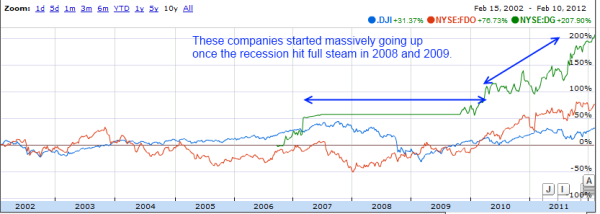
Dollar stores have been around for many decades but the surge in big name dollar stores really hit a full head of steam once the recession arrived:

dollar general and family dollar chart stock

You can see that the two leading dollar stores, Dollar General and Family Dollar hit full stride after 2008. This is a billion dollar business that is benefitting from the weakness in the overall economy. As more income is concentrated in fewer hands, the middle class gets squeezed down and with trillion dollar bailouts targeted at the financial sector, many Americans are seeing their purchasing power dwindle. Yet this compression is not felt as heavily at dollar stores where many can live large with a declining dollar, even if it is only for a brief shopping experience.

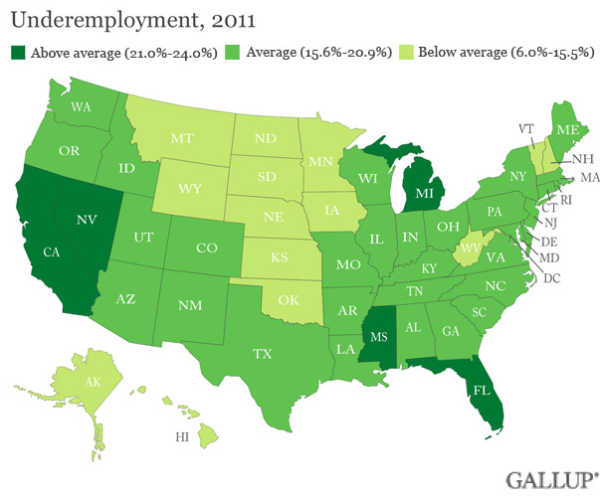
Part of this growth also comes from our persistently high unemployment rate:

unemployment us 2012

5 states still have underemployment rates that are above 20 percent. So even though jobs are being added many are being added in lower-wage service sector fields. 5 million good paying jobs were lost since the recession hit and only about 1 million have been recovered.

Impact of compressing middle class on dollar stores

One of the surprising trends with dollar store growth comes from more affluent Americans becoming customers:

"(NY Times) Financial anxiety — or the New Consumerism, if you like — has been a boon to dollar stores. Same-store sales, a key measure of a retailer's health, spiked at the three large, publicly traded chains in this year's first quarter — all were up by at least 5 percent — while Wal-Mart had its eighth straight quarterly decline. Dreiling says that much of Dollar General's growth is generated by what he calls "fill-in trips" ­— increasingly made by wealthier people. Why linger in the canyons of Wal-Mart or Target when you can pop into a dollar store? Dreiling says that 22 percent of his customers make more than $70,000 a year and added, "That 22 percent is our fastest-growing segment."

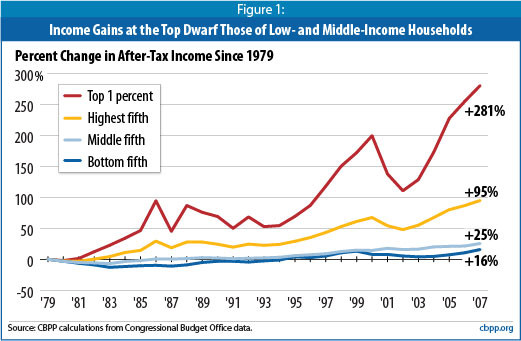
I found this trend intriguing but this stems from the fact that most average Americans are seeing a compression to their real wage growth:

growth-in-income-inequality

The fastest growing segment of dollar store customers are coming from those making $70,000 a year or more. In fact, 1 out of 5 dollar store shoppers come from this group. Keep in mind the median household income in the US is $50,000 and those that make $70,000 a year or more are in the top 35 percent of households.

This also plays into the reality of those lower-wage service sector jobs being added:

"This growth has led to a building campaign. At a time when few businesses seem to be investing in new equipment or ventures or jobs, Dreiling's company announced a few months ago that it would be creating 6,000 new jobs by building 625 new stores this year. Kiley Rawlins, vice president for investor relations at Family Dollar, said her company would add 300 new stores this year, giving it more than 7,000 in 44 states."

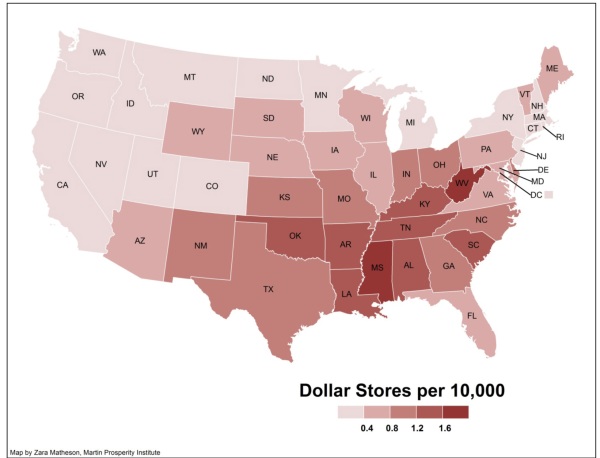
If you look at where dollar stores are most prevalent you will find them all across the country but they are most prevalent in the South:

dollar stores us

The rise of the dollar store goes hand and hand with the loss of the middle class in America. The largest customers at dollar stores are still those with lower incomes, households making $40,000 a year or less make up nearly half the customer base. But when this pool continues to grow you have business growth and that is what we are seeing here. The average per capita income in the US is $25,000 which doesn't go far given the cost of healthcare, energy, and education.

It is also fascinating to see that 40 to 45 percent of dollar store items now come from big name brand companies. This industry is now a multi-billion dollar industry. I've driven around and see Subway and KFC for example now having marketing material showing "EBT accepted here" and dollar stores with a large and growing segment of their aisles made up of by food, are seeing a boon in this economy. I mean think about it with 45,000,000+ Americans receiving food assistance this is a large customer base. You also have many retirees who heavily rely only on Social Security stretching their declining buying power at these stores. Even with low profit margins business can be good. Not sure if we should be thrilled that dollar stores are one business segment that is booming in our modern day economy.