Showing posts with label Great Recession. Show all posts

Monday, September 8, 2014

Harvard survey: Businesses don't want to hire

What about Obamacare?  What about "uncertainty?"  This Harvard competitiveness survey can't be right. I'd rather trust one of those instant click-on surveys on Fox News' homepage.


By Mark Gongloff
September 8, 2014 | Huffington Post

America's capitalists take every chance they get to remind us that they are our "job creators," but it turns out that their least-favorite thing on earth to do is create jobs.

Most U.S. business leaders would rather build robots, outsource work or use part-time employees than hire workers full-time, according to a new Harvard Business School survey. Here's a nice infuriating graphic from the smarty-pantses at Harvard Business School, who are educating all of our future non-job-creators in the art of not creating jobs:

hiring decisions

As you can see from the chart, 46 percent of our job creators would rather spend money on technology than employ humans, compared with a sad 26 percent who prefer people to robots, and another 29 percent who were confused or indifferent about the question or fell asleep while the survey taker was talking. Forty-nine percent would rather outsource than hire, compared with 30 percent who'd rather hire.

Ever notice how the stock market and corporate profits are at all-time highs, while our wages are flat and roughly half of us still think the economy is in recession? This chart helps explain it, and helps explain why workers' share of those corporate profits is near its lowest since the Truman administration.

This is also bad news for the future of the economy because it means fewer workers are getting the training they need for our super-awesome, high-tech, no-job economy, Harvard pointed out:

"Firms invest most deeply in full-time employees, so preferences for automation, outsourcing, and part-time hires are likely to lead to less skills development," the study authors wrote.

This will give business leaders, who already think we lack the necessary skills for their precious jobs, even less reason to hire us in the future.

Thursday, July 17, 2014

Waldman: Kansas is a Tea Party lesson for the rest of US

Me and a Democrat buddy of mine (notice I omit the -ic at the end of Democrat to pander to my conservative friends) were complaining about Republican politicians when he said in frustration, "We should just elect all their Tea Party guys and let them run the country into the ground so people can see once and for all what happens."

I admit I'm tempted by that possibility sometimes; then I remember that we're talking about millions of people's lives and well being at stake, including innocent children who would probably lose their food stamps, school meals, libraries, health care, etc. if the Grand Old Tea Party got its way.

Instead we can look to Kansas, one of our 50 "laboratories of democracy," to see what happens when extreme right-wing ideologues take power.  Paul Waldman is Kansas' herald of doom [emphasis mine]:

In 2012 and 2013, [Governor] Brownback and Republicans in the legislature cut income taxes twice, eliminated taxes on corporate profits that are “passed through” to individuals (making it the only state that does this), and since they’re Republicans, made changes to the tax code that had the effect of raising taxes on the poor (the Center on Budget and Policy Priorities has agood explanation of the tax changes and their effects). The governor has said his goal is to eventually eliminate the income tax completely.

And what happened? At a time when most states are seeing higher revenues as the country recovers economically, Kansas’ revenues have plummeted. The result has been cuts to schools, cuts to higher education, cuts to libraries, and cuts to local health centers.  Kansas’ job growth and income growth are lagging the nation’s.  In response to the fiscal difficulties, Moody’s recently lowered the state’s bond rating.

Waldman should also have noted that Kansas was not that bad off to begin with in 2012 when the GOP took over. Relatively speaking, Kansas was in the middle. And in terms of economic security as an index of factors, Kansas was one of the most secure economically, post-recession.  

So, based on ideology not fiscal or economic necessity, Gov. Sam Brownback and his GOP super-majority, said basically, "If it ain't broke let's fix it."  

Thankfully, their toxic experiment was contained to relatively isolated and sparsely populated Kansas. The only good results are, as I said, a warning to the rest of us, and that the Kansas GOP is now in a state of "civil war" between Tea Party extremists and everybody else.


By Paul Waldman
July 16, 2014 | Washington Post

Needless economic damage of the 'sequester'

Just in case you forgot how much damage the idiotic, Tea Party-inspired budget sequestration did to the U.S. economy, here's a reminder: at least $351 billion

"Less austerity in the short term would have meant more growth, less unemployment and an even faster-shrinking deficit in the long term," concludes Mark Gongloff.

We should never again allow conservative debt fetishists to impose their confusion about cause (economic downturn) and effect (rising deficits) on the rest of us.  


By Mark Gongloff
July 16, 2014 | Huffington Post

Austerity is like a bad tattoo: It's going to be with us, causing misery, for years to come.

The broad spending cuts that were the fruits of the Republican Congress' budget obsession of the past few years have already cost the U.S. economy $351 billion in lost economic activity, according to a new study by the Center for American Progress. This austerity will cost a total of $633 billion by the year 2020, according to the study. Here's a chart from CAP to help put it in perspective:

600 billion

"Congress has severely damaged the economy with deep spending cuts in a misguided attempt to solve a short-term debt crisis that simply does not exist," wrote CAP economists Harry Stein and Adam Hersh.

The progressive think tank's analysis is based on the latest budget outlook from the Congressional Budget Office, the nonpartisan congressional research group, which was released on Tuesday.

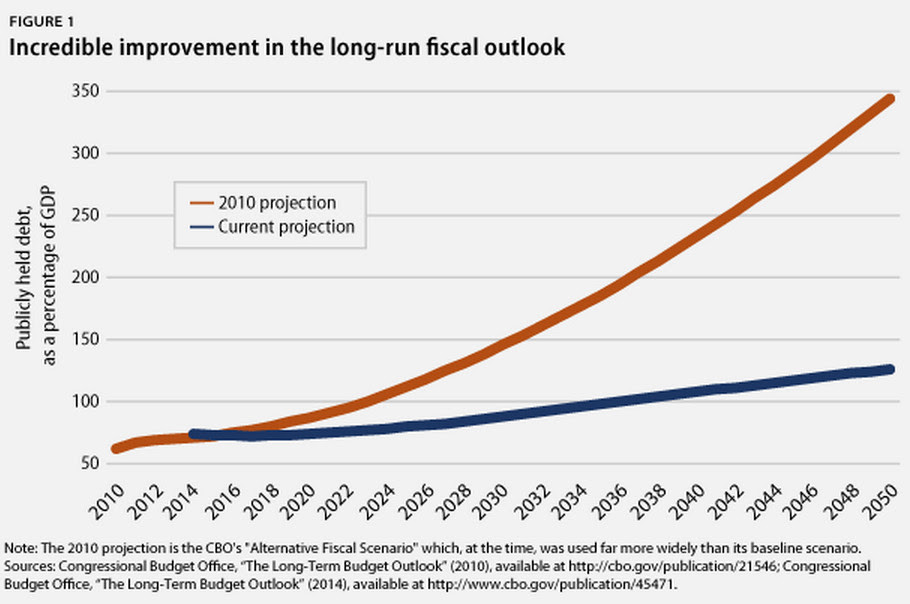
The CBO found that, despite relentless panic about supposedly out-of-control government spending, the long-term path of federal debt has dramatically improved lately. You can see that in this second CAP chart, showing the CBO forecast for the ratio of federal debt to gross domestic product:

debt outlook

Budget cuts have probably helped bring down the long-term debt outlook a bit. But an improving economy has helped much more, by raising tax revenue and dramatically shrinking the government's annual budget deficit.

The CAP study is the latest in a series of studies tallying the costs of austerity. The long and short of it: Less austerity in the short term would have meant more growth, less unemployment and an even faster-shrinking deficit in the long term.

Sunday, June 22, 2014

Krugman reviews Geithner's book 'Stress Test'

I don't care much about Tim Geithner or his financial memoir Stress Test. But Krugman's review of the book features many teachable moments so the review is well worth reading, especially as revisionist historians would like to distort what really happened.  Here's the first one:

Quite early on, two somewhat different stories emerged about the economic crisis. One story, which Geithner clearly preferred, saw it mainly as a financial panic—a supersized version of a classic bank run. And there certainly was a very frightening panic in 2008–2009. But the alternative story, which has grown more persuasive as the economy remains weak, sees the financial panic, while dangerous in its own right, as a symptom of something broader and deeper—mainly a large overhang of private debt, in particular household debt.

Krugman obviously and correctly goes with the latter story. The overhang of private debt -- particularly mortgage debt among the middle and lower class, and more recently, student debt, now about $1 trillion -- is the real anchor weighing down our economy today.

Next, Krugman points out that the FIRE sector is not synonymous with the U.S. economy, something that CNBC and Wall Street types seem to forget sometimes [emphasis mine]:

Whatever the reasons, however, the stress test pretty much marked the end of the panic. ...[S]everal key measures of financial disruption—the TED spread, an indicator of perceived risks in lending to banks, the commercial paper spread, a similar indicator for businesses, and the Baa spread, indicating perceptions of corporate risk. All fell sharply over the first half of 2009, returning to more or less normal levels. By the end of 2009 one could reasonably declare the financial crisis over.

But a funny thing happened next: banks and markets recovered, but the real economy, and the job market in particular, didn’t.

That's because the Great Recession wasn't just a mega run on banks that the "confidence fairy" could restore, via cheap money for banks from the Fed. Rather, the Great Recession was a problem of too much private debt dragging down aggregate demand and hence economic growth, in a vicious cycle:

The logic of a balance sheet recession is straightforward. Imagine that for whatever reason people have grown careless about both borrowing and lending, so that many families and/or firms have taken on high levels of debt. And suppose that at some point people more or less suddenly realize that these high debt levels are risky. At that point debtors will face strong pressures from their creditors to “deleverage,” slashing their spending in an effort to pay down debt.  But when many people slash spending at the same time, the result will be a depressed economy. This can turn into a self-reinforcing spiral, as falling incomes make debt seem even less supportable, leading to deeper cuts; but in any case, the overhang of debt can keep the economy depressed for a long time.

And here's where we get down to the brass tacks of the federal government's response, and the Fed's position (Geithner's) on that response:

Unlike a financial panic, a balance sheet recession can’t be cured simply by restoring confidence: no matter how confident they may be feeling, debtors can’t spend more if their creditors insist they cut back. So offsetting the economic downdraft from a debt overhang requires concrete action, which can in general take two forms: fiscal stimulusand debt relief. That is, the government can step in to spend because the private sector can’t, and it can also reduce private debts to allow the debtors to spend again. Unfortunately, we did too little of the first and almost none of the second.

Yes, there was the American Recovery and Reinvestment Act, aka the Obama stimulus, and it surely helped end the economy’s free fall. But the stimulus was too small and too short-lived given the depth of the slump: stimulus spending peaked at 1.6 percent of GDP in early 2010 and dropped rapidly thereafter, giving way to a regime of destructive fiscal austerity. And the administration’s efforts to help homeowners were so ineffectual as to be risible.

And Geithner, who was in the middle of Obama's inner circle of trusted economic advisers, opposed both stimulus and debt relief, notes Krugman:

Geithner also makes some demonstrably false statements about the public debate over stimulus. “At the time,” he declares, “$800 billion over two years was considered extraordinarily aggressive, twice as much as a group of 387 mostly left-leaning economists had just recommended in a public letter.” Um, no. A number of economists, including Columbia’s Joseph Stiglitz and myself, were warning that the package was too small; so was Romer, internally. And that economists’ letter called for $300 to $400 billion per year. The Recovery Act never reached that level of spending; even if you include tax cuts of dubious effectiveness, it only briefly grazed that target in 2010, before rapidly fading away.

And then there’s the issue of debt relief. Geithner would have us believe that he was all for it, but that the technical and political obstacles were too difficult for him to do very much. This claim has been met with derision from Republicans as well as Democrats. For example, Glenn Hubbard, who was chief economic adviser under George W. Bush, says that Geithner “personally and actively opposed mortgage refinancing.”

Krugman takes exception to Geithner's victory dance on ending the crisis and the Great Recession:

To the rest of us, however, the victory over financial crisis looks awfully Pyrrhic. Before the crisis, most analysts expected the US economy to keep growing at around 2.5 percent per year; in fact it has barely managed 1 percent, so that our annual national income at this point is around $1.7 trillion less than expected. Headline unemployment is down, but that’s largely because many workers, despairing of ever finding a job, have stopped looking. Median family income is still far below its pre-crisis level. And there’s a growing consensus among economists that much of the damage to the economy is permanent, that we’ll never get back to our old path of growth.

There's more to this story that Krugman forgivingly overlooks, such as why Geithner was so solicitous to Wall Street banks and not Main Street Americans. After all, Geithner "met more often with Goldman Sachs CEO Lloyd Blankfein than Congressional leaders, including the Speaker of the House and the Senate Majority Leader," in his first few months in office.  Why??


By Paul Krugman
June 10, 2014 | The New York Review of Books

Sunday, June 8, 2014

Half the U.S. makes under $27 K, and other signs the middle class is dying

Submitted by Tyler Durden
June 5, 2014 | Zero Hedge

Submitted by Michael Snyder of The Economic Collapse blog,

If you make more than $27,520 a year at your job, you are doing better than half the country is.  But you don't have to take my word for it, you can check out the latest wage statistics from the Social Security administration right here.  But of course $27,520 a year will not allow you to live "the American Dream" in this day and age. After taxes, that breaks down to a good bit less than $2,000 a month.  You can't realistically pay a mortgage, make a car payment, afford health insurance and provide food, clothing and everything else your family needs for that much money.  That is one of the reasons why both parents are working in most families today.  In fact, sometimes both parents are working multiple jobs in a desperate attempt to make ends meet.  Over the years, the cost of living has risen steadily but our paychecks have not.  This has resulted in a steady erosion of the middle class.  Once upon a time, most American families could afford a nice home, a couple of cars and a nice vacation every year.  When I was growing up, it seemed like almost everyone was middle class.  But now "the American Dream" is out of reach for more Americans than ever, and the middle class is dying right in front of our eyes.

One of the things that was great about America in the post-World War II era was that we developed a large, thriving middle class.  Until recent times, it always seemed like there were plenty of good jobs for people that were willing to be responsible and work hard.  That was one of the big reasons why people wanted to come here from all over the world.  They wanted to have a chance to live "the American Dream" too.

But now the American Dream is becoming a mirage for most people.  No matter how hard they try, they just can't seem to achieve it.

And here are some hard numbers to back that assertion up.  The following are 15 more signs that the middle class is dying...

#1 According to a brand new CNN poll, 59 percent of Americans believe that it has become impossible for most people to achieve the American Dream...

The American Dream is impossible to achieve in this country.
 
So say nearly 6 in 10 people who responded to CNNMoney's American Dream Poll, conducted by ORC International. They feel the dream -- however they define it -- is out of reach.
 
Young adults, age 18 to 34, are most likely to feel the dream is unattainable, with 63% saying it's impossible. This age group has suffered in the wake of the Great Recession, finding it hard to get good jobs.

#2 More Americans than ever believe that homeownership is not a key to long-term wealth and prosperity...

The great American Dream is dying. Even though many Americans still desire to own a home, they are losing faith in homeownership as a key to prosperity.
 
Nearly two-thirds of Americans, or 64%, believe they are less likely to build wealth by buying a home today than they were 20 or 30 years ago, according to a survey sponsored by non-profit MacArthur Foundation. And nearly 43% said buying a home is no longer a good long-term investment.

#3 Overall, the rate of homeownership in the United States has fallen for eight years in a row, and it has now dropped to the lowest level in 19 years.

#4 52 percent of Americans cannot even afford the house that they are living in right now...

"Over half of Americans (52%) have had to make at least one major sacrifice in order to cover their rent or mortgage over the last three years, according to the “How Housing Matters Survey,” which was commissioned by the nonprofit John D. and Catherine T. MacArthur Foundation and carried out by Hart Research Associates. These sacrifices include getting a second job, deferring saving for retirement, cutting back on health care, running up credit card debt, or even moving to a less safe neighborhood or one with worse schools."

#5 According to the U.S. Census Bureau, only 36 percent of Americans under the age of 35 own a home.  That is the lowest level that has ever been measured.

#6 Right now, approximately one out of every six men in the United States that are in their prime working years (25 to 54) do not have a job.

#7 The labor force participation rate for Americans from the age of 25 to the age of 29 has fallen to an all-time record low.

#8 The number of working age Americans that are not employed has increased by 27 million since the year 2000.

#9 According to the government's own numbers, about 20 percent of the families in the entire country do not have a single member that is employed at this point.

#10 This may sound crazy, but 25 percent of all American adults do not even have a single penny saved up for retirement.

#11 As I noted in one recent article, total consumer credit in the United States has increased by 22 percent over the past three years, and 56 percent of all Americans have "subprime credit" at this point.

#12 Major retailers are shutting down stores at the fastest pace that we have seen since the collapse of Lehman Brothers.

#13 It is hard to believe, but more than one out of every five children in the United States is living in poverty in 2014.

#14 According to one recent report, there are 49 million Americans that are dealing with food insecurity right now.

#15 Overall, the U.S. poverty rate is up more than 30 percent since 1966.  It looks like LBJ's war on poverty didn't work out too well after all.

Sadly, it does not appear that there is much hope on the horizon for the middle class.  More good jobs are being shipped out of the country and are being lost to technology every single day, and our politicians seem convinced that "business as usual" is the right course of action for our nation.

Unless something dramatic happens, it is going to become increasingly difficult to eke out a middle class existence as a "worker bee" in American society.  The truth is that most big companies these days do not have any loyalty to their workers and really do not care what ends up happening to them.

To thrive in this kind of environment, new and different thinking is required.  The paradigm of "go to college, get a job, stay loyal and retire after 30 years" has been shattered.  The business world is more unstable now than it has been during any point in the post-World War II era, and we are all going to have to adjust.

Our McJobs economy...and the GOP plan to make it worse

My dear conservative friends will blame the shrinking middle class and more McJobs on Obama, naturally. 

But to see they're wrong you only have to look at their policy "fixes": no minimum wage; no guaranteed health insurance for workers; no right to unionize; and privatizing Medicare.  Oh, and cutting unemployment benefits to motivate more people to compete for low-wage jobs, thereby driving wages down even further. The most radical Tea Partiers even say we should abolish the Department of Education, when U.S. public schools are most people's shot at a better life.  

None of these ideas makes any economic sense.  (It makes a heckuva lot of sense from a class warfare perspective, however.)  And in the case of conservatives' debt fetish, they confuse economic cause and effect: debt causes recessions, not the other way around.

So they can't diagnose the problem, nor can they prescribe any cures.

But wait, they have more great ideas. Cutting "job-killing regulations" and income taxes on the rich should stimulate growth, then all the unemployed could get jobs in the new businesses that Republicans say their hands-off policies would create.  Yet we tried that before and saw how it worked out.  

Conservative talk radio says we can all move to Texas or North Dakota and find high-paying jobs in the shale gas boom, but that's hardly practical. Most people can't just pick up and move their entire lives, like Okies of the Depression era, to where the jobs are.  Doesn't matter. Republicans want to open up even more public lands for oil & gas drilling, even though that oil is sold by multinational corporations on the world market; it's not "ours."

Or as I like to sum it up, the GOP thinks we can cut and burn our way to a better economic future.  


David Nather over at Politico put it thusly in his article, "And the GOP economic plan is...?":


It’s the sixth year of Barack Obama’s presidency, the job market is still sluggish, most Americans say they’re unhappy with the economy, and Obama’s approval ratings are down. So what’s the Republican plan to turn it around?

The answer is, they don’t all think they need one and those who do can’t agree on a unified view.

This is why it's so ominous that Republicans, thanks to gerrymandering and stronger off-election turnout, could take over Congress in November.  I'm not saying they're solely responsible for the Great Recession, (although Phil Gramm could certainly make a case), but they certainly haven't learned any economic lessons from it, and that's scary. This is a party that's pissed off yet feels zero responsibility for its policies -- it's a veritable chimpanzee with a hand grenade.... And they have as many good ideas as a chimp how to grow the middle class and get Americans back to work.


Posted by mybudget360 | June 8, 2014

The US is slowly becoming a McJob nation. While the press jumps up and down that the US is now finally at a breakeven point from the jobs lost since the recession started in 2007, they fail to mention that those not in the labor force is up by nearly 13 million. Even looking into the recent employment report, we continue to find a heavy trend of hiring in low wage employment sectors. For example, 32,000 jobs were added in “leisure and hospitality” bringing the annual total of jobs added to 311,000. Another 21,000 jobs were added in social assistance which pay very little but will grow as demand for health support grows by an aging populationThe system at least in the eyes of Wall Street and the government is working perfectly fine. We have a plentiful supply of low wage labor while laws and bailout mechanisms are in place for the financially and politically connected. The middle class continues to fall off the bandwagon one by one and enters a labor force of permanent low wage labor with very little prospect of a decent retirement. In fact, most will be working until all the wheels come flying off. We also find that 1 out of 4 Americans are working in jobs that pay $10 or less per hour. How about trying to earn the Americans Dream on that McJob salary?

Breaking even and seeing the non-labor force surge

It has taken us 7 slow and painful years simply to recover the jobs we had back in 2007. With the latest jobs number, we finally are back to where we were in 2007. Of course, the population has increased and many of these new jobs come with horrible benefits, lower wages, and very little security. Is it any wonder why home buying in the country continues to be so anemic?

Low wages are also creating an entire nation that is unprepared for retirement. For example, 1 out of 3 Americans has zero dollars in their savings account. Half the country is one paycheck away from a financial avalanche. During the last 7 years, we have added close to 13 million Americans to the “not in the labor force” category:

record jobs in context
Source:  BLS, ZH

A part of this growth is an older population but a large part of it isn’t. We have many digging into college degrees with massive debt to avoid the current economic situation. Others have simply given up looking for work. The low wage recovery has been extremely painful for many Americans and wealth growth has not occurred for 90 percent of the country. These are simply the facts. This is what we find in every piece of data we look at.

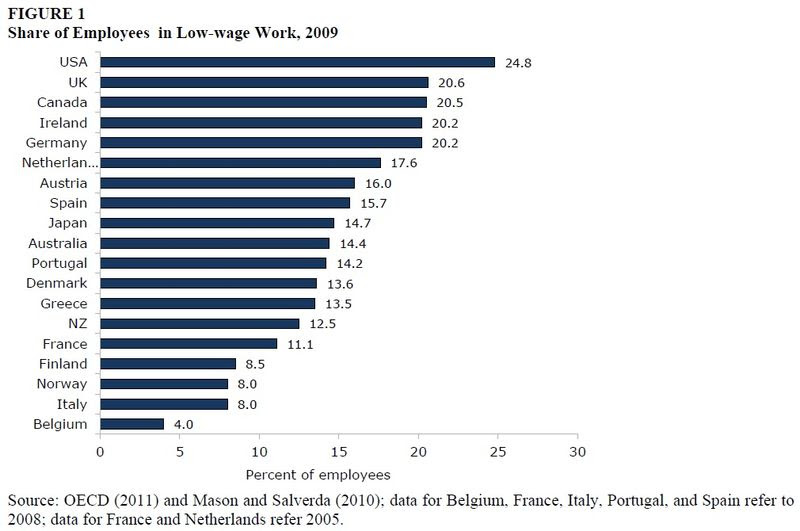
Economist Tim Taylor presented a chart highlighting that the US has a very high portion of its population working in low wage jobs. This is contrary to the image that the US is a land with middle class jobs for many:

low-wage-2
low-wage-2

Low wage work as defined in the data set above is employment that pays less than $10 per hour. Imagine trying to support a family on this. 2,000 hours of work would yield $20,000 which is below the poverty line for a family of three. And then we wonder how we have roughly 47 million Americans on food stamps.

The reason we continue to see this kind of recovery is that all policy made during the collapse was dictated by those in the banking industry that led up to this collapse in the first place. Even former Treasury Secretary Tim Geithner mentioned that if we didn’t do the bailouts exactly as we did (i.e., keep big payouts to banking execs, money for corrupt workers, etc) then the economy would have imploded. Well the economy did implode for most workers and a recovery never happened. Maybe for his closely knit group of people things are looking great:

growth-in-income-inequality

But for the rest of country people are running the Red Queen’s Race by working harder and harder simply to stay in the same place. A McJob recovery is not something to be proud about especially when the middle class in the US continues to dwindle.

Friday, May 30, 2014

Commencement season: Time to pile on Millennials

Ever since the 2012 "you are not special" commencement speech at Wellesley High School went viral among conservatives, it has become fashionable among some to browbeat young millennials, who are supposedly the most self-centered generation in American history (after the Baby Boomers), into pessimistic realism.

There is some truth and good intentions in all this parental "tough love," but the fact that it's coming from the same parents who, up to commencement time, coddled and molded said millennials is a bit odd, to say the least, if not downright hypocritical.  

Yet it's just about what you'd expect from the (formerly) most self-centered generation in American history -- to blame their children for being "deluded" instead of blaming themselves for deluding them.  

I mean, these kids didn't raise and praise themselves.  The same helicopter parents who have told these students for years they were so special are now back-lashing against... themselves?... and telling these kids that their days of awards and assistance falling from the sky are over with??

(I strongly suspect that the awards/honors/praise allegedly bestowed on Millennials is way overblown. There is always a bell curve, and somebody is always more praiseworthy or praised than somebody else. Hence the law of averages tells us that most kids probably never got any awards or accolades for anything. So I suspect but cannot prove that a lot of this anti-millennial rhetoric is directed at the socio-economic cream of the millennial generation from the cream of the Baby Boomers. The question is, why are Boomers suddenly reversing themselves? One theory is that they see our post-Great Recession economic reality and want to quickly steel their children to be ready for it, while avoiding taking any responsibility for the housing bubble, rising student debt, youth unemployment and Great Recession upon themselves. As for the non-cream, it's a convenient pre-emptive excuse by the ruling Boomers for the historically bad troubles that youngin's are graduating into: they are too coddled and cocksure to successfully take on the "real world" awaiting them.  But I digress....) 

Fine.  I for one give today's kids enough credit that they'll figure the real world out on their own without adults' piling on to their economic-demographic burden, a burden they didn't ask for or create themselves. Young grads today have the added advantage of having seen their parents' successes -- and failures -- hopefully to duplicate the former and avoid the latter.


By Alexandra Petri
May 21, 2014 | Washington Post

Thursday, February 20, 2014

Baker: Stimulus worked, but it was too small

Two-fisted liberal pride!  Don't ever back down!  The GOP watered down the stimulus with 1/3 tax cuts and cut the overall amount from more than $1 trillion that was required to about $700 billion.  

Sums up Dean Baker: "In other words, we were trying offset a loss of $1.4 trillion in annual demand with a stimulus package of $300 billion a year. Surprise! This was not enough."

Even so, the stimulus helped avoid a second Great Depression.  

My progressive comrades: don't ever apologize, don't ever make excuses. THE STIMULUS WORKED.  The fact that it couldn't do more is entirely the fault of Republicans.

Now read below to get the numbers.


By Dean Baker
February 20, 2014 | CNN

When President Obama proposed his stimulus in January 2009, the economy was in a freefall, losing more than 700,000 jobs a month. The immediate cause of the plunge was the freezing up of the financial system after the collapse of Lehman Brothers, but the deeper cause was the loss of demand after the collapse of the housing bubble.

The bubble had been driving the economy both directly and indirectly. The unprecedented run-up in house prices led to a record rate of construction, with about 2 million homes built at the peak in 2005.

In addition, the $8 trillion in housing equity created by the bubble led to an enormous consumption boom. People saw little reason to save for retirement when their home was doing it for them. The banks also made it very easy to borrow against bubble-generated equity, which many people did. As a result, the personal saving rate fell to 3% in the years 2002-07.

The bubble also indirectly enriched state and local governments with higher tax revenue. And there was a mini-bubble in nonresidential real estate, but that came to an end in 2008 as well.

The economy had already been in recession for nine months before the collapse of Lehman because the bubble was deflating, but the Lehman bankruptcy hugely accelerated the pace of decline. This was the context in which Obama planned his stimulus package before he even entered the White House.

At that point, most economists still did not recognize the severity of the downturn, just as they had not seen the dangers of the housing bubble that had been building over the previous six years.

The Congressional Budget Office projections, which were very much in the mainstream of the economics profession, showed a combined drop in GDP for 2008 and 2009 of 1%, before the economy resumed growth again in 2010. This is with no stimulus. By contrast, the economy actually shrank by 3.1% in those years, even with the stimulus beginning to kick in by the spring of 2009.

Given this background, it was easy to see that the stimulus was far too small.  It was designed to create about 3 million jobs, which might have been adequate given the Budget Office projections. Since the package Congress approved was considerably smaller than the one requested, the final version probably created about 2 million jobs. This was a very important boost to the economy at the time, but we needed 10 million to 12 million jobs to make up for jobs lost to the collapse of the bubble.

The arithmetic on this is straightforward. With the collapse of the bubble, we suddenly had a huge glut of unsold homes. As a result, housing construction plunged from record highs to 50-year lows. The loss in annual construction demand was more than $600 billion. Similarly, the loss of $8 trillion in housing equity sent consumption plunging. People no longer had equity in their homes against which to borrow, and even the people who did would face considerably tougher lending conditions. The drop in annual consumption was on the order of $500 billion.

The collapse of the bubble in nonresidential real estate cost the economy another $150 billion in annual demand, as did the cutbacks in state and local government spending as a result of lost tax revenue. This brings the loss in annual demand as a result of the collapse of the bubble to $1.4 trillion.

Compared with this loss of private sector demand, the stimulus was about $700 billion, excluding some technical tax fixes that are done every year and have nothing to do with stimulus. Roughly $300 billion of this was for 2009 and another $300 billion for 2010, with the rest of the spending spread over later years.

In other words, we were trying offset a loss of $1.4 trillion in annual demand with a stimulus package of $300 billion a year. Surprise! This was not enough.

That is not 20/20 hindsight; some of us were yelling this as loudly as we could at the time.  It was easy to see that the stimulus package was not large enough to make up for the massive shortfall in private sector demand. It was going to leave millions unemployed and an economy still operating far below its potential level of output.

We are still facing the consequences of an inadequate stimulus. The reality is that we have no simple formula for getting the private sector to replace the demand lost from the collapse of the bubble.

Contrary to what Republican politicians tell us, private businesses don't run out and create jobs just because we throw tax breaks at them and profess our love.  If the government doesn't create demand, then we will be doomed to a long period of high unemployment -- just as we saw in the Great Depression. The government could fill the demand gap by spending on infrastructure, education and other areas, but in a political world where higher spending is strictly verboten, that doesn't seem likely.

The one alternative, which has been successfully pursued by Germany, is to reduce the supply of labor through work sharing. Companies reduce all their employees' hours and pay so everyone keeps their jobs. The government then pays the workers part-time unemployment benefits -- cheaper than paying someone full-time unemployment.

Germans have used this route to lower their unemployment rate to 5.2%, even though their nation's growth has been slower than ours.

Some bipartisan baby steps have been taken in this direction; we will need much more if we are to get back to near full employment any time soon. In a world where politics makes further stimulus impossible, work sharing is our best hope.

Sunday, December 22, 2013

America's 'age of unprecedented austerity'

You won't hear this from the mainstream media!

The greatest trick austerians ever pulled was convincing people that it was stimulus that had failed.

And the greatest trick the Koch brothers ever pulled was convincing Tea Party Republicans that deficits are a cause, not an effect.


By Matthew O'Brien
December 20, 2013 | The Atlantic

We're living in an age of unprecedented austerity.

Now, that sounds impossible to conservatives who know, just know, that government has exploded under Obama's socialist watch. And that we have trillion dollar deficits—dun, dun, dun—as far as the eye can see. But I have some good news for them (though not the economy). They're wrong. Government employment has actually fallen under Obama, and the deficit is falling fast too

As Ben Bernanke put it, "people don't appreciate how tight fiscal policy has been." And how much that's knee-capped the economy. Take jobs. Bernanke points out that total public sector employment—local, state, and federal—has fallen by over 600,000 during the recovery alone. As point of comparison, it rose by 400,000 during the previous one.

But even this million person job swing doesn't tell us how historic austerity has been this time. You have to look at the chart below to see that. It shows government job growth during every recovery on record, going back to 1945. This is the least there's ever been.


How is it possible that government added more jobs after World War II demobilization than now? Or after the 1980 recession, which was followed by another recession a year later? Well, it's what Paul Krugman calls the 50 Herbert Hoovers effect. See, state governments are required to (mostly) run balanced budgets, even during a recession. That's usually not too much of a problem as long as the slump is quick or shallow.

But the Great Recession was neither. The crisis hit and tax revenue disappeared—and didn't come back. Now, the federal government did use the stimulus to fill some of these state budget holes, which is why public sector employment didn't fall much in the first year of the recovery. But then the stimulus money ran out—really, it did—and states were left on their own. Like Hoover in the 1930s, they tried to balance their books amidst a depressed economy. And like Hoover in the 1930s, it didn't work out too well. They went on a cops-and-teachers firing spree the likes of which we've never seen before. And one that was the difference between unemployment being 6 instead of 7 percent today.

The greatest trick austerians ever pulled was convincing people that it was stimulus that had failed.

Friday, July 26, 2013

Obama preaching to vanishing middle class

Cox's conclusion is quite alarming:

Referring to "the middle class" as a sympathetic totem, or even as an aspirational construct, now runs the risk of alienating voters as much as inspiring or comforting them. Offering "protections" to the middle class might even raise resentments: for a growing number of Americans, that means giving benefits to someone else.

I've been talking for years now about the disappearance of the middle class.  See here, here, here and here.  Economists tell us that things have been bad for years, just covered up by households borrowing and spending more than they could afford to.  The Great Recession removed that fig leaf of middle-class affluence and laid bare the truth.  


By Ana Marie Cox
July 24, 2013 | Guardian

Republicans seized upon Obama's speech on the economy as a chance to reiterate their contention that very little about the nation's situation has changed in the past five years – and, paradoxically, there's very little Obama could do about it, even if he wanted to.

"The president himself said [the speech] isn't going to change any minds," John Boehner said in a floor speech before Obama even started. "All right, well. So exactly what will change? What's the point? What's it going to accomplish? You probably got the answer: nothing."

Of course, inertia – in both the political and economic sense – was a major theme of the speech itself. Obama started off with some applause-worthy boosterism: the country leads in technological advances! We manufacture a lot of stuff!

But the crux of the speech was less optimistic: the existing trends in "a winner-take-all economy where a few do better and better, while everybody else just treads water – have been made worse by the recession."

Obama's complaints about the parallel stagnation in Washington were familiar as well. He called out Republican obstructionism repeatedly, and in at least one unscripted and pointed assertion:  "Repealing Obamacare and cutting spending is not an economic plan. It's not."

Your opinion as to whether the speech served its purpose depends on your party identification, and your opinion on what its purpose was probably does, too. For me, it's a split decision: I am sympathetic to the president's policies – using government spending as a lever to enable upward mobility – but I think he may not have succeeded in what most progressives probably thought was the purpose of the speech: to rally his base and frame a renewed economic policy debate over the coming months.

Maybe, I'm being too literal, but I keep getting stuck on the very title of the speech, "A Better Bargain for the Middle Class."

Here's the problem: the "middle class" – a once-reliable rallying point for both parties – is shrinking (not really news); and so are the numbers of Americans who think they are members of it.  What used to be the case – Americans defined themselves as "middle class" even if they weren't – is starting to adjust to sad reality: Americans don't think of themselves as "middle class", because they're not.

Pew study this spring found the number of Americans defining themselves as "middle class" has slipped from 53% to 49% since 2008, while those identifying themselves as "lower class" went from 25% to 32%.  Actual class slippage mirrors this finding almost exactly: the 2011 census found that since 2007, the share of working families with an income less than double the federal poverty line (the government's definition of "low income") rose from 28% to 32%.

Referring to "the middle class" as a sympathetic totem, or even as an aspirational construct, now runs the risk of alienating voters as much as inspiring or comforting them. Offering "protections" to the middle class might even raise resentments: for a growing number of Americans, that means giving benefits to someone else.

It may be sometime before political rhetoric adjusts to these harsh realities. I hope that the economy turns around before it has to.

Sunday, March 17, 2013

The morality of capitalism v. redistribution

Where to begin with the question "Is capitalism moral"? Let's start with the title. Kind of a loaded question. Anyway let's be precise. Pearlstein is really discussing political economy, i.e. how our laws and governance influence commerce and the general welfare. Pearlstein means to debate the role that government should play in the economy. 

To start, Pearlstein correctly notes that, "For most of the past 30 years, the world has been moving in the direction of markets," and yet increasingly over that same period we have "stagnant incomes, gaping inequality, a string of crippling financial crises and 20-somethings still living in their parents’ basements."

Thus Republicans have pivoted, Pearlstein says, to focusing on capitalism's moral superiority because they certainly can't make a prima facie case for capitalism's benefits. Unfortunately, Pearlstein takes their bait and tries to analyze, more or less objectively, which side -- the "free-market capitalists" or the "redistributionists" -- is indeed morally superior, and the flaws with each.

The truth, as with most things, is muddled and complicated.  But I want to lay down a few markers. First, very few liberals/progressives/Democrats insist on having this "moral" debate. Why? Because we liberals are outcome-based. By contrast, conservatives and free-marketeers believe that one's moral principles should determine the rules of the game, and if one's moral principles are sound, then ipso facto, the results will take care of themselves. More precisely, conservatives believe that economic results are morality-free; only our political economics must be morally sound.

Let's admit though that his whole debate has been predicated by recent shitty economic outcomes. For a liberal, a more appropriate question would be to ask: whose political economy is the most responsible for the shitty state of today's economy?  True liberals would be even more precise: what specific policies have led us to these terrible outcomes? Conservatives would obviously like to dodge this question, and instead talk in philosophical or moral abstractions, parables and anecdotes, because the facts -- the results -- of their 30 years of neo-liberal rule do not support the morality of their political economy.

Second marker: to quote Paul Rosenberg: "economics used to be called 'political economy', because the great classical economists never lost sight of the fact that economics was a thoroughly political activity, not something outside of the life of a political community." In other words, economics never, ever, ever happens in a political vacuum. Thus, the notion that, in some ideal country, the free-market capitalism of Adam Smith hums and churns along for the betterment of all, unfettered by and independent of government, is naive and silly. Government has a role to play, it sets the rules of the economic game, we all know that.  To what extent government is involved is a matter of degrees. 

Again, liberals believe that government's role should be evidence- or outcomes-based, i.e. tweaked according to the outcomes achieved, whereas conservatives believe that outcomes, like people, should take care of themselves. What's important for them is to set up a system of rigid, unchanging moral conditions under which people operate.

Third marker: noting the terrible results of recent deregulation, privatization-outsourcing and tax cutting is not the same as saying "capitalism is bad." Conservatives and perhaps Pearlstein would like to provoke us liberals into saying that. It's not necessary, or rather, it's an academic argument rather than a real one, since we have not had a "free-market" system for a very long time, if ever. Indeed the U.S. Government has been "meddling" in the economy for a very long time, just in different ways and to varying degrees. 

The recent political-economic bag is mixed: just as union membership has been plummeting, charter schools have been blooming, taxes on the One Percent were being cut, and regulations on Too Big To Fail banks were being torn down, so was USG spending on the military-industrial complex going through the roof (Afghanistan, Iraq, and the Department of Homeland Security apparatus), not to mention Dubya's tremendous addition to the Medicare entitlement -- altogether resulting in a 91 percent increase in our national debt from 2002-2009. 

To be sure, we also had the Great Recession from 2007-2009 that is almost entirely to blame for our persistently high unemployment and deficits since then. This begs the question: what political-economic philosophy was more responsible for the Great Recession? Because we wouldn't be having this discussion right now if it weren't for the Great Recession. You could skip all the junk I wrote above and below, and if you answer this one question correctly, then you are nearly at the truth....


But anyway, back to Pearlstein. He critiques liberals because "they have yet to articulate the moral principles with which to determine how far the evening-up [redistribution] should go -- not just with education but with child care, health care, nutrition, after-school and summer programs, training, and a host of other social services."  There are two big problems with where Pearlstein is going with this.

First, his critique is simply untrue. Liberals have laid out their moral principles, most eloquently in President Roosevelt's 1941 "Four Freedoms" speech that included the "freedom from want," and then in President Johnson's "Great Society" initiatives in the 1960s.  


In fact, our moral calculus is much easier to understand than conservatives'. We believe that, in the richest, most powerful nation in the history of the world, nobody should go hungry, uneducated or without health care. Furthermore, we believe that our nation's children, elderly and disabled deserve special care and protection, including additional food, medical and housing assistance. This is pretty easy to understand, and to verify. Can a child perform well in school relative to his peers? Does a person go hungry or malnourished? Does a child have a roof over his head? And so on. Depending on the answer, we have a moral obligation to do something. It couldn't be easier to understand.

Second problem: Pearlstein asks liberals to lay out: 1) our moral principles [check]; but also, unfairly, 2) a formula for government redistribution that is clear and will work forever and ever, amen. That's just childishly naive, I'm sorry. Pearlstein needs to get real. First, he ignores political reality that demands compromise. Nobody gets his way all the time, 100%. And let's just remind ourselves why this matters: if tomorrow President Obama would say that a "fair share" of taxes on the One Percent was, say, 30 percent, then this would be all anybody could talk about. Conservatives and their armies in think tanks, cable and talk radio would parse and mince it to death for weeks and months. When in fact it's all relative; and liberals don't care what the number is, as long as it generates sufficient revenues and ensures economic growth. (But historically, until the 1980s, the top marginal rate didn't fall below 70%).  At the end of his essay, Pearlstein admits as much:

Moral philosophers since Adam Smith have understood that free-market economies are not theoretical constructs -- they are embedded in different political, cultural and social contexts that significantly affect how they operate. If there can be no pure free market, then it follows that there cannot be only one neutral or morally correct distribution of market income.

Second, Pearlstein fails to acknowledge that liberals, unlike conservatives, think and act according to feedback loops: from problem/result --> intervention --> result/problem, and so on. Therefore, without observations of actual events, we cannot tell you what will be a fair and equitable taxation rate 5, 10 or 50 years from now, or a fair distribution of wealth. We won't even hazard a guess. 

Such tolerance for uncertainty drives doctrinaire conservatives to conniption. But that's a fundamental difference between us.  Therefore, a real liberal would start with our current and projected expenditures and sources of revenue and go from there; he wouldn't start the analysis with, "Well, it's just plain unfair and immoral for somebody to pay more than x percent of his gross income in taxes."  And besides, if that is my "moral" conviction, then how in the world can we debate that? We'd start at an impasse.

Pearlstein does argue that the distribution of economic rewards will shift over time, but liberals already know this:

[T]he way markets distribute rewards is neither divinely determined nor purely the result of the “invisible hand.” It is determined by laws, regulations, technology, norms of behavior, power relationships, and the ways that labor and financial markets operate and interact. These arrangements change over time and can dramatically affect market outcomes and incomes.

Pearlstein's next critique of liberals is that they "have been able to create a welfare state only by addicting a middle-class majority to government subsidies -- subsidies that now can be financed only by taking more and more money from the rich." 

Do I really need to cite statistics about tax and income inequality and the disappearing U.S. middle class?  If so, read thisthisthisthis and this. And don't even get me started about the $29 trillion bank bailouts, that primarily went to save financial markets in which the top One Percent owns 42 percent of all financial wealth, and the top 20 percent owns about 90 percent. The TBTF bank bailouts clearly demonstrate who is really "addicted" to Big Government and to what degree! 

Overall, although Pearlstein leans conservative, he touches on most of the important questions. The main take-aways from our debate are these:

  • Pure capitalism (or socialism, for that matter) has never existed anywhere, nor can it;
  • We are only worried about rising deficits and redistribution payments because of the Great Recession that in turn resulted from financial deregulation that conservatives support, even to this day;
  • Liberals should never feel obligated to justify the morality of their political economy, when if fact we are much clearer on this than conservatives who claim to care about the poor just as much as we do, yet have no idea how to remedy persistent poverty;
  • Liberals should not fall into conservatives' trap of naming "ideal" marginal tax rates, debt:GDP ratios, or anything of the kind, because 1) it's unwise tactically, in a political system that demands compromise, and 2) the correct answers will change over time.

A final note on political-economic morality: Pearlstein doesn't mention it but I will: conservatives' economic morality depends on personal pain and suffering. They firmly believe that pain teaches us lessons and can be personally redeeming; therefore, for redistributionist Big Government to deny a person the pain that he "deserves" is to deny him the chance to learn and improve himself.  

There is also a religious conservative variant of this belief: even if one's suffering wasn't caused by one's poor decisions, it may still be part of God's plan for that person; therefore, for redistributionist Big Government to prevent that pain and suffering is to interfere with God's plan for that person. Moreover, government assistance to a suffering person denies true Christians the opportunity to curry favor with God by performing charitable works for that suffering person. 

I hope I don't have to explain how sick and twisted such moral reasoning is, much less why it cannot be the basis for our country's political economy....

Finally, a note on redistribution. I will take the liberty here of quoting myself at length:

[L]et's recall for a minute what the U.S. Government -- any government from the dawn of human civilization -- actually does, in pure basics: it collects taxes from the people how it sees fit, and then spends that money how it wants. It does not, for example, say, "Mr. David Koch, since you contributed 0.01 percent of federal income tax revenues in FY 2011, we are allocating 0.01 percent of the FY 2012 federal budget to you."  

Since our government doesn't do this -- since no government has ever done this, ever -- then by definitionwhat our government does is redistribute wealth.  Moreover, sooner or later all government spending ends up in private hands -- just not necessarily (and not usually) in the hands that gave it its money in the first place.  If that's not redistribution then I don't know what is.

By Steven Pearlstein
March 15, 2013 | Washington Post