Showing posts with label Romney. Show all posts

Thursday, September 18, 2014

Gessen: What comes next 'will be bloodier and more frightening'

Here's the meat of Gessen's essay [emphasis mine]:

This narrative [of essentially blaming the Ukraine crisis on Western-NATO expansion into Russia's traditional sphere of influence] is not without merit. The bombing of Yugoslavia enabled an unprecedented rise in nationalist politics in Russia. And NATO expansion confirmed Russians’ worst suspicions about the West. Ukraine’s attempted move westward last year terrified the Kremlin, as did everything that has happened in that country since the protests began in Kiev last November.

But the sleeping-bear story is missing two essential components: the role of Ukraine and its people, who have been fighting to choose their own destiny – indeed, this story tends to ignore the existence of Ukrainians altogether – and, ironically, the fact that Putin has his own agency.

It is tempting to view Putin as merely the embodiment of Russia’s reaction to the actions of Western powers. It creates the illusion that he can be managed, or contained. If all he wants is a buffer zone between Russia and NATO, then the way to prevent a large European war is to give it to him, whatever the people of Ukraine might want. Let him keep Crimea, make Ukraine grant significant autonomy to its eastern regions and promise not to enter into any military alliances – and the Nobel Peace Prize is on its way.

The only problem is that portraying Putin as an unlikable but, essentially, Western politician – one who formulates his strategic objectives in a way Western analysts can understand – misses the point entirely. Russia’s behavior over the past week of a fragile cease-fire in eastern Ukraine has shown this very clearly. Russia kidnapped an Estonian security officer on Estonian territory – the Russians claim he was arrested on Russian soil while spying – and is holding him in Russia. It has re-opened Soviet-era desertion cases against a large number of Lithuanian men. And Russia has ratcheted up its nuclear saber-rattling.

All this points to the possibility that, rather than the beginning of the end of the conflict, the cease-fire is a stepping stone to the next stage of the crisis. That stage may or may not involve Ukraine, but it will definitely involve the use of force and, as it always happens in warfare, it will be bloodier and even more frightening than what came before.

First, brava to Gessen for an important point about the Maidan Revolution and Russia's ensuing military action in Crimea and eastern Ukraine: many analysts and journalists dismiss the role of Ukrainians altogether, and portray them as helpless pawns of either the West or Russia. What do most Ukrainians want their government to do; and what kind of country do they want to live in? These basic questions often get overlooked, because we've become accustomed to thinking of Ukrainians as pawns in outsiders' game.

Second, contrary to what some have argued, Putin did have a choice whether to invade Crimea and destabilize eastern Ukraine with weapons and fighters. His hand was not forced. This is what Gessen meant by "Putin has his own agency."


Third, kudos to Gessen for acknowledging that Putin "isn't like us" in the West. To many Western leaders' recent astonishment, Putin has no compunction telling one lie today, and a contradictory lie tomorrow. Why? Because he is a former KGB agent and homo soveticus; for him lying is like breathing: second nature. (See Russian writer Mikhail Shishkin's excellent essay on this topic.) 

P.S. -- U.S. conservatives keep crowing that "Romney was right!" and Obama was wrong to criticize him when Romney said in March 2012 that Russia was "without question our number one geopolitical foe."  They have some cause to gloat... although I didn't hear their concern back then, or until March 2014, about Russia's intentions. My only clarification here would be that Russia is not Putin. On the world stage, for all intents and purposes, the two are now one in the same. Yet it is not destiny that the West finds itself opposed to Russia, it is because of Putin

Let's recall that in March 2012, Putin was Prime Minister and Dmitry Medvedev, his protege, was President. Putin had not yet become President again in May 2012, although many feared he would when Russia amended its constitution in 2008 to extend the president's term to six years. Nor had Putin yet cracked down on Russian mediaNGOsopposition political figures and public events. Prior to 2012, there was some hope among liberal Russians that Putin would let a new generation of modern, pragmatic politicians reform Russia. When Putin didn't, there were the most massive and violent street protests that Russia had seen in many years. 

Even former Kremlin insiders say that, since 2012, Putin has become more insular, impulsive and unpredictable. And it wasn't until 2014 that Putin started describing the "Russian World" and Russia's "right to protect" ethnic Russians and Russian speakers wherever they may be; when he started substituting the word russkiy (ethnic Russian) for rossiskiy (regarding matters of Russian state and national interest). 

Essentially, in Russia we are witnessing the frightening metamorphosis of a young, semi-reformist autocrat into a paranoid, bitter old dictator. Indeed, Putin first came to power in 2000. If we count Putin's term as ministerial "gray cardinal" under Medvedev and his likely re-election in 2018 and 2024Putin will have been in power almost as long as Josef Stalin, and outlast at least three U.S. Presidents.


By Masha Gessen
September 15, 2014 | Reuters

Wednesday, March 5, 2014

Beinart: Russia's invasion of Ukraine ended the 'War on Terror'

Interesting thesis.

For what it's worth, I've been saying all along the GWOT was a distraction for the U.S.  For the past 12 years we've been swatting mosquitoes and calling them dragons.

And, call me racist or whatever, but Europe is different. It just is. War in Europe will always get America's attention.

Finally, I want to give belated props not to Sarah Palin, but Mitt Romney, who declared during the 2012 campaign that Russia was America's "No. 1 geopolitical foe."  FOX is having a high time resurrecting that sound bite. Keep in mind though: Obama never disagreed with Romney. There are just certain obvious things that a presidential candidate can afford to say that a sitting U.S. President cannot. 


By Peter Beinart
March 4, 2014 | The Atlantic

Monday, February 17, 2014

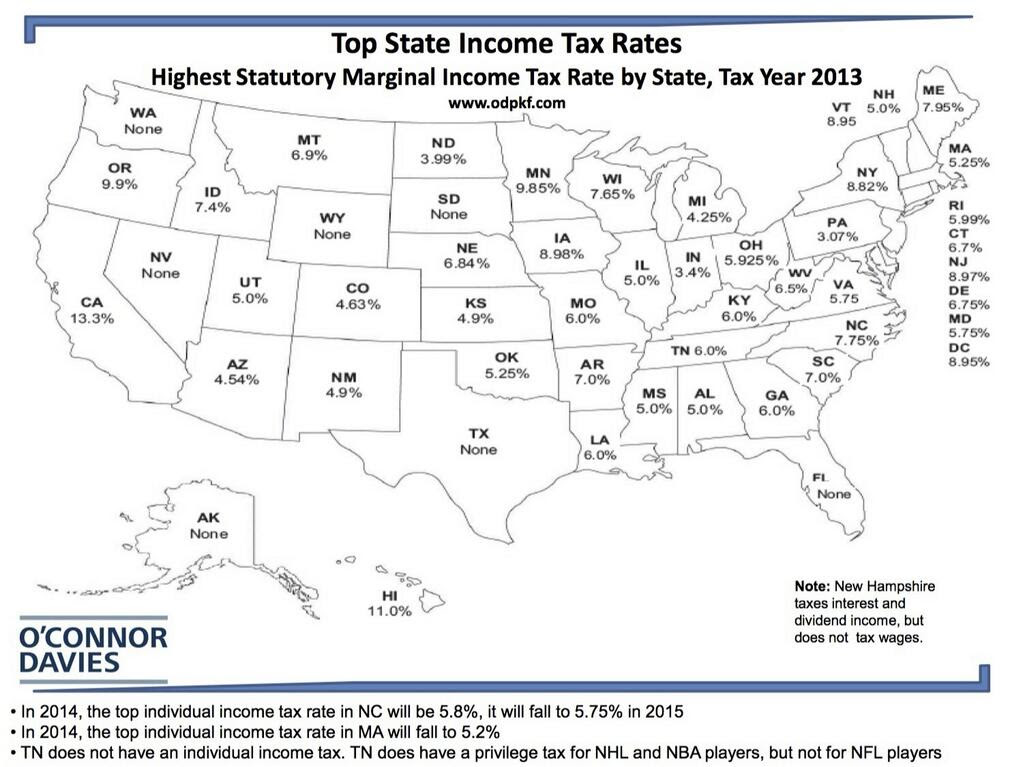
U.S. map of income tax: Blue States walk the talk

This map shows that Blue States practice what they preach: they want government to do more, and they tax income at a higher rate in order to do it:

Using the 2012 election results to measure that, we find the average state income tax rate in states (plus D.C.) that Obama won is 6.4 percent, while the average rate in states Mitt Romney won is 4.9 percent.

tumblr_n09mr3WwQZ1rasnq9o1_1280


By Sean Sullivan
February 16, 2014 | Washington Post

Friday, January 3, 2014

Moore: We deserve better than Obamacare

Never let it be said that Michael Moore is a Democratic hack. He speaks his mind.

Of course, for some conservatives, Moore's call for single-payer feeds right into their conspiracy theory that Obamacare was always meant to fail, thereby somehow (I still don't get the how) opening the door for single-payer medical insurance for all Americans who want it.


By Michael Moore
December 31, 2013 | New York Times

Today marks the beginning of health care coverage under the Affordable Care Act’s new insurance exchanges, for which two million Americans have signed up. Now that the individual mandate is officially here, let me begin with an admission: Obamacare is awful.

That is the dirty little secret many liberals have avoided saying out loud for fear of aiding the president’s enemies, at a time when the ideal of universal health care needed all the support it could get. Unfortunately, this meant that instead of blaming companies like Novartis, which charges leukemia patients $90,000 annually for the drug Gleevec, or health insurance chief executives like Stephen Hemsley of UnitedHealth Group, who made nearly $102 million in 2009, for the sky-high price of American health care, the president’s Democratic supporters bought into the myth that it was all those people going to get free colonoscopies and chemotherapy for the fun of it.

I believe Obamacare’s rocky start — clueless planning, a lousy website, insurance companies raising rates, and the president’s telling people they could keep their coverage when, in fact, not all could — is a result of one fatal flaw: The Affordable Care Act is a pro-insurance-industry plan implemented by a president who knew in his heart that a single-payer, Medicare-for-all model was the true way to go. When right-wing critics “expose” the fact that President Obama endorsed a single-payer system before 2004, they’re actually telling the truth.

What we now call Obamacare was conceived at the Heritage Foundation, a conservative think tank, and birthed in Massachusetts by Mitt Romney, then the governor. The president took Romneycare, a program designed to keep the private insurance industry intact, and just improved some of its provisions. In effect, the president was simply trying to put lipstick on the dog in the carrier on top of Mitt Romney’s car. And we knew it.

By 2017, we will be funneling over $100 billion annually to private insurance companies. You can be sure they’ll use some of that to try to privatize Medicare.

For many people, the “affordable” part of the Affordable Care Act risks being a cruel joke. The cheapest plan available to a 60-year-old couple making $65,000 a year in Hartford, Conn., will cost $11,800 in annual premiums. And their deductible will be $12,600. If both become seriously ill, they might have to pay almost $25,000 in a single year. (Pre-Obamacare, they could have bought insurance that was cheaper but much worse, potentially with unlimited out-of-pocket costs.)

And yet — I would be remiss if I didn’t say this — Obamacare is a godsend. My friend Donna Smith, who was forced to move into her daughter’s spare room at age 52 because health problems bankrupted her and her husband, Larry, now has cancer again. As she undergoes treatment, at least she won’t be in terror of losing coverage and becoming uninsurable. Under Obamacare, her premium has been cut in half, to $456 per month.

Let’s not take a victory lap yet, but build on what there is to get what we deserve: universal quality health care.

Those who live in red states need the benefit of Medicaid expansion. It may have seemed like smart politics in the short term for Republican governors to grab the opportunity offered by the Supreme Court rulings that made Medicaid expansion optional for states, but it was long-term stupid: If those 20 states hold out, they will eventually lose an estimated total of $20 billion in federal funds per year — money that would be going to hospitals and treatment.

In blue states, let’s lobby for a public option on the insurance exchange — a health plan run by the state government, rather than a private insurer. In Massachusetts, State Senator James B. Eldridge is trying to pass a law that would set one up. Some counties in California are also trying it. Montana came up with another creative solution. Gov. Brian Schweitzer, a Democrat who just completed two terms, set up several health clinics to treat state workers, with no co-pays and no deductibles. The doctors there are salaried employees of the state of Montana; their only goal is their patients’ health. (If this sounds too much like big government to you, you might like to know that Google, Cisco and Pepsi do exactly the same.)

All eyes are on Vermont’s plan for a single-payer system, starting in 2017. If it flies, it will change everything, with many states sure to follow suit by setting up their own versions. That’s why corporate money will soon flood into Vermont to crush it. The legislators who’ll go to the mat for this will need all the support they can get: If you live east of the Mississippi, look up the bus schedule to Montpelier.

So let’s get started. Obamacare can’t be fixed by its namesake. It’s up to us to make it happen.

Tuesday, December 31, 2013

MB360: U.S. income divide is a yawning chasm

Here MB360 reminds us how the U.S. middle class has disappeared in our new Gilded Age of wealth inequality, where the top 10 Percent own 75 percent of all wealth [emphasis mine]:

Since the 1950s the trend has only moved in one direction.  People often talk about top tax brackets and how high income taxes are but if you look at the above chart, the average tax rate for those in the top 1 percent is 23.5 percent.  How is that when the top tax bracket is 39.6 percent?  First, many people have better methods of tax avoidance: IRAs, 401ks, dividend income, real estate deductions, etc.  Since the bulk of wealth is in the hands of the top 10 percent, this group is already lowering their tax burden via these deductions and beneficial tax structures.  Since the typical American is living paycheck to paycheck with little saved for retirement these tax reducers don’t really help.  Besides, their income tax burden share is minimal.  However, their other tax burdens are large as a proportion to their income.  This is usually ignored when people talk about how little the working class pay in this country as they try to scapegoat the disappearing middle class.

More to the point, the middle class by definition should be well, the middle.  In this case, being middle class is a household making $35,000 or more.  We often hear about $250,000 being middle class by the media but by the IRS tax data, this is closer to being in the top 2 percent of AGI.  Not exactly middle class when 98 percent are below you.  Even if we look at the bottom 75 percent, the cutoff here is $70,492; certainly a far away cry from $250,000.  Or even the top 5 percent starting point of $167,728.

Remember the 2012 presidential campaign when Romney said, amazingly, that the middle class was any household making "$200,000 to $250,000 and less"?  And less, indeed. The media didn't put his absurd comment in context, although the IRS income data was right there for them to see -- probably because the Obama campaign's definition of middle class was basically the same. 

Folks, U.S. economic inequality is still the elephant in the room; it was the most under-reported story of 2013.

Happy New Year!  Let's hope it's a more equitable one.


Posted by mybudget360 | December 31, 2013

Friday, May 10, 2013

U.S. workers and the real 'freeloaders'

Huffington Post featured three excellent articles in two days about the plight of America's workers, who struggle to work enough hours to pay their bills, while not getting any paid leave or health insurance.

This week a Republican friend was complaining to me about "freeloaders" in America who don't pay any income taxes and thus feel no responsibility for our government; they just want to take, take, take.  This was his version of Mitt Romney's secretly taped complaint about the "47 percent" -- a moment of candor that likely cost Romney the 2012 U.S. presidential election.  (Such complaints are bald assertion: there is no indication that a large number of our fellow citizens feel this way; and people who make such accusations don't feel any need to offer evidence for such a conclusion.)

I replied to my friend, first, that Romney's 47 percent by definition includes millions of Red State Republicans.  Second, I said that nobody who works in America is a freeloader, even if they don't pay income tax.  Why?

The article about KFC provides a pretty good example.  A young man worked hard and was promoted by his boss and given extra hours and responsibilities, with a promise that a raise was just around the corner, but the raise never came. When he said he didn't want to be a manager anymore, it was too much stress for a poverty wage, his boss accused him of being "selfish."  Meanwhile, from 2007 to 2011, KFC (part of Yum!Brands) saw its profits rise 45 percent. 

This is true nationwide, where U.S. corporate profits are at an all-time high, while workers' wages are at an all-time low.  Yes, companies are getting more efficient and workers are getting more productive, but the profit gains from all that increased productivity are not going to workers.  

So just who is freeloading off of whom?  I don't mean to sound like a Marxist, but obviously, that guy working his tail off at KFC while living in his uncle's basement is not seeing any of that 45 percent in profits; it's all going to the corporate managers and shareholders.  His story has been repeated millions of times at other fast-food and retail joints around the country.

Or take the article about Amazon that, like many companies, outsources many aspects of its operations to temp agencies that don't give their workers any job security, full-time hours or benefits. Similarly, the U.S. Government's contractors often employ temp and part-time workers who earn below-poverty wages who then must rely partly on government benefits.  

This is not to mention Wal-Mart, the nation's #1 employer, whose average employee earns less than $9 an hour (less than $19,000 a year, full-time), and who has the most employees receiving federal welfare benefits.

Knowing all this, I don't see how anybody can have the gall to complain about the "selfishness" of U.S. workers who don't pay income tax.  Paying income tax is an elite privilege; and I'm sure these poor working Americans would love to be members of that elite club, earning enough money on salary with benefits to qualify for the "burden" of paying income taxes... while still enjoying all the other tax expenditures that middle- and upper-class Americans receive, which, according to Bloomberg, make up the largest category of government spending$1.3 trillion:


Middle-class families get an average benefit from the mortgage interest deduction of $139, while families in the top 1 percent get $3,752.


Taken together, individual income tax expenditures are the equivalent of sending $686 each year to those in the bottom fifth of the income distribution, $3,175 to those in the middle fifth, and $30,714 to those in the upper fifth. The average member of the top 1 percent gets nearly a quarter of a million dollars a year -- a statistic that might have proved useful for the folks protesting in Zuccotti Park.


By Saki Knafo
May 7, 2013 | Huffington Post

By Jillian Berman
May 8, 2013 | Huffington Post

By Dave Jamieson
May 8, 2013 | Huffington Post

Monday, November 12, 2012

Pro-Romney CEO lays off workers with a prayer -- BARF!


What a jerk!  If coal magnate Robert E. Murray wanted to lay off his workers he should lay them off, but don't blame President Obama for it, much less hide behind God!  Here's his self-serving pink slip "prayer:"

Dear Lord:
The American people have made their choice. They have decided that America must change its course, away from the principals of our Founders. And, away from the idea of individual freedom and individual responsibility. Away from capitalism, economic responsibility, and personal acceptance.

We are a Country in favor of redistribution, national weakness and reduced standard of living and lower and lower levels of personal freedom.

My regret, Lord, is that our young people, including those in my own family, never will know what America was like or might have been. They will pay the price in their reduced standard of living and, most especially, reduced freedom.

The takers outvoted the producers. In response to this, I have turned to my Bible and in II Peter, Chapter 1, verses 4-9 it says, “To faith we are to add goodness; to goodness, knowledge; to knowledge, self control; to self control, perseverance; to perseverance, godliness; to godliness, kindness; to brotherly kindness, love.”

Lord, please forgive me and anyone with me in Murray Energy Corp. for the decisions that we are now forced to make to preserve the very existence of any of the enterprises that you have helped us build. We ask for your guidance in this drastic time with the drastic decisions that will be made to have any hope of our survival as an American business enterprise.

Amen.

Yet nothing changed on November 9 in the mining industry.  And since Murray Energy is privately owned, we have no idea how well it's doing, or will do, we just have to take old Bob's word for it that he's in "survival mode" now.  

In fact, Murray just wanted to make a political point against President Obama -- and he used the Lord's name and 156 workers and their families to make it.  (Gee, do you think it'll work if they pray to God to get their old jobs back; or will their prayers just cancel each other out?)

And let's not forget the complaint to the Federal Election Commission in October that alleges Murray threatened employees with reprisals, including the loss of their jobs, to coerce them to make contributions to the company's PAC.

Self-made millionaires like Robert E. Murray can be the most insufferable egotists.  They figure if they made it big then everybody else should be able to as well.  People like Murray discount luck and chalk up all their success to themselves (and maybe "God," in the abstract.)  He's probably too dumb to realize his father and himself probably could have avoided their terrible mining accidents if Big Government had been allowed to ensure adequate mine safety.  

So anyway, now Murray says he's in "survival mode," trying to generate all the cash he can.  I wonder what survival mode means for a rich CEO like Robert Murray?  I bet it's not the same, quantitatively or qualitatively, as survival mode for his laid-off workers.


By Kim Geiger
November 10, 2012 | Tribune Washington Bureau

Monday, November 5, 2012

Ohio Romney supporters in their own words - YIKES

Like I said before, perhaps the best "tactic" of the Left is simply to give committed right-wingers a microphone and enough rope to hang themselves with.

Wait till you get to the part on when the correspondent asks what is Romney's plan?

And finally, we have an answer to the question that inquiring minds want to know: is Obama a communist, an atheist, or a Muslim?  "He's all three."

Even worse, we can't even go outside with somebody watching us.

Meanwhile, those damn Buddhists are taking away our freedom of religion.

Watch the whole thing, seriously.  Then ask yourself, if you're a Romney supporter: Can you do any better than these morons in explaining yourself?


By NewLeftMedia
November 1, 2012 | YouTube

Bennett: Why vote for Romney - WHY NOT!

I'll repeat myself a little here but it seems warranted, because Romney's main backer, Bill "The Gambler" Bennett, makes the case for Romney trotting out qual's that are actually disqualifications.

First, he holds up Romney's experience at Bain Capital as the primary reason that Romney could turn around the ailing U.S. economy (that has posted 25 straight months of job growth and 13 straight quarters of GDP growth, incidentally, after losing jobs for 25 straight months from February 2008.)  In October, Ronald Reagan's budget director, a private equity guy himself, destroyed Romney's Bain qual's better than anybody.  As he described in meticulous detail, deal by deal, Romney's experience at Bain of buying ailing companies, loading them up with debt, laying off workers and/or exporting jobs overseas, and making questionable mergers to achieve questionable "synergies" that never panned out but temporarily pumped up stock prices, all the while collecting huge fees for himself and his buddies before this businesses went bust, is the exact opposite of what America's economy needs right now.  

Here's how David Stockman summed up his analysis:

The Bain Capital investments here reviewed accounted for $1.4 billion or 60 percent of the fund’s profits over 15 years, by my calculations. Four of them ended in bankruptcy; one was an inside job and fast flip; one was essentially a massive M&A brokerage fee; and the seventh and largest gain—the Italian Job—amounted to a veritable freak of financial nature.

Only trouble is, there is nobody to whom Romney can pawn off this hot potato we call America in 4 years.  We can't take a 57 percent chance that America won't be a going concern post-Romney.  

Next, Bill Bennett cites Romney's experience turning around the Salt Lake City Winter Olympics.  OK, sure, he deserves some credit for that.  But so does Big Government, which bailed out Salt Lake City at Romney's request:  

"The $1.5 billion in taxpayer dollars that Congress is pouring into Utah is 1.5 times the amount spent by lawmakers to support all seven Olympic Games held in the U.S. since 1904 —combined," Donald Barlett and James Steele reported for Sports Illustrated in 2001.

But let's give Romney credit -- back then -- for giving Big Government credit where credit was due:

In his own 2004 book, Turnaround, Romney acknowledged the central role of the federal government in making the Olympics possible. "No matter how well we did cutting costs and raising revenue, we couldn't have Games without the support of the federal government."

Next, Bennett cites Romney's success as governor of Massachusetts.  Yet he curiously leaves out Romney's signature accomplishment: Romneycare.  That he alternately praises and disowns.  A health care plan based on plans by the Heritage Foundation and endorsed by Newt Gingrinch no less -- twice.  Can you say, "Media bias?"  

Next, Bennett cites Romney's moral character.  I don't need to dispute whether Romney cares about his friends and family, or humanity in the abstract.  He's not a monster.  But then again, neither is Obama, who is by all indications an extremely nice person with a lovely family, a guy who -- to his own detriment -- refuses to say bad things about his political opponents.  

Finally, Bennett cites Romney's "plans" if he is elected.  This gets back to the moral character issue.  How can we trust anything Romney says if he has flip-flopped so many times, from his $5 trillion tax cut plan (that he publicly disowned in the first 15 minutes of the first presidential debate when Obama challenged him on it) to Obama's saving the U.S. auto industry?  The guy simply cannot be honest about his own record.  "Etch A Sketch" will forever be etched into our political discourse thanks to Romney.  Some moral character!

So this is the best Romney's most eloquent spokesman could come up with.  Too bad.

In conclusion, I leave you with some of my favorite lines from Kingsley Amis's Lucky Jim, something I remember when I'm hiring somebody: 

However. I think you'll do the job all right, Dixon. It's not that you've got the qualifications, for this or any other work, but there are plenty who have. You haven't got the disqualifications, though, and that's much rarer. 

You may find that truth insufficiently inspiring.  I don't.  Any number of Democrats would make a better POTUS than Obama.  But those guys didn't make it this far.  Romney and Obama did.  Obama ain't perfect, not by a long shot. He's not nearly liberal enough; or, at least, he doesn't have the courage of his liberal convictions. But his lack of disqualifications makes him the clear choice.

(I suppose this quote could be turned on Obama if you think caring about the general welfare and believing "we're all in this together" is a disqualification. Vote your conscience.)


By William J. Bennett
November 5, 2012 | CNN

Sunday, November 4, 2012

Sandy sent by God to elect Obama?


If I were the type of guy to attend a church with a Jumbotron and a mall in it, I might believe that Hurricane Sandy had been sent by God to remind us what a real President looks like, and believes in: we're all in this together, and we help each other.

We must not even consider privatizing/disbanding FEMA and other parts of the government that keep our fellow Americans alive.


By Paul Krugman
November 4, 2012 | New York Times

Romney's hopes rest in 'contempt for the electorate'

Romney really has been hoping that nobody would care to dig into any of his statements or arguments, like his plan to cut taxes by $5 trillion and increase military spending by $2 trillion and yet (somehow) cut the deficit:

The important thing to remember here is that the GOP argument for a Romney victory rests explicitly on the hope that those who turned out to vote for Obama last time won’t be quite as engaged this time around. Republicans are hoping the electorate is not as diverse as it was in 2008, and they are arguing that the GOP base’s enthusiasm is much higher than that of core Dem constituencies. The Romney camp seems to think it will help whip GOP base voters into a frenzy — and perhaps boost turnout — if Romney casts the way Obama is urging Democratic base voters to get more involved in the process as something sinister and threatening. This is beyond idiotic; it is insulting to people’s intelligence.

The Post editorial board, in a widely cited piece, has claimed that the one constant about the Romney campaign has been that it is driven by “contempt for the electorate.” To make this case, the editorial cites Romney’s nonstop flip flops, his evasions about his own proposals, his refusal to share basic information about his finances and bundlers, and his monumental Jeep falsehood and all his other big lies. It’s fitting that Romney’s closing argument rests heavily on one last sustained expression of that contempt for the electorate — one focused squarely on a call for more engagement in the political process, i.e., on something that is fundamental to democracy itself.

Call me a conspiracy nut, but I think many smart Republicans realize Romney's plans are pie-in-the-sky.  It's just that they hate Obama so deeply, so viscerally, that they will vote for anyone running against him.  And those Republicans are mostly white people, mostly white men, mostly white older men.  It's really as simple as that.  This isn't a campaign about ideas for them.


By Greg Sargent
November 4, 2012 | Washington Post

Friday, November 2, 2012

Taibbi: We're all 'Big Government conservatives'

Matt Taibbi's latest post is worth reading in full but here are the best parts:

All year, the press has been banging a similar drum, i.e. that Mitt Romney and his budget-slashing sidekick Paul Ryan are for small government, while the closet socialist Barack Obama and his old-school New Dealer VP Joe Biden are the obvious big-government candidates.

The only problem with this new line of rhetoric is that it isn't really true. The almost certain reality is that we'll end up with a big (and perhaps even a rapidly-expanding) government no matter who gets elected. People seem to forget that this time four years ago, George W. Bush was winding down one of the most activist, expensive, intrusive presidencies in history, an eight-year period that saw a massive expansion in the size of the federal government.

And it's not only Dubya who was a hypocrite; we're all "Big Government conservatives" at heart:

In the abstract, most Americans want a smaller and less intrusive government. In reality, what Americans really want is a government that spends less money on other people.

Hurricane Sandy is a perfect, microcosmic example of America's attitude toward government. We have millions of people who, most of the year, are ready to bash anyone who accepts government aid as a parasitic welfare queen, but the instant the water level rises a few feet too high in their own neighborhoods, those same folks transform into little Roosevelts, full of plaudits for the benefits of a strong state.

The truth is, nobody, be he rich or poor, wants his government services cut.

That's right, Big Gubument is here to stay:

The point is, we will end up with a big government no matter who wins next week's election, because neither Mitt Romney nor Barack Obama is supported by a coalition that has any interest in tightening its own belt. The only reason we're having this phony big-versus-small argument is because of yet another longstanding media deception, i.e. that the only people who actually receive government aid are the poor and the elderly and other such traditional "welfare"-seekers. Thus a politician who is in favor of cutting services to that particular crowd, like Mitt Romney, is inevitably described as favoring "small government," no matter what his spending plans are for everybody else.

So is it any wonder that U.S. politicians refuse to be honest with voters when voters refuse to be honest with themselves?

It's this weird national paranoia about being seen as needy, or labeled a parasite who needs government aid, that leads to lunacies like the idea that having a strong disaster-relief agency qualifies as a "big government" concept, when in fact it's just sensible. If everyone could just admit that government is a fact of life, we could probably do a much better job of fixing it and managing its costs.  Instead, we have to play this silly game where millions of us pretend we're above it all, that we don't walk on regularly-cleaned streets or fly in protected skies. It shouldn't take a once-in-a-generation hurricane for Americans to admit they need the government occasionally, but that's apparently where we are.

Let the silly game continue this Tuesday....


By Matt Taibbi
November 1, 2012 | Rolling Stone

Sunday, October 28, 2012

Krugman: No way for 'V-shaped recovery' in 2009


Team Romney insists that the U.S. economy could and should have had a "V-shaped recovery" starting in 2009, despite all the historical and theoretical evidence to the contrary.

For the record, here's what Paul Krugman wrote in January 2008 (a year before Obama was President):

There’s still the question of how deep the slump will be. I can see the case for arguing that it will be nasty. The 1990-91 recession was brought on by a credit crunch, the 2001 recession by overinvestment; this time we’ve got both. I guess we’ll see. In any case, whatever happens will probably last quite a while.


By Paul Krugman
October 28, 2012 | New York Times

Why are both candidates silent on mortgage crisis?

President Obama has done almost nothing to help Americans restructure their mortgages.  With HAMP, Obama pledged to modify 4 million mortgages; but in fact "more than 1 million homeowners have been bounced out of the program."  

Meanwhile, about one-quarter of all U.S. houses are still underwater to the tune of about $690 billion.

So why is Romney silent on Obama's failure?

Because Romney promises to be even worse.  He has not made one proposal for re-structuring mortgages to somehow reduce mortgage principles.  Indeed, Republicans believe underwater mortgages are an issue of personal responsibility, a sacred trust between the bank and the borrower into which Big Government shouldn't intrude.

My hero, economics professor Joseph Stiglitz, finds it "shocking" that both candidates have been silent about the housing crisis.  And it has a been "a gross miscarriage of justice" that not one banker has ended up behind bars, said Stiglitz.  Then again, we shouldn't be surprised, since both candidates are in the pocket of the TBTF banks.


October 24, 2012 | Reuters TV

Friday, October 26, 2012

Poll: It's a black thing?

Thank goodness we're a post-racial society where people vote for their economic interests.

Oh, wait a minute....

Seriously though, one person already countered with that '90s line: "It's the economy, stupid."

You think so?  If that's so, then I guess that means only white men understand economics. And even they admit that Obama would do more to help the non-rich. Hmm... something doesn't add up....


Poll finds deepest racial split since ’88
By Scott Clement, Jon Cohen
October 25, 2012 | Washington Post

Thursday, October 25, 2012

Dionne: No matter who wins, Tea Party already lost

It's a Wa-Po twofer today.

Here's the best line I've read in a while:  "Not to put too fine a point on it, but if the conservatives are forgiving Romney because they think he is lying [about his moderate stances], what should the rest of us think?"

Dionne points out that the Tea Party made election gains in an off-year when people were demoralized, distracted and too tired to show up.  It was no revolution.  Nobody wants to buy what the teabaggers are selling except that waning white sliver of conservative Republican "purity" that's shrinking visibly by the day.


By E.J. Dionne Jr.
October 25, 2012 | Washington Post

The right wing has lost the election of 2012.

The evidence for this is overwhelming, yet it is the year’s best-kept secret. Mitt Romney would not be throwing virtually all of his past positions overboard if he thought the nation were ready to endorse the full-throated conservatism he embraced to win the Republican nomination.

If conservatism were winning, does anyone doubt that Romney would be running as a conservative? Yet unlike Ronald Reagan and Barry Goldwater, Romney is offering an echo, not a choice. His strategy at the end is to try to sneak into the White House on a chorus of me-too’s.

The right is going along because its partisans know Romney has no other option. This, too, is an acknowledgment of defeat, a recognition that the grand ideological experiment heralded by the rise of the tea party has gained no traction. It also means that conservatives don’t believe that Romney really believes the moderate mush he’s putting forward now. Not to put too fine a point on it, but if the conservatives are forgiving Romney because they think he is lying, what should the rest of us think?

Almost all of the analysis of Romney’s highly public burning of the right’s catechism focuses on such tactical issues as whether his betrayal of principle will help him win over middle-of-the-road women and carry Ohio. What should engage us more is that a movement that won the 2010 elections with a bang is trying to triumph just two years later on the basis of a whimper.

It turns out that there was no profound ideological conversion of the country two years ago. We remain the same moderate and practical country we have long been. In 2010, voters were upset about the economy, Democrats were demobilized, and President Obama wasn’t yet ready to fight. All the conservatives have left now is economic unease. So they don’t care what Romney says. They are happy to march under a false flag if that is the price of capturing power.

The total rout of the right’s ideology, particularly its neoconservative brand, was visible in Monday’s debate, in which Romney praised one Obama foreign policy initiative after another. He calmly abandoned much of what he had said during the previous 18 months. Gone were the hawkish assaults on Obama’s approach to Iraq, Iran, Afghanistan, Israel, China and nearly everywhere else. Romney was all about “peace.”

Romney’s most revealing line: “We don’t want another Iraq.” Thus did he bury without ceremony the great Bush-Cheney project. He renounced a war he had once supported with vehemence and enthusiasm.

Then there’s budget policy. If the Romney/Paul Ryan budget and tax ideas were so popular, why would the candidate and his sidekick, the one-time devotee of Ayn Rand, be investing so much energy in hiding the most important details of their plans? For that matter, why would Ryan feel obligated to forsake his love for Rand, the proud philosopher of “the virtue of selfishness” and the thinker he once said had inspired his public service?

Romney knows that, by substantial margins, the country favors raising taxes on the rich and opposes slashing many government programs, including Medicare and Social Security. Since Romney’s actual plan calls for cutting taxes on the rich, he has to disguise the fact. Where is the conviction?

The biggest sign that tea party thinking is dead is Romney’s straight-out deception about his past position on the rescue of the auto industry.

The bailout was the least popular policy Obama pursued — and, I’d argue, one of the most successful. It was Exhibit A for tea partyers who accused our moderately progressive president of being a socialist. In late 2008, one prominent Republican claimed that if the bailout the Detroit-based automakers sought went through, “you can kiss the American automotive industry good-bye.” The car companies, he said, would “seal their fate with a bailout check.” This would be the same Mitt Romney who tried to pretend on Monday that he never said what he said or thought what he thought. If the bailout is now good politics, and it is, then free-market fundamentalism has collapsed in a heap.

“Ideas have consequences” is one of the conservative movement’s most honored slogans. That the conservatives’ standard-bearer is now trying to escape the consequences of their ideas tells us all we need to know about who is winning the philosophical battle — and, because ideas do matter, who will win the election.