Trump just said in New Hampshire that he's going to unleash competition on U.S. healthcare after he repeals Obamacare, specifically by allowing Americans to buy health insurance across state lines.
Trump said the insurance companies are making a killing on Obamacare. The fact is, insurance companies are taking about 3 cents of every healthcare dollar in profit.
The problem is that U.S. medical care is too damn expensive. Insurance companies chip away at the edges and screw us in the process, through recission, yes, but they aren't the real problem.
Buying a cracker-jack health policy from a rinky-dink insurance provider in Rhode Island isn't going to do a thing for the cost of your care at home; it's only going to hit you when you actually need it that your insurance policy doesn't cover s**t.
Showing posts with label Obamacare. Show all posts
Showing posts with label Obamacare. Show all posts
Saturday, February 6, 2016


Tuesday, November 11, 2014
On Jonathan Gruber's comments 'bashing' Obamacare
Further to Jonathan Gruber's comments from 2013 on YouTube,
which have talk radio, Fox and Republicans publicly all aflutter. So check this out:
"Healthy people pay, sick people get money," is the way all health insurance works, I'm afraid. It's the way insurance works, period: "Unsunken ships pay; sunken ships get money;" "Undamaged homes pay; damaged homes get money;" "Safe drivers pay; unsafe drivers get money," and so on.
Nevertheless the insurance companies through rescission have tried, illegally, to mitigate the economics of health insurance, retroactively; but PHSA, HIPPA and Obamacare have restricted that underhanded business practice.
No, Obamacare isn't "something for nothing." It's not "free healthcare." More people have to pay in by buying private insurance, or having their employer pay part of their insurance cost, but the economics are sound, there is no other way. The other side of the ledger, (which any accountant should acknowledge), is that having more people insured will lower health spending overall. That's what the CBO has said consistently.
In the U.S. we're spending nearly 20 percent of GDP on health care, and that's not sustainable. It's also not competitive. Check this out from the World Bank,health expenditure, total (% of GDP):
Australia -- 9.1 percentCanada -- 10.9 percentFrance -- 11.1 percentGermany -- 11.3 percentGreat Britain -- 9.4 percentJapan -- 10.1 percent... and so on.
Next, take a deep breath and check this out: "Revisions to CBO's Projections of Federal Health Care Spending" from July 2014. Upshot: The U.S. economy, at least the federal government'share of it, is projected to spend less on health care in the long term, which is exactly what we liberal-progressives wanted, to bend the cost curve:
But how can that be, my conservative interlocutor will ask? How can the government be spending more on [Obamacare] subsidies yet projected to spend less, overall?CBO now projects that, if current laws remained generally unchanged, net federal spending for the government’s major health care programs in 2039 would equal 8.0 percent of gross domestic product (GDP)—1.6 percentage points, or about 15 percent, less than the 9.6 percent the agency projected in 2010 (see the figure below). That revision stems in large part from the observed slowdown in health care spending in recent years, but it also includes the effects of other factors; some of those factors reduced projected spending, and others increased it.The programs included in the calculations are Medicare, Medicaid, the Children’s Health Insurance Program, and subsidies for insurance purchased through exchanges.
The answer, (not to get too wonky), if you read between the lines of the CBO's revised estimate, is that growth in healthcare spending, including on Medicare, has been slowing down faster than anybody projected.
Indeed, noted conservative Forbes, "The current numbers represent the slowest rate of growth since the government began tracking the data in 1960."
And why is that? Apparently nobody knows yet. But for four years running, the rate of spending on health care in America has slowed... just coincidentally under President Obama, under an Obamacare regime.
Harvard economist David Cutler argued in the Washington Post a few days ago that, in fact, we do indeed have Obamacare to thank for it.
Probably it's still premature to say for sure, but the signs are good. Yet one more reason not to "repeal and replace" Obamacare when it's doing what it was designed to do -- covering about 7 million more Americans in its first full year; and lowering -- or at least not increasing -- healthcare costs for four years running.
UPDATE (11.15.2014): Here's kind of a fair and balanced analysis of what Jonathan Gruber said (on multiple occasions, unfortunately), from none other than CNN: "Obamacare: Voters, are you stupid?"
Saturday, October 11, 2014
News digest / Catching up on news (10.11.2014)
I've been busy lately for personal reasons, but also my laptop was out of commission for a week thanks to my 2-year-old (see photo), so below are some stories that deserved more attention than I was able to give them. If you've read these then you know (some of) what I do. Enjoy!
 |
| It took her about 2 minutes to do that. God love her, the little s--t. |
"Scott Walker lost his fight for voter ID. He's still everything that's wrong with the GOP," By Arvina Martin, October 10, 2014, Guardian. URL: http://gu.com/p/42a3m ANOTHER MAD TEA PARTY EXPERIMENT BLOWING UP IN THEIR FACES... CONTAINED AT THE STATE LEVEL, THANKFULLY.
"The War Nerd: Technology, culture wars & jihad," By Gary Brecher, October 9, 2014, Pando Daily. URL:http://pando.com/2014/10/09/
"Bill de Blasio: From Education to Poverty, Leadership by Example," By Richard (RJ) Eskow, October 9, 2014, Huffington Post. URL: http://huff.to/1vR5knB
"Millennials Are Blue Now, But Party Allegiance Could Be Up For Grabs," By Mara Liasson, October 9, 2014, NPR. URL:http://n.pr/1vRcyIo
"Will China Spark a Currency War?" By William Pesek, October 8, 2014, Bloomberg. URL: http://www.bloombergview.com/
"Time for a Guaranteed Income?" By Veronique de Rugy, March 2014 issue, Reason. URL: http://reason.com/archives/
"Voter Registration Rises In Ferguson Since Death Of Michael Brown (UPDATE)," By Igor Bobic, October 7, 2014, Huffington Post. URL: http://huff.to/1rPw4FO
"Some Americans Boosted Charitable Giving In Recession; The Rich Did Not," By Bill Chappell, October 6, 2014, NPR. URL: http://n.pr/1CPvxHk CHARITY WORKS THE LEAST WHEN IT'S NEEDED MOST -- TIME TO STOP RELYING ON IT, IT'S JUST A FEEL-GOOD OUTLET FOR THE FORTUNATE.
"Why would anyone want to talk on the phone ever again?" By Jess Zimmerman, October 6, 2014, Guardian. URL:http://gu.com/p/426qh AGREED: PHONES ARE ANNOYING AND INTRUSIVE.
"Firestone Did What Governments Have Not: Stopped Ebola In Its Tracks," By Jason Beaubien, October 6, 2014., NPR. URL: http://n.pr/1COVoPL UMM... NOT SURE WHAT TO THINK ABOUT THIS ONE. KUDOS TO THE COMPANY FOR WANTING ITS WORKERS NOT TO DIE? WELL OK THEN.
"How the Russian Orthodox Church answers Putin's prayers in Ukraine," By Gabriela Baczynska and Tom Heneghan, October 6, 2014, Reuters. URL: http://www.reuters.com/
"Voodoo Economics, the Next Generation," By Paul Krugman, October 5, 2014, New York Times. URL: http://huff.to/1s49pG2 DYNAMICALLY SCORE THIS!
"Oceans Getting Hotter Than Anybody Realized," By John Upton, October 5, 2014, Climate Central. URL:http://www.climatecentral.org/
"Vatican Synod Tests The Pope's Vision Of A More Merciful Church," By Sylvia Poggioli, October 5, 2014, NPR. URL:http://n.pr/Z3PBqc
"Ten Reasons Why Russia Could Invade Ukraine Before Winter – Thoughts from Kiev," By Mychailo Wynnyckyj, October 3, 2014, Circus Bazaar. URL: http://www.circusbazaar.com/
"Even if we defeat the Islamic State, we’ll still lose the bigger war," By Andrew J. Bacevich, October 3, 2014, Washington Post. URL:
http://wapo.st/1vlnuxk NOBODY GETS THIS. IT'S LIKE TALKING TO A BRICK WALL.
"Regarding political differences, just blame biology," By Cynthia M. Allen, October 3, 2014, McClatchy DC. URL:http://www.mcclatchydc.com/
"Can US Support for Ukraine Help Prevent a New Russian Invasion?" By James Rupert, October 3, 2014, Atlantic Council. URL: http://www.atlanticcouncil.
"China’s explanation for the Hong Kong protests? Blame America," By Anne Applebaum, October 3, 2014, Washington Post. URL: http://wapo.st/1py9Y5S JUST LIKE PUTIN DOES, BLAME AMERICA. GEE, WHO KNEW WE WERE SO POWERFUL?? (YET WE CAN'T TAKE OUT A BUNCH OF YAHOOS IN THE DESERT??...)
"The US is slipping into a disastrous engagement against the Islamic State," By Marvin Zonis, October 3, 2014, Chicago Tribune. URL: http://www.mcclatchydc.com/
"Big Food more effective than Big Government in tackling obesity," By Richard Williams, October 3, 2014, McClatchy-Tribune. URL: http://www.mcclatchydc.com/
"Sentiment divided at haj pilgrimage over role of Islamist militants," By Amena Bakr, October 3, 2014, Reuters. URL:http://www.reuters.com/
"Russia ends US student exchange in part over 'friendly relations' of gay men," By Alec Luhn, October 2, 2014, Guardian. URL: http://gu.com/p/42568 WELL IF YOU DON'T WANT YOUR KIDS TO BE GAY THEN DON'T SEND THEM TO THE U.S. OBVIOUSLY. JEEZ.
"Europe, facing common jihadi threat, has no common security policy," By Matthew Schofield, October 2, 2014, McClatchy DC. URL: http://www.mcclatchydc.com/
"Your baby looks like your ex? This research is scarier than Alien," By Daisy Buchanan, October 2, 2014, Guardian. URL:http://gu.com/p/424kt YES INDEED, DAISY, YOUR BABY WITH TOM LOOKS JUST LIKE GATSBY!
"Who will win the ridesharing war? Probably not consumers," By Catherine Rampell, October 2, 2014, Washington Post. URL: http://www.washingtonpost.com/
"The War Nerd: Islamic State is sulking on the edge of Baghdad," By Gary Brecher, October 2, 2014, Pando Daily. URL:http://pando.com/2014/10/02/
"Putin Supports Project to ‘Secure' Russia Internet," By Andrew E. Kramer, October 2, 2014. New York Times. URL:http://huff.to/1rPXsUi
"We all know about jihadists, but what about those waging an ‘anti-jihad’?" By Karima Bennoune, October 1, 2014, Reuters. URL: http://www.reuters.com/
"The White House Could Be Made A Fortress, But Should It Be?" By Ron Elving, October 1, 2014, NPR. URL:http://n.pr/1oAUG01 THE U.S. PRESIDENTIAL INAUGURATION USED TO BE AN OPEN HOUSE PARTY... WHO COULD IMAGINE IT NOWADAYS?!
"The 9 Biggest Myths About ISIS Debunked," By Andrew Hart, October 1, 2014, Huffington Post. URL: http://huff.to/YH0xKH
"Putin’s view of power was formed watching East Germany collapse," By Mary Elise Sarotte, October 1, 2014, Guardian. URL:
http://gu.com/p/4249a DAS IST KAPUT!
"Is The New AP U.S. History Really Anti-American?" By Emmanuel Felton, October 1, 2014, Huffington Post. URL:http://huff.to/1rM7XrO CRITICAL THINKING IS INHERENTLY ANTI-AMERICAN, DUH.
"Obamacare's First Year: How'd It Go?" By John Ydstie, October 1, 2014, NPR. URL: http://n.pr/1ozUXR2 IT WENT PRETTY F-ING WELL: I GOT HEALTH INSURANCE AND SO DID MY REPUBLICAN UNCLE T. 'NUF SAID.
"Is America on the ISIS Hit List?," By Graham Allison, September 30, 2014, The National Interest. URL:http://nationalinterest.org/
"Federalization as a ’Terrorist’ Act," By Halya Coynash, September 30, 2014, Human Rights in Ukraine. URL:http://khpg.org/index.php?id=
"Embracing Assad Is a Better Strategy for the U.S. Than Supporting the Least Bad Jihadis," By Graham E. Fuller, September 29, 2014, Huffington Post. URL: http://huff.to/1rGasf4
"Earth lost 50% of its wildlife in the past 40 years, says WWF," By Damian Carrington, September 29, 2014, Guardian. URL:http://gu.com/p/42vvx SCARY. SCARY. DID I SAY SCARY?
"Income Inequality 2014: Ahead Of Midterm Elections, Harvard Study Says Americans Grossly Underestimate Inequality," By David Sirota, September 29, 2014, International Business Times. URL: http://www.ibtimes.com/income-
"Neoliberalism has brought out the worst in us," By Paul Verhaeghe, September 29, 2014, Guardian. URL:http://gu.com/p/42v9g
"When income growth hits a brick wall: From 1949 to 1979 over 60 percent of all income growth went to the bottom 90 percent. After that, things changed for the middle class," By MB 360, September 29, 2014. URL:http://www.mybudget360.com/
"Europe’s Austerity Zombies," By Joseph E. Stiglitz, September 26, 2014, Project Syndicate. URL: http://www.project-syndicate.
"The Economic Case for Paternity Leave," By Gwynn Guilford, September 24, 2014, The Atlantic. URL:http://www.theatlantic.com/
Thursday, June 19, 2014
The backwards South is moving backward
It's strange and pathetic how the today's Southern states promotes themselves to businesses and investors as a kind of third-world enclave within the United States -- not only low-tax but also low-wage, and of course no unions.
Maybe that strategy is OK for Bangladesh, but touting oneself as low-wage is not a long-term winning strategy for the US of A. Lower wages and incomes mean a lower tax base, leading to poorer schools, less infrastructure and hence weaker long-term economic growth.
Indeed, the poorest and most miserable U.S. states are located in the South.
By Nelson Lichtenstein
June 18, 2014 | Reuters
We used to call it the “New South.” That was the era after Reconstruction and before the Civil Rights laws — when the states of the old Confederacy seemed most determined to preserve a social and economic order that encouraged low-wage industrialization as they fought to maintain Jim Crow.
What was then distinctive about the South had almost as much to do with economic inequality as racial segregation. Between roughly 1877 and 1965, the region was marked by low-wages, little government, short lives and lousy health — not just for African-Americans but for white workers and farmers.
The Civil Rights revolution and the rise of an economically dynamic Sun Belt in the 1970s and ‘80s seemed to end that oppressive and insular era. The Research Triangle in North Carolina, for example, has more in common with California’s Silicon Valley than with Rust Belt manufacturing. The distinctive American region known as the South had truly begun to vanish.
This is the thesis of economic historian Gavin Wright’s new book on the economic consequences of the civil rights revolution,Sharing the Prize. Ending segregation, Wright argues, improved the economic and social status of both white and black workers The South became far less distinctive as wages and government-provided benefits increased to roughly the national level.
But the New South has returned with a vengeance, led by a ruling white caste now putting in place policies likely to create a vast economic and social gap between most Southern states and those in the North, upper Midwest and Pacific region. As in the late 19th century, the Southern elite appears to believe that the only way their region can persuade companies to relocate there is by taking the low road: keeping wages down and social benefits skimpy. They seem to regard any trade union as the vanguard of a Northern army of occupation.
Exhibit A is the refusal of every Southern state except Kentucky and Arkansas to expand Medicaid under the Affordable Care Act. Senator David Vitter (R-La.), running to replace Bobby Jindal as Louisiana’s governor, made headlines Monday when he announced he would consider adopting the Medicaid expansion.
In 2012 the Supreme Court gave states the right to back out of this part of Obamacare. The South rushed to take this opportunity — despite the loss of billions in federal dollars. Now 5 million poor Southerners are consigned to health insurance purgatory.
The Republican Party as a whole has made opposition to Obamacare virtually a fetish. But outside the South, Republican governors from Arizona and Nevada in the West to Iowa, Ohio, and New Jersey further East, have seen the economic logic and social utility of taking the federal money. After the 2014 elections, when Democrats look likely to oust Republicans from statehouses in Pennsylvania and Maine, those states will do the same.
Southern states also keep wages low by neglecting to raise their state minimum wage standards. In the North and West, a movement to dramatically increase wages — to $10, $12 or even $15 dollars an hour — has caught fire. Seattle just mandated a $15 minimum wage that will kick in over the next few years.
Today 21 states have raised minimum wages higher than that of the federal standard of $7.25 an hour. But only two of these states, Missouri and Florida, border on the South. As in the New South era, when textile factories were enticed to flee the North for the low-wage Piedmont region, Southern states now trumpet not just low taxes and an absence of trade unions, but low wages.
Although Oklahoma joined the Union in 1907, it immediately joined the ranks of the Jim Crow South with its strong segregation and anti-union policies. This continues today. In April, for example, when Oklahoma City residents sought to put a municipal wage increase on the November ballot, the state legislature quickly enacted a law banning any city or town from raising the local minimum wage or requiring that employees have a right to sick days or vacation, either paid or unpaid.
Of course, such regressive social policies, including voting rights limitations, are supported by a fierce white partisanship. The solid South has returned in full force. Black voters there are overwhelmingly Democratic, whites of almost every income level equally determined to vote Republican.
The presence of an African-American in the White House plays a large role in this racial-political polarization on the ground in Dixie. But not even Southern-born white Democrats, like former President Bill Clinton and former Vice President Al Gore, have been able to transcend this Southern partisanship. Despite for their cultural affinities and Southern accents, they could not persuade Southern whites to vote Democratic.
This is, however, not just a product of racial fears and resentments. Instead it appears to reflect an increasingly inbred Southern hostility to the exercise of economic regulatory power on virtually any level. As in the 19th century, many in the South, including a considerable proportion of the white working-class, have been persuaded that the federal government is their enemy.
As in the New South era, Southern whites, both elite and plebian, have adopted an insular and defensive posture toward the rest of the nation and toward newcomers in their own region. Echoing the Jim Crow election laws promulgated by Southern states at the turn of the 20th century, the new wave of 21st century voting restrictions promise to sharply curb the Southern franchise, white, black, and brown.
The new New South rejects not only the cosmopolitanism of a multiracial, religiously pluralist society, but the legitimacy of government, both federal and state, that seeks to ameliorate the poverty and inequality that has been a hallmark of Southern distinctiveness for more than two centuries.
The Civil War has yet to be won.
Sunday, June 8, 2014
Our McJobs economy...and the GOP plan to make it worse
My dear conservative friends will blame the shrinking middle class and more McJobs on Obama, naturally.
But to see they're wrong you only have to look at their policy "fixes": no minimum wage; no guaranteed health insurance for workers; no right to unionize; and privatizing Medicare. Oh, and cutting unemployment benefits to motivate more people to compete for low-wage jobs, thereby driving wages down even further. The most radical Tea Partiers even say we should abolish the Department of Education, when U.S. public schools are most people's shot at a better life.
None of these ideas makes any economic sense. (It makes a heckuva lot of sense from a class warfare perspective, however.) And in the case of conservatives' debt fetish, they confuse economic cause and effect: debt causes recessions, not the other way around.
So they can't diagnose the problem, nor can they prescribe any cures.
So they can't diagnose the problem, nor can they prescribe any cures.
But wait, they have more great ideas. Cutting "job-killing regulations" and income taxes on the rich should stimulate growth, then all the unemployed could get jobs in the new businesses that Republicans say their hands-off policies would create. Yet we tried that before and saw how it worked out.
Conservative talk radio says we can all move to Texas or North Dakota and find high-paying jobs in the shale gas boom, but that's hardly practical. Most people can't just pick up and move their entire lives, like Okies of the Depression era, to where the jobs are. Doesn't matter. Republicans want to open up even more public lands for oil & gas drilling, even though that oil is sold by multinational corporations on the world market; it's not "ours."
Or as I like to sum it up, the GOP thinks we can cut and burn our way to a better economic future.
It’s the sixth year of Barack Obama’s presidency, the job market is still sluggish, most Americans say they’re unhappy with the economy, and Obama’s approval ratings are down. So what’s the Republican plan to turn it around?The answer is, they don’t all think they need one and those who do can’t agree on a unified view.
This is why it's so ominous that Republicans, thanks to gerrymandering and stronger off-election turnout, could take over Congress in November. I'm not saying they're solely responsible for the Great Recession, (although Phil Gramm could certainly make a case), but they certainly haven't learned any economic lessons from it, and that's scary. This is a party that's pissed off yet feels zero responsibility for its policies -- it's a veritable chimpanzee with a hand grenade.... And they have as many good ideas as a chimp how to grow the middle class and get Americans back to work.
Posted by mybudget360 | June 8, 2014
The US is slowly becoming a McJob nation. While the press jumps up and down that the US is now finally at a breakeven point from the jobs lost since the recession started in 2007, they fail to mention that those not in the labor force is up by nearly 13 million. Even looking into the recent employment report, we continue to find a heavy trend of hiring in low wage employment sectors. For example, 32,000 jobs were added in “leisure and hospitality” bringing the annual total of jobs added to 311,000. Another 21,000 jobs were added in social assistance which pay very little but will grow as demand for health support grows by an aging population. The system at least in the eyes of Wall Street and the government is working perfectly fine. We have a plentiful supply of low wage labor while laws and bailout mechanisms are in place for the financially and politically connected. The middle class continues to fall off the bandwagon one by one and enters a labor force of permanent low wage labor with very little prospect of a decent retirement. In fact, most will be working until all the wheels come flying off. We also find that 1 out of 4 Americans are working in jobs that pay $10 or less per hour. How about trying to earn the Americans Dream on that McJob salary?
Breaking even and seeing the non-labor force surge
It has taken us 7 slow and painful years simply to recover the jobs we had back in 2007. With the latest jobs number, we finally are back to where we were in 2007. Of course, the population has increased and many of these new jobs come with horrible benefits, lower wages, and very little security. Is it any wonder why home buying in the country continues to be so anemic?
Low wages are also creating an entire nation that is unprepared for retirement. For example, 1 out of 3 Americans has zero dollars in their savings account. Half the country is one paycheck away from a financial avalanche. During the last 7 years, we have added close to 13 million Americans to the “not in the labor force” category:

record jobs in context
Source: BLS, ZH
A part of this growth is an older population but a large part of it isn’t. We have many digging into college degrees with massive debt to avoid the current economic situation. Others have simply given up looking for work. The low wage recovery has been extremely painful for many Americans and wealth growth has not occurred for 90 percent of the country. These are simply the facts. This is what we find in every piece of data we look at.
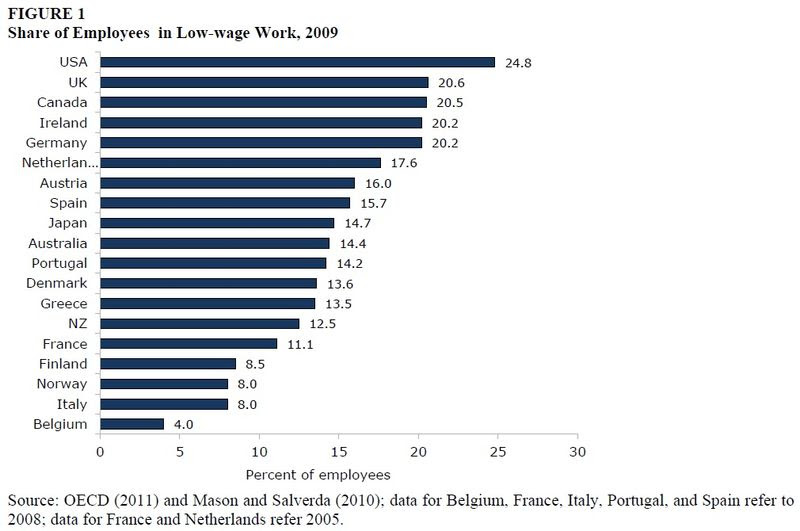
Economist Tim Taylor presented a chart highlighting that the US has a very high portion of its population working in low wage jobs. This is contrary to the image that the US is a land with middle class jobs for many:
low-wage-2
Low wage work as defined in the data set above is employment that pays less than $10 per hour. Imagine trying to support a family on this. 2,000 hours of work would yield $20,000 which is below the poverty line for a family of three. And then we wonder how we have roughly 47 million Americans on food stamps.
The reason we continue to see this kind of recovery is that all policy made during the collapse was dictated by those in the banking industry that led up to this collapse in the first place. Even former Treasury Secretary Tim Geithner mentioned that if we didn’t do the bailouts exactly as we did (i.e., keep big payouts to banking execs, money for corrupt workers, etc) then the economy would have imploded. Well the economy did implode for most workers and a recovery never happened. Maybe for his closely knit group of people things are looking great:

growth-in-income-inequality
But for the rest of country people are running the Red Queen’s Race by working harder and harder simply to stay in the same place. A McJob recovery is not something to be proud about especially when the middle class in the US continues to dwindle.
Friday, May 30, 2014
Gov. Beshear to Mitch McConnell: Obamacare is working
Excellent! This is from a Democratic governor in a Red State who isn't afraid to tell it like it is to his conservative constituents:
[O]ver 421,000 Kentuckians have signed up for health insurance through "kynect" -- about 75 percent of whom didn't previously have insurance and about 52 percent of whom were under age 35.That's almost 1 in 10 Kentuckians....[I]f each of the over 421,000 people who signed up via "kynect" could grab 10 minutes of Sen. McConnell's time to explain what health care coverage means for their families, and if the Senator had the endurance to listen 24/7, it would take eight years to hear from each enrollee.
I'll say it again, "Big Government" programs like ACA and Social Security aren't just debits, they aren't just financial obligations, they represent real assets -- because they sustain and improve millions of real Americans' lives. Somebody living longer and being more productive -- that's harder to quantify in dollars and cents the same way we can track federal spending, but heck if it isn't just as real.
(Every other corporation says, "Our people are our most important asset;" and this is even truer for the U.S. Government of its citizens!)
It's high time Republicans stopped ignoring half our nation's balance sheet, i.e. ignoring the assets that government produces and sustains all around us.
P.S. -- Unless something changes soon, I'll become an Obamacare "customer" in June. I've already shopped for plans and consulted on the telephone with kynect representatives, who were very friendly, helpful and knew their stuff. I was impressed, especially compared to the experience of calling an insurance provider for answers!
P.S. -- Unless something changes soon, I'll become an Obamacare "customer" in June. I've already shopped for plans and consulted on the telephone with kynect representatives, who were very friendly, helpful and knew their stuff. I was impressed, especially compared to the experience of calling an insurance provider for answers!
By Gov. Steve Beshear
May 29, 2014 | Huffington Post
Thursday, May 1, 2014
2 Americas when it comes to health care
So, once again we see Southern conservatives love to be poor and sick, and continually vote against their own best interests. Boy, talk radio and FOX have sure done a number on them!....
What's really a shame are the poor blacks "imprisoned" in these mostly Southern states, who can't get decent health care like their fellow Americans in other parts of the country, because of white conservative voters in the majority.
By Jillian Berman
April 30, 2014 | Huffington Post
When it comes to the quality of health care, there are two Americas.
In one America, infant mortality, avoidable deaths, health-care costs and other measures are far worse than in the other America, according to a new study by the Commonwealth Fund, a health policy research firm. And thanks to Republican lawmakers and the Supreme Court, the gulf between them may only get wider.
The map below from the Commonwealth Fund shows the stark divide. States with the worst overall health care systems -- as measured by factors like the number of insured adults and children, avoidable emergency room visits and access to affordable care -- are dark blue. States with better health-care systems are white.

When it comes to things like health care access, quality and cost, certain states can be as much as eight times better than others, the report found.
“We continue to see this very wide geographic spread,” said Commonwealth Fund senior vice president Cathy Schoen, a coauthor of the report. Millions of lives could be saved if the low-performing states could close just half the gap with the top states, Schoen said. "We really need to stay focused on aiming higher.”
Many of the lower-performing states have higher rates of early deaths that could have been prevented by access to quality health care. The Commonwealth map below shows the number of avoidable deaths per 100,000 in each state.
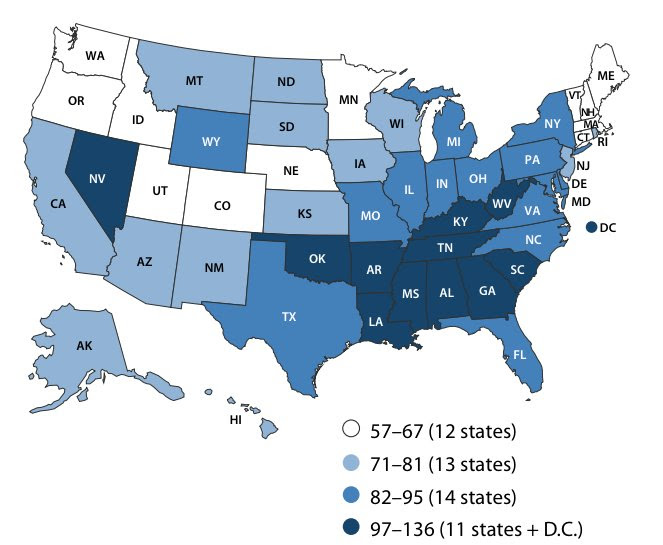
Many of the worst states for health care have several things in common. They’re mostly in the South and are more likely to be among the poorest in the nation. Many of them have long had unusually tight standards for applicants to qualify for Medicaid, said Schoen, and many have been slow to expand children’s health insurance.
What's more, 16 of the 26 states at the bottom of the Commonwealth Fund’s scorecard aren’t expanding Medicaid under the Affordable Care Act, also known as Obamacare.
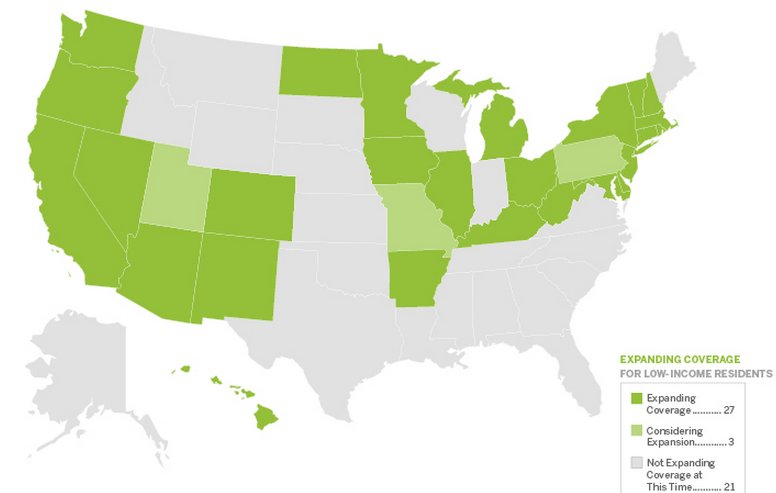
The states in grey aren't expanding Medicaid. Many of these are also states in which overall health systems are worse.
One of Obamacare’s major tools for giving the poor better access to health care is expanding Medicaid to those making 133 percent of the federal poverty limit -- about $15,521 for a single person -- or less.
But the Supreme Court ruled in 2012 that states could opt out of joining the Medicaid expansion and the extra federal money that came with it. Many states with Republican governors or majority Republican legislators have done just that, leaving millions of their residents out of the national effort to cover the uninsured.
Increasing access to Medicaid isn't a cure-all for low-performing states, and improving health care outcomes overall will require more than just expanding Medicaid. But it could help, Schoen said. For one, it will extend health coverage to more people, making it less likely that poor patients will head to the emergency room for things other than emergencies. And if more low-income residents can pay for health care, more doctors might be convinced to move to poor or rural areas.
"The states that stay out could fail to improve, or fail to improve as fast as other states that choose to participate,” Schoen said. “In some of these states, staying where you are is not very good performance.”
Black Americans are likely to suffer disproportionately from these policies. More than two-thirds of poor, uninsured blacks live in states not expanding Medicaid, according to a December 2013 New York Times report. Already, the rate of avoidable early deaths among blacks is twice as high as among whites in many states, Commonwealth found. That gap is even wider in states with higher early death rates overall.

Map via The Advisory Board.
The difference in avoidable death rates in white and black populations in different states.
Still, there is some hope: Kentucky, Arkansas and Nevada, which all rank in the bottom quarter of the Commonwealth Fund's scorecard, are expanding Medicaid. That could help them catch up.
"You could see a few states start to improve quickly," Schoen said.
Saturday, March 8, 2014
Sunday, February 9, 2014
The myth of Obama's part-time workforce
Here's a graph from Derek Thompson that shows how U.S. part-time employment rises and falls, historically, in perfect sync with recessions and recoveries:

That's right. No negative Obamacare effect at all. Zilch. In fact, Thompson notes that, "in the last year, new full-time jobs outnumbered part-time jobs by 1.8 million to 8,000. For every new part-time job, we're creating 225 full-time positions."
Here's how Thompson sums how badly many journalists are skewing economic reality:
It is a free country, and journalists have every constitutional right to claim that we're moving toward a Part-Time America. They will, however, be in the uncomfortable position of making a falsifiable statement that has been relentlessly falsified by every available statistic. The entire increase in part-time employment happened before Obamacare became a law.
Wherefore the dastardly lib'rul media when we need them?
By Derek Thomson
February 7, 2014 | The Atlantic
Tuesday, February 4, 2014
'Liberal' media lies: Obamacare will cost 2 million jobs
So did the CBO really mean to forecast that 2 million people would lose their jobs because of Obamacare? No. But that's how the mainstream media -- including the "liberal" axis at the New York Times and Washington Post reported it.
As Weinstein clarifies, here's what the CBO actually said:
CBO estimates that the ACA will reduce the total number of hours worked, on net, by about 1.5 percent to 2.0 percent during the period from 2017 to 2024, almost entirely because workers will choose to supply less labor—given the new taxes and other incentives they will face and the financial benefits some will receive.
Is that just wonkish liberal-progressive spin? Is that just "figures lie, and liars figure?" No again:
When workers no longer have to rely on full-time employers to get affordable health care, they suddenly have the freedom to not work full-time. That could mean people stuck in crappy hourly jobs 40 hours a week at, say, the local big-box store. Or creatives jammed in underpaying urban admin assistant jobs. Indeed, the CBO adds:
Because the largest declines in labor supply will probably occur among lower-wage workers… the impact on the overall economy will be proportionally smaller than the reduction in hours worked.
Weinstein sums it up [emphasis mine]:
The problem here is truly philosophical. It is ideological. It is rooted in the two Americas' distressingly divergent answers to a simple question: What is a job for?For pundits and pointy-headed analysts, it's to keep The Economy and Growth flowing. That is its good. That is its end. Workers are the means. For most workers (the vast majority of whom aren't leaving their families and schlepping through megastorms to cubicles or factories for the love), the job is the means to a different, individualized end: the ability to buy one's own way, to keep loved ones fed and happy and healthy, to stave off poverty.So what the CBO said today, in essence, was that if this Obamacare thing works out, people won't need to work full-time jobs just to keep health care benefits. They may actually be able to spend more time with those families. They may be able to freelance, to split hours between two parents rather than having one stay-at-home parent and one full-time earner. They may be able to take a chance on that novel or Etsy shop, instead of staying at the office until death.That's not what conservatives hear, though, because that's not what conservatives care about. Their concern for people is subverted by their concern for commercial output, or economic abstractions that appear to impact commercial output.
People are real. They are not economic abstractions. And health care (and Medicare and food stamps, for that matter) is not single-sided accounting, with all costs and liabilities and no assets or benefits. Health insurance that is not tied to employment facilitates Americans' labor mobility, unleashes their creativity and risk-taking, simply because they don't have to make one of the most important decisions in life -- where to work -- based solely on where they can get decent health insurance.
By Adam Weinstein
February 5, 2014 | Gawker
Friday, January 3, 2014
Moore: We deserve better than Obamacare
Never let it be said that Michael Moore is a Democratic hack. He speaks his mind.
Of course, for some conservatives, Moore's call for single-payer feeds right into their conspiracy theory that Obamacare was always meant to fail, thereby somehow (I still don't get the how) opening the door for single-payer medical insurance for all Americans who want it.
By Michael Moore
December 31, 2013 | New York Times
Today marks the beginning of health care coverage under the Affordable Care Act’s new insurance exchanges, for which two million Americans have signed up. Now that the individual mandate is officially here, let me begin with an admission: Obamacare is awful.
That is the dirty little secret many liberals have avoided saying out loud for fear of aiding the president’s enemies, at a time when the ideal of universal health care needed all the support it could get. Unfortunately, this meant that instead of blaming companies like Novartis, which charges leukemia patients $90,000 annually for the drug Gleevec, or health insurance chief executives like Stephen Hemsley of UnitedHealth Group, who made nearly $102 million in 2009, for the sky-high price of American health care, the president’s Democratic supporters bought into the myth that it was all those people going to get free colonoscopies and chemotherapy for the fun of it.
I believe Obamacare’s rocky start — clueless planning, a lousy website, insurance companies raising rates, and the president’s telling people they could keep their coverage when, in fact, not all could — is a result of one fatal flaw: The Affordable Care Act is a pro-insurance-industry plan implemented by a president who knew in his heart that a single-payer, Medicare-for-all model was the true way to go. When right-wing critics “expose” the fact that President Obama endorsed a single-payer system before 2004, they’re actually telling the truth.
What we now call Obamacare was conceived at the Heritage Foundation, a conservative think tank, and birthed in Massachusetts by Mitt Romney, then the governor. The president took Romneycare, a program designed to keep the private insurance industry intact, and just improved some of its provisions. In effect, the president was simply trying to put lipstick on the dog in the carrier on top of Mitt Romney’s car. And we knew it.
By 2017, we will be funneling over $100 billion annually to private insurance companies. You can be sure they’ll use some of that to try to privatize Medicare.
For many people, the “affordable” part of the Affordable Care Act risks being a cruel joke. The cheapest plan available to a 60-year-old couple making $65,000 a year in Hartford, Conn., will cost $11,800 in annual premiums. And their deductible will be $12,600. If both become seriously ill, they might have to pay almost $25,000 in a single year. (Pre-Obamacare, they could have bought insurance that was cheaper but much worse, potentially with unlimited out-of-pocket costs.)
And yet — I would be remiss if I didn’t say this — Obamacare is a godsend. My friend Donna Smith, who was forced to move into her daughter’s spare room at age 52 because health problems bankrupted her and her husband, Larry, now has cancer again. As she undergoes treatment, at least she won’t be in terror of losing coverage and becoming uninsurable. Under Obamacare, her premium has been cut in half, to $456 per month.
Let’s not take a victory lap yet, but build on what there is to get what we deserve: universal quality health care.
Those who live in red states need the benefit of Medicaid expansion. It may have seemed like smart politics in the short term for Republican governors to grab the opportunity offered by the Supreme Court rulings that made Medicaid expansion optional for states, but it was long-term stupid: If those 20 states hold out, they will eventually lose an estimated total of $20 billion in federal funds per year — money that would be going to hospitals and treatment.
In blue states, let’s lobby for a public option on the insurance exchange — a health plan run by the state government, rather than a private insurer. In Massachusetts, State Senator James B. Eldridge is trying to pass a law that would set one up. Some counties in California are also trying it. Montana came up with another creative solution. Gov. Brian Schweitzer, a Democrat who just completed two terms, set up several health clinics to treat state workers, with no co-pays and no deductibles. The doctors there are salaried employees of the state of Montana; their only goal is their patients’ health. (If this sounds too much like big government to you, you might like to know that Google, Cisco and Pepsi do exactly the same.)
All eyes are on Vermont’s plan for a single-payer system, starting in 2017. If it flies, it will change everything, with many states sure to follow suit by setting up their own versions. That’s why corporate money will soon flood into Vermont to crush it. The legislators who’ll go to the mat for this will need all the support they can get: If you live east of the Mississippi, look up the bus schedule to Montpelier.
So let’s get started. Obamacare can’t be fixed by its namesake. It’s up to us to make it happen.
Subscribe to:
Comments (Atom)