Showing posts with label inflation. Show all posts

Sunday, September 7, 2014

News digest / Catching up on news (09.07.2014)

Here's more good stuff from my mailing list that I didn't have time to re-post on TILIS:


"Russia sees a military solution in Ukraine even if the West doesn’t." By Editorial Board, September 5, 2014, Washington Post. URL: http://wapo.st/Yj13ir  


"The Senate Republicans’ foolish fight over ambassadors." By David Ignatius, Septmeber 2, 2014, Washington Post. URL: http://wapo.st/1w4aflz

"A second Sunni Awakening?" By Fareed Zakaria, September 2, 2014, Washington Post. URL: http://wapo.st/1lz1QpE

"Putin's Trap: Why Ukraine Should Withdraw from Russian-Held Donbas." By Alexander J. Motyl, September 1, 2014, Foreign Affairs. URL:http://www.foreignaffairs.com/articles/141946/alexander-j-motyl/putins-trap  -- A CONTROVERSIAL POINT OF VIEW; BUT IF THIS PAINFUL OUTCOME IS TO HAPPEN ANYWAY, SHOULDN'T UKRAINE TAKE THE INITIATIVE?


"Labor Day: The Beginning of a Breakthrough." By Robert Kuttner, August 31, 2014, Huffington Post. URL: http://huff.to/1Chs0SW

"We need to tell the truth about what Russia is doing in Ukraine."  By Wesley Clark, August 31, 2014, Guardian. URL: http://gu.com/p/4x6hh

"A Market Basket of dignity." By E.J. Dionne, August 31, 2014, Washington Post. URL: http://wapo.st/1owAqLW  -- AT LEAST ONE CEO NOW GETS IT; I GUESS WE JUST HAVE TO FIRE THEM ALL SO THEY WILL UNDERSTAND

"Russian nationalism and the logic of the Kremlin's actions on Ukraine." By Henry E. Hale, August 29, 2014, Guardian. URL: http://gu.com/p/4x5tq  -- REMEMBER, IN UKRAINE NATIONALISM IS CALLED 'FASCISM'; IN RUSSIA IT'S PATRIOTISM

"Why Russia Wants the Federalization of Ukraine." By Alexander Motyl, August 28, 2014, Huffington Post. URL: http://huff.to/1tH7Uxu


"Donetsk POW March: When Is A Parade A War Crime?" By Carl Schreck, August 25, 2014, RFE/RL. URL: http://www.rferl.org/content/ukraine-pow-march-war-crime/26548667.html  -- OF COURSE IT'S A WAR CRIME BUT FAT CHANCE IT'LL BE PROSECUTED

"Hawks Crying Wolf." By Paul Krugman, August 22, 2014, New York Times. URL: http://huff.to/1BJIHpT  -- I BELIEVE THAT 'CHICKEN LITTLE' IS THE MORE APT FAIRY TALE HERE.

"If this is real religion, then you can count me as an atheist." By Giles Fraser, August 22, 2014, Guardian. URL: http://gu.com/p/4xx22  -- TAKE NOTE, CONSERVATIVE XENOPHOBES: MODERATE MUSLIMS ARE SPEAKING OUT

"Never an excuse for shooting unarmed suspects, former police chief says." By Joseph D. McNamara, August 19, 2014, Reuters. URL:http://www.reuters.com/article/2014/08/19/idUS212937500020140819  -- IT WORKED IN THIS MISSOURI TOWN, AND GEE, ALL THROUGHOUT GREAT BRITAIN WHERE POLICE AREN'T EVEN ARMED!

Thursday, January 2, 2014

Is Red Lobster an economic bellwether?


As you may recall, I'm a fan of Dead Lobster, (no snickering!), even though I've criticized Darden Restaurants (Red Lobster's owner) for trying in 2012 to cut back on employee hours to avoid giving them health insurance. Facing a 37 percent drop in revenue, Darden was apparently trying to scapegoat Obamacare for its restaurants' poor performance.

LZ Granderson sees ominous portents in Darden's plan announced late 2013 to spin off its 700 Red Lobster restaurants because they are losing money. He says this reflects poor and middle class families' shrinking wages and buying power. Especially black and Latino families.

My latest visit to Red Lobster was a bust: it was so busy that the wait time was one hour and 40 minutes. So my local Lobster seems to be doing OK.

At any rate, Granderson rightly laments the U.S. working class's 30-year fall from prosperity:

From November 2012 to November 2013, weekly earnings rose 1.1% while the consumer price index increased 1.2%, according to the Bureau of Labor Statistics. That small uptick may not seem like much until you factor in three years ago, wages increased 1.8%, and the CPI was up 3.5%. And that may not seem like much until you realize that almost every year since 1983, a series of small ticks like those two examples has been widening the gap between between what we earn and what we can buy.

Consider the poverty threshold.

For a family of four in 1983 it was $10,178. Adjusted for inflation, that should be $23,817.03 today. However, the actual 2013 poverty threshold is $23,492, a difference of $325.03.

When you're living check to check, that's a lot of money.

Indeed, a family of four can have a very nice meal at the Lobster for about 70-80 bucks. So $325 is about four trips to Red Lobster a year, now out of the picture. Or maybe it's money spent on something else, it doesn't really matter in macroeconomic terms. Multiply that $325 times 9.5 million poor households, and we're talking $3 billion in consumer demand sucked out of the U.S. economy. 

This is where the minimum wage, SNAP and unemployment benefits matter, because we have an economy built to serve the working poor and disappearing middle class, and if those people don't have income then businesses that cater to them will die, taking more jobs and income with them, in a vicious cycle. 

It's much easier to destroy than to create; and what's destroyed doesn't come back.

UPDATE (04.01.2014): Furthermore, Harvard economist Lawrence Katz recently estimated that the U.S. economy is losing $400 million to $1 billion every week  thanks to Republicans' decision to end long-term unemployment benefits for about 1.3 million Americans.


By LZ Granderson
January 1, 2014 | CNN

Sunday, December 1, 2013

MB360: Americans back to spending on credit

Any economist, pundit or politician who tells you that our economy would get better if we could only increase access to credit (debt) or "incentivize" poor people to work while cutting their food stamps and the minimum wage, is either a charlatan or an idiot.

What happens when Americans, as a nation, start saving and stop spending on credit is economic stagnation or recession. So we must increase Americans' household incomes, and/or lower their household expenses to allow them to continue spending. After all, the well-off can buy only so many houses, yachts and luxury goods. Yes, they can save and invest in stocks and other securities... but their investments won't translate into U.S. jobs and economic growth if there is no market (consumer demand) to drive it. 

Indeed, the Dow just hit a record high, corporate profits and U.S. workers' productivity are at all-time highs, and yet... nobody is doing an economic endzone dance right now. Working class Americans feels more economically insecure than ever.

And that's why Obamacare is so necessary, among other federal programs.  

According to a 2013 study by the AARP, over the past 10 years, health care spending for average middle-income households increased 51 percent, compared to only 30 percent growth in household income. Over that same period, healthcare inflation increased three times the rate of growth for all other products and services; and per capita expenditure on health care increased 72 percent! 

We must cut our per capita expenditure on health care while protecting average Americans from treatable illness and medical bankruptcy. Only the Democrats are proposing real solutions to do that.  Republicans keep dawdling while Americans are dying and drowning in debt.  

Under President Obama, the rate of healthcare inflation has finally slowed and is projected to slow further. Coincidence?


Posted by mybudget360 | December 1, 2013

Saturday, May 25, 2013

Krugman: 5 litmus tests for true conservatives?

Krugman is totally right about one's values determining one's view on the welfare state. (I would say it's more a question of aesthetics.)  It's not something you can really debate. Believe me, I've tried.

There really are people who believe in the "work or starve" / "let the devil take the hindmost" philosophy of social Darwinism, and they make up about 20 percent of the U.S. population and the core of the Tea Parties and Republican Party.

When it comes to the general welfare, they are not interested in outcomes, but rather in ideology, in establishing ideal, Randian rules of the game that don't impede the unlimited accumulation of wealth with no responsibility to give anything back.  For them that belief is ironclad; it's beyond argument.

Krugman offers 5 issues, on the other hand, that do hinge on results, on empirical evidence.  One side is definitely right or wrong.  For these issues it's not a question of values or what's "right," but rather what's provably correct.  Krugman observes that while liberals can and do disagree on these 5 issues, and still call themselves liberal without suffering ideological exile, conservatives must answer a certain way on all 5 or else be confined to an ideological reservation for "RINOs."


By Paul Krugman
May 25, 2013 | New York Times

Saturday, May 4, 2013

Japan v. Europe / stimulus v. austerity


It's still early, but so far so good for the anti-austerity economic policies of Japan's Prime Minister Shinzo Abe aimed at pulling Japan out of 20 years of economic doldrums.  

He's doing the exact opposite of what the IMF/WSJ/CNBC/Davos talking heads say to do, by spending money and encouraging inflation. 

I know, I know, many old teabaggers are clutching their chests and turning purple upon reading those words, but there are unintended evils attendant with high savings and zero inflation.

So, once again, the rest of the world is doing us a favor, showing us what works and what doesn't, and all we have to do is watch and copy the smart guys.

It's austerity on the right in Europe, and stimulus on the left in Japan.  Who's gonna win?  

Rest assured that your ace blogger will be following this story!....

(This is totally off-topic, but remember that Michael Crichton novel & movie Rising Sun?  Remember how he and others warned us that Japan's economy was going to eat our lunch?  Seems very silly now.  This was the same Michael Crichton, by the way, (may he RIP) who reportedly convinced Dubya that man-made global warming was a scientific hoax.  So that's, uh, two big strikes against the dead guy.)


By Stanley White and Kaori Kaneko
April 30, 2013 | Reuters

Wednesday, October 31, 2012

Reagan's 1981 recession v. W's Great Recession

Let's compare the 1981-82 recession to the Great Recession:
  • Duration:  16 months vs. 18 months
  • GDP:  -2.7 % vs. -4.1% *
  • Consumption:  +0.1 % vs. -2.3 %
  • Investment:  -9.3 % vs. -23.4 %
* The biggest drop in GDP since WWII.

Here are some more measures in 1981-82 vs. the Great Recession:
  • Personal income: +7 % vs. -1 %
  • Industrial production:  -8.6 % vs. -12 %
  • Dow Jones Avg.:  +9 % vs. -22 %
  • Housing prices:  +2.2 % vs. - 5.7%
  • Rate of foreclosures:  0.67% (max) vs. 4.3 % (2009)

Regarding interest rates, you can thank the Fed, which intentionally targeted a high interest rate to kill inflation.  With 11% inflation the 19% interest rate in 1980 was not so high in fact.

Regarding unemployment, it grew more during the Great Recession (5.1 percent) than during the 1981 recession (3.6 percent).  Unemployment rose for 22 straight months during the Great Recession, the longest period since WWII.  It was also the first recession when all 50 states reported increased unemployment, meaning you couldn't simply move to find work in another state.  Long-term unemployment was also worse during the Great Recession: 5.6 million vs. 2.6 million; and in October 2009, the average length of unemployment was 26.9 months -- the longest on record.

Finally, the Great Recession was also (and still is, in some countries) a global recession.  

So I don't want to hear any more about how all it would take is a President Reagan to pull us out of the Great Recession.

Wednesday, September 5, 2012

Ritholtz: Declining U.S. middle class


Median income is down, savings are down, prices are up.  It's been a long, steady decline for the American middle class since the 70s...


Friday, February 3, 2012

MB360: Boomers have no savings, live on SS


We shouldn't let grumpy old Boomers, who are over-represented in the Tea Parties, lecture younger generations about responsibility, work and savings, because they have no savings and rely on Social Security for almost all their income.

We'll still take care of you old timers, because we're well-raised and we're all in this together, but please: no more sanctimonious lectures.


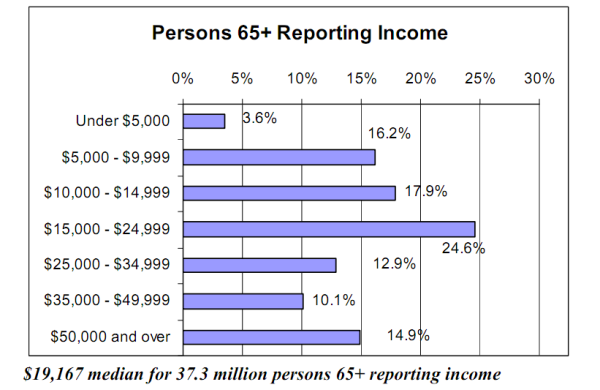
What happens when a society that prides itself on a middle class and self-sufficiency suddenly starts losing both? For over a decade the middle class in the US has been shrinking. This isn't some speculation but is reflected in the stagnant household income data. You also have a giant demographic train in that many baby boomers are now retiring in mass. Over 10,000 baby boomers enter into retirement each day and many have an inadequate amount of savings (if any) to get them through the leaner years. Couple this with a less affluent younger generation and you have a recipe for financial and social turmoil. Many of these younger Americans, many saddled with large student debt, are moving back home with parents that have seen their entire home equity evaporate. Do you think these are happy households especially when the median income of those 65+ is $19,167?

Median income of the old

There seems to be this misconception that older Americans are simply well off. The data shows us otherwise:

median income persons 65 and older

Source: US Dept. of Health

What is troubling about the above data is that during some of the most affluent decades in US history, most Americans have very little income in older age. In fact, most rely on Social Security as their primary source of income:

"Social Security constituted 90% or more of the income received by 34% of beneficiaries (21% of married couples and 43% of non-married beneficiaries)."

How is this even possible? Keep in mind the average Social Security payout is roughly $1,000 per month and this is fixed. Since the government has juiced the CPI data most of these fixed income Americans are seeing their energy and healthcare costs soar all the while they are told inflation is virtually non-existent. Try arguing that after going to the grocery store.

There is also this sense that since many older Americans own their home, they are somehow immune to the housing bubble. That is not true:

"In 2009, 48% of older householders spent more than one-fourth of their income on housing costs – 42% for owners"

Many older Americans still spend a lot of money on housing even if they are owners. Much of this comes from property taxes and costs associated with owning a home. Since many older Americans do own their home this housing bubble crash has harmed their largest asset.

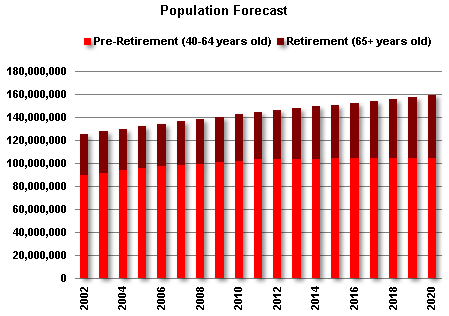
As time presses on more and more of our population is going into retirement. Lower birth rates and more Americans making it into older age conjure up memories of Japan:

baby-boomer-statistics
Source: Baby boomer stats

-There are approximately 77.6 million baby boomers in the U.S.

-The baby boom phenomenon is responsible for over half of all consumer spending in the United States

-80% of all leisure travel is taken by boomers.

-Every 8.5 seconds a baby boomer in the U.S. turns 50 years old.

-The baby boom generation is the largest generation in American history.

-On January 1st, 2011 the very first Baby Boomers turned 65

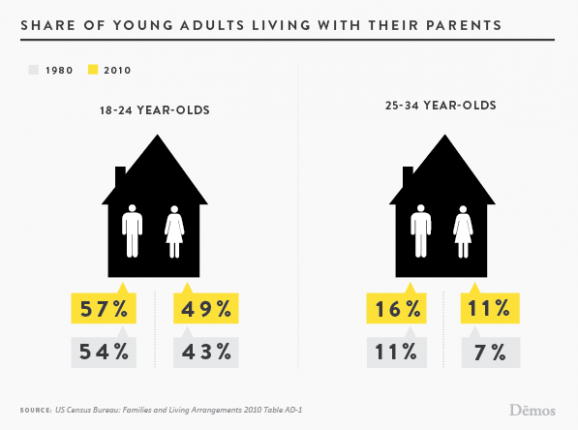
Baby boomers tended to also be big spenders (at least they were during the debt bubbles). But what now? The strongest spending group is losing a large part of their wealth with the housing crash and many are exiting their peak earning stages. From the Social Security data, we realize many did not save in what was likely the most affluent times for America. With many younger Americans carrying major debt loads and finding items like pensions disappearing, how will they prepare for retirement? What access to savings do they have? Homes are still expensive for many younger Americans and that is why millions have moved back home:

living-at-home

A society that has preaches independence and pushes out young at 18 will have a hard time dealing with boomerang kids coming back home. Many younger Americans will feel the strain as well especially if they "did the right thing" and went to college but now find a tough employment market and being back home. This demographic train has left the station and nothing will slow it down.

Sunday, December 4, 2011

Krugman: Europe is cautionary tale for U.S., but not how you think

We in the U.S. have a bit of time to see how austerity and high interest rates help Europe's economy before we ourselves go into full austerity mode, but so far the effects in Europe have been dire. Soon to be catastrophic.

In the U.S. we also have too many who irrationally fear the inflation bogeyman -- primarily those who are living comfortably and don't want to see the value of any of their assets fall on some distant and undefined future date. We cannot let them rule the present day.


By Paul Krugman
December 1, 2011 | New York Times

Can the euro be saved? Not long ago we were told that the worst possible outcome was a Greek default. Now a much wider disaster seems all too likely.

True, market pressure lifted a bit on Wednesday after central banks made a splashy announcement about expanded credit lines (which will, in fact, make hardly any real difference). But even optimists now see Europe as headed for recession, while pessimists warn that the euro may become the epicenter of another global financial crisis.

How did things go so wrong? The answer you hear all the time is that the euro crisis was caused by fiscal irresponsibility. Turn on your TV and you're very likely to find some pundit declaring that if America doesn't slash spending we'll end up like Greece. Greeeeeece!

But the truth is nearly the opposite. Although Europe's leaders continue to insist that the problem is too much spending in debtor nations, the real problem is too little spending in Europe as a whole. And their efforts to fix matters by demanding ever harsher austerity have played a major role in making the situation worse.

The story so far: In the years leading up to the 2008 crisis, Europe, like America, had a runaway banking system and a rapid buildup of debt. In Europe's case, however, much of the lending was across borders, as funds from Germany flowed into southern Europe. This lending was perceived as low risk. Hey, the recipients were all on the euro, so what could go wrong?

For the most part, by the way, this lending went to the private sector, not to governments. Only Greece ran large budget deficits during the good years; Spain actually had a surplus on the eve of the crisis.

Then the bubble burst. Private spending in the debtor nations fell sharply. And the question European leaders should have been asking was how to keep those spending cuts from causing a Europe-wide downturn.

Instead, however, they responded to the inevitable, recession-driven rise in deficits by demanding that all governments — not just those of the debtor nations — slash spending and raise taxes. Warnings that this would deepen the slump were waved away. "The idea that austerity measures could trigger stagnation is incorrect," declared Jean-Claude Trichet, then the president of the European Central Bank. Why? Because "confidence-inspiring policies will foster and not hamper economic recovery."

But the confidence fairy was a no-show.

Wait, there's more. During the years of easy money, wages and prices in southern Europe rose substantially faster than in northern Europe. This divergence now needs to be reversed, either through falling prices in the south or through rising prices in the north. And it matters which: If southern Europe is forced to deflate its way to competitiveness, it will both pay a heavy price in employment and worsen its debt problems. The chances of success would be much greater if the gap were closed via rising prices in the north.

But to close the gap through rising prices in the north, policy makers would have to accept temporarily higher inflation for the euro area as a whole. And they've made it clear that they won't. Last April, in fact, the European Central Bank began raising interest rates, even though it was obvious to most observers that underlying inflation was, if anything, too low.

And it's probably no coincidence that April was also when the euro crisis entered its new, dire phase. Never mind Greece, whose economy is to Europe roughly as greater Miami is to the United States. At this point, markets have lost faith in the euro as a whole, driving up interest rates even for countries like Austria and Finland, hardly known for profligacy. And it's not hard to see why. The combination of austerity-for-all and a central bank morbidly obsessed with inflation makes it essentially impossible for indebted countries to escape from their debt trap and is, therefore, a recipe for widespread debt defaults, bank runs and general financial collapse.

I hope, for our sake as well as theirs, that the Europeans will change course before it's too late. But, to be honest, I don't believe they will. In fact, what's much more likely is that we will follow them down the path to ruin.

For in America, as in Europe, the economy is being dragged down by troubled debtors — in our case, mainly homeowners. And here, too, we desperately need expansionary fiscal and monetary policies to support the economy as these debtors struggle back to financial health. Yet, as in Europe, public discourse is dominated by deficit scolds and inflation obsessives.

So the next time you hear someone claiming that if we don't slash spending we'll turn into Greece, your answer should be that if we do slash spending while the economy is still in a depression, we'll turn into Europe. In fact, we're well on our way.

Thursday, May 12, 2011

Report: Healthcare more expensive, but not due to ObamaCare

By Julie Rovner
May 11, 2011 | NPR

OK, health care is expensive. And the costs keep going up.

But the latest report from the green-eyeshade experts at Milliman does include a few surprises about what is — and isn't — driving those costs higher.

First, a tidbit that sort of passes for good news. Last year, health costs rose by 7.3 percent, which is the slowest rate of increase in more than a decade. By comparison, though, the Consumer Price Index rose only about 1.5 percent last year.
Now the bad news: Even at that relatively slow rate, the overall increase in the amount of money required to cover a typical family of four in a preferred provider organization was $1,319 in 2011 — the highest figure in the more than 50 years Milliman has been doing this study.

Who paid the freight? Employers kicked in just under half, or $641, with employees paying the rest either in the form of higher premiums or larger cost-sharing.

And here's a little more bad news. Since 2002, the total cost to American families for their health care has more than doubled to $19,393 from $9,235.

So what's driving the increases? Here's a hint: It's not the new federal health law.

"At the most basic level, healthcare costs are determined by the quantity of services provided at a given cost," says the report. "To the extent that healthcare reform affects healthcare utilization and/or unit costs, it will contribute to future healthcare cost trends. Ultimately it is the change in the underlying cost of care that matters."

In other words, if the law works as intended, costs could go down. If not, they won't. But the law hasn't had much effect yet.

So what is making a difference? Outpatient care, it turns out.

For three straight years, outpatient care has led all other categories of care in cost increases. Ninety percent of the increase is in more types of care being delivered in outpatient settings. "Unit costs are increasing both because the same services have increased in price and also because new, more expensive services continue to emerge," the report says.

Hospitals costs were the second biggest driver of last year's increase (largely because hospital care is so expensive), followed by physician care, drug costs, and other types of care, such as durable medical equipment and home health care.

You can make some dent in your costs by moving to a different part of the country, according to Milliman. For example, if you live in Miami, New York City, or Chicago, you're paying higher-than-average prices for your health care. You might consider relocating to Phoenix, Atlanta, or Seattle, where prices are somewhat lower than average.

A move might become even more appealing starting in 2018, when the new law begins imposing a 40 percent tax on "high cost" health plans. Unless of course, costs actually start to come down by then.

Thursday, February 17, 2011

Inflation bogeyman's gonna getcha!

In Boogeyman, it's all slight of hand.

For months now I've been hearing a lot about the (hyper-?)inflation fears of conservative gold bugs and 'Bama haters. (As I've noted before, gold is a hedge against uncertainty, not against inflation.) I wonder if any of these scaremongers looks at actual inflation?

True, the recent and significant rise in commodities prices is troubling, but its effects in 2011 in the U.S. will probably be "a ripple," although food prices may have contributed significantly to fomenting revolution in Tunisia and Egypt. Lately commodities prices have very little to do with Obama or the U.S. period, (growing U.S. demand for biofuels excepted), and much more to do with demand in China and speculators reacting to droughts in Australia, fires in Russia, political upheavals in the Mideast, etc.

What really bothers me about these inflation scaredycats is that they forget about real U.S. workers who have no job, or a part-time job, or a job that pays much less than their previous one, although their basic needs haven't decreased. A rise in food prices of 1-2 percent is unwelcome but pales in comparison to a 20-100 percent cut in monthly income. In the West, inflation is the bogeyman of the comfortable.

And *macroeconomics 101 tells us that an economy operating way below capacity with large unemployment cannot have high inflation. In fact, just a few months ago the Fed was more worried about deflation, which is bad for several reasons.

So I file all this inflation talk away in the "Obama's going to take away your guns" category. It's impossible to refute because it's pure speculation about some future event that probably won't happen, but since we live in the present I can't say the nutjobs are definitely wrong. (Although they are definitely wrong.)


* For us to have significant inflation right now, we'd have to have a leftward shift in the Aggregate Supply curve, meaning business costs would be rising faster than productivity. In fact, U.S. annual average productivity (output per worker per hour) increased 3.6 percent from 2009 to 2010, according to the Bureau of Labor Statistics; and wage increases were about 1.5 percent September 2009 on September 2010 vs. a 1.1 percent increase in consumer prices, hardly Zimbabwe-type increases.

Monday, November 15, 2010

$ign of the (end?)times: Gold bug paranoia

I guess gold is like Glenn Beck's "Food Insurance," only in this case it would be "Money Insurance." The only thing is, if there is a total collapse of civilization like Beck predicts, then what are people going to need gold for? They can't eat it, can't build with it, it won't keep them warm, etc. That doesn't stop Beck from trying to fleece his herd with Goldline coin adverts though.

What Rush Limbaugh, Glenn Beck, Laura Ingraham, and other right-wing pundits are really asking their followers to do is to speculate in gold and pump up an existing bubble. As a commodity, gold doesn't produce anything so its value depends purely on trading. The more people who buy gold, the bigger the bubble gets, and the more they'll lose when the gold bubble invetiably bursts. (After all, Republicans will eventually take control of Washington, save America, and restore the dollar, right?) Of course, those in the know who got in early on this paranoia and will sell out before the bubble bursts could make a bundle. But are you that cunning, and did you buy gold early enough? If the answer to either is "no," then stay away from gold unless you're an eccentric millionaire.

Remember, gold is not a very good hedge against inflation, it's a hedge against calamity and instability.


Analysis: Here's why the world's love affair with gold is dangerous.
By David Case
November 10, 2010 | GlobalPost

URL: http://www.globalpost.com/dispatch/101110/gold-investment-robert-zoellick