Showing posts with label student loans. Show all posts

Tuesday, September 3, 2013

Sirota: Higher education should be a right like high school

Following up on Matt Taibbi's expose of the scam that federal student loans have become, David Sirota offers us an alternative [emphasis mine]:

Just consider the critical difference between how high school and college education programs are funded.

The former is funded by broad-based taxes and few would ever suggest changing it to an individual tuition system. Why? Because we've come to view access to high school as a right. This view is based not just on notions of morality but also on an economic calculation. Basically, we know we need a workforce with as many high school graduates as possible, and we've decided that forcing young people to go into crushing debt to get a high school degree would deter many from getting the degree.

Yet, even though we know that higher education is also increasingly an economic necessity, we do not have the same funding model or outlook for college. Instead, we still predicate access to higher education on a student's wealth and/or their willingness to go into crushing debt.

[...]  No doubt, shifting our policies to treat post-secondary education as equally necessary as high school -- and therefore worthy of similar fiscal treatment -- requires a paradigm shift in thinking.

It requires us to see higher education as not just 4-year university programs, but also 2-year community college programs and vocational and technical education.

As I've been saying for years, we can give millions of Americans marketable, in-demand job skills without four-year colleges.  For too many, four years of college is an extravagant waste of time and money; they don't want or really even need to be there, (hurting the college experience for those who do); they just need a piece of paper at the end that generically qualifies them for gainful employment.


By David Sirota
August 29, 2013 | Alternet

Tuesday, August 27, 2013

Taibbi: College loan system scam

Better late than never, I'm posting this exposé by Taibbi about the exorbitant cost of U.S. higher education.

Today's graduates leave college with have an average of $27,000 in student loan debt.


As Taibbi reveals, 

... the dirty secret of American higher education is that student-loan interest rates are almost irrelevant. It's not the cost of the loan that's the problem, it's the principal – the appallingly high tuition costs that have been soaring at two to three times the rate of inflation, an irrational upward trajectory eerily reminiscent of skyrocketing housing prices in the years before 2008.

Another dirty little secret is that the federal government, by its own estimates, stands to make $185 billion in profit on student loans over the next 10 years. Boosting the government's profits, borrowers cannot discharge their student loan debt through personal bankruptcy. The Department of Education can even garner federal disability checks!

So why is college so expensive in America?  The knee-jerk conservative response is: tenured ivory tower professors; and money for Democrats from the education lobby.

The former is untrue and the latter is only partly true.  But conservatives should note that the federal student loan system does cause a kind of market distortion, the so-called "Bennet hypothesis," named after conservative William Bennett: with any accredited college eligible to receive students with federal financial aid, there is really no incentive for colleges to cut costs, compete, or focus on degrees that give students a decent Return on Investment (ROI).  

"A degree in bullshit" does the job for both colleges and the government lender when the collection rate on student loans can exceed 100 percent.

And as we all know, the newer for-profit colleges have been gaming the student loan system -- as well as the education allowances given to members of the U.S. Military -- for several years now, even as students at for-profit colleges have a loan default rate as high as 40 percent.

Another reason colleges are so expensive is what Taibbi calls "gilding": the expensive administration buildings, sports stadiums and celebrity professors. These used to be paid for by nervous, eager parents... until they ran out of money. Now the federal government subsidizes colleges. So why shouldn't colleges go on a spending spree?


By Matt Taibbi
August 15, 2013 | Rolling Stone

Sunday, June 30, 2013

MB360: Record-high delinquency of student loans

I don't necessarily agree with MB360 that student loan debt is a "bubble" in the sense that speculation is driving up prices beyond any underpinning value.  A few weeks ago, Law professor Charles J. Reid explained why:

Student loans, however, are not like this, for the simple reason that they are non-dischargeable in bankruptcy. They are not a bubble and cannot become one. What they can become -- and show increasing signs of actually becoming -- is an anchor that is sinking the fortunes of an entire generation.

But just because they're not a bubble doesn't mean these levels of indebtedness are not extremely worrying. They are.  These delinquency rates mean that graduates are not getting the kinds of jobs they thought they would get thanks to their expensive degrees.  If higher education is not the key to employment and higher income, then what is?  So far, our nation does not have another answer.


By mybudget360 
June 30, 2013

If the news for college graduates couldn’t get any better.  Our woefully motivated millionaire Congress is unable to figure out what is necessary to stop the doubling of interest rates on student debt.  While the Fed can turn on a dime to rectify zero percent interest rates for member banks, trying to help the youth of the nation well, that is just too hard to do.  Milling around through the data I found that for the first time in history, student debt had the highest delinquency rate of all household debts.  This is a big deal given that Americans now carry over $1 trillion in student debt and most of it is in the hands of the young.  At the nucleus of this argument is that people are going into too much debt to finance their educational pursuits.  Collecting tips at the Olive Garden is not exactly going to payoff that $50,000 in student debt.  How is it that the Fed can subsidize big banks with zero percent rates so they can speculate in real estate and other ventures while college graduates are now faced with the doubling of interest rates?

Half of college graduates not utilizing degree

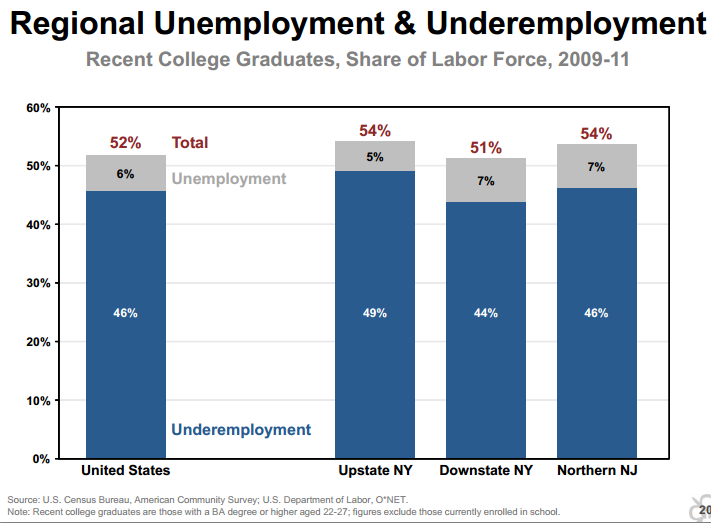
Part of the problem is the voting power (or lack of it) from younger Americans.  Many simply do not vote.  And the baby boomer cohort is guiding many policies through elected officials although they only serve a tiny pizza slice of the baby boomers at that.  So with that said, the voice of the young is largely drowned out by big business and higher education has turned into a very lucrative private-public venture.  With that as our backdrop, half of college graduates are not utilizing their increasingly more expensive degrees:

college graduates underemployed

Half of recent college graduates are either unemployed or underemployed.  And recently many have given up on pursuing careers where their degrees would be utilized and have taken up other jobs.  Other jobs that would have gone to lower skilled workers.  And of course, these workers get pushed down into a lower level of the economic ladder.  And what a shocker that as we go into the various levels of Dante’s Economic Inferno we find that 47.7 million Americans are on food stamps.

The above chart is rather sobering because many recent graduates are leaving school with high levels of debt.  Incomes for many of these graduates are not justifying the sky high rates of tuition at many schools.  Education is still a worthy venture and that is why people continue to go into high levels of debt for this.  Yet our banking system has been rather obsessed with one sector of our economy since the tech bubble burst in the early 2000s.  Real estate has seemed to dominate every big decision in the last decade to the detriment of creating an economy where millions of jobs are added to meet this more educated workforce.  That has clearly not happened.  Colleges are not going to turn their back on willing students with fresh loans in hand.  And I suppose that is the point.  Easy access to debt is like an aphrodisiac for the industry.  Go to any college campus and you will see palatial stadiums and massive buildings.  Do Olympic sized pools make people discover cures for modern diseases quicker?

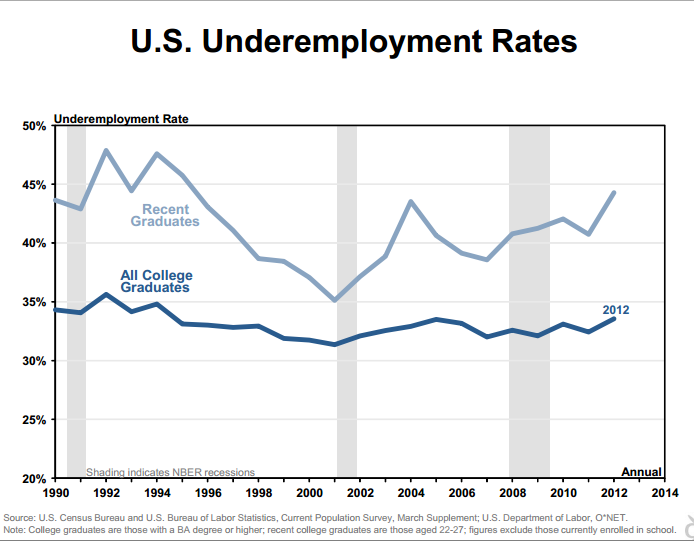
What is even more troubling is that the underemployment rate for recent college graduates has trended up in the last few years while the overall unemployment rate has fallen:

recent college grad data

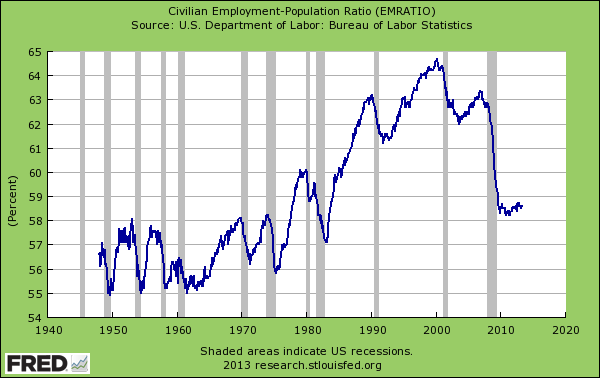
No, we are not looking at a chart of Spain or Greece but a chart of US recent graduates.  A large part of the decline in the unemployment rate has come because the civilian employment population ratio continues to lower:

civilian pop ratio

While many older Americans have dropped off the radar, many recent graduates simply do not have this option.  Many over the last few years have clearly opted to take on jobs that are underutilizing their degrees.  Does that mean they overpaid for their education?  $1 trillion in student debt seems to give us an answer that not only did many overpay, they didn’t even have the funds to afford it in the first place.  Higher tuition would make more sense if wages were also rising but that doesn’t seem to be the case with the new batch of graduates.  And many are falling into student debt quicksand and are unable to pay the loans they now have.

The most delinquent of them all

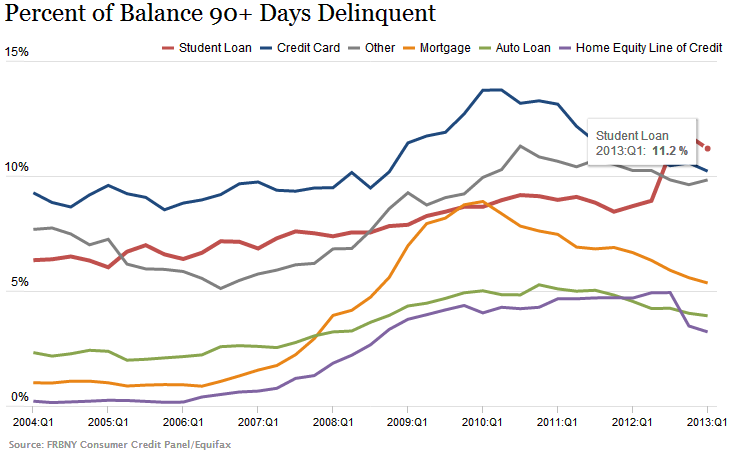
Student debt before the 2000s hit was typically a safe financial bet.  Delinquencies on student debt reflected this.  Today, we now find ourselves at the precipice of another bubble with student debt having the highest delinquency of any form of household debt:

student loan bad debt

You can see this rate doubling only in the last few years.  Keep in mind this is occurring without the potential doubling of student loan interest rates.  Rates are set to go from 3.4 percent to 6.8 percent if Congress does not act.  Amazingly, they are able to act quickly when it comes to the interest of large banking but to help the young in our nation?  No, let us go on holiday break and see what happens.

The rising delinquency rates are simply the last straw in the student debt bubble.  This is a bubble.  When you have prices soaring without any underlying economic change, you have a big problem on hand.  Keep in mind that what you can afford and the price of something are fully disengaged since the government will lend pretty much whatever is necessary to go to school.  If the cap was $100,000 a year, you can rest assured you will have some for-profits cropping up with $100,000 a year degrees.  Record delinquencies and half of recent graduates working in jobs where a massively expensive degree is not being used does not bode well for higher ed at the moment.  No one has a crystal ball on how this will play out but you can rest assured that something is going to give.  You don’t need a college degree to figure that one out.

Saturday, May 18, 2013

MB360: US student debt grew 284% from 2004-13

The facts behind the mountain of student debt: 13 percent of students owe more than $50,000 and nearly 4 percent owe more than $100,000. Student debt grew by 284 percent from 2004 to 2013.
Posted by mybudget360 
May 18, 2013

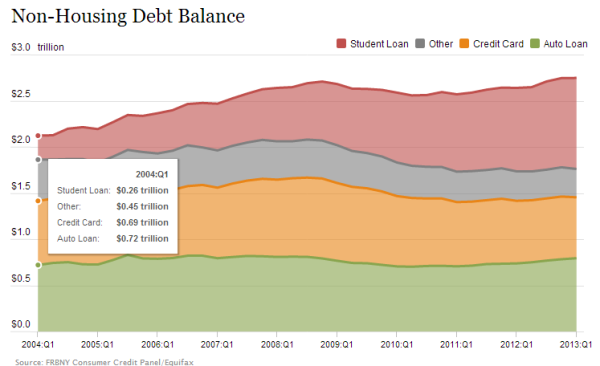
Many Americans view a college education as a way to build a better life.  College is seen as an avenue for better prosperity and the ability to pull yourself up beyond your current circumstances.  In fact, after World War II programs like the G.I. Bill allowed many Americans the opportunity to pursue a college degree.  In many cases, the United States at this time developed the largest middle class the world had come to know.  This is still the case today but the economic trends show a shrinking middle class that is largely having a tough time competing in this quickly globalizing economy.  One fact that stands out is that back in 2004, student debt was the smallest portion of all non-housing related debt in the US.  Only a short nine years later, student debt is the largest portion of debt in non-housing related debt.  What happened in this short period of time and what information can we pull from the mountains of student debt information?

Student debt and the decade of massive growth

One could argue that every segment of the economy experienced a growth in debt over the last decade.  That is not true.  Let us examine non-housing related debt carefully:

non-housing debt and student debt

Source:  Federal Reserve, Equifax

This is an interesting chart.  What we find is that Auto debt was the largest debt segment in 2004.  This was followed up by credit card debt and then other debt.  Student loan debt at this time was $260 billion.  In total, student debt made up 12 percent of all non-housing related debt back in 2004.

Fast forward to where we stand today:

non-housing debt and student debt 2

Source:  Federal Reserve, Equifax

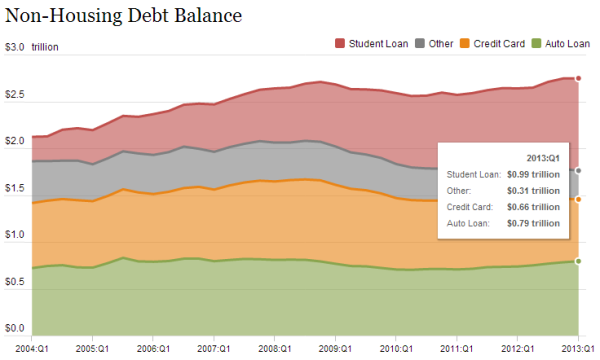
Student debt is now by far the largest portion of non-housing related debt in our economy.  Student debt is now well above $1 trillion.  The growth of student debt in this short window was 284 percent.  Student debt now makes up a stunning 36 percent of all non-housing related debt.  What is interesting then is when we compare this to the growth of the other segments of non-housing related debt:

Growth between 2004 and 2013
Non-housing related debt
Auto loans:       9%
Other:              -31%
Credit Card:     4.5%
Student Debt:  284%

In essence, nearly all the growth in non-housing related debt over this time has come from student debt growth.  This makes the following data more troubling regarding the amounts of student debt by tiers but also the rising number of delinquencies:

“(NY Times)  According to the Federal Reserve Bank of New York, almost 13 percent of student-loan borrowers of all ages owe more than $50,000, and nearly 4 percent owe more than $100,000. These debts are beyond students’ ability to repay, (especially in our nearly jobless recovery); this is demonstrated by the fact that delinquency and default rates are soaring. Some 17 percent of student-loan borrowers were 90 days or more behind in payments at the end of 2012. When only those in repayment were counted — in other words, not including borrowers who were in loan deferment or forbearance — more than 30 percent were 90 days or more behind. For federal loans taken out in the 2009 fiscal year, three-year default rates exceeded 13 percent.

America is distinctive among advanced industrialized countries in the burden it places on students and their parents for financing higher education. America is also exceptional among comparable countries for the high cost of a college degree, including at public universities. Average tuition, and room and board, at four-year colleges is just short of $22,000 a year, up from under $9,000 (adjusted for inflation) in 1980-81.”

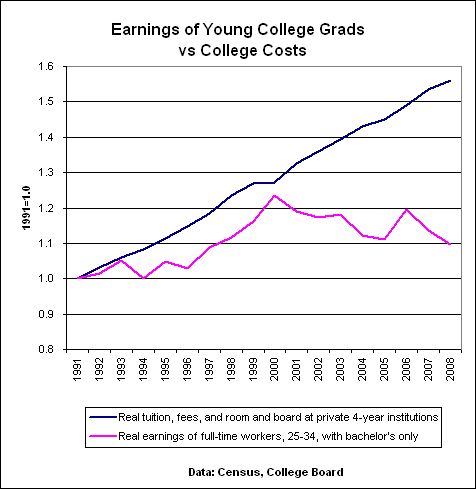
Averages do hide a lot of the facts but what we can deduct is that the 13 percent that owe more than $50,000 and the 4 percent that owe more than $100,000 have largely come in the recent decade.  While the cost of tuition has soared in this short period of time a large part of it has not corresponded to actual earnings:

college grads and earnings

What is interesting about the above chart is that real tuition is up (with new data) by close to 70 percent while real earnings are roughly the same as they were back in 1991.  So over a 20 year period college costs have soared but the return doesn’t seem to justify the rise.  We also have the proliferation of non-profit schools that target lower income Americans and provide them a questionable level of education.  Yet this is only one small part of the larger issue.  The addiction to debt.  We have discussed how this recession has hit young Americans incredibly hard.  In the current marketplace it has become hyper-competitive and expensive while starting salaries have fallen behind when it comes to inflation.  The rising number of delinquencies also shows that many students are simply unable to pay their debts.

If student debt were to grow at the current rate, we would be at $3.84 trillion in student by 2023.  Do you think that is sustainable?  If not, something has to give.

Saturday, April 20, 2013

Have historians been unfair to Dubya?

Prof. Stephen Knott argues that Dubya has been treated unfairly by historians making their Best & Worst Presidents lists.  (As if their lists matter to anybody, but let's forget that for now....)

There are two ways to evaluate the success of a U.S. president: by what the evaluator thinks a president did right or wrong; or by how effectively a president got what he wanted; furthermore, one could evaluate how enduring were the gains a president won.

By the first measure, many people, including many Republicans, think Bush was a failure. But partisanship, ideology and ego affect our judgment, so it's one of those things best left to argue over beers. By the second measure, however, I'd argue that Bush was pretty darn successful, unfortunately. And his "achievements" endure.

Why do I say "unfortunately"? We had a recent example. Last night, when noting the nation's reaction to the apprehension of the Boston bombers and their alleged Islamist beliefs, I posted"It's still Dubya's America and we're just living in it... including President Obama."

That is, I meant that Dubya and his team (including his team at FOX News and Clear Channel) have been extremely successful in framing our view of Muslims, so successful that even President Obama seems prisoner to our prejudices.  The Left is silent while Obama is under constant pressure by the Right to link the entire religion of Islam to terrorism.

Here's the latest bulletin from the conservative GWOT Language Police: "The language of terror," by Charles Krauthammer.  You have to read through a lot of nothing to get to Krauthammer's point at the very end:

Obama has performed admirably during the Boston crisis, speaking both reassuringly and with determination. But he continues to be linguistically uneasy. His wavering over the word terrorism is telling, though in this case unimportant. The real test will come when we learn the motive for the attack.

As of this writing, we don’t know. It could be Islamist, white supremacist, anarchist, anything. What words will Obama use? It is a measure of the emptiness of Obama’s preferred description — “violent extremists” — that, even as we know nothing, it can already be applied to the Boston bomber(s). Which means, the designation is meaningless.

You see, it makes all the difference in the world that the Boston bombers' alleged motivation was Islamist beliefs, and that our President says so. Why? Well, it's obvious, isn't it? Because it's ammunition for those who want to categorize all Muslims, including legal U.S. residents and citizens, as suspected terrorists. There's no other reason for the Right to police this language issue so severely. 

And as George Orwell warned us, language controls our thoughts. Control our language, control our thoughts. That is just one "achievement" of the successful George W. Bush "imperial" presidency, but it's a mighty one.

How about some more?  Bush's Great War on Terra (GWOT) continues and even escalates: with drone attacks, G'itmo, sanctioned rendition and torture, domestic spying and Internet surveillance, prosecuting government whistle blowers, and assassinating U.S. citizens when they are overseas. Obama continues Bush's extra-constitutional practice of presidential signing statements. Bush's occupations of choice in Afghanistan and Iraq are inexorable; Obama cannot or will not get out of them. Deregulated Wall Street banks may still gamble, legally, with depositors' and taxpayers' free money and are now Too Bigger To Fail. Deregulated for-profit colleges that live on government-backed student loans still hold the majority of student debt, now at $1 trillion. The budget of Bush's Department of Homeland Security now rivals the Pentagon's. Bush's unfunded Medicare Advantage entitlement is still wildly popular even among seniors in the Tea Parties... yet to put Medicare's finances back in order requires cutting or reforming Medicare Advantage, giving Republicans the opportunity to accuse Democrats of "cutting Medicare." Clinton's federal assault-weapons ban was allowed to expire in 2004; meanwhile right-to-carry and concealed-carry laws were passed in most states with Bush's encouragement, even as mass shootings increased.  And speaking of guns, Obama ironically got blamed for Bush's "Fast and Furious" "gunwalking"/drug-interdiction program by the ATF. And finally, Bush's unaffordable tax cuts on the very wealthy are now sacrosanct even among Democrats who once fought them, even in the worst economic climate since the Great Depression, with the two aforementioned wars still on the nation's credit card, unpaid for.  

As a result of all this and more, Bush increased our national debt 91 percent ($5.9 trillion), and yet somehow escapes blame for it; meanwhile spineless Democrats are ready to apologize for Obama's deficits (totaling $4.9 trillion or a 41 percent increase over FY 2009) caused by Bush's Great Recession and two unfinished wars. For that political magic act, we are compelled to acknowledge that Dubya was a brilliant politician. Obama is a dunderhead by comparison.

I haven't read Knott's book, but based on its title, Rush to Judgment: George W. Bush, the War on Terror, and His Critics, it probably highlights Bush's achievements in fighting terrorism.  If that's so, then Knott has an excellent case to make that Bush got everything he wanted and more, i.e. he was pretty darn successful. Too bad for us. 

UPDATE (04.24.2013): Ralph Nader repeats a lot of what I've said in his op-ed: "Obama Is Comfortable With Bush's Inferno." 

UPDATE (04.26.2013):  Here's an acerbic take on Dubya's strategy of "Keep Quiet and Hope They Forget" by Alexandra Petri: "George W. Bush was the greatest president of all time, ever."  It's working.  Dumbo has outsmarted us again.  [Facepalm.]


By Stephen F. Knott
April 20, 2013 | Washington Post

Wednesday, February 20, 2013

Stiglitz: American Dream is statistically a myth


Equal Opportunity, Our National Myth
By Joseph E. Stiglitz
February 16, 2013 | New York Times

President Obama’s second Inaugural Address used soaring language to reaffirm America’s commitment to the dream of equality of opportunity: “We are true to our creed when a little girl born into the bleakest poverty knows that she has the same chance to succeed as anybody else, because she is an American; she is free, and she is equal, not just in the eyes of God but also in our own.”

The gap between aspiration and reality could hardly be wider. Today, the United States has less equality of opportunity than almost any other advanced industrial country. Study after study has exposed the myth that America is a land of opportunity. This is especially tragic: While Americans may differ on the desirability of equality of outcomes, there is near-universal consensus that inequality of opportunity is indefensible. The Pew Research Center has found that some 90 percent of Americans believe that the government should do everything it can to ensure equality of opportunity.

Perhaps a hundred years ago, America might have rightly claimed to have been the land of opportunity, or at least a land where there was more opportunity than elsewhere. But not for at least a quarter of a century. Horatio Alger-style rags-to-riches stories were not a deliberate hoax, but given how they’ve lulled us into a sense of complacency, they might as well have been.

It’s not that social mobility is impossible, but that the upwardly mobile American is becoming a statistical oddity. According to research from the Brookings Institution, only 58 percent of Americans born into the bottom fifth of income earners move out of that category, and just 6 percent born into the bottom fifth move into the top. Economic mobility in the United States is lower than in most of Europe and lower than in all of Scandinavia. [...]

Monday, April 9, 2012

Report: Real causes of U.S. college tuition hikes

For all those who believe that an abundance of overpaid, tenured professors is to blame for skyrocketing U.S. college tuition costs, check it out:

In the past decade at public two-year colleges ... published tuition and fees, excluding scholarship aid and adjusted for inflation, have increased by 44.8 percent.  Faculty salaries, meanwhile, have decreased by 2.5 percent, according to the [American Association of University Professors] report.
Over the past decade at public four-year colleges and universities, tuition and fees have increased by 72 percent, the association said.

The cost of higher education continues to soar, rising 8.3 percent at four-year public colleges in the fall, the College Board reported.

So what is the real cause of college tuition hikes?

Tuition prices have been rising, in part, because state funding is providing a smaller proportion of revenues, and institutions have shifted more of the burden to students and their families, Curtis said.  At the same time, financial aid awards have not kept pace, and have been converted primarily into loans rather than grants, thereby increasing the student debt burden.


By Susanna Kim
April 9, 2012 | ABC News

Friday, February 3, 2012

MB360: Boomers have no savings, live on SS


We shouldn't let grumpy old Boomers, who are over-represented in the Tea Parties, lecture younger generations about responsibility, work and savings, because they have no savings and rely on Social Security for almost all their income.

We'll still take care of you old timers, because we're well-raised and we're all in this together, but please: no more sanctimonious lectures.


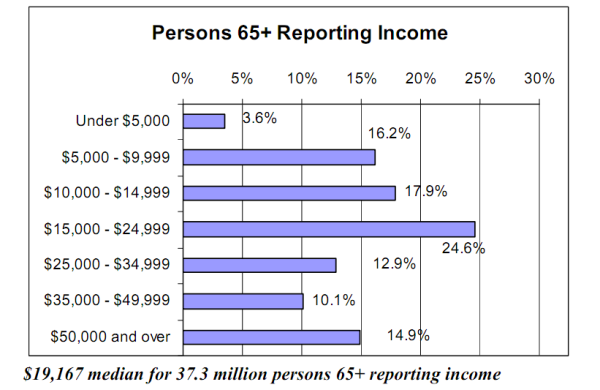
What happens when a society that prides itself on a middle class and self-sufficiency suddenly starts losing both? For over a decade the middle class in the US has been shrinking. This isn't some speculation but is reflected in the stagnant household income data. You also have a giant demographic train in that many baby boomers are now retiring in mass. Over 10,000 baby boomers enter into retirement each day and many have an inadequate amount of savings (if any) to get them through the leaner years. Couple this with a less affluent younger generation and you have a recipe for financial and social turmoil. Many of these younger Americans, many saddled with large student debt, are moving back home with parents that have seen their entire home equity evaporate. Do you think these are happy households especially when the median income of those 65+ is $19,167?

Median income of the old

There seems to be this misconception that older Americans are simply well off. The data shows us otherwise:

median income persons 65 and older

Source: US Dept. of Health

What is troubling about the above data is that during some of the most affluent decades in US history, most Americans have very little income in older age. In fact, most rely on Social Security as their primary source of income:

"Social Security constituted 90% or more of the income received by 34% of beneficiaries (21% of married couples and 43% of non-married beneficiaries)."

How is this even possible? Keep in mind the average Social Security payout is roughly $1,000 per month and this is fixed. Since the government has juiced the CPI data most of these fixed income Americans are seeing their energy and healthcare costs soar all the while they are told inflation is virtually non-existent. Try arguing that after going to the grocery store.

There is also this sense that since many older Americans own their home, they are somehow immune to the housing bubble. That is not true:

"In 2009, 48% of older householders spent more than one-fourth of their income on housing costs – 42% for owners"

Many older Americans still spend a lot of money on housing even if they are owners. Much of this comes from property taxes and costs associated with owning a home. Since many older Americans do own their home this housing bubble crash has harmed their largest asset.

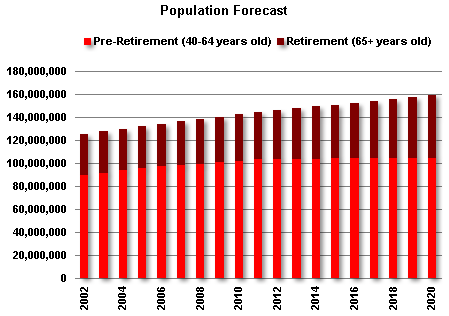
As time presses on more and more of our population is going into retirement. Lower birth rates and more Americans making it into older age conjure up memories of Japan:

baby-boomer-statistics
Source: Baby boomer stats

-There are approximately 77.6 million baby boomers in the U.S.

-The baby boom phenomenon is responsible for over half of all consumer spending in the United States

-80% of all leisure travel is taken by boomers.

-Every 8.5 seconds a baby boomer in the U.S. turns 50 years old.

-The baby boom generation is the largest generation in American history.

-On January 1st, 2011 the very first Baby Boomers turned 65

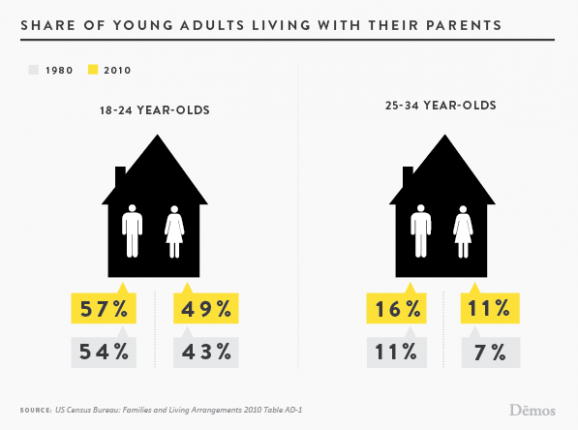
Baby boomers tended to also be big spenders (at least they were during the debt bubbles). But what now? The strongest spending group is losing a large part of their wealth with the housing crash and many are exiting their peak earning stages. From the Social Security data, we realize many did not save in what was likely the most affluent times for America. With many younger Americans carrying major debt loads and finding items like pensions disappearing, how will they prepare for retirement? What access to savings do they have? Homes are still expensive for many younger Americans and that is why millions have moved back home:

living-at-home

A society that has preaches independence and pushes out young at 18 will have a hard time dealing with boomerang kids coming back home. Many younger Americans will feel the strain as well especially if they "did the right thing" and went to college but now find a tough employment market and being back home. This demographic train has left the station and nothing will slow it down.

Sunday, October 23, 2011

Fed's zero-interest policy has consequences

The Fed thinks it's wonderful American households are de-leveraging. With their zero interest-rate policy the Fed is clearly trying to induce Americans to pay down debt and/or spend, since ordinary savings earn no return.

However the Fed's Duke neglected to mention that U.S. student loan debt has reached nearly $1 trillion, with default rates at for-profit colleges rivaling sub-prime loans. All those poor students -- many of them U.S. troops -- believed the hype that "education is the key" to employment, and now they're in high water.


By Sarah Hutchins
October 22, 2011 | Reuters

Households' caution about taking on debt and spending will stand them in good stead when the economic recovery becomes more robust, a top Federal Reserve official said on Saturday.

Fed Governor Elizabeth Duke did not comment on the outlook for the economy or the monetary policy in a speech about financial planning.

Household debt-to-income ratios skyrocketed during 2001-2007, but households cut debt and spending significantly during the financial crisis that began in 2007, Duke said.

The declines in spending and borrowing reflect the weak economy, but also a greater aversion to debt and a desire to hold down debt levels.

"Going forward, as income and asset values recover, these improvements in the aggregate household position should be felt by more and more U.S. households.," she said.

The Fed cut benchmark interest rates to near zero almost three years ago and has bought $2.3 trillion in bonds to boost economic growth.

Recent data suggest the economy may have escaped slipping back into recession over the summer, but Fed officials will debate further steps to lower a high unemployment rate at their next meeting November 1-2.

Tuesday, June 7, 2011

MB360: Student loans the next big bubble

U.S. student loan debt has increased from about $200 billion in 2000 to nearly $1 trillion in 2011. It is the next big bubble, sold cynically by Wall Street and guaranteed by the U.S. Government -- the same corporate socialism in the name of "helping" consumers that blew up the housing bubble.

MB360 believes student debt has all the ingredients of the next economic bubble:

"The cost of going to college has outpaced every category of living by a very wide margin. It is hard to believe but the cost of college has even surpassed the now historic housing bubble. How can this be? You have a perfect combination of:

- Un-regulated casino like financial sector
- Government bought out by financial sector and used as a dumping ground
- A myth that any college is a good college
- A marketing and propaganda machine that is actively destroying the middle class"

As MB360 notes, "We are seeing now an army of unemployed college graduates" who are laden with an "albatross" of onerous student loans. Indeed, since the 2008 recession, "every other item of consumer debt has contracted strongly except that of student loans." Partly this is because you can't write off student loans when declaring personal bankruptcy, unlike with mortgage or credit card debts; and the late-payment fees just keep piling up.

For-profit colleges are diploma factories substituting credentials for real knowledge, but employers aren't fooled. They aren't hiring. It's a shame that so many enrollees in these colleges are from our Armed Services, and financed by the US Government! Obama is trying to regulate for-profit colleges but not aggressively enough.


Posted by mybudget360
June 6, 2011