Showing posts with label austerity. Show all posts

Monday, November 3, 2014

Roubini: Global economy running on one engine

More bad news from "Dr. Doom."  Doesn't Roubini know that a Republican Congress will solve everything, and that despite its higher growth rate, the U.S. is still inferior to austerity-loving Europe?

Roubini's analysis is going to be so far over the heads of my Tea Party friends who think belt-tightening by the public sector is the answer to everything, the European example be damned. 

Bottom line: Team Keynes was right. Either you're a Keynesian cheerleader and get to sip his milkshake at the victory party, or you're with the losing team sent home to your trailer community in mirthless shame on a quiet bus.


By Nouriel Roubini
October 31, 2014 | Project Syndicate

The global economy is like a jetliner that needs all of its engines operational to take off and steer clear of clouds and storms. Unfortunately, only one of its four engines is functioning properly: the Anglosphere (the United States and its close cousin, the United Kingdom).

The second engine – the eurozone – has now stalled after an anemic post-2008 restart. Indeed, Europe is one shock away from outright deflation and another bout of recession. Likewise, the third engine, Japan, is running out of fuel after a year of fiscal and monetary stimulus. And emerging markets (the fourth engine) are slowing sharply as decade-long global tailwinds – rapid Chinese growth, zero policy rates and quantitative easing by the US Federal Reserve, and a commodity super-cycle – become headwinds.

So the question is whether and for how long the global economy can remain aloft on a single engine. Weakness in the rest of the world implies a stronger dollar, which will invariably weaken US growth. The deeper the slowdown in other countries and the higher the dollar rises, the less the US will be able to decouple from the funk everywhere else, even if domestic demand seems robust.

Falling oil prices may provide cheaper energy for manufacturers and households, but they hurt energy exporters and their spending. And, while increased supply – particularly from North American shale resources – has put downward pressure on prices, so has weaker demand in the eurozone, Japan, China, and many emerging markets. Moreover, persistently low oil prices induce a fall in investment in new capacity, further undermining global demand.

Meanwhile, market volatility has grown, and a correction is still underway. Bad macro news can be good for markets, because a prompt policy response alone can boost asset prices. But recent bad macro news has been bad for markets, owing to the perception of policy inertia. Indeed, the European Central Bank is dithering about how much to expand its balance sheet with purchases of sovereign bonds, while the Bank of Japan only now decided to increase its rate of quantitative easing, given evidence that this year’s consumption-tax increase is impeding growth and that next year’s planned tax increase will weaken it further.

As for fiscal policy, Germany continues to resist a much-needed stimulus to boost eurozone demand. And Japan seems to be intent on inflicting on itself a second, growth-retarding consumption-tax increase.

Furthermore, the Fed has now exited quantitative easing and is showing a willingness to start raising policy rates sooner than markets expected. If the Fed does not postpone rate increases until the global economic weather clears, it risks an aborted takeoff – the fate of many economies in the last few years.

If the Republican Party takes full control of the US Congress in November’s mid-term election, policy gridlock is likely to worsen, risking a re-run of the damaging fiscal battles that led last year to a government shutdown and almost to a technical debt default. More broadly, the gridlock will prevent the passage of important structural reforms that the US needs to boost growth.

Major emerging countries are also in trouble. Of the five BRICS economies (Brazil, Russia, India, China, and South Africa), three (Brazil, Russia, and South Africa) are close to recession. The biggest, China, is in the midst of a structural slowdown that will push its growth rate closer to 5% in the next two years, from above 7% now. At the same time, much-touted reforms to rebalance growth from fixed investment to consumption are being postponed until President Xi Jinping consolidates his power. China may avoid a hard landing, but a bumpy and rough one appears likely.

The risk of a global crash has been low, because deleveraging has proceeded apace in most advanced economies; the effects of fiscal drag are smaller; monetary policies remain accommodative; and asset reflation has had positive wealth effects. Moreover, many emerging-market countries are still growing robustly, maintain sound macroeconomic policies, and are starting to implement growth-enhancing structural reforms. And US growth, currently exceeding potential output, can provide sufficient global lift – at least for now.

But serious challenges lie ahead. Private and public debts in advanced economies are still high and rising – and are potentially unsustainable, especially in the eurozone and Japan. Rising inequality is redistributing income to those with a high propensity to save (the rich and corporations), and is exacerbated by capital-intensive, labor-saving technological innovation.

This combination of high debt and rising inequality may be the source of the secular stagnation that is making structural reforms more politically difficult to implement. If anything, the rise of nationalistic, populist, and nativist parties in Europe, North America, and Asia is leading to a backlash against free trade and labor migration, which could further weaken global growth.

Rather than boosting credit to the real economy, unconventional monetary policies have mostly lifted the wealth of the very rich – the main beneficiaries of asset reflation. But now reflation may be creating asset-price bubbles, and the hope that macro-prudential policies will prevent them from bursting is so far just that – a leap of faith.

Fortunately, rising geopolitical risks – a Middle East on fire, the Russia-Ukraine conflict, Hong Kong’s turmoil, and China’s territorial disputes with its neighbors – together with geo-economic threats from, say, Ebola and global climate change, have not yet led to financial contagion. Nonetheless, they are slowing down capital spending and consumption, given the option value of waiting during uncertain times.

So the global economy is flying on a single engine, the pilots must navigate menacing storm clouds, and fights are breaking out among the passengers. If only there were emergency crews on the ground.

Monday, October 27, 2014

Soros: EU, US must aid the 'new Ukraine' against Russia

I have not much to add to this op-ed by the alleged "evil" billionaire and "Colored Revolution"-maker George Soros, so I'm re-posting it in full, except to say: If there is some dumbbell in the Obama Admin. who is still not sure what to do about Ukraine, this is a good place to start.

The rest of my thoughts are highlighted below.

I will add this though: Americans who want a "strong" U.S. foreign policy had better realize that that requires more than tough words and finger-wagging by our government. In the case of Ukraine, it requires money -- billions, in fact, to lend to Ukraine's government as it tries to rebuild its army and simultaneously deal with economic recession and Russian economic-war tactics via trade sanctions and natural gas prices, not to mention economically crippling eastern Ukraine.

Anybody who says Obama isn't "tough enough" against Russia had better advocate billions of dollars in loan guarantees and aid for Ukraine -- a modern-day Marshall Plan -- or else they are political hacks who might as well be on the same side as Putin.  


By George Soros
October 23, 2014 | The New York Review of Books

Europe is facing a challenge from Russia to its very existence. Neither the European leaders nor their citizens are fully aware of this challenge or know how best to deal with it. I attribute this mainly to the fact that the European Union in general and the eurozone in particular lost their way after the financial crisis of 2008.

The fiscal rules that currently prevail in Europe have aroused a lot of popular resentment. Anti-Europe parties captured nearly 30 percent of the seats in the latest elections for the European Parliament but they had no realistic alternative to the EU to point to until recently. Now Russia is presenting an alternative that poses a fundamental challenge to the values and principles on which the European Union was originally founded. It is based on the use of force that manifests itself in repression at home and aggression abroad, as opposed to the rule of law. What is shocking is that Vladimir Putin’s Russia has proved to be in some ways superior to the European Union—more flexible and constantly springing surprises. That has given it a tactical advantage, at least in the near term.

Europe and the United States—each for its own reasons—are determined to avoid any direct military confrontation with Russia. Russia is taking advantage of their reluctance. Violating its treaty obligations, Russia has annexed Crimea and established separatist enclaves in eastern Ukraine. In August, when the recently installed government in Kiev threatened to win the low-level war in eastern Ukraine against separatist forces backed by Russia,President Putin invaded Ukraine with regular armed forces in violation of the Russian law that exempts conscripts from foreign service without their consent.

In seventy-two hours these forces destroyed several hundred of Ukraine’s armored vehicles, a substantial portion of its fighting force. According to General Wesley Clark, former NATO Supreme Allied Commander for Europe, the Russians used multiple launch rocket systems armed with cluster munitions and thermobaric warheads (an even more inhumane weapon that ought to be outlawed) with devastating effect.* The local militia from the Ukrainian city of Dnepropetrovsk suffered the brunt of the losses because they were communicating by cell phones and could thus easily be located and targeted by the Russians. President Putin has, so far, abided by a cease-fire agreement he concluded with Ukrainian President Petro Poroshenko on September 5, but Putin retains the choice to continue the cease-fire as long as he finds it advantageous or to resume a full-scale assault.

In September, President Poroshenko visited Washington where he received an enthusiastic welcome from a joint session of Congress. He asked for “both lethal and nonlethal” defensive weapons in his speech. However, President Obama refused his request for Javelin hand-held missiles that could be used against advancing tanks. Poroshenko was given radar, but what use is it without missiles? European countries are equally reluctant to provide military assistance to Ukraine, fearing Russian retaliation. The Washington visit gave President Poroshenko a façade of support with little substance behind it.

Equally disturbing has been the determination of official international leaders to withhold new financial commitments to Ukraine until after the October 26 election there (which will take place just after this issue goes to press). This has led to an avoidable pressure on Ukrainian currency reserves and raised the specter of a full-blown financial crisis in the country.

There is now pressure from donors, whether in Europe or the US, to “bail in” the bondholders of Ukrainian sovereign debt, i.e., for bondholders to take losses on their investments as a precondition for further official assistance to Ukraine that would put more taxpayers’ money at risk. That would be an egregious error. The Ukrainian government strenuously opposes the proposal because it would put Ukraine into a technical default that would make it practically impossible for the private sector to refinance its debt. Bailing in private creditors would save very little money and it would make Ukraine entirely dependent on the official donors.

To complicate matters, Russia is simultaneously dangling carrots and wielding sticks. It is offering—but failing to sign—a deal for gas supplies that would take care of Ukraine’s needs for the winter. At the same time Russia is trying to prevent the delivery of gas that Ukraine secured from the European market through Slovakia. Similarly, Russia is negotiating for the Organization for Security and Cooperation in Europe to monitor the borders while continuing to attack the Donetsk airport and the port city of Mariupol.

It is easy to foresee what lies ahead. Putin will await the results of the elections on October 26 and then offer Poroshenko the gas and other benefits he has been dangling on condition that he appoint a prime minister acceptable to Putin. That would exclude anybody associated with the victory of the forces that brought down the Viktor Yanukovych government by resisting it for months on the Maidan—Independence Square. I consider it highly unlikely that Poroshenko would accept such an offer. If he did, he would be disowned by the defenders of the Maidan; the resistance forces would then be revived.

Putin may then revert to the smaller victory that would still be within his reach: he could open by force a land route from Russia to Crimea and Transnistria before winter. Alternatively, he could simply sit back and await the economic and financial collapse of Ukraine. I suspect that he may be holding out the prospect of a grand bargain in which Russia would help the United States against ISIS—for instance by not supplying to Syria the S300 missiles it has promised, thus in effect preserving US air domination—and Russia would be allowed to have its way in the “near abroad,” as many of the nations adjoining Russia are called. What is worse, President Obama may accept such a deal.

That would be a tragic mistake, with far-reaching geopolitical consequences. Without underestimating the threat from ISIS, I would argue that preserving the independence of Ukraine should take precedence; without it, even the alliance against ISIS would fall apart. The collapse of Ukraine would be a tremendous loss for NATO, the European Union, and the United States. A victorious Russia would become much more influential within the EU and pose a potent threat to the Baltic states with their large ethnic Russian populations. Instead of supporting Ukraine, NATO would have to defend itself on its own soil. This would expose both the EU and the US to the danger they have been so eager to avoid: a direct military confrontation with Russia. The European Union would become even more divided and ungovernable. Why should the US and other NATO nations allow this to happen?

The argument that has prevailed in both Europe and the United States is that Putin is no Hitler; by giving him everything he can reasonably ask for, he can be prevented from resorting to further use of force. In the meantime, the sanctions against Russia—which include, for example, restrictions on business transactions, finance, and trade—will have their effect and in the long run Russia will have to retreat in order to earn some relief from them.

These are false hopes derived from a false argument with no factual evidence to support it. Putin has repeatedly resorted to force and he is liable to do so again unless he faces strong resistance. Even if it is possible that the hypothesis could turn out to be valid, it is extremely irresponsible not to prepare a Plan B.

There are two counterarguments that are less obvious but even more important. First, Western authorities have ignored the importance of what I call the “new Ukraine” that was born in the successful resistance on the Maidan. Many officials with a history of dealing with Ukraine have difficulty adjusting to the revolutionary change that has taken place there. The recently signed Association Agreement between the EU and Ukraine was originally negotiated with the Yanukovych government. This detailed road map now needs adjustment to a totally different situation. For instance, the road map calls for the gradual replacement and retraining of the judiciary over five years whereas the public is clamoring for immediate and radical renewal. As the new mayor of Kiev, Vitali Klitschko, put it, “If you put fresh cucumbers into a barrel of pickles, they will soon turn into pickles.”

Contrary to some widely circulated accounts, the resistance on the Maidan was led by the cream of civil society: young people, many of whom had studied abroad and refused to join either government or business on their return because they found both of them repugnant. (Nationalists and anti-Semitic extremists made up only a minority of the anti-Yanukovych protesters.) They are the leaders of the new Ukraine and they are adamantly opposed to a return of the “old Ukraine,” with its endemic corruption and ineffective government.

The new Ukraine has to contend with Russian aggression, bureaucratic resistance both at home and abroad, and confusion in the general population. Surprisingly, it has the support of many oligarchs, President Poroshenko foremost among them, and the population at large. There are of course profound differences in history, language, and outlook between the eastern and western parts of the country, but Ukraine is more united and more European-minded than ever before. That unity, however, is extremely fragile.

The new Ukraine has remained largely unrecognized because it took time before it could make its influence felt. It had practically no security forces at its disposal when it was born. The security forces of the old Ukraine were actively engaged in suppressing the Maidan rebellion and they were disoriented this summer when they had to take orders from a government formed by the supporters of the rebellion. No wonder that the new government was at first unable to put up an effective resistance to the establishment of the separatist enclaves in eastern Ukraine. It is all the more remarkable that President Poroshenko was able, within a few months of his election, to mount an attack that threatened to reclaim those enclaves.

To appreciate the merits of the new Ukraine you need to have had some personal experience with it. I can speak from personal experience although I must also confess to a bias in its favor. I established a foundation in Ukraine in 1990 even before the country became independent. Its board and staff are composed entirely of Ukrainians and it has deep roots in civil society. I visited the country often, especially in the early years, but not between 2004 and early 2014, when I returned to witness the birth of the new Ukraine.

I was immediately impressed by the tremendous improvement in maturity and expertise during that time both in my foundation and in civil society at large.Currently, civic and political engagement is probably higher than anywhere else in Europe. People have proven their willingness to sacrifice their lives for their country. These are the hidden strengths of the new Ukraine that have been overlooked by the West.

The other deficiency of the current European attitude toward Ukraine is that it fails to recognize that the Russian attack on Ukraine is indirectly an attack on the European Union and its principles of governance. It ought to be evident that it is inappropriate for a country, or association of countries, at war to pursue a policy of fiscal austerity as the European Union continues to do. All available resources ought to be put to work in the war effort even if that involves running up budget deficits. The fragility of the new Ukraine makes the ambivalence of the West all the more perilous. Not only the survival of the new Ukraine but the future of NATO and the European Union itself is at risk. In the absence of unified resistance it is unrealistic to expect that Putin will stop pushing beyond Ukraine when the division of Europe and its domination by Russia is in sight.

Having identified some of the shortcomings of the current approach, I will try to spell out the course that Europe ought to follow. Sanctions against Russia are necessary but they are a necessary evil. They have a depressive effect not only on Russia but also on the European economies, including Germany. This aggravates the recessionary and deflationary forces that are already at work. By contrast, assisting Ukraine in defending itself against Russian aggression would have a stimulative effect not only on Ukraine but also on Europe. That is the principle that ought to guide European assistance to Ukraine.

Germany, as the main advocate of fiscal austerity, needs to understand the internal contradiction involved. Chancellor Angela Merkel has behaved as a true European with regard to the threat posed by Russia. She has been the foremost advocate of sanctions on Russia, and she has been more willing to defy German public opinion and business interests on this than on any other issue. Only after the Malaysian civilian airliner was shot down in July did German public opinion catch up with her. Yet on fiscal austerity she has recently reaffirmed her allegiance to the orthodoxy of the Bundesbank—probably in response to the electoral inroads made by the Alternative for Germany, the anti-euro party. She does not seem to realize how inconsistent that is. She ought to be even more committed to helping Ukraine than to imposing sanctions on Russia.

The new Ukraine has the political will both to defend Europe against Russian aggression and to engage in radical structural reforms. To preserve and reinforce that will, Ukraine needs to receive adequate assistance from its supporters. Without it, the results will be disappointing and hope will turn into despair. Disenchantment already started to set in after Ukraine suffered a military defeat and did not receive the weapons it needs to defend itself.

It is high time for the members of the European Union to wake up and behave as countries indirectly at war. They are better off helping Ukraine to defend itself than having to fight for themselves. One way or another, the internal contradiction between being at war and remaining committed to fiscal austerity has to be eliminated. Where there is a will, there is a way.

Let me be specific. In its last progress report, issued in early September, the IMF estimated that in a worst-case scenario Ukraine would need additional support of $19 billion. Conditions have deteriorated further since then. After the Ukrainian elections the IMF will need to reassess its baseline forecast in consultation with the Ukrainian government. It should provide an immediate cash injection of at least $20 billion, with a promise of more when neededUkraine’s partners should provide additional financing conditional on implementation of the IMF-supported program, at their own risk, in line with standard practice.

The spending of borrowed funds is controlled by the agreement between the IMF and the Ukrainian government. Four billion dollars would go to make up the shortfall in Ukrainian payments to date; $2 billion would be assigned to repairing the coal mines in eastern Ukraine that remain under the control of the central government; and $2 billion would be earmarked for the purchase of additional gas for the winter. The rest would replenish the currency reserves of the central bank.

The new assistance package would include a debt exchange that would transform Ukraine’s hard currency Eurobond debt (which totals almost $18 billion) into long-term, less risky bonds. This would lighten Ukraine’s debt burden and bring down its risk premium. By participating in the exchange, bondholders would agree to accept a lower interest rate and wait longer to get their money back. The exchange would be voluntary and market-based so that it could not be mischaracterized as a default. Bondholders would participate willingly because the new long-term bonds would be guaranteed—but only partially—by the US or Europe, much as the US helped Latin America emerge from its debt crisis in the 1980s with so-called Brady bonds (named for US Treasury Secretary Nicholas Brady).

Such an exchange would have a few important benefits. One is that, over the next two or three critical years, the government could use considerably less of its scarce hard currency reserves to pay off bondholders. The money could be used for other urgent needs.

By trimming Ukraine debt payments in the next few years, the exchange would also reduce the chance of a sovereign default, discouraging capital flight and arresting the incipient run on the banks. This would make it easier to persuade owners of Ukraine’s banks (many of them foreign) to inject urgently needed new capital into them. The banks desperately need bigger capital cushions if Ukraine is to avoid a full-blown banking crisis, but shareholders know that a debt crisis could cause a banking crisis that wipes out their equity.

Finally, Ukraine would keep bondholders engaged rather than watch them cash out at 100 cents on the dollar as existing debt comes due in the next few years. This would make it easier for Ukraine to reenter the international bond markets once the crisis has passed. Under the current conditions it would be more practical and cost-efficient for the US and Europe not to use their own credit directly to guarantee part of Ukraine’s debt, but to employ intermediaries such as the European Bank for Reconstruction and Development or the World Bank and its subsidiaries.

The Ukrainian state-owned company Naftogaz is a black hole in the budget and a major source of corruption. Naftogaz currently sells gas to households for $47 per thousand cubic meters (TCM), for which it pays $380 per TCM. At present people cannot control the temperature in their apartments. A radical restructuring of Naftogaz’s entire system could reduce household consumption at least by half and totally eliminate Ukraine’s dependence on Russia for gas. That would involve charging households the market price for gas. The first step would be to install meters in apartments and the second to distribute a cash subsidy to needy households.

The will to make these reforms is strong both in the new management and in the incoming government but the task is extremely complicated (how do you define who is needy?) and the expertise is inadequate. The World Bank and its subsidiaries could sponsor a project development team that would bring together international and domestic experts to convert the existing political will into bankable projects. The initial cost would exceed $10 billion but it could be financed by project bonds issued by the European Investment Bank and it would produce very high returns.

It is also high time for the European Union to take a critical look at itself. There must be something wrong with the EU if Putin’s Russia can be so successful even in the short term. The bureaucracy of the EU no longer has a monopoly of power and it has little to be proud of. It should learn to be more united, flexible, and efficient. And Europeans themselves need to take a close look at the new Ukraine. That could help them recapture the original spirit that led to the creation of the European Union. The European Union would save itself by saving Ukraine.

Saturday, October 11, 2014

News digest / Catching up on news (10.11.2014)

I've been busy lately for personal reasons, but also my laptop was out of commission for a week thanks to my 2-year-old (see photo), so below are some stories that deserved more attention than I was able to give them. If you've read these then you know (some of) what I do. Enjoy!

It took her about 2 minutes to do that. God love her, the little s--t.

"Scott Walker lost his fight for voter ID. He's still everything that's wrong with the GOP," By Arvina Martin, October 10, 2014, Guardian. URL: http://gu.com/p/42a3m  ANOTHER MAD TEA PARTY EXPERIMENT BLOWING UP IN THEIR FACES... CONTAINED AT THE STATE LEVEL, THANKFULLY.


"Bill de Blasio: From Education to Poverty, Leadership by Example," By Richard (RJ) Eskow, October 9, 2014, Huffington Post. URL: http://huff.to/1vR5knB


"Time for a Guaranteed Income?" By Veronique de Rugy, March 2014 issue, Reason. URL: http://reason.com/archives/2014/02/19/time-for-a-guaranteed-income  WATCH OUT, THE LIBERTARIANS ARE TALKING SOCIALIST REDISTRIBUTION!


"Some Americans Boosted Charitable Giving In Recession; The Rich Did Not," By Bill Chappell, October 6, 2014, NPR. URL: http://n.pr/1CPvxHk  CHARITY WORKS THE LEAST WHEN IT'S NEEDED MOST -- TIME TO STOP RELYING ON IT, IT'S JUST A FEEL-GOOD OUTLET FOR THE FORTUNATE.

"Why would anyone want to talk on the phone ever again?" By Jess Zimmerman, October 6, 2014, Guardian. URL:http://gu.com/p/426qh  AGREED: PHONES ARE ANNOYING AND INTRUSIVE.

"Firestone Did What Governments Have Not: Stopped Ebola In Its Tracks," By Jason Beaubien, October 6, 2014., NPR. URL: http://n.pr/1COVoPL  UMM... NOT SURE WHAT TO THINK ABOUT THIS ONE. KUDOS TO THE COMPANY FOR WANTING ITS WORKERS NOT TO DIE?  WELL OK THEN.

"How the Russian Orthodox Church answers Putin's prayers in Ukraine," By Gabriela Baczynska and Tom Heneghan, October 6, 2014, Reuters. URL: http://www.reuters.com/article/idUSKCN0HV0MH20141006   KBG AND NOW FSB COLLABORATORS.

"Voodoo Economics, the Next Generation," By Paul Krugman, October 5, 2014, New York Times. URL: http://huff.to/1s49pG2  DYNAMICALLY SCORE THIS!

"Oceans Getting Hotter Than Anybody Realized," By John Upton, October 5, 2014, Climate Central. URL:http://www.climatecentral.org/oceans


"Even if we defeat the Islamic State, we’ll still lose the bigger war," By Andrew J. Bacevich, October 3, 2014, Washington Post. URL: 
http://wapo.st/1vlnuxk    NOBODY GETS THIS.  IT'S LIKE TALKING TO A BRICK WALL.

"Regarding political differences, just blame biology," By Cynthia M. Allen, October 3, 2014, McClatchy DC. URL:http://www.mcclatchydc.com/2014/10/03/242055/cynthia-m-allen-regarding-political.html   KIND OF DEPRESSING, ACTUALLY. WHY DO I BOTHER?


"China’s explanation for the Hong Kong protests? Blame America," By Anne Applebaum, October 3, 2014, Washington Post. URL: http://wapo.st/1py9Y5S   JUST LIKE PUTIN DOES, BLAME AMERICA.  GEE, WHO KNEW WE WERE SO POWERFUL?? (YET WE CAN'T TAKE OUT A BUNCH OF YAHOOS IN THE DESERT??...)


"Big Food more effective than Big Government in tackling obesity," By Richard Williams, October 3, 2014, McClatchy-Tribune. URL: http://www.mcclatchydc.com/2014/10/03/242079/big-food-more-effective-than-big.html   I'LL RAISE MY DIET COKE AND OLESTRA CHIPS TO THAT!


"Russia ends US student exchange in part over 'friendly relations' of gay men," By Alec Luhn, October 2, 2014, Guardian. URL: http://gu.com/p/42568  WELL IF YOU DON'T WANT YOUR KIDS TO BE GAY THEN DON'T SEND THEM TO THE U.S. OBVIOUSLY. JEEZ.

"Europe, facing common jihadi threat, has no common security policy," By Matthew Schofield, October 2, 2014, McClatchy DC. URL: http://www.mcclatchydc.com/2014/10/02/241856/europe-facing-common-jihadi-threat.html   EUROPE IS INFURIATING IN ITS SLOWNESS AND DIVISION IN THE MIDST OF SO-CALLED UNITY.

"Your baby looks like your ex? This research is scarier than Alien," By Daisy Buchanan, October 2, 2014, Guardian. URL:http://gu.com/p/424kt    YES INDEED, DAISY, YOUR BABY WITH TOM LOOKS JUST LIKE GATSBY!


"Putin Supports Project to ‘Secure' Russia Internet," By Andrew E. Kramer, October 2, 2014. New York Times. URL:http://huff.to/1rPXsUi


"The White House Could Be Made A Fortress, But Should It Be?" By Ron Elving, October 1, 2014, NPR. URL:http://n.pr/1oAUG01   THE U.S. PRESIDENTIAL INAUGURATION USED TO BE AN OPEN HOUSE PARTY... WHO COULD IMAGINE IT NOWADAYS?!

"The 9 Biggest Myths About ISIS Debunked," By Andrew Hart, October 1, 2014, Huffington Post. URL: http://huff.to/YH0xKH

"Putin’s view of power was formed watching East Germany collapse," By Mary Elise Sarotte, October 1, 2014, Guardian. URL: 
http://gu.com/p/4249a   DAS IST KAPUT!

"Is The New AP U.S. History Really Anti-American?" By Emmanuel Felton, October 1, 2014, Huffington Post. URL:http://huff.to/1rM7XrO  CRITICAL THINKING IS INHERENTLY ANTI-AMERICAN, DUH.

"Obamacare's First Year: How'd It Go?" By John Ydstie, October 1, 2014, NPR. URL: http://n.pr/1ozUXR2   IT WENT PRETTY F-ING WELL: I GOT HEALTH INSURANCE AND SO DID MY REPUBLICAN UNCLE T.  'NUF SAID.

"Is America on the ISIS Hit List?," By Graham Allison, September 30, 2014, The National Interest. URL:http://nationalinterest.org/feature/america-the-isis-hit-list-11372   I'LL SAY IT AGAIN: THERE'S NO BETTER LOCATION TO STAGE A TERRORIST INVASION OF AMERICA THAN THE SYRIAN DESERT, NO SIR.

"Federalization as a ’Terrorist’ Act," By Halya Coynash, September 30, 2014, Human Rights in Ukraine. URL:http://khpg.org/index.php?id=1411869882   WHAT'S GOOD FOR THE GOOSE WILL GET THE GOOSE COOKED, OR SOMETHING LIKE THAT....


"Earth lost 50% of its wildlife in the past 40 years, says WWF," By Damian Carrington, September 29, 2014, Guardian. URL:http://gu.com/p/42vvx  SCARY. SCARY.  DID I SAY SCARY?


"Neoliberalism has brought out the worst in us," By Paul Verhaeghe, September 29, 2014, Guardian. URL:http://gu.com/p/42v9g


"Europe’s Austerity Zombies," By Joseph E. Stiglitz, September 26, 2014, Project Syndicate. URL: http://www.project-syndicate.org/commentary/joseph-e--stiglitz-wonders-why-eu-leaders-are-nursing-a-dead-theory   EUROPE IS WEIRD.

"The Economic Case for Paternity Leave," By Gwynn Guilford, September 24, 2014, The Atlantic. URL:http://www.theatlantic.com/business/archive/2014/09/the-economic-case-for-paternity-leave/380716/   THE WORLD MUST BE PEOPLED! 

Thursday, July 17, 2014

Needless economic damage of the 'sequester'

Just in case you forgot how much damage the idiotic, Tea Party-inspired budget sequestration did to the U.S. economy, here's a reminder: at least $351 billion

"Less austerity in the short term would have meant more growth, less unemployment and an even faster-shrinking deficit in the long term," concludes Mark Gongloff.

We should never again allow conservative debt fetishists to impose their confusion about cause (economic downturn) and effect (rising deficits) on the rest of us.  


By Mark Gongloff
July 16, 2014 | Huffington Post

Austerity is like a bad tattoo: It's going to be with us, causing misery, for years to come.

The broad spending cuts that were the fruits of the Republican Congress' budget obsession of the past few years have already cost the U.S. economy $351 billion in lost economic activity, according to a new study by the Center for American Progress. This austerity will cost a total of $633 billion by the year 2020, according to the study. Here's a chart from CAP to help put it in perspective:

600 billion

"Congress has severely damaged the economy with deep spending cuts in a misguided attempt to solve a short-term debt crisis that simply does not exist," wrote CAP economists Harry Stein and Adam Hersh.

The progressive think tank's analysis is based on the latest budget outlook from the Congressional Budget Office, the nonpartisan congressional research group, which was released on Tuesday.

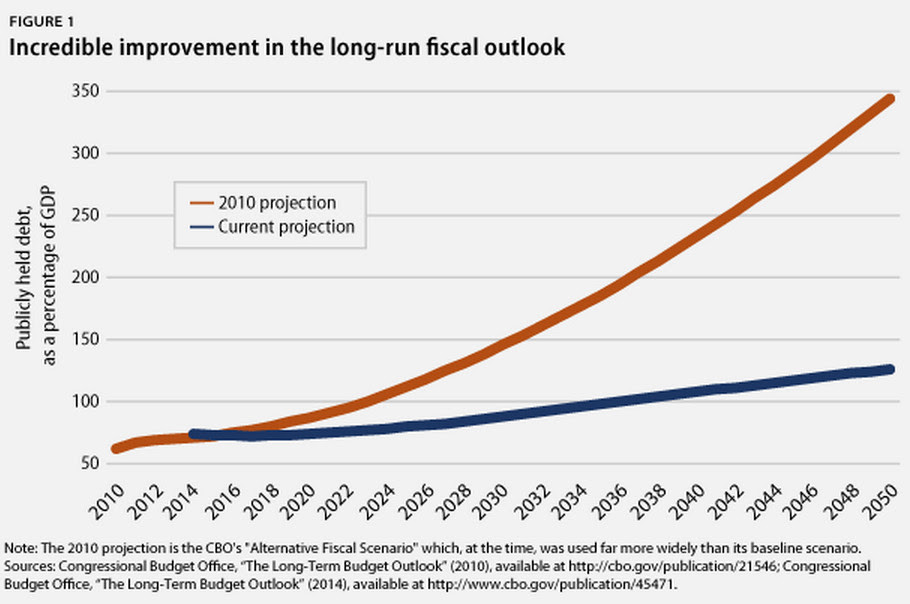
The CBO found that, despite relentless panic about supposedly out-of-control government spending, the long-term path of federal debt has dramatically improved lately. You can see that in this second CAP chart, showing the CBO forecast for the ratio of federal debt to gross domestic product:

debt outlook

Budget cuts have probably helped bring down the long-term debt outlook a bit. But an improving economy has helped much more, by raising tax revenue and dramatically shrinking the government's annual budget deficit.

The CAP study is the latest in a series of studies tallying the costs of austerity. The long and short of it: Less austerity in the short term would have meant more growth, less unemployment and an even faster-shrinking deficit in the long term.

Monday, March 10, 2014

U.S. recovered from recession faster than everybody but....

Now for all you who disparaged and tore down the stimulus package, aka the American Reinvestment and Recovery Act, here are the facts.

Of course the stimlus could have been bigger and better, and not 1/3 tax cuts that the Republicans would never give the Demcroacts credit for. Nonetheless, the stimulus helped the U.S. recover quicker than every country except Germany from the financial crisis caused by the Too Big Too Fail Banks.

This is a Germany with labor unions as part of every corporate board, with "socialized" medicine and free college education.

Let's not forget history while it's still fresh!


By Sabrina Siddiqui
March 10, 2014 | Huffington Post

Sunday, December 22, 2013

America's 'age of unprecedented austerity'

You won't hear this from the mainstream media!

The greatest trick austerians ever pulled was convincing people that it was stimulus that had failed.

And the greatest trick the Koch brothers ever pulled was convincing Tea Party Republicans that deficits are a cause, not an effect.


By Matthew O'Brien
December 20, 2013 | The Atlantic

We're living in an age of unprecedented austerity.

Now, that sounds impossible to conservatives who know, just know, that government has exploded under Obama's socialist watch. And that we have trillion dollar deficits—dun, dun, dun—as far as the eye can see. But I have some good news for them (though not the economy). They're wrong. Government employment has actually fallen under Obama, and the deficit is falling fast too

As Ben Bernanke put it, "people don't appreciate how tight fiscal policy has been." And how much that's knee-capped the economy. Take jobs. Bernanke points out that total public sector employment—local, state, and federal—has fallen by over 600,000 during the recovery alone. As point of comparison, it rose by 400,000 during the previous one.

But even this million person job swing doesn't tell us how historic austerity has been this time. You have to look at the chart below to see that. It shows government job growth during every recovery on record, going back to 1945. This is the least there's ever been.


How is it possible that government added more jobs after World War II demobilization than now? Or after the 1980 recession, which was followed by another recession a year later? Well, it's what Paul Krugman calls the 50 Herbert Hoovers effect. See, state governments are required to (mostly) run balanced budgets, even during a recession. That's usually not too much of a problem as long as the slump is quick or shallow.

But the Great Recession was neither. The crisis hit and tax revenue disappeared—and didn't come back. Now, the federal government did use the stimulus to fill some of these state budget holes, which is why public sector employment didn't fall much in the first year of the recovery. But then the stimulus money ran out—really, it did—and states were left on their own. Like Hoover in the 1930s, they tried to balance their books amidst a depressed economy. And like Hoover in the 1930s, it didn't work out too well. They went on a cops-and-teachers firing spree the likes of which we've never seen before. And one that was the difference between unemployment being 6 instead of 7 percent today.

The greatest trick austerians ever pulled was convincing people that it was stimulus that had failed.

Monday, November 25, 2013

Bankrate: Americans still struggling to pay debts

Ordinary Americans are still de-leveraging after the Great Recession. Their continued debts are hurting consumer demand, which in turn is hurting employment and investment because companies don't want to produce or sell what people don't have the money to buy.

What can politicians do to ease the pain and get our economy going again?  Republicans' knee-jerk reaction is to cut taxes. Yet... the same folks struggling to pay their bills are the same "47 percent" of "entitled" moochers who already pay little or no income tax. And corporations are more profitable than ever, with billions of cash on hand. Meanwhile, Republicans urge fiscal austerity -- mainly by cutting "welfare" like WIC, food stamps and unemployment benefits for these same struggling Americans.

Something's gotta give. The Fed's continued quantitative easing is not reaching average Americans. If their struggles continue, then we can anticipate another decade of economic malaise: the "secular stagnation" theory.  In this context the risk -- the temptation, for some -- is to blow up another asset bubble to give the economy the appearance of health and spur consumer confidence, thus consumer spending. But we know that such bubbles burst eventually, leaving those same working-class people worse off.  

It's a shame our leaders can't come up with anything to break this vicious cycle, besides yet more asset bubbles that benefit business insiders, and free money for Wall Street banks that don't need it and doesn't "trickle down" in the form of loans to Main Street Americans.


By Polyana da Costa
November 25, 2013 | Bankrate

Tuesday, November 5, 2013

Stiglitz: For nations, economic inequality is a choice

It's not too late to post this stirring essay on global inequality by my main bearded liberal economist Joe Stiglitz!


By Joseph E. Stiglitz
October 13, 2013 | New York Times

It’s well known by now that income and wealth inequality in most rich countries, especially the United States, have soared in recent decades and, tragically, worsened even more since the Great Recession. But what about the rest of the world? Is the gap between countries narrowing, as rising economic powers like China and India have lifted hundreds of millions of people from poverty? And within poor and middle-income countries, is inequality getting worse or better? Are we moving toward a more fair world, or a more unjust one?

These are complex questions, and new research by a World Bank economist named Branko Milanovic, along with other scholars, points the way to some answers.

Starting in the 18th century, the industrial revolution produced giant wealth for Europe and North America. Of course, inequality within these countries was appalling — think of the textile mills of Liverpool and Manchester, England, in the 1820s, and the tenements of the Lower East Side of Manhattan and the South Side of Chicago in the 1890s — but the gap between the rich and the rest, as a global phenomenon, widened even more, right up through about World War II. To this day, inequality between countries is far greater than inequality within countries.

But starting around the fall of Communism in the late 1980s, economic globalization accelerated and the gap between nations began to shrink. The period from 1988 to 2008 “might have witnessed the first decline in global inequality between world citizens since the Industrial Revolution,” Mr. Milanovic, who was born in the former Yugoslavia and is the author of “The Haves and the Have-Nots: A Brief and Idiosyncratic History of Global Inequality,” wrote in a paper published last November. While the gap between some regions has markedly narrowed — namely, between Asia and the advanced economies of the West — huge gaps remain. Average global incomes, by country, have moved closer together over the last several decades, particularly on the strength of the growth of China and India. But overall equality across humanity, considered as individuals, has improved very little. (The Gini coefficient, a measurement of inequality, improved by just 1.4 points from 2002 to 2008.)

So while nations in Asia, the Middle East and Latin America, as a whole, might be catching up with the West, the poor everywhere are left behind, even in places like China where they’ve benefited somewhat from rising living standards.

From 1988 to 2008, Mr. Milanovic found, people in the world’s top 1 percent saw their incomes increase by 60 percent, while those in the bottom 5 percent had no change in their income. And while median incomes have greatly improved in recent decades, there are still enormous imbalances: 8 percent of humanity takes home 50 percent of global income; the top 1 percent alone takes home 15 percent. Income gains have been greatest among the global elite — financial and corporate executives in rich countries — and the great “emerging middle classes” of China, India, Indonesia and Brazil. Who lost out? Africans, some Latin Americans, and people in post-Communist Eastern Europe and the former Soviet Union, Mr. Milanovic found.

The United States provides a particularly grim example for the world. And because, in so many ways, America often “leads the world,” if others follow America’s example, it does not portend well for the future.

On the one hand, widening income and wealth inequality in America is part of a trend seen across the Western world. A 2011 study by the Organization for Economic Cooperation and Development found that income inequality first started to rise in the late ’70s and early ’80s in America and Britain (and also in Israel). The trend became more widespread starting in the late ’80s. Within the last decade, income inequality grew even in traditionally egalitarian countries like Germany, Sweden and Denmark. With a few exceptions — France, Japan, Spain — the top 10 percent of earners in most advanced economies raced ahead, while the bottom 10 percent fell further behind.

But the trend was not universal, or inevitable. Over these same years, countries like Chile, Mexico, Greece, Turkey and Hungary managed to reduce (in some cases very high) income inequality significantly, suggesting that inequality is a product of political and not merely macroeconomic forces. It is not true that inequality is an inevitable byproduct of globalization, the free movement of labor, capital, goods and services, and technological change that favors better-skilled and better-educated employees.

Of the advanced economies, America has some of the worst disparities in incomes and opportunities, with devastating macroeconomic consequences. The gross domestic product of the United States has more than quadrupled in the last 40 years and nearly doubled in the last 25, but as is now well known, the benefits have gone to the top — and increasingly to the very, very top.

Last year, the top 1 percent of Americans took home 22 percent of the nation’s income; the top 0.1 percent, 11 percent. Ninety-five percent of all income gains since 2009 have gone to the top 1 percent. Recently released census figures show that median income in America hasn’t budged in almost a quarter-century. The typical American man makes less than he did 45 years ago (after adjusting for inflation); men who graduated from high school but don’t have four-year college degrees make almost 40 percent less than they did four decades ago.

American inequality began its upswing 30 years ago, along with tax decreases for the rich and the easing of regulations on the financial sector. That’s no coincidence. It has worsened as we have under-invested in our infrastructure, education and health care systems, and social safety nets. Rising inequality reinforces itself by corroding our political system and our democratic governance.

And Europe seems all too eager to follow America’s bad example. The embrace of austerity, from Britain to Germany, is leading to high unemployment, falling wages and increasing inequality. Officials like Angela Merkel, the newly re-elected German chancellor, and Mario Draghi, president of the European Central Bank, argue that Europe’s problems are a result of a bloated welfare spending. But that line of thinking has only taken Europe into recession (and even depression). That things may have bottomed out — that the recession may be “officially” over — is little comfort to the 27 million out of a job in the E.U. On both sides of the Atlantic, the austerity fanatics say, march on: these are the bitter pills that we need to take to achieve prosperity.  But prosperity for whom?

Excessive financialization — which helps explain Britain’s dubious status as the second-most-unequal country, after the United States, among the world’s most advanced economies — also helps explain the soaring inequality. In many countries, weak corporate governance and eroding social cohesion have led to increasing gaps between the pay of chief executives and that of ordinary workers — not yet approaching the 500-to-1 level for America’s biggest companies (as estimated by the International Labor Organization) but still greater than pre-recession levels. (Japan, which has curbed executive pay, is a notable exception.) American innovations in rent-seeking — enriching oneself not by making the size of the economic pie bigger but by manipulating the system to seize a larger slice — have gone global.

Asymmetric globalization has also exerted its toll around the globe. Mobile capital has demanded that workers make wage concessions and governments make tax concessions. The result is a race to the bottom. Wages and working conditions are being threatened. Pioneering firms like Apple, whose work relies on enormous advances in science and technology, many of them financed by government, have also shown great dexterity in avoiding taxes. They are willing to take, but not to give back.

Inequality and poverty among children are a special moral disgrace. They flout right-wing suggestions that poverty is a result of laziness and poor choices; children can’t choose their parents. In America, nearly one in four children lives in poverty; in Spain and Greece, about one in six; in Australia, Britain and Canada, more than one in 10. None of this is inevitable. Some countries have made the choice to create more equitable economies: South Korea, where a half-century ago just one in 10 people attained a college degree, today has one of the world’s highest university completion rates.

For these reasons, I see us entering a world divided not just between the haves and have-nots, but also between those countries that do nothing about it, and those that do. Some countries will be successful in creating shared prosperity — the only kind of prosperity that I believe is truly sustainable. Others will let inequality run amok. In these divided societies, the rich will hunker in gated communities, almost completely separated from the poor, whose lives will be almost unfathomable to them, and vice versa. I’ve visited societies that seem to have chosen this path. They are not places in which most of us would want to live, whether in their cloistered enclaves or their desperate shantytowns.