Showing posts with label CBO. Show all posts

Tuesday, November 11, 2014

On Jonathan Gruber's comments 'bashing' Obamacare


which have talk radio, Fox and Republicans publicly all aflutter. So check this out:


"Healthy people pay, sick people get money," is the way all health insurance works, I'm afraid. It's the way insurance works, period: "Unsunken ships pay; sunken ships get money;" "Undamaged homes pay; damaged homes get money;" "Safe drivers pay; unsafe drivers get money," and so on.

Nevertheless the insurance companies through rescission have tried, illegally, to mitigate the economics of health insurance, retroactively; but PHSA, HIPPA and Obamacare have restricted that underhanded business practice.

No, Obamacare isn't "something for nothing." It's not "free healthcare." More people have to pay in by buying private insurance, or having their employer pay part of their insurance cost, but the economics are sound, there is no other way. The other side of the ledger, (which any accountant should acknowledge), is that having more people insured will lower health spending overall. That's what the CBO has said consistently. 

In the U.S. we're spending nearly 20 percent of GDP on health care, and that's not sustainable. It's also not competitive. Check this out from the World Bank,health expenditure, total (% of GDP):

Australia -- 9.1 percent
Canada -- 10.9 percent
France -- 11.1 percent
Germany -- 11.3 percent
Great Britain -- 9.4 percent
Japan -- 10.1 percent
... and so on.

Next, take a deep breath and check this out: "Revisions to CBO's Projections of Federal Health Care Spending" from July 2014. Upshot: The U.S. economy, at least the federal government'share of it, is projected to spend less  on health care in the long term, which is exactly what we liberal-progressives wanted, to bend the cost curve:

CBO now projects that, if current laws remained generally unchanged, net federal spending for the government’s major health care programs in 2039 would equal 8.0 percent of gross domestic product (GDP)—1.6 percentage points, or about 15 percent, less than the 9.6 percent the agency projected in 2010 (see the figure below). That revision stems in large part from the observed slowdown in health care spending in recent years, but it also includes the effects of other factors; some of those factors reduced projected spending, and others increased it.

The programs included in the calculations are Medicare, Medicaid, the Children’s Health Insurance Program, and subsidies for insurance purchased through exchanges. 

But how can that be, my conservative interlocutor will ask? How can the government be spending more on [Obamacare] subsidies yet projected to spend less, overall?  

The answer, (not to get too wonky), if you read between the lines of the CBO's revised estimate, is that growth in healthcare spending, including on Medicare, has been slowing down faster than anybody projected. 

Indeed, noted conservative Forbes, "The current numbers represent the slowest rate of growth since the government began tracking the data in 1960."

And why is that? Apparently nobody knows yet. But for four years running, the rate of spending on health care in America has slowed... just coincidentally under President Obama, under an Obamacare regime. 

Harvard economist David Cutler argued in the Washington Post a few days ago that, in fact, we do indeed have Obamacare to thank for it.

Probably it's still premature to say for sure, but the signs are good. Yet one more reason not to "repeal and replace" Obamacare when it's doing what it was designed to do -- covering about 7 million more Americans in its first full year; and lowering -- or at least not increasing -- healthcare costs for four years running.


UPDATE (11.15.2014): Here's kind of a fair and balanced analysis of what Jonathan Gruber said (on multiple occasions, unfortunately), from none other than CNN: "Obamacare: Voters, are you stupid?"

Thursday, July 17, 2014

Needless economic damage of the 'sequester'

Just in case you forgot how much damage the idiotic, Tea Party-inspired budget sequestration did to the U.S. economy, here's a reminder: at least $351 billion

"Less austerity in the short term would have meant more growth, less unemployment and an even faster-shrinking deficit in the long term," concludes Mark Gongloff.

We should never again allow conservative debt fetishists to impose their confusion about cause (economic downturn) and effect (rising deficits) on the rest of us.  


By Mark Gongloff
July 16, 2014 | Huffington Post

Austerity is like a bad tattoo: It's going to be with us, causing misery, for years to come.

The broad spending cuts that were the fruits of the Republican Congress' budget obsession of the past few years have already cost the U.S. economy $351 billion in lost economic activity, according to a new study by the Center for American Progress. This austerity will cost a total of $633 billion by the year 2020, according to the study. Here's a chart from CAP to help put it in perspective:

600 billion

"Congress has severely damaged the economy with deep spending cuts in a misguided attempt to solve a short-term debt crisis that simply does not exist," wrote CAP economists Harry Stein and Adam Hersh.

The progressive think tank's analysis is based on the latest budget outlook from the Congressional Budget Office, the nonpartisan congressional research group, which was released on Tuesday.

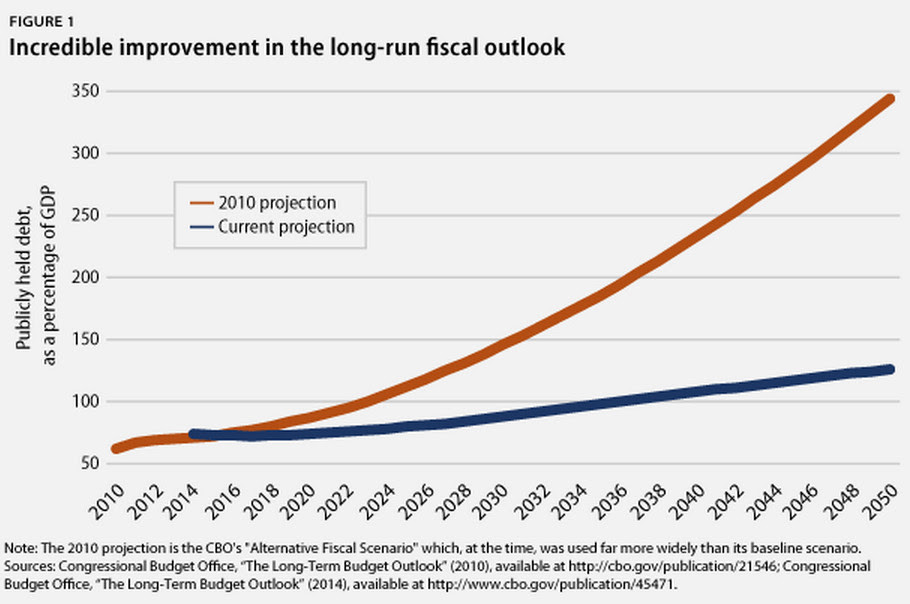
The CBO found that, despite relentless panic about supposedly out-of-control government spending, the long-term path of federal debt has dramatically improved lately. You can see that in this second CAP chart, showing the CBO forecast for the ratio of federal debt to gross domestic product:

debt outlook

Budget cuts have probably helped bring down the long-term debt outlook a bit. But an improving economy has helped much more, by raising tax revenue and dramatically shrinking the government's annual budget deficit.

The CAP study is the latest in a series of studies tallying the costs of austerity. The long and short of it: Less austerity in the short term would have meant more growth, less unemployment and an even faster-shrinking deficit in the long term.

Wednesday, October 31, 2012

Dems must fight any 'grand bargain' (aka austerity)

As Bill Black notes, it can only be Obama's "vanity" making him promise a "grand bargain" on spending and tax cuts if he is re-elected.  In fact, we are now in a classic period of debt-deflation, the only answer to which is more public spending.

Sadly, it sounds like Obama has swallowed the Republican Kool-Aid that we're facing a fiscal "crisis," and that something must be done now to dismantle or privatize Social Security, Medicare, SNAP and a host of federal agencies, or else somebody's grandchildren will have to pay higher taxes.  

(In fact, the CBO estimates that the Budget Control Act that the Right so desperately wanted will turn about 4.4 percent projected GDP growth in 2013 into a recession in 1H 2013 with measly 0.5 percent GDP growth for the year. Much like what is happening in Europe: see below).  

In other words, Obama seems to have embraced austerity, even though the U.S., which partially embraced fiscal stimulus, has been growing consistently since July 2009 (albeit slowly), and partly because of the stimulus and not despite it.  By contrast, the EU is sadly realizing that austerity has been self-defeating: in the EU, debt-to-GDP ratios are growingGDP is shrinking; and unemployment is growing.

If you still don't understand how that could be so, read this:

Why is [the EU's] fiscal consolidation so much more damaging now? Under normal circumstances a tightening in fiscal policy would also lead to a relaxation in monetary policy. However, with interest rates already at exceptionally low levels, this is unlikely or infeasible. Moreover, during a downturn, when unemployment is high and job security low, a greater percentage of households and firms are likely to find themselves liquidity constrained. Finally, with all countries consolidating simultaneously, output in each country is reduced not just by fiscal consolidation domestically, but by that in other countries, because of trade. In the EU, such spillover effects are likely to be large.

[...] The result of coordinated fiscal consolidation is a rise in the debt-GDP ratio of approximately five percentage points.  


P.S. - This makes 2001 posts to my blog, all-time, not counting the shit I deleted. So cue Strauss's Sunrise!:  "Buuum-buuum-buuuuuuuuuuum BUM-BUM! Boom-boom boom-boom boom-boom boom-boom boom-boom boom-boom boom!"

Monday, July 16, 2012

CBO: Obama is biggest tax-cutter in 30 years (but still Marxist)

Don't be fooled -- he's still a Muslim cryptosocialist!  This whole time he's just been waiting for us to re-elect him, so that he can implement all the godless, job-killing, freedom-destroying policies that we feared in 2008 he would pass if we elected him the first time.  That's how devious he is -- the devil is patient!


By Elizabeth Hewitt 
July 11, 2012 | Slate

Americans paid the lowest federal tax rate in three decades during President Obama's first year in office, according to a new government report out this week.

The Congressional Budget Office found that the average tax rate in 2009 was 17.4 percent, the lowest since 1979, and down from 19.9 percent in 2007. Although figures are only available through 2009, the CBO expects to see the historic lows maintained through 2010 and 2011.

(The Washington Post points out the irony: 2009 was the same year anti-tax protesters began their full-throated criticism of White House tax policies.)

In part, the tax decline was due to the dramatic decrease in average income that year, an effect of the Great Recession that caused many Americans to slide down into lower tax brackets. In 2009, the average household income was $88,400, according to the Financial Times, notably less than the $101,000 average in 2007. The top 1 percent of earners saw their income decrease by more than a third.

But, the low rates also reflect measures the Obama administration took to mediate the impact of the recession, including the "Making Work Pay" tax credit and other cuts bundled in the stimulus package. The lowest fifth of earners saw the most dramatic decrease, paying an average tax rate of 1 percent compared with 5.1 percent in 2007.

Only the top 1 percent of earners were exempt from the trend. Those in the top bracket, who earn approximately $1.2 million annually, paid a 28.9 percent federal tax rate, up from 28.1 the previous year, the Wall Street Journal reports.

Republicans and Democrats (shockingly!) are bickering over the implications of the CBO report. According to the Dems, the numbers prove the claims from across the aisle about Obama's tax policies false. "However much Republicans try to perpetuate false claims, the facts speak for themselves," Rep. Sander Levin, ranking Democrat on the Ways and Means Committee said. But a spokesman for the chair of the committee, Rep. Dave Camp, R-Mich., countered that the low tax rates prove just how low average American incomes slid under the president. "A weak economy and fewer jobs is nothing to cheer about."

Friday, May 25, 2012

CBO: Budget cuts + tax hikes = recession in 2013

Let's not repeat the mistakes of history!


By Lucia Mutikani and Kim Dixon
May 22, 2012 | Reuters

A stalemate over how to tackle a series of fiscal deadlines at year's end would likely push the United States economy into recession in the first half of next year, the Congressional Budget Office warned on Tuesday.

A wave of U.S. tax hikes and automatic spending cuts - dubbed the "fiscal cliff" - are set to take effect in January unless Congress and the White House agree on ways to delay or revise at least some of them.

The CBO, the official budget and economic analyst for lawmakers, said the U.S. economy would contract at an annual rate of 1.3 percent for the first half of 2013 if lawmakers take no action to prevent the looming tax hikes and spending cuts.

"Given the pattern of past recessions ... such a contraction in output in the first half of 2013 would probably be judged to be a recession," the CBO said.

At the same time, CBO said growth would snap back in the second half of the year to 2.3 percent, though it did not offer an explanation.

Historically low tax rates enacted under former President George W. Bush in 2001 and 2003, and jobless benefits for the long-term unemployed are both set to expire on Dec. 31, as is a temporary payroll tax cut.

In addition, $1.2 trillion in across-the-board reductions in spending on federal programs would begin to phase in as a result of Congress' failure late last year to find a comprehensive deal to cut the budget deficit.

House of Representatives Speaker John Boehner rekindled the debate last week over how to handle the pending deadlines when he declared that Republicans would not consider a boost to federal borrowing authority without a greater increase in spending cuts.

While the CBO did not explicitly address the debt-limit issue, it is among the potential decisions lawmakers face at the end of the year.

The CBO said that although taking action to prevent some of the tax hikes and spending cuts could boost growth in the short term, having no long term plan for "fiscal restraint" is not sustainable.

The conventional wisdom has been that lawmakers will take no action on any of these major issues until after the Nov. 6 elections.

Earlier on Tuesday, the Organization for Economic Cooperation and Development warned of a sharp fiscal contraction next year that could derail the U.S. economic recovery if lawmakers stalled. It also urged the government to move only gradually to tighten its budget.

"The programmed expiration of tax cuts and emergency unemployment benefits, together with automatic federal spending cuts, would result in a sharp fiscal retrenchment in 2013 that might derail the recovery," the OECD said in its latest economic outlook.

Wall Street economists forecast that fiscal policy could tighten by about $600 billion next year, or about 4 percent of GDP, if lawmakers fail to reach an agreement. Goldman Sachs estimates the "fiscal cliff" could shave nearly 4 percentage points from GDP in the first half of 2013.

Most economists, however, expect lawmakers to find a way to soften the blow.

In its forecasts, the OECD said the U.S. economy should grow 2.4 percent this year and 2.6 percent in 2013. Those projections assume the budget deficit is cut by 1 percent and 1-1/2 percent of GDP, respectively, this year and next.

The United States has run budget deficits topping $1 trillion for three straight years, and it is on course to do so for a fourth.

Thursday, April 12, 2012

Obamacare won't increase the deficit

Big surprise, a Koch-funded think tank was behind the bogus report that the Affordable Care Act (Obamacare) would increase the deficit.

That claim was false.  In fact, the CBO recently revised its estimates to say Obamacare would cost $50 billion less over 10 years.


By Jonathan Chait
April 10, 2012 | New York Magazine

Thursday, March 18, 2010

CBO: Reconciliation HC bill, like Senate predecessor, cuts deficit

Look, this bill is by no means what liberals wanted, but the CBO says it will cut the deficit and cover more than 30 million Americans. That can't be all bad.

This is pretty consistent with the CBO and Joint Committe on Taxation's estimation in December 2009 of the Senate bill that was passed, before the House reconciliation added some provisions. The CBO-JCT estimated that from 2010-2019 the bill would yield a net reduction of federal deficits of $119 billion.

Of course you're free to disregard all that at your discretion, if you hate Big Guvmint and all, but then, you're not really acting based upon reason, but upon your irrational fears and prejudices. The "great" thing about America is that you're free to do that. Just please do us all a favor and do it in Idaho, Montana, or some other unpopulated podunk that doesn't matter.


Dem Source: CBO Says Health Bill Cuts Deficit, Costs $940 Billion
By Brian Beutler
March 18, 2010 | TPM

URL: http://tpmdc.talkingpointsmemo.com/2010/03/dem-source-cbo-says-health-bill-cuts-deficit-costs-940-billion.php

Monday, December 7, 2009

Bank bailout now estimated to cost only $159 B, but...

The TARP is supposed to cost only $159 billion now, according to the CBO. However, if I understand high finance these days, it's no surprise that troubled banks which were allowed to borrow at 0% interest from the Fed and do with it what they pleased -- which did not include extending credit to small businesses and home buyers --- have been able to pay back their TARP loans in no time.


Forthcoming projection would put price tag of bailout program at $141 billion, far less that original White House estimates.

By David Ellis
December 7, 2009 | CNN

Saturday, December 5, 2009

Forbes: Senate bill too slow, with too many giveaways

Well, maybe the Senate bill is not so good. If the insurance companies support it, it can only mean that they stand to gain.

Charges Sen. Jay Rockefeller (D): "The insurance industry gets to walk away with nearly half a trillion dollars in federal subsidies--without any requirement that they spend those federal dollars on medical care."

Writes Lenzner for Forbes:

The so-called "public option" to insure less healthy patients will cost "typically higher premiums than the average plan," figures the Congressional Budget Office, which estimates that only 3 million to 4 million people will be covered by the public option. That's only about one out of every 10 uninsured people. That's scandalous and reveals the influence of the powerful insurance and pharmaceutical industries. This is not anything approaching socialism, but it is the thumb in the eye of the people that were supposed to be helped.


The Horrendous Truth About Health Care Reform
By Robert Lenzner
December 4, 2009 | Forbes

You were right if you thought the insurance companies would emerge unscathed from what the government wants to call reform.

URL:
http://www.forbes.com/2009/12/04/cigna-unitedhealth-aetna-personal-finance-investing-ideas-humana-wellpoint.html?partner=alerts

Friday, November 27, 2009

Obama's emissions targets not so costly after all?

So, estimates of the cost of Obama's goal to reduce CO2 emissions by 17% below 2005 levels vary from -$40 a year for an average family of four, to $1,539 per year by 2020. It all depends on who's doing the estimating. Conservatives will say that the EPA and the CBO harbor a dastardly liberal agenda so their estimates can't be trusted; liberals will say that Big Business is only looking out for itself, and scaring up some big numbers.

Personally, I would go with the CBO's numbers: the poorest households would save $40 per year; while the richest households would see an increased cost of $245 a year. In either case, emissions reductions would hardly cause the sky to fall on consumers' heads.

What we should not forget in all of this is that (1) reducing CO2 is a good thing, no matter what, because emissions are waste which equals inefficiency, both physical and economic, and (2) there is the untold health/human cost of greenhouse gases (aka air pollution) which increases heart and lung disease. Less CO2 in our atmosphere could save thousands of U.S. lives a year.


By Seth Borenstein
November 26, 2009 | Associated Press

Wednesday, August 19, 2009

Forbes: Good summary of health debate

Conservative Forbes gives a pretty good summary below of what the various health care bills in Congress do and don't say. And although Forbes uses the term "Obamacare" incessantly, it admits that Obama has only laid out 3 broad goals for reform; and in response, the House and Senate have proposed several different versions of health care reform.

I understand why Republicans latched onto the term "Obamacare" -- because labelling Hillary's health care bill "Hillarycare" in the 90s really helped kill it. However, unlike Hillary, Obama never came up with a bill in secret, he never plopped a bill in front of Congress and said, "Pass this." He just laid out the goals.

Obama's laid-back approach, however, has probably been his undoing.

This $1 trillion figure (which included a public option -- which Obama has since caved on) from the CBO sounds like a lot, but as Forbes points out, that's only $3,333 for every man, woman and child over 10 years, or $333 per person per year. For many of us, $333 is less than the cost of one month's insurance premium. (It's less than half of mine). $1 trillion still sounds like a scary number, until you consider that the U.S. will spend about $2.5 trillion on health care in 2009 alone, accounting for 17.6 percent of GDP. By 2018, the annual cost of health care is estimated to more than double to $4.4 trillion. Over the last decade, employer-sponsored health insurance premiums have increased 119 percent. Today, the average employer-sponsored health premium costs $13,000 for a family of four, or $3,250 per person, and employees pay 30 percent of that cost, or $3,900 per year, on average. Does that $3,333 estimate over 10 years still sound so scary? Furthermore, the CBO (yes, the same CBO that gave us that scary $1 trillion figure that Republicans have pounced on) estimated that employer-based health costs for an average family of four will reach $25,000 per year by 2018.


So, at the same time you're considering the cost of reform, weigh the intolerable cost of doing nothing. Oh, and by the way, conservative Forbes says that health cooperatives won't increase the number of people who get insurance. But co-ops probably will be included in the final bill. Sorry.

Health Care Checkup
By Brian Wingfield and David Whelan

August 18, 2009 | Forbes.com

Feeling a bit lost in the debate over health care reform? It's understandable.

America's health care system was already confusing even before Congress' ideas for changing it. Now, special interests have made things yet murkier. The White House has backed away from its initial support of a government-run insurance program; town hall meetings are brimming with scorn for the ideas on the table, and health care chatter has consumed the airwaves.

Lawmakers will determine this fall what's in the final bill, but as the debate rages this summer, here's a guide to help you get up to speed and back to the beach as quickly as possible:

What's been proposed?

President Obama wants to see reform that includes, among other things, coverage for all Americans, allows people to choose their providers and lowers the growth in health care costs. Congress has to figure out the dicey details.

In July, leaders in the House of Representatives proposed a bill that would create a government-run insurance plan, or "public option," to compete with private insurers. It requires individuals to have coverage and mandates that large businesses provide it or pay a tax to the government. To help pay for the public option, it would increase taxes on the wealthy. Several House committees have produced their own, slightly different, versions of this bill.

The Senate's health committee also proposed a plan in July, and it too includes a public option and individual and employer mandates. However, the Senate Finance Committee, which determines how to pay for the Senate proposal, is deliberating until at least mid-September.

For this reason, "ObamaCare" doesn't really have a formal definition. It's basically still a handful of proposals.

What's still on the table?

Technically, everything; but in fact, a lot has been cut out. Most recently, the White House has backed off from its support of a public option, the most expensive part of reform and an idea that might not pass the Senate. The idea of taxing the wealthy is also probably gone. And the president doesn't support the idea of killing a tax subsidy for employer-provided coverage because it might raise taxes on the middle class.

So what's left? Proposed cost reductions in Medicare, Medicaid and prescription drugs. Perhaps a plan for health insurance to be provided by nonprofit cooperatives instead of the government. The main thing that remains: the problem of figuring out how to insure an additional 46 million people without adding to the deficit.

What's likely to get done, if anything?

Democrats in control of Congress and the White House aren't going to walk away from this battle without being able to claim victory, so expect some type of health care reform to happen this year. Much depends on what the Senate Finance Committee determines.

Reform will most likely cost less than $1 trillion, paid for by entitlement savings and various tax increases. It will likely expand health insurance, though probably not as much as the president hopes. And it seems increasingly likely that it won't include a public option.

What's it likely to cost?

With a public plan, the bill is projected by the Congressional Budget Office to cost just under $1 trillion over 10 years. That's $3,333 for every man woman and child. Take out the public plan completely and that drops by $773 billion, so the administration will have more room to spend that money on other proposals, like health co-ops or expanding Medicaid eligibility, promoting electronic health records or comparative effectiveness research. Removing that cost could also allow the final bill to include fewer Medicare cuts to hospitals or doctors.

What would it mean to the way I get medical care?

If you are part of the demographic that right now is not well served by the private insurance market and you don't qualify for Medicaid, Medicare or S-CHIP--you could suffer without a public plan option. The public plan would be ideal for small businesses that can't afford double-digit annual premium increases or low-to-middle income individuals with preexisting conditions who, in many states, can't even find an HMO to buy a plan from.

Co-ops could provide another option for these patients, but where they already operate, there's no evidence that they solve the uninsured and under-insured problems.

If you work at a big company, have Medicare or qualify for Medicaid, likely your medical care will not dramatically change, though the long-term fiscal pressures on the government plans will likely lead to cost-cutting and tax increases down the road.

What happens next?

Supporters of the public plan will likely make a push to ensure it's in the final bill. If they succeed, the final passage will happen, but it will be a bruising battle until the end. Expect more angry town halls. And forget about beer and car ads during football season. It will be all health care all the time.

If they don't get it back in, it will be much easier to get congressional support from moderates and even Republicans--but the president and the original band of reformers will face criticism that they didn't accomplish what they set out to do.