Your one-stop shop for news, views and getting clues. I AM YOUR INFORMATION FILTER, since 2006.
Thursday, February 20, 2014
Baker: Stimulus worked, but it was too small
Thursday, August 29, 2013
MB360: FIRE sector is back, big time
In 1947, the FIRE side of the economy made up roughly 10 percent of GDP. Today it is 21 percent. On the other hand manufacturing in 1947 made up 25 percent of GDP while today it is closer to 11 percent.
Saturday, July 13, 2013
Black: Lenders & appraisers hyper-inflated housing bubble
Sunday, January 27, 2013
Bill Black: Loan fraud caused the Great Recession
The ultra brief version is (1) by 2006 roughly 40 percent of total mortgage loans originated were "liar's loans," (fyi, roughly half of all loans called "subprime" were also liar's loans -- the categories are not mutually exclusive, (2) the incidence of fraud among liar's loans is 90 percent, (3) an honest real estate lender would not make pervasively fraudulent loans because doing so would inevitably cause the firm to fail (absent a bailout), (4) liar's loans, however, are optimal "ammunition" for "accounting control fraud", (5) investigations (and logic) have confirmed that it was overwhelmingly lenders and their agents who put the lies in liar's loans, (6) no lender was ever required or encouraged by the government to make or purchase liar's loans -- the opposite was true, the government discouraged such loans and industry documents confirm this fact, (7) liar's loans make an excellent "natural experiment" because even Fannie and Freddie were not encouraged to make these loans -- because they did not aid them in meeting the "affordable housing goals", (8) Fannie and Freddie, eventually, purchased enormous amounts of liar's loans for the same reason that the investment banks (not subject to the CRA or any affordable housing goals did) they created massive (albeit fictional) short-term accounting income, which flowed through to the bonuses of many Fannie and Freddie executives. Let me put these data in another format -- by 2006, lenders were making over two million fraudulent liar's loans annually. Fraudulent liar's loans grew massively because lenders (and purchasers) created perverse incentives to make and purchase massive amounts of these fraudulent loans.This level of fraud is massively greater than during the S&L debacle, where accounting control fraud never became a dominant national lending strategy. Liar's loans grew so rapidly, and became such a large share of the market that they constituted the loans "on the margin" that hyper-inflated the financial bubble, which drove the Great Recession.
One of our mantras in white-collar criminology is: "if you don't look, you won't find." The Frontline documentary begins the process of explaining what those of us who are aware of what a real investigation is and what it requires have been saying for years -- neither the Bush nor the Obama administration has been willing to conduct a real investigation of the elite banksters whose frauds made them wealthy and drove the financial crisis and the Great Recession. This is one of the hallmarks of crony capitalism. It cripples our economy, our democracy, and our integrity.
[...] Any bank that is too big to fail and to prosecute is a clear and present danger that should be promptly shrunk to the point that it can no longer hold the global economy hostage in order to extort immunity from the criminal laws for the controlling officers who became wealthy by being what Akerlof and Romer aptly described as "looters."
Thursday, October 18, 2012
Consumer Financial Protection Bureau sells out
“Federal regulators are considering giving mortgage lenders protection from certain lawsuits…The potential move, which would be a partial victory for mortgage lenders, is part of a broader effort to write new rules for the U.S. housing market in the wake of the mortgage meltdown. The proposal for the first time would establish a basic national standard for loans, known as a ‘qualified mortgage.’ (“Home Loans May Get Shield”, Wall Street Journal)
“As part of its deliberation, the Consumer Financial Protection Bureau is considering providing a full legal shield for high-quality loans that qualify, mandating that judges rule in lenders’ favor if consumers contest foreclosures, these people say….The shield against lawsuits would be a welcome move for mortgage lenders. Seven major U.S. banks have spent more than $76 billion on mortgage-related costs and litigation since 2008, according to Credit Suisse Group.
“Lawsuits aren’t the only worry for mortgage lenders. Banks have also kept underwriting standards tight in recent years due to uncertainty about whether they’ll be forced to buy back loans made in the housing boom.
“JPMorgan Chase & Co. and Wells Fargo & Co., the nation’s largest home lenders, each reported double-digit quarterly earnings growth Friday. The big jump in profit was thanks largely to a surge in their mortgage businesses, fueled by low interest rates and waves of refinancing.At Wells Fargo, mortgage business revenue rose 55% to $2.8 billion during the third quarter from $1.8 billion in the year-earlier period. …JPMorgan’s mortgage business posted a 71% increase to $2.4 billion from $1.4 billion last year. This led the bank to beat expectations with an overall profit of $5.7 billion.” (“Banks see a housing rebound”, Los Angeles Times)
“The U.S. attorney in Manhattan has accused Wells Fargo of defrauding a government-backed mortgage insurance program, in another major civil case brought in the wake of the housing bust and financial crisis.The mortgage-fraud suit, filed by U.S. attorney Preet Bharara, seeks “hundreds of millions of dollars” in damages for claims the U.S. Department of Housing and Urban Development has paid for defaulted loans “wrongfully certified” by Wells Fargo.The suit alleges the San Francisco banking giant falsely certified loans insured by the government’s Federal Housing Administration.‘As the complaint alleges, yet another major bank has engaged in a longstanding and reckless trifecta of deficient training, deficient underwriting and deficient disclosure, all while relying on the convenient backstop of government insurance,’ Bharara said in a statement.Adding ‘accelerant to a fire,’ Bharara said, was Wells Fargo’s bonus system that rewarded employees based on the number of loans it approved.The lawsuit alleges the bank failed to properly underwrFite more than 100,000 loans it certified to be eligible for FHA insurance. When Wells Fargo discovered problems with the loans, it failed to notify HUD, which administers the FHA program, as required, the suit said. The action alleges more than 10 years of misconduct.“The extremely poor quality of Wells Fargo’s loans was a function of management’s nearly singular focus on increasing the volume of FHA originations — and the bank’s profits — rather than on the quality of the loans being originated,” Bharara’s office said in a statement.(“Feds hit Wells Fargo with mortgage-fraud suit”, Los Angeles Times)
Wednesday, June 20, 2012
Baker: What politicians won't say about U.S. economy -- MUST READ!
Friday, February 3, 2012
MB360: Boomers have no savings, live on SS
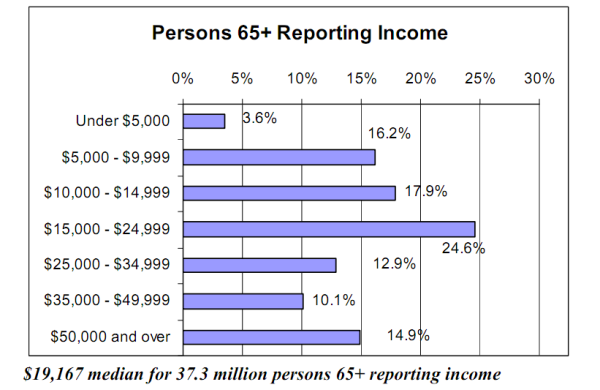
What happens when a society that prides itself on a middle class and self-sufficiency suddenly starts losing both? For over a decade the middle class in the US has been shrinking. This isn't some speculation but is reflected in the stagnant household income data. You also have a giant demographic train in that many baby boomers are now retiring in mass. Over 10,000 baby boomers enter into retirement each day and many have an inadequate amount of savings (if any) to get them through the leaner years. Couple this with a less affluent younger generation and you have a recipe for financial and social turmoil. Many of these younger Americans, many saddled with large student debt, are moving back home with parents that have seen their entire home equity evaporate. Do you think these are happy households especially when the median income of those 65+ is $19,167?
Median income of the old
There seems to be this misconception that older Americans are simply well off. The data shows us otherwise:
Source: US Dept. of Health
What is troubling about the above data is that during some of the most affluent decades in US history, most Americans have very little income in older age. In fact, most rely on Social Security as their primary source of income:
"Social Security constituted 90% or more of the income received by 34% of beneficiaries (21% of married couples and 43% of non-married beneficiaries)."
How is this even possible? Keep in mind the average Social Security payout is roughly $1,000 per month and this is fixed. Since the government has juiced the CPI data most of these fixed income Americans are seeing their energy and healthcare costs soar all the while they are told inflation is virtually non-existent. Try arguing that after going to the grocery store.
There is also this sense that since many older Americans own their home, they are somehow immune to the housing bubble. That is not true:
"In 2009, 48% of older householders spent more than one-fourth of their income on housing costs – 42% for owners"
Many older Americans still spend a lot of money on housing even if they are owners. Much of this comes from property taxes and costs associated with owning a home. Since many older Americans do own their home this housing bubble crash has harmed their largest asset.
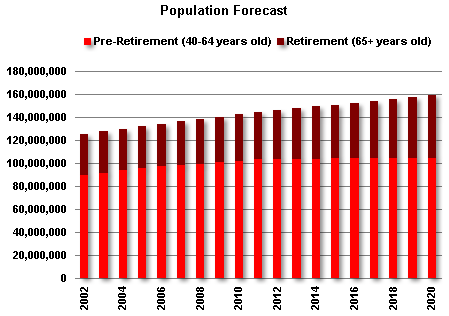
As time presses on more and more of our population is going into retirement. Lower birth rates and more Americans making it into older age conjure up memories of Japan:
Source: Baby boomer stats
-There are approximately 77.6 million baby boomers in the U.S.
-The baby boom phenomenon is responsible for over half of all consumer spending in the United States
-80% of all leisure travel is taken by boomers.
-Every 8.5 seconds a baby boomer in the U.S. turns 50 years old.
-The baby boom generation is the largest generation in American history.
-On January 1st, 2011 the very first Baby Boomers turned 65
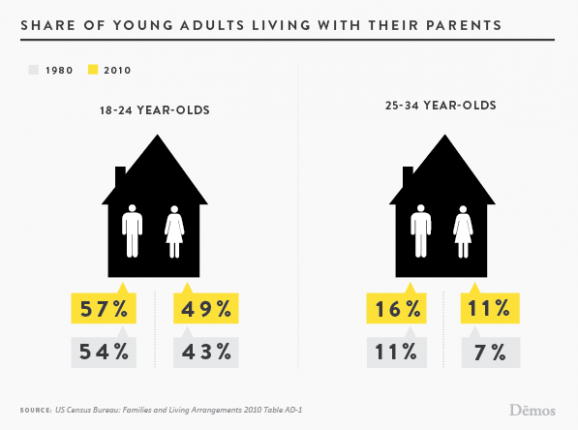
Baby boomers tended to also be big spenders (at least they were during the debt bubbles). But what now? The strongest spending group is losing a large part of their wealth with the housing crash and many are exiting their peak earning stages. From the Social Security data, we realize many did not save in what was likely the most affluent times for America. With many younger Americans carrying major debt loads and finding items like pensions disappearing, how will they prepare for retirement? What access to savings do they have? Homes are still expensive for many younger Americans and that is why millions have moved back home:
A society that has preaches independence and pushes out young at 18 will have a hard time dealing with boomerang kids coming back home. Many younger Americans will feel the strain as well especially if they "did the right thing" and went to college but now find a tough employment market and being back home. This demographic train has left the station and nothing will slow it down.
Thursday, December 1, 2011
Forbes: 'Every day is Black Friday' in housing sector
"Any sort of self-sustaining [housing sector] recovery, at this point, appears unfathomable."
The U.S. economy won't recover until housing recovers; and housing won't recover until the U.S. economy recovers. It's a perfect Catch-22!
So when's the last time you heard a single national-level politician offer an idea how to address this, the #1 problem our economy is facing right now? If they were waiting for the Fed's low interest rates to save us, they should have given up a year ago.
You know, I could almost respect a mean but frank right-winger who said, "Screw homeowners, banks and markets, let this foreclosure backlog work itself out," who would then be honest that this process could take years, maybe a decade, and in the meantime the U.S. economy would drag and unemployment would be high, no matter what else happened. But where is such an honest ideologue these days? No, instead the free-marketers and tea-party types want to blame our poor economy on excess federal regulation, Obamacare (which has yet to really take effect), and not enough oil drilling and coal mining. And nobody -- not the MSM or the Democrats -- are calling them on it.
The ones who haven't gone mute have gone insane!
'Every Day Is Black Friday' In Housing As Prices Tank, Case-Shiller Shows
By Agustino Fontevecchia
November 29, 2011 | Forbes
Thursday, June 9, 2011
Double dip means time to buy?
Saturday, June 4, 2011
Banks, real estate agents, & consumer advocates are all wrong
Friday, December 10, 2010
Zillow: Homes fell $1.7 trillion in 2010, same in 2011
This year's estimated decline, more than the $1.05 trillion drop in 2009, brings the loss since the June 2006 home-price peak to $9 trillion, the Seattle-based company [Zillow] said today in a statement.
"It's definitely going to continue into 2011," Stan Humphries, Zillow's chief economist, said in an interview on Bloomberg Television today. "The back half of 2010 looked horrible and 2011 should look like the mirror image of that."
U.S. Home Values to Drop by $1.7 Trillion This Year, Zillow Says
By Hui-yong Yu and John Gittelsohn
December 10, 2010 Bloomberg
Wednesday, December 1, 2010
MB360: 2.2 housing:income ratio wrecked since 2000
Posted by mybudget360
November 30, 2010
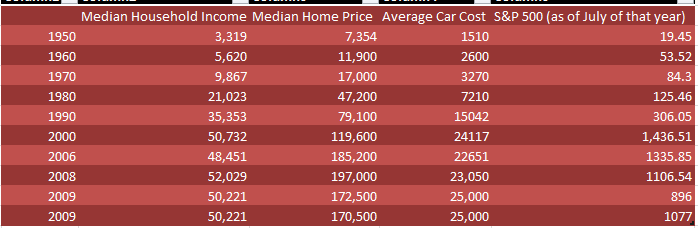
The typical American family is facing the biggest economic uncertainty since the Great Depression and must feel like their lives are in a washer spin cycle. Many unemployed Americans are now entering a stage where unemployment insurance is being cut off which will send tens of thousands of people into the street. The mainstream media won't cover this because they rather gossip about the next tan face to drink themselves into a gutter at a nightclub. 43 million Americans are receiving some kind of food assistance yet this is some kind of recovery? Many are wondering how banks can produce such large profits without actually producing anything real or of substance in the economy. Yet banks are largely casinos that now operate to siphon off real wealth from the economy through bailouts, frauds, and other activities that harm the overall economy. In a decade where banks were unleashed to do what they may with limited regulation and a cozy Fed, we are now left with an economy in tatters but a banking sector that is still healthy based on oversized bonuses. I wanted to gather data over the last 60 years and measure how most Americans are now fairing. The data shows a largely underwater nation.
Let us look at the data carefully:
Back in 1950 the median home price cost a little above 2 times the annual median household income:
1950: $7354 / $3,319 =2.2
In 1960 the ratio remained roughly the same:
1960: $11,900 / $5,620 = 2.1
In fact, over this ten year period the typical household gained buying power when it came to housing. Even in 1970 the ratio became more favorable to US households:
1970: $17,000 / $9,867 =1.7
This was the lowest point at the start of any decade in modern history. After this point, with all the push for deregulation and allowing Wall Street to run rampant prices remained fairly stable only because of the two income household (that is until we hit 2000):
1980: $47,200 / $21,023 = 2.2
1990: $79,100 / $35,353 = 2.2
2000: $119,600 / $50,732 = 2.3
This was sustained via the two income household:After this point, things went haywire. Incomes went stagnant or dropped yet home prices sky rocketed. Even today after the severe correction the ratio is still out of sync with 50 years of data:
2010: $170,500 / $50,221 = 3.3
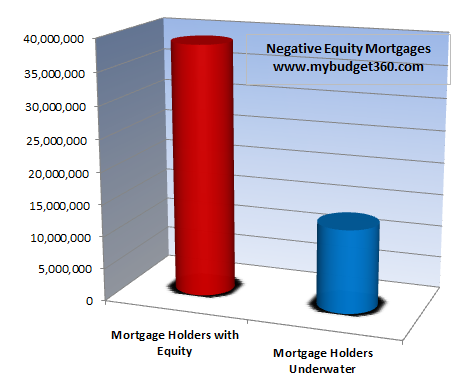
In fact, given the current income levels the median nationwide home price should be down to $119,000 (a 30% drop from current levels). Some will argue that we should factor in for inflation. This would only be the case if we also saw wage growth. For the first time in modern history did we see wages stagnant for an entire decade. So the average American family is still looking at inflated assets and that is why we have millions of people sitting in underwater homes:Just think of what negative equity represents. It represents a household that has over paid for a home. I don't think the desire to own a home has dramatically gone up or down in the last fifty years. Homeownership has always been a big part of the American Dream. But what happened over the last ten years is that banks were able to get their grubby hands on mortgages and convert them into another commodity where they could place large bets and ultimately push losses to taxpayers. People that over paid are paying via foreclosure. What is the penalty that banks are paying? That is why now that banks have raided and had their way with housing, they are looking for other markets to gamble in (with taxpayer money). The above chart shows the millions of homeowners who hold mortgages that are worth more than the homes they are in. Any thinking person realizes that the only way home prices are justified at current levels would be if incomes shot up to make the ratio closer to 2.2. Over half a century of data and never did we have a housing bubble on a nationwide level. All of a sudden Glass-Steagall is repealed in 1999 and a housing bubble takes off with banks leading the way because the line between investment and commercial banking was blurred. Only those who want to deceive themselves would place blame elsewhere.
The average American is going to struggle throughout the next decade. It is hard to see how wages will go up so it is likely that home prices will adjust lower given the magnitude of foreclosures in the pipeline. People might be jumping up and down about the recent job growth but they are occurring in lower paying sectors. So this does nothing to justify current prices. Low mortgage rates are merely a gimmick so banks can use cheap money to speculate on a global scale. Even with mortgage rates at levels we've never seen the housing market remains stalled like an old car. Why? Because the actual sticker price is still inflated based on income levels.
We need to reform the banking system, break up investment and commercial banks, and finally restore sanity in the market. There is a reason the metrics are all off but nothing has been done to change this so we are only a short ways away from another crisis. Ireland for example can be likened to a homeowner that took on too much debt with too little income. So the international banking sector idea of a solution is to extend them a credit line? What they should do is tell the IMF and Euro to shove it, default, and start from scratch and learn from their mistake. Otherwise, they'll be in the same position as Americans who bailed out their corrupt banking sector.