Showing posts with label mortgage crisis. Show all posts

Sunday, June 22, 2014

Krugman reviews Geithner's book 'Stress Test'

I don't care much about Tim Geithner or his financial memoir Stress Test. But Krugman's review of the book features many teachable moments so the review is well worth reading, especially as revisionist historians would like to distort what really happened.  Here's the first one:

Quite early on, two somewhat different stories emerged about the economic crisis. One story, which Geithner clearly preferred, saw it mainly as a financial panic—a supersized version of a classic bank run. And there certainly was a very frightening panic in 2008–2009. But the alternative story, which has grown more persuasive as the economy remains weak, sees the financial panic, while dangerous in its own right, as a symptom of something broader and deeper—mainly a large overhang of private debt, in particular household debt.

Krugman obviously and correctly goes with the latter story. The overhang of private debt -- particularly mortgage debt among the middle and lower class, and more recently, student debt, now about $1 trillion -- is the real anchor weighing down our economy today.

Next, Krugman points out that the FIRE sector is not synonymous with the U.S. economy, something that CNBC and Wall Street types seem to forget sometimes [emphasis mine]:

Whatever the reasons, however, the stress test pretty much marked the end of the panic. ...[S]everal key measures of financial disruption—the TED spread, an indicator of perceived risks in lending to banks, the commercial paper spread, a similar indicator for businesses, and the Baa spread, indicating perceptions of corporate risk. All fell sharply over the first half of 2009, returning to more or less normal levels. By the end of 2009 one could reasonably declare the financial crisis over.

But a funny thing happened next: banks and markets recovered, but the real economy, and the job market in particular, didn’t.

That's because the Great Recession wasn't just a mega run on banks that the "confidence fairy" could restore, via cheap money for banks from the Fed. Rather, the Great Recession was a problem of too much private debt dragging down aggregate demand and hence economic growth, in a vicious cycle:

The logic of a balance sheet recession is straightforward. Imagine that for whatever reason people have grown careless about both borrowing and lending, so that many families and/or firms have taken on high levels of debt. And suppose that at some point people more or less suddenly realize that these high debt levels are risky. At that point debtors will face strong pressures from their creditors to “deleverage,” slashing their spending in an effort to pay down debt.  But when many people slash spending at the same time, the result will be a depressed economy. This can turn into a self-reinforcing spiral, as falling incomes make debt seem even less supportable, leading to deeper cuts; but in any case, the overhang of debt can keep the economy depressed for a long time.

And here's where we get down to the brass tacks of the federal government's response, and the Fed's position (Geithner's) on that response:

Unlike a financial panic, a balance sheet recession can’t be cured simply by restoring confidence: no matter how confident they may be feeling, debtors can’t spend more if their creditors insist they cut back. So offsetting the economic downdraft from a debt overhang requires concrete action, which can in general take two forms: fiscal stimulusand debt relief. That is, the government can step in to spend because the private sector can’t, and it can also reduce private debts to allow the debtors to spend again. Unfortunately, we did too little of the first and almost none of the second.

Yes, there was the American Recovery and Reinvestment Act, aka the Obama stimulus, and it surely helped end the economy’s free fall. But the stimulus was too small and too short-lived given the depth of the slump: stimulus spending peaked at 1.6 percent of GDP in early 2010 and dropped rapidly thereafter, giving way to a regime of destructive fiscal austerity. And the administration’s efforts to help homeowners were so ineffectual as to be risible.

And Geithner, who was in the middle of Obama's inner circle of trusted economic advisers, opposed both stimulus and debt relief, notes Krugman:

Geithner also makes some demonstrably false statements about the public debate over stimulus. “At the time,” he declares, “$800 billion over two years was considered extraordinarily aggressive, twice as much as a group of 387 mostly left-leaning economists had just recommended in a public letter.” Um, no. A number of economists, including Columbia’s Joseph Stiglitz and myself, were warning that the package was too small; so was Romer, internally. And that economists’ letter called for $300 to $400 billion per year. The Recovery Act never reached that level of spending; even if you include tax cuts of dubious effectiveness, it only briefly grazed that target in 2010, before rapidly fading away.

And then there’s the issue of debt relief. Geithner would have us believe that he was all for it, but that the technical and political obstacles were too difficult for him to do very much. This claim has been met with derision from Republicans as well as Democrats. For example, Glenn Hubbard, who was chief economic adviser under George W. Bush, says that Geithner “personally and actively opposed mortgage refinancing.”

Krugman takes exception to Geithner's victory dance on ending the crisis and the Great Recession:

To the rest of us, however, the victory over financial crisis looks awfully Pyrrhic. Before the crisis, most analysts expected the US economy to keep growing at around 2.5 percent per year; in fact it has barely managed 1 percent, so that our annual national income at this point is around $1.7 trillion less than expected. Headline unemployment is down, but that’s largely because many workers, despairing of ever finding a job, have stopped looking. Median family income is still far below its pre-crisis level. And there’s a growing consensus among economists that much of the damage to the economy is permanent, that we’ll never get back to our old path of growth.

There's more to this story that Krugman forgivingly overlooks, such as why Geithner was so solicitous to Wall Street banks and not Main Street Americans. After all, Geithner "met more often with Goldman Sachs CEO Lloyd Blankfein than Congressional leaders, including the Speaker of the House and the Senate Majority Leader," in his first few months in office.  Why??


By Paul Krugman
June 10, 2014 | The New York Review of Books

Thursday, February 20, 2014

Baker: Stimulus worked, but it was too small

Two-fisted liberal pride!  Don't ever back down!  The GOP watered down the stimulus with 1/3 tax cuts and cut the overall amount from more than $1 trillion that was required to about $700 billion.  

Sums up Dean Baker: "In other words, we were trying offset a loss of $1.4 trillion in annual demand with a stimulus package of $300 billion a year. Surprise! This was not enough."

Even so, the stimulus helped avoid a second Great Depression.  

My progressive comrades: don't ever apologize, don't ever make excuses. THE STIMULUS WORKED.  The fact that it couldn't do more is entirely the fault of Republicans.

Now read below to get the numbers.


By Dean Baker
February 20, 2014 | CNN

When President Obama proposed his stimulus in January 2009, the economy was in a freefall, losing more than 700,000 jobs a month. The immediate cause of the plunge was the freezing up of the financial system after the collapse of Lehman Brothers, but the deeper cause was the loss of demand after the collapse of the housing bubble.

The bubble had been driving the economy both directly and indirectly. The unprecedented run-up in house prices led to a record rate of construction, with about 2 million homes built at the peak in 2005.

In addition, the $8 trillion in housing equity created by the bubble led to an enormous consumption boom. People saw little reason to save for retirement when their home was doing it for them. The banks also made it very easy to borrow against bubble-generated equity, which many people did. As a result, the personal saving rate fell to 3% in the years 2002-07.

The bubble also indirectly enriched state and local governments with higher tax revenue. And there was a mini-bubble in nonresidential real estate, but that came to an end in 2008 as well.

The economy had already been in recession for nine months before the collapse of Lehman because the bubble was deflating, but the Lehman bankruptcy hugely accelerated the pace of decline. This was the context in which Obama planned his stimulus package before he even entered the White House.

At that point, most economists still did not recognize the severity of the downturn, just as they had not seen the dangers of the housing bubble that had been building over the previous six years.

The Congressional Budget Office projections, which were very much in the mainstream of the economics profession, showed a combined drop in GDP for 2008 and 2009 of 1%, before the economy resumed growth again in 2010. This is with no stimulus. By contrast, the economy actually shrank by 3.1% in those years, even with the stimulus beginning to kick in by the spring of 2009.

Given this background, it was easy to see that the stimulus was far too small.  It was designed to create about 3 million jobs, which might have been adequate given the Budget Office projections. Since the package Congress approved was considerably smaller than the one requested, the final version probably created about 2 million jobs. This was a very important boost to the economy at the time, but we needed 10 million to 12 million jobs to make up for jobs lost to the collapse of the bubble.

The arithmetic on this is straightforward. With the collapse of the bubble, we suddenly had a huge glut of unsold homes. As a result, housing construction plunged from record highs to 50-year lows. The loss in annual construction demand was more than $600 billion. Similarly, the loss of $8 trillion in housing equity sent consumption plunging. People no longer had equity in their homes against which to borrow, and even the people who did would face considerably tougher lending conditions. The drop in annual consumption was on the order of $500 billion.

The collapse of the bubble in nonresidential real estate cost the economy another $150 billion in annual demand, as did the cutbacks in state and local government spending as a result of lost tax revenue. This brings the loss in annual demand as a result of the collapse of the bubble to $1.4 trillion.

Compared with this loss of private sector demand, the stimulus was about $700 billion, excluding some technical tax fixes that are done every year and have nothing to do with stimulus. Roughly $300 billion of this was for 2009 and another $300 billion for 2010, with the rest of the spending spread over later years.

In other words, we were trying offset a loss of $1.4 trillion in annual demand with a stimulus package of $300 billion a year. Surprise! This was not enough.

That is not 20/20 hindsight; some of us were yelling this as loudly as we could at the time.  It was easy to see that the stimulus package was not large enough to make up for the massive shortfall in private sector demand. It was going to leave millions unemployed and an economy still operating far below its potential level of output.

We are still facing the consequences of an inadequate stimulus. The reality is that we have no simple formula for getting the private sector to replace the demand lost from the collapse of the bubble.

Contrary to what Republican politicians tell us, private businesses don't run out and create jobs just because we throw tax breaks at them and profess our love.  If the government doesn't create demand, then we will be doomed to a long period of high unemployment -- just as we saw in the Great Depression. The government could fill the demand gap by spending on infrastructure, education and other areas, but in a political world where higher spending is strictly verboten, that doesn't seem likely.

The one alternative, which has been successfully pursued by Germany, is to reduce the supply of labor through work sharing. Companies reduce all their employees' hours and pay so everyone keeps their jobs. The government then pays the workers part-time unemployment benefits -- cheaper than paying someone full-time unemployment.

Germans have used this route to lower their unemployment rate to 5.2%, even though their nation's growth has been slower than ours.

Some bipartisan baby steps have been taken in this direction; we will need much more if we are to get back to near full employment any time soon. In a world where politics makes further stimulus impossible, work sharing is our best hope.

Saturday, July 13, 2013

Black: Lenders & appraisers hyper-inflated housing bubble

Once again, two-fisted ex-regulator Bill Black takes a baseball bat to the kneecaps of the myth that "stupidity" and "greed" were to blame for the mortgage crisis.  And if that doesn't work, let's blame it all on the FMs.

Fraud.  We don't say it, you certainly won't hear it in the mainstream media, but it's there, and it remains unpunished and undeterred.


By William K. Black
July 9, 2013 | Huffington Post

Saturday, March 2, 2013

Black: Fraud 'pervasive' at 'most reputable' banks

Bill Black has been vindicated by a new study of global financial institutions:

The central point we have been arguing for years is now admitted -- and treated as a universally known fact: "mortgage originators were told to do whatever it took to get loans approved, even if that meant deliberately altering data about borrower income and net worth." The crisis was driven by liar's loans. By 2006, half of all the loans called "subprime" were also liar's loans -- the categories are not mutually exclusive (Credit Suisse 2007). As I have explained on many occasions, we know that it was overwhelmingly lenders and their agents (the loan brokers) who put the lies in liar's loans.

The incidence of fraud in liar's loans was 90 percent (MARI 2006). Liar's loans are a superb "natural experiment" because no entity (and that includes Fannie and Freddie) was ever required to make or purchase liar's loans. Indeed, the government discouraged liar's loans (MARI 2006). By 2006, roughly 40% of all U.S. mortgages originated that year were liar's loans (45% in the U.K.). Liar's loans produce extreme "adverse selection" in home lending, which produces a "negative expected value" (in plain English -- making liar's home loans will produce severe losses). Only a firm engaged in control fraud would make liar's loans. The officers who control such a firm will walk away wealthy even as the lender fails. 

And let's repeat: not a single officer of a major bank has been prosecuted or gone to jail for control fraud. 


By William K. Black
February 28, 2013 | Huffington Post

Sunday, October 28, 2012

Why are both candidates silent on mortgage crisis?

President Obama has done almost nothing to help Americans restructure their mortgages.  With HAMP, Obama pledged to modify 4 million mortgages; but in fact "more than 1 million homeowners have been bounced out of the program."  

Meanwhile, about one-quarter of all U.S. houses are still underwater to the tune of about $690 billion.

So why is Romney silent on Obama's failure?

Because Romney promises to be even worse.  He has not made one proposal for re-structuring mortgages to somehow reduce mortgage principles.  Indeed, Republicans believe underwater mortgages are an issue of personal responsibility, a sacred trust between the bank and the borrower into which Big Government shouldn't intrude.

My hero, economics professor Joseph Stiglitz, finds it "shocking" that both candidates have been silent about the housing crisis.  And it has a been "a gross miscarriage of justice" that not one banker has ended up behind bars, said Stiglitz.  Then again, we shouldn't be surprised, since both candidates are in the pocket of the TBTF banks.


October 24, 2012 | Reuters TV

Wednesday, September 5, 2012

Underwater mortgages down, still total $690 BILLION

This report explains most if not all our current economic malaise.  I mean, if 24 percent of all homeowners are underwater on their mortgages to the sum of $691 billion (!), they're not going to feel secure enough to spend and stimulate the economy, or take the risk of opening their own business.  Their first priority is to pay off debt, and/or try to modify their mortgage with the bank -- a Kafkaesque nightmare that becomes like a second job.  

Sure, technically, many of these households are "saving," meaning they are paying down debt; however, this is not like savings invested in start-ups, stocks or bonds that drives long-term economic growth.

The Obama Administration has done almost nothing so far to help distressed borrowers.  Yet Republicans promise to do even less.  Indeed they reminded us in Tampa that they are the party of personal responsibility and hyper-individualism.  "Irresponsible" borrowers must "take their medicine" and learn a moral lesson from it -- that's what they deserve, that's what's fair, say Republicans.  Maybe so.  But it's definitely not what our country needs.  

So with Obama or with Romney, it won't make much difference, this thing is going to take years, if not a decade, to work itself out on its own without government intervention.  


By Mamta Badkar 
July 12, 2012 | Business Insider

11.4 million or 23.7 percent of all residential properties with a mortgage were in negative equity – when borrowers owe more on their mortgages than their property is worth – according to a new report by Corelogic.

This is down from 25.2 percent of all residential properties in the fourth quarter of last year. And lower than 24.7 percent in Q1 2011.

The negative equity share is at its lowest in nearly three years.

Here are some details from the report:
  • Negative equity declined to $691 billion in the first quarter, from $742 billion in the fourth quarter.
  • Over 700,000 households returned to positive equity in the first quarter.
  • 2.3 million borrowers had less than 5 percent equity i.e. were in near-negative equity in the first quarter.
  • Negative equity and near-negative equity mortgages accounted for 28.5 percent of all residential properties in Q1. This is down from 30.1 percent in Q4.
  • Nevada had the highest negative equity percentage with 61 percent of all mortgaged properties underwater.
  • The bulk of negative equity is focused on the low-end of the market. The negative equity for low-to-mid value homes (under $200,000) is at 31 percent of borrowers, nearly double the 15.9 percent for borrowers with home values over $200,000.
Decline in home values or an increase in mortgage debt cause an increase in negative equity. Negative equity improved in large part because of an improvement in home price levels.

"In the first quarter of 2012, rebounding home prices, a healthier balance of real estate supply and demand, and a slowing share of distressed sales activity helped to reduce the negative equity share," said Mark Fleming, chief economist for CoreLogic. "This is a meaningful improvement that is driven by quickly improving outlooks in some of the hardest hit markets."

Monday, September 3, 2012

Obama owes liberals an explanation -- and an apology

A little grayer, but any wiser after 4 years of giving in to the GOP?
Conservatives dislike Obama for their own silly reasons, most of which relate to his non-traditional background: his mixed race; his peripatetic, multi-cultural, international upbringing (encapsulated in Birtherism); his "inexplicable" entrance into and completion of Columbia University and Harvard Law School; his "angry black" former pastor; his community organizing in Chicago; his proximity to ACORN and Saul Alinsky, etc.  

Indeed, it's quite telling how, even after four years in office, conservatives still primarily fixate on, and object to, Obama's origins, i.e. everything leading up to his term as Senator from Illinois.  It just goes to show that they were never going to accept him, never going to admit him into their country club, no matter what he did.  

Prime example: when Obama rolled out a health care bill after months of consultation with private insurance companies and Big Pharma -- a bill that was originally conceived by the conservative Heritage Foundation, passed into law by Republican Mitt Romney in 2006, and endorsed by Republican Newt Gingrich in 2006 and again 2008 -- because it came from Obama, Republicans called it Socialism and Big Government tyranny.  (And today, the aforementioned three feel not the slightest bit of shame in criticizing it as such!)

Unlike conservatives, we liberal-progressives have real gripes with Obama.  Unlike them, we are entitled to feel baffled and betrayed at Obama's first four years, because we voted for him with hope for change, and then watched as he let himself get beat up, again and again, by the Republican Congress, while he gave up key concessions for nothing, including: 

  • the public option in Obamacare; 
  • a stimulus bill in excess of $1.2 billion that was not one-third tax cuts; 
  • real mortgage modifications with principal reduction for millions of underwater homeowners; 
  • letting Bush's irresponsible tax cuts expire; and
  • real banking-financial reform to end Too Big To Fail and speculation with taxpayers' guarantee.

This is not to mention Obama's erstwhile support for fast U.S. troops withdrawals from Afghanistan and Iraq, perhaps the most mobilizing issue among Obama's grassroots supporters.  (By the way, during Clint Eastwood's curious, rambling speech at the GOP convention when he called for immediate withdrawal from Afghanistan, the conservative crowd erupted in cheers.  Gee, what a difference four years and a Democratic commander-in-chief makes!)

This past weekend, Sam Stein and Ryan Grim posted a very good synopsis of the disappointments of Obama's first term from a progressive's point of view.  It shows how Obama foolishly tried to play an "inside game" with Congressional Republicans who stated publicly that their #1 priority was to defeat him in 2012, and who sabotaged a deal with Obama on the deficit because it would have helped him get re-elected.

His pointless concessions were even more tragic and stupid, considering Obama's record 13 million e-mail addresses and 3 million individual online donors in 2008. Obama had this huge mass of active grassroots support with which he could have bludgeoned obstinate Republicans into submission, but instead Obama forswore his base, laying down his greatest weapon only to be barraged by Republican fusillades.

Maybe he's just too nice a guy.  Certainly he's too weak.  Maybe he had bad advice. (OK, he definitely had bad advice: Summers, Geithner, Emanuel, Axelrod, et al.)  Or maybe he was vain and bought into the hype that he was a "transformational" leader whom Republicans would have no choice but to bargain with, thanks to his irresistible post-partisan reasonableness.  Whatever the reason, it was such a wasted opportunity.


Sunday, May 6, 2012

Yves Smith: PBS whitewashed crisis, bailouts

If this is how the "liberal media" (PBS) takes on America's corrupt bankster-regulator nexus, then the conservative media can relax.  The fix is already in.  History has been re-written by the victors.


By Yves Smith
April 27, 2012 | Naked Capitalism

Tuesday, February 14, 2012

U.S. spending power won't come back

The lost spending power of U.S. consumers was driven largely by debt, largely financed by inflated home values. On the part of banks, this vanished wealth was based on derivatives whose value was based on homes whose value evaporated, bringing down the whole house of financial cards. In both cases it was wealth that should never have existed in the first place. We all must come to terms with the new normal. There is no going back to 2005. Anybody who says we can is ignorant or a charlatan.


By Bonnie Kavoussi
February 13, 2012 | Huffington Post

"The economy that we had before the recession is gone," said Kenneth Goldstein, economist at the Conference Board. "It's not coming back."

The U.S. economy is transitioning to a new normal in which businesses invest less and consumers spend less than before the recession, Goldstein told The Huffington Post in an interview last week. As a result, he said, economic growth and job growth will be slower than before.

He said that businesses, consumers and the government would need to spend at least $1 trillion more than they are likely to spend in order for the economy to return to its pre-recession growth rate. But he added that no one is willing to spend the money necessary to jumpstart the economy, since the government is cutting spending, consumers are saving more, and businesses expect a lower return on their investments.

"Where's the money?" Goldstein asked.

The Conference Board, which counts half of all Fortune 500 companies among its members, provides economic and business advice and research to its member companies.

The main problem is that consumers' expectations for the future have plunged, Goldstein said. They suffered from such a large economic shock in 2008 and 2009 that many older people now do not expect to return to work, and many younger people no longer expect to make that much money, he continued. As a result, Americans have cut back on spending.

Consumers are indeed saving more than they did before the recession. They saved 3.7 percent of their incomes at the end of 2011, in contrast to less than 2 percent of their incomes during all of 2005, according to government statistics. Their wages, when accounting for inflation, actually fell in 2011.

Consumer confidence has been at recessionary levels for the past four years, according to the Conference Board's Consumer Confidence Index.

Like consumers, businesses are spending less because they have lowered their expectations of future income, Goldstein said. While businesses could expect returns of 8 to 12 percent on their investments before the recession, they are now expecting returns of about half that amount. If they raise prices too much, consumers will choose cheaper alternatives, he said.

Exports are one of the only bright spots sustaining U.S. economic growth at this slower pace, he added.

Now that people's homes are often worth less and credit is expensive, people are relying on their wages to be able to spend money -- and their wages have barely been growing, said Lynn Franco, director of the Conference Board's Consumer Research Center. She said this means that economic growth will be slower than it was before the recession for the foreseeable future, since consumer spending comprises two-thirds of the U.S. economy.

"If you just take a look at the fundamentals alone," she said, "you cannot get back to the levels of consumer spending that we had prior to the crisis."

Tuesday, January 10, 2012

Obama's greatest failure as POTUS?

One of Obama's greatest, tragic failures as President has been his willful neglect of mortgage borrowers in distress.

By contrast, when the Too Big To Fail (TBTF) banks were in trouble, starting in 2007, help from Congress, Treasury and the Fed was overwhelming (in the $ trillions, not $ billions) and above all FAST, with so little oversight that to this day we don't know who got loans why and under what terms and conditions.

But help for distressed homeowners has been almost nil, ostensibly because of poor administration and contradicting directives, but in fact because of Obama's lack of interest and political will.

It just goes to show that Obama is Wall Street's boy, not Main Street's.


By Loren Berlin
December 9, 2012 | Huffington Post

Monday, October 17, 2011

For the last time: Fannie did NOT cause financial disaster

Gee, I'm sure this well-researched article will put an end to the false belief that the FMs caused the financial crisis, which has become an article of faith among many, especially on the Right.

I'm doubly sure that those who refute this article will come back with statistics or studies or something checkable to support their false claim that the FMs/GSEs caused the financial crisis.

Yep, I'm absolutely sure, because we're all reasonable, fact-based thinkers.


By Jeff Madrick and Frank Partnoy
October 27, 2011 | New York Review of Books

Amid the current financial turmoil, the causes of the crisis that just preceded it—the bursting of the housing bubble—are being badly distorted. Some analysts, including the authors of the book under review [Reckless Endangerment: How Outsized Ambition, Greed, and Corruption Led to Economic Armageddon, by Gretchen Morgenson and Joshua Rosner], are arguing that the housing and financial crises of 2007 and 2008 were the direct result of federal guarantees of mortgages, a program first created in the 1930s, and therefore less so the result of the aggressive creation of mortgages by private business than has been widely reported.

In particular, the authors accuse two quasi-public but profit-making companies, Fannie Mae (the Federal National Mortgage Association) and Freddie Mac (the Federal Home Loan Mortgage Corporation), of adding risks to the mortgage markets that resulted in disaster. Much the same criticism has been made by Peter Wallison, a fellow of the American Enterprise Institute, who wrote an angry dissent to the findings of the Financial Crisis Inquiry Commission (FCIC), which was appointed by Congress to investigate the causes of the crash. Contrary to Wallison, the nine other members of the commission, including three others appointed by Republicans, concluded that Fannie and Freddie were not the main causes of the crisis.

Along with many other experts, the nine members pointed to considerable evidence that, despite large losses, these government-sponsored enterprises (GSEs), as they are known, bought or guaranteed too few highly risky loans, and did so too late in the 2000s, to cause the crisis. But in their new book, Reckless Endangerment, the New York Times reporter Gretchen Morgenson and mortgage securities analyst Joshua Rosner try to revive the issue of their responsibility.

The book boldly and passionately asserts that the risk-taking of Fannie Mae and Freddie Mac was a major element in causing the housing bubble. In particular, the authors blame the crisis on the goals set by the Clinton administration in the early 1990s to make lending "affordable" to more middle- and low-income home buyers. These goals were raised several times over the next dozen years so as to include more people, with the result that loans became cheaper. The authors write, "The homeownership drive helped to plunge the nation into the worst economic crisis since the Great Depression." They add, "How Clinton's calamitous Homeownership Strategy was born, nurtured, and finally came to blow up the American economy is a story of greed and good intentions, corporate corruption and government support."

This bold claim, however, is not substantiated by persuasive analysis or by any hard evidence in the book. The GSEs did generate large losses, but their bad investments in housing loans followed rather than led the crisis; most of those investments involved purchases or guarantees made well after the subprime and housing bubbles had been expanded by private loans and were almost about to burst.

Even then, the GSEs' overall purchases and guarantees were much less risky than Wall Street's: their default rates were one fourth to one fifth those of Wall Street and other private financial firms, a fact not made clear by the authors. A further review of other literature shows that Clinton's goals to increase "affordable lending" had little to do with the risks the GSEs took. The FCIC, for example, argued that in several years these goals were largely met by the GSEs' standard loans with traditional down payments.

Although they were set up originally by the federal government, the GSEs have been private companies for roughly the last forty years. They are traded on the stock market and were on a hunt for profits like much of Wall Street, in part because their executives' bonuses were linked to earnings per share. Even so, by comparison with other companies they restrained their risk. Private firms on Wall Street and mortgage companies across the nation, uncontrolled by adequate federal regulation, unambiguously caused the crisis as they expanded in the 2000s. They were the ones who "came to blow up the American economy."

This is not to say that the GSEs' way of doing business was sensible or that their losses—up to $230 billion—can be justified. The hybrid business model of a quasi-public but profit-making company, whose bonds were treated in the financial markets as if they were guaranteed by the federal government, was likely to lead to abuse and careless investment. Financial markets assumed that the GSEs were relatively safe partly because they were regulated by a federal agency, the Office of the Federal Housing Enterprise Oversight (OFHEO) and were subject to a web of rules. They also had a long record of backing safe mortgages. The authors describe well how, beginning in the 1990s, Fannie in particular betrayed its responsibilities. It aggressively minimized federal regulation of its activities and it fought off attempts to tax its profits, partly through extravagant favors to influential lawmakers. This is a story that needed telling. Reform of the GSEs should be an urgent part of a new federal housing agenda.

But the book's unjustified thesis that Fannie and Freddie were major causes of the financial crisis is being used by politicians and pundits to soften criticism of private business and by lobbyists and others who would water down the new regulations passed by Congress under the Dodd-Frank Act. The book is also being exploited by those who believe the federal government should have little if anything to do with support for the mortgage market, a view we find unfounded.

Reviving the housing market was a high priority for Franklin Delano Roosevelt when he took office in 1933. In 1934, he created the Federal Housing Administration, which guaranteed mortgage payments, and provided insurance for savers' deposits in the thrift institutions that then were the nation's leading mortgage writers. He had also created a government bank, the Home Owners' Loan Corporation, to make new loans to distressed home owners and buy bad mortgages from failing financial institutions. Finally, in 1938, he established Fannie Mae to guarantee mortgages that met adequate standards or buy them outright from private financial institutions; it issued its own debt to major investors to support its practices. The goal was to maintain a stable mortgage market with reasonable borrowing rates in all regions of the country.

For roughly fifty years, Fannie Mae did its job. Home ownership rates rose from about 40 percent in the 1920s to about 60 percent and, in contrast to earlier, far more volatile history, the mortgage market was mostly stable. Freddie Mac was created in 1970 as a private company to package mortgages into securities that could be sold to institutional investors like pension funds.

That the GSEs were private began to draw increasing criticism as they grew larger. The implied federal guarantee of the debt of these private, profit-making companies, which lowered their borrowing rates, made it easier for them to grow and make new and riskier loans. Some urged that the GSEs be fully privatized and stripped of any advantage they might have because of federal regulation. Wall Street and mortgage firms wanted for themselves the business Fannie and Freddie were doing, including the packaging of mortgages into securities.

In the early 1990s, Congress recognized that Fannie and Freddie, which were growing rapidly, required closer regulation. President Clinton and Congress also were eager to channel more loans to lower-income Americans. Congress passed the Federal Housing Enterprises Financial Safety and Soundness Act of 1992, which established a new agency to oversee the GSEs and set affordable lending goals.

From the beginning, the new oversight agency—OFHEO—was weak. And this is essentially where Reckless Endangerment begins, with sordid details about how James Johnson, Fannie's chief executive and an influential Democratic insider, fended off control by OFHEO during its first seven years. Johnson established an expensive twelve-person lobbying office, gave campaign money to powerful politicians, and made contributions to the favorite charities of influential congressmen. He opened local development offices in congressional districts as a public relations campaign to show how congressmen were helping their local constituents get mortgages.

By means of such measures, Johnson won congressional support and repeatedly resisted attempts by a handful in Congress to rein Fannie in, as did his successor in 1999, Franklin Raines, President Clinton's former budget director. Perhaps most important, Johnson tied his own CEO bonuses and those of other executives to the earnings of the company.

Morgenson and Rosner make a strong if one-sided case against Johnson. We never hear from any of his defenders, and he refused, the authors write, to be interviewed. But as they make clear, Johnson, partly by his egregious self-promotion, made Fannie virtually untouchable politically. Above all, he exploited the Fannie mandate to lend to lower-income Americans in order to expand the company's reach, and in the process increase both its earnings and his personal wealth.

They also note that Democrats ranging from Congressman Barney Frank, who got his partner a job with Fannie, to former Clinton adviser Lanny Davis were strong supporters of Fannie Mae. William Daley, a high-level adviser to President Obama, was on Fannie's board. They cite Republicans who were Fannie supporters or executives as well, including Newt Gingrich, Senator Christopher Bond, and Robert Zoellick, legal counsel of Fannie and currently head of the World Bank.

The authors make no serious charges of outright fraudulent corruption on the part of these people, however. The one potential exception is Angelo Mozilo, the flamboyant head of Countrywide Financial, the nation's largest mortgage originator, who offered beneficial mortgage rates to some influential politicians. But the authors add nothing new here. The "friends of Mozilo," who got cut-rate VIP loans, included Johnson, Senators Chris Dodd and Kent Conrad, and the late Ambassador Richard Holbrooke, among others. But while Mozilo did favors for them, Morgenson and Rosner cite no specific favors returned to Mozilo by Dodd, Conrad, Holbrooke, or the others mentioned.

In these and other cases, the authors tar with a broad brush. They write that they conducted interviews over more than a decade and amassed a "mountain of notes," but many sources quoted are anonymous and the book does not cite references in footnotes so there is no way to assess many of their assertions. They almost never deal with counterarguments to their many claims, if only to show them wrong.

They make some odd errors as well, such as stating that Walter Mondale was "sitting out" the 1980 presidential election, when as vice president he ran again as Jimmy Carter's running mate. Their scathing criticism of a Federal Reserve Bank of Boston study published in 1992, which demonstrated prejudice against minorities in the distribution of mortgages in the Boston area, is an especially disturbing example of their one-sided reporting. They assert that this study, which they say influenced Congress's adoption of affordable lending goals, was deeply flawed. They mock the primary author of the study, the economist Alicia Munnell, and state that the Boston Fed made "a fool of itself."

But they don't point out that the Boston Fed's study was later subject to a stringent peer-review process and was published in 1996 in the respected American Economic Review. Indeed, few research papers have been as closely scrutinized. The published results, which corrected some methodological errors, showed persuasively that there was in fact a bias in the mortgage markets. In 1998, another peer-reviewed paper—also ignored by the authors—analyzed the criticisms of the Boston Fed study, as well as other research on mortgage bias, and concluded that the study was fundamentally correct. "The bottom line is that the results related to race are extremely robust," wrote the author.

The one claim that Morgenson and Rosner depend upon most for their extreme conclusions about Fannie and Freddie is especially poorly documented. Fannie, they write, started influencing the private sector in damaging ways beginning in the 1990s, when the GSEs reduced the down payments required for mortgages in order to help poorer Americans acquire housing loans. Fannie's lower standards "set the tone for private-sector lenders across the nation." In support, they cite two quotes from one unidentified former Fannie executive. They offer no empirical evidence, or even telling illustrations or anecdotes. A more recent paper by economist Edward Pinto offers more supposedly illustrative anecdotes about reduced down payments but remains unpersuasive. In fact, the loans guaranteed by Fannie in those years were always privately insured.

But the key point—which is largely missing from Reckless Endangerment —is that private lenders made far riskier loans than GSEs bought or guaranteed, especially during the 1990s, when subprimes issued to borrowers with low income and poor credit were relatively new. You will not read in Reckless Endangerment that the GSEs bought very few subprimes in these years. Rather than leading the way, Fannie's market share of the low-income home buyers fell behind private industry's far riskier lending to poorer home owners and others.

The increased risk-taking of the GSEs during the 1990s, far more modest than what was to come in the 2000s in the private sector, had no bearing on the financial crisis of 2007 and 2008. The authors make it seem as if it did, however. They write:

Clinton's public-private partnership was ramping up…. To meet the goals Fannie and Freddie had to buy riskier mortgages, such as those defined as subprime….

Some $160 billion in subprime mortgages would be underwritten in 1999, up from $40 billion five years earlier. And in another four years, that figure would jump to $332 billion.

Many of those loans wound up in Fannie's and Freddie's portfolios. By 2008, some $1.6 trillion of toxic mortgages, or almost half of those that were written, were purchased or guaranteed by Fannie and Freddie.

As noted, the GSEs bought very few subprimes in the 1990s. But it might especially surprise the inexpert reader to know that the GSEs did not own almost half of the "toxic mortgages" written by private companies, a remarkable exaggeration on the part of the authors. As usual, no source for the estimate is given, but it is likely based on the analysis of Pinto, who was a former Fannie official and is a colleague of Wallison's at the American Enterprise Institute. To make the claim, Pinto radically redefined what qualified a mortgage to be subprime or an Alt-A, for which mortgage-holders were often not required to document their income, rejecting the conventional and widely accepted definitions. In his analysis, almost any mortgage held by Fannie and Freddie with modest above-average risk was categorized, to use Morgenson and Rosner's term, as "toxic."

If so, one would presume the delinquency rates suffered by the GSEs during the crisis would have been very high. But David Min, an analyst with the Center for American Progress, shows that the after-crisis delinquency rates on the large additional portion of GSE mortgages that Pinto claimed were high risk, and that was termed "toxic" by Morgenson and Rosner, was roughly 10 percent, far lower than the 25 to 30 percent default rate of true subprimes. In fact, the rate of delinquencies for all GSE securities in 2004 was 4.3 percent, compared to a delinquency rate in private industry of 15.1 percent of mortgages. In 2005, the GSE rate was 7.8 percent compared to 28.7 percent, and in 2006 and 2007, the rates reached 13.2 and 14.9 percent in the GSEs and 45.1 and 42.3 percent in the private market. None of these figures are cited in Reckless Endangerment. In fact, losses as a proportion of mortgages guaranteed or bought by the GSEs were far lower than in private industry.

When Wall Street was taking more and more risk in the 2000s, as the housing bubble expanded, the GSEs were, relatively speaking, sitting it out. Johnson had left Fannie at the end of 1998 with a $21 million pay package, joining the board of Goldman Sachs and eventually running the Brookings Institution and becoming a key adviser to Senator John Kerry in his run for the presidency. But serious accounting irregularities under Raines, perhaps initiated under Johnson, left Fannie subject to immense pressure years later to get its books straightened out. Overall mortgage debt grew by 11.9 percent a year from 2003 to 2007, but the amount funded by the GSEs grew by only 7.6 percent a year. The GSE market share fell from over 50 percent to 40 percent.6

The GSEs did buy subprime mortgages in the 2000s, but contrary to the impression given by Morgenson and Rosner, their purchases were always a distinct minority of those sold by Wall Street. As Jason Thomas and Robert Van Order of George Washington University further point out, the subprimes the GSEs bought in these years were from the safer triple-A tranches of basic mortgage-backed securities, i.e., the highest quality of groups of mortgages rated by their risk of default. The GSEs never bought the far riskier collateralized debt obligations (CDOs) that were also rated triple-A and were the main source of the financial crisis. (The triple-A classifications of some of those CDOs were conferred on them very dubiously by the credit-rating agencies, Standard & Poor's and Moody's.) It turned out that subprimes accounted for only 5 percent of the GSEs' ultimate losses, according to Thomas and Van Order.

Some, like Alan Greenspan, argued that the GSEs' purchases of subprimes, nevertheless, helped hold down mortgage rates and therefore pushed up demand for housing and housing prices. But Thomas and Van Order strongly dispute that as well, showing that there was so much demand for the healthier triple-A tranches the GSEs bought that the purchases of subprimes made virtually no difference.

What then caused the losses of up to $230 billion by the GSEs that required the Treasury to put them into conservatorship in September 2008—they are now run by the Federal Housing Finance Agency—and a federal bailout of up to $150 billion in capital? It had little to do with pursuit of the original goals of "affordable lending." The GSEs were far more concerned to maximize their profits than to meet these goals; they were borrowing at low rates to buy high-paying mortgage securities once their accounting irregularities were behind them. For example, they started aggressively buying Alt-A loans that did not generally meet affordable lending goals because they were made to higher-income individuals. This was irresponsible. Most disturbing about the GSEs, they refused to maintain adequate capital as a cushion against losses, despite demands from their own regulators that they do so.

The GSEs never took nearly the risks that the private market took. Still, when housing prices collapsed so sharply, even modestly risky and traditionally safe mortgages produced losses. The risky lending was not driven by the affordable lending goals; nor did it cause the crisis. Thomas and Van Order write convincingly that the downfall of the GSEs "was quick, primarily due to mortgages originated in 2006 and 2007. It…was mostly associated with purchases of risky-but-not-subprime mortgages and insufficient capital to cover the decline in property values."

After devoting roughly two thirds of their book to Johnson and the GSEs, Morgenson and Rosner comment, "Of all the partners in the homeownership push, no industry contributed more to the corruption of the lending process than Wall Street." The assertion is jarring, coming so late in the book and after so much blame has been leveled at the GSEs. The authors do not really try to prove their point. They do not seriously address the derivatives market—the highly leveraged securities based on other securities that were at the core of excessive risk-taking. They mostly present a random collection of examples of wrongdoing, and their points have largely been made elsewhere.

But they add some useful details. Earlier in the book, they tell very well the story of NovaStar Financial, a mortgage originator that began doing business in the 1990s and exploited home owners still more in the 2000s. The company's history can serve as a quintessential example of regulatory failure. Respected Wall Street firms fed NovaStar and other dubious mortgage-writing companies with more money than they could wisely use. The authors also show how Goldman Sachs supplied mortgage money to Fremont, which they call "one of the nation's most wanton mortgage originators." Goldman, however, was only one of the pack, and many Wall Street investment banks owned their own aggressive mortgage originators.

The authors, moreover, explain clearly how the prices of collateralized debt obligations were driven up by credit-rating agencies. They show how some banks used off-balance-sheet accounting that permitted them to stuff risky assets into hidden "Special Purpose Vehicles," or SPVs. But here they mix up SPVs with more complex "Structured Investment Vehicles," or SIVs, which resemble CDOs but have shorter-term debt. Both the book and its index mislabel SIVs as "Special Investment Vehicles." They incorrectly write that Citigroup's large losses were due to problems in their SIVs. The big bank's losses actually came from the highly rated parts of CDOs they retained as well tens of billions of dollars of guarantees they made to those who bought the CDOs they underwrote, known as liquidity puts.

Clearly, the GSEs must be reformed and, if they are allowed to have the advantage of a presumed government guarantee, their practices and profits must be controlled and limited. A federal presence in the mortgage market is required to maintain liquidity and adequate access for home buyers. As for poorer families, a system of mortgages based on affordable lending goals is not necessarily the most efficient way to enable them to purchase homes. Direct vouchers might be a better alternative. Finally, there is the larger and more controversial question of whether many people, and the financial system itself, might be better off if more homes were rented, not bought.

But these are different debates than the one this book has provoked. Contrary to many commentators on Reckless Endangerment, and to its chief claims, it was Wall Street, not the GSEs, that fundamentally caused the 2007–2008 crisis, which was driven not merely by a headlong pursuit of easy profit but also by ethically dubious practices. Morgenson and Rosner discuss a handful of these practices and raise appropriate questions about why Wall Street participants were not criminally prosecuted. We will turn our attention to this important issue in a second article.

—This is the first of two articles.

Wednesday, October 12, 2011

Fed bailouts: $16 trillion... and counting

As Alan Grayson and others are pointing out, page 131 of this report from the GAO to Congress shows that from December 1, 2007 to July 31, 2011, the Fed has lent $16.1 trillion to U.S. and foreign banks!

As Grayson notes, that's $50,000 for every man, woman and child in the U.S.

But for the federal government to compel those same banks to give Americans something in return, like real mortgage modifications and debt relief for "stupid" borrowers, would be wrong both morally and economically.


By Government Accountability Office (GAO)
July 2011

Wednesday, September 14, 2011

Cheney 'embarrassed' by S&P now, but not then

Yeah, the same guy who said "deficits don't matter" was embarrassed by S&P's downgrade of U.S. debt, although he was not at all embarrassed by S&P's estimation of sub-crime crap as AAA, which was a direct cause of the Great Recession and the resulting U.S. fiscal crisis.

Just goes to show you whose side the puppet masters are on. (Hint: Not yours).


By Amanda Terkel
September 14, 2011 | Huffington Post

Monday, August 29, 2011

Channel Marx to save capitalism?

By George Magnus
August 28, 2011 | Bloomberg

Policy makers struggling to understand the barrage of financial panics, protests and other ills afflicting the world would do well to study the works of a long-dead economist: Karl Marx. The sooner they recognize we're facing a once-in-a-lifetime crisis of capitalism, the better equipped they will be to manage a way out of it.

The spirit of Marx, who is buried in a cemetery close to where I live in north London, has risen from the grave amid the financial crisis and subsequent economic slump. The wily philosopher's analysis of capitalism had a lot of flaws, but today's global economy bears some uncanny resemblances to the conditions he foresaw.

Consider, for example, Marx's prediction of how the inherent conflict between capital and labor would manifest itself. As he wrote in "Das Kapital," companies' pursuit of profits and productivity would naturally lead them to need fewer and fewer workers, creating an "industrial reserve army" of the poor and unemployed: "Accumulation of wealth at one pole is, therefore, at the same time accumulation of misery."

The process he describes is visible throughout the developed world, particularly in the U.S. Companies' efforts to cut costs and avoid hiring have boosted U.S. corporate profits as a share of total economic output to the highest level in more than six decades, while the unemployment rate stands at 9.1 percent and real wages are stagnant.

U.S. income inequality, meanwhile, is by some measures close to its highest level since the 1920s. Before 2008, the income disparity was obscured by factors such as easy credit, which allowed poor households to enjoy a more affluent lifestyle. Now the problem is coming home to roost.

Over-Production Paradox

Marx also pointed out the paradox of over-production and under-consumption: The more people are relegated to poverty, the less they will be able to consume all the goods and services companies produce. When one company cuts costs to boost earnings, it's smart, but when they all do, they undermine the income formation and effective demand on which they rely for revenues and profits.

This problem, too, is evident in today's developed world. We have a substantial capacity to produce, but in the middle- and lower-income cohorts, we find widespread financial insecurity and low consumption rates. The result is visible in the U.S., where new housing construction and automobile sales remain about 75% and 30% below their 2006 peaks, respectively.

As Marx put it in Kapital: "The ultimate reason for all real crises always remains the poverty and restricted consumption of the masses."

Addressing the Crisis

So how do we address this crisis? To put Marx's spirit back in the box, policy makers have to place jobs at the top of the economic agenda, and consider other unorthodox measures. The crisis isn't temporary, and it certainly won't be cured by the ideological passion for government austerity.

Here are five major planks of a strategy whose time, sadly, has not yet come.

First, we have to sustain aggregate demand and income growth, or else we could fall into a debt trap along with serious social consequences. Governments that don't face an imminent debt crisis -- including the U.S., Germany and the U.K. -- must make employment creation the litmus test of policy. In the U.S., the employment-to-population ratio is now as low as in the 1980s. Measures of underemployment almost everywhere are at record highs. Cutting employer payroll taxes and creating fiscal incentives to encourage companies to hire people and invest would do for a start.

Lighten the Burden

Second, to lighten the household debt burden, new steps should allow eligible households to restructure mortgage debt, or swap some debt forgiveness for future payments to lenders out of any home price appreciation.

Third, to improve the functionality of the credit system, well-capitalized and well-structured banks should be allowed some temporary capital adequacy relief to try to get new credit flowing to small companies, especially. Governments and central banks could engage in direct spending on or indirect financing of national investment or infrastructure programs.

Fourth, to ease the sovereign debt burden in the euro zone, European creditors have to extend the lower interest rates and longer payment terms recently proposed for Greece. If jointly guaranteed euro bonds are a bridge too far, Germany has to champion an urgent recapitalization of banks to help absorb inevitable losses through a vastly enlarged European Financial Stability Facility -- a sine qua non to solve the bond market crisis at least.

Build Defenses

Fifth, to build defenses against the risk of falling into deflation and stagnation, central banks should look beyond bond- buying programs, and instead target a growth rate of nominal economic output. This would allow a temporary period of moderately higher inflation that could push inflation-adjusted interest rates well below zero and facilitate a lowering of debt burdens.

We can't know how these proposals might work out, or what their unintended consequences might be. But the policy status quo isn't acceptable, either. It could turn the U.S. into a more unstable version of Japan, and fracture the euro zone with unknowable political consequences. By 2013, the crisis of Western capitalism could easily spill over to China, but that's another subject.

(George Magnus is senior economic adviser at UBS and author of "Uprising: Will Emerging Markets Shape or Shake the World Economy?")

Saturday, June 4, 2011

Banks, real estate agents, & consumer advocates are all wrong

For the record, I'm in favor of preferred mortgage rates for those who pay 20 percent down on a house. [UPDATE: You can hardly qualify for a loan at any rate nowadays without 20 percent down.] It might sound illiberal of me, but during the Bush years too many darn people bought houses they couldn't afford, or speculated in housing as a leveraged investment, and that's partly why we're in this mess now.

And I'm in favor of proposed regulations that would require banks to hold on to 5 percent of the risk associated with bundled mortgagees, or mortgage-backed securities. Banks have to keep some skin in the game.

If buyers can't put down 20 percent, or their monthly mortgage payment is more than 1/3 their net monthly income, then they should buy a cheaper house, or rent. That is the old rule of thumb that was thrown out the window, to our detriment.

Politicians should not save the banks and bondholders (again) by propping up the housing market (again); we need time to let existing houses go down in price and clear the market. 13 percent of U.S. housing stock is currently sitting vacant. We need those thousands of McMansions to be sold at McDonald's prices!


By Janell Ross
June 2, 2011 | Huffington Post

Tuesday, December 7, 2010

Army Times: 'Ethical' troops fight & die to pay underwater mortgages

Gee, I guess we can call this "supporting our troops" ... with financial advice.

But wouldn't it be more supportive to give our troops assistance in meeting their mortgage payments? After all, we bailed out the bankers -- who risk nothing except a papercut at work -- holding their mortgages with more than $9 trillion.

Instead of lecturing our troops about the "ethical" and financial hazards of walking away from their underwater mortgages -- not to mention threatening to revoke their security clearance for unpaid debts! -- why can't Uncle Sam find some cash under Wall Street's couch cushions to help our men & women in uniform?

What indeed our are troops fighting for? Not for a rigged financial system like this, I hope.


Consumer Watch: Walking away from your mortgage
By Karen Jowers
December 6, 2010 Army Times

URL: http://www.armytimes.com/money/financial_advice/offduty-walking-away-from-your-mortgage-120610w/?source=patrick.net

Wednesday, December 1, 2010

MB360: 2.2 housing:income ratio wrecked since 2000

The magical 2.2 housing ratio between median nationwide home prices and household income – Nationwide home prices still inflated by 30 percent based on 50 years of household data.
Posted by mybudget360
November 30, 2010

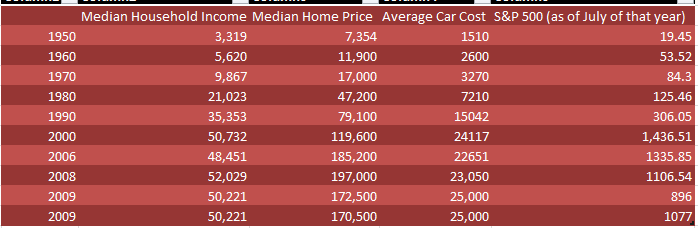
The typical American family is facing the biggest economic uncertainty since the Great Depression and must feel like their lives are in a washer spin cycle. Many unemployed Americans are now entering a stage where unemployment insurance is being cut off which will send tens of thousands of people into the street. The mainstream media won't cover this because they rather gossip about the next tan face to drink themselves into a gutter at a nightclub. 43 million Americans are receiving some kind of food assistance yet this is some kind of recovery? Many are wondering how banks can produce such large profits without actually producing anything real or of substance in the economy. Yet banks are largely casinos that now operate to siphon off real wealth from the economy through bailouts, frauds, and other activities that harm the overall economy. In a decade where banks were unleashed to do what they may with limited regulation and a cozy Fed, we are now left with an economy in tatters but a banking sector that is still healthy based on oversized bonuses. I wanted to gather data over the last 60 years and measure how most Americans are now fairing. The data shows a largely underwater nation.

Let us look at the data carefully:

us household data

Back in 1950 the median home price cost a little above 2 times the annual median household income:

1950: $7354 / $3,319 =2.2

In 1960 the ratio remained roughly the same:

1960: $11,900 / $5,620 = 2.1

In fact, over this ten year period the typical household gained buying power when it came to housing. Even in 1970 the ratio became more favorable to US households:

1970: $17,000 / $9,867 =1.7

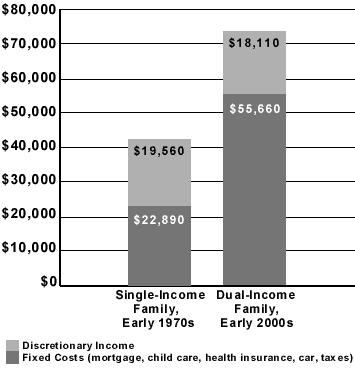
This was the lowest point at the start of any decade in modern history. After this point, with all the push for deregulation and allowing Wall Street to run rampant prices remained fairly stable only because of the two income household (that is until we hit 2000):

1980: $47,200 / $21,023 = 2.2

1990: $79,100 / $35,353 = 2.2

2000: $119,600 / $50,732 = 2.3

This was sustained via the two income household:

middle-class-trap

After this point, things went haywire. Incomes went stagnant or dropped yet home prices sky rocketed. Even today after the severe correction the ratio is still out of sync with 50 years of data:

2010: $170,500 / $50,221 = 3.3

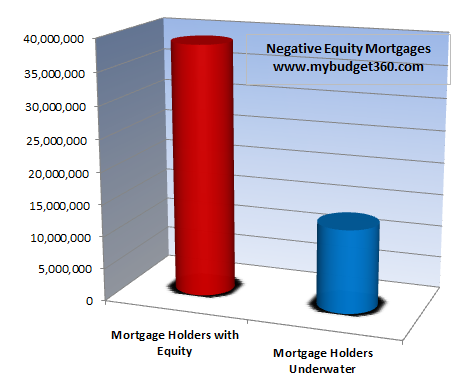
In fact, given the current income levels the median nationwide home price should be down to $119,000 (a 30% drop from current levels). Some will argue that we should factor in for inflation. This would only be the case if we also saw wage growth. For the first time in modern history did we see wages stagnant for an entire decade. So the average American family is still looking at inflated assets and that is why we have millions of people sitting in underwater homes:

negative equity


Just think of what negative equity represents. It represents a household that has over paid for a home. I don't think the desire to own a home has dramatically gone up or down in the last fifty years. Homeownership has always been a big part of the American Dream. But what happened over the last ten years is that banks were able to get their grubby hands on mortgages and convert them into another commodity where they could place large bets and ultimately push losses to taxpayers. People that over paid are paying via foreclosure. What is the penalty that banks are paying? That is why now that banks have raided and had their way with housing, they are looking for other markets to gamble in (with taxpayer money). The above chart shows the millions of homeowners who hold mortgages that are worth more than the homes they are in. Any thinking person realizes that the only way home prices are justified at current levels would be if incomes shot up to make the ratio closer to 2.2. Over half a century of data and never did we have a housing bubble on a nationwide level. All of a sudden Glass-Steagall is repealed in 1999 and a housing bubble takes off with banks leading the way because the line between investment and commercial banking was blurred. Only those who want to deceive themselves would place blame elsewhere.

The average American is going to struggle throughout the next decade. It is hard to see how wages will go up so it is likely that home prices will adjust lower given the magnitude of foreclosures in the pipeline. People might be jumping up and down about the recent job growth but they are occurring in lower paying sectors. So this does nothing to justify current prices. Low mortgage rates are merely a gimmick so banks can use cheap money to speculate on a global scale. Even with mortgage rates at levels we've never seen the housing market remains stalled like an old car. Why? Because the actual sticker price is still inflated based on income levels.

We need to reform the banking system, break up investment and commercial banks, and finally restore sanity in the market. There is a reason the metrics are all off but nothing has been done to change this so we are only a short ways away from another crisis. Ireland for example can be likened to a homeowner that took on too much debt with too little income. So the international banking sector idea of a solution is to extend them a credit line? What they should do is tell the IMF and Euro to shove it, default, and start from scratch and learn from their mistake. Otherwise, they'll be in the same position as Americans who bailed out their corrupt banking sector.